What is Agent Washing?
Turn this article into takeaways for your work.


Each assistant summarizes the article only for you and suggests best practices for your work.
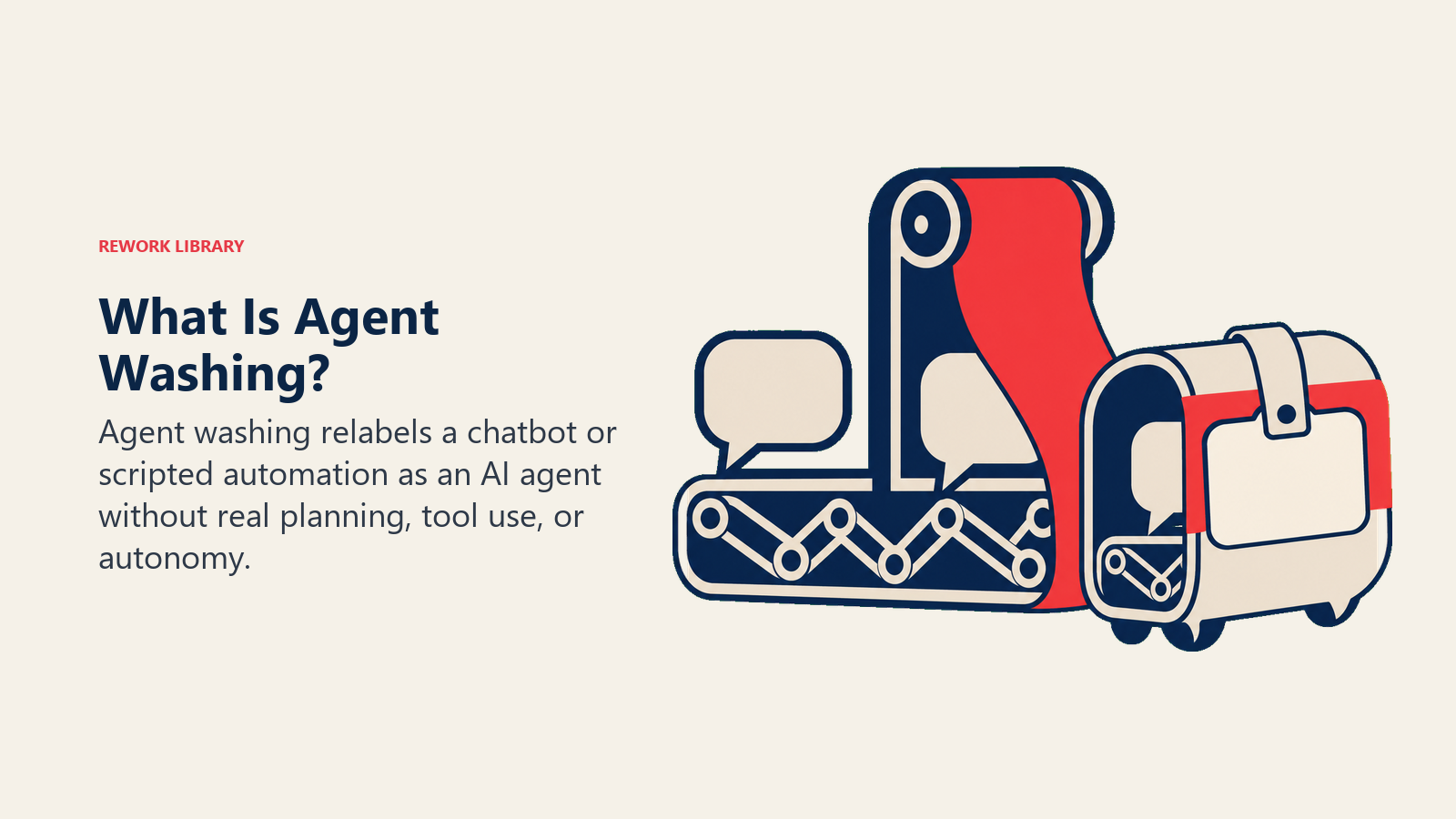
Agent washing is when vendors rebrand existing chatbots, robotic process automation, or scripted assistants as "AI agents" without the underlying autonomy, planning, or tool use that defines real agentic AI. It's a marketing tactic, not a technical upgrade, and it leaves buyers paying agent-tier prices for automation they already owned.
The term borrows its shape from "greenwashing": a product gets a new label, not new capability. And because "agentic AI" became the hottest phrase in enterprise software almost overnight, the incentive to slap it on last year's chatbot is enormous. If you're evaluating vendors right now, agent washing is probably the single biggest reason a demo looks impressive and the production rollout doesn't.
Why Agent Washing Became a Real Buying Risk
Every hype cycle in enterprise software produces the same pattern: a genuinely new capability shows up, budget follows fast, and vendors relabel their existing product to catch that budget before they've built the thing it implies. It happened with "cloud" in the early 2010s and "AI-powered" in the 2020s. Agentic AI is going through it now, at a faster pace, because the underlying technology (large language models, tool use, and orchestration frameworks) matured just as procurement budgets opened up for anything called an "agent."
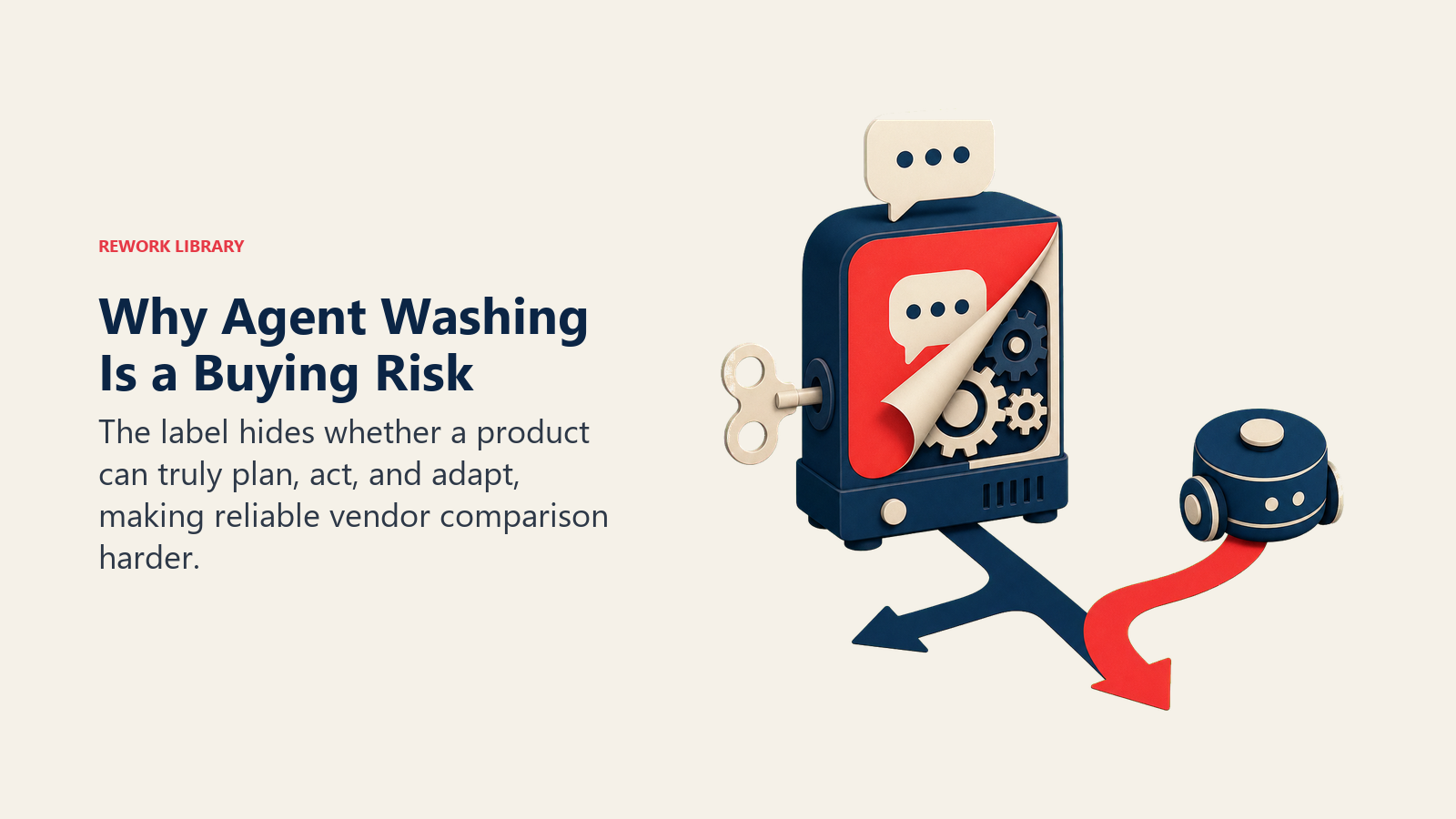
The difference this time is how specific the underlying claim is. An AI agent implies a system that perceives a situation, plans a sequence of steps, acts on your systems, and adapts when something goes wrong, not just a chat window with a friendlier prompt. That's a high bar, and most products marketed as agents in 2026 don't clear it.
Gartner's Warning: Most "Agentic AI" Isn't
Gartner put a name and a number on this problem in 2025. Analyst Anushree Verma has stated that the vast majority of agentic AI vendors are "agent washing" their product portfolios: rebranding existing AI assistants, RPA, and chatbots as agentic without meaningfully new autonomous capability. Gartner's related forecast is blunt about the fallout: over 40% of agentic AI projects will be canceled by the end of 2027 because of escalating costs, unclear business value, or inadequate risk controls, and Gartner explicitly flags agent washing as one of the reasons projects fail to deliver what was promised at the pitch stage.
That warning matters for anyone approving budget right now. A canceled project isn't just a wasted purchase order, it's a credibility hit that makes the next (possibly legitimate) AI investment harder to get approved.
How to Spot Agent Washing: Autonomy, Tool Use, and Planning
Three questions separate a genuine agent from a relabeled tool. Ask them of any vendor pitching "AI agents," and ask to see the answer live, not in a slide.
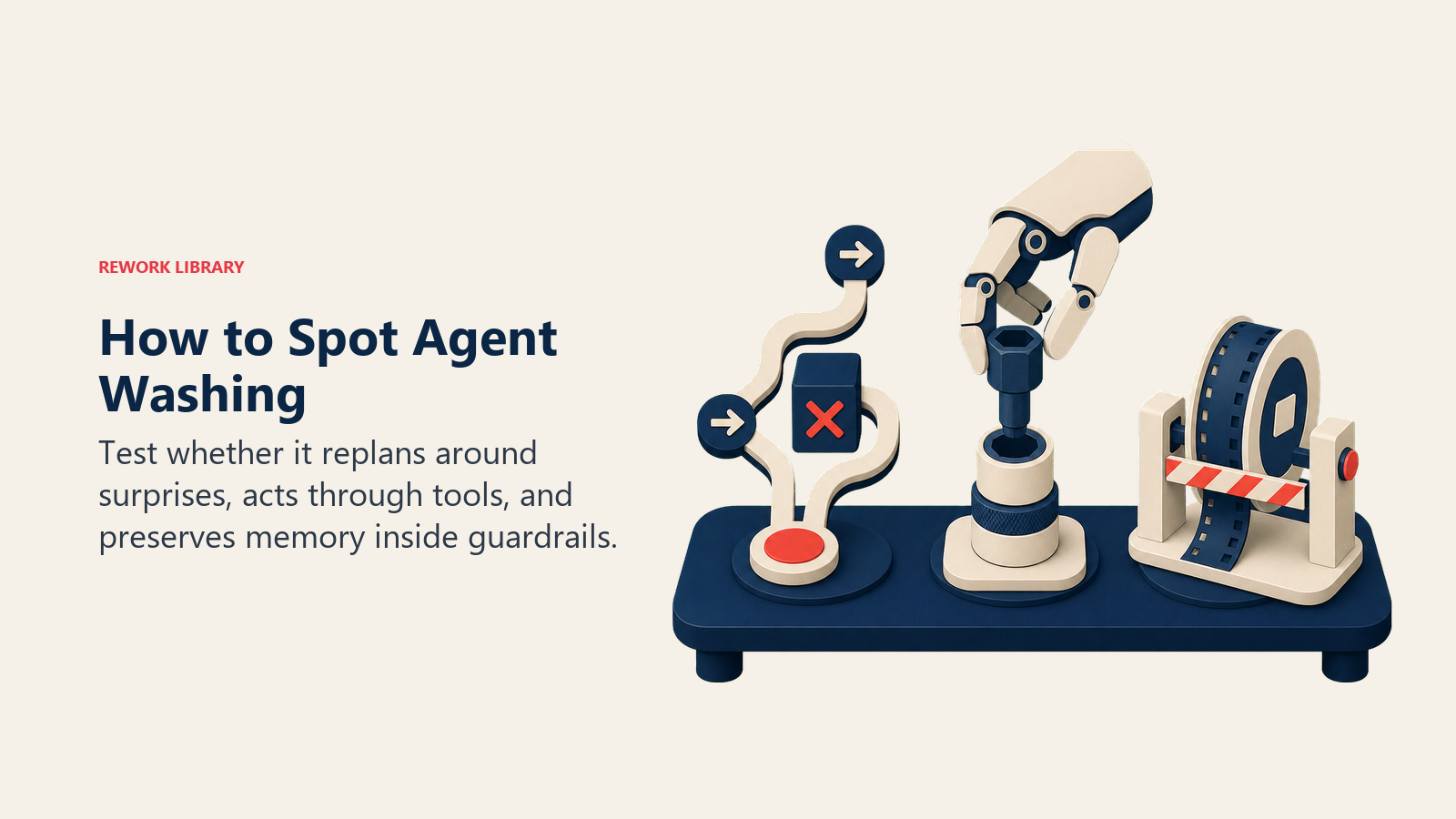
1. Does it plan, or does it follow a script? A real agent breaks a goal into steps and adjusts the plan mid-task when new information shows up: a missing field, a failed API call, a changed priority. A washed product runs one fixed decision tree. If the "agent" can't handle a scenario the vendor didn't anticipate, it isn't planning, it's branching logic with a chat interface on top.
2. Does it use tools to act, or does it just describe what to do? Genuine agentic systems call APIs, update records, and take action inside your actual business systems through tool use. A washed product often stops at generating a recommendation or a draft for a human to execute manually, which makes it a well-dressed AI copilot, not an agent.
3. Does it carry memory and operate with real autonomy inside guardrails, or does every interaction start from zero? An agent remembers what it already tried on this task and, often, what worked on similar tasks before. It operates independently within a defined scope and escalates only when it hits the edge of that scope. A washed product usually resets with every message and needs a human to supervise every step, which defeats the point of calling it autonomous.
Common tells that a demo is agent-washed: it only works on one scripted happy-path scenario, it can't show you what happens when a tool call fails, it has no visible memory across steps, and the vendor can't produce an audit trail of decisions the system made on its own.
Agent Washing vs Genuine Agentic AI
| Aspect | Agent-Washed Product | Genuine Agentic AI |
|---|---|---|
| Decision-making | Fixed rules or a single scripted response, relabeled as "agentic" | Independent, chooses its own next steps toward a goal |
| Planning | None, or a single predetermined branch | Breaks the goal into steps and revises the plan as conditions change |
| Tool use | Limited or none, output is usually a suggestion or a draft | Calls APIs, updates records, and takes action across systems |
| Memory | Resets each session, no context carried forward | Tracks progress within a task and often across sessions |
| Autonomy | Requires a human to execute every recommended step | Acts independently inside defined guardrails, escalates at the edge |
| What a live demo shows | One happy-path scenario, breaks under an unscripted question | Handles a messy, unscripted version of the task in front of you |
| Honest self-test | "Would this still work if we called it a chatbot instead?" Usually yes | The autonomy and tool use are the product, not the label |
The Buyer's Checklist Before You Sign an "AI Agent" Contract
- Ask for a live, unscripted demo. Give it a task variation the vendor hasn't rehearsed. A genuine agent adapts; a washed one breaks or falls back to a canned response.
- Ask what happens when a tool call or API fails. Real agentic systems have a fallback or retry path. If the answer is "it stops and notifies someone," that's closer to automation than agency.
- Ask about memory persistence. Does it remember what it already tried on this task, or does every retry start cold?
- Ask for an audit trail. You should be able to see the sequence of decisions the system made, not just the final output. No audit trail usually means no real planning loop underneath.
- Ask what percentage of the workflow still needs a human to execute manually. If the number is high, you're buying a copilot with agent-branded marketing.
- Ask what it's built on underneath. Some legitimate products are genuinely rule-based automation with agentic features layered on top for specific steps. That can be fine, as long as it's disclosed rather than sold as fully autonomous.
- Ask for a reference customer running it at real volume, not a pilot. Pilots can be hand-held. Production usage at scale is where agent washing gets exposed.
- Run the vendor evaluation through a standard framework, not gut feel. See AI vendor evaluation for a fuller checklist that applies to any AI purchase, not just agents.
The Business Risk of Buying Into Agent Washing
The direct cost is budget: agent-tier pricing for what turns out to be RPA or a chatbot you could have bought for less under an honest label. The bigger cost shows up later. Teams that get burned by a washed "agent" often become skeptical of the next AI pitch, even when it's the real thing, which slows adoption of tools that would have delivered genuine value. Given Gartner's forecast that over 40% of agentic AI projects get canceled by 2027, a chunk of that failure rate traces directly back to buyers approving a "agent" that was never built to plan, act, and adapt on its own in the first place.
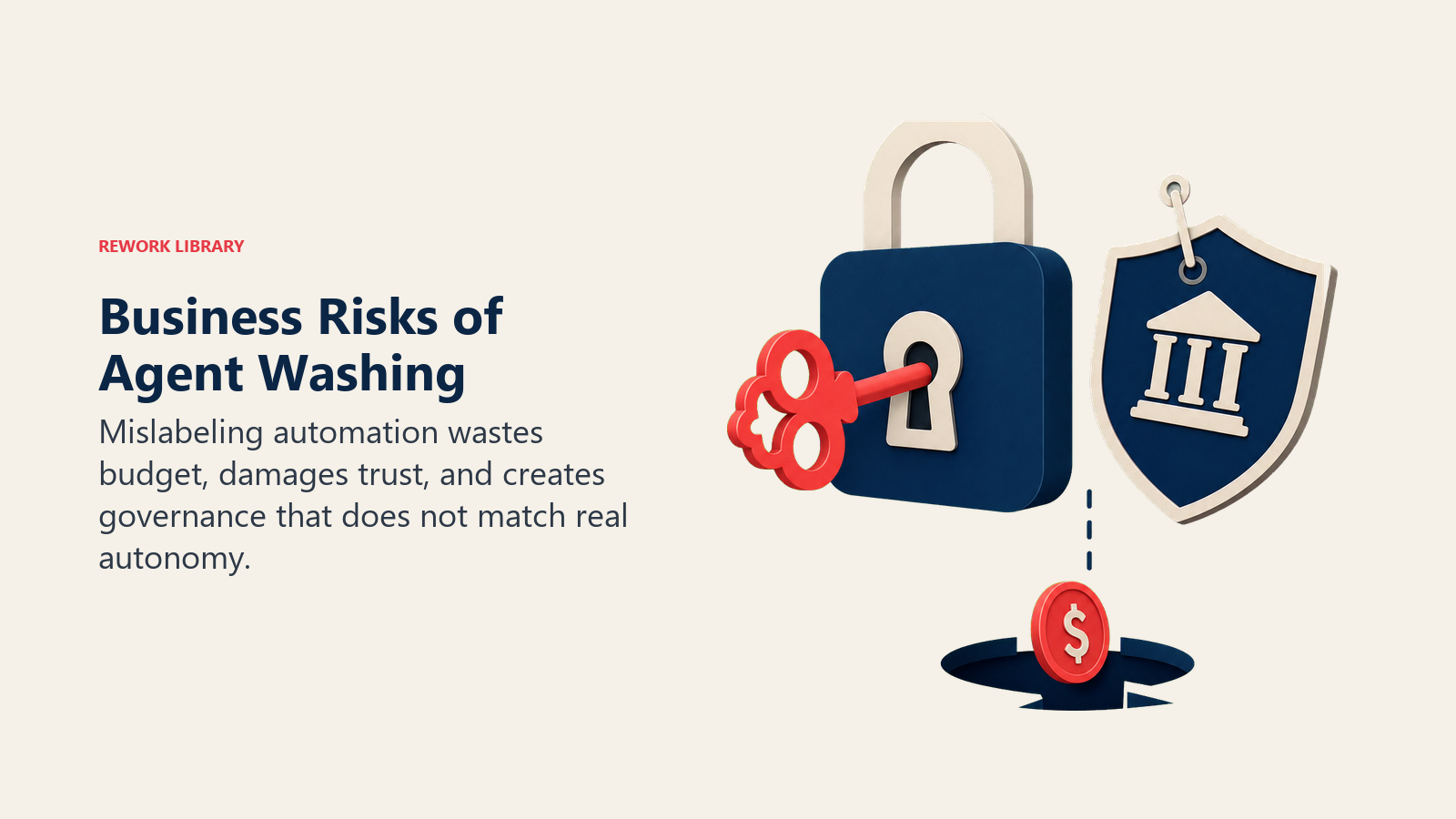
There's a governance angle too. A genuine agent, one that takes autonomous action inside your systems, needs real AI governance: defined guardrails, an audit trail, and a human-in-the-loop escalation path. A washed product doesn't need any of that because it isn't actually acting independently, but teams sometimes apply agent-level oversight to a tool that never needed it, or worse, skip oversight on a tool that quietly does need it because everyone assumed "it's just automation." Knowing which one you actually bought determines whether your governance model fits the risk.
One honest, neutral note on where this applies broadly: any tool marketed as an "AI agent," including built-in copilots inside platforms teams already run for sales and operations, deserves the same three-question test above. The label on the pricing page tells you what marketing wants you to believe; a live unscripted demo tells you what the system actually does.
Key Facts
- Gartner analyst Anushree Verma has stated that the vast majority of agentic AI vendors are "agent washing" their product portfolios by rebranding existing AI assistants, RPA, and chatbots without significant new agentic capability. Gartner
- Over 40% of agentic AI projects will be canceled by the end of 2027 due to escalating costs, unclear business value, or inadequate risk controls. Gartner
- 33% of enterprise software applications will include agentic AI by 2028, up from less than 1% in 2024, a growth curve that widens the incentive to mislabel non-agentic products. Gartner
- Only 16% of enterprise AI deployments qualify as true agents (systems that plan, execute, observe feedback, and adapt); most are still fixed-sequence workflows wearing agent branding. Menlo Ventures
- Within enterprise horizontal AI spending, agent platforms captured just $750 million in 2025 (about 10% of that category), while simpler AI copilots captured $7.2 billion (86%), a sign of how much of the "agent" market is really copilot spend. Menlo Ventures
- 23% of organizations report they're scaling a genuine agentic AI system somewhere in the enterprise, and another 39% are still experimenting, per McKinsey's 2025 global AI survey, leaving a wide gap between "using AI agents" and "agents actually in production." McKinsey
- 25% of companies already using generative AI planned to launch agentic AI pilots or proofs of concept in 2025, a share Deloitte expects to reach 50% by 2027, which is exactly the buying wave agent washing is designed to intercept. Deloitte
Related AI Concepts
- AI Agents - The autonomous systems agent washing falsely claims to deliver
- What is Agentic AI? - The genuine capability agent washing borrows the name of
- Agentic Workflows - How real multi-step autonomous systems operate end to end
- AI Copilots - The collaborative tools often relabeled as agents
- AI Vendor Evaluation - A fuller due-diligence framework for any AI purchase
- Best AI Agents 2026 - A vetted roundup of tools that back up the agent label with real capability
External Resources
- Gartner: Agentic AI Project Cancellations - The forecast and the "agent washing" warning
- McKinsey: The State of AI - Global survey on enterprise AI and agent adoption
- Deloitte: Autonomous Generative AI Agents - Predictions on agentic AI pilot growth
- Menlo Ventures: State of Generative AI in the Enterprise - Enterprise spending and true-agent deployment data
Part of the AI Terms Collection. Last updated: 2026-07-16

Co-Founder, Rework.com
On this page
- Why Agent Washing Became a Real Buying Risk
- Gartner's Warning: Most "Agentic AI" Isn't
- How to Spot Agent Washing: Autonomy, Tool Use, and Planning
- Agent Washing vs Genuine Agentic AI
- The Buyer's Checklist Before You Sign an "AI Agent" Contract
- The Business Risk of Buying Into Agent Washing
- Key Facts
- Related AI Concepts
- External Resources