AI Build vs Buy: The $2M Decision That Makes or Breaks AI Strategy
Turn this article into takeaways for your work.


Each assistant summarizes the article only for you and suggests best practices for your work.
Your CTO wants to build a custom AI model for $2M. Your VP of Product says "just use ChatGPT's API for $50K." Both are right. Both are wrong. The build vs buy decision determines whether AI becomes your competitive advantage or a budget black hole. Get it right, and you move fast with manageable costs. Get it wrong, and you're rebuilding in 18 months.
The Evolution of AI Procurement
The build vs buy debate emerged with cloud computing in the 2000s but intensified after OpenAI released GPT-3's API in 2020. Suddenly, capabilities that required $10M+ research teams were available via API for cents. The 2023 large language model explosion made this decision critical for every business.
According to Boston Consulting Group's 2024 AI Strategy Report, the AI build vs buy decision is defined as "the strategic choice between leveraging existing AI platforms and APIs from vendors versus developing proprietary AI capabilities, evaluated across cost, control, customization, competitive differentiation, and time-to-market dimensions."
The breakthrough came when companies like Shopify (API-first) and Meta (build-first) published contrasting success stories, proving both approaches work when aligned with business strategy.
AI Build vs Buy for Business Leaders
For business leaders, AI build vs buy means choosing between renting AI capabilities from vendors like OpenAI or Anthropic (faster, cheaper, less control) versus developing custom AI systems in-house (slower, costlier, full control) based on your competitive needs, available resources, and required differentiation.
Think of it like transportation. Sometimes you Uber (buy/rent) - fast, predictable cost, good enough. Sometimes you buy a car (build) - higher upfront cost but full control and customization. The choice depends on frequency, specific needs, and strategic importance.
In practical terms, most companies should buy commodity AI capabilities (content generation, basic analysis) and build only when AI defines competitive advantage.
Five Decision Factors
AI build vs buy decisions hinge on these critical factors:
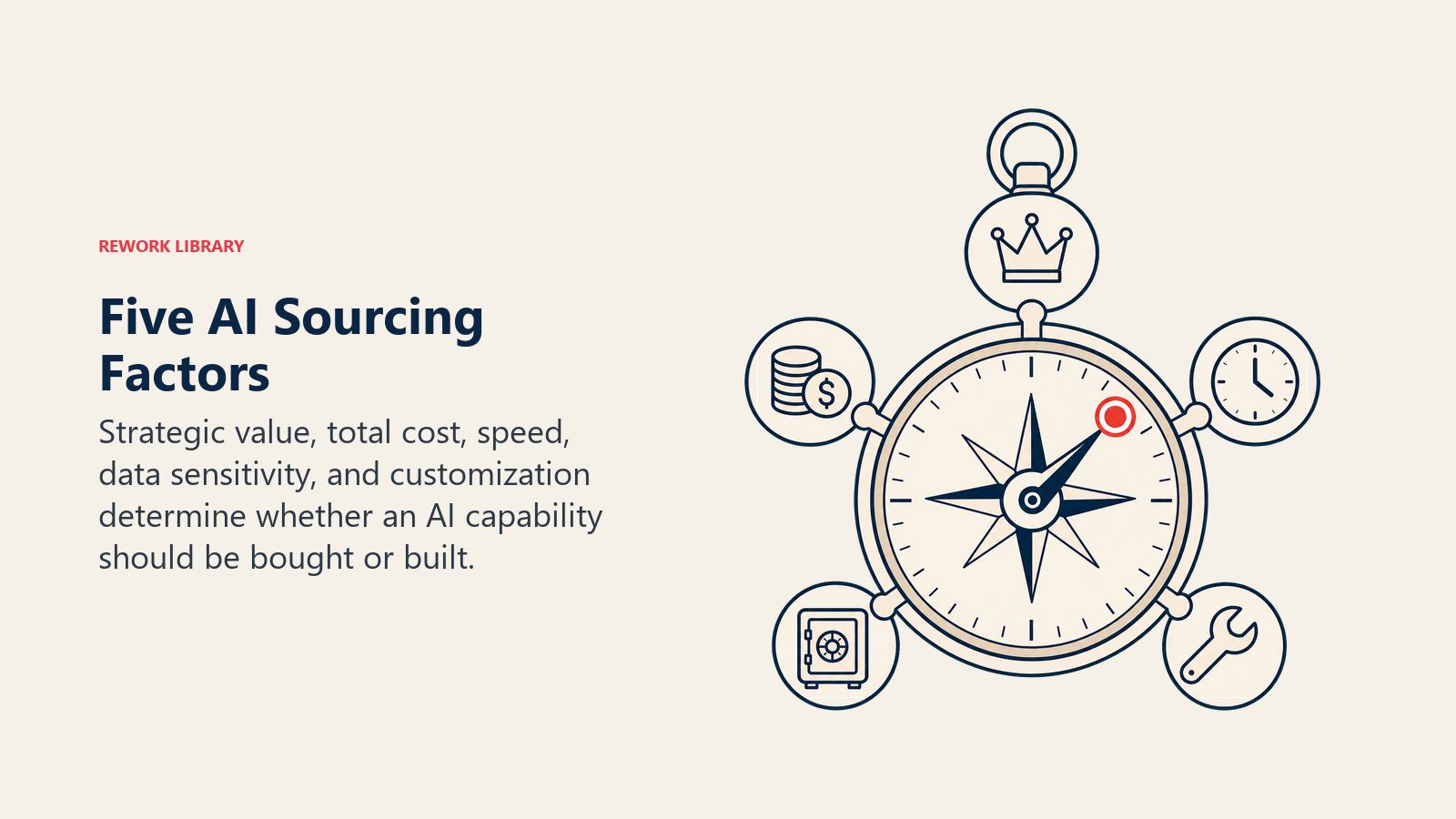
• Strategic Importance: Is AI core to your competitive differentiation? Build what separates you from competitors, buy what's table stakes for industry participation
• Cost Structure: Budget reality - building requires $500K-$5M+ initial investment plus ongoing costs; buying starts at $1K-$100K with predictable monthly expenses
• Speed Requirements: Time pressure - vendor APIs deploy in days/weeks; custom AI takes 6-18 months from concept to production
• Data Sensitivity: Privacy and security needs - buying means sharing data with vendors; building keeps everything internal with full control
• Customization Depth: How unique your requirements are - APIs handle 80% of use cases well; custom models needed for highly specialized domains
The Decision Framework
Apply this systematic approach:
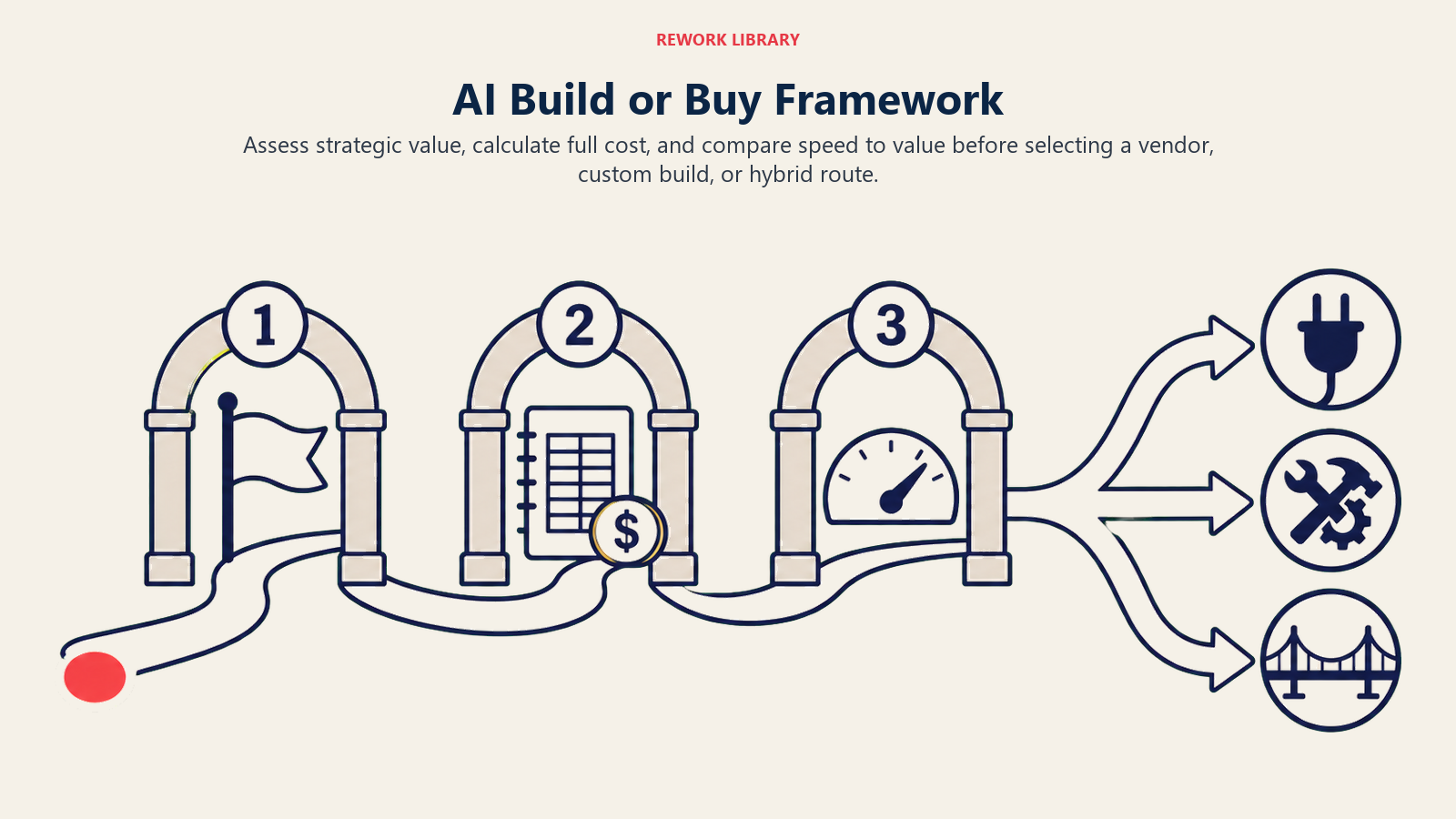
Assess Strategic Value: Map AI initiative to competitive advantage - is this a differentiator or efficiency play? Customer-facing AI that defines your brand suggests build; back-office automation suggests buy.
Calculate True Costs: Compare AI Total Cost of Ownership - vendor API at $50K annually vs custom model at $800K year one, $300K ongoing. Factor in compute, talent, maintenance for honest comparison.
Evaluate Speed-to-Value: Estimate time to ROI - API delivers value in weeks with low risk; custom AI requires 6-12 month investment before first results, higher failure risk.
This framework produces clear recommendations: buy for speed and cost efficiency, build for strategic control and unique capabilities.
Buy: Vendor AI Platforms
Use vendor APIs when:
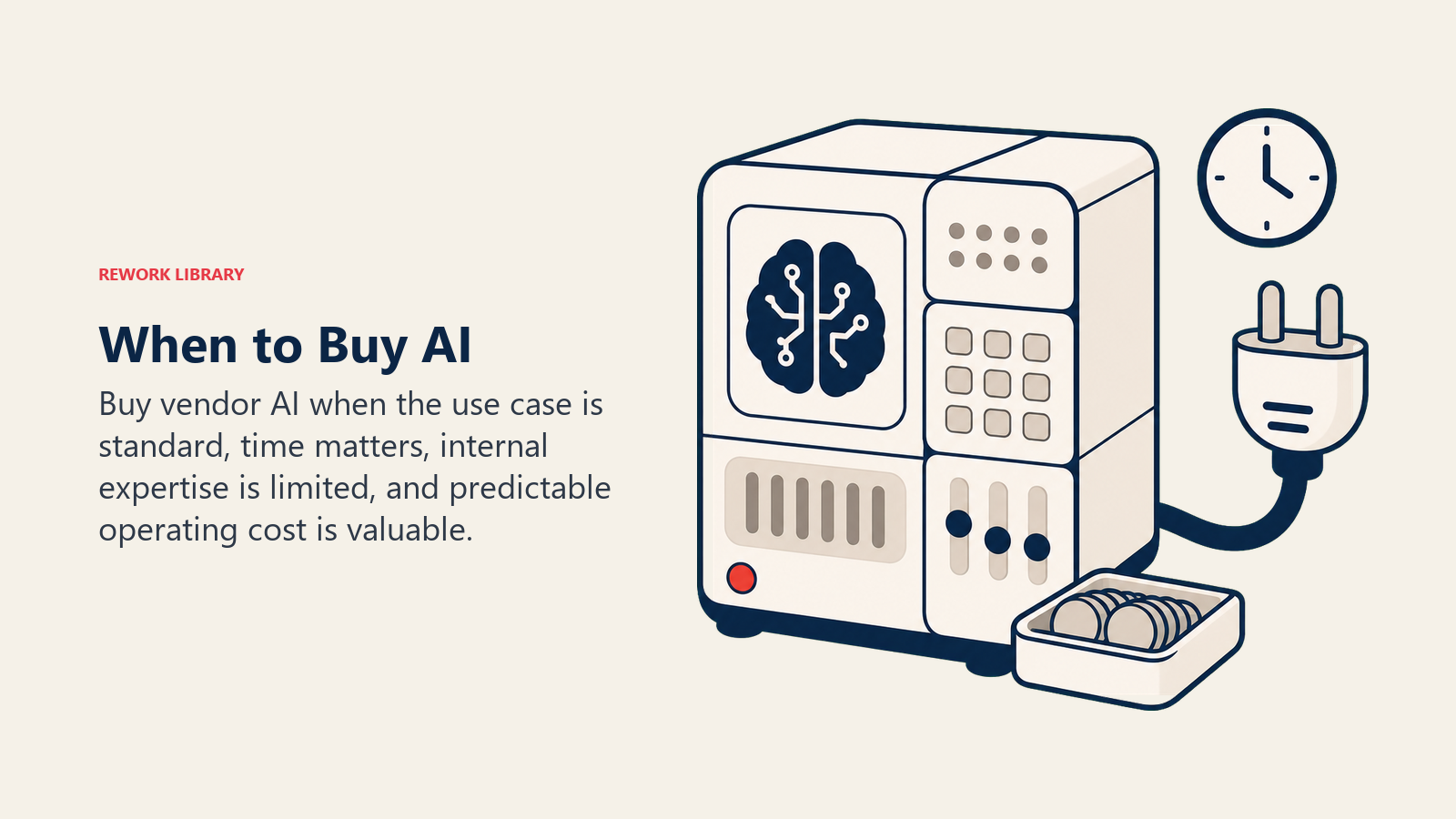
Scenario 1: Standard Use Cases Situation: Content generation, customer service, data analysis Best approach: OpenAI, Anthropic, Google AI APIs Cost: $1K-$100K annually depending on volume Time to value: 1-8 weeks
Scenario 2: Limited AI Expertise Situation: No ML team, urgent business need Best approach: Turnkey solutions like Salesforce Einstein Cost: $50K-$500K annually Time to value: 4-12 weeks
Scenario 3: Variable Workload Situation: Seasonal or unpredictable AI usage Best approach: Pay-per-use APIs (OpenAI, Anthropic Claude) Cost: Pure variable cost, no infrastructure investment Time to value: Days to weeks
Scenario 4: Proof of Concept Situation: Testing AI viability before major investment Best approach: Start with APIs, build later if validated Cost: $5K-$50K pilot budget Time to value: 2-4 weeks
Build: Custom AI Development
Build custom AI when:
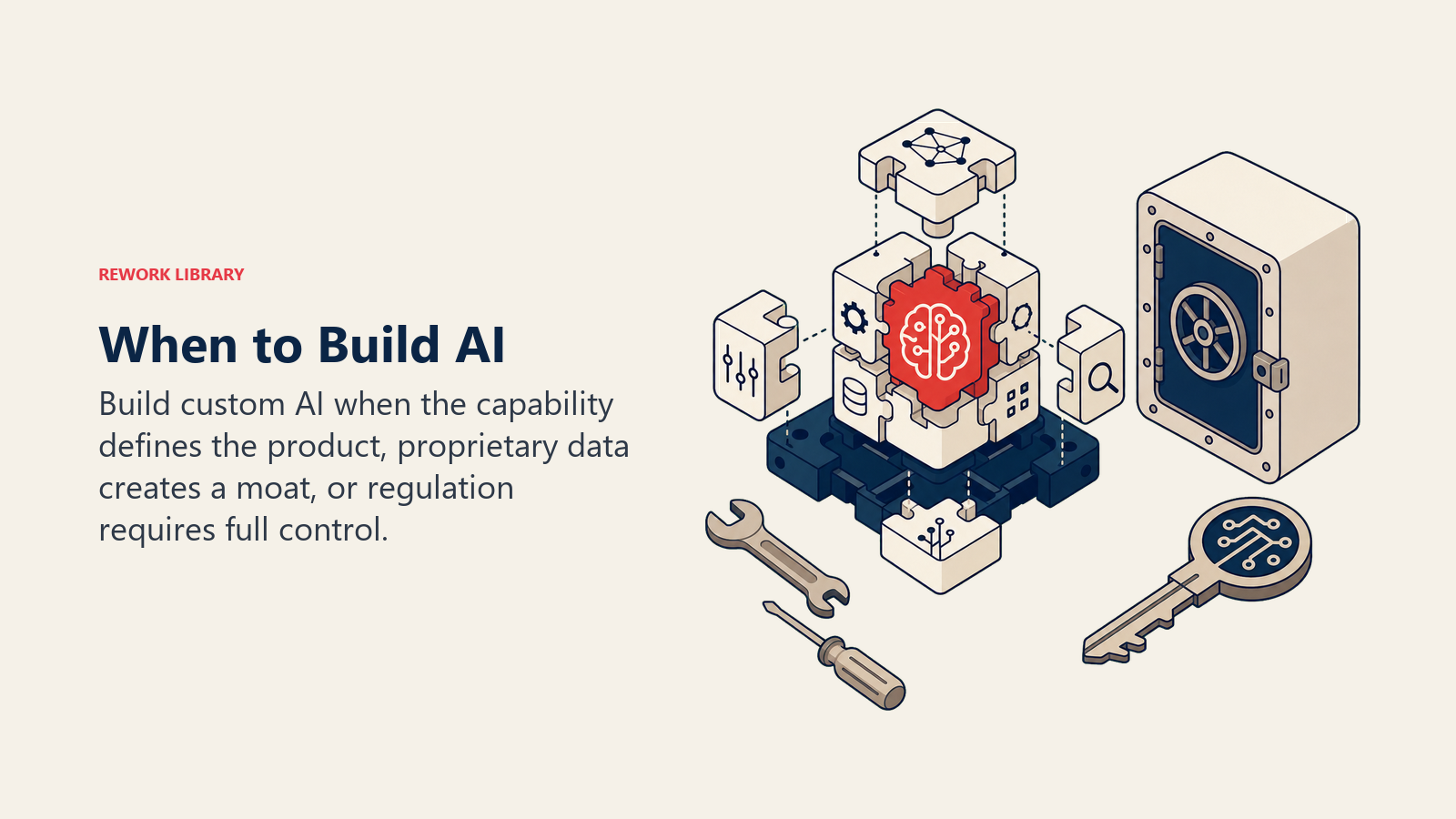
Scenario 1: Unique Competitive Advantage Situation: AI IS your product or defines market position Best approach: In-house models with proprietary data Cost: $1M-$10M+ initial, $500K-$2M annual Justification: Control, differentiation, moat creation
Scenario 2: Highly Regulated Industry Situation: Healthcare, finance with strict compliance Best approach: Self-hosted models, full data control Cost: $500K-$5M including security and compliance Justification: Risk mitigation, audit requirements
Scenario 3: Proprietary Data Advantage Situation: Unique datasets that create defensible value Best approach: Fine-tuning or custom training Cost: $200K-$2M depending on approach Justification: Leverage data moat competitors can't replicate
Scenario 4: Scale Economics Situation: Extremely high volume makes APIs expensive Best approach: Self-hosted inference infrastructure Cost: $300K-$3M infrastructure, but lower per-unit costs Justification: Cost savings at massive scale
Real Decision Examples
Here's how companies actually decide:
Buy Success Story: Jasper (AI content platform) built their entire product on OpenAI APIs rather than custom models. Result: reached $75M ARR in 18 months with 10-person team, 1/10th the cost of building proprietary models. Trade-off: dependent on OpenAI, limited differentiation at model level (differentiate on UX and workflows instead).
Build Success Story: Bloomberg developed BloombergGPT, a custom LLM trained on financial data. Investment: $10M+ initial development. Result: 30% better financial analysis accuracy than GPT-4, defensible competitive advantage. Trade-off: 2-year development time, ongoing $2M+ annual maintenance.
Hybrid Success Story: Notion uses Claude API for basic AI features but built custom models for semantic search over user data. Approach: buy commodity capabilities, build strategic differentiators. Result: fast time-to-market with sustainable advantages.
The Build-Buy Spectrum
Reality isn't binary - most companies use a hybrid approach:
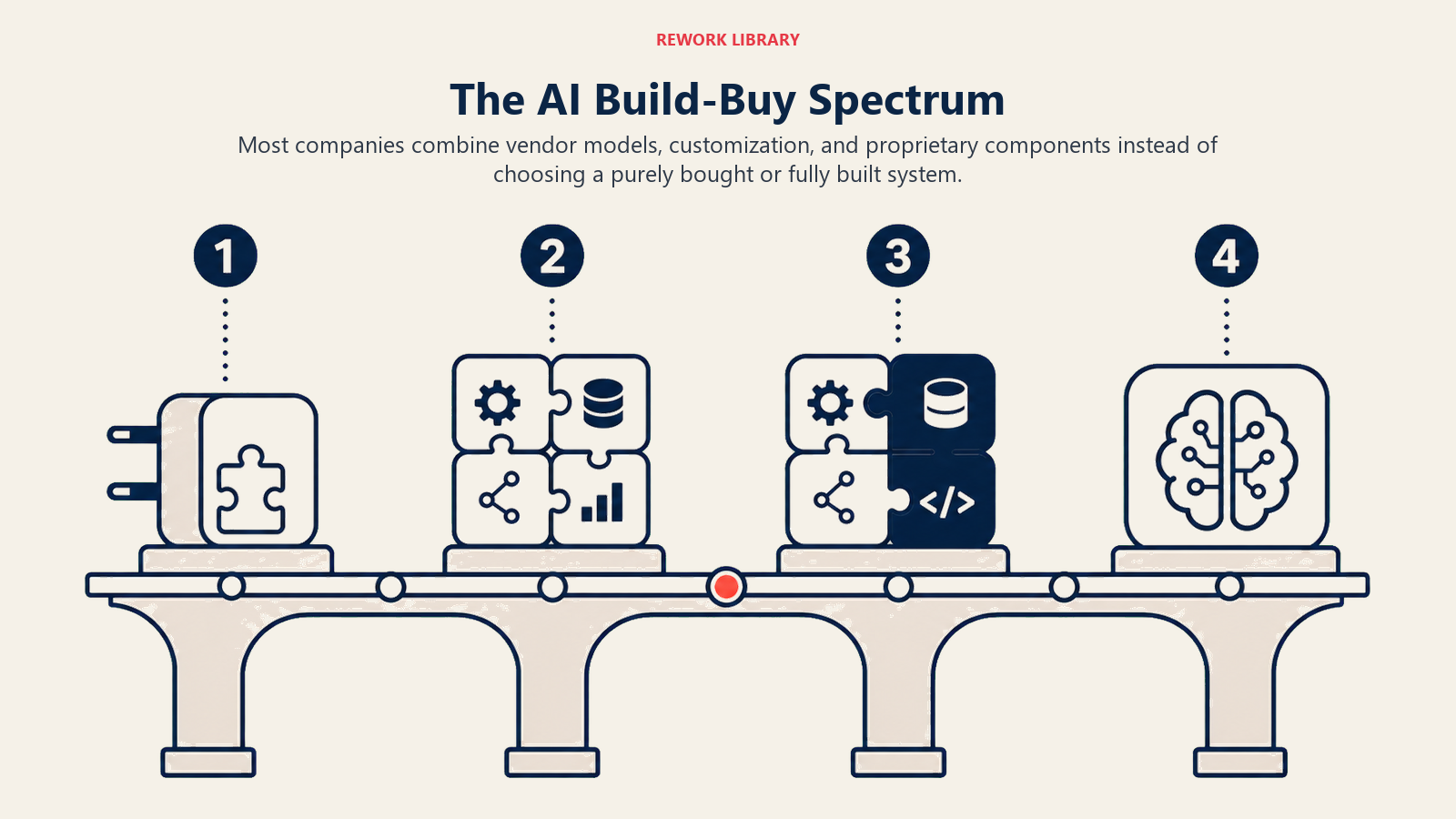
Level 1: Pure Buy (80% of companies) Approach: Use vendor APIs exclusively Investment: $10K-$500K annually Best for: Non-AI companies adding AI features
Level 2: Customized Buy (15% of companies) Approach: Vendor APIs + fine-tuning with your data Investment: $100K-$1M annually Best for: AI-enhanced products needing personalization
Level 3: Hybrid (4% of companies) Approach: Buy commodity AI, build strategic models Investment: $500K-$5M annually Best for: AI-first companies with differentiated needs
Level 4: Pure Build (1% of companies) Approach: Proprietary models and infrastructure Investment: $2M-$50M+ annually Best for: AI labs, tech giants, AI-native businesses
Decision Matrix
Use this matrix to guide your choice:
| Factor | Buy (API) | Build (Custom) |
|---|---|---|
| Initial Cost | $1K-$100K | $500K-$5M+ |
| Time to Market | Days-Weeks | 6-18 months |
| Ongoing Cost | Predictable monthly | Variable + maintenance |
| Customization | Limited | Unlimited |
| Data Privacy | Shared with vendor | Full control |
| Competitive Edge | Low | High |
| Technical Risk | Low | High |
| Vendor Lock-in | High | None |
Building Your Strategy
Ready to make the build vs buy decision?
- Start with AI Use Case Prioritization to identify strategic projects
- Calculate costs accurately via AI Total Cost of Ownership
- Measure expected returns with AI ROI Measurement
- Compare options using AI Vendor Evaluation
Frequently Asked Questions about AI Build vs Buy
What is AI Build vs Buy?
AI Build vs Buy is the strategic choice between leveraging existing vendor AI platforms and APIs (buy) versus developing proprietary AI capabilities in-house (build), evaluated across cost, control, customization, and competitive differentiation.
When should companies buy AI instead of building?
Buy when solving standard use cases, lacking AI expertise, needing fast deployment, or running proof-of-concept tests. Most companies should buy commodity AI capabilities and build only for strategic differentiation.
When does building custom AI make sense?
Build when AI defines competitive advantage, in highly regulated industries requiring data control, when leveraging proprietary data moats, or at massive scale where per-unit economics favor ownership.
What's the typical cost difference between build and buy?
Buying via APIs costs $10K-$500K annually with predictable expenses. Building custom AI requires $500K-$5M initial investment plus $300K-$2M annual ongoing costs for talent and infrastructure.
Can companies use both approaches?
Yes, hybrid approaches are common. Buy commodity AI capabilities (content generation, basic analysis) while building custom models for strategic differentiators. This balances speed, cost, and competitive advantage.
Related Resources
Explore these related concepts to master AI investment decisions:
- AI Total Cost of Ownership - Complete cost framework for AI investments
- AI ROI Measurement - Quantifying AI investment returns
- AI Vendor Evaluation - Comparing AI providers and platforms
- Large Language Models - Understanding vendor AI capabilities
External Resources
- Boston Consulting Group AI Reports - Strategic AI investment frameworks
- OpenAI API Documentation - Understanding vendor AI capabilities
- Anthropic Research - Claude API and enterprise AI options
Part of the AI Terms Collection. Last updated: 2026-02-09

Co-Founder, Rework.com