AI ROI Measurement: From Hype to Hard Numbers
Turn this article into takeaways for your work.


Each assistant summarizes the article only for you and suggests best practices for your work.
AI ROI measurement is the systematic way to quantify the financial and operational return on AI investments by tracking four categories: productivity gains, cost reduction, revenue impact, and quality improvement. The core formula is (Total Benefits minus Total Costs) divided by Total Costs, applied with the same rigor you would use for any capital investment.
Your board asks: "What's the return on our $2M AI investment?" Marketing says "productivity is up," but finance wants numbers. Without proper ROI measurement, AI projects become faith-based initiatives that lose funding when budgets tighten. The companies winning with AI know exactly what they're getting for every dollar spent.
The Evolution of AI Investment Metrics
AI ROI measurement evolved from IT project metrics in the 2010s. Early attempts focused on accuracy scores and technical benchmarks, but CFOs needed business metrics. The field matured after McKinsey's 2018 study showing 70% of AI projects failed to demonstrate clear ROI.
According to Gartner's 2023 AI Research, AI ROI measurement is defined as "a systematic approach to quantifying the financial and operational returns from AI investments by tracking specific metrics across productivity gains, cost reduction, revenue impact, and risk mitigation."
The breakthrough came when companies like Microsoft and Amazon published actual numbers showing 3-5x returns on AI investments, proving measurable value was possible with the right frameworks.
AI ROI for Business Leaders
For business leaders, AI ROI measurement means tracking specific financial and operational metrics that connect AI spending directly to measurable outcomes - productivity improvements, cost savings, revenue increases, and risk reduction - using the same rigor applied to any capital investment.
Think of AI ROI like measuring any equipment purchase. If you buy a $500K machine, you track units produced, defects reduced, and labor saved. AI investments deserve the same discipline: hours saved, errors eliminated, and dollars generated.
In practical terms, this means establishing baseline metrics before implementation, tracking changes monthly, and calculating payback period just like traditional technology investments.
Core ROI Measurement Components
AI ROI measurement consists of these essential elements:
• Baseline Metrics: Pre-AI performance data across time, quality, cost, and revenue metrics, establishing the "before" state for comparison
• Cost Tracking: Complete spend including software licenses, compute resources, implementation services, training, and ongoing maintenance
• Benefit Quantification: Measured improvements in productivity (time saved), quality (errors reduced), cost (expenses eliminated), and revenue (sales increased)
• Attribution Model: Framework for isolating AI impact from other business changes, determining what results AI actually caused
• Payback Calculation: Time required to recover initial investment through accumulated benefits, the key metric executives understand
The ROI Measurement Process
AI ROI measurement follows this structured approach:
Establish Baselines: Measure current state before AI: average handling time, error rates, cost per transaction, conversion rates - creating benchmark data
Track All Costs: Document AI investment completely: $150K annual license, $50K implementation, $30K training, $20K monthly compute = $470K year one total cost
Measure Benefits: Quantify improvements monthly: customer service AI saves 20,000 hours annually at $25/hour = $500K labor value, plus quality improvements
This cycle continues with regular reporting showing cumulative ROI trending toward break-even and positive returns.
Critical AI ROI Metrics
Effective AI ROI measurement tracks these key metrics:
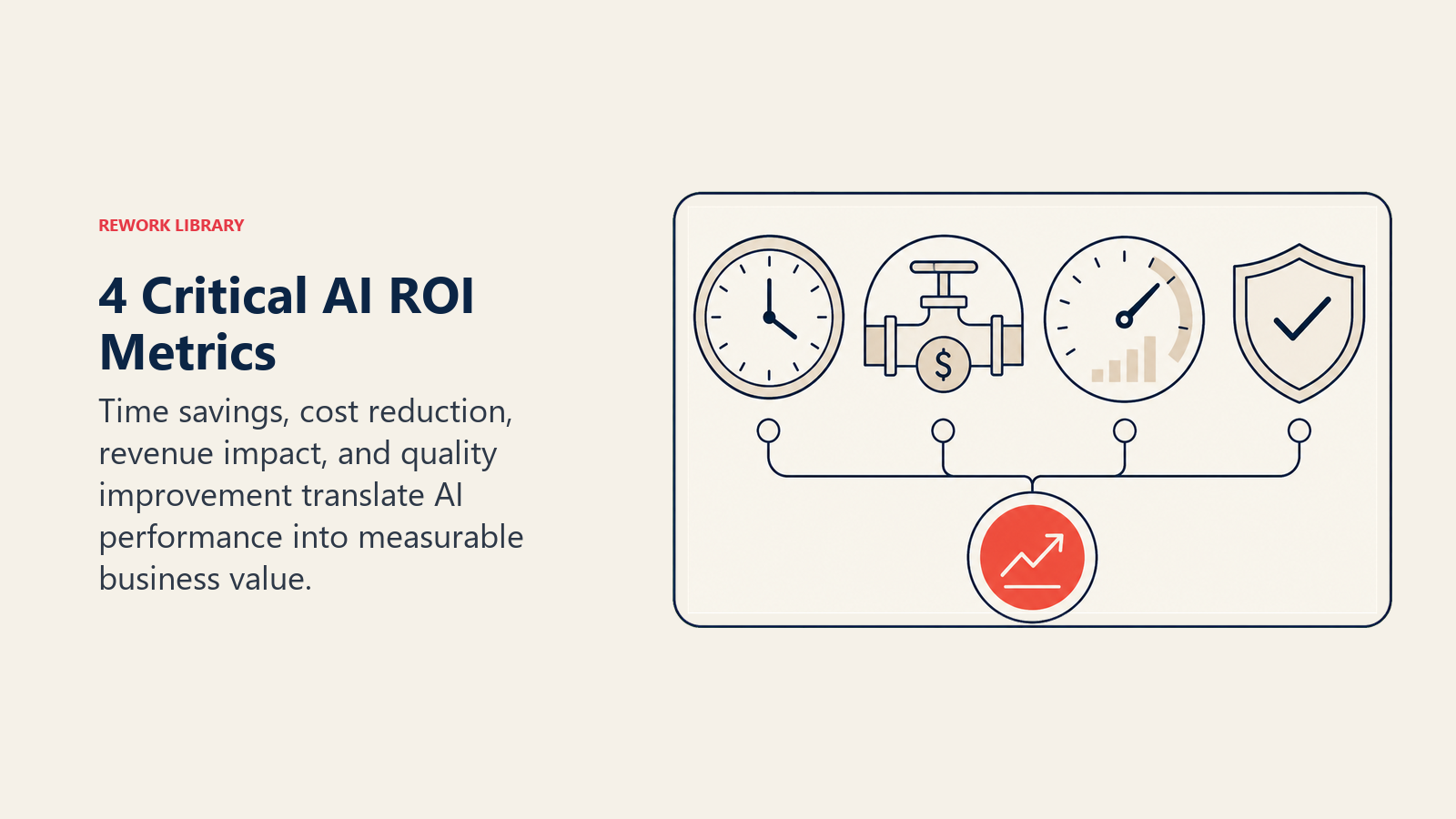
Metric 1: Time Savings Best for: Process automation and productivity tools Formula: (Hours saved × Hourly cost) × Annual volume Example: AI coding assistant saves developers 10 hours/week × $75/hr × 50 developers = $1.95M annually
Metric 2: Cost Reduction Best for: Operational efficiency improvements Formula: Previous cost - New cost = Savings Example: AI customer service reduces support costs from $12/interaction to $3 = $9 saved × 100K interactions = $900K annually
Metric 3: Revenue Impact Best for: Sales and marketing AI applications using AI automation Formula: (Conversion rate increase × Customer value) × Total opportunities Example: AI lead scoring increases conversions 15% × $5K average deal × 2,000 leads = $1.5M incremental revenue
Metric 4: Quality Improvement Best for: Error reduction and accuracy enhancement Formula: (Error cost × Error reduction rate) × Transaction volume Example: AI invoice processing reduces errors from 5% to 0.5% × $200 correction cost × 50K invoices = $450K saved
AI ROI in Practice
Here's how companies actually measure AI returns:
Enterprise Example: Siemens deployed AI agents for software testing, tracking ROI quarterly. Initial investment: $850K. Year one results: 40,000 testing hours saved ($3.2M value), 60% faster release cycles, 35% fewer production bugs. Payback achieved in 4 months, 3.8x ROI by year end.
Mid-Market Example: A logistics company implemented AI route optimization for $120K. They measured fuel costs (saved $180K annually), driver hours (reduced 15% = $240K), and delivery times (improved 25% = higher customer satisfaction). Total ROI: 3.5x within 12 months.
Small Business Example: Marketing agency adopted AI content tools for $15K annually. They tracked billable hours (increased 30% without new hires = $180K revenue), client acquisition costs (reduced 40%), and content output (3x increase). ROI exceeded 10x within first year.
Building Your ROI Framework
Ready to measure AI returns rigorously?
- Start with fundamentals in Business Metrics
- Understand AI capabilities via Large Language Models
- Structure evaluation with AI Build vs Buy decisions
- Track implementation via AI Total Cost of Ownership
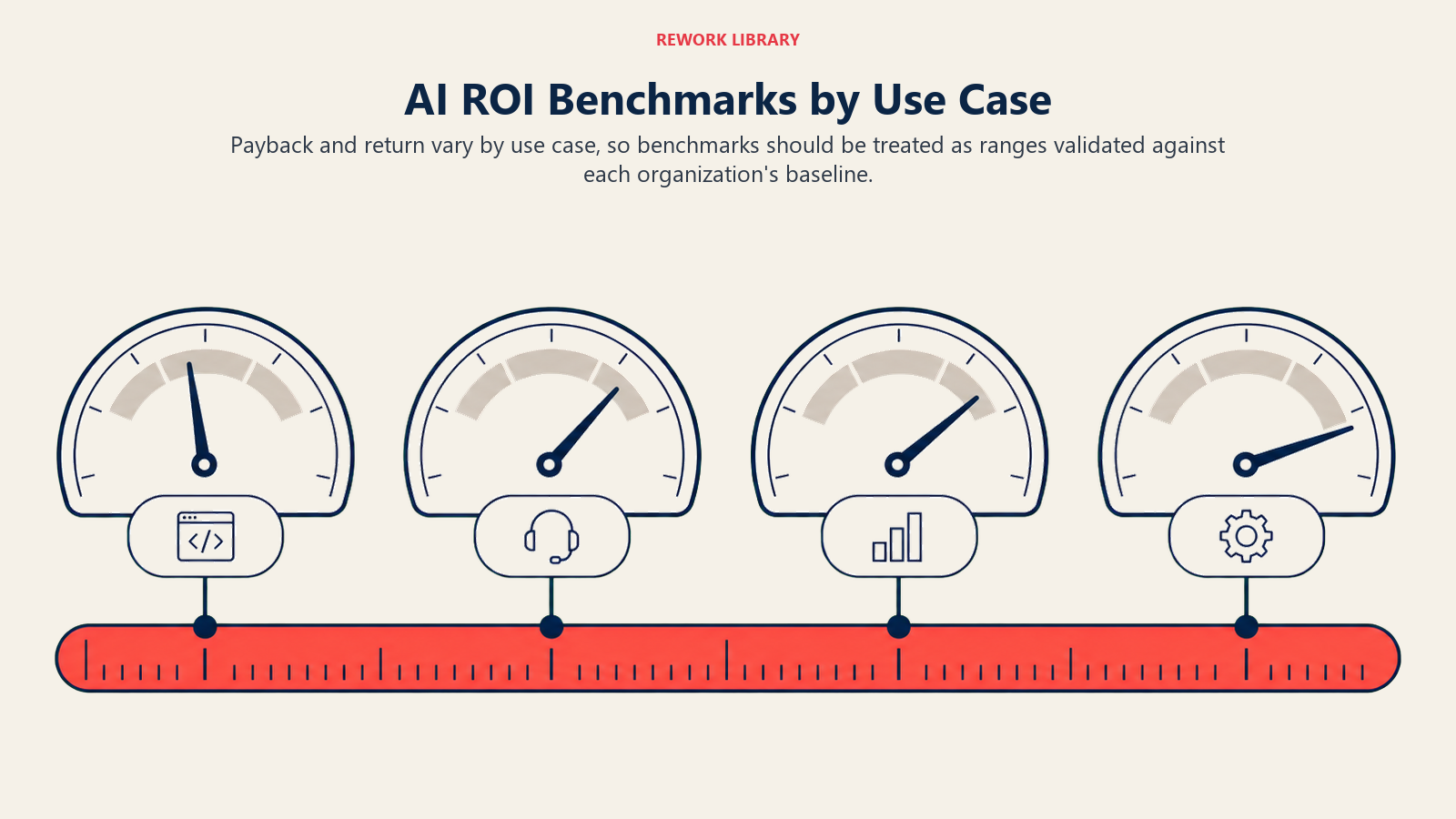
Industry ROI Benchmarks
Software Development AI Tools
- Average ROI: 4-6x
- Payback period: 2-4 months
- Key metric: Developer productivity (20-40% improvement)
Customer Service AI
- Average ROI: 3-5x
- Payback period: 6-9 months
- Key metric: Cost per interaction (50-70% reduction)
Sales & Marketing AI
- Average ROI: 2-4x
- Payback period: 9-12 months
- Key metric: Conversion rate improvement (10-25% increase)
Operations & Logistics AI
- Average ROI: 3-7x
- Payback period: 4-8 months
- Key metric: Process efficiency (25-45% improvement)
Source: McKinsey AI Impact Study 2024, Gartner AI Survey 2024
Frequently Asked Questions about AI ROI Measurement
What is AI ROI Measurement?
AI ROI measurement is a systematic approach to quantifying financial and operational returns from AI investments by tracking productivity gains, cost reductions, revenue increases, and risk mitigation using specific metrics and formulas.
What's the basic formula for calculating AI ROI?
AI ROI = (Total Benefits - Total Costs) / Total Costs × 100. For example, if AI generates $500K in benefits with $300K in costs, ROI is ($500K - $300K) / $300K = 67% return.
What are the four main categories of AI benefits to measure?
Productivity gains (time saved), cost reduction (expenses eliminated), revenue impact (sales increased), and quality improvements (errors reduced). Track at least two categories for comprehensive ROI.
How long should AI ROI payback take?
Industry benchmarks show 4-12 month payback periods for most AI investments. Projects taking longer than 18 months often signal implementation issues requiring review.
What costs should be included in AI ROI calculations?
Include ALL costs: software licenses, API fees, compute resources, implementation services, training, ongoing maintenance, dedicated personnel, and opportunity costs of team time.
External Resources
- McKinsey AI Research - Industry ROI benchmarks
- Gartner AI Insights - Executive guidance
- MIT Sloan Management Review - AI business strategy
Related Resources
Explore these related concepts to master AI investment decisions:
- AI Total Cost of Ownership - Complete cost framework beyond initial investment
- AI Build vs Buy - Decision framework for custom vs vendor solutions
- AI Vendor Evaluation - Comparing AI providers and platforms
- AI Use Case Prioritization - Which AI projects to fund first
Part of the AI Terms Collection. Last updated: 2026-02-09
