What is Midjourney?
Turn this article into takeaways for your work.


Each assistant summarizes the article only for you and suggests best practices for your work.
Midjourney is an independent, self-funded AI research lab and product that generates images, and now short videos, from text prompts. Founded in 2021 by David Holz, it built its reputation on Discord before expanding to a standalone web app, and it's widely regarded as having the highest aesthetic ceiling of any mainstream generative AI image tool.
That one-line definition covers what most people search for, but it leaves out the parts that matter for a business decision: how the tool actually works, what it costs at each tier, who it's actually built for, and the copyright lawsuit that's been hanging over the company since mid-2025. This explainer walks through all of it. If you're comparing Midjourney against other tools side by side, our best AI image generators guide ranks 13 options by use case instead of covering one company in depth, which is what this page does.
Background: From Discord Bot to Independent AI Lab
Midjourney launched in open beta in July 2022, distributed entirely through a Discord bot rather than a standard web app or API. For its first two years, using Midjourney meant typing /imagine commands into a Discord channel, watching your prompt queue behind millions of other users, and grabbing your result from a shared feed. That workflow was clunky by modern standards, but it also gave Midjourney something most AI startups never get: a built-in, self-reinforcing community where people learned prompting technique from watching each other's results in real time.
The company has never taken outside venture funding. Holz, who previously co-founded the motion-sensor company Leap Motion, set out to build Midjourney as what he's called "a self-funded research lab" that wouldn't answer to investors. It reached profitability within about six months of its public launch and has stayed independent since, a rare position among AI companies burning through billions in outside capital.
Midjourney closed most of the gap with a real product in the years since. A standalone web app now handles account management, generation, and community browsing without requiring Discord at all, though the Discord server, still one of the largest on the platform, remains active for real-time prompting and community feedback. The most significant recent shift: Version 7, released in April 2025, rebuilt the underlying model architecture and cut hand and face rendering errors dramatically, and a first-generation video model followed two months later, turning static Midjourney images into multimodal short clips instead of stopping at a single frame. See our best AI video generators guide for how that video feature stacks up against dedicated video tools.
How Midjourney Works
Midjourney is built on a diffusion model, the same underlying technique behind most modern image generators. You give it a text description, and instead of drawing anything from scratch, the model starts with a canvas of random noise and gradually removes that noise across dozens of steps, guided at each step by your prompt, until a coherent image emerges. Our diffusion models explainer covers the mechanics in more depth if you want the technical version.
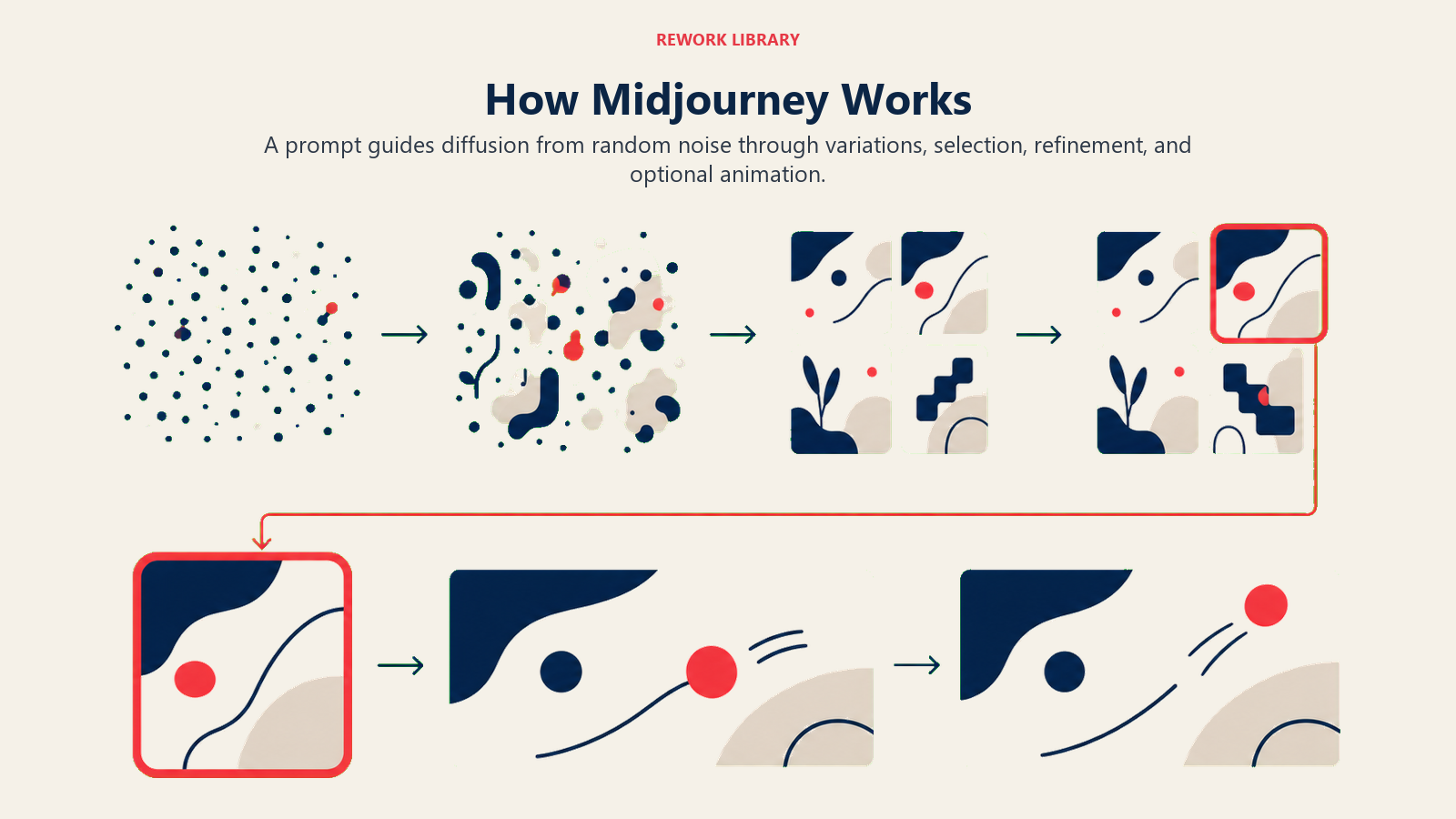
In practice, using Midjourney looks like this:
- Write a prompt. A short phrase works, but results improve sharply with more specific prompt engineering: describing lighting, composition, camera angle, and style rather than just a subject.
- Generate a grid. Midjourney returns four variations at once so you can compare directions before committing to one.
- Upscale or vary. Pick a favorite, then either upscale it to full resolution or generate variations that keep the same general composition with small changes.
- Refine with parameters. Advanced users add flags like
--sref(style reference),--cref(character reference), or aspect ratio controls to lock in a consistent look across a batch of images, useful for anyone producing a series of on-brand visuals rather than a single one-off. - Animate, optionally. Since June 2025, any generated image can be extended into a 5 to 21 second video clip using the same interface, no separate tool required.
The whole loop, from prompt to finished image, typically takes under a minute once you know roughly what you're going for.
Key Facts
- Midjourney was founded in 2021 and has never taken outside venture funding, according to its Forbes company profile.
- The company brought in $300 million in revenue in the 2024 fiscal year and has been profitable since shortly after its 2022 launch, per PitchBook data cited by Forbes.
- Midjourney runs with roughly 60 employees as of 2026, according to its Forbes profile.
- Version 7 launched April 3, 2025 and became the platform's default model on June 17, 2025, per VentureBeat.
- Midjourney's first native video model shipped June 18, 2025, letting users turn still images into short clips, also reported by VentureBeat.
- Disney, NBC Universal, and DreamWorks sued Midjourney on June 11, 2025, seeking $150,000 per infringed work across an exhibit listing more than 150 allegedly copied characters, according to CNN.
- Warner Bros. filed a separate copyright suit in September 2025, and the court consolidated it with the Disney and Universal case on November 4, 2025, with the Disney action as the lead docket, per court records on CourtListener.
- The global AI image generator market is valued at $484.29 million in 2026 and projected to reach $1.75 billion by 2034, a 17.4% compound annual growth rate, according to Fortune Business Insights.
Midjourney Pricing in 2026
Midjourney sells GPU compute time rather than a fixed image count, which makes the pricing model a little unusual compared to a typical SaaS tool. There's no free tier; Midjourney removed its free trial in March 2023 and hasn't brought one back.
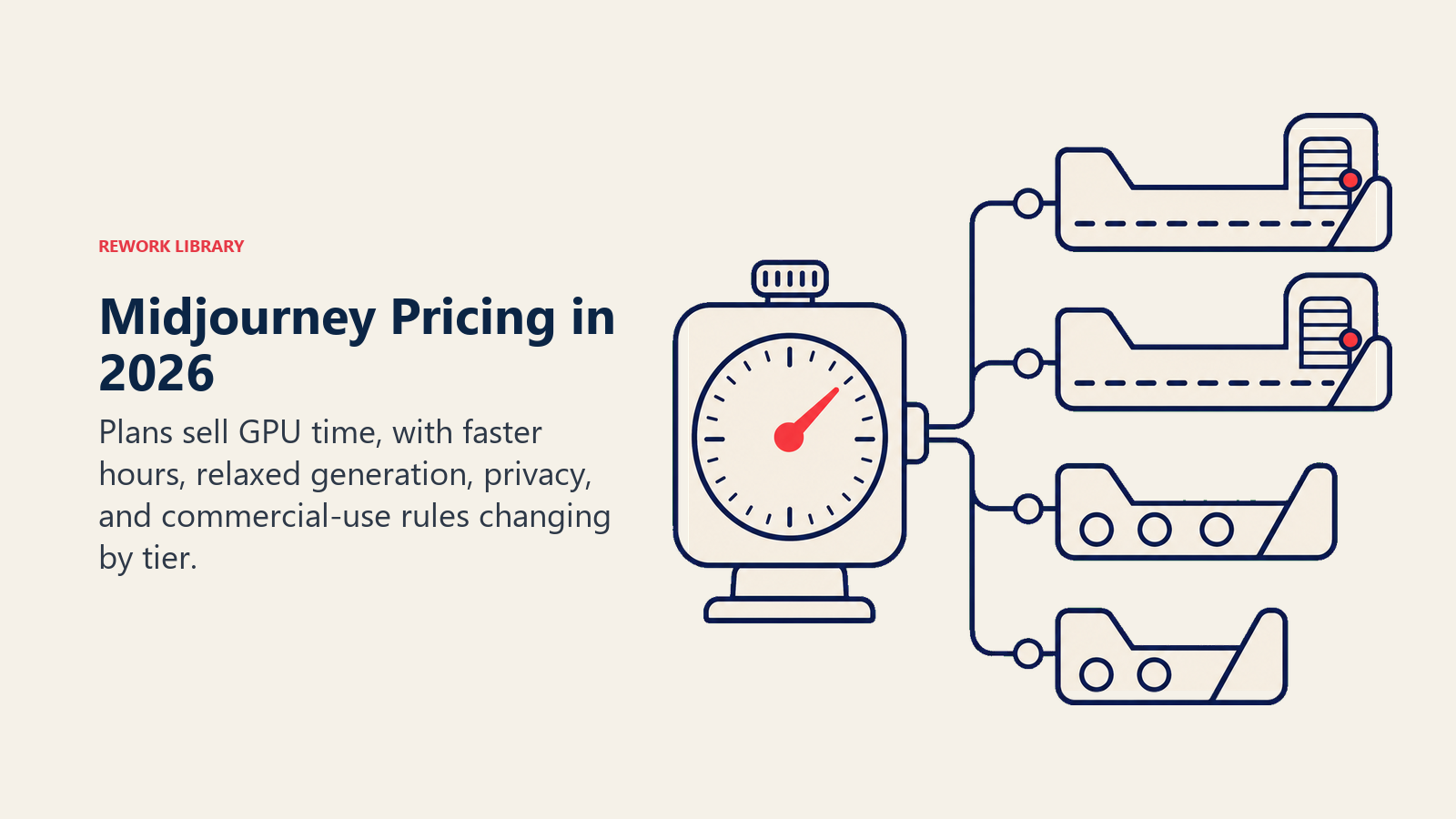
| Plan | Monthly | Annual (per mo) | Fast GPU Hours | Relax Mode | Stealth Mode | Commercial Use |
|---|---|---|---|---|---|---|
| Basic | $10 | $8 | ~3.3 hours | Not included | No | Included (companies under $1M annual revenue) |
| Standard | $30 | $24 | 15 hours | Unlimited images | No | Included (companies under $1M annual revenue) |
| Pro | $60 | $48 | 30 hours | Unlimited images and video | Yes | Required for companies earning $1M+ annual revenue |
| Mega | $120 | $96 | 60 hours | Unlimited images and video | Yes | Required for companies earning $1M+ annual revenue |
A few details worth knowing before you pick a tier, per Midjourney's official plan comparison page:
- Fast GPU hours don't roll over. Unused hours expire at the end of each billing cycle regardless of whether you're on a monthly or annual plan.
- Relax Mode is the workaround for heavy usage. Once you're out of Fast hours, Relax Mode generations still work on Standard and above, just slower, with no separate cost.
- The $1 million revenue rule is the one that catches teams off guard. A company earning more than $1 million a year in gross revenue must be on Pro or Mega to use Midjourney output commercially, regardless of how many seats it needs. A five-person team at a $5 million company can't stay on Basic or Standard for commercial work.
- Video generation costs roughly 8x an image job in Fast GPU time, so teams planning to lean on the video feature should budget for Pro or Mega rather than Basic.
Who Midjourney Is For
Midjourney fits best where visual quality and stylistic range matter more than pixel-perfect brand control or embedded text. Creative directors, marketing teams producing campaign concept art, agencies pitching visual directions, and game or entertainment studios exploring character and environment design are the clearest fits. It's also a common choice for product mockups and moodboards in early-stage design work, using computer vision-adjacent techniques to interpret a text prompt into a coherent composition, before a human designer takes over for final production files.
It's a weaker fit for a few specific jobs. Anything that needs legible text or typography baked into the image (packaging, posters, infographics) tends to work better in a tool built for that, since Midjourney's text rendering still trails purpose-built competitors. Teams that need airtight commercial licensing guarantees, particularly ones publishing AI-generated visuals in paid advertising at scale, often lean toward a vendor with a more transparent training-data story and formal indemnification, which is part of why the lawsuit below matters for buying decisions, not just as industry news.
The Disney and Universal Copyright Lawsuit
In June 2025, Disney, NBC Universal, and DreamWorks Animation filed a federal copyright infringement suit against Midjourney in the U.S. District Court for the Central District of California. The complaint describes Midjourney's image service as functioning like "a virtual vending machine" for unauthorized copies of the studios' characters, citing examples where the tool could be prompted to generate recognizable versions of Star Wars characters, Shrek, and other studio-owned intellectual property. The suit lists more than 150 allegedly infringed works and seeks statutory damages of up to $150,000 per work, along with an order barring future infringement.
Midjourney filed its response in August 2025, arguing that training an AI model on copyrighted images is transformative fair use, distinct from directly copying and redistributing protected content, and asked the court to dismiss the case. Warner Bros. Entertainment filed a related but separate copyright suit against Midjourney in September 2025; the court consolidated that case with the Disney and Universal action in November 2025, with the Disney case serving as the lead docket going forward.
This is presented here as a neutral factual summary, not legal guidance. The case is ongoing and unresolved, and its outcome could set precedent for how AI ethics and copyright law apply to generative image models trained on web-scraped data more broadly. Any business evaluating Midjourney for commercial use, especially work involving recognizable characters or IP-adjacent visuals, should track how the litigation develops rather than treat the current legal landscape as settled.
Midjourney vs DALL-E vs Adobe Firefly
These three tools get compared constantly, but they're built around different priorities. This is a quick-reference summary; the best AI image generators guide covers 13 tools in full detail with commercial licensing notes for each.
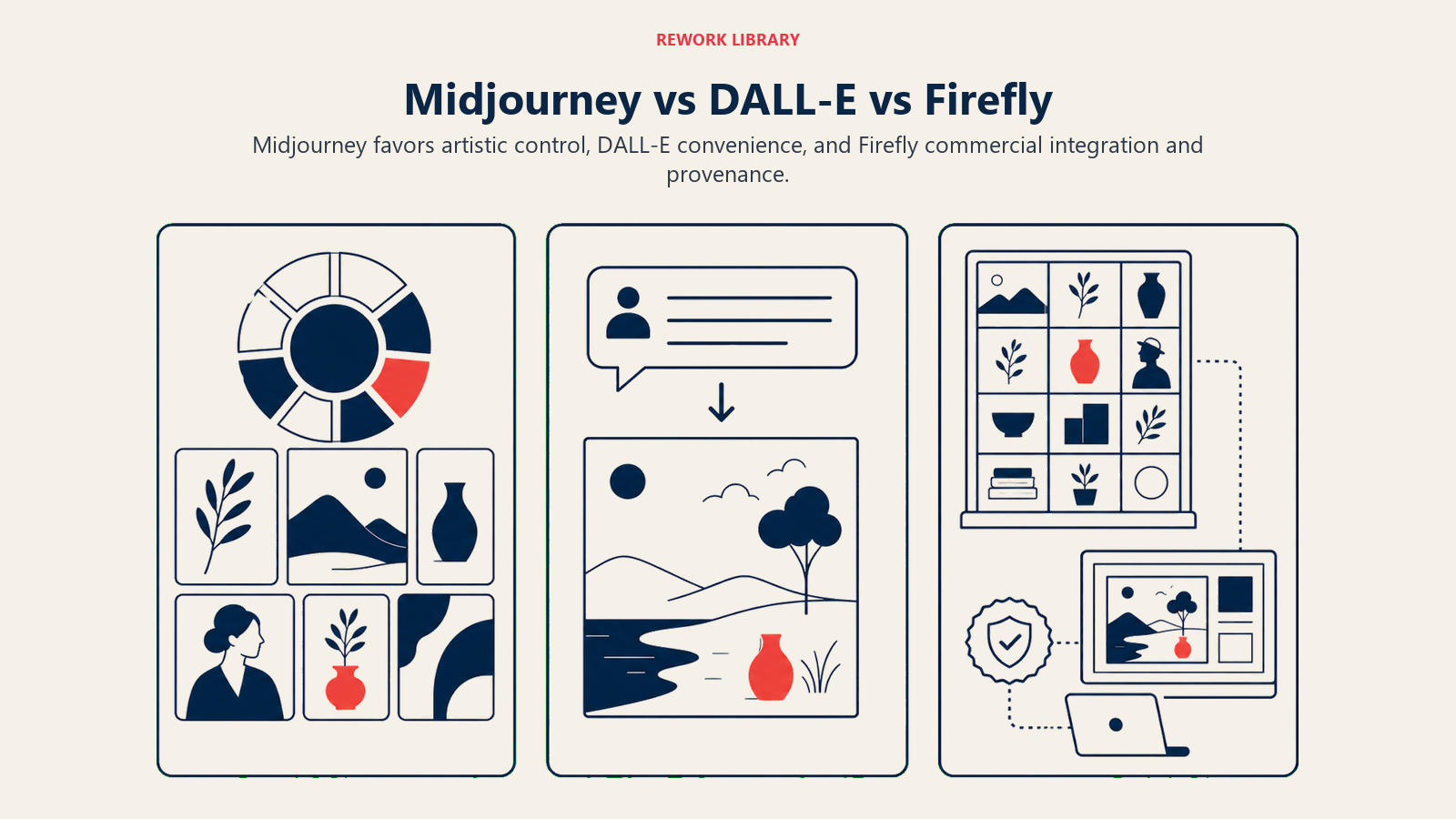
| Aspect | Midjourney | DALL-E 3 / GPT Image (via ChatGPT) | Adobe Firefly |
|---|---|---|---|
| Access | Discord and standalone web app | Built into ChatGPT | Standalone app and Adobe Creative Cloud |
| Strongest at | Highest aesthetic ceiling for stylized, artistic visuals | Fast images without leaving an existing ChatGPT session | Commercially safe assets inside an Adobe workflow |
| Training data | Broad web-scraped data, dataset not disclosed | OpenAI-trained, dataset not fully disclosed | Adobe Stock, licensed, and public-domain content |
| Starting price | $10/mo (Basic) | Bundled in ChatGPT Plus, $20/mo | $9.99/mo (Standard) |
| Free tier | None since March 2023 | Limited generations on ChatGPT's free tier | Limited free generations |
| Legal exposure (2026) | Facing an active, consolidated Disney/Universal/Warner Bros. copyright suit | Less public litigation exposure to date | Lowest exposure; Adobe offers IP claims coverage on Firefly-model output for eligible customers |
The practical takeaway: Midjourney wins on pure visual quality, Firefly wins on licensing peace of mind, and DALL-E/GPT Image wins on convenience if your team already lives inside ChatGPT.
Frequently Asked Questions about Midjourney
What is Midjourney AI in simple terms?
Midjourney is an AI tool that turns a written text prompt into an image, and now a short video, using a diffusion model. You type a description, it generates several options, and you pick, upscale, or refine the one that fits.
Is Midjourney free to use?
No. Midjourney removed its free trial in March 2023, and as of 2026 every plan requires payment starting at $10/month for Basic.
How much does Midjourney cost?
Four paid tiers: Basic $10/month, Standard $30/month, Pro $60/month, and Mega $120/month, each roughly 20% cheaper if billed annually. Plans differ mainly in Fast GPU hours, Relax Mode access, and Stealth Mode for private generations.
Can I use Midjourney images for commercial purposes?
Yes, on any paid plan, with one condition: companies earning more than $1 million in annual gross revenue must be on the Pro or Mega tier to use Midjourney output commercially. Below that revenue threshold, Basic and Standard include commercial rights too.
What is the Disney and Universal lawsuit against Midjourney about?
Disney, NBC Universal, and DreamWorks sued Midjourney in June 2025, alleging the tool generates unauthorized copies of their copyrighted characters and seeking up to $150,000 per infringed work. Midjourney argues its training process is protected fair use. Warner Bros.' related suit was consolidated into the same case in November 2025, and the litigation is still ongoing.
Does Midjourney make videos now?
Yes. Since June 2025, any image generated in Midjourney can be extended into a 5 to 21 second video clip inside the same interface, though video generation uses roughly 8 times the Fast GPU time of a single image.
How is Midjourney different from DALL-E?
Midjourney generally produces more stylized, artistically striking output and gives users more control over consistent style across a series of images. DALL-E (now the GPT Image family inside ChatGPT) is more convenient for users who want a quick image without leaving an existing chat session, but it isn't a dedicated creative tool the way Midjourney is.
Who owns Midjourney, and is it a public company?
Midjourney is privately held and independent. Founder David Holz has never taken outside venture funding, and the company has been profitable since shortly after its 2022 public launch.
Is Midjourney safe to use for a business, given the copyright lawsuit?
That depends on your risk tolerance and use case. The lawsuit specifically concerns Midjourney's ability to generate recognizable studio-owned characters; it doesn't mean every generated image carries legal risk. Businesses producing visuals close to existing copyrighted characters or brands should factor the ongoing litigation into that decision and consult legal counsel for anything customer-facing at scale.
Related AI Concepts
- Generative AI - The broader category of AI that creates content, including images, text, and video
- Diffusion Models - The core technique behind how Midjourney turns noise into images
- Prompt Engineering - How to write prompts that get better results from tools like Midjourney
- Multimodal AI - The category covering AI systems that work across images, video, text, and more
Compare Midjourney to Other Tools
- Best AI Image Generators in 2026 - A 13-tool ranked comparison by use case, including Midjourney, Adobe Firefly, and DALL-E
- Best AI Video Generators in 2026 - Where Midjourney's video feature fits among dedicated video generation tools
External Resources
- Forbes: Midjourney Company Profile - Revenue, funding, and employee figures
- CNN: Disney and Universal Sue Midjourney - Original coverage of the June 2025 lawsuit filing
- CourtListener: Disney Enterprises Inc. v. Midjourney Inc. - Official case docket, including the Warner Bros. consolidation
- Midjourney: Comparing Midjourney Plans - Official pricing and plan feature comparison
- Fortune Business Insights: AI Image Generator Market - Market sizing and growth projections
Part of the AI Terms Collection. Last updated: 2026-07-20

Co-Founder, Rework.com