What is an AI Humanizer?
Turn this article into takeaways for your work.


Each assistant summarizes the article only for you and suggests best practices for your work.
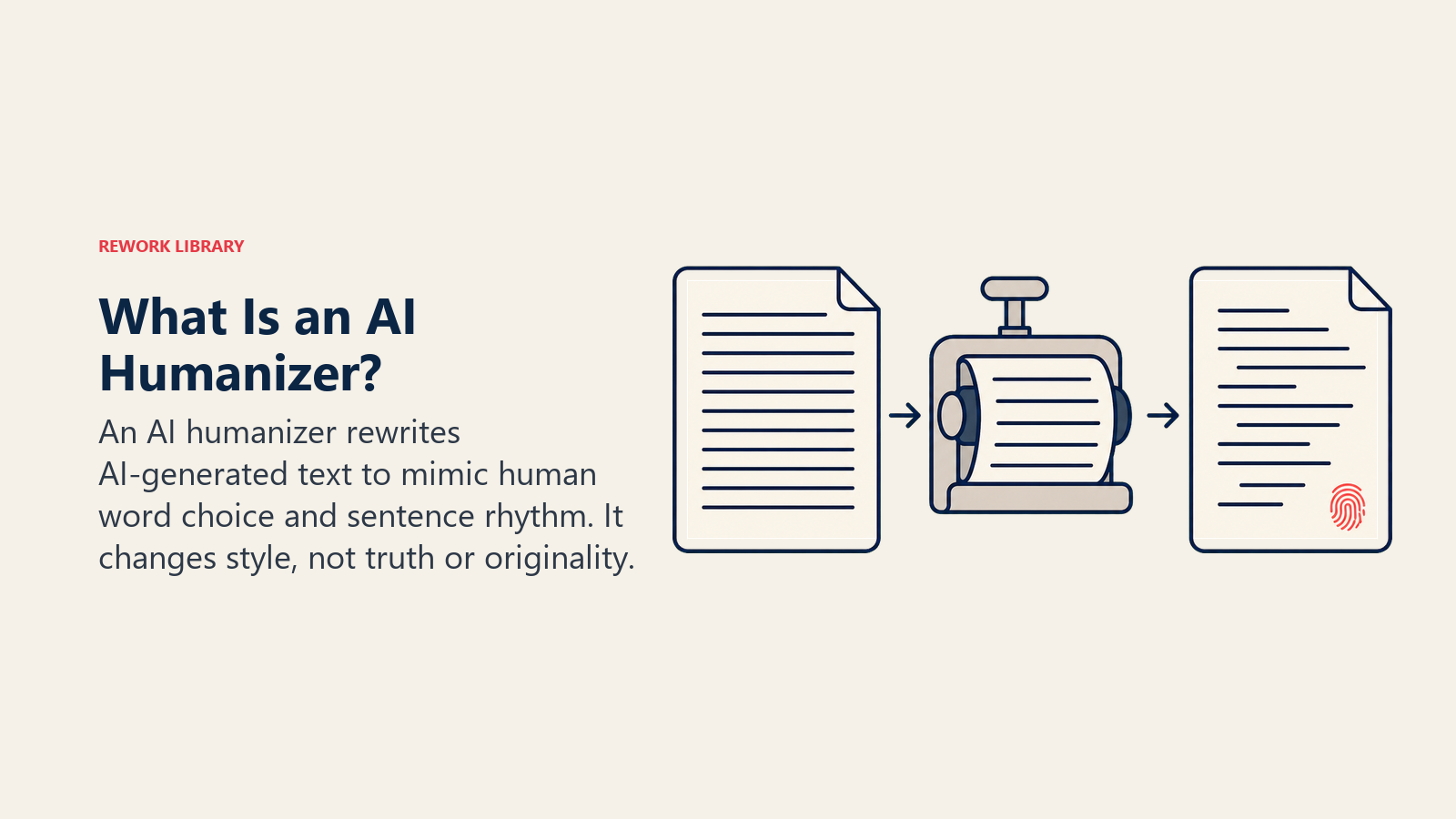
An AI humanizer is a tool that rewrites AI-generated text, swapping word choices, varying sentence length, adding minor imperfections, to make it read as if a person wrote it and to lower the odds an AI detector flags it as machine-made. It doesn't create original thought. It disguises the surface pattern of text that already exists.
That distinction matters. A humanizer takes a draft from ChatGPT, Claude, or another model and runs it through a second pass, sometimes another AI model, sometimes a rules-based paraphraser, that specifically targets the statistical fingerprints detectors look for: predictable word choice and uniform sentence rhythm. The output reads more naturally. Whether it's more honest is a separate question, and one worth sitting with before you reach for one of these tools.
How AI Humanizers Work
Most AI humanizers target the same two signals AI detectors were built to catch, just in reverse.
They break up predictability. Detectors flag text where the model consistently picks the statistically "safest" next word, a pattern called low perplexity. Humanizers counter this by swapping common words for less expected synonyms, restructuring clauses, and injecting small stylistic quirks, deliberately pushing word choice toward the messier, less predictable patterns of human writing.
They vary sentence rhythm. AI output tends to run at a fairly uniform sentence length and structure, called low burstiness. Humanizer tools chop long sentences into short ones, merge short ones into longer, winding constructions, and mix in sentence fragments, mimicking the natural unevenness of how people actually write.
Some layer in "imperfection" on purpose. A few tools go further, inserting mild grammatical quirks, contractions, or conversational asides, features that read as more human but that a careful editor would still catch on a close read.
Under the hood, most commercial humanizers are themselves powered by a language model, one trained or prompted specifically to paraphrase in a way that evades classifier-based and perplexity-based detection. That's the same basic move researchers have studied directly: Google's DIPPER paraphrasing model, built to test this exact evasion technique, dropped one detector's accuracy from 70.3% to just 4.6% and also evaded GPTZero and OpenAI's own classifier in controlled testing (Krishna et al., NeurIPS 2023). A humanizer is, mechanically, a productized version of that same paraphrasing attack.
The Cat-and-Mouse Game with AI Detectors
Humanizers and detectors are locked in a direct arms race, and neither side is standing still.
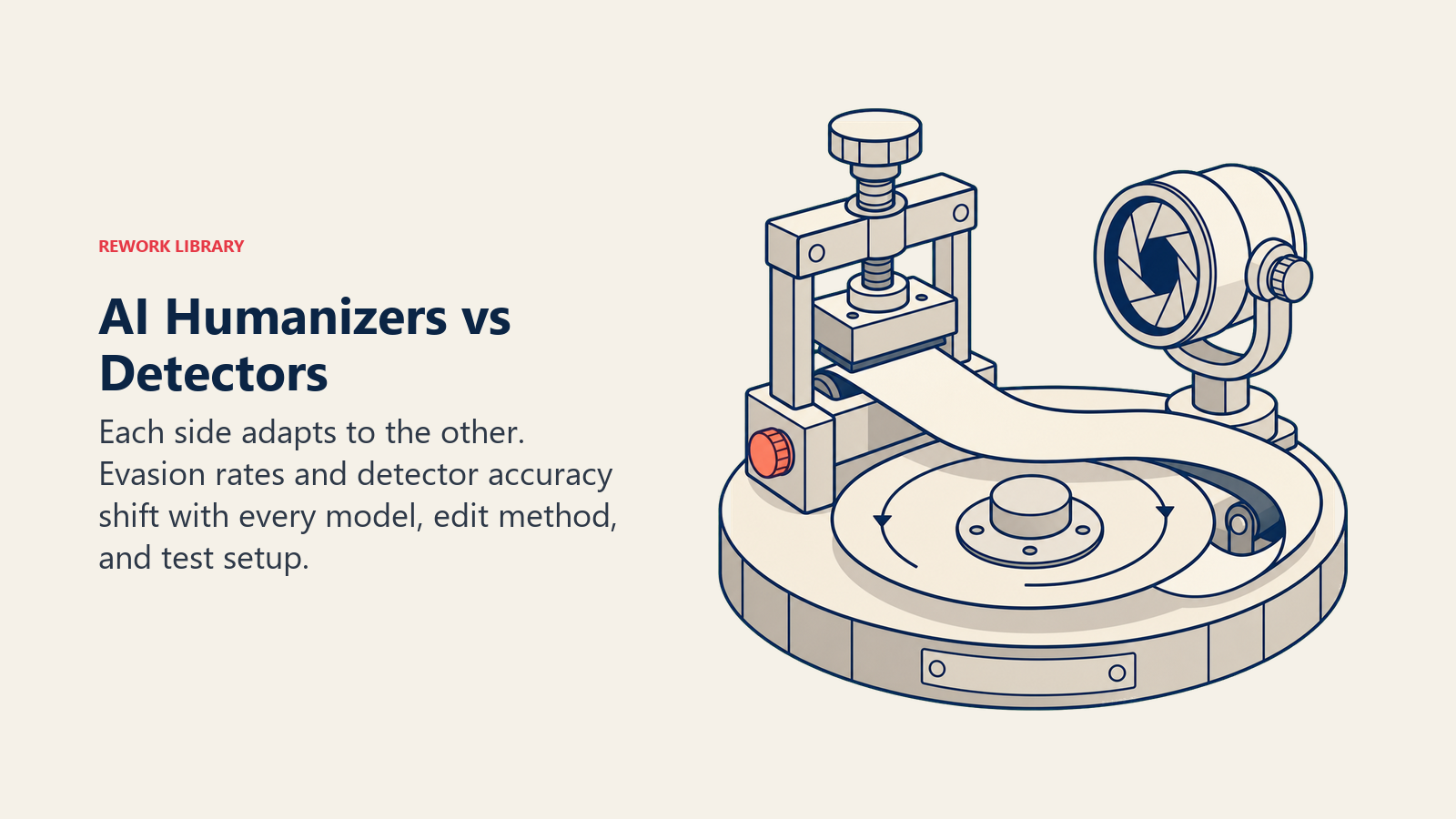
Every time a detector vendor tunes its model to catch a known humanizing pattern, humanizer tools adjust their output to slip past the new baseline. Turnitin's February 2026 model update specifically expanded detection to flag AI-paraphrased text, not just raw AI output, splitting results into separate "AI-generated" and "AI-paraphrased" categories. Simple word-swapping that worked against Turnitin in 2024 is now caught more often. GPTZero has made similar claims about its latest models being built to catch humanized and bypassed text. But "built to catch it" and "reliably catches it" aren't the same claim, and independent testing on that gap is thin.
Key Facts: AI Humanizers vs. Detectors
- Turnitin's own data shows AI-generated submissions rising sharply: an average of 14.8% of English-language submissions between October 2025 and February 2026 contained 80% or more AI-generated writing, up from an average of 3.3% when its original AI detector launched in April 2023 (Turnitin)
- A peer-reviewed test of 14 AI-text detectors found accuracy fell sharply as text was modified: roughly 20% of raw AI-generated text was misclassified as human-written, rising to about 52% once manually edited and about 71% once machine-paraphrased (Weber-Wulff et al., International Journal for Educational Integrity, 2023)
- A 2026 study built specifically to test humanizer tools, AuthorMist, reported evasion success rates of 78.6% to 96.2% against individual commercial detectors including GPTZero, WinstonAI, and Originality.ai, while keeping semantic similarity to the original text above 0.94 (arXiv, 2026)
- Researchers evaluating 19 commercial AI humanizer and paraphrasing tools found that many existing AI detectors failed to catch the humanized output at all, a gap that motivated the researchers to build a new detection model (arXiv, DAMAGE study, 2025)
- GPTZero markets a 99% accuracy rate against AI-generated text and 96.5% accuracy on mixed human-and-AI documents, based on independent benchmarking it says was run with Penn State's AI Research Lab (GPTZero)
Read across those numbers and a pattern emerges: independent academic testing of humanizing and paraphrasing techniques consistently finds high evasion rates, often above 70%, while detector vendors simultaneously market accuracy rates in the high 90s against the same category of attack. Both claims can be technically true at once, tested against different tool versions, different detectors, and different humanizer configurations. What that really means is the fight is unsettled and shifting month to month, not that either side has a durable advantage.
Does Humanizing Actually Work? An Honest Look
The honest answer is: sometimes, against some detectors, for now. Not: reliably, against all detectors, forever.
Independent, non-vendor testing (the DIPPER paraphrasing study, the AuthorMist evasion research, the 14-detector accuracy study above) consistently finds that paraphrasing and humanizing techniques meaningfully reduce detection rates, in several cases by a wide margin. That's a real, reproducible effect, not just marketing. But three things complicate any claim of a guaranteed bypass.
Detectors update faster than most users realize. A humanizer tuned against last year's detector model may fail against this year's version, and users generally have no way to know which version they're being tested against.
Evasion and quality are a trade-off. The features that beat detectors, less predictable word choice, uneven sentence rhythm, can also make text read stranger, less coherent, or less on-brand if pushed too far. A "successfully humanized" document can still read as obviously synthetic to a human editor, even when it fools a classifier.
Passing a detector doesn't verify the content is good. A humanizer can smooth over the statistical fingerprint of AI generation without touching accuracy, originality, or whether the underlying claims are even true. It's a stylistic filter, not a fact-check or an editorial pass. Content that has AI hallucinations baked in will keep those errors after humanizing, dressed in more natural-sounding prose.
Popular AI Humanizer Tools, Briefly
The category is crowded and fast-moving. A few names come up repeatedly in independent comparisons; each makes strong claims, and each has caveats worth knowing before you rely on one.
| Tool | Positioning | Vendor Claim | Honest Caveat |
|---|---|---|---|
| QuillBot | Paraphrasing and writing assistant with a humanize mode | Markets improved "human" scoring across major detectors | Independent tests have found bypass rates well below top-tier competitors, often in the 40-50% range against tools like GPTZero and Turnitin |
| Undetectable AI | Purpose-built AI humanizer | Markets high bypass rates against named detectors | Bypass performance varies significantly by detector and shifts every time a detector updates its model |
| StealthWriter | Purpose-built AI humanizer for academic and content use | Markets "undetectable" output | The word "undetectable" is a marketing claim, not a guarantee; treat it as unproven against every major detector |
| Originality.ai's own humanizer | Built by a detection vendor, positioned as a testing tool | Markets itself against its own detector's accuracy claims | An unusual position: the same company sells both the detector and a tool designed to beat it, worth knowing when reading either product's marketing |
Treat every accuracy or bypass-rate claim on a vendor's own site the same way you'd treat a detector vendor's accuracy claim: as a starting point for research, not a verified fact.
The Ethics and Risks
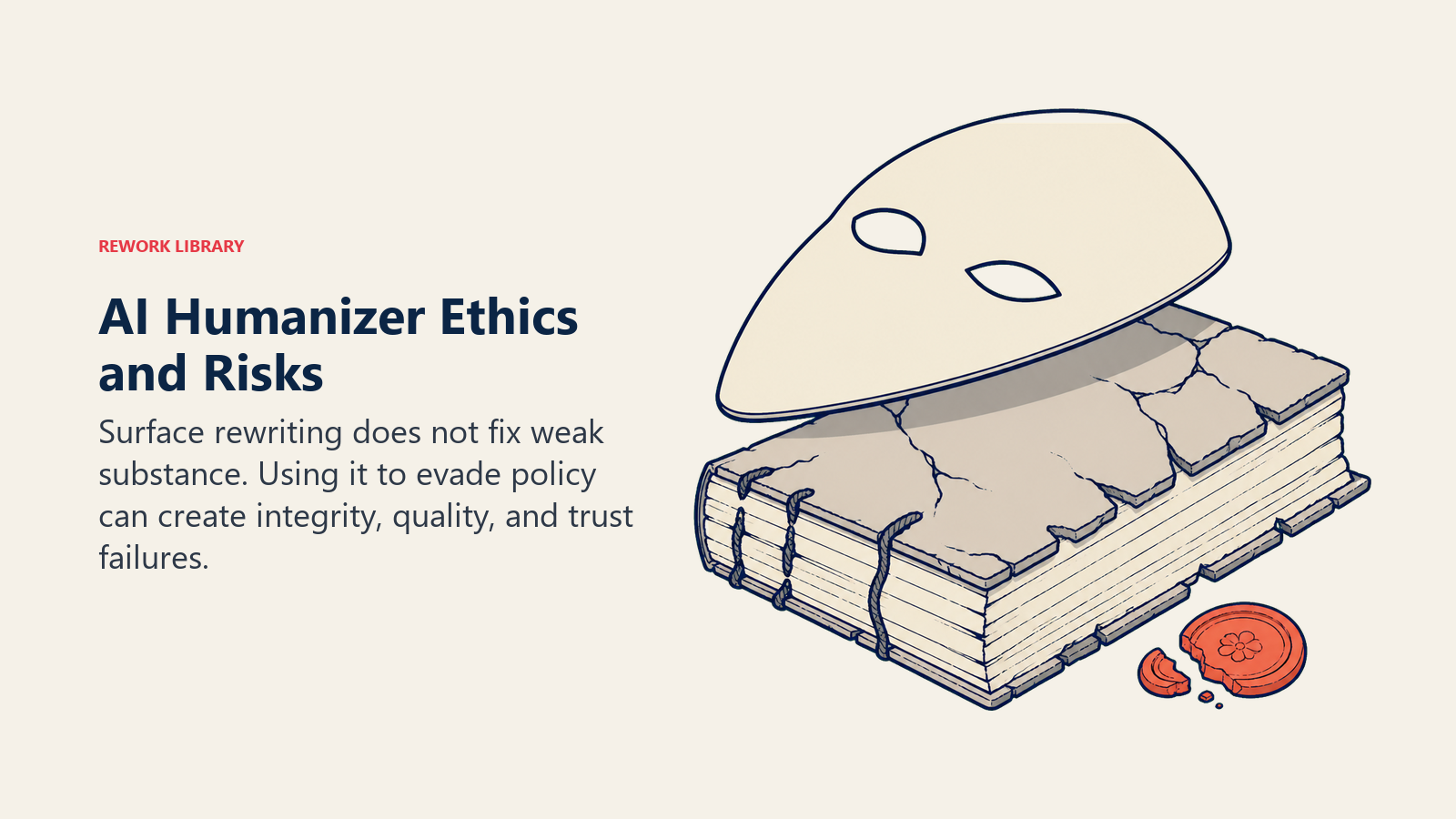
Using an AI humanizer isn't illegal, and the tools themselves aren't inherently deceptive; a writer touching up AI-assisted brainstorming into their own voice is a different act than laundering an unreviewed AI draft to pass as original work. But the intent behind most humanizer use is worth being honest about, because the risks scale with that intent.
Academic integrity. Students using a humanizer specifically to submit AI-written work as their own are attempting to evade a policy, not just adjust a writing style. Given how AI governance around academic AI use is still being written school by school, a student caught with humanized text that's later flagged, or investigated through non-detector means like draft history, faces the same consequences as one caught with raw AI output, plus the added appearance of intent to deceive.
Content quality and originality. A humanizer changes surface style, not substance. Businesses that mass-produce content, run it through a humanizer to dodge AI-content flags, and publish without real editorial review are still producing what's increasingly labeled AI slop, just slop with better camouflage. The underlying quality, accuracy, and originality problems don't go away because the text reads more naturally.
Trust, once broken, is hard to rebuild. If a business, publication, or platform later discovers that "human-written" content was AI-generated and deliberately humanized to evade disclosure, that's a worse trust failure than disclosed AI assistance would have been. Readers and platforms increasingly expect transparency about AI use, not evasion of the question.
Detection is unreliable in both directions. It's worth remembering that AI detectors themselves produce meaningful false positives, especially against non-native English writers and formulaic writing, a problem covered in depth in what an AI detector actually is. Humanizer tools exploit real weaknesses in genuinely flawed technology. That context doesn't make evading academic or editorial policy acceptable, but it does mean the fight between humanizers and detectors is happening on shaky ground on both sides.
Better Alternatives to Humanizing AI Text
If the goal is text that reads as genuinely good and genuinely yours, there's a more durable path than chasing whichever humanizer beats this month's detector version.
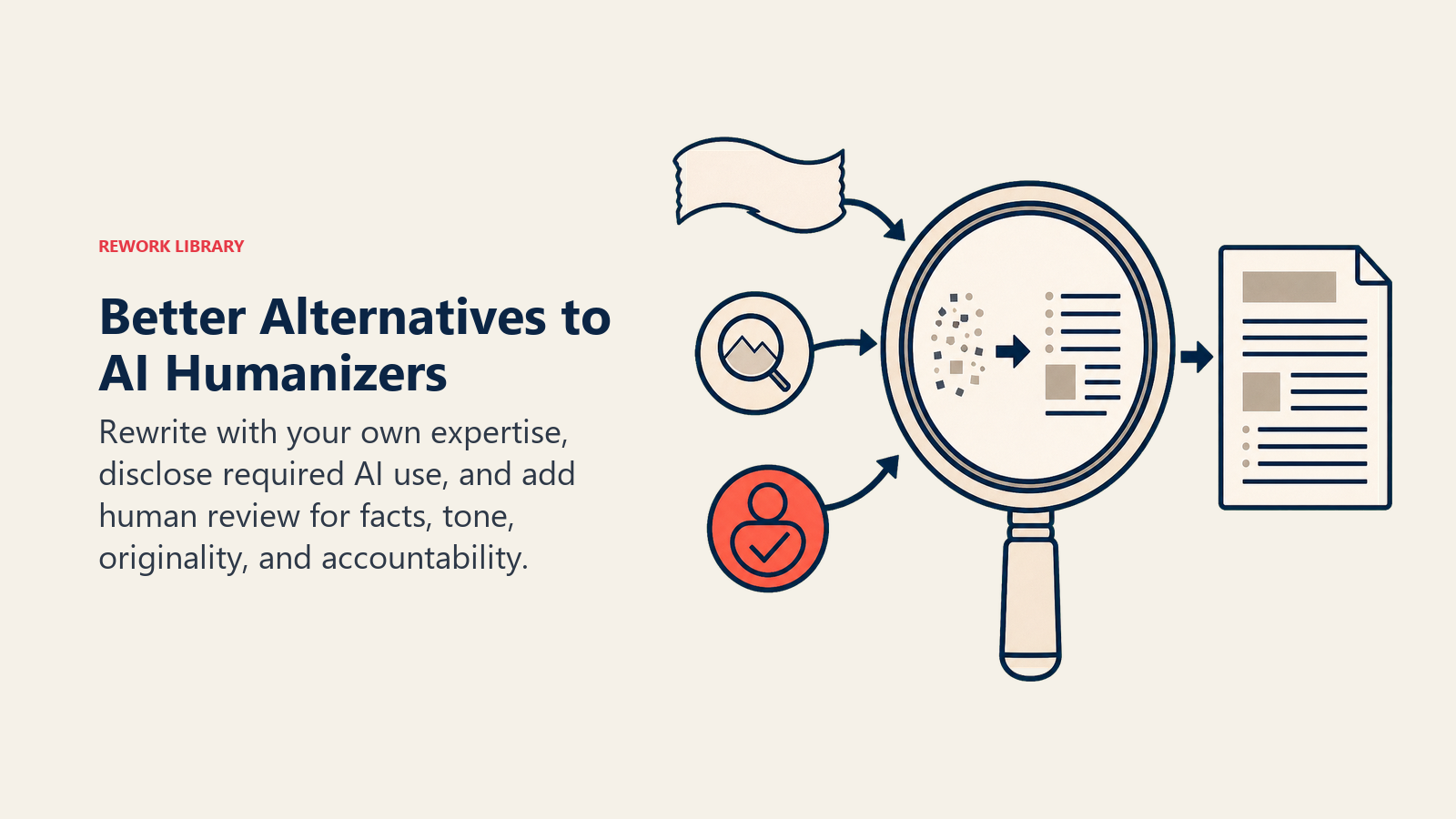
Edit the AI draft yourself. Use AI output as a starting point, then rewrite it in your own words, add your own examples, and cut anything you can't personally stand behind. This produces writing that's actually original, not just statistically disguised, and it holds up under any future detector, any editor, and any fact-check.
Add real expertise the AI can't supply. A model can draft competent, generic prose. It can't add your team's first-hand experience, a specific customer story, or an opinion earned from doing the work. That's the difference detectors were never built to measure, but readers and editors notice it immediately.
Use AI writing tools built for editorial workflows, not evasion. Some tools are designed around drafting assistance, outlining, and research support rather than one-click disguise. A list like the best AI writing tools is a better starting point than a humanizer if the actual goal is better writing rather than a lower detection score. Tools purpose-built for writers, reviewed in guides like the best AI tools for content writers, tend to support that editorial process instead of working around it.
Disclose AI assistance where policy requires it. If a school, employer, or publication has a stated AI-use policy, follow it and disclose accordingly rather than trying to engineer around detection. Policies are increasingly explicit about this, and disclosed, reviewed AI-assisted work carries far less risk than work built specifically to look like it wasn't AI-assisted.
Build a human-in-the-loop review step into anything that matters. Whether it's a student essay, a piece of marketing copy, or code, a human checking facts, tone, and originality before anything ships catches problems no humanizer or detector ever will, and it's the one step that actually improves the output instead of just its score.
Learn More
Explore related AI concepts to deepen your understanding:
- What is an AI Detector?: the tool humanizers are built to evade, and why its scores aren't as reliable as they look
- What is AI Slop?: the low-quality, mass-produced content problem humanizers can help disguise but never fix
- AI Hallucination: why humanized text can still be confidently wrong
- Bias in AI: the same structural pattern behind detectors' false positives on non-native English writing
- AI Governance: the policy frameworks schools and businesses are still writing around AI-assisted writing
- Prompt Engineering: getting better first drafts from AI, so there's less to disguise later
- Large Language Models (LLMs): the models powering both AI writing and the humanizer tools built on top of them
- Best AI Writing Tools in 2026: editorial-focused tools worth comparing against a one-click humanizer
External Resources
- Paraphrasing Evades Detectors of AI-Generated Text, but Retrieval Is an Effective Defense (DIPPER) - the foundational study on paraphrasing-based detector evasion
- Testing of Detection Tools for AI-Generated Text - the peer-reviewed 14-detector study showing accuracy collapse on edited and paraphrased text
- Turnitin Data Shows Transparency About AI Use Benefits Students and Educators - Turnitin's own submission data on rising AI-generated writing
Frequently Asked Questions about AI Humanizers
What is an AI humanizer?
An AI humanizer is a tool that rewrites AI-generated text to sound more human and to make it less likely to be flagged by an AI detector, typically by varying word choice and sentence rhythm. It changes the style of text, not the substance or accuracy behind it.
What is the best AI humanizer?
There isn't a single best AI humanizer with a verified, independently reproduced accuracy claim. Bypass rates in independent research vary widely by tool, by detector, and by how recently each side updated its model, so any "best" claim should be checked against current, independent testing rather than a vendor's own marketing page.
Do AI humanizers actually work against AI detectors?
Sometimes, and the effect is real in independent research. Academic studies on paraphrasing-based evasion have found detection accuracy dropping sharply, in some cases from over 70% to under 5%. But detectors update regularly to catch known humanizing patterns, so a technique that works today isn't guaranteed to work against tomorrow's detector version.
Is it safe to use an AI humanizer for a school assignment?
No, not if the goal is to submit AI-written work as your own under a policy that prohibits it. Even if a humanizer evades a specific detector, schools increasingly use non-detector evidence like draft history, and being caught after deliberately disguising AI use typically carries a bigger consequence than disclosed AI assistance would have.
Can AI detectors catch humanized text?
Increasingly, some can, for some humanizers. Turnitin's 2026 update specifically added detection for AI-paraphrased text, and GPTZero has made similar claims about newer models. But independent research still finds high evasion rates against many commercial detectors, so "increasingly detectable" doesn't mean "reliably detectable" yet.
Does humanizing AI text improve its quality?
No. A humanizer changes surface style, word choice and sentence rhythm, not the accuracy, originality, or usefulness of the underlying content. Text with factual errors or generic ideas keeps those problems after humanizing; it just reads more naturally while having them.
What's a better alternative to using an AI humanizer?
Editing an AI draft yourself, adding real first-hand expertise the model can't supply, and running a human review pass before anything ships. That produces writing that's genuinely original and holds up under scrutiny, rather than text that's just statistically disguised to pass one specific detector's current model.
Are AI humanizer tools illegal?
No, using one isn't illegal. The risk is contextual: using a humanizer to evade an academic integrity policy, a publishing disclosure requirement, or an employer's AI-use policy can carry serious consequences even though the tool itself is legal to use.
Part of the AI Terms Collection. Updated July 2026.
