What is Project Stargate?
Turn this article into takeaways for your work.


Each assistant summarizes the article only for you and suggests best practices for your work.
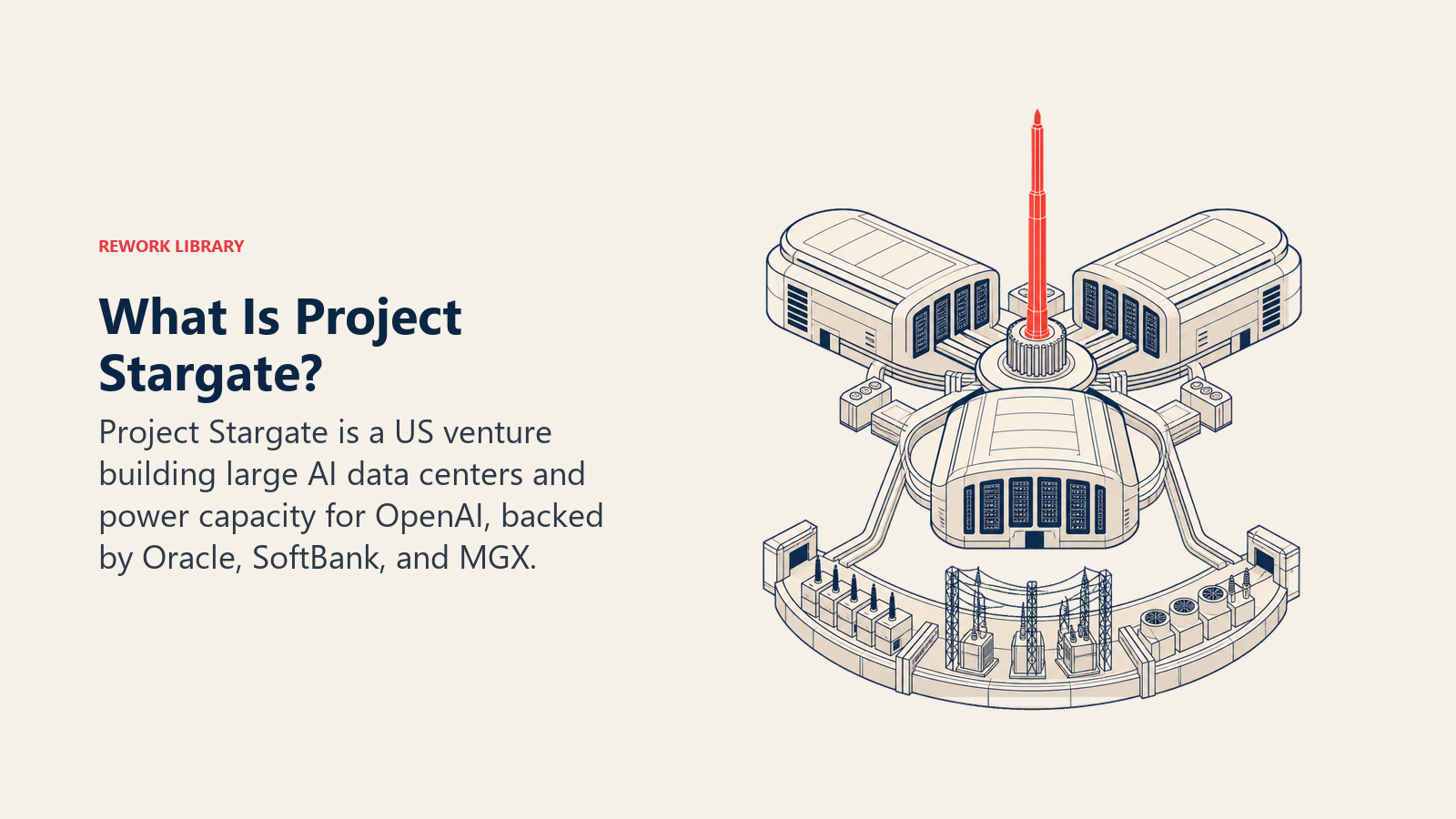
Project Stargate is a US artificial intelligence infrastructure venture backed by OpenAI, Oracle, SoftBank, and MGX, announced in January 2025 with plans to invest up to $500 billion in data centers by 2029. It builds the computing capacity OpenAI needs to train and run its models, starting with $100 billion in committed capital.
You'll often see it called "Stargate AI" online, though the official name is simply the Stargate Project, incorporated as Stargate LLC. It has nothing to do with the movie or TV franchise of the same name. It's the physical infrastructure layer behind the AI boom: the land, power, chips, and buildings that let a company like OpenAI keep training bigger models and serving hundreds of millions of users without running out of computing capacity. This article covers who's behind Stargate, what it actually builds, how far construction has gotten through 2026, why it matters beyond OpenAI, and the financing questions that have followed the project since its launch.
Who's Behind Stargate: Backers and Structure
Stargate was formally announced on January 21, 2025, at a White House event with President Donald Trump, alongside OpenAI CEO Sam Altman, SoftBank CEO Masayoshi Son, and Oracle chairman Larry Ellison. Four organizations put up the initial equity capital and hold ownership stakes in the joint venture.
| Partner | Role | Initial Commitment |
|---|---|---|
| SoftBank Group | Financial responsibility; Masayoshi Son chairs the venture | $19 billion |
| OpenAI | Operational responsibility; the primary customer of the compute Stargate builds | $19 billion |
| Oracle | Cloud infrastructure and data center operator on multiple sites | $7 billion |
| MGX | Abu Dhabi-based investment firm, financial backer | $7 billion |
SoftBank and OpenAI each hold roughly 40% of the venture, with Oracle and MGX holding the remainder. Beyond the four equity partners, Nvidia, Microsoft, Arm, AMD, and Broadcom are named technology partners supplying chips, networking, and cloud capacity. Microsoft, notably, was OpenAI's primary infrastructure partner before Stargate and remains involved even though it isn't one of the four core equity holders.
The remaining funds beyond that initial $100 billion are expected to come from limited partners and debt financing rather than the four founding investors alone, which is part of why the project's financing has drawn scrutiny (more on that below).
What Stargate Actually Builds
Stargate exists to solve one problem for OpenAI: it doesn't own enough computing capacity to train its next generation of models or serve its existing user base at the scale it needs. Stargate builds AI data centers, campuses packed with GPUs, high-speed networking, and dedicated power infrastructure, purpose-built for training and running large language models and other foundation models at a scale a general-purpose cloud data center was never designed to handle.
In practice, that means physical construction: land acquisition, power substations, on-site or contracted electricity generation, liquid cooling systems, and buildings filled with racks of Nvidia GPUs (Blackwell-generation chips at the flagship site, with AMD and Broadcom hardware also part of the broader supply chain). Oracle operates several of the sites and leases compute capacity back to OpenAI under long-term contracts. The output isn't a product a business buys directly, it's raw compute that OpenAI uses to train models, run inference for ChatGPT and its API, and increasingly to support test-time compute, the reasoning-heavy workloads that consume far more compute per query than a simple chat response does.
Stargate's Progress Through 2026
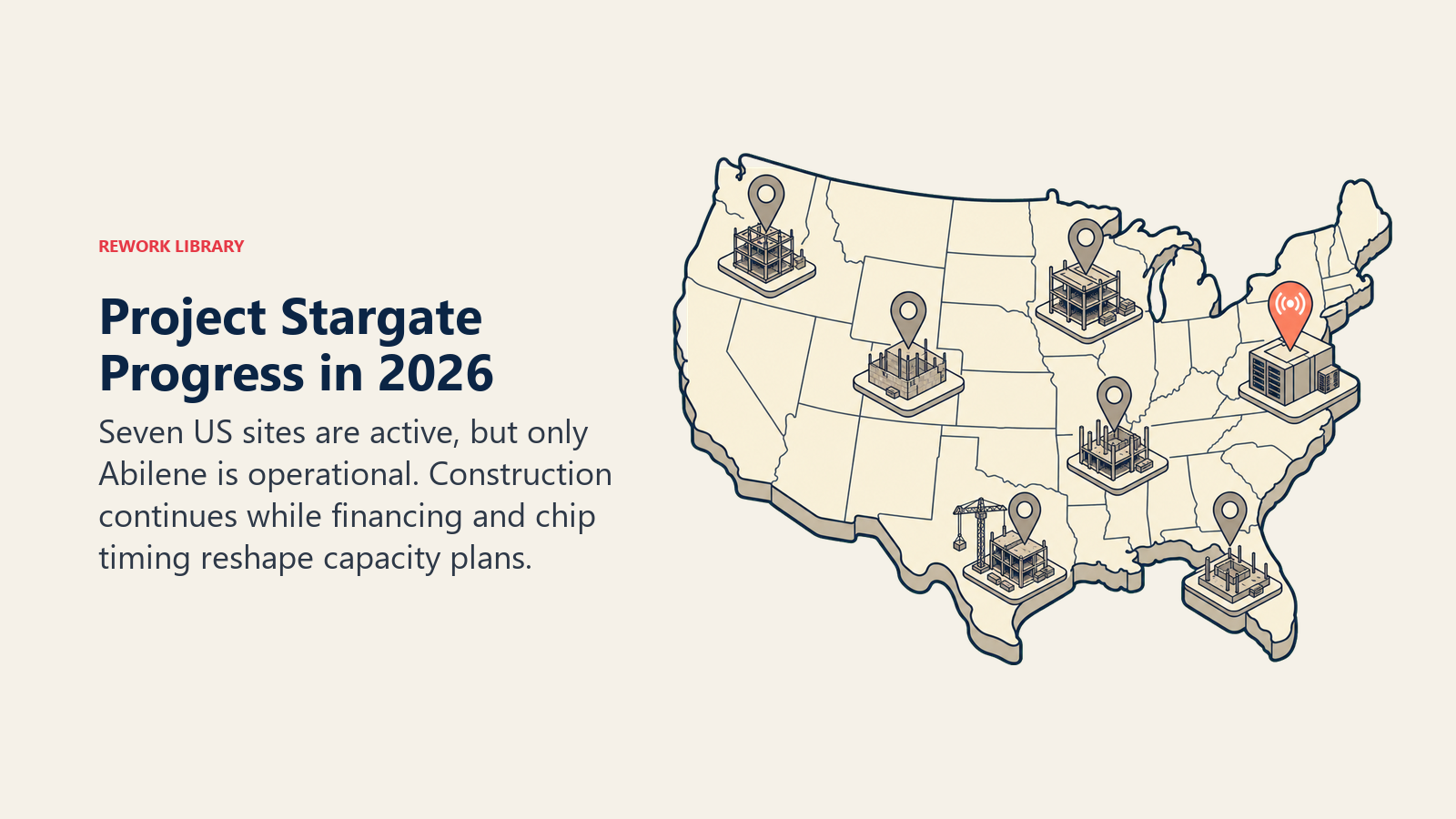
Construction has moved slower than the original announcement suggested, but it hasn't stalled. As of mid-2026, Stargate spans seven active US sites with a combined planned capacity of more than 9 gigawatts, roughly comparable to the peak power demand of a city the size of New York.
| Site | State | Status (mid-2026) |
|---|---|---|
| Abilene | Texas | Operational, running at an estimated 0.3 GW; the only fully live site |
| Shackelford County | Texas | Under construction |
| Milam County | Texas | Under construction |
| Doña Ana County | New Mexico | Under construction |
| Lordstown | Ohio | Under construction |
| Unnamed site | Wisconsin | Under construction |
| Unnamed site | Michigan | Under construction |
Abilene remains the flagship: four of its planned eight buildings are operational, running roughly 250,000 H100-equivalent GPUs, with the site targeted to reach full capacity by late 2026. But it also shows the friction in the project. In March 2026, Oracle and OpenAI scrapped a planned 600 megawatt expansion of the Abilene campus, which would have grown it from 1.2 GW toward roughly 2 GW, after financing negotiations stalled and OpenAI decided it would rather wait for next-generation Nvidia chips than lock in more of the current generation. The capacity originally earmarked for that expansion is being redirected to the Wisconsin and Michigan sites instead, part of a broader 4.5 GW Oracle-OpenAI capacity agreement that remains on track even as individual site plans shift.
Internationally, OpenAI, Oracle, and SoftBank have also floated Stargate-branded expansions in the UAE, UK, Norway, Japan, and Argentina, though those sit well behind the US buildout in scale and confirmed commitments.
Why Stargate Matters
Stargate matters for three reasons that go beyond OpenAI's own roadmap.
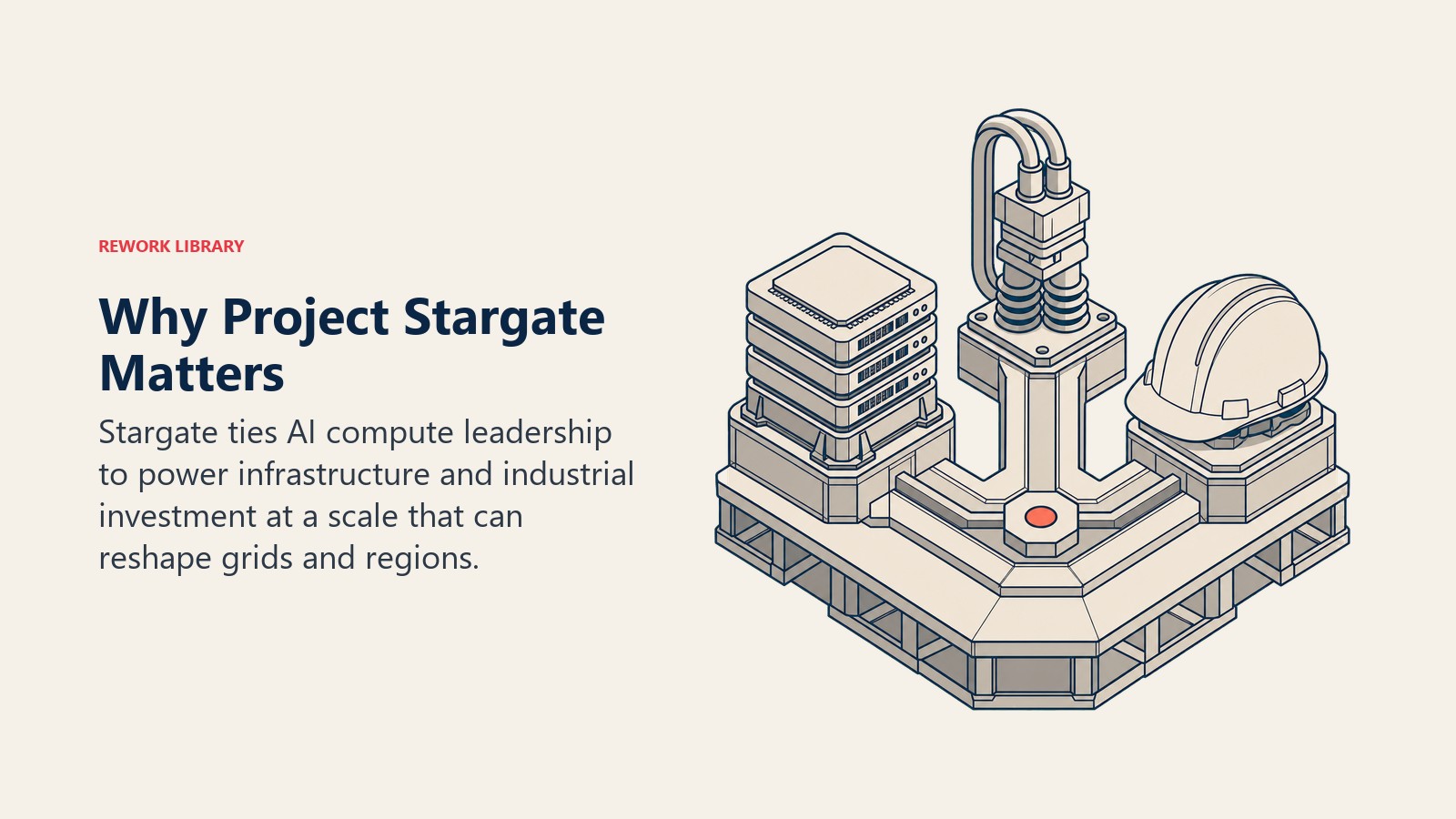
The compute race. Whoever controls the most usable AI compute can train the most capable models and serve them to the most users without hitting capacity limits. Stargate is OpenAI's answer to the fact that Microsoft's Azure alone couldn't keep pace with its compute needs, and it puts OpenAI in a similar infrastructure-ownership position to Google, which builds much of its own AI infrastructure through Alphabet.
Power and the grid. A single Stargate site can draw as much electricity as a mid-size city, and the project is a visible piece of a much larger trend: data centers are expected to account for nearly half of all new US electricity demand growth through 2030. That's why Stargate sites increasingly pair with dedicated power infrastructure, including on-site natural gas generation at several locations, rather than relying purely on the existing grid.
Jobs and economic claims. OpenAI, SoftBank, and Oracle have said Stargate will create more than 100,000 US jobs and support the "re-industrialization" of American manufacturing and construction tied to AI infrastructure. Those figures come from the venture's own announcement rather than independent verification, which is worth keeping in mind when you see them repeated in press coverage. For a broader look at how AI infrastructure economics flow through to what businesses actually pay for AI tools, see AI total cost of ownership.
Stargate also sits inside a wider pattern of nations wanting AI capacity they control directly rather than renting it from a US hyperscaler, a trend covered in more depth under sovereign AI.
The Skepticism: Financing Questions
Not everyone reads Stargate as a straightforward infrastructure success story. Three concerns come up most often among analysts and short sellers watching the project.
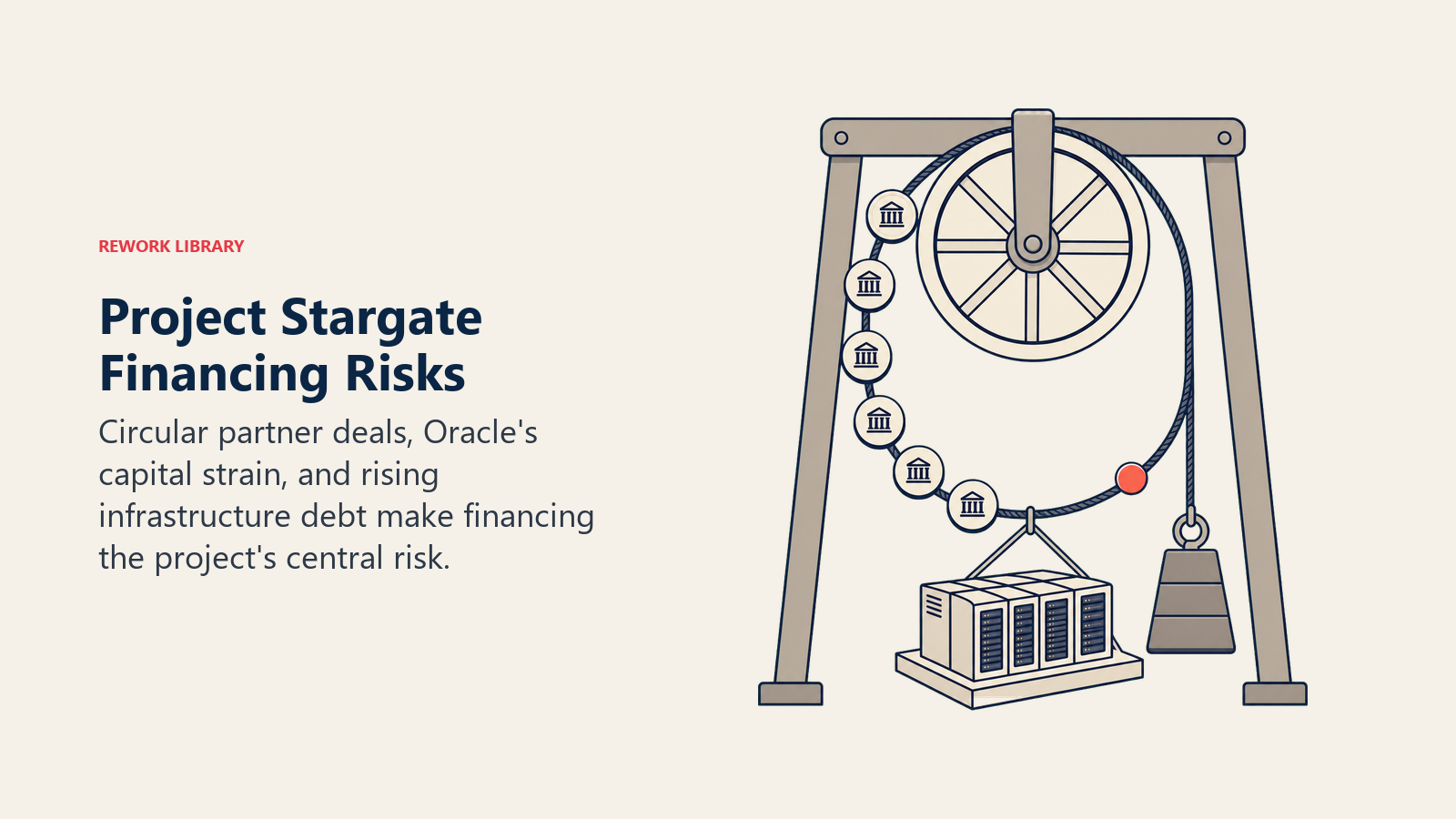
Circular financing. Critics, including short sellers Jim Chanos and Michael Burry, have flagged what they call artificial demand created by a loop of related-party deals: Nvidia invests in OpenAI, OpenAI uses that capital (directly and through Oracle and CoreWeave) to buy Nvidia chips, and Nvidia also holds a stake in CoreWeave. The concern isn't that any single deal is improper, it's that the same dollars can appear to support demand more than once as they move through the ecosystem.
Anchor tenant strain. Oracle, one of the four core Stargate partners and operator of several sites, reported quarterly operating cash flow of roughly $2.1 billion against capital expenditure of about $12 billion in a recent quarter, a gap of roughly $10 billion covered largely through debt. Because Oracle is the anchor tenant on multiple Stargate-linked financings, some lenders have reportedly grown more cautious about new deals where Oracle is the counterparty.
The debt math industry-wide. Stargate isn't financed by equity alone. Hyperscaler debt issuance to fund AI infrastructure has surged well past $100 billion a year, and PIMCO estimates that capital expenditure will consume roughly 94% of hyperscalers' operating cash flow in 2026 and 2027, up from about 40% just three years earlier. That doesn't mean Stargate collapses, but it does mean the buildout increasingly depends on continued access to cheap debt and steady AI demand growth, not just committed equity from OpenAI, SoftBank, Oracle, and MGX. It's also one reason Stargate keeps coming up in the broader AI bubble debate: the project is a visible test case for whether AI infrastructure spending is running ahead of the revenue needed to justify it.
None of this means Stargate is a bad bet. It means the project's biggest risk isn't technical, it's financial: whether the debt and demand both hold up long enough for the compute to get built and put to profitable use.
Key Facts
- Stargate was announced on January 21, 2025, with OpenAI, SoftBank, Oracle, and MGX committing to invest up to $500 billion in US AI infrastructure by 2029, with $100 billion deployed immediately. Source
- SoftBank and OpenAI each committed $19 billion of initial capital (roughly 40% ownership each), while Oracle and MGX each contributed $7 billion. Source
- The venture's backers say Stargate will create more than 100,000 US jobs. Source
- Stargate spans seven active US sites with combined planned capacity of more than 9 gigawatts as of mid-2026, according to Epoch AI's site-by-site tracker. Source
- Only the Abilene, Texas site is fully operational, running at an estimated 0.3 gigawatts with roughly 250,000 H100-equivalent GPUs online. Source
- Oracle and OpenAI scrapped a planned 600 megawatt expansion of the Abilene campus in March 2026, redirecting that capacity to sites in Wisconsin and Michigan under a separate 4.5 gigawatt Oracle-OpenAI capacity agreement. Source
- PIMCO estimates hyperscaler capital expenditure will consume about 94% of operating cash flow in 2026 and 2027, up from roughly 40% in 2023, as debt-funded buildouts like Stargate scale up. Source
Frequently Asked Questions about Project Stargate
What is Project Stargate in simple terms?
Project Stargate is a joint venture between OpenAI, Oracle, SoftBank, and MGX to build up to $500 billion in AI data center infrastructure across the United States by 2029. It exists to give OpenAI the computing capacity it needs to train and run its AI models at scale.
Is Stargate an OpenAI product?
No. Stargate isn't something businesses or consumers buy directly. It's infrastructure, the data centers and compute capacity that OpenAI uses behind the scenes to train models and serve products like ChatGPT and its API.
Who owns Project Stargate?
SoftBank and OpenAI each hold roughly 40% of the venture and put up $19 billion in initial capital apiece. Oracle and MGX each contributed $7 billion. SoftBank has financial responsibility for the venture, OpenAI has operational responsibility, and SoftBank's Masayoshi Son chairs it.
How many Stargate sites are there, and where?
As of mid-2026, Stargate spans seven active US sites: Abilene, Shackelford County, and Milam County in Texas; Doña Ana County in New Mexico; Lordstown in Ohio; and sites in Wisconsin and Michigan. Combined, they represent planned capacity of more than 9 gigawatts.
Is any part of Stargate actually built and running?
Yes. The Abilene, Texas site is operational, running at an estimated 0.3 gigawatts with roughly 250,000 H100-equivalent GPUs online as of mid-2026, though full build-out of that single site is still in progress.
Why did Oracle and OpenAI cancel part of the Abilene expansion?
In March 2026, Oracle and OpenAI dropped a planned 600 megawatt expansion of Abilene after financing negotiations stalled and OpenAI decided it preferred to wait for next-generation Nvidia chips rather than commit more capacity to the current generation. That capacity was redirected to sites in Wisconsin and Michigan instead.
Is Project Stargate financially risky?
Analysts and short sellers have raised real concerns, including circular financing arrangements between Nvidia, OpenAI, Oracle, and CoreWeave, Oracle's negative free cash flow on its AI buildout, and industry-wide hyperscaler capex projected to consume around 94% of operating cash flow through 2027. None of that means the project fails, but it does mean Stargate's completion depends heavily on continued debt financing and AI demand holding up.
How does Stargate relate to the AI bubble debate?
Stargate is one of the largest and most visible examples of AI infrastructure spending, which makes it a frequent reference point in debates over whether AI capital expenditure is outrunning the revenue AI has actually generated so far. Its financing structure and site delays are watched closely as an early signal either way.
Does Stargate only operate in the United States?
The core buildout is entirely US-based. OpenAI, Oracle, and SoftBank have discussed Stargate-branded international expansions in the UAE, UK, Norway, Japan, and Argentina, but those remain much smaller in scale and less firmly committed than the seven confirmed US sites.
Learn More
- What is an AI Data Center? - The type of facility Stargate builds, and why it's so different from a traditional data center
- What is OpenAI? - The company Stargate's compute is built for, its history, products, and funding
- What is the AI Bubble? - The broader debate over whether AI infrastructure spending like Stargate is outrunning AI revenue
- Large Language Models - What actually gets trained and run on Stargate's compute
- Foundation Models - The category of large, general-purpose models Stargate's compute supports
- What is Test-Time Compute? - Why reasoning-heavy AI workloads consume so much more compute per query
- AI Total Cost of Ownership - How data center economics like Stargate's flow into what businesses pay for AI
- What is Sovereign AI? - Why other nations are building their own Stargate-style infrastructure rather than renting US capacity
- AI Governance - The organizational frameworks shaping decisions like Stargate's national security and economic claims
External Resources
- OpenAI: Announcing the Stargate Project - OpenAI's own announcement of the venture, its partners, and its goals
- Epoch AI: OpenAI Stargate, Where the US Sites Stand - Site-by-site tracking of construction status and planned capacity
- Data Center Dynamics: OpenAI and SoftBank to Both Invest $19bn in Stargate - Breakdown of the initial equity commitments
- Tom's Hardware: Oracle and OpenAI Scrap Planned 600MW Abilene Expansion - Details on the March 2026 Abilene expansion cancellation
- PIMCO: AI Credit Expansion, Assessing the Micro and Macro Risks - Analysis of hyperscaler debt and capex-to-cash-flow trends
- Wikipedia: Stargate LLC - Background on the venture's structure, partners, and timeline
Part of the AI Terms Collection. Last updated: 2026-07-20
