What is Agentic RAG? Definition, Architecture, and How It Differs from Traditional RAG
Turn this article into takeaways for your work.


Each assistant summarizes the article only for you and suggests best practices for your work.
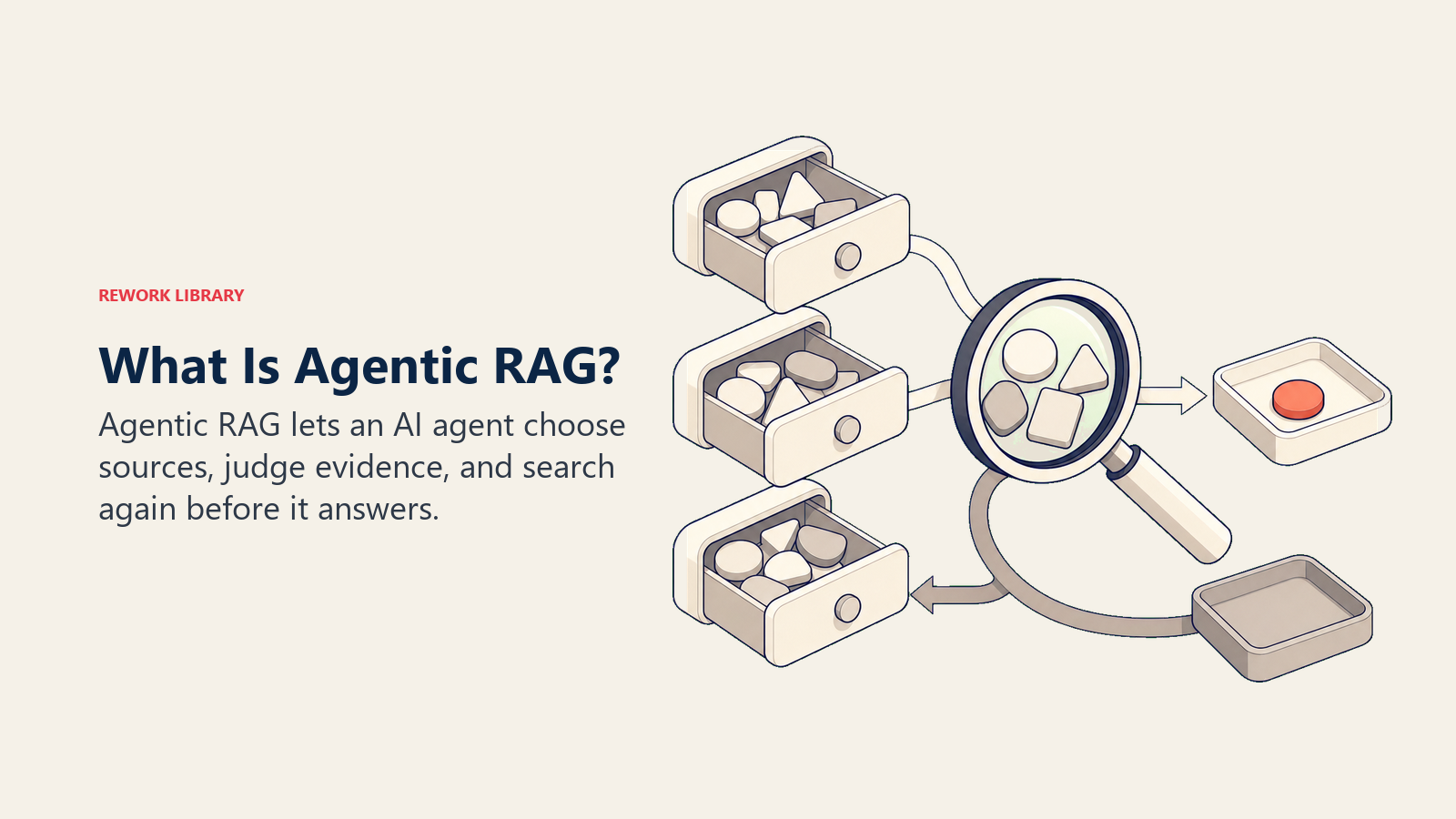
Agentic RAG is retrieval-augmented generation controlled by an AI agent instead of a fixed pipeline: the agent decides when to retrieve, what sources to query, whether the evidence it finds is good enough, and whether to search again before answering, rather than running one lookup and generating a response.
That one change, handing retrieval decisions to a reasoning system instead of a script, is why agentic RAG shows up in the harder enterprise problems: multi-document research, compliance questions that touch several policies at once, and support tickets that need one system checked, then a second one checked against the first.
Agentic RAG vs Traditional RAG: What Actually Changes
Standard Retrieval-Augmented Generation runs a fixed sequence: convert the question into a vector, pull the top-matching chunks from one knowledge base, hand them to the model, generate an answer. It's fast and predictable, and it's also brittle the moment a question needs more than one lookup.
Agentic RAG wraps that same retrieval machinery in a reasoning loop. An AI agent sits in front of the pipeline and makes three decisions a static pipeline can't:
- When to retrieve. Not every question needs a lookup. A simple clarifying question might not, while a multi-part question might need retrieval at each step, not just once at the start.
- What and where to retrieve. The agent can choose between a vector database, a SQL table, an API, or a web search, and it can query more than one source when a single knowledge base won't answer the full question.
- Whether the answer is good enough. After retrieving, the agent evaluates the evidence. If it's thin, contradictory, or off-topic, the agent reformulates the query and retrieves again instead of generating a shaky answer from weak evidence.
That third decision, self-correction, is the practical difference most teams notice first. A traditional RAG system that gets a bad initial retrieval just generates a bad answer with confidence. An agentic RAG system can notice the retrieval was weak and try a different query, a different source, or break the question into smaller pieces before it ever generates a final response.
The Architecture Behind Agentic RAG
Strip away the vendor branding and agentic RAG systems share a common set of parts, most of them familiar from standard RAG, plus a reasoning layer on top.
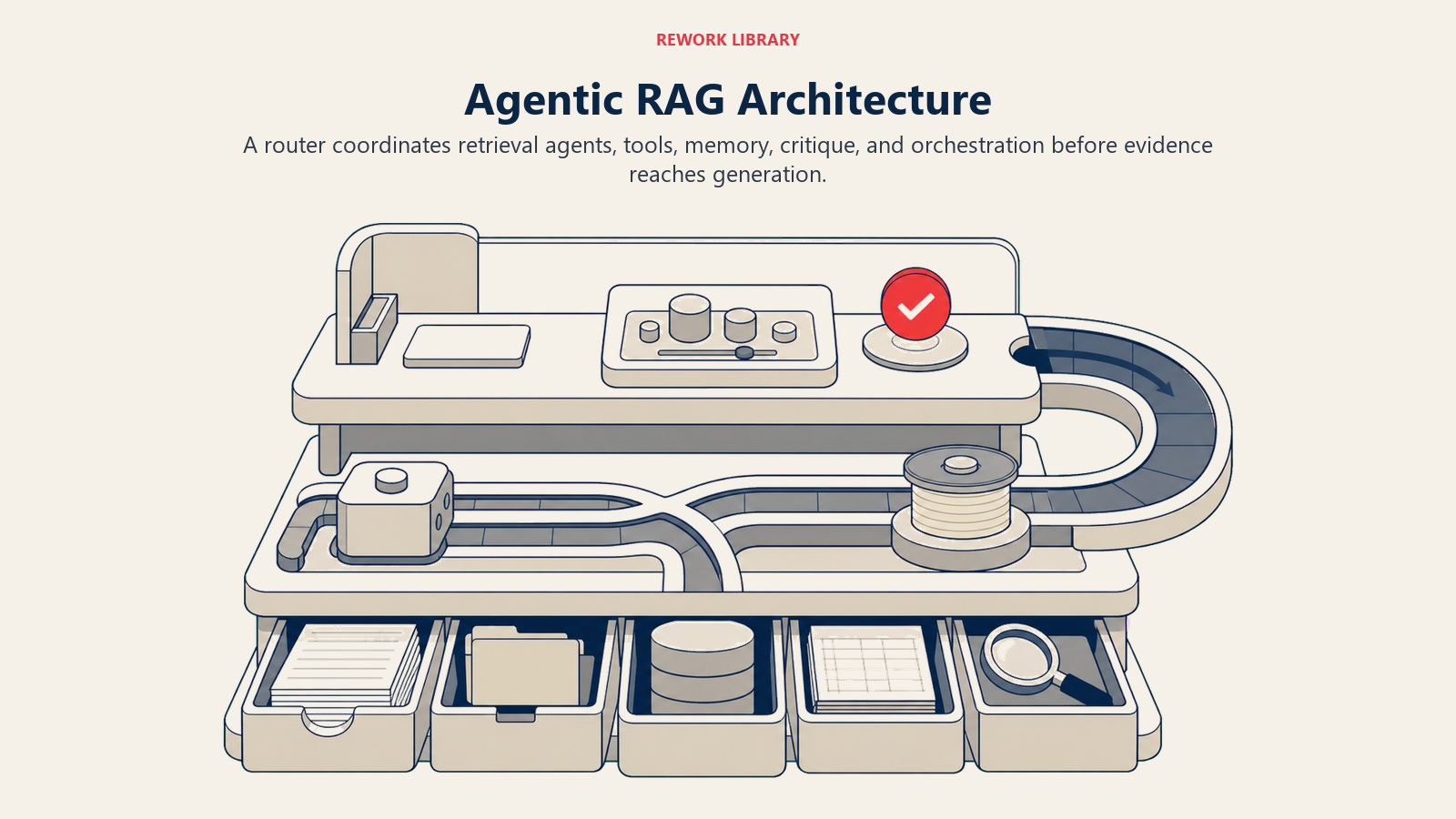
- Query router: The first decision point. It classifies the incoming question and decides whether it needs retrieval at all, which source (or sources) to query, and whether the question should be broken into sub-questions first. This is the piece that doesn't exist in traditional RAG.
- Retrieval agents: Specialized sub-agents, each responsible for one knowledge source, a product documentation vector store, a CRM record lookup, a live web search, a structured database query. The router can call one or several depending on the question.
- Tools: Everything the system can call beyond text search, a calculator for numeric questions, a SQL engine for structured data, a web search API for current events. See tool use for how this works generally in agentic systems.
- Memory: Working memory holds the current question and everything retrieved so far in this session. Longer-term memory, often backed by a vector database, lets the system reuse prior retrievals or remember what worked on similar questions before. See AI memory for the fuller breakdown.
- Critique and self-correction loop: After each retrieval, a review step (sometimes the same model, sometimes a separate one) checks whether the retrieved evidence actually supports an answer. If not, it triggers another retrieval round with a reformulated query, up to a set limit so the system doesn't loop indefinitely.
- Orchestration layer: Coordinates the whole sequence, when to hand off between retrieval agents, when to stop retrieving and generate, when to escalate to a human. This overlaps heavily with general AI orchestration and agentic workflows.
Semantic search and embeddings still do the heavy lifting inside each retrieval step. Agentic RAG doesn't replace that machinery, it decides when and how to point it.
Agentic RAG vs Standard RAG
| Aspect | Standard RAG | Agentic RAG |
|---|---|---|
| Retrieval trigger | Always runs once, on every query | The agent decides if, when, and how many times to retrieve |
| Source selection | Fixed, usually one knowledge base | Agent chooses among multiple sources, or queries several |
| Multi-step questions | Struggles, treats the question as one lookup | Breaks the question into sub-questions and retrieves for each |
| Self-correction | None, generates from whatever was retrieved | Evaluates evidence quality and re-retrieves if it's weak |
| Tool use | Typically none beyond vector search | Can call calculators, SQL engines, APIs, and web search |
| Latency and cost | Low, one retrieval pass | Higher, multiple retrieval and reasoning passes |
| Failure mode | Confidently wrong answer from bad evidence | Slower, but more likely to flag or fix a bad initial retrieval |
| Best fit | Simple Q&A over a single, well-scoped document set | Multi-hop research, cross-system questions, compliance checks |
The practical takeaway: standard RAG is the right default for narrow, well-scoped lookups where speed and cost matter more than handling edge cases. Agentic RAG earns its extra latency and cost on questions that genuinely need more than one lookup or a second opinion on the evidence.
Real 2026 Enterprise Use Cases for Agentic RAG
Financial research: Analysts ask questions that span multiple filings, earnings calls, and market data feeds at once. An agentic RAG system checks each source, cross-references figures, and flags when two sources disagree instead of quietly picking one.
Legal and compliance review: A single compliance question, "does this contract clause conflict with our current data-processing policy", often needs the contract, the policy document, and sometimes a regulatory reference checked against each other. Agentic RAG retrieves from all three and verifies consistency before answering.
Customer support escalation: Support systems route a question to product docs first, then to account-specific data if the docs don't fully answer it, then to a human if neither source resolves it with confidence. That branching logic is exactly what a query router and self-correction loop are built for.
Technical and engineering search: Developers ask questions that span a codebase, internal documentation, and past incident reports. Agentic RAG can query all three and reconcile them rather than returning whichever source happened to rank highest on a single vector search.
Sales and account research: Reps ask for a full picture of a prospect, CRM history, recent news, firmographic data. An agentic RAG system decides which sources are relevant to that specific account and skips the ones that won't add anything.
Benefits and Limitations
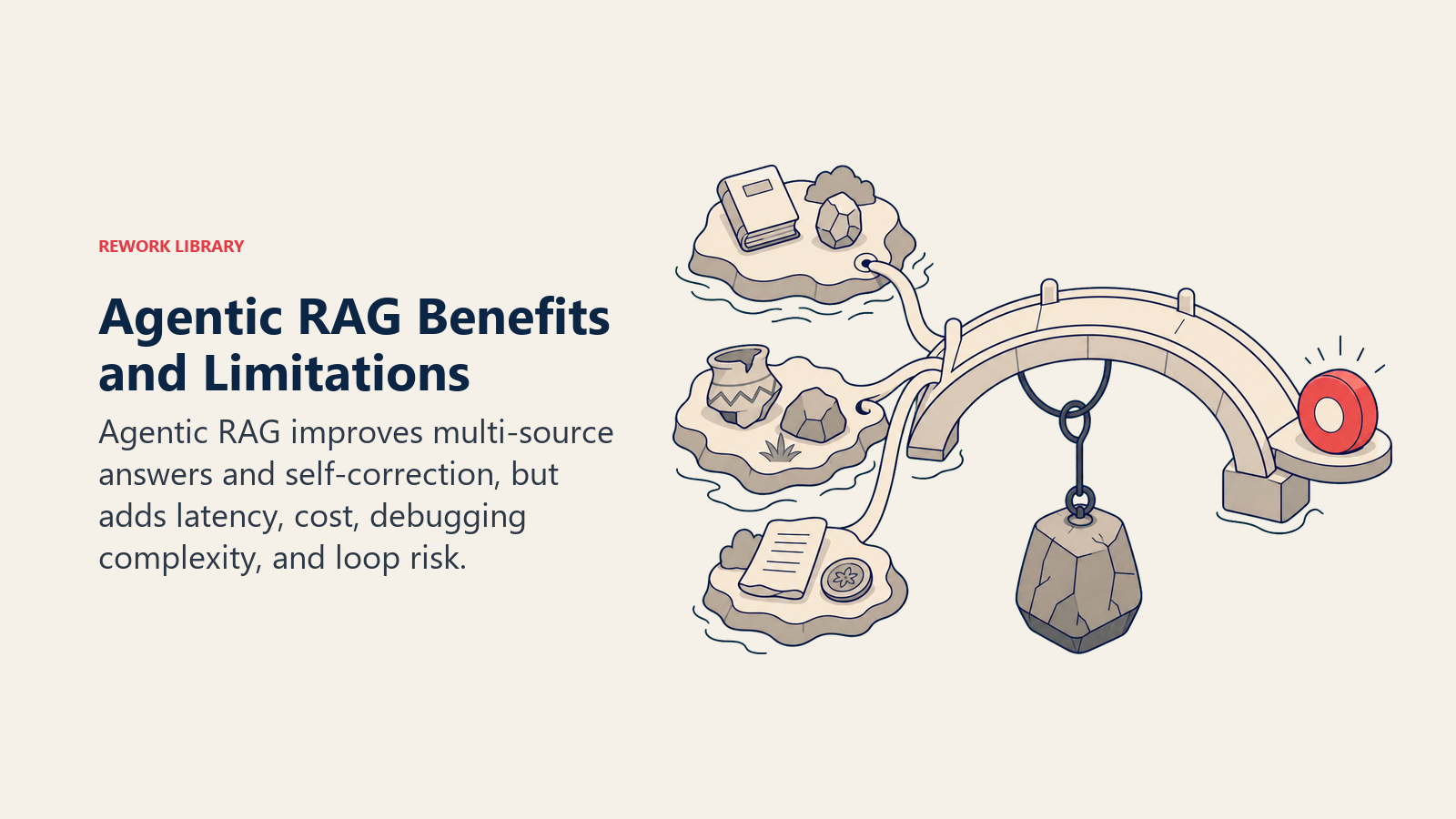
The architecture trades a better chance of finding and checking the right evidence for more moving parts at runtime.
Benefits:
- Handles multi-hop questions that need evidence from more than one source, where standard RAG just returns a partial or wrong answer
- Catches weak or contradictory retrievals before they turn into a confident wrong answer, reducing hallucination risk
- Adapts which source it queries per question, instead of always hitting the same fixed knowledge base
- Scales naturally as more knowledge sources get added, the router just gets another option, not a rebuilt pipeline
Limitations:
- Latency and cost: Multiple retrieval and reasoning passes take longer and cost more per query than a single-shot RAG lookup. Not every use case can absorb that.
- Harder to debug: When a static RAG answer is wrong, the fix is usually one bad chunk. When an agentic RAG answer is wrong, the failure could be in the router, the retrieval, the critique step, or the final generation, which takes more instrumentation to trace.
- Runaway retrieval loops: Without a hard cap on retrieval attempts, a self-correction loop can keep re-querying on a genuinely unanswerable question instead of surfacing that it doesn't have enough evidence.
- Still dependent on source quality: An agent that queries three bad sources instead of one still returns a bad answer. Agentic RAG improves how retrieval decisions get made, not the underlying data quality.
- Overkill for simple lookups: A single-fact question over one clean document set doesn't need a router, a critique loop, or multi-source orchestration. Standard RAG is the better fit there.
Human-in-the-loop checkpoints remain the main safeguard for high-stakes agentic RAG deployments, particularly in compliance and legal use cases where a wrong answer has real consequences.
Key Facts
- 70% of companies using generative AI now layer in tools, retrieval systems, and vector databases rather than relying on off-the-shelf language models alone. Databricks
- Vector database adoption grew 377% year-over-year, the fastest-growing category among all LLM-related technologies tracked. Databricks
- Enterprises moved from single chatbots to coordinated multi-agent systems, which grew 327% in less than four months. Databricks
- Companies with formal AI governance in place put over 12 times more AI projects into production than those without it. Databricks
- Only 16% of enterprise AI deployments (27% at startups) qualify as true agents that plan, execute, observe feedback, and adapt, most are still fixed-sequence or routing-based workflows. Menlo Ventures
- 40% of enterprise applications will include task-specific AI agents by the end of 2026, up from less than 5% in 2025. Gartner
- Over 40% of agentic AI projects will be canceled by the end of 2027 due to escalating costs, unclear business value, or inadequate risk controls, the same discipline gap that trips up ambitious agentic RAG rollouts. Gartner
Frequently Asked Questions about Agentic RAG
What is agentic RAG in simple terms?
Agentic RAG is retrieval-augmented generation where an AI agent, not a fixed script, decides when to search, which sources to search, and whether the evidence it finds is good enough before answering. If the first retrieval falls short, the agent tries again instead of generating from weak evidence.
How is agentic RAG different from traditional RAG?
Traditional RAG runs one retrieval pass per query against a single knowledge base and generates an answer regardless of how good the retrieved evidence is. Agentic RAG can query multiple sources, break a question into sub-questions, evaluate the evidence it gets back, and retrieve again if needed.
Does agentic RAG use more than one knowledge source?
Yes, that's one of its core advantages. A query router can send different parts of a question to different sources, a document store, a database, a live API, and combine what comes back, instead of being locked to one fixed knowledge base like standard RAG.
What is self-correction in agentic RAG?
It's the step where the system checks whether the retrieved evidence actually supports an answer before generating one. If the evidence is thin or contradictory, the agent reformulates its query and retrieves again rather than answering from weak information.
Is agentic RAG slower and more expensive than standard RAG?
Generally yes. Multiple retrieval and reasoning passes take longer and cost more per query than a single-shot lookup. That tradeoff is worth it for multi-hop or high-stakes questions, and usually not worth it for simple single-fact lookups.
What business problems is agentic RAG best suited for?
Questions that need evidence from more than one source, financial research spanning several filings, compliance checks that cross-reference multiple policies, support tickets that need product docs and account data checked together, and technical search across a codebase and its documentation.
What are the main risks of agentic RAG?
Runaway retrieval loops on genuinely unanswerable questions, harder debugging since a wrong answer could trace back to the router, the retrieval, or the critique step, and the fact that querying more sources doesn't fix bad source data in the first place.
Do I need agentic RAG, or is standard RAG enough?
If your questions are narrow and answerable from one well-scoped document set, standard RAG is faster, cheaper, and simpler to maintain. Reach for agentic RAG when questions routinely need more than one lookup or a check against multiple sources before you'd trust the answer.
Related AI Concepts
- Retrieval-Augmented Generation - The retrieval and generation foundation agentic RAG builds on
- What is Agentic AI? - The broader autonomous, goal-directed approach agentic RAG is one application of
- AI Agents - The autonomous systems that make the retrieval decisions in agentic RAG
- Agentic Workflows - How multi-step agent processes get coordinated end to end
- AI Orchestration - Coordinating multiple retrieval agents and tools in sequence
- Vector Databases - The storage layer most retrieval agents query against
- AI Memory - How agentic RAG systems track context across retrieval rounds
- AI Hallucination - The failure mode agentic RAG's self-correction loop is built to catch
External Resources
- Databricks: State of AI Enterprise Adoption and Growth Trends - RAG and vector database adoption data
- Databricks: 2026 State of AI Agents - Multi-agent system growth and governance impact on production deployment
- Menlo Ventures: 2025 State of Generative AI in the Enterprise - True-agent deployment rates in enterprise vs startups
- Gartner: 40% of Enterprise Apps Will Feature Task-Specific AI Agents by 2026 - Enterprise agent adoption forecast
- Gartner: Agentic AI Project Cancellations - Risk and governance context for agentic deployments
Part of the AI Terms Collection. Last updated: 2026-07-16
