What is OpenAI?
Turn this article into takeaways for your work.


Each assistant summarizes the article only for you and suggests best practices for your work.
OpenAI is an AI research and product company, founded in San Francisco in 2015, best known for creating ChatGPT and the GPT family of large language models. It also builds the DALL-E and Sora image and video generation tools, an API that other companies build on, and it operates as a Public Benefit Corporation controlled by a nonprofit foundation, with Microsoft as its largest outside shareholder.
Most people meet OpenAI through ChatGPT, the chatbot that popularized generative AI for a mainstream audience starting in late 2022. But OpenAI itself is bigger than any one product: it's a research lab, a model developer, an API platform other software companies build on, and increasingly a subject of its own governance and safety debates. This article covers what OpenAI is, how it got here, what it sells, and where it fits next to Anthropic and Google.
A Brief History of OpenAI
OpenAI was founded in December 2015 as a nonprofit research lab, with Sam Altman and Elon Musk as co-chairs alongside co-founders including Greg Brockman and Ilya Sutskever. The founders and early backers, including Musk, Altman, Reid Hoffman, and Peter Thiel, pledged roughly $1 billion in funding, with the stated mission of ensuring artificial general intelligence benefits humanity rather than concentrating power in any single company.
Training frontier AI models turned out to cost far more than philanthropic donations could sustain, so in 2019 OpenAI restructured. It created a "capped-profit" subsidiary, OpenAI LP, that could raise investor capital while capping investor returns at a fixed multiple of their original investment. The nonprofit parent kept ultimate control. That same year, Microsoft made its first major investment, eventually committing more than $13 billion across multiple rounds and becoming OpenAI's primary cloud infrastructure partner through Azure.
The company's public profile changed almost overnight in November 2022, when it released ChatGPT as a free research preview. It became the fastest-growing consumer application in history at the time, and it turned "AI chatbot" into something with mainstream reach rather than a demo built for developers.
Governance tension has followed OpenAI's growth. In November 2023, the board briefly fired and then reinstated Altman as CEO after a dispute over transparency with the board, an episode that put OpenAI's unusual nonprofit-over-for-profit structure under public scrutiny. That structure changed again on October 28, 2025, when OpenAI completed a restructuring into the OpenAI Group Public Benefit Corporation (PBC), still controlled by the nonprofit OpenAI Foundation, with Microsoft receiving roughly a 27% equity stake in the new PBC. The restructuring also removed prior caps on OpenAI's fundraising and set the company on a path that observers widely expect leads toward a future public listing.
What OpenAI Makes
OpenAI's product line splits into a few distinct categories: a consumer assistant, a family of underlying models, a developer platform, and a set of agent and generation tools.
ChatGPT. OpenAI's flagship consumer and business product, a conversational assistant built on its GPT models. ChatGPT is available as a free tier and as paid Plus, Pro, Business, and Enterprise plans, with capabilities that now extend well past text chat into file analysis, image generation, web browsing, code execution, and connected apps.
GPT models. The large language models that power ChatGPT and OpenAI's API. OpenAI ships GPT as a family of models rather than a single release: faster, cheaper variants for everyday tasks and slower, more expensive "reasoning" variants that work through harder problems step by step. See reasoning models for how that distinction works technically.
API platform. Developers and businesses can call OpenAI's models directly through an API to build their own products, from customer support bots to document processing pipelines. This is the layer most enterprise software, including many AI copilots built by other vendors, actually runs on. It's also why "OpenAI wrapper" became shorthand for a whole category of startups built on top of the API; see what is an AI wrapper for that debate.
Agents and Operator. OpenAI has pushed beyond chat into AI agents that can take multi-step actions on a user's behalf, such as Operator, a browser-using agent designed to complete tasks like filling out forms or placing orders. This reflects a broader industry shift from AI that answers questions toward AI that uses tools and completes workflows.
Image and video generation. DALL-E generates images from text prompts and is built into ChatGPT. Sora, OpenAI's diffusion-model-based video generator, launched a standalone app in 2024 and a more capable Sora 2 model with synchronized audio in 2025. Worth knowing if you're evaluating it today: OpenAI discontinued the standalone Sora web and mobile app on April 26, 2026, and confirmed the Sora API will be retired on September 24, 2026, after reporting that the app's operating costs far outpaced the revenue it generated. Video generation capability continues to exist within OpenAI's broader model lineup, but the dedicated Sora product is being wound down.
Business and Enterprise Offerings
OpenAI sells to businesses through two channels: ChatGPT seat licenses for teams that want a ready-made assistant, and API access for teams building custom products on top of the models.
On the ChatGPT side, as of mid-2026 the tiers run roughly:
- ChatGPT Plus: around $20/month per individual user, for the fastest models and higher usage limits than the free tier
- ChatGPT Go: an $8/month per-user tier OpenAI introduced in January 2026, positioned below Business for smaller teams
- ChatGPT Business: around $20 to $25/user/month with a small seat minimum, adding admin controls and data protections aimed at small and midsize teams
- ChatGPT Enterprise: roughly $45 to $75/user/month depending on seat count and contract length, typically requiring a 150-seat minimum and an annual commitment, with SSO, higher security guarantees, and dedicated support
On the API side, pricing is usage-based, charged per million tokens processed, and varies significantly by which model tier a business calls. Businesses building agents, copilots, or automated workflows generally pay for API usage directly rather than buying ChatGPT seats, since the API gives more control over what data the model sees and how it's used.
Many business software platforms connect to OpenAI's models under the hood rather than building their own foundation model from scratch, often through OpenAI's API directly or through the Model Context Protocol, the open standard for connecting AI to external tools and data. That's true across the industry, including for some AI features inside work management and CRM platforms like Rework, which is one reason understanding what OpenAI actually is (and isn't) matters even for teams that never touch OpenAI's products directly.
Who Uses OpenAI
OpenAI's user base spans four rough groups. Individual consumers use the free and Plus tiers of ChatGPT for writing, research, coding help, and everyday questions. Developers and startups build products on the API, from customer support tools to specialized vertical applications; this is the group most associated with the "AI wrapper" label. Enterprises deploy ChatGPT Enterprise or custom API integrations for internal productivity, customer-facing tools, and workflow automation, with adoption concentrated in software, financial services, professional services, and media. And researchers and policymakers engage with OpenAI as a subject of study, given its outsized influence on how AI safety, regulation, and labor-market questions are being framed globally.
OpenAI vs Anthropic vs Google
These three labs anchor most enterprise AI purchasing decisions in 2026. Here's how they compare at a glance.
| OpenAI | Anthropic | Google (DeepMind) | |
|---|---|---|---|
| Founded | 2015, San Francisco | 2021, San Francisco (by former OpenAI researchers) | Google Brain and DeepMind merged in 2023; Google itself founded 1998 |
| Flagship consumer product | ChatGPT | Claude (chat and API) | Gemini app |
| Flagship model family | GPT (currently the GPT-5.x series) | Claude (Opus, Sonnet, Haiku tiers) | Gemini (currently the Gemini 3 series) |
| Structure | Nonprofit-controlled Public Benefit Corporation; Microsoft holds roughly 27% | Public benefit corporation; independent, backed by Google and Amazon among others | Wholly owned subsidiary of Alphabet |
| Primary business model | ChatGPT subscriptions + API usage fees | Claude subscriptions + API usage fees, strong enterprise/developer focus | Bundled into Google Workspace, Cloud, and Android; also standalone API |
| Known for | Largest consumer reach, fastest-moving product releases | Emphasis on safety research and enterprise-grade reliability | Deep integration across Google's existing product and cloud ecosystem |
| Primary cloud partner | Microsoft Azure | Amazon Web Services and Google Cloud | Google Cloud (native) |
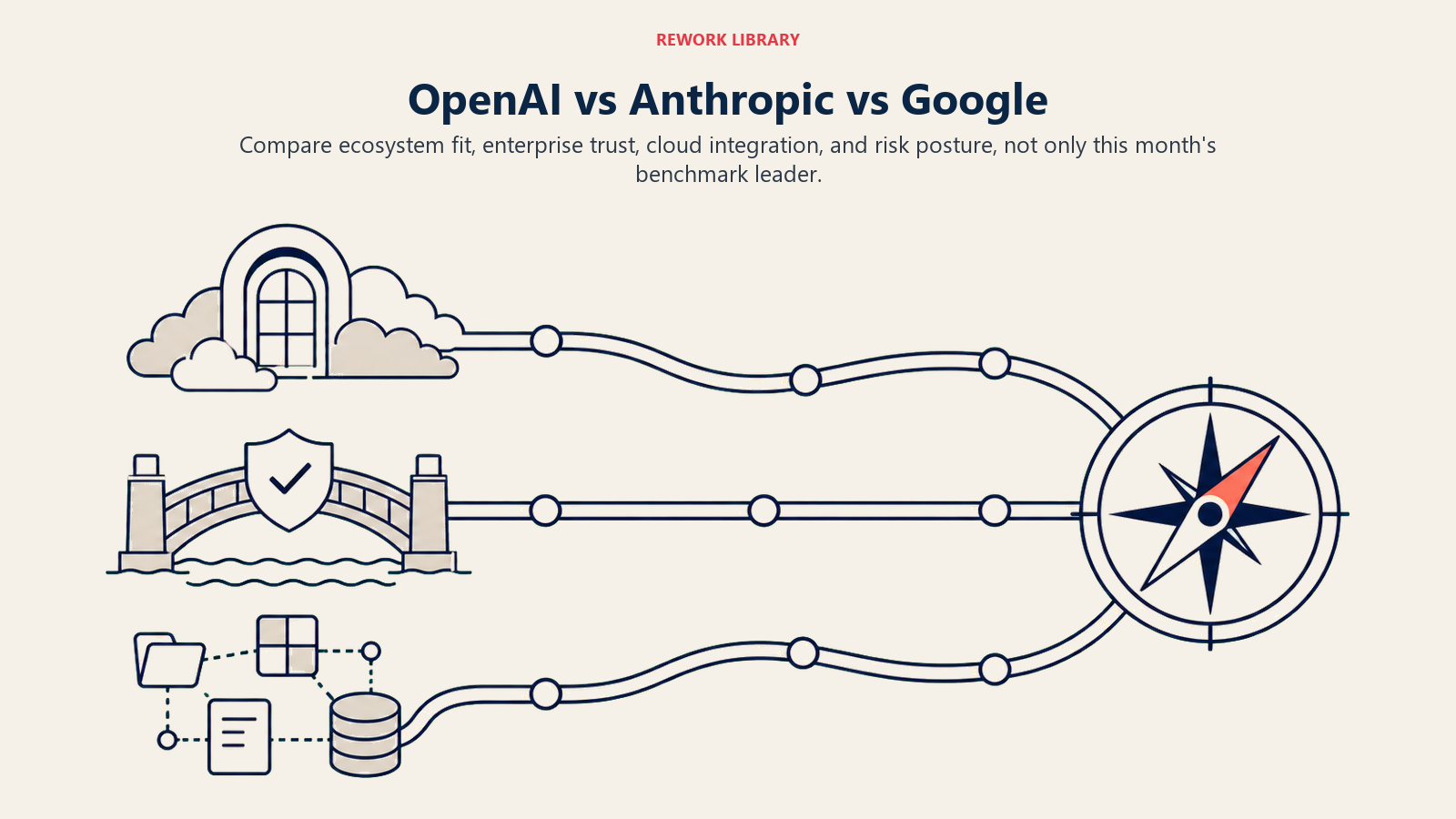
The practical difference for a business buyer is less about which model scores highest on a given benchmark this month, since that leader rotates every few months, and more about integration surface and risk tolerance. Teams already inside Microsoft's ecosystem often default to OpenAI's models via Azure. Teams prioritizing a strong enterprise trust and safety posture frequently evaluate Claude alongside GPT. Teams already deep in Google Workspace or Google Cloud tend to reach for Gemini first because it's already wired into tools they use daily.
Governance and Safety Debates
OpenAI's growth has run alongside a genuinely contested debate about whether its governance structure still matches its original nonprofit mission, and that debate has played out in public far more than at most AI companies.
The clearest flashpoint was Elon Musk's 2024 lawsuit against OpenAI and Altman, alleging the company had abandoned its founding promise to remain a nonprofit dedicated to open, safety-first AI development in favor of a structure that benefits investors and executives. The case went to trial in spring 2026, and on May 18, 2026, a nine-member advisory jury found in OpenAI's favor, ruling that Musk's claims fell outside the statute of limitations rather than ruling on the underlying merits of his argument. Musk said he would appeal.
Separately, OpenAI has faced criticism, including from former employees, over how much weight safety review gets relative to product speed, and several senior researchers focused on long-term AI safety left the company in 2024, publicly citing disagreements over resourcing and priorities. Regulators have taken notice too: Florida's attorney general sued OpenAI and Altman in 2026, alleging the company prioritized profit and growth over the safety commitments it made publicly.
None of this means OpenAI is uniquely unsafe among AI labs. It means OpenAI is the most-watched company in an industry where AI governance and AI safety are still being defined in real time, and its size and consumer reach make its internal decisions a matter of public interest in a way that's less true for smaller labs. For business buyers, the practical takeaway is to evaluate any AI vendor, OpenAI included, on its documented data handling, model behavior guarantees, and incident response record rather than on marketing claims alone.
Key Facts About OpenAI
- ChatGPT reached 900 million weekly active users by February 2026, up from 400 million a year earlier, according to OpenAI's own announcement. Source
- The ChatGPT app crossed 1 billion global monthly active users in June 2026, the fastest app in history to hit that mark, according to market intelligence firm Sensor Tower's estimates. Source
- OpenAI closed a $122 billion funding round at an $852 billion valuation in March 2026, anchored by Amazon, Nvidia, and SoftBank alongside continued Microsoft participation. Source
- OpenAI's annualized revenue exceeded $25 billion by May 2026, up from about $6 billion in 2024. Source
- OpenAI completed its restructuring into a Public Benefit Corporation on October 28, 2025, with Microsoft receiving roughly a 27% equity stake in the new for-profit entity, which remains controlled by the nonprofit OpenAI Foundation. Source
- ChatGPT Enterprise generally requires a 150-seat minimum and an annual contract, with per-seat pricing that OpenAI itself describes as flexible depending on deployment size. Source
- A jury ruled in OpenAI's favor in Elon Musk's lawsuit on May 18, 2026, finding his claims that OpenAI abandoned its nonprofit mission were filed outside the statute of limitations. Source
Frequently Asked Questions about OpenAI
What is OpenAI in simple terms?
OpenAI is an AI research and product company, founded in 2015, that builds ChatGPT, the GPT family of language models, and tools like DALL-E and Sora. It operates as a Public Benefit Corporation controlled by a nonprofit foundation, with Microsoft as its largest outside investor.
Is OpenAI the same thing as ChatGPT?
No. ChatGPT is OpenAI's flagship consumer product, a chat interface built on OpenAI's GPT models. OpenAI is the company; ChatGPT, GPT, DALL-E, Sora, and the developer API are all products OpenAI makes.
Who founded OpenAI, and is it still a nonprofit?
OpenAI was founded in December 2015 by a group including Sam Altman and Elon Musk as co-chairs, along with Greg Brockman, Ilya Sutskever, and other researchers. It started as a pure nonprofit, restructured into a "capped-profit" model in 2019, and completed a further restructuring into a Public Benefit Corporation controlled by a nonprofit foundation in October 2025.
What's the relationship between OpenAI and Microsoft?
Microsoft has invested more than $13 billion in OpenAI since 2019 and serves as its primary cloud infrastructure partner through Azure. Following OpenAI's October 2025 restructuring, Microsoft holds roughly a 27% equity stake in the OpenAI Group Public Benefit Corporation.
How does OpenAI make money?
Primarily through ChatGPT subscriptions (Plus, Go, Business, and Enterprise tiers) and usage-based fees for its API, which developers and businesses pay to build products on top of OpenAI's models. OpenAI's annualized revenue exceeded $25 billion by May 2026.
Is OpenAI a public company?
Not yet. OpenAI's October 2025 restructuring removed prior caps on its fundraising and is widely viewed as a step toward an eventual public listing, but as of mid-2026 it remains privately held, most recently valued at $852 billion.
How is OpenAI different from Anthropic and Google?
OpenAI, Anthropic, and Google (through DeepMind) all build competing large language models and chat assistants. OpenAI has the largest consumer user base through ChatGPT. Anthropic, founded by former OpenAI researchers, emphasizes safety research and enterprise reliability with its Claude models. Google integrates its Gemini models directly into Workspace, Cloud, and Android at a scale only Google's existing distribution can match.
Why is OpenAI's governance structure controversial?
OpenAI began as a nonprofit dedicated to safe, broadly beneficial AI, then restructured twice, first into a capped-profit model in 2019 and then into a Public Benefit Corporation in 2025, each time raising questions about whether the company still prioritizes its founding mission over investor returns. Elon Musk sued over exactly this question in 2024; a jury ruled in OpenAI's favor in May 2026 on procedural grounds without addressing the underlying claims.
What happened to Sora, OpenAI's video generator?
OpenAI launched Sora as a standalone app in 2024 and released the more capable Sora 2 with synchronized audio in 2025. In 2026, OpenAI discontinued the standalone Sora app (April 26) and announced the Sora API would be retired (September 24), citing operating costs that far outpaced the revenue the product generated.
Learn More
- Large Language Models - The underlying technology behind GPT and every other major chat assistant
- Generative AI - The broader category of AI that creates original content, which OpenAI's products sit inside
- AI Agents - How tools like Operator move beyond chat into taking multi-step actions
- Reasoning Models - The technical distinction behind GPT's faster and slower "thinking" model tiers
- Model Context Protocol - The open standard, co-founded by OpenAI, for connecting AI models to business tools
- What is an AI Wrapper? - Why so many startups are built directly on OpenAI's API
- AI Governance - The organizational frameworks companies use to manage AI risk, the debate at the center of OpenAI's own structure
- AI Safety - The research field at the heart of the criticism OpenAI has faced from former employees and regulators
- Foundation Models - The category of large, general-purpose models that GPT belongs to
External Resources
- TechCrunch: ChatGPT Reaches 900M Weekly Active Users - Source of the February 2026 weekly active user milestone
- CNBC: OpenAI Closes Funding Round at $852 Billion Valuation - Details on the March 2026 funding round and investors
- CNBC: OpenAI Completes Restructure, Microsoft Takes Stake - Coverage of the October 2025 Public Benefit Corporation restructuring
- NPR: Jury Dismisses Elon Musk's Lawsuit Against Sam Altman - Outcome of the Musk v. Altman trial
- OpenAI Help Center: Flexible Pricing for Enterprise, Edu, and Business Plans - OpenAI's own explanation of its business pricing tiers
- Wikipedia: OpenAI - Background on OpenAI's founding, founders, and early structure
