What is ElevenLabs?
Turn this article into takeaways for your work.


Each assistant summarizes the article only for you and suggests best practices for your work.
ElevenLabs is an AI voice technology company that builds text-to-speech, voice cloning, dubbing, and conversational AI agent tools for generating realistic, human-sounding speech in dozens of languages. Founded in 2022, the company reached an $11 billion valuation in early 2026, and its voice models now power products at Fortune 500 enterprises, media companies, and independent creators alike.
That one paragraph covers the core idea, but ElevenLabs has grown from a text-to-speech demo into a multi-product voice platform in just a few years. This guide covers who built it and how it's funded, what it actually does today, current pricing, how businesses use it, the consent and safety questions that come with voice cloning, and how it compares to other AI voice platforms.
Background: From Weekend Project to $11 Billion Company
ElevenLabs was started in April 2022 by Piotr Dąbkowski, a former Google machine learning engineer, and Mati Staniszewski, a former Palantir deployment strategist. Both are Polish, and the two began the project as a side effort focused on a specific frustration: AI-dubbed movies and shows that lost the original actor's tone and emotion in translation. That early focus on emotionally expressive, natural-sounding speech became the company's core differentiator.
The company's funding history moved quickly once it caught investor attention:
| Round | Date | Amount | Valuation |
|---|---|---|---|
| Series A | June 2023 | $19 million | Approximately $100 million |
| Series B | January 2024 | $80 million | $1.1 billion |
| Series C | January 2025 | $180 million | $3.3 billion |
| Series D | February 2026 | $500 million | $11 billion |
The Series D, led by Sequoia Capital with existing backers Andreessen Horowitz and ICONIQ Capital increasing their stakes, brought ElevenLabs' total funding to $781 million across five rounds since its 2022 founding, according to TechCrunch. The company is headquartered in New York City, with a European base in London and additional offices in Warsaw, San Francisco, Bangalore, and Tokyo.
Key Facts: ElevenLabs
- ElevenLabs raised a $500 million Series D in February 2026 at an $11 billion valuation, more than triple its valuation a year earlier, bringing total funding to $781 million across five rounds, according to TechCrunch and ElevenLabs' own announcement.
- At the time of the Series D announcement, ElevenLabs disclosed annual recurring revenue of more than $330 million as of the end of 2025, per ElevenLabs' official Series D blog post.
- By May 2026, industry reporting put ElevenLabs' ARR above $500 million, up from roughly $350 million at the end of 2025, according to The AI Insider.
- At its Series C announcement in January 2025, ElevenLabs said employees at over 60% of Fortune 500 companies were using its platform and API, according to ElevenLabs' Series C blog post.
- More than 250,000 conversational AI agents were built on ElevenLabs' platform within two months of that product's launch, per the same Series C announcement.
- ElevenLabs' Dubbing product had localized more than 1 million hours of audio content into other languages as of January 2025, according to ElevenLabs' Series C blog post.
- ElevenLabs' pricing runs from a free tier with 10,000 monthly credits to a Business plan at $990/month with 6 million credits and 10 seats, per ElevenLabs' official pricing page.
- Named enterprise customers disclosed in the Series D announcement include Deutsche Telekom, Square, Revolut, Duolingo, NVIDIA, TIME, Meta, Epic Games, Salesforce, and the Ukrainian government, per ElevenLabs' Series D blog post.
What ElevenLabs Actually Does
ElevenLabs is a suite of voice products built on the same underlying models and the same account, rather than a single tool. The main pieces are:
Text-to-Speech (TTS). Converts written text into natural-sounding speech using a library of stock voices spanning dozens of languages and accents, plus adjustable settings for tone, pacing, and emphasis. This is the original product and still the entry point for most users, whether they're narrating a video, building an app feature, or generating audio for generative AI content pipelines.
Voice Cloning. Two tiers exist: Instant Voice Cloning, which recreates a voice from a short audio sample for personal or lower-stakes use, and Professional Voice Cloning, which requires identity and consent verification and produces higher-fidelity clones cleared for commercial use.
Dubbing Studio. Takes a video or audio file and translates and re-voices it into another language while preserving the original speaker's tone and timing, aimed at localizing content without a full re-recording process.
Conversational AI (ElevenAgents). A platform for building real-time voice agents that can hold a phone or app-based conversation, similar in category to the AI voice agents space more broadly. This is billed by the minute rather than by character, since agents run live conversations instead of generating a fixed script.
Eleven Music. A newer product for generating original music tracks from a text prompt, extending the platform beyond speech into a broader audio-generation category.
ElevenReader and Voice Library. ElevenReader is a consumer app that reads articles, PDFs, and ebooks aloud using ElevenLabs voices. The Voice Library is a marketplace where voice actors and creators can license their cloned voices to other users, with ElevenLabs reporting more than $2 million paid out to voice creators through the program.
Under the hood, all of these products run on the same conversational AI and speech-synthesis research, and a single ElevenLabs account and credit pool covers text-to-speech, cloning, dubbing, and agent minutes together.
ElevenLabs Pricing in 2026
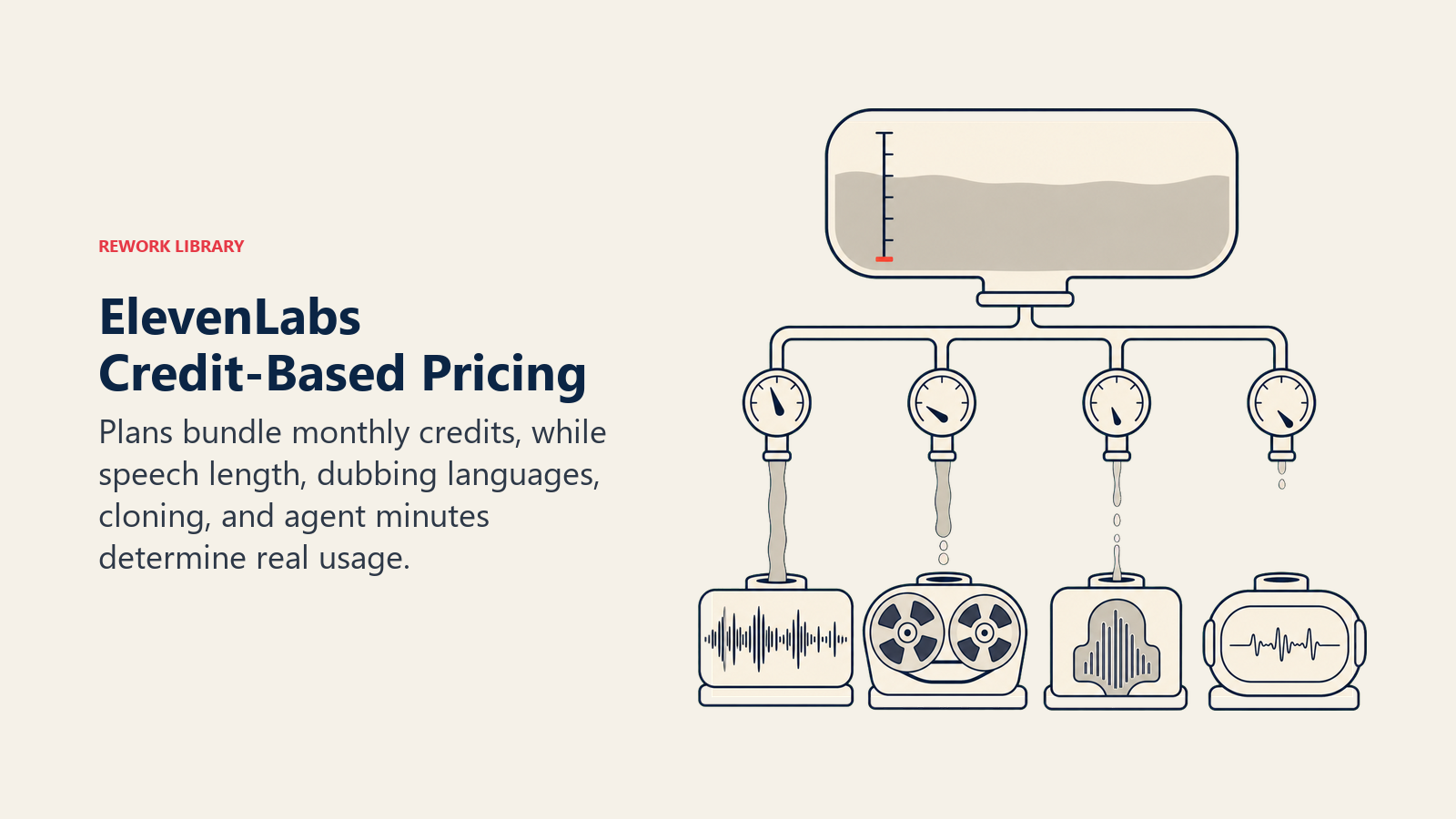
ElevenLabs prices its consumer and team plans through a monthly credit allowance, where credits are consumed differently depending on the product (roughly 1 credit per character for standard text-to-speech, more for dubbing and professional cloning, and per-minute billing for conversational agents). As of July 2026, the published plans are:
| Plan | Price | Credits | What's Included |
|---|---|---|---|
| Free | $0 | 10,000/month | Basic text-to-speech, speech-to-text, sound effects, voice design |
| Starter | $6/month | 30,000/month | Commercial license, instant voice cloning |
| Creator | $22/month | 121,000/month | Professional Voice Cloning, everything in Starter |
| Pro | $99/month | 600,000/month | Higher audio quality (up to 192kbps), advanced API access |
| Scale | $299/month | 1,800,000/month | 3 workspace seats, multiple professional voice clones |
| Business | $990/month | 6,000,000/month | 10 workspace seats, team collaboration tools |
| Enterprise | Custom | Custom | Custom DPA/SLA terms, BAAs for HIPAA customers, priority support |
Source: ElevenLabs' official pricing page. Annual billing brings a discount of roughly 17% off the monthly rate. ElevenLabs also runs a startup grants program offering up to 12 months of free access to companies building on its conversational AI platform. For a broader look at how ElevenLabs' pricing compares to the rest of the category, see best AI voice generators in 2026, which tracks pricing across 14 vendors.
Weighing ElevenLabs against other voice tools on cost alone misses the bigger picture, though: for teams evaluating a real deployment, credit usage scales quickly with script length and language count, so it's worth running an AI total cost of ownership estimate against actual projected volume before committing to a tier.
How Businesses Use ElevenLabs
ElevenLabs' named enterprise customers span a wide range of industries rather than one clear vertical. Deutsche Telekom and Square represent telecom and fintech customer experience use cases. Revolut and Duolingo point to fintech and edtech products embedding voice into their own apps. TIME and Epic Games represent media and gaming, where voice generation supports narration and localized content at scale. Salesforce, NVIDIA, and Meta reflect enterprise software companies building voice features into their own platforms. The Ukrainian government is also a named customer, using the technology for public communications, according to ElevenLabs' Series D announcement.
In practical terms, the recurring business patterns across these deployments fall into a handful of categories:
Content localization. Dubbing marketing videos, courses, or media into multiple languages without hiring voice actors and re-recording in each market.
Customer experience and support. Building conversational voice agents that handle routine calls or in-app voice interactions, a use case that overlaps with call analytics once transcripts start feeding back into coaching and forecasting workflows.
Accessibility and content consumption. Reading articles, documents, and books aloud for users who prefer or need audio, the core use case behind ElevenReader.
Product voice features. Embedding natural speech generation directly into an app or device, from language-learning apps to enterprise software assistants.
Media and entertainment production. Narration, character voices, and audio content production at a volume that would be costly with traditional voice talent alone.
Voice Cloning Ethics, Safety, and Consent
Voice cloning raises a real risk that doesn't exist with plain text-to-speech: the ability to convincingly impersonate a specific, identifiable person. ElevenLabs has a documented history with this problem. In January 2023, shortly after the company released a public beta of its voice generator, users on 4chan used the tool to clone the voices of celebrities including Emma Watson and Joe Rogan and generate offensive audio, including one clip of a synthetic Emma Watson voice reading a passage from Mein Kampf, according to Vice. ElevenLabs said at the time it was adding safeguards in response.
Since then, ElevenLabs' published safety policy describes several measures built into the product: blocking the cloning of celebrity and other high-risk voices by default, requiring identity and consent verification before granting access to Professional Voice Cloning, introducing "no-go voices" that block the creation of AI clones mimicking active political candidates in certain jurisdictions, and content moderation intended to catch misuse after the fact. The company's terms of service prohibit cloning someone's voice without their consent, using a cloned voice to harass or deceive, or misrepresenting AI-generated audio as human-recorded.
This sits inside a broader regulatory shift the whole voice AI category has had to respond to. The FTC's Impersonation Rule, finalized in 2024, bans using a cloned voice to sell something without the real person's consent. Tennessee's ELVIS Act, also 2024, made unauthorized commercial voice cloning a civil and criminal offense, and California, New York, and Illinois have since passed similar consent laws. The federal TAKE IT DOWN Act, signed in May 2025, created the first nationwide takedown framework for non-consensual synthetic media. See best AI voice generators in 2026 for a fuller breakdown of how these laws affect buyers across the category, not just ElevenLabs.
For a business evaluating ElevenLabs, the practical takeaway is straightforward: document consent before cloning any real person's voice, keep records of that consent (use case, duration, and platforms specified), and treat responsible AI practices around synthetic voice the same way you would treat any other identity-sensitive data.
ElevenLabs vs Other AI Voice Platforms
ElevenLabs competes with both broad TTS providers and platforms built for a narrower use case. Here's how the main options differ:
| Platform | Primary focus | Model approach | Best fit |
|---|---|---|---|
| ElevenLabs | Broadest voice cloning, TTS, dubbing, and conversational agents in one account | Proprietary voice models, built voice-first | Teams needing multiple voice use cases (cloning, dubbing, agents) under one platform |
| Murf AI | Corporate voiceover and e-learning narration | Licensed voice library with a timeline editor | L&D and marketing teams producing narrated video without a dedicated audio editor |
| PlayHT / Cartesia | Low-latency streaming for real-time voice agents | API-first, optimized for conversational latency | Developers building voice agents where response speed matters most |
| Resemble AI | Real-time cloning with built-in deepfake detection | Consumption-based, includes audio watermarking | Security and trust-and-safety teams that need to verify synthetic audio provenance |
| OpenAI TTS | Developer-first, instructable voice generation | Third-party model layered into the broader OpenAI ecosystem | Developers already building on OpenAI's API who want voice as one more model call |
ElevenLabs' pitch is breadth: one account and one credit pool covering cloning, dubbing, TTS, and agents, instead of stitching together separate vendors for each use case. That's worth weighing against a narrower, purpose-built tool as part of a full AI vendor evaluation that also checks latency, language coverage, and consent workflows against your specific use case.
Limitations to Know
The main trade-offs emerge when teams move from a voice prototype to sustained production use.
- Credit consumption scales fast. Long scripts, multilingual dubbing, and high-volume conversational agent minutes all draw down credits quickly, and teams that underestimate usage often find themselves upgrading a tier sooner than planned.
- Professional cloning requires verification. The stricter identity and consent checks that make Professional Voice Cloning safer also add friction and lead time compared to instant cloning.
- Not the cheapest option at raw API scale. For high-volume, low-emotion TTS use cases like automated notifications, providers such as Amazon Polly or Google Cloud TTS price lower per character than ElevenLabs.
- Ongoing legal and reputational exposure. As the category leader, ElevenLabs remains a frequent subject of misuse cases and regulatory scrutiny simply due to its scale and voice quality, which businesses should factor into any public-facing deployment.
- No published enterprise pricing. Business and Enterprise tiers above the self-serve plans require a custom quote, making early budgeting harder than with a flat-rate competitor.
Frequently Asked Questions about ElevenLabs
What is ElevenLabs used for?
ElevenLabs is used to generate realistic AI speech for text-to-speech narration, clone a specific voice for reuse, dub video and audio into other languages, build conversational voice agents, and generate AI music, all from one platform and account.
Who founded ElevenLabs and when?
ElevenLabs was founded in April 2022 by Piotr Dąbkowski, a former Google machine learning engineer, and Mati Staniszewski, a former Palantir deployment strategist. Both are Polish, and the project began as a side effort focused on more natural-sounding AI dubbing.
How much is ElevenLabs worth?
ElevenLabs was valued at $11 billion after a $500 million Series D funding round in February 2026, led by Sequoia Capital. That's more than triple its $3.3 billion valuation from its Series C round just over a year earlier.
How much does ElevenLabs cost?
As of July 2026, ElevenLabs offers a free plan with 10,000 monthly credits, paid plans from $6/month (Starter) up to $990/month (Business, 10 seats), and custom Enterprise pricing. Pricing is credit-based, with different products consuming credits at different rates.
Is ElevenLabs voice cloning legal?
Voice cloning itself is legal, but using a cloned voice without the real person's documented consent can violate the FTC's Impersonation Rule and state laws like Tennessee's ELVIS Act. ElevenLabs requires identity and consent verification for its Professional Voice Cloning tier and blocks cloning of many public figures by default.
What is the difference between ElevenLabs and AI voice agents in general?
AI voice agents are the broader category of phone- or app-based systems that hold real-time spoken conversations. ElevenLabs' Conversational AI (ElevenAgents) product is one platform for building those agents, alongside its separate text-to-speech, voice cloning, and dubbing products.
What companies use ElevenLabs?
Named enterprise customers disclosed in ElevenLabs' Series D announcement include Deutsche Telekom, Square, Revolut, Duolingo, NVIDIA, TIME, Meta, Epic Games, Salesforce, and the Ukrainian government, spanning telecom, fintech, edtech, media, gaming, and enterprise software.
How is ElevenLabs different from Murf, PlayHT, or Resemble AI?
ElevenLabs covers the broadest set of use cases (cloning, dubbing, TTS, and conversational agents) in one account. Murf focuses on corporate voiceover with a built-in video editor, PlayHT and Cartesia focus on low-latency streaming for voice agents, and Resemble AI adds built-in deepfake detection alongside cloning.
Related AI Concepts
- AI Voice Agents - The broader category of phone- and app-based AI that ElevenLabs' Conversational AI product belongs to
- Conversational AI - The underlying field of natural-language dialogue systems powering ElevenLabs' agents
- What is PolyAI? - An enterprise voice AI company focused specifically on call center agents, a narrower use case than ElevenLabs' full platform
- Generative AI - The underlying technology category behind ElevenLabs' speech and music generation
- Human-in-the-Loop - How voice agent deployments decide when to escalate to a person
- Responsible AI - The governance practices relevant to consent and voice cloning
- Dialogue Design - Principles for designing the conversation flows ElevenLabs' agents run
- Call Analytics - Turning voice agent transcripts and outcomes into business insight
- AI Vendor Evaluation - A framework for comparing ElevenLabs against other voice AI vendors
- AI Total Cost of Ownership - Modeling ElevenLabs' credit-based pricing against real usage volume
- What is OpenAI? - The company behind the competing TTS models referenced in this article's comparison table
External Resources
- Best AI Voice Generators in 2026 - A 14-tool comparison of ElevenLabs against Murf, PlayHT, Resemble AI, and other voice generators, with verified pricing
- Best AI Tools for Customer Support in 2026 - Where voice-first platforms like ElevenLabs fit alongside text and ticketing-based AI support tools
- ElevenLabs - Official company site
- ElevenLabs: Series D Announcement - Funding, valuation, ARR, and named customers
- ElevenLabs: Series C Announcement - Fortune 500 adoption and product usage stats
- ElevenLabs Pricing - Official, current plan pricing and credit allowances
- ElevenLabs Safety - The company's published voice cloning safeguards and consent policy
- TechCrunch: ElevenLabs Raises $500M From Sequoia at an $11 Billion Valuation - Independent reporting on the Series D round
- Vice: AI-Generated Voice Firm Clamps Down After 4chan Makes Celebrity Voices for Abuse - Reporting on ElevenLabs' 2023 voice cloning misuse incident
Part of the AI Terms Collection. Last updated: 2026-07-20

Co-Founder, Rework.com