What is Generative AI? Your AI Creative Department
Turn this article into takeaways for your work.


Each assistant summarizes the article only for you and suggests best practices for your work.
What if you had a creative team that never sleeps, generates unlimited ideas, and works at the speed of thought? Generative AI makes this reality, creating original content from marketing copy to product designs on demand. It's not just automation: it's innovation at scale.
The Rise of Creative AI
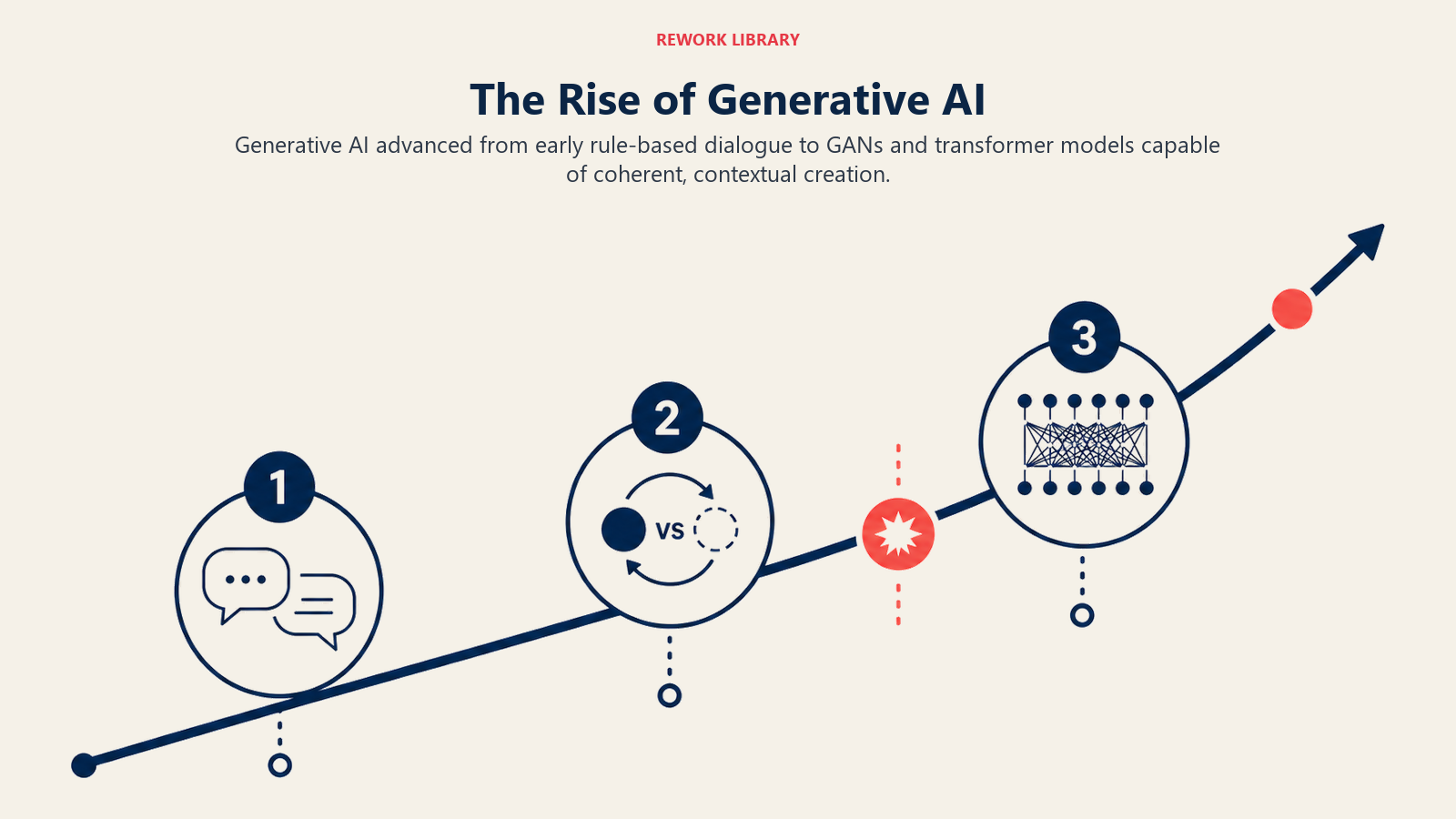
Generative AI's roots trace to the 1960s with early chatbots like ELIZA, but the modern era began with Ian Goodfellow's 2014 invention of Generative Adversarial Networks (GANs). The field exploded with transformer architectures in 2017.
According to Stanford's AI Index, generative AI is defined as "artificial intelligence capable of generating new content that resembles human-created content, learning patterns from training data to produce novel outputs rather than simply analyzing or categorizing existing information."
The breakthrough came with OpenAI's GPT series and other large language models, which demonstrated that AI could create coherent, contextual, and creative content indistinguishable from human work.
What Changed in 2026
Generative AI stopped being a single-prompt-in, single-output-out tool. By mid-2026, the frontier models (OpenAI's GPT-5.6 family, Anthropic's Claude Sonnet 5 and Claude Fable 5, Google's Gemini 3.1) generate text, code, and images inside the same conversation, and video generation moved from experimental demo to a production tool with Google's Veo 3.1 leading after OpenAI retired Sora 2 in April 2026.
The bigger shift is agentic. Generative AI used to stop at producing a draft for a human to review. Now it increasingly plans a sequence of steps, calls tools, checks its own output, and only asks for help when a decision falls outside what it's allowed to do. Gartner expects 40% of enterprise applications to include task-specific AI agents by the end of 2026, up from under 5% in 2025 (see Key Facts below). Generative models still do the "creating," but they're now one component inside a larger system that also plans and executes. For the deeper mechanics of that shift, see What is Agentic AI?
Key Facts
- 70% of organizations now use generative AI in at least one business function, and 88% use AI in some form, up sharply from a few years ago. Stanford HAI AI Index 2026
- 71% of organizations say they regularly use generative AI in at least one business function, up from 65% in early 2024 and just 37% in 2023, though only about 7% have scaled it enterprise-wide. McKinsey State of AI
- Generative AI reached 53% global population adoption within three years, faster than the personal computer or the internet. Stanford HAI AI Index 2026
- Measured productivity gains from generative AI use: 14 to 15% in customer support, 26% in software development, and 50% in marketing output, with smaller gains on tasks that need deep reasoning. Stanford HAI AI Index 2026
- Enterprise generative AI investment hit $37 billion in 2025, nearly tripling from $11.5 billion in 2024, with at least 10 gen AI products now generating over $1 billion in annual recurring revenue. Menlo Ventures
- Gartner predicts 40% of enterprise applications will include task-specific AI agents by the end of 2026, up from less than 5% in 2025, as generative AI shifts from single-prompt output to multi-step execution. Gartner
Practical Business Impact
For business leaders, generative AI means having an infinitely scalable creative and knowledge workforce that produces original content (text, images, code, designs) based on simple instructions.
Think of generative AI as a universal creator. Just as a skilled employee can write reports, design graphics, or code solutions, generative AI does all of this simultaneously, learning your style and improving with feedback.
In practical terms, this transforms content production from a bottleneck to a competitive advantage, enabling personalization at scale and rapid experimentation.
Five Core Components
Generative AI consists of these essential elements:
• Foundation Models: Pre-trained neural networks with broad knowledge, like the GPT-5.6, Claude Sonnet 5, and Gemini 3.1 families for text and code, or Veo for video, providing the base intelligence
• Prompt Interface: The instruction system where users describe desired outputs in natural language, the "creative brief" for AI
• Generation Engine: Algorithms that create new content by predicting patterns, combining learned elements in novel ways
• Feedback Mechanism: Systems for refining outputs through iteration, incorporating user preferences and quality standards
• Output Filters: Safety and quality controls ensuring appropriate, accurate, and brand-aligned content
The Generation Process
The generative AI process follows these steps:
Prompt Processing: User provides instructions in natural language like "Write a product description for eco-friendly sneakers targeting millennials"
Pattern Application: AI accesses its training to understand context, style, and requirements, drawing on millions of examples to inform creation
Content Generation: The model produces original output by predicting what should come next, creating unique combinations while maintaining coherence
This isn't copying; it's creating new content based on learned patterns, like how human creators draw inspiration from experience.
Four Generation Categories
Generative AI generally falls into four main categories. In 2026, the frontier models increasingly blend two or three of these in one system (a single chat model that writes text, generates an image, and narrates it), but the categories still matter for choosing the right tool for a specific job.
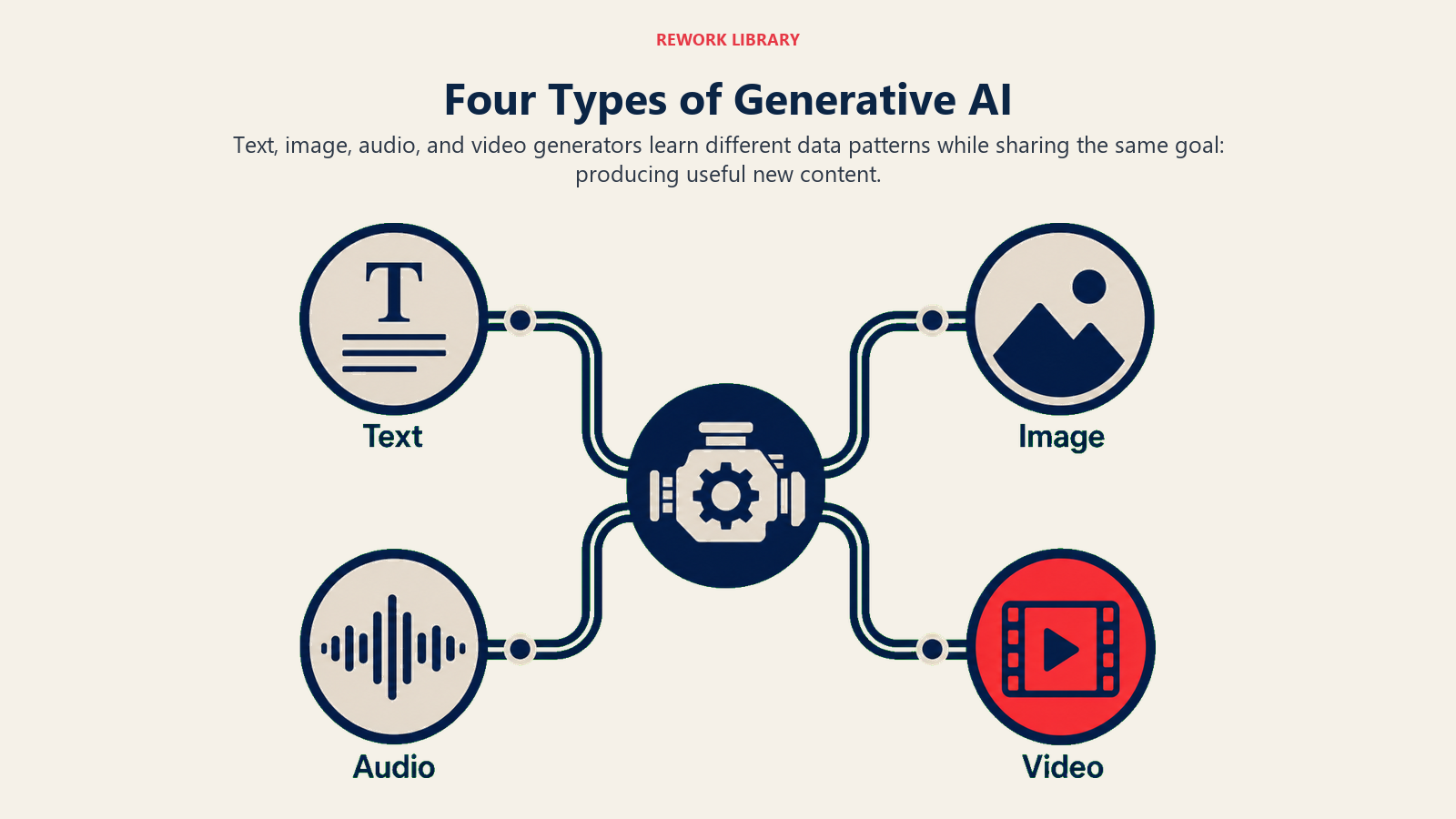
Type 1: Text Generation Best for: Content writing, code generation, translation Key feature: Creates human-like text in any style or format using natural language processing Example: ChatGPT (GPT-5.6), Claude (Sonnet 5, Fable 5 for coding), Gemini, marketing copy generators
Type 2: Image Generation Best for: Visual content, design, product mockups Key feature: Creates images from text descriptions using computer vision techniques Example: DALL-E, Midjourney, Stable Diffusion, plus native image generation built into chat models like GPT and Gemini
Type 3: Audio Generation Best for: Music, voice synthesis, sound effects Key feature: Creates original audio content Example: Voice cloning, music composition AI
Type 4: Video Generation Best for: Marketing videos, training content Key feature: Creates moving images from prompts, now production-ready rather than experimental Example: Google Veo, Runway, Synthesia (OpenAI retired Sora 2 in April 2026, leaving Veo as the leading general-purpose video model)
Generative AI at Work
Here's how businesses actually use generative AI:
Marketing Example: Coca-Cola's "Create Real Magic" platform used generative AI to produce personalized, culturally relevant ad variations at scale, drawing over 120,000 user-generated creations and a reported drop in content production time of roughly 40%.
E-commerce Example: Online sellers increasingly use generative AI to draft product descriptions, creating unique copy for large catalogs that improves search visibility and, in many cases, lifts conversion versus generic template copy.
Software Example: 51% of developers now use AI coding tools every working day, and GitHub Copilot alone generates an average of 46% of the code written by active users. GitHub Octoverse 2025
Start Creating
Ready to harness generative AI for your business?
- Understand the foundation with Large Language Models
- Explore Prompt Engineering for better results
- Learn about Fine-tuning to customize models for your needs
- Discover AI Automation strategies for implementation
Frequently Asked Questions about Generative AI
What is Generative AI?
Generative AI is artificial intelligence that creates new, original content (text, images, code, audio, video) by learning patterns from training data and combining them in novel ways based on user prompts. As of 2026, 70% of organizations use it in at least one business function.
What's the difference between Generative AI and traditional AI?
Traditional AI analyzes and categorizes existing information to make predictions. Generative AI creates entirely new content that didn't exist before, like writing original articles or creating unique images.
What are the four types of content Generative AI can create?
Text Generation (articles, code, translations), Image Generation (artwork, designs, photos), Audio Generation (music, voice, sound effects), and Video Generation (animations, synthetic media). In 2026, many frontier models handle two or three of these types inside one system rather than staying siloed.
What is a foundation model in Generative AI?
A foundation model is a large, pre-trained neural network, like the GPT-5.6, Claude Sonnet 5, or Gemini 3.1 families, that serves as the base intelligence for generating specific types of content, which can be fine-tuned or connected to tools for particular tasks.
How is Generative AI different from Agentic AI in 2026?
Generative AI produces a single output, like a paragraph or an image, from a single prompt for a person to review. Agentic AI takes a goal, breaks it into steps, and uses generative AI as one component while it plans, calls tools, checks its own work, and executes across multiple systems with less human review at each step.
Related Resources
Explore these related AI concepts to deepen your understanding:
- Deep Learning - The neural network approach powering generative AI
- Transfer Learning - How models apply knowledge across domains
- AI Ethics - Responsible considerations for AI content creation
- Conversational AI - Building AI systems that communicate naturally
- AI Personalization - Using generative AI to tailor content and experiences to each individual
- What is Agentic AI? - How generative AI becomes one component inside a goal-driven, multi-step system
External Resources
- OpenAI Generative Models Research - Leading research in text and image generation
- Google DeepMind on Generative AI - Academic perspectives on generative systems
- Anthropic's Claude Technical Papers - Safety and capabilities of language generation
Part of the AI Terms Collection. Last updated: 2026-07-16
