What is the Future of AI? A Balanced 2026 Outlook
Turn this article into takeaways for your work.


Each assistant summarizes the article only for you and suggests best practices for your work.
The future of AI is the trajectory of AI capability, adoption, and impact over the coming years: nearer-term progress in agents, multimodal reasoning, and tool use, a contested mid-term debate over artificial general intelligence and its effect on jobs and the economy, and longer-term uncertainty over governance and control. No single roadmap covers it, because researchers, lab leaders, and economists disagree sharply on pace.
For business leaders, "the future of AI" isn't a prediction to wait for. It's a planning problem you're already living in. Capability keeps arriving in increments, this year's agent handles more of a workflow than last year's copilot did, and each increment changes which decisions still need a person. You don't need certainty about 2030 to make a good call about the next 12 months. You need a clear read on what's proven, what's plausible, and what's still speculation dressed up as inevitability.
Near-Term (Now to 2027): Agents, Multimodal, and Reasoning
This is the part of the future that's already arriving, not the part still under debate.
Agents are moving from pilot to production, unevenly. Agentic AI, systems that plan, act, and check their own work rather than just answering a single prompt, is where most of the near-term capability gain is showing up. McKinsey's November 2025 State of AI survey found 23% of organizations are already scaling an agentic AI system somewhere in the enterprise, and another 39% are experimenting with one. That's real movement, but it's concentrated in a handful of functions, IT, software engineering, and customer service lead adoption, while most business functions still show single-digit scaling rates.
Reasoning models changed what "smart" means for AI. Instead of producing an answer in one pass, reasoning models spend extra computation working through a problem step by step before responding, similar to a person sketching out a plan before acting. That shift, combined with tool use, is a big part of why agents got good enough to trust with real tasks in 2025 and 2026. Stanford's 2026 AI Index reports that scores on SWE-bench Verified, a coding benchmark, rose from around 60% to near 100% in a single year, one of the sharpest capability jumps the index has tracked.
Multimodal AI closed the gap between text and the rest of the world. Multimodal AI that reads text, looks at images, listens to audio, and increasingly parses video in one unified model is now standard in frontier releases, not a specialty feature. That matters for business because most real work isn't text-only: a support ticket with a screenshot, a contract with a signature page, a warehouse camera feed. Progress here is genuine, but it's also "jagged." The same Stanford report notes a model that won International Mathematical Olympiad gold in 2025 still read analog clocks correctly only about half the time on a dedicated benchmark, a reminder that AI capability doesn't improve evenly across every task at once.
Adoption is broad and getting cheaper per user. Stanford's index puts generative AI at 53% population adoption within three years, faster than the PC or the internet reached the same mark, with organizational adoption at 88%. Global corporate AI investment reached $581.7 billion in 2025, up 130% year over year. The near-term future isn't a question of whether AI keeps improving. It clearly is. The open questions start at what comes after this.
Mid-Term (2028 to Early 2030s): The AGI Debate and What It Means for Jobs
This is where credible forecasts diverge the most, and where a lot of vendor marketing outruns the actual evidence.
Lab leaders and independent researchers do not agree on AGI timing. What is AGI covers this in depth, but the short version: Anthropic CEO Dario Amodei has said "powerful AI," systems smarter than a Nobel laureate across most fields, could arrive as early as 2026 or 2027. Google DeepMind CEO Demis Hassabis has publicly pushed back on that shorter timeline, putting human-level AI five to ten years out as of early 2025. The broader research community is more conservative still: the AI Impacts 2023 survey of 2,778 published AI researchers put a 50% probability of "high-level machine intelligence" at 2047, with only a 10% chance by 2027. When a forecast doesn't say whether it's citing a lab CEO or a researcher survey, treat it as marketing until you know which one it is.
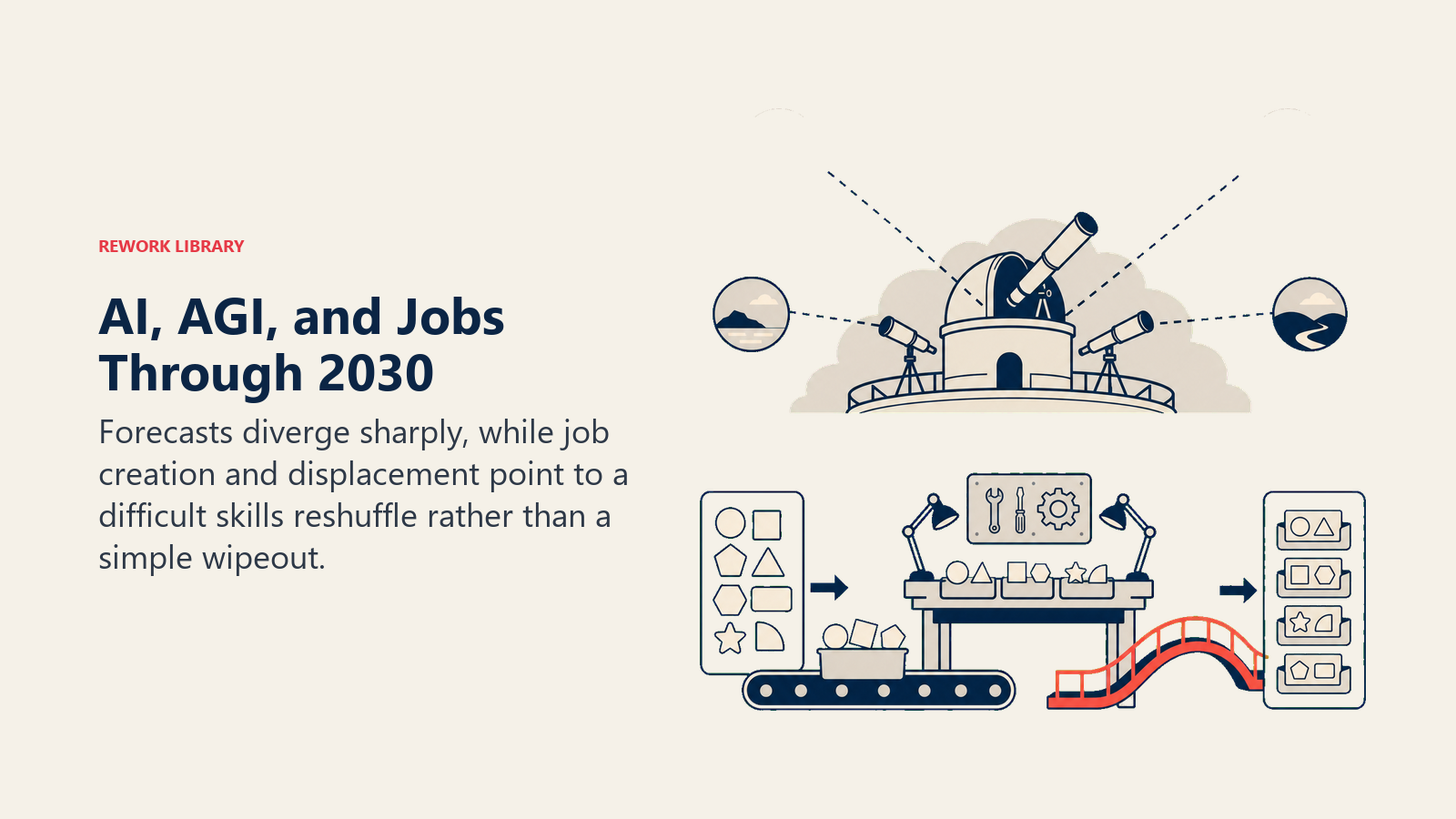
The jobs conversation is a reshuffle, not a wipeout, and the reshuffle is the hard part. The World Economic Forum's Future of Jobs Report 2025 projects that AI and related technologies will displace 92 million existing jobs by 2030 while creating 170 million new ones, a net gain of 78 million jobs globally. That headline number understates the difficulty: the report is explicit that this isn't a one-to-one swap. The roles that disappear and the roles that appear aren't in the same place, on the same team, or filled by the same people, and the same report estimates 39% of existing skill sets will become outdated in that window. For a leader, the planning implication isn't "AI takes jobs" or "AI creates jobs." It's "the skills mix your organization needs in 2030 is not the mix it has today," which is a workforce and AI talent strategy problem you can start on now.
Economic forecasts are wide and getting more cautious in the details. Goldman Sachs estimates generative AI could raise global GDP by roughly 7%, about $7 trillion, over a ten-year horizon, while PwC puts AI's potential boost to global economic output as high as 15 percentage points by the mid-2030s under favorable conditions, or as low as 1% in a low-trust, low-cooperation scenario. Notably, Goldman's own 2026 analysis found no meaningful relationship between AI adoption and productivity at the broad economy-wide level yet, even while flagging a roughly 30% productivity lift in the two use cases (like coding) where adoption is deepest. Big aggregate numbers and thin ground-level results can both be true at the same time, which is exactly why "AI will add $X trillion" headlines deserve a second look at the assumptions underneath them.
Risks and Governance: What Could Slow This Down
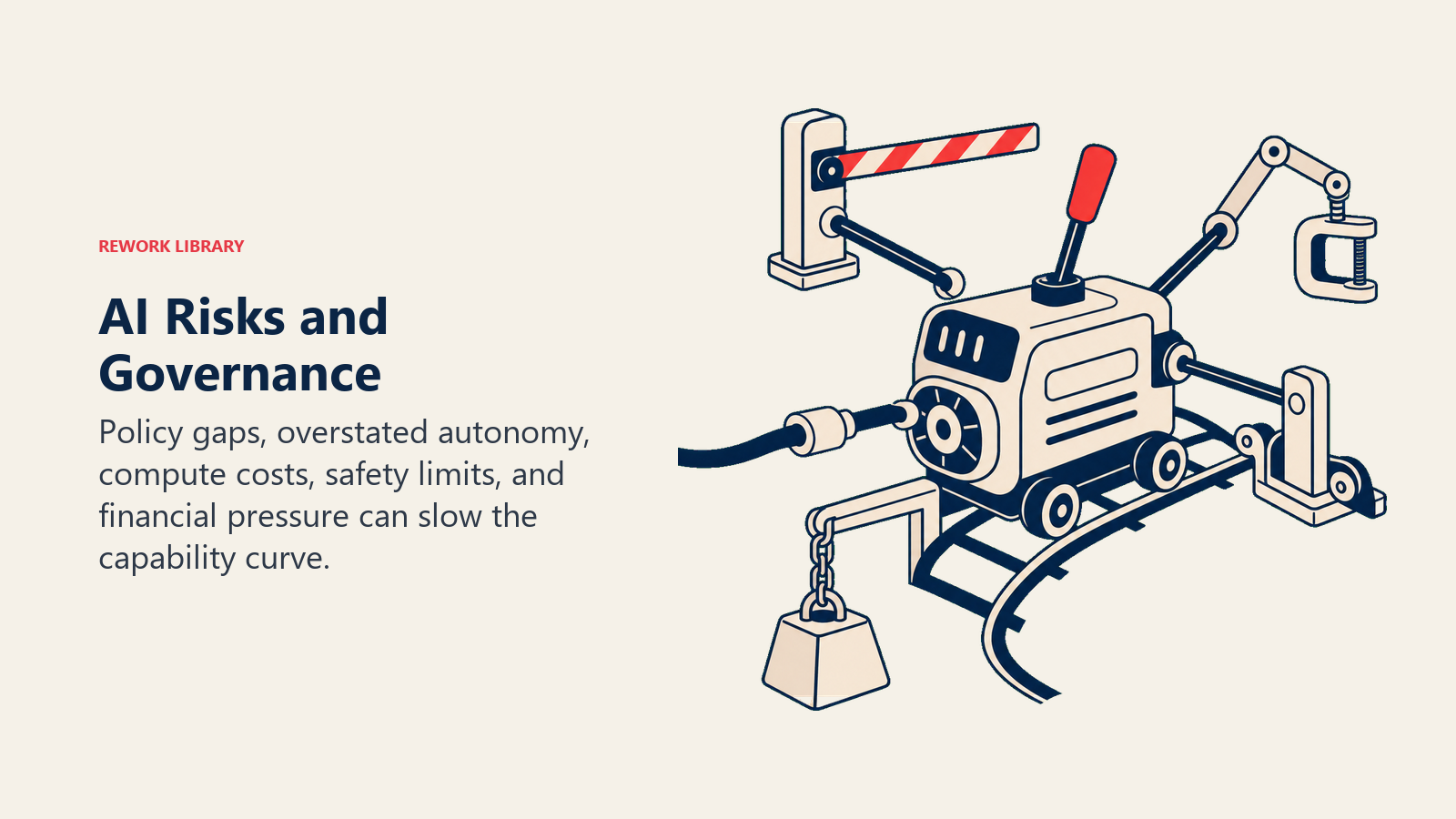
The future of AI isn't just a capability curve. It's also a governance race that's currently behind the capability it's supposed to manage.
- Oversight hasn't caught up to deployment. Fewer than half of U.S. middle and high schools have clear AI policies, per Stanford's 2026 index, and the pattern repeats in the enterprise: most organizations are deploying AI faster than they're building the guardrails around it. See AI governance for what a working framework actually looks like.
- "Agentic" gets oversold. Gartner has warned that many vendors rebrand existing chatbots or RPA as agentic without the underlying autonomy, and separately projects that over 40% of agentic AI projects will be canceled by the end of 2027 due to cost overruns, unclear value, or inadequate risk controls. Ask what a system actually does before you ask what it's called.
- Compute and environmental cost are rising with capability. Stanford's index tracked one frontier model's training emissions at over 72,000 tons of CO2 equivalent, alongside data center power capacity climbing to nearly 30 gigawatts. Capability gains aren't free, and that cost curve is itself a planning input for anyone evaluating vendor roadmaps.
- Safety and alignment remain open research problems, not solved ones. Building a system that reliably does what its operators intend gets harder, not easier, as capability grows. See AI safety and AI alignment for the fuller picture.
- Spending has outrun revenue in places, which is its own risk. What is the AI bubble covers the valuation and infrastructure-spend argument directly: real revenue exists, but a correction in AI stocks or a slowdown in compute buildout wouldn't necessarily mean the underlying technology stops working. It would mean some bets on it were wrong.
None of this is an argument to wait. It's an argument to build the same discipline into AI investment that you'd apply to any other capital decision: verify the claim, check the source, and separate the technology's trajectory from any one vendor's pitch.
What Business Leaders Should Do Now
- Separate proven capability from projected capability. Agents handling well-scoped, high-volume tasks, reasoning models, multimodal input, all proven in production today. AGI timelines and multi-trillion-dollar GDP forecasts are projections built on assumptions you should be able to name, not facts you can bank a budget on.
- Pilot narrow, well-defined use cases before betting on broad transformation. The gap between 88% of organizations using AI somewhere and only 39% reporting bottom-line impact at the enterprise level is exactly where over-scoped pilots go to stall. Start with one workflow that has a clear, measurable outcome.
- Treat governance as infrastructure, not paperwork. Decide now what an AI system can decide alone and what always routes to a person. Building this after a mistake is far more expensive than building it before one.
- Plan the skills shift, not just the tool rollout. If close to 40% of your team's current skill set is going to age out within a few years, your training plan needs the same budget line as your software license.
- Re-check any AI vendor claim that cites a market size without a source. If a pitch deck says AI will add "$X trillion" to the economy, ask which forecast it's drawing from, Goldman's, PwC's, or someone's rounded-up blend of both, and what assumptions sit underneath that number.
- Revisit the plan on a fixed cadence, not just when something breaks. The distance between last year's capability and this year's is large enough that a strategy set in January can be stale by summer. Quarterly is a reasonable minimum for anything AI-related right now.
A Realistic Timeline
No one, including the people building frontier models, can tell you exactly what arrives when. This table separates what's already shipping from what's genuinely contested, so you can weight each claim accordingly.
| Timeframe | What's largely agreed | What's still contested |
|---|---|---|
| Now to 2027 | Agents handle well-scoped multi-step tasks; reasoning models and multimodal input are standard in frontier releases; adoption keeps climbing | Whether "powerful AI" (Amodei's term) or early AGI-adjacent capability arrives within this window |
| 2028 to 2030 | AI-driven job displacement and creation both continue at scale (WEF projects 92 million lost, 170 million created by 2030); skills requirements keep shifting | Whether AGI, by any agreed definition, has been reached; how much of forecast GDP impact actually materializes broadly versus in a handful of use cases |
| Early to mid-2030s | Compute, energy, and governance debates intensify as systems get more capable | Superintelligence and the technological singularity, still speculative, discussed mainly in AI safety research, not a mainstream forecast |
| Beyond, undated | Continued incremental capability gains are the safest bet in the whole table | Everything else. Treat any specific year attached to superintelligence as a guess, not a forecast |
Key Facts
- Global corporate AI investment reached $581.7 billion in 2025, up 130% year over year. Stanford HAI, 2026 AI Index Report
- Generative AI reached 53% population adoption within three years, faster than the PC or the internet, with organizational adoption at 88%. Stanford HAI, 2026 AI Index Report
- Scores on the SWE-bench Verified coding benchmark rose from around 60% to near 100% within a single year. Stanford HAI, 2026 AI Index Report
- 23% of organizations are already scaling an agentic AI system somewhere in the enterprise, and another 39% are experimenting with one, per McKinsey's November 2025 State of AI survey. McKinsey: The State of AI
- AI and related technologies are projected to displace 92 million existing jobs while creating 170 million new ones by 2030, a net gain of 78 million jobs. World Economic Forum, Future of Jobs Report 2025
- Goldman Sachs estimates generative AI could raise global GDP by roughly 7%, about $7 trillion, over a ten-year horizon. Goldman Sachs
- PwC estimates AI adoption could boost global GDP by up to 15 percentage points by the mid-2030s under favorable conditions. PwC
- The AI Impacts 2023 survey of 2,778 published AI researchers put a 50% probability of "high-level machine intelligence" at 2047, with only a 10% chance by 2027. AI Impacts / arXiv
Frequently Asked Questions about the Future of AI
What is the future of AI in simple terms?
It's the ongoing trajectory of AI getting more capable and more widely used, agents handling more of a task, models reading text and images and audio together, and reasoning through problems step by step, alongside a genuine, unresolved debate over when or whether AI reaches human-level general capability and what that would mean for jobs and the economy.
Will AI take my job?
The World Economic Forum projects AI will displace 92 million jobs while creating 170 million new ones by 2030, a net gain, but not a one-to-one swap. The bigger risk for most people isn't a job disappearing outright, it's the skills that role requires shifting faster than they can retrain for.
Is AGI going to happen soon?
Depends who you ask. Some lab CEOs, like Anthropic's Dario Amodei, have floated 2026 to 2027 for closely related capability milestones. A 2023 survey of 2,778 published AI researchers put a 50% probability closer to 2047. There's no expert consensus, so treat any confident specific date as one person's opinion, not a settled fact.
How much will AI actually add to the economy?
Estimates vary widely and depend heavily on assumptions. Goldman Sachs puts the ten-year global GDP impact of generative AI at roughly 7%. PwC's range runs from about 1% in a pessimistic, low-trust scenario up to 15 percentage points in a favorable one. Goldman's own 2026 analysis also found no clear productivity-AI link yet at the broad economy-wide level, even as narrower use cases like coding show real gains.
What's the difference between the near-term future of AI and the AGI debate?
The near-term (agents, reasoning models, multimodal capability, rising adoption) is largely proven and already shipping in production. The AGI debate, and the technological singularity beyond it, is speculative, contested among experts, and not something current evidence settles either way.
What should a business do to prepare for the future of AI, if the timeline is uncertain?
Focus on what's already proven, agents on well-scoped tasks, reasoning and multimodal tools, rather than betting a strategy on a specific AGI date. Build governance and a skills plan now, since both take years to mature and neither depends on knowing exactly when the next capability jump lands.
Is the AI boom a bubble that's about to pop?
There's a real bull case (genuine revenue, proven narrow-task gains) and a real bear case (spending that's outrun demonstrated returns in places). Both can be true at once. Planning for either outcome looks similar: fund what shows measurable results, and be skeptical of spend justified purely by valuation momentum.
How fast is AI actually improving right now?
Unevenly, but fast on the benchmarks that matter most for business use. Stanford's 2026 AI Index found a coding benchmark went from about 60% to near 100% accuracy in a single year, while a model that won an international math olympiad still struggled with a basic clock-reading test. Progress is real but not uniform across every task.
Where can I read more about the specific pieces of this future (agents, AGI, the singularity)?
Start with what is agentic AI for what's shipping now, what is AGI for the human-level capability debate, and what is the technological singularity for the more speculative long-range scenario. Each covers its slice in more depth than a single overview article can.
Related AI Concepts
- What is Agentic AI? - The near-term capability doing most of the current work
- What is AGI (Artificial General Intelligence)? - The contested mid-term threshold this outlook builds on
- What is the Technological Singularity? - The speculative long-range scenario beyond AGI
- What is the AI Bubble? - The spending and valuation debate shaping how fast this future gets funded
- Reasoning Models - The technique behind recent sharp capability gains
- Multimodal AI - Models that combine text, image, audio, and video
- AI Governance - Building oversight before capability outpaces it
- AI Talent Strategy - Planning the workforce skills shift this outlook implies
External Resources
- Stanford HAI: 2026 AI Index Report - Annual benchmark, adoption, investment, and governance data
- McKinsey: The State of AI in 2025 - Global survey on enterprise AI and agent adoption
- World Economic Forum: Future of Jobs Report 2025 - Job displacement and creation projections through 2030
- Goldman Sachs: Generative AI Could Raise Global GDP by 7% - Ten-year global GDP impact estimate
- PwC: AI Adoption Could Boost Global GDP - Scenario-based global GDP forecast
- AI Impacts: Thousands of AI Authors on the Future of AI - The 2023 survey of 2,778 published AI researchers on AGI timelines
Part of the AI Terms Collection. Updated July 2026.

Co-Founder, Rework.com