What is Vertex AI?
Turn this article into takeaways for your work.


Each assistant summarizes the article only for you and suggests best practices for your work.
Vertex AI is Google Cloud's unified platform for building, deploying, and managing machine learning and generative AI models at enterprise scale. It combines model training, a curated model marketplace called Model Garden, agent-building tools, and MLOps infrastructure in one console, so data teams can move from experimentation to production without stitching together separate services.
That definition still describes the product, but the name changed. In April 2026, at Google Cloud Next, Google renamed Vertex AI to the Gemini Enterprise Agent Platform, folding in Agentspace and repositioning the service around agents rather than models alone. The underlying APIs, Model Garden, training pipelines, and endpoints did not change, and most practitioners, documentation, and job postings still say "Vertex AI" out of habit. This article uses "Vertex AI" throughout for that reason, and notes where the rebrand actually changes something.
What Vertex AI Actually Does
Vertex AI covers the full path from raw data to a running model, which is what separates it from a single-purpose API.
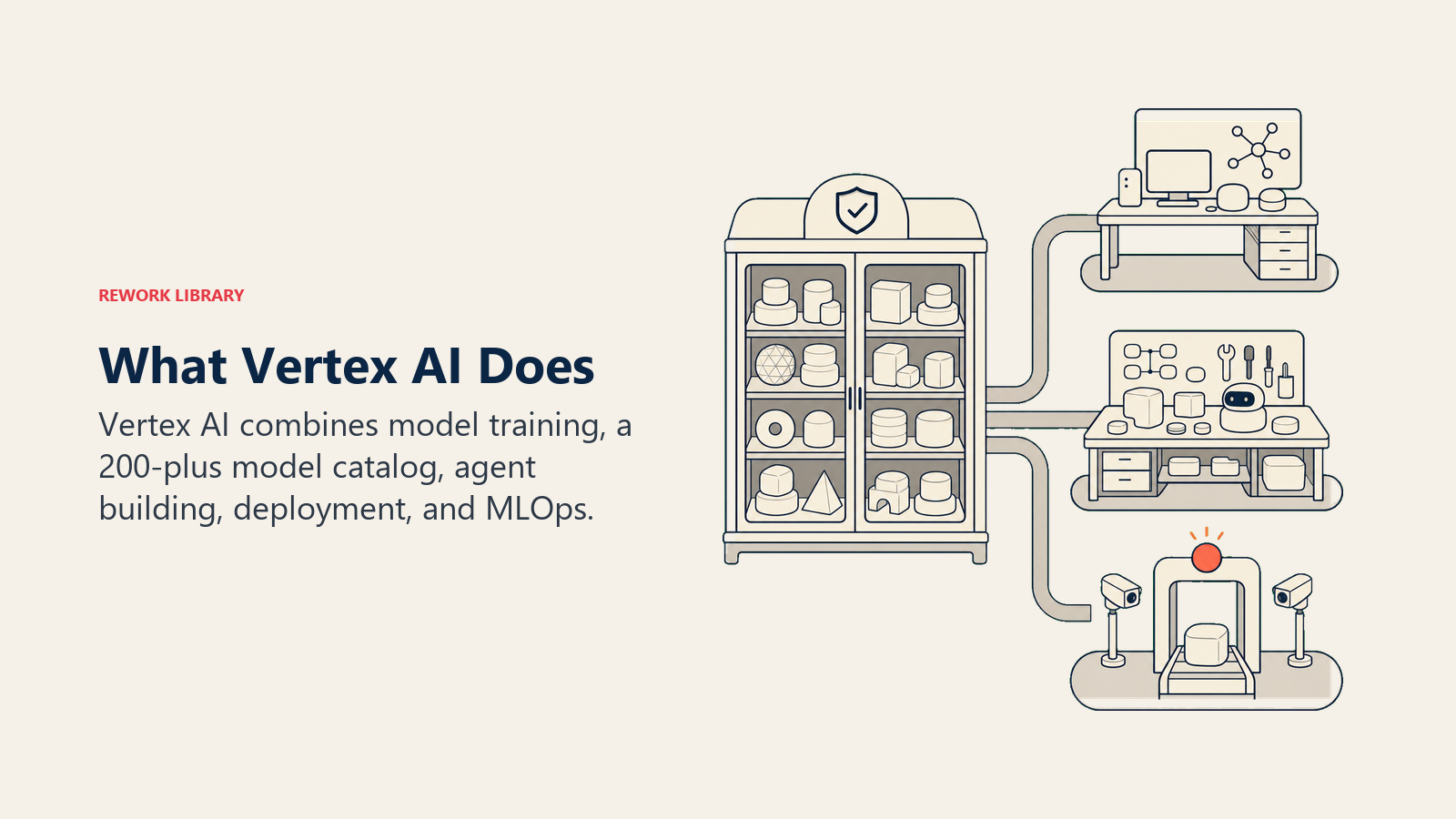
Model training and custom development. Teams can train custom models from scratch using AutoML for structured data and common tasks, or build fully custom machine learning pipelines with their own code, data, and compute. Vertex AI Pipelines, Feature Store, and Experiments handle the plumbing: versioning datasets, tracking training runs, and managing the features that feed a model.
Model Garden. Instead of training everything from zero, most teams start here. Model Garden is a single catalog of more than 200 foundation models from Google and its partners, including Google's own Gemini family, Anthropic's Claude, Meta's Llama, Mistral, Gemma, DeepSeek, and Qwen. Teams can compare models side by side, fine-tune the ones that support it, and deploy with a few clicks rather than standing up their own serving infrastructure. This is also where most generative AI work starts on the platform, whether that's text generation, image generation with Imagen, or video generation with Veo.
Agent Builder. This is the part of the platform Google pushed hardest in the 2026 rebrand. Agent Builder bundles the Agent Development Kit (ADK), an open-source, code-first framework for building AI agents in Python, Go, Java, or TypeScript; Agent Studio, a low-code canvas for designing agentic workflows; and Agent Garden, a library of prebuilt agent templates. It also includes RAG Engine for grounding agent responses in company data, plus Agent Identity and Agent Registry for permissioning and cataloging agents once an organization has more than a handful running.
MLOps. Once a model or agent is live, Vertex AI handles the operational layer: model monitoring for drift and performance decay, versioned model registries, automated retraining triggers, and endpoint scaling. This is standard MLOps discipline applied at the platform level. For teams building generative AI features specifically, that operational layer starts to look more like LLMOps, covering prompt versioning, evaluation sets, and retrieval pipeline health rather than just model accuracy.
Who Vertex AI Is For
Vertex AI is built for enterprise machine learning and data teams, not individual developers experimenting with a single prompt. The platform assumes you already have data infrastructure (most commonly BigQuery), an identity and access management setup through Google Cloud IAM, and a reason to keep models, pipelines, and agents inside one governed environment rather than scattered across notebooks and personal API keys.
In practice, that means three groups get the most value from it. Data science and ML engineering teams use it to train, version, and serve custom models without building their own MLOps stack. Application and platform teams use Agent Builder and Model Garden to add generative AI features to existing products without training anything from scratch. And IT and governance teams use its identity, audit logging, and access controls to keep AI usage compliant as adoption spreads past a single pilot team.
Organizations already running on Google Cloud, particularly those with data sitting in BigQuery, get a meaningfully shorter path to production than teams starting from an empty cloud account, because the data gravity and the AI platform live in the same place.
How Vertex AI Is Priced
Vertex AI uses consumption-based pricing with no flat platform fee. What you pay depends on which part of the platform you're using.
Generative AI model calls are billed per token, with rates set per model. As of mid-2026, Gemini 2.5 Flash-Lite costs $0.10 per million input tokens and $0.40 per million output tokens, while the flagship Gemini 2.5 Pro starts at $1.25 per million input tokens and $10.00 per million output tokens. Pricing scales up for longer context windows and down for smaller, faster models, which is why teams building at volume often route easy queries to a cheaper model and reserve the expensive one for harder tasks.
Custom training and compute is billed by node-hour, with GPU and TPU charges layered on top of the base compute rate. An NVIDIA A100 GPU, for example, runs roughly $2.93 per hour in compute plus a $0.44 per hour Vertex AI management fee, for about $3.37 per hour combined. Supervised fine-tuning is billed by training tokens processed rather than by the hour.
Throughput tiers scale automatically: Google's Standard PayGo tier increases available throughput as your rolling 30-day spend grows, and committed-use discounts are available for predictable workloads, with Google generally offering longer commitment terms than AWS or Azure in exchange for a lower rate.
The practical risk is the same one that shows up across every hyperscaler AI platform: a quoted per-token rate looks small until inference volume, fine-tuning runs, storage, and networking are added up across a full year. Modeling that properly is exactly what an AI total cost of ownership framework is for, and it's worth doing before committing budget based on a per-token headline number alone.
Vertex AI vs. AWS Bedrock vs. Azure AI Foundry
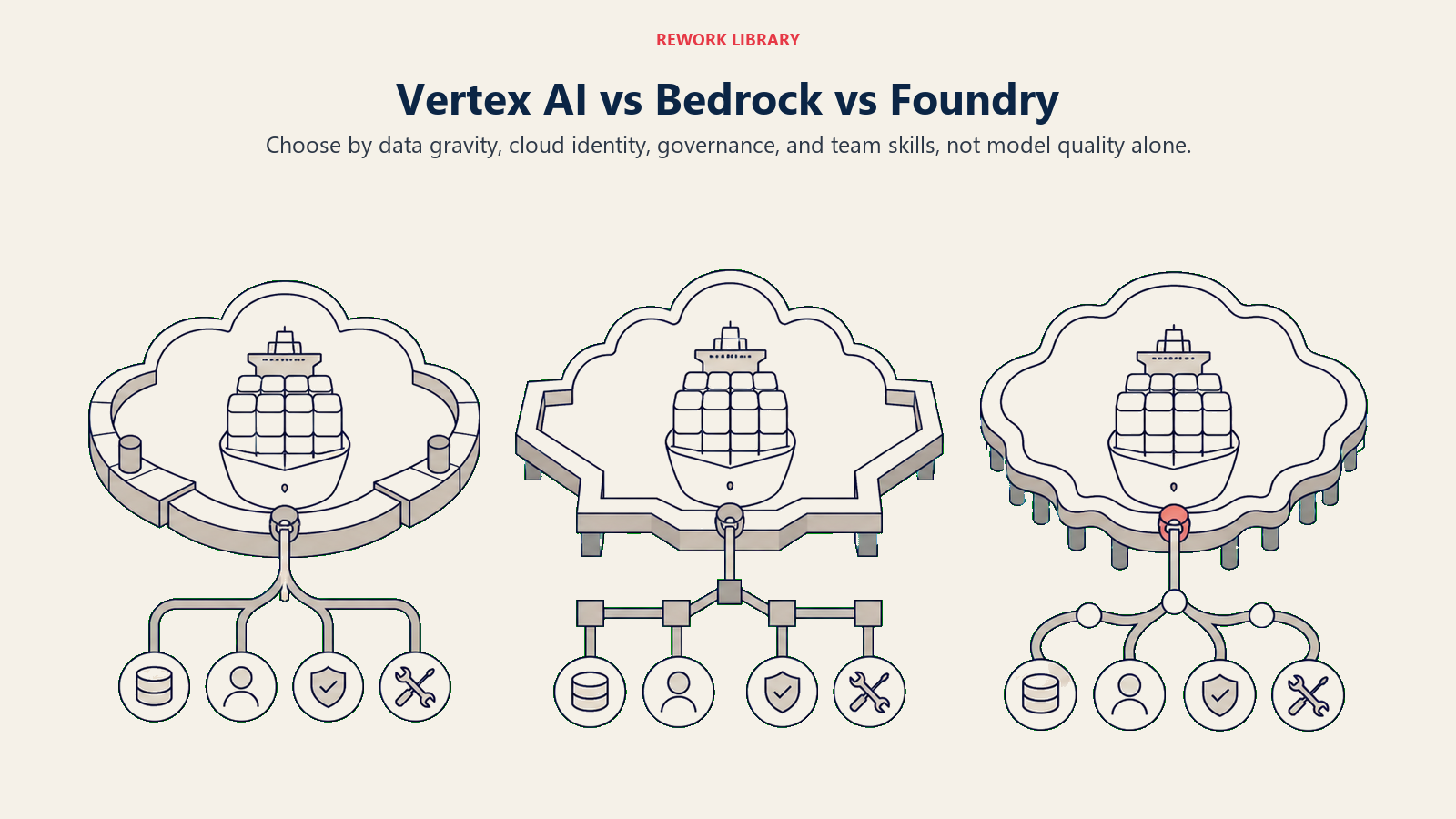
All three hyperscaler AI platforms host leading commercial and open-weight models, support fine-tuning, and integrate with their own cloud's identity and storage systems. The differences show up in catalog depth, agent tooling, and which ecosystem you're already standing on.
| Dimension | Vertex AI (Gemini Enterprise Agent Platform) | AWS Bedrock | Azure AI Foundry |
|---|---|---|---|
| Model catalog | 200+ models via Model Garden: Gemini, Claude, Llama, Mistral, Gemma, DeepSeek, Qwen | 40+ foundation models from around eight providers, including Claude and Llama | Deepest first-party OpenAI/GPT integration, plus open models |
| Agent tooling | Agent Builder: ADK, Agent Studio, Agent Garden, Agent Registry | Bedrock AgentCore | Foundry Agent Service |
| Pricing model | Per-token inference, per-node-hour training, committed-use discounts | Per-token inference, provisioned throughput options | Per-token inference, consumption and provisioned tiers |
| Strongest fit | GCP-native teams with BigQuery data gravity and multimodal needs (Imagen, Veo) | AWS-native teams, especially Claude-centric or Anthropic-heavy architectures | Microsoft 365 and Azure-native enterprises, OpenAI-model-first workloads |
| Identity and governance | Google Cloud IAM, Agent Identity, Agent Registry | AWS IAM, native to existing AWS compliance certifications | Microsoft Entra ID and Purview integration |
None of the three wins on model quality alone. Model performance gaps between the leading providers are typically small, so the platform decision usually comes down to which cloud already holds your data, your compliance requirements, and your existing engineering skill set, which is the kind of tradeoff worth running through a structured AI vendor evaluation rather than a feature checklist.
Key Facts
- Google renamed Vertex AI to the Gemini Enterprise Agent Platform at Google Cloud Next in April 2026, absorbing Agentspace and repositioning the product around agents while keeping existing APIs and endpoints unchanged, according to Google Cloud's official product page.
- Model Garden gives access to more than 200 validated models from Google and its partners, including Gemma, Qwen, DeepSeek, and Llama, per Google Cloud's Model Garden page.
- Google Cloud revenue topped $20 billion in a single quarter for the first time in Q1 2026, growing 63% year over year, according to CNBC's coverage of Alphabet's Q1 2026 earnings.
- Google Cloud holds roughly 12% of the global cloud infrastructure market in 2026, behind AWS at about 31 to 33% and Microsoft Azure at about 23 to 25%, based on Synergy Research Group data reported by BusinessStats.
- Gemini 2.5 Pro is priced from $1.25 per million input tokens and $10.00 per million output tokens, while Gemini 2.5 Flash-Lite runs $0.10 per million input tokens and $0.40 per million output tokens, according to CloudZero's 2026 Vertex AI pricing breakdown.
- Custom training on an NVIDIA A100 GPU costs about $2.93 per hour in compute plus a $0.44 per hour Vertex AI management fee, roughly $3.37 per hour combined, per CloudZero's pricing analysis.
Why Vertex AI Matters for the Business
The strategic case for Vertex AI isn't the model quality, since Gemini, Claude, and GPT-class models trade leadership positions every few months and the gaps between them are usually small. It's the operational layer around the models: one place to train, deploy, monitor, and govern AI work instead of managing separate vendors for inference, fine-tuning, agent orchestration, and compliance logging.
That consolidation matters more as AI usage spreads past a single pilot team. A model monitoring gap, an ungoverned agent with too much access, or an untracked fine-tuning bill are the kind of problems that stay small when one team is experimenting and get expensive once a dozen teams are shipping AI features independently. Google Cloud's $462 billion cloud backlog reported alongside its Q1 2026 earnings, per IG.com's Alphabet earnings preview, reflects how much enterprise AI spend is now being committed years in advance rather than bought on demand, which is exactly the kind of platform bet Vertex AI is built to serve.
For organizations already running on Google Cloud, the practical draw is proximity: data in BigQuery, models in Model Garden, and agents in Agent Builder, all inside the same IAM boundary. That reduces the integration work needed to get from a working prototype to a production feature, which is usually the slower half of any enterprise AI project.
Limitations to Know
Vertex AI isn't the right default for every team, and a few limitations are worth weighing before committing.
- The 2026 rebrand adds friction. Documentation, job titles, third-party tutorials, and internal runbooks still reference "Vertex AI," while new marketing and some newer features reference the Gemini Enterprise Agent Platform. Expect naming inconsistency for a while.
- It's strongest inside the Google Cloud ecosystem. Teams without existing GCP infrastructure, particularly BigQuery, take on extra setup work that AWS- or Azure-native teams skip on their respective platforms.
- Costs are layered and can be hard to predict. Token pricing, node-hour compute, storage, and networking each bill separately, and a rough estimate based on the headline per-token rate alone routinely undercounts real spend.
- Agent tooling is newer than the model training side. Agent Builder, ADK, and Agent Registry launched or matured mostly through 2025 and 2026, so the ecosystem of examples, third-party integrations, and hiring pool is smaller than for the platform's longer-established training and deployment features.
- Regional and model availability varies. Not every model in Model Garden is available in every Google Cloud region, which matters for teams with data residency requirements.
Frequently Asked Questions about Vertex AI
What is Vertex AI?
Vertex AI is Google Cloud's unified platform for training, deploying, and managing machine learning and generative AI models. It includes Model Garden for accessing pre-built models, Agent Builder for creating AI agents, and MLOps tools for monitoring and maintaining models in production.
Is Vertex AI still called Vertex AI in 2026?
Officially, no. Google renamed it the Gemini Enterprise Agent Platform in April 2026, absorbing Agentspace and shifting the branding toward agents. The underlying APIs and core services are unchanged, and most practitioners still refer to the product as Vertex AI.
What is Model Garden in Vertex AI?
Model Garden is Vertex AI's catalog of more than 200 foundation models from Google and its partners, including Gemini, Claude, Llama, Mistral, Gemma, DeepSeek, and Qwen. It lets teams compare, fine-tune, and deploy models without building their own serving infrastructure.
How is Vertex AI priced?
Vertex AI uses consumption-based pricing. Generative AI model calls are billed per token at rates that vary by model, custom training and compute are billed per node-hour with GPU or TPU surcharges, and fine-tuning is billed by training tokens processed. There's no flat platform fee.
What is Vertex AI Agent Builder?
Agent Builder is the suite of tools for creating and managing AI agents on Vertex AI. It includes the Agent Development Kit (ADK) for code-first agent development, Agent Studio for low-code agent design, Agent Garden for prebuilt templates, and RAG Engine for grounding agent responses in company data.
How does Vertex AI compare to AWS Bedrock and Azure AI Foundry?
All three offer pay-per-token pricing and access to leading foundation models. Vertex AI has the deepest catalog at 200+ models and the strongest fit for teams already on Google Cloud with BigQuery data. AWS Bedrock has around 40 models from about eight providers and suits AWS-native or Claude-centric teams. Azure AI Foundry has the tightest OpenAI/GPT integration and suits Microsoft 365-centric enterprises.
Who should use Vertex AI?
Enterprise ML engineering teams training custom models, application teams adding generative AI features without training models from scratch, and IT or governance teams that need centralized identity, audit logging, and access controls across AI usage. It's a stronger fit for organizations already running on Google Cloud.
What are the main downsides of Vertex AI?
Naming confusion from the 2026 rebrand, a steeper setup for teams outside the Google Cloud ecosystem, layered pricing that's easy to underestimate, a newer and smaller ecosystem around agent tooling compared to model training, and inconsistent model availability across regions.
Related AI Concepts
- Retrieval-Augmented Generation - The technique Vertex AI's RAG Engine uses to ground agent responses in company data
- API Integration - How Vertex AI's models and agents connect to existing business applications
- Model Serving - The infrastructure layer Vertex AI uses to expose trained models as production endpoints
External Resources
- Gemini Enterprise Agent Platform (formerly Vertex AI) - Google Cloud's official product overview
- Model Garden on Google Cloud - The official catalog of 200+ models available through Vertex AI
- Vertex AI Pricing - Google Cloud's official pricing reference
