What is DeepSeek?
Turn this article into takeaways for your work.


Each assistant summarizes the article only for you and suggests best practices for your work.
DeepSeek is a Chinese AI research lab, founded in 2023 by hedge fund manager Liang Wenfeng, known for building low-cost, open-weight large language models. Its DeepSeek-R1 reasoning model, released in January 2025, matched Western frontier models on math and coding benchmarks at a fraction of the reported training cost, triggering a global reassessment of AI infrastructure spending.
Most people first heard of DeepSeek the week its app shot to the top of the Apple App Store and Nvidia lost more market value in a single day than almost any company in history. But DeepSeek is more than a headline event: it's an active model developer shipping new releases through 2026, an open-weight alternative to closed labs like OpenAI and Anthropic, and a live case study in the data-privacy and geopolitical questions that come with using AI tools built in China. This article covers what DeepSeek is, how it got here, its model lineup, the efficiency story behind it, and what to weigh before a business adopts it.
The "DeepSeek Moment": Background and the January 2025 Shock
DeepSeek was founded in 2023 as a research offshoot of High-Flyer, a Hangzhou-based quantitative hedge fund that Liang Wenfeng co-founded in 2015. High-Flyer had already been using AI to power its trading models, and it gave the new lab access to a large stockpile of Nvidia GPUs it had accumulated before US export controls tightened, resources that let DeepSeek train competitive models without the multi-billion-dollar budgets of its US rivals.
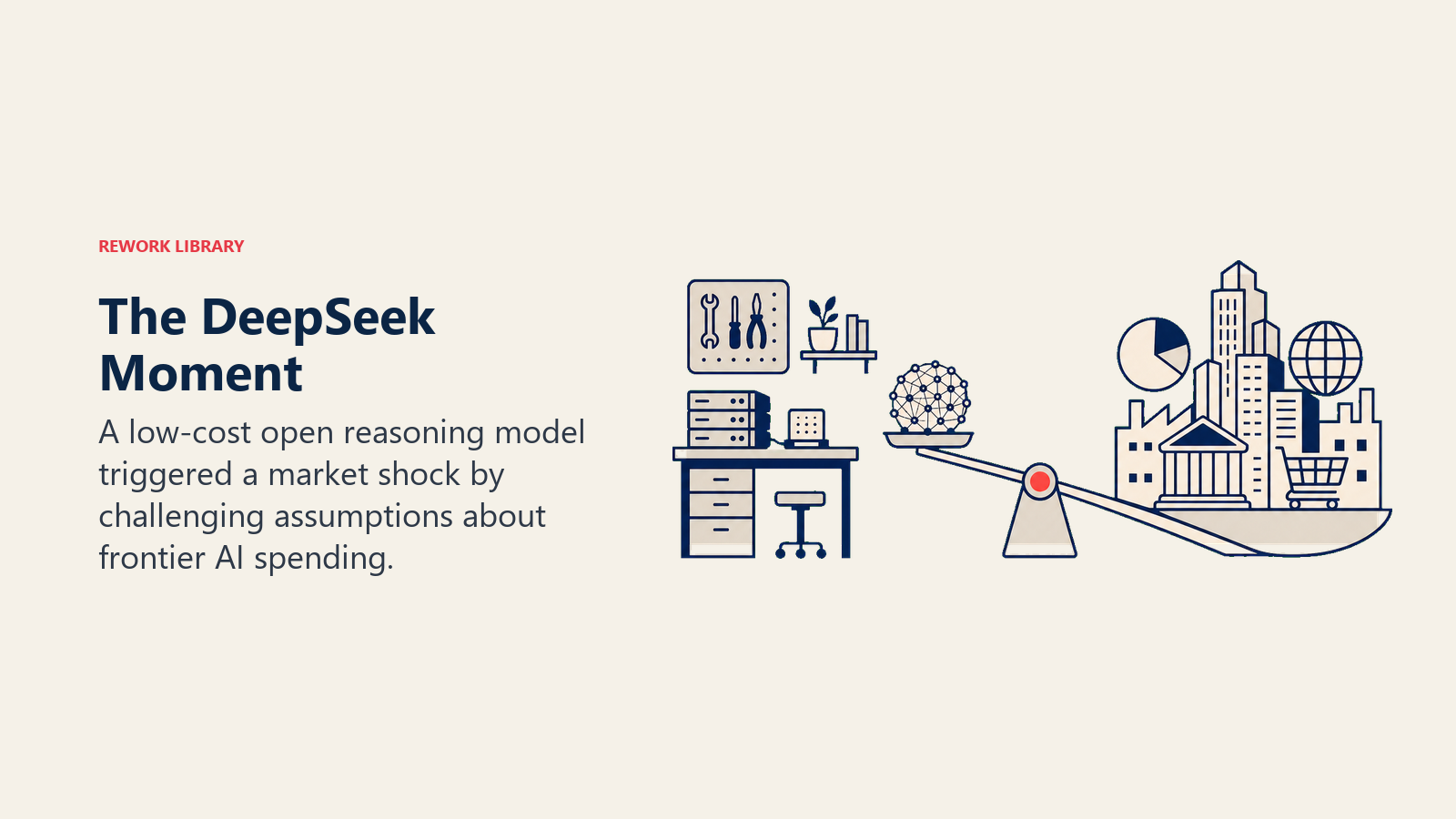
The lab built steadily through 2024, but the moment that made it a household name came on January 20, 2025, when DeepSeek released R1, an open-weight reasoning model that matched OpenAI's o1 on math, coding, and science benchmarks. The DeepSeek app, launched January 10, climbed to the number one spot on the US iOS App Store by January 27, overtaking ChatGPT. That same day, Nvidia's stock fell nearly 17%, wiping out $589 billion in market value, the largest single-day loss for any company in stock market history, as investors questioned whether the industry actually needed as much GPU spending as it had assumed.
The panic centered on cost. DeepSeek's own technical report for the underlying V3 base model claimed a training cost of roughly $5.6 million, a fraction of what US labs were reportedly spending on comparable frontier models. That number came under scrutiny almost immediately (more on that below), but the broader signal held: a lab operating under US chip restrictions had produced a model competitive with the best in the world, and it gave the weights away for anyone to download and run.
DeepSeek's Model Lineup: From V3 to R1 to V4
DeepSeek ships models on a fast, public release cadence rather than a single flagship product.
DeepSeek-V3 (December 2024) is the foundation model that started the story. It uses a mixture of experts architecture, activating only a fraction of its total parameters for any given query, which is a large part of why it trains and runs more cheaply than a dense model of similar size.
DeepSeek-R1 (January 2025) is the reasoning model built on top of V3. It uses extended chain-of-thought computation, working through problems step by step before answering, the same category of technique behind test-time compute. DeepSeek also released a family of smaller "distilled" R1 variants, using knowledge distillation to compress R1's reasoning ability into models small enough to run on a single GPU or a high-end laptop.
DeepSeek-V3.2 (December 2025) added tool use directly into the model's thinking process, letting it reason through a problem and call external tools in the same pass. DeepSeek reported it scored gold-medal-level results on the 2025 International Mathematical Olympiad and International Olympiad in Informatics benchmark sets.
DeepSeek-V4 (previewed April 24, 2026, with a stable release following in July 2026) is the current generation, shipped as two variants: V4-Pro, a large mixture-of-experts model, and V4-Flash, a smaller, faster variant. Both support a 1-million-token context window and, like every DeepSeek release to date, ship under an open license.
The Efficiency and Cost Story
DeepSeek's reputation rests on doing more with less, and the numbers, while contested, are real enough to matter.
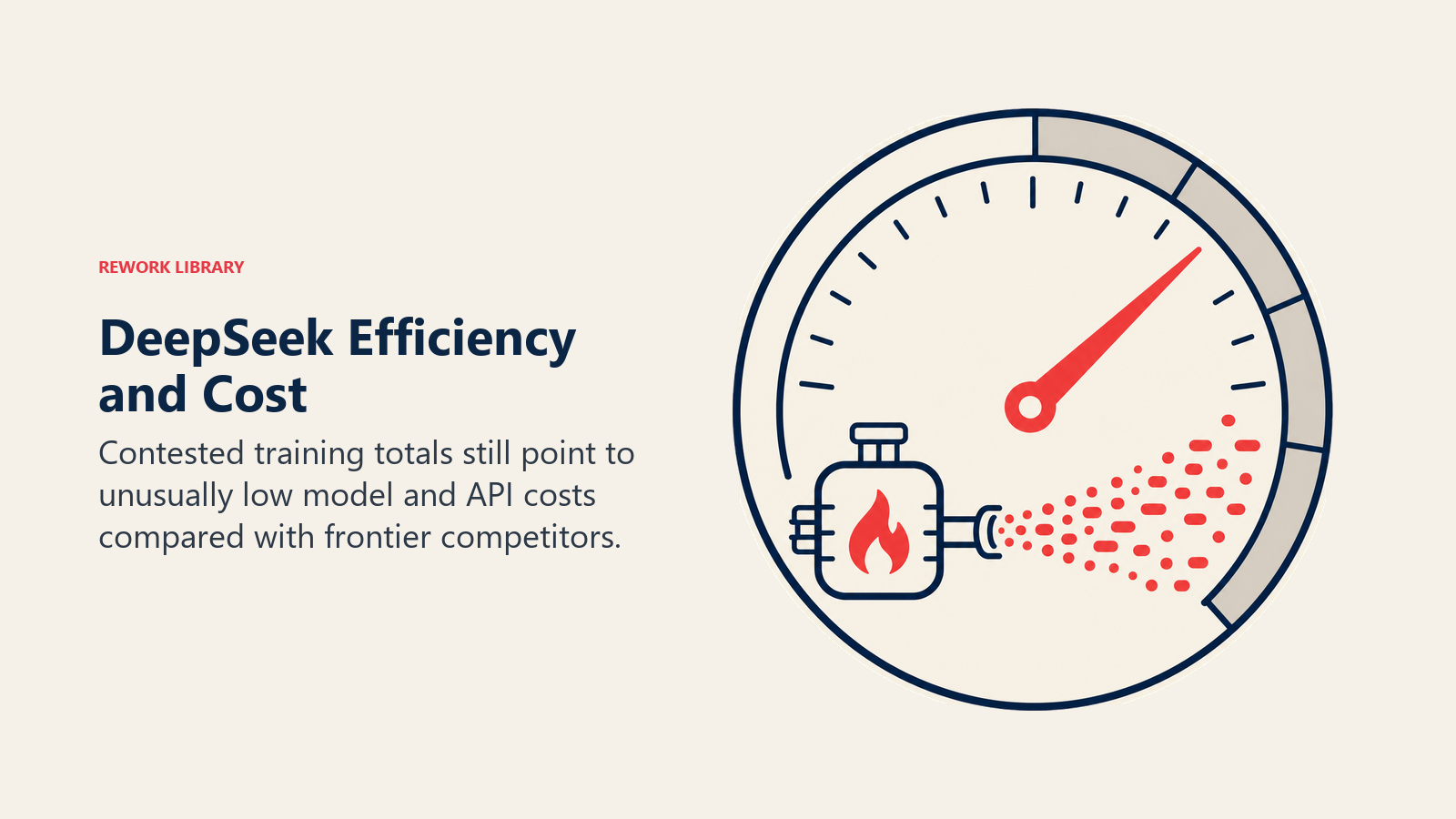
DeepSeek's own V3 technical report puts total training compute at 2.788 million H800 GPU hours, or about $5.576 million at roughly $2 per GPU hour. In September 2025, DeepSeek published a peer-reviewed paper in Nature disclosing a separate $294,000 figure specifically for R1's additional reasoning training on top of V3. Independent analysts, including researchers at Epoch AI, have argued the true all-in cost (accounting for the underlying V3 base training, hardware, and R&D overhead DeepSeek's figures exclude) runs closer to 20 times the headline number. Even at that higher estimate, DeepSeek's training cost still lands well below what OpenAI and Anthropic have reported for comparable frontier runs.
The cost advantage shows up most clearly in what DeepSeek charges to use its models. As of mid-2026, DeepSeek's V4-Flash API prices output tokens at $0.28 per million, compared with $15 per million for OpenAI's GPT-5.4 and Anthropic's Claude Sonnet 4.6, a roughly 50x gap. That pricing, not just the original training-cost headline, is what keeps DeepSeek relevant to cost-conscious developers well after the January 2025 news cycle faded.
Open Weights and Licensing
Unlike GPT and Claude, DeepSeek's models are open weight: anyone can download the actual trained model files, run them on their own infrastructure, fine-tune them, and build commercial products on top without paying DeepSeek a licensing fee.
DeepSeek-R1 and the V-series models ship under the permissive MIT license, which allows commercial use, modification, and distillation into other models, requiring only that the license text be preserved in redistributions. That's a meaningfully more open stance than the "open" label some competitors use loosely; DeepSeek genuinely lets a company self-host the model and never send a single query to DeepSeek's own servers.
This matters practically in two ways. First, cost-sensitive teams can run a distilled R1 variant locally instead of paying per-token API fees at all. Second, self-hosting sidesteps most of the data-handling concerns covered next, since nothing leaves the company's own infrastructure. The tradeoff is that self-hosting requires the GPU capacity and MLOps expertise to run the model reliably, which is exactly the kind of infrastructure work most business teams pay OpenAI or Anthropic to avoid.
Using DeepSeek for Business: What to Know First
DeepSeek's low cost and open licensing make it attractive for engineering teams, but it comes with caveats that a typical closed-model vendor doesn't carry.
The hosted DeepSeek app and API route data through servers based in China, which fall under Chinese data and national security law rather than the frameworks like GDPR or CCPA that govern US and EU vendors. Italy's data protection authority ordered an immediate block on DeepSeek's processing of Italian users' data in January 2025, one of the first formal regulatory actions against the company, and other governments and enterprises have since restricted DeepSeek on official devices over the same concern. None of this is unique to DeepSeek among Chinese AI vendors, but it's a materially different risk profile than a US-based provider, and it belongs in any AI vendor evaluation before a team adopts it for anything touching customer or employee data.
Self-hosting the open-weight model, through a domestic cloud provider or on-premises hardware, largely resolves the data-routing concern since queries never reach DeepSeek's infrastructure at all. That's the option most enterprise security teams land on when they want DeepSeek's cost and reasoning quality without the exposure of the hosted service. The broader question of whether to trust models built and trained under a foreign government's jurisdiction is part of the larger debate captured under sovereign AI, and it's worth reading before standardizing any workflow on DeepSeek.
DeepSeek vs OpenAI vs Claude
Here's how DeepSeek compares to the two labs most enterprise AI buying decisions default to.
| DeepSeek | OpenAI | Anthropic (Claude) | |
|---|---|---|---|
| Founded | 2023, Hangzhou, China (spun out of the hedge fund High-Flyer) | 2015, San Francisco | 2021, San Francisco |
| Flagship models | V4-Pro, V4-Flash, R1 (reasoning) | GPT-5.x series | Claude (Opus, Sonnet, Haiku tiers) |
| Open weights | Yes, MIT license across the R1 and V-series lines | No, closed weights | No, closed weights |
| Self-hosting | Yes, download and run on your own infrastructure | No, API or ChatGPT only | No, API or Claude only |
| Approx. output pricing (per 1M tokens) | $0.28 (V4-Flash) | $15 (GPT-5.4) | $15 (Sonnet 4.6) |
| Context window | Up to 1M tokens (V4) | Varies by model tier | Varies by model tier |
| Data handling | Hosted app routes through China-based servers; self-hosting keeps data local | US-based, enterprise data controls (SOC 2, admin consoles) | US-based, strong enterprise trust and safety posture |
| Known for | Lowest-cost open-weight models at frontier-class quality | Largest consumer reach, fastest release cadence | Enterprise-grade safety research and reliability |
The practical takeaway: DeepSeek wins on raw price-per-token and on giving you the option to self-host, which OpenAI and Claude don't offer at all. OpenAI and Anthropic win on data governance, enterprise support, and the assurance of operating under US jurisdiction, which is often the deciding factor for regulated industries regardless of benchmark scores.
Limitations of DeepSeek
A few limitations matter beyond the data-privacy question above. DeepSeek's models, like most systems trained in China, apply content restrictions on politically sensitive topics related to the Chinese government, and researchers have documented the hosted chat app refusing or redirecting certain questions that closed Western models answer directly. DeepSeek also lacks the enterprise support infrastructure OpenAI and Anthropic have built, including formal SLAs, dedicated account teams, and mature compliance certifications, which matters for larger organizations more than for individual developers. And the original training-cost figures that made DeepSeek famous remain genuinely disputed; treat the "$5.6 million" and "$294,000" numbers as DeepSeek's own disclosed figures rather than an independently audited total.
Key Facts About DeepSeek
- DeepSeek's V3 base model cost an estimated $5.576 million to train, using 2.788 million H800 GPU hours at roughly $2 per GPU hour, according to DeepSeek's own technical report. Source
- DeepSeek separately disclosed a $294,000 training cost for R1 in a peer-reviewed paper published in Nature in September 2025, though independent estimates put the true all-in compute cost closer to 20 times that figure once V3's base training is included. Source
- Nvidia lost $589 billion in market value on January 27, 2025, the largest single-day loss for any company in stock market history, after DeepSeek's release raised doubts about AI infrastructure spending. Source
- The DeepSeek app became the #1 free app on the US iOS App Store on January 27, 2025, overtaking ChatGPT within weeks of its January 10 launch. Source
- Italy's data protection authority ordered an immediate block on DeepSeek's processing of Italian users' data on January 30, 2025, one of the first formal government actions taken against the company over data handling. Source
- DeepSeek-R1 shipped under the MIT license on January 20, 2025, permitting commercial use, modification, and distillation into other models without royalties. Source
- DeepSeek-V4 launched in preview on April 24, 2026, with both the V4-Pro and V4-Flash variants supporting a 1-million-token context window under the same open license. Source
- DeepSeek's V4-Flash API prices output tokens at $0.28 per million, versus $15 per million for OpenAI's GPT-5.4, a roughly 50x gap that anchors DeepSeek's reputation as the low-cost option. Source
Frequently Asked Questions about DeepSeek
What is DeepSeek AI in simple terms?
DeepSeek is a Chinese AI lab, founded in 2023, that builds open-weight large language models you can download and run yourself. It's best known for R1, a reasoning model released in January 2025 that matched top Western models on math and coding benchmarks at a much lower reported training cost.
Is DeepSeek free to use?
The DeepSeek chat app and a limited API allowance are free. Heavier API use is paid per token, though DeepSeek's pricing (around $0.28 per million output tokens on V4-Flash) is far cheaper than OpenAI or Anthropic's equivalent models. The open-weight models themselves are also free to download and self-host under the MIT license.
Who owns DeepSeek?
DeepSeek was founded by Liang Wenfeng, who also co-founded the Chinese quantitative hedge fund High-Flyer in 2015. High-Flyer funded DeepSeek's early GPU infrastructure and remains closely tied to the lab, though DeepSeek operates as its own research and product organization.
Why did DeepSeek cause Nvidia's stock to crash?
DeepSeek's January 2025 release of R1, alongside its disclosed low training cost, raised doubts among investors about whether the AI industry needed as much GPU spending as previously assumed. Nvidia lost $589 billion in market value on January 27, 2025, the largest single-day loss in stock market history for any company.
Is DeepSeek open source?
DeepSeek's model weights are open under the MIT license, meaning anyone can download, run, modify, and commercially deploy them. That's different from fully open source in the traditional software sense, since DeepSeek hasn't published the training data or full training code, only the resulting model weights and inference code.
Is it safe for businesses to use DeepSeek?
It depends on deployment. The hosted DeepSeek app and API route data through China-based servers subject to Chinese law, which has led regulators like Italy's data protection authority to restrict it and some governments to ban it on official devices. Self-hosting the open-weight model on your own infrastructure avoids that specific risk, since no data leaves your systems.
How does DeepSeek compare to ChatGPT and Claude?
DeepSeek is dramatically cheaper per token and, unlike ChatGPT or Claude, lets you download and self-host the model. OpenAI and Anthropic offer more mature enterprise support, US-based data handling, and compliance certifications, which matter more to regulated industries than raw benchmark scores or price.
What is DeepSeek-R1 used for?
R1 is a reasoning model suited to multi-step problems like coding, mathematical analysis, and complex logic tasks, similar to OpenAI's o1 or Claude's extended thinking mode. Its distilled variants are also popular for running capable AI locally on modest hardware, since they don't require calling an external API at all.
Learn More
- Large Language Models - The underlying technology behind DeepSeek's V-series and every other major chat assistant
- Reasoning Models - The technical category R1 belongs to, and how it compares to OpenAI's o1
- What is Test-Time Compute? - The extended-thinking technique behind R1's reasoning ability
- Mixture of Experts - The architecture behind DeepSeek-V3 and V4's efficiency
- Knowledge Distillation - How DeepSeek compressed R1 into smaller, locally runnable models
- What is OpenAI? - The lab behind ChatGPT and GPT, DeepSeek's most direct comparison point
- What is Claude AI? - Anthropic's model family and enterprise-focused alternative
- AI Vendor Evaluation - The framework for weighing cost against data-governance risk before adopting a model like DeepSeek
- What is Sovereign AI? - The broader debate over AI models built and governed under different national jurisdictions
External Resources
- DeepSeek-V3 Technical Report (arXiv) - DeepSeek's own disclosure of V3's training compute and cost
- CNN: DeepSeek Reveals Training Cost of Its AI Model - Coverage of the Nature-published $294,000 R1 training-cost paper
- CNBC: Nvidia Sheds Almost $600 Billion in Market Cap - Reporting on the January 27, 2025 stock selloff
- Bird & Bird: Italy's Garante Blocks DeepSeek Data Processing - Legal summary of Italy's January 2025 order
- Hugging Face: DeepSeek-R1 Model Card - Official model weights and MIT license terms
- DeepSeek API Docs: V4 Preview Release - Official announcement of DeepSeek-V4-Pro and V4-Flash
- DeepSeek API Docs: Pricing - Current per-token pricing for DeepSeek's hosted models
Part of the AI Terms Collection. Last updated: 2026-07-20

Co-Founder, Rework.com
On this page
- The "DeepSeek Moment": Background and the January 2025 Shock
- DeepSeek's Model Lineup: From V3 to R1 to V4
- The Efficiency and Cost Story
- Open Weights and Licensing
- Using DeepSeek for Business: What to Know First
- DeepSeek vs OpenAI vs Claude
- Limitations of DeepSeek
- Key Facts About DeepSeek
- Learn More
- External Resources