Participative Leadership: Definition, Examples, and How to Lead
Turn this article into takeaways for your work.


Each assistant summarizes the article only for you and suggests best practices for your work.
Participative leadership is the management approach where leaders actively draw out input from their team before making a decision. It's one of the most researched styles in organizational behavior, and in the right context, it produces better decisions, higher commitment, and teams that actually want to show up.
What is participative leadership?
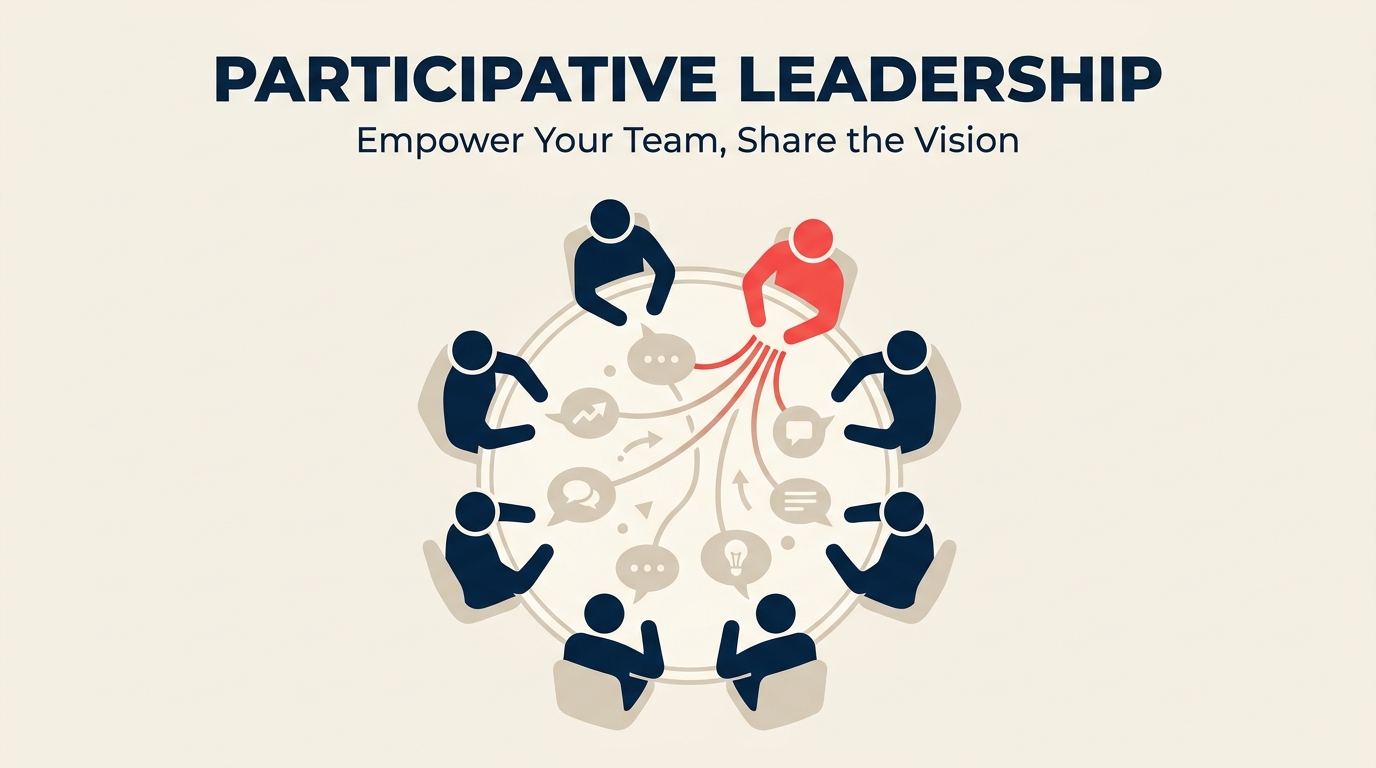
Participative leadership is a leadership style where the leader deliberately involves team members in generating ideas, evaluating options, and shaping a course of action, then retains ownership of the final decision. The key word is involves. The leader is not running a vote, and they're not stepping aside. They're creating structured space for real input before the call is made.
The concept traces back to Rensis Likert's management systems framework. Likert studied thousands of managers and arranged their behaviors on a four-system scale, from System 1 (exploitative-authoritative, decisions from the top with no input) to System 4 (participative, where leaders and teams plan together and trust flows in both directions). System 4 correlates strongly with higher productivity, lower turnover, and better organizational health in his research.
The core distinction from other styles: In participative leadership, the process is collaborative but the authority stays with the leader. That's what separates it from democratic leadership (where the group often decides by consensus) and from laissez-faire leadership (where the leader disengages almost entirely).
Key Facts
- Rensis Likert's The Human Organization (1967) identified System 4 participative management as the highest-performing management system across the organizations he studied over two decades.
- Gallup's 2023 State of the Global Workplace report found that employees who feel their opinions matter are 4.6 times more likely to feel empowered to perform their best work.
- Organizations where employees participate in decision-making show 14% higher productivity and 27% lower absenteeism, according to Gallup's employee engagement meta-analysis.
Types of participative leadership
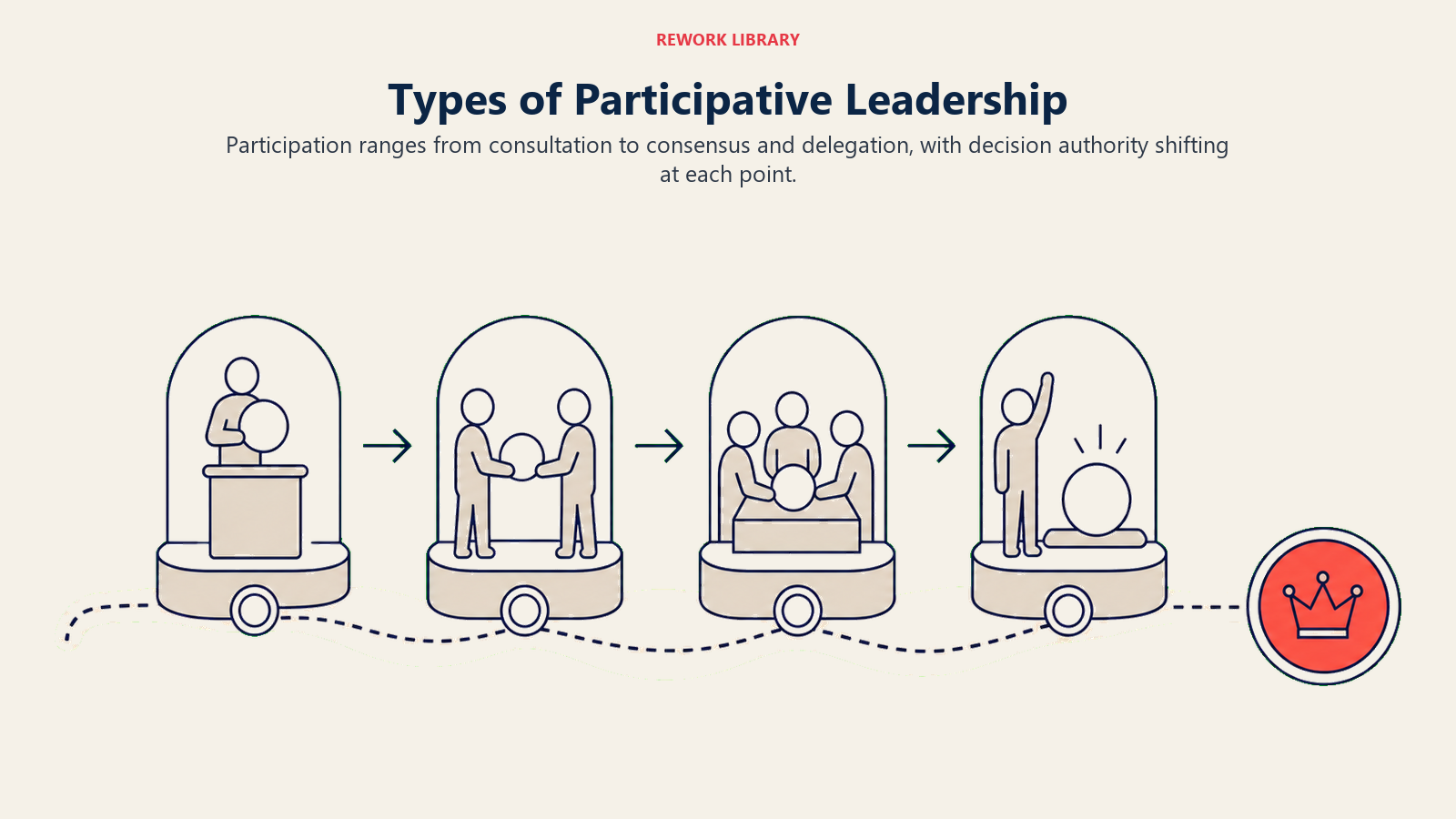
Participative leadership isn't one thing. There's a spectrum of how much involvement a leader creates, from light consultation to near-full delegation.
| Type | How it works | Who decides |
|---|---|---|
| Consultative | Leader asks for input from individuals or groups, weighs it, then decides alone | Leader |
| Consensus-seeking | Leader facilitates discussion until the group reaches broad agreement; leader formally endorses | Group + leader |
| Democratic | Leader frames the question and lets the group vote or reach a majority position | Group |
| Delegative | Leader assigns the decision entirely to a team member or sub-group | Delegate |
Most day-to-day participative leadership sits in the consultative zone. The leader invites perspectives, names the trade-offs they heard, and makes the call. They explain the reasoning, especially when the decision goes against what the team preferred.
Moving toward consensus or delegation makes sense when the team has domain expertise the leader lacks, or when execution buy-in matters more than speed.
Participative vs democratic vs autocratic leadership
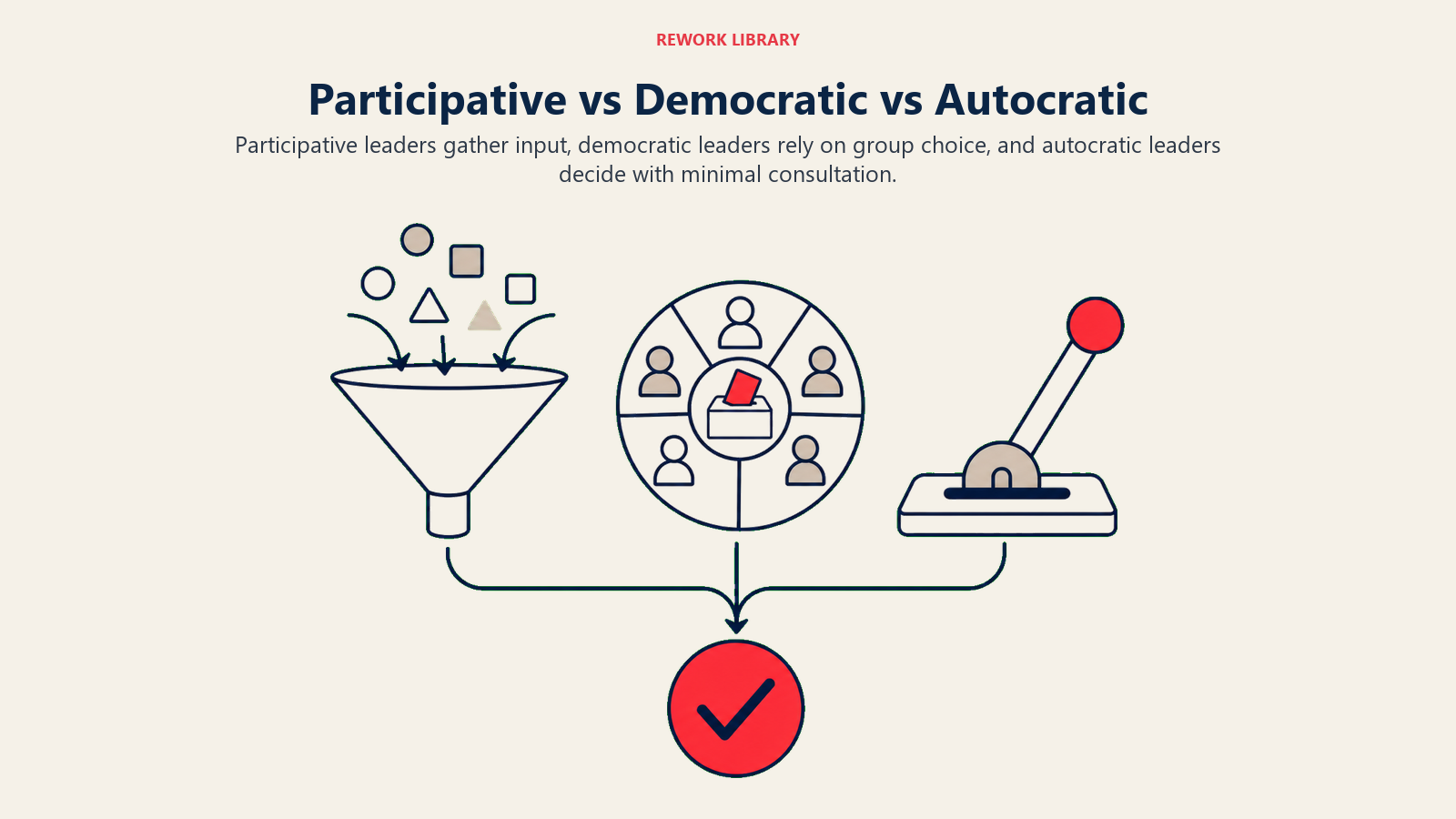
These three leadership styles often get used interchangeably, and that creates real confusion. Here's how they actually differ.
| Dimension | Participative | Democratic | Autocratic |
|---|---|---|---|
| Who decides | Leader (after consulting team) | Group (by consensus or vote) | Leader alone |
| Team input | Actively solicited | Central to the process | Minimal or none |
| Decision speed | Moderate | Slower | Fast |
| Accountability | Stays with leader | Shared or unclear | Clearly with leader |
| Employee engagement | High | High | Lower |
| Best fit | Complex decisions needing expertise + fast enough execution | Policy-setting, values work, low-stakes decisions | Crisis, safety, time-critical calls |
The practical gap between participative and democratic is mostly about what happens when the discussion ends. A participative leader hears "we'd prefer option B," but if their analysis says option A is right, they choose A and explain why. A democratic leader typically goes with what the group decides.
Both styles share roots in the same Lewin-Lippitt-White research and Likert's systems framework. Democratic leadership is essentially a more group-sovereign variant. Neither is better in absolute terms; the right choice depends on the decision type, the team's expertise, and the stakes involved. Read the full comparison in the democratic leadership article.
The contrast with autocratic leadership is sharper. An autocratic leader controls the information flow and rarely explains reasoning. Participative leaders do the opposite: they share context openly so team input is actually informed.
At the other extreme, bureaucratic leadership follows prescribed rules and procedures with little room for team input. It prioritizes consistency and compliance over the kind of collaborative deliberation that defines participative management. And Theory Z, William Ouchi's framework derived from studying Japanese management practices, goes a step further than participative leadership: it advocates collective decision-making embedded in the organization's culture, with consensus as the default rather than a tool the leader selects situationally.
Benefits of participative leadership
Better decisions. No leader has full information on every problem. When you involve people closest to the work, you surface context that changes the outcome. A product manager consulting her engineers before a sprint trade-off call will catch implementation risks a pure top-down decision would miss.
Higher commitment. People execute decisions they helped shape with more energy than decisions handed to them. This isn't a soft consideration. It cuts re-work, resistance, and the passive compliance that kills execution quality.
Skill development. Involving team members in real decisions builds judgment and problem-solving skills over time. That compounds into a stronger team and a shallower bench-dependency on the leader.
Lower turnover. Employees who feel heard report higher job satisfaction. The psychological safety that participative environments build is one of the strongest predictors of team retention.
Better leader credibility. Leaders who invite input and explain their reasoning (even when they override it) are consistently rated as more trustworthy and fair. That credibility makes future decisions land better.
Drawbacks and when participative leadership fails
It's slower. Gathering input, running discussions, synthesizing perspectives, and explaining decisions takes time. In a genuine crisis, or when a decision needs to happen in minutes, participative process creates risk.
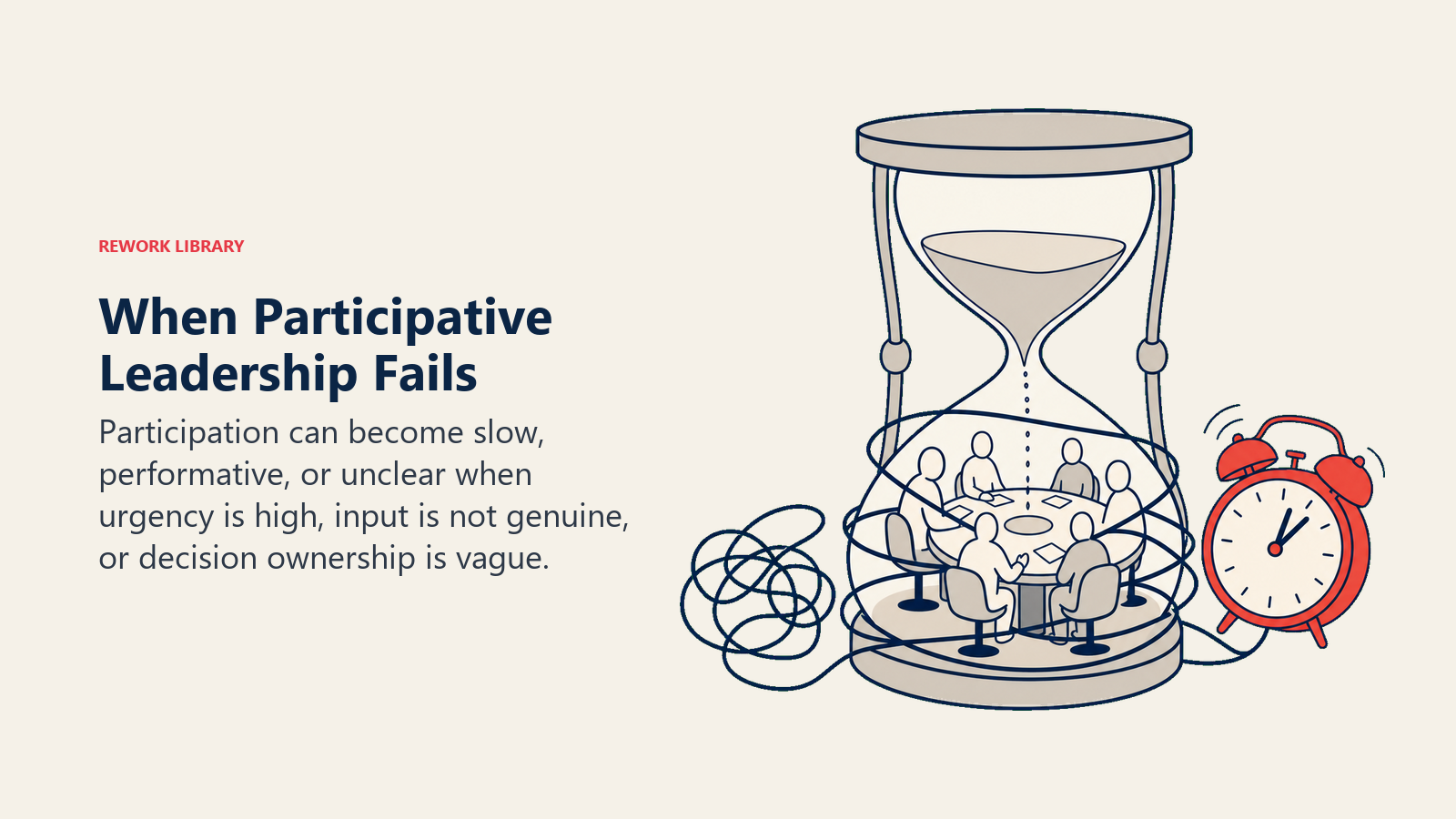
It can create false expectations. If team members believe their input always determines the outcome, they'll feel misled when the leader overrides them. The fix is clarity upfront: "I'm asking for your perspective, and I'll make the call."
It amplifies bad group dynamics. If one voice dominates your consultation process, or if quieter experts don't speak up, you get the form of participation without the substance. Facilitation skills matter.
It doesn't suit every team. A team of new hires or specialists in a new domain may not yet have the expertise to offer useful input on the hardest decisions. Seeking input from people who don't have relevant knowledge can waste time and frustrate them.
It can diffuse accountability. When a decision goes badly, a participative process can blur ownership. The leader needs to be clear that the team's input informs, and does not replace, the leader's accountability.
The Blake-Mouton Managerial Grid captures this tension well: high concern for people and high concern for production is the "team management" ideal, but it requires situational judgment to know when to emphasize which.
How to lead participatively
Step 1: Frame the decision clearly
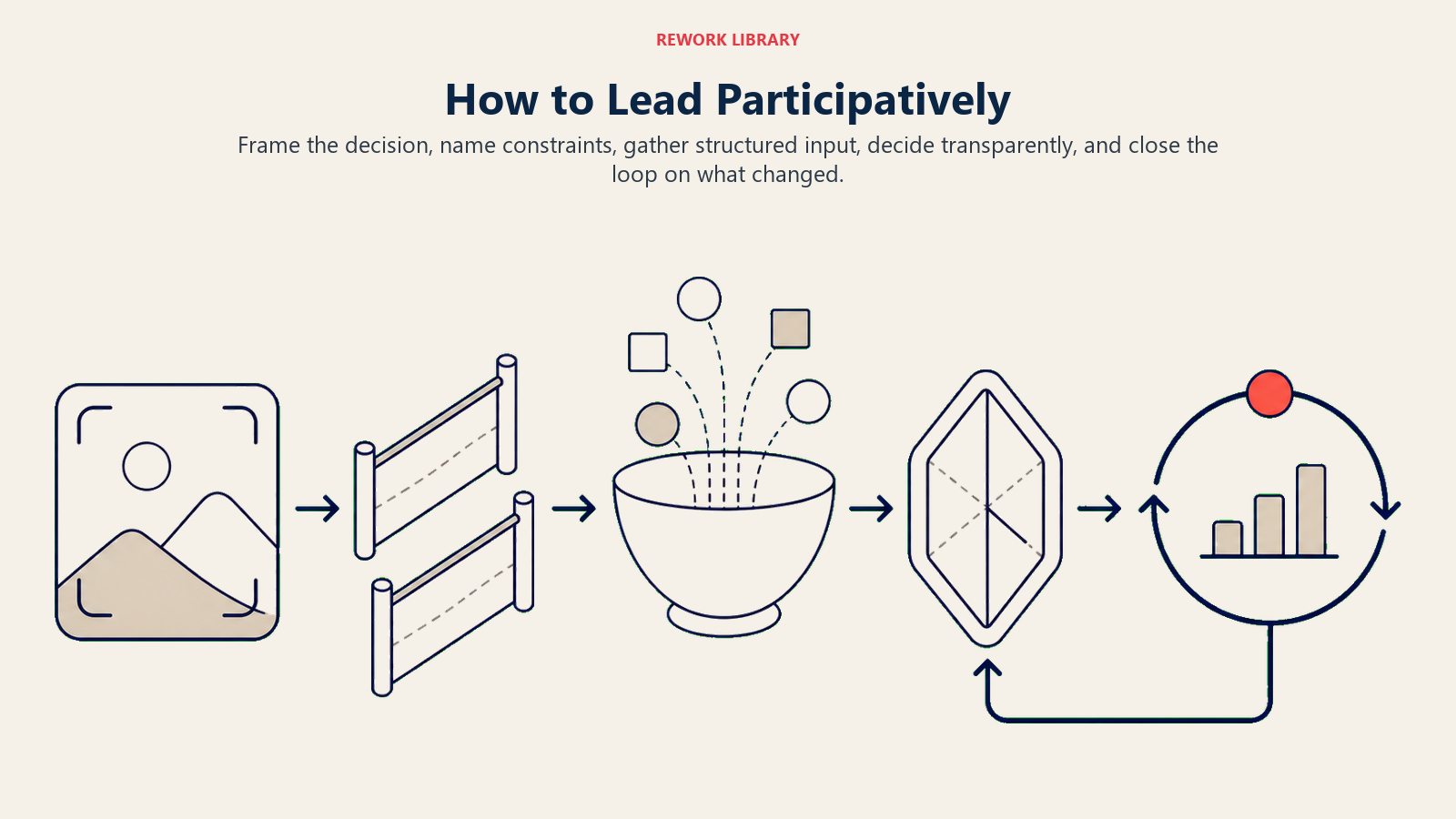
Before asking for input, name the decision, the constraints, and the timeline. "We need to choose a vendor by Thursday. Budget ceiling is $80K. I'm looking for perspective on reliability and integration fit." Vague asks produce vague input.
Step 2: Choose your involvement mode
Decide in advance whether you're consulting, seeking consensus, or delegating. Tell the team which mode you're in. This prevents the frustration that comes when people think they're deciding but the leader had already made up their mind.
Step 3: Create real space for dissent
Participative leadership fails when it becomes a rubber-stamp process. Ask directly for objections: "What's the strongest case against this approach?" Assign a devil's advocate if your team tends toward agreement. The psychological safety to disagree is the mechanism that makes consultation valuable.
Step 4: Close the loop on reasoning
Once you've made the call, explain it. Name what input changed your thinking and what you weighed differently. If you went against the team's preference, say so plainly and explain why. This is what separates a participative leader from one who performs consultation theater.
Step 5: Adjust based on stakes and expertise
Not every decision warrants the same depth of involvement. A low-stakes process call can be delegated. A high-stakes strategic call with legal, financial, or safety dimensions may warrant structured consultation but tighter leader control. Match the depth of involvement to the decision.
Step 6: Build the habit, not just the meeting
Participative leadership isn't a single conversation style. It shows up in how you structure standups (do people shape the agenda?), how you run planning cycles (does the team contribute to goals?), and how you handle post-mortems (does the team name what went wrong?). The Tannenbaum-Schmidt Leadership Continuum is a useful map for calibrating where to sit on the control-vs-delegation axis for different situations.
Participative leadership examples
| Context | What a participative leader does |
|---|---|
| Product roadmap | Runs structured input sessions with engineering, sales, and CS before locking priorities; names trade-offs and decides based on customer impact data |
| Team restructure | Shares the business rationale, asks each function lead for practical concerns, adjusts the plan based on feasibility feedback, then announces the final structure |
| Budget allocation | Invites team leads to propose resource needs with supporting logic; reviews together; allocates based on strategy, not loudest voice |
| Crisis response | Pulls the two or three people with the most relevant expertise, gathers input in 15 minutes, then decides and moves; skips broad consultation when time is short |
| Policy change | Drafts a proposal, runs a structured comment period with the affected team, revises based on substantive feedback, then finalizes with a clear owner |
| Hiring decision | Runs structured interviews with multiple team members, collects independent ratings, discusses as a group, then makes the final call as the hiring manager |
Real-world leaders associated with participative approaches include Satya Nadella's "growth mindset" model at Microsoft (where listening and learning from employees reset a stagnating culture), and Alan Mulally's famous Business Plan Review process at Ford, where participative transparency among leaders across divisions broke down the silo culture that was bankrupting the company.
Participative leadership rewards leaders who are honest about authority and disciplined about process. Involve the team, name the trade-offs, make the call, explain the reasoning. Done consistently, that cycle builds the kind of team that earns trust in both directions.

Senior Operations & Growth Strategist
On this page
- What is participative leadership?
- Types of participative leadership
- Participative vs democratic vs autocratic leadership
- Benefits of participative leadership
- Drawbacks and when participative leadership fails
- How to lead participatively
- Step 1: Frame the decision clearly
- Step 2: Choose your involvement mode
- Step 3: Create real space for dissent
- Step 4: Close the loop on reasoning
- Step 5: Adjust based on stakes and expertise
- Step 6: Build the habit, not just the meeting
- Participative leadership examples