Sales Call Recording and Transcript Analysis: The Meeting Intelligence Pattern
Turn this article into takeaways for your work.


Each assistant summarizes the article only for you and suggests best practices for your work.
Every sales call is a goldmine. Buyers tell you exactly what they care about, what they're afraid of, what a competitor told them, and what they need to hear before they'll sign. Reps log maybe 15% of that into the Customer Relationship Management (CRM) system, filtered through whatever they remembered and had time to type.
The rest disappears when the call ends.
Meeting Intelligence is the ACE Framework (Ingest, Analyze, Predict, Generate, Execute) pattern that changes this: Ingest the recording, Analyze the transcript, Generate structured outputs (CRM notes, coaching flags, summary emails), and Execute the updates across the systems that need them. The result is a searchable, analyzable, institutional memory of every sales conversation your team has ever had.
This is the anchor article for Pattern 2: Meeting Intelligence for Sales. It covers the technology, the business case, and the compliance requirements you can't ignore.
The Meeting Intelligence pattern
The Meeting Intelligence pattern runs through four ACE capabilities:
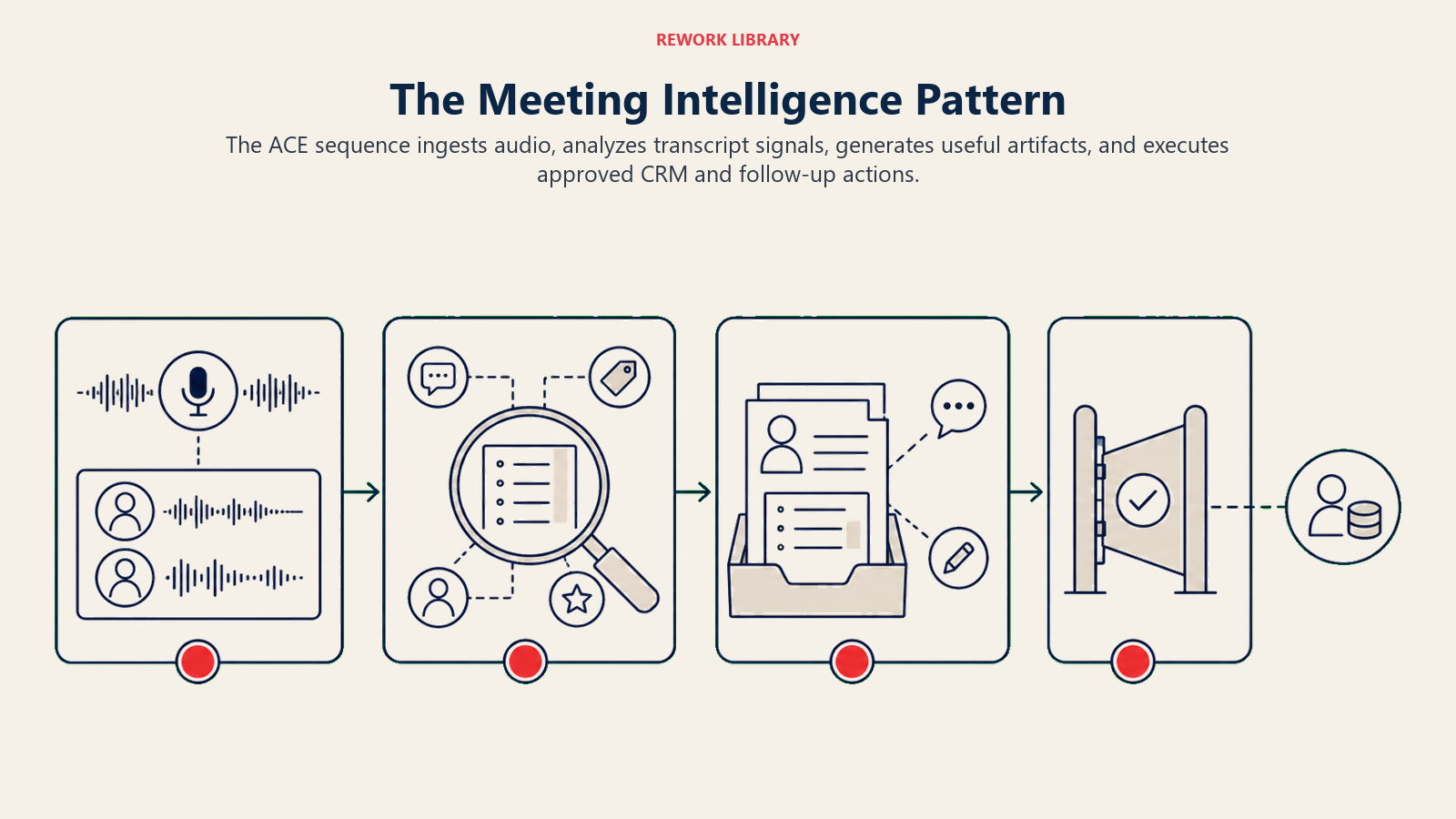
Ingest: Audio or video recording of the call is captured. Speaker diarization separates the voices into distinct speaker tracks. Speech-to-text converts audio to a timestamped transcript.
Analyze: The transcript is processed for structured signals: topics discussed, objections raised, sentiment by speaker and over time, talk-time ratios, question frequency, competitor mentions, next-step commitments, and pricing discussion moments.
Generate: From the analysis, AI drafts CRM notes, a call summary, coaching flag tags, and a follow-up email draft. The outputs are artifacts in draft form, awaiting rep confirmation or auto-push depending on configured confidence thresholds.
Execute: Approved or high-confidence outputs push to the CRM (updating deal stage notes, creating tasks, logging next-step dates), send follow-up emails, and route coaching flags to the manager's review queue. Execute is what separates a system that surfaces insights from one that acts on them.
This is how an AI Sales Operator converts a 45-minute conversation into 3 minutes of rep administrative work rather than 15. And the coverage difference it creates is what the next section makes concrete.
Key Facts: Meeting Intelligence Impact
- An average enterprise Account Executive (AE) spends 15-20 minutes per discovery call updating CRM notes; AI Meeting Intelligence reduces that to a 2-3 minute review-and-confirm workflow, recovering 75-100 minutes of selling time per day for reps running 5 calls
- Manager call review sampling without AI covers 5-10% of all conversations; AI Meeting Intelligence covers 100% of recorded calls with no additional headcount, providing coaching signal coverage at 10-20x human scale
- Gartner identifies conversation intelligence as one of the core components of revenue intelligence platforms, noting how it captures and analyzes seller interactions to surface coaching opportunities and pipeline signals at the team level
The business case for call recording
Note-taking time elimination: An average enterprise AE spends 15-20 minutes per discovery call updating CRM notes afterward. At 5 calls per day, that's 75-100 minutes of administrative time that could go to selling. Meeting Intelligence reduces that to a 2-3 minute review-and-confirm workflow. HBR's analysis of how generative AI will change sales points to exactly this category of task as among the highest-leverage automation targets in the sales function: routine note-taking and follow-up drafting that currently consumes disproportionate rep time.
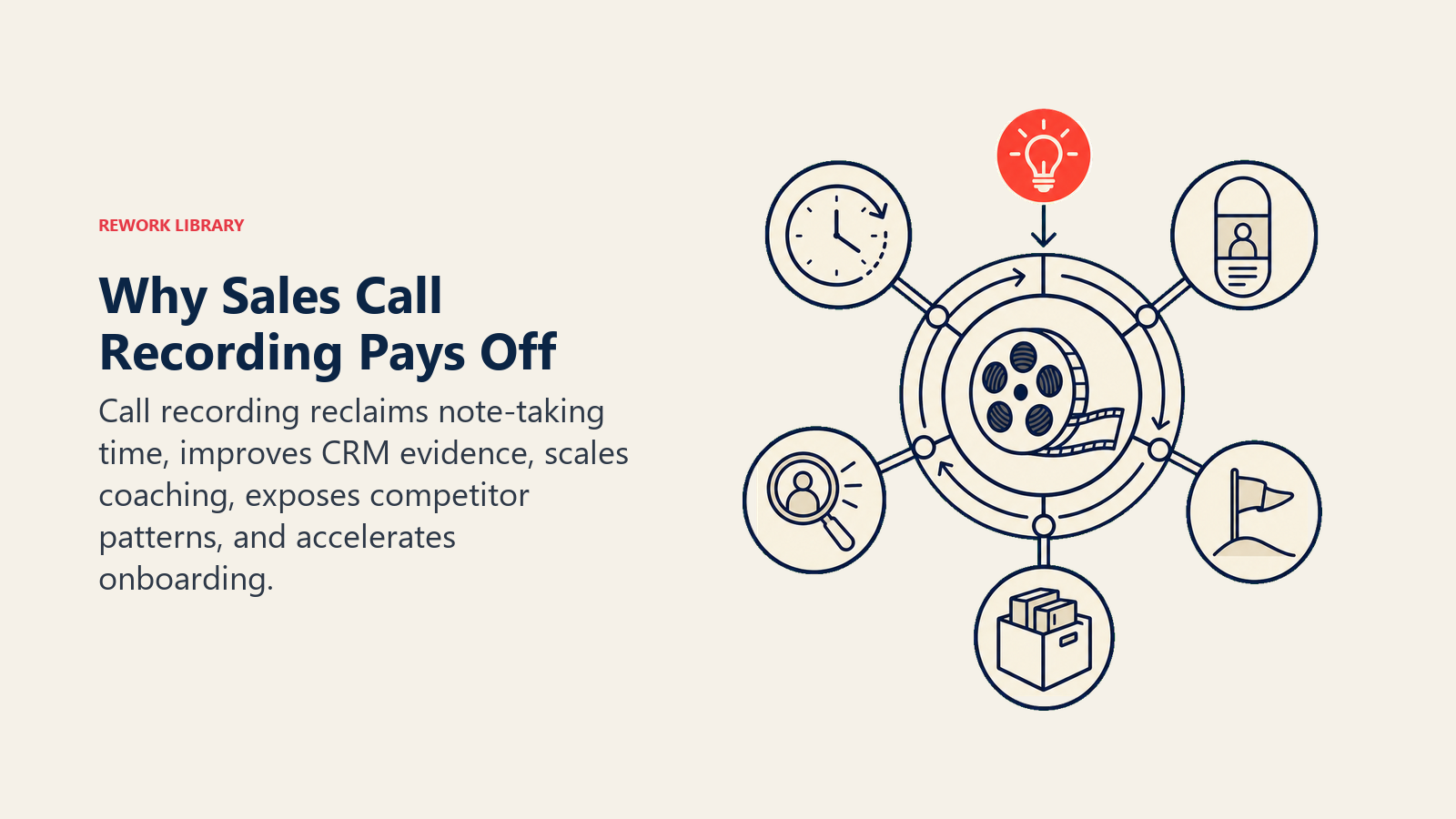
CRM data quality: Rep-logged notes reflect what reps want to record, filtered by memory and motivation. AI-extracted notes capture what buyers actually said. Deal risk signals like "we're also looking at Competitor X" or "we can't move until Q4 budget approval" live in call recordings, not in CRM fields, unless something extracts them.
Coaching at scale: A manager with 10 direct reports can't listen to 50 calls per week. AI call scoring surfaces the 5 calls that need attention based on risk signals, so managers spend their limited coaching time where it has the most impact. Gartner identifies conversation intelligence as one of the core components of revenue intelligence platforms, specifically noting how it captures and analyzes seller interactions to surface coaching opportunities and pipeline signals. See coaching reps with conversation intelligence for the full coaching workflow.
Competitive intelligence: What objections do buyers raise most often? What are competitors saying about your product? Which features come up in deals that close vs. deals that don't? This data exists in call recordings. Meeting Intelligence makes it queryable.
Onboarding acceleration: New reps can listen to the top 20 discovery calls by close rate from their predecessor, curated by AI rather than depending on a manager to hand-pick examples.
The 5 Ms of Call Intelligence
The 5 Ms of Call Intelligence is a framework for organizing what Meeting Intelligence extracts and why each output matters to sales operations. The five Ms are: (1) Macro Patterns, team-level aggregates like average talk ratio, question frequency per call type, and win rate by discovery methodology; (2) Micro Moments, specific call instances where a rep handled an objection well or missed a buying signal; (3) Mentions, explicit references to competitors, features, timelines, or budget constraints that the buyer named; (4) Misses, questions a rep should have asked based on the deal stage but didn't, or commitments made by buyers that weren't logged in the CRM; and (5) Momentum, sentiment arc data showing whether buyer engagement increased or decreased during the call. Macro patterns inform coaching programs. Micro moments inform individual coaching sessions. Mentions, Misses, and Momentum inform deal management decisions.
How transcription works at enterprise quality
Not all transcription is equal. Quality factors matter for downstream analysis:
Speaker diarization: Separating which voice belongs to which speaker. In a two-person call this is straightforward. In a multi-stakeholder call with 4 people, accurate diarization requires distinct audio tracks (Zoom, Teams, and Google Meet all support this) and a model trained on overlapping speech. Gong and Chorus handle enterprise multi-speaker scenarios significantly better than consumer transcription APIs.
Filler word and crosstalk handling: "Um," "uh," and overlapping speech shouldn't confuse topic extraction. Enterprise tools strip or annotate fillers rather than treating them as semantic content.
Technical vocabulary tuning: A cybersecurity software vendor's calls will include terminology like "zero-trust architecture," "SIEM integration," and "SOC2 Type II." Out-of-the-box transcription models trained on general English may render these incorrectly or inconsistently, breaking keyword extraction. Better tools allow custom vocabulary lists or domain-tuning.
Confidence thresholds: Low-confidence transcription segments (heavily accented speech, background noise, phone audio) should be flagged rather than silently mis-transcribed. Silent errors in transcript downstream corrupt coaching metrics and CRM data.
Integration with meeting platforms: Gong, Chorus, and Fireflies all offer native integrations with Zoom, Microsoft Teams, and Google Meet that enable reliable audio capture. Phone call recording from dialers (Outreach, Salesloft, Aircall) requires a different integration path than video call recording.
What gets extracted from transcripts: the taxonomy
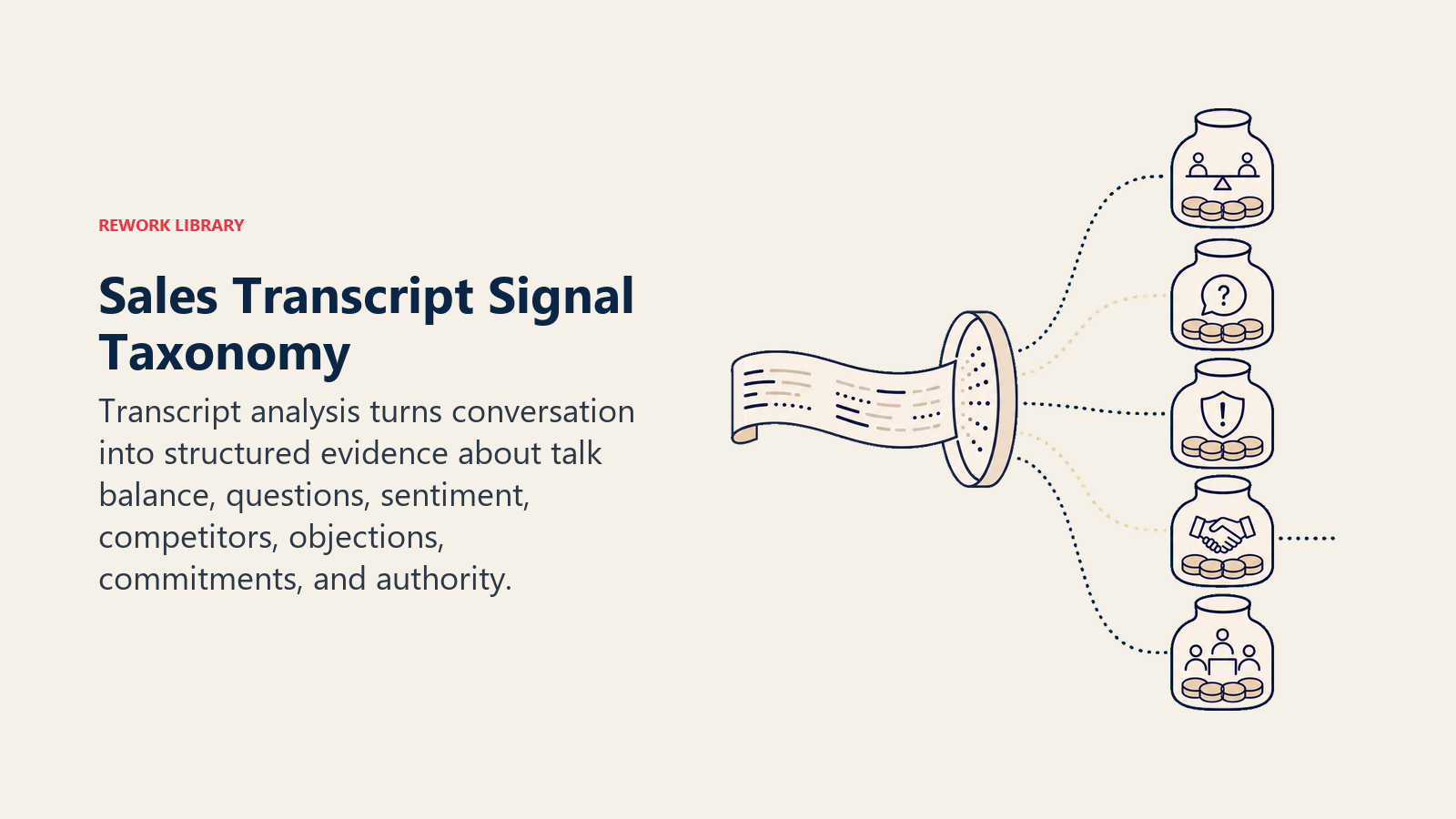
Beyond words on a page, a well-built Meeting Intelligence pipeline extracts these categories of signal:
| Signal category | What it measures | Business use |
|---|---|---|
| Talk-time ratio | Percentage of speaking time per participant | Rep coaching (ideal discovery: rep talks 40%, buyer 60%) |
| Question frequency | Count and rate of questions asked by rep | Discovery quality indicator; top performers ask more questions |
| Sentiment trend | Buyer sentiment arc across the call | Risk flag if buyer sentiment drops in second half |
| Competitor mentions | Specific competitor names raised by buyer | Competitive intelligence, deal risk |
| Objection keywords | Pricing, timeline, budget, authority objections | Coaching, objection preparation |
| Next-step commitments | Verbal commitments to a next meeting, demo, or action | CRM pipeline stage update |
| Pricing discussion timing | When in the call pricing was introduced | Discovery methodology compliance (too early = bad) |
| Feature/pain topic matching | Which product features map to stated pains | Product feedback loop |
| Decision-maker identification | Buyer statements indicating authority level | Deal qualification data |
| Call energy markers | Speaking pace changes, long pauses | Buyer engagement signals |
The most valuable of these for Revenue Operations (RevOps) are: next-step commitments (directly affects CRM accuracy), competitor mentions (competitive intelligence), and talk-time ratio (coaching foundation). These three are where most teams should start before expanding to the full taxonomy.
CRM update workflow
Meeting Intelligence systems generate CRM updates with varying confidence levels, and how those are handled affects both data quality and rep adoption.
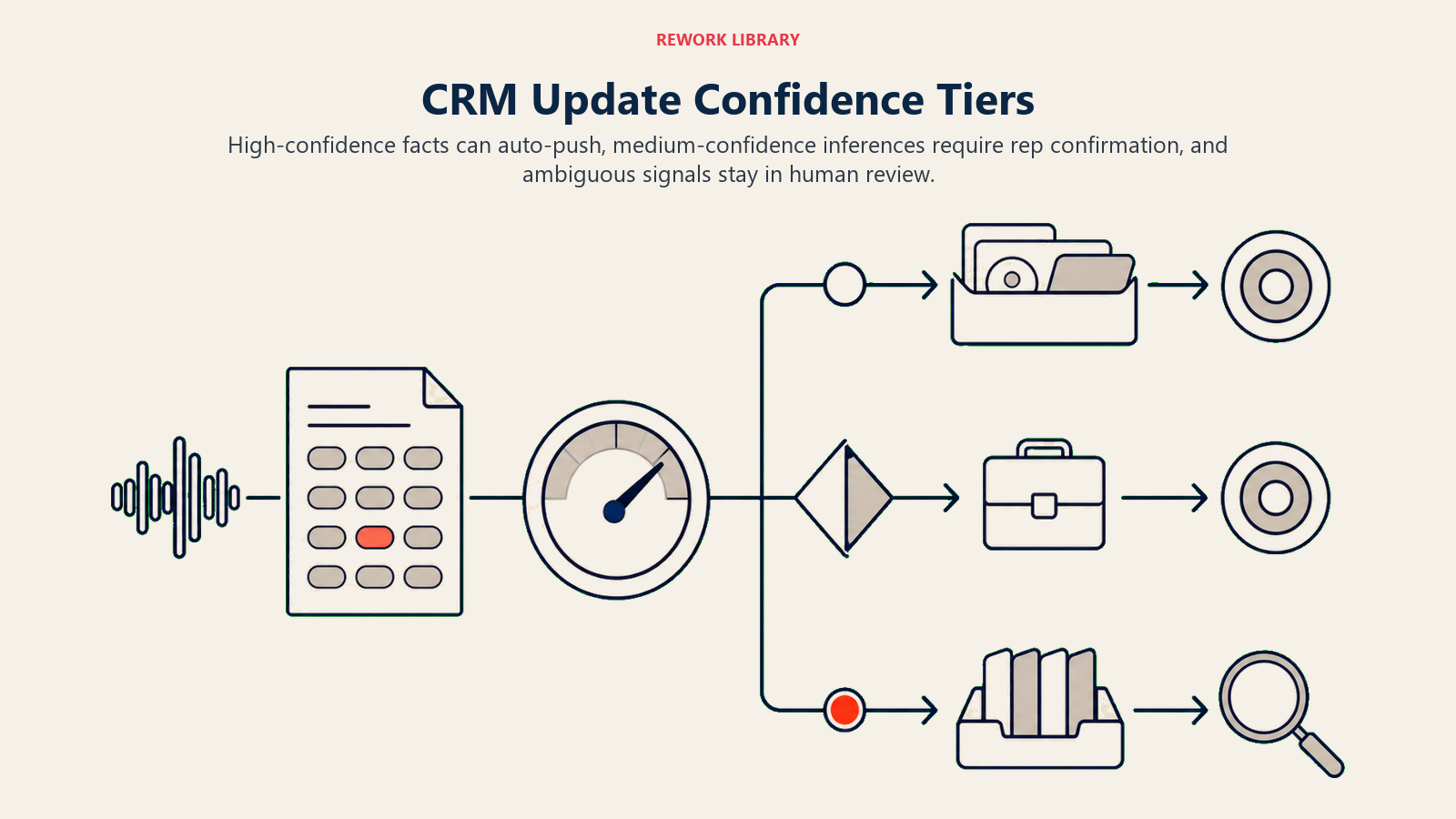
High-confidence auto-push: Clearly stated facts like "we're meeting again on June 15" or "their budget is $50K" can push directly to CRM fields without rep review. The threshold for auto-push should be set conservatively: only fields where the AI extracted a specific, unambiguous statement from the buyer.
Medium-confidence rep-review: Inferences like "buyer seems interested in the enterprise tier" or "decision may involve the CFO" go to the rep's review queue. The rep sees the evidence (transcript snippet) and confirms or edits before the CRM updates.
Low-confidence flagged: Ambiguous statements or complex sentiment signals go to a flag queue with the full transcript section highlighted. The rep or manager reviews the source material directly.
From call to CRM update automatically covers the full CRM integration workflow, including field mapping and audit trail requirements.
Compliance and consent: this section is not optional
Recording sales calls without proper consent is a legal exposure. The requirements vary by jurisdiction and call type, and getting this wrong is not a minor operational issue.
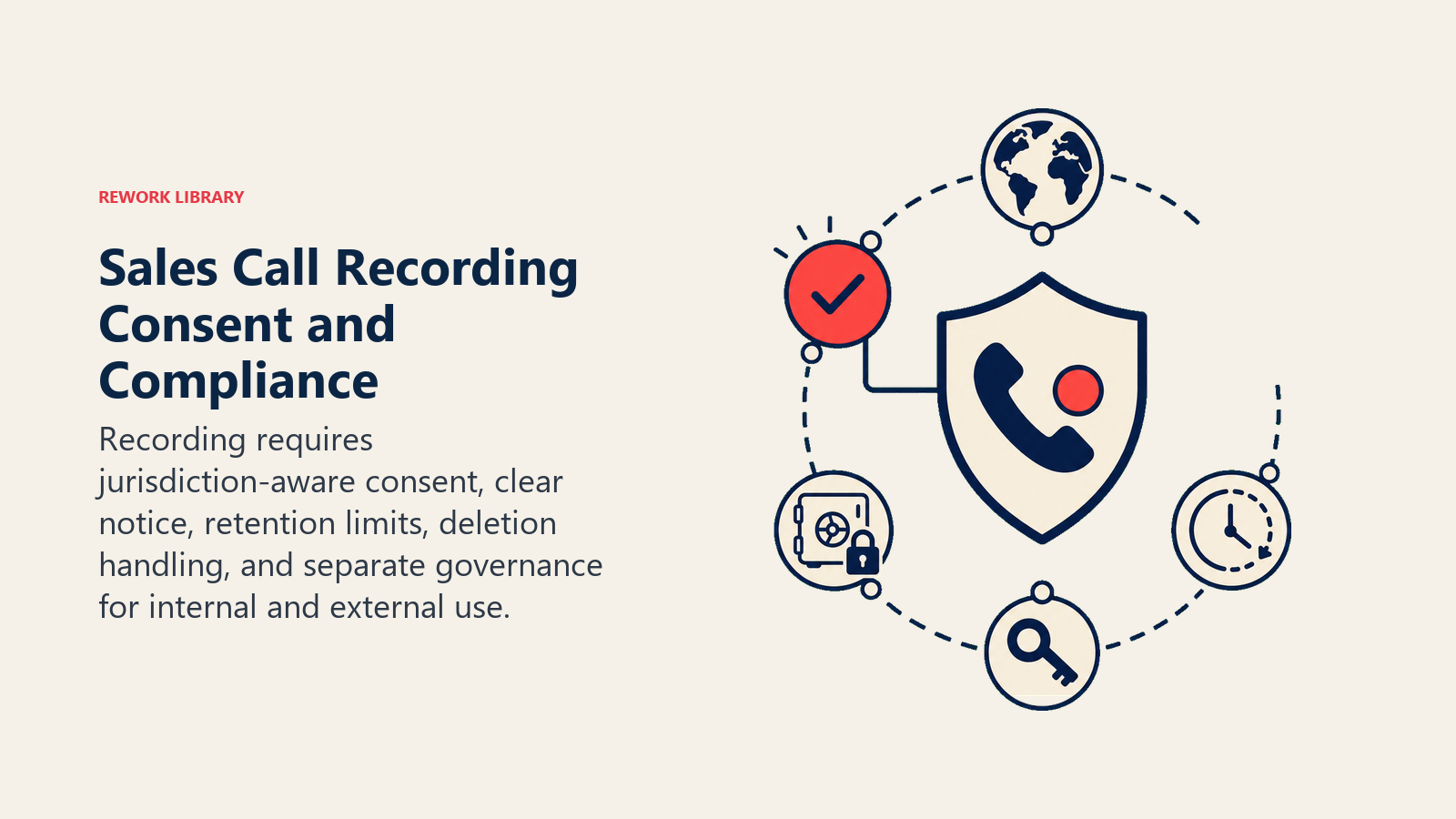
US federal law (Electronic Communications Privacy Act): Federal law requires at least one party to the call to consent to recording. In practice, this means the rep recording the call satisfies federal consent. But federal law is a floor, not a ceiling.
US state two-party consent laws: Several US states require all parties to consent:
- California (Penal Code 632): All-party consent required. Violation is a criminal offense, not just a civil liability.
- Illinois (Eavesdropping Act): All-party consent.
- Maryland (Wiretapping and Electronic Surveillance Act): All-party consent.
- Massachusetts (General Laws Chapter 272, Section 99): All-party consent.
- Pennsylvania, Washington, Florida: All-party consent.
If a prospect or customer is calling from or is located in a two-party consent state, you need their consent to record. Not their state on the CRM record, their actual location.
GDPR (EU and UK): Recording a call with an EU or UK-based person requires a lawful basis. Legitimate interest may apply for internal coaching recordings, but informing the data subject is mandatory. GDPR also requires data retention limits: you can't keep call recordings indefinitely. Define and enforce a retention policy.
CCPA (California Consumer Privacy Act): California residents have rights over their recorded data. If your business handles California consumer data, you need to disclose recording in your privacy policy and have a process for deletion requests.
How enterprise tools handle consent: Gong, Chorus, and Fireflies all offer automated pre-call bot notifications ("This call may be recorded for quality purposes") that play when the recording bot joins the meeting. This handles notification for video call platforms. For phone calls, the dialer system should play a consent notice before the rep joins. Configure these before you deploy, not after your first compliance question.
Internal coaching vs. external compliance: Recordings used only internally for coaching have different requirements than recordings shared with third parties or used in customer-facing outputs. Keep the use cases separate in your governance documentation.
Vendor snapshot
Gong: The enterprise market leader for conversation intelligence. Strongest on analytics depth: aggregate talk patterns across the team, deal risk scoring, and competitive battle card triggering from transcript keywords. Expensive ($100-200+ per user per month at enterprise scale). Best ROI for teams of 20+ AEs with dedicated RevOps resources to build out analytics.
Chorus by ZoomInfo: Strong on transcript accuracy and ZoomInfo data integration (automatically enriches call participants with ZoomInfo firmographic data). Good coaching workflow. More affordable than Gong at mid-market scale. Native ZoomInfo integration is valuable if you're already paying for ZoomInfo.
Fireflies.ai: The most accessible price point. Good transcription quality, straightforward CRM integrations, and a solid meeting summary workflow. Less depth in aggregate analytics than Gong or Chorus. Well-suited for teams wanting core Meeting Intelligence without enterprise pricing.
Salesloft Rhythm / Conversation Intelligence: Native to the Salesloft platform. If your outbound sequencing lives in Salesloft, keeping conversation intelligence in the same platform reduces workflow friction. Less powerful as a standalone analytics tool but strong for teams already invested in the Salesloft stack.
ExecVision (by MediaFly): Strong on coaching-specific workflows. Call scoring rubrics, manual and AI-assisted, with dedicated coaching modules. Less focus on CRM automation, more on structured rep development.
The right choice depends on your team size, existing stack, and whether analytics depth or workflow simplicity is the primary priority.
Rework Analysis: The competitive intelligence use case is the most underutilized output of Meeting Intelligence in most deployments. Teams set up call recording for coaching and note-taking, get ROI from that, and never build the aggregate intelligence workflow. But if you have 6 months of transcript data and you query "which competitor was mentioned in deals we lost in the last 90 days," you have a sales leadership insight that used to require a quarterly survey and rep memory. The same query applied to "which objections come up in deals that stall past 30 days" gives your product and marketing teams real signal about message-market fit. Build the aggregate query workflows in your first 90 days, not 18 months later when you remember the feature exists.
What about objection mining?
One of Meeting Intelligence's highest-value secondary outputs is competitive and objection intelligence. When you aggregate transcript analysis across hundreds of calls, patterns emerge: which objections come up in deals that stall, which competitor is most often mentioned in late-stage losses, which features buyers ask about most in deals that close.
This is intelligence that didn't exist before call recording because it lived in individual memories, not structured data. A sales leader who can look at the last 90 days of transcripts and answer "what are buyers most worried about this quarter?" has a different kind of insight than one reading rep-filtered CRM notes.
The honest summary
Call recording isn't surveillance. It's institutional memory.
Without Meeting Intelligence, every call ends and most of what was learned disappears. Reps carry their learnings personally. Coaching is based on memory and gut feel. Competitive intelligence lives in Slack threads. When a rep leaves, they take their knowledge with them.
With Meeting Intelligence, the call record persists, the insights compound, and the team improves on data rather than anecdote. But none of this is possible without solving compliance first. Recording calls in California or Germany without proper consent creates legal exposure that negates the operational value.
Set up consent flows before you turn on recording. Define retention policies. Train reps on what recording is for. Then the system works as designed: as a coaching and intelligence layer, not a surveillance tool.
Frequently Asked Questions
What is sales call recording and transcript analysis?
Sales call recording captures audio from sales conversations (discovery calls, demos, negotiations) and transcript analysis uses AI to extract structured data from those recordings: talk ratios, competitor mentions, objections raised, next-step commitments, sentiment arcs, and buyer decision signals. The result is a searchable institutional memory of every conversation, replacing the rep-filtered CRM notes that currently capture about 15% of what's said on a call.
What is the Meeting Intelligence pattern?
The Meeting Intelligence pattern is an ACE Framework Level 2 pattern that runs four capabilities in sequence: Ingest (capture audio, diarize speakers, transcribe), Analyze (extract structured signals from transcript), Generate (draft CRM notes, call summary, coaching flags, follow-up email), and Execute (push approved updates to CRM, send follow-up, route coaching flags to manager). It's the core AI pattern behind tools like Gong, Chorus, and Fireflies.
How much time does AI call recording save sales reps?
An average enterprise AE spends 15-20 minutes per discovery call on post-call CRM note-taking. AI Meeting Intelligence reduces that to 2-3 minutes for review-and-confirm. For a rep running 5 calls per day, that's 75-100 minutes of recovered selling time daily. At scale, McKinsey estimates this category of admin automation (routine note-taking, follow-up drafting) as among the highest-leverage AI applications in sales.
Is sales call recording legal?
Legality depends on jurisdiction and call type. US federal law requires one-party consent, but multiple US states including California, Illinois, Maryland, Massachusetts, and Washington require all-party consent. EU/UK GDPR requires informing the data subject before recording and enforcing data retention limits. Automated pre-call consent notifications from tools like Gong, Chorus, and Fireflies handle most video call consent requirements. Phone call recording requires a separate consent flow at the dialer level. Configure consent flows before activating recording.
What are the 5 Ms of Call Intelligence?
The 5 Ms are: Macro Patterns (team-level aggregates like talk ratios and win rates by methodology), Micro Moments (specific call instances with coaching value), Mentions (explicit competitor, feature, timeline, or budget references from the buyer), Misses (questions not asked or commitments not logged), and Momentum (buyer sentiment arc through the call). Macro patterns inform team coaching programs. Micro moments inform individual sessions. The remaining three directly affect deal management quality.
Which Meeting Intelligence tool is best for a mid-market sales team?
For teams prioritizing analytics depth and team-level insights with a budget for enterprise pricing, Gong is the market leader. For teams wanting strong transcription quality with ZoomInfo data integration at a more accessible price point, Chorus by ZoomInfo is the leading alternative. For teams needing core Meeting Intelligence capabilities at the most affordable price point, Fireflies.ai provides solid transcription, CRM integrations, and meeting summary workflows. The right choice depends on team size, existing tech stack, and whether analytics depth or workflow simplicity is the primary priority.
What is the most valuable output of call transcript analysis for RevOps?
For sales operations, next-step commitments (which directly improve CRM pipeline accuracy), competitor mentions (which enable real-time competitive intelligence without rep-filtered CRM notes), and coaching signals (talk ratio, question frequency, objection patterns) are the highest-value outputs. For product and marketing, aggregate objection frequency data and feature request patterns extracted from transcripts provide signal that rep-mediated feedback loops miss.
Learn More
- What Is an AI Sales Operator?
- Coaching Reps With Conversation Intelligence
- Objection Mining: What Buyers Actually Push Back On
- Discovery Question Compliance With AI Review
- From Call to CRM Update Automatically
- Choosing a Conversation Intelligence Tool
- Meeting Intelligence: From Audio to Action Items
- Execute: When AI Changes External State

Co-Founder, Rework.com
On this page
- The Meeting Intelligence pattern
- The business case for call recording
- The 5 Ms of Call Intelligence
- How transcription works at enterprise quality
- What gets extracted from transcripts: the taxonomy
- CRM update workflow
- Compliance and consent: this section is not optional
- Vendor snapshot
- What about objection mining?
- The honest summary
- Learn More