What Is an AI Agent? A Plain-English Definition (2026)
Turn this article into takeaways for your work.


Each assistant summarizes the article only for you and suggests best practices for your work.
"AI agent" gets used for everything from a fancy chatbot to a full autopilot. Most of that is marketing. This page gives you a working definition you can use to tell a real agent from a rebranded feature, then walks one concrete business example end to end. It's the anchor page for the whole AI Agents library, so start here and branch out to the specific blueprints from the links along the way.
An AI Agent in 30 Seconds
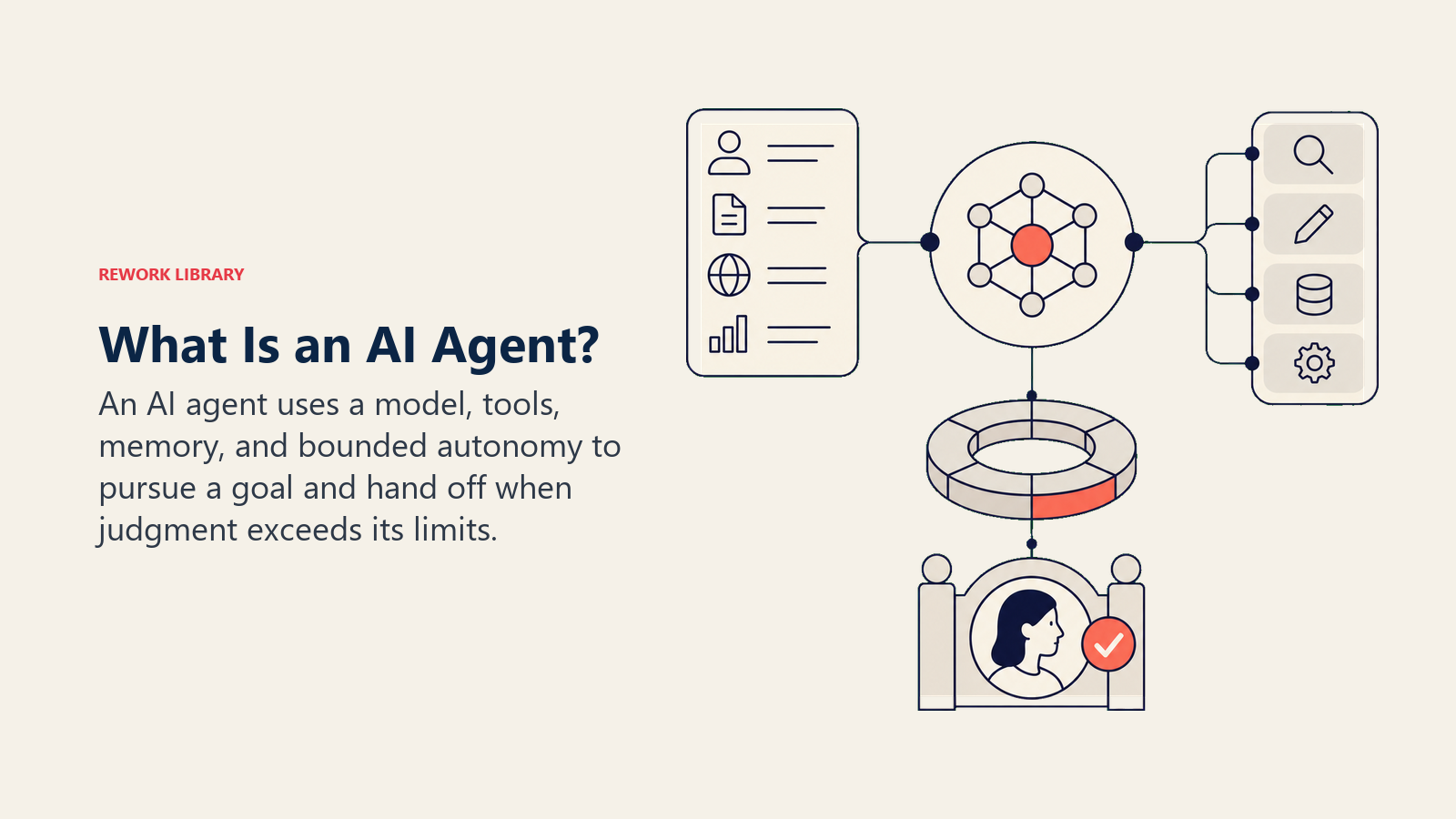
An AI agent is software that takes in information, decides what to do, and then does it, all toward a goal you set. It uses tools to act (send an email, update a record, book a meeting), it remembers what happened so it can act sensibly across steps, and it works with bounded autonomy: free to act inside limits you define, and required to hand off to a human at the edge of those limits.
Put simply, an agent is the loop of perceive, decide, act, repeat, pointed at an outcome. A plain language model just answers a prompt. An agent uses a language model as its brain but adds the parts that let it get something done in your systems.
The Five Parts That Make Software an Agent
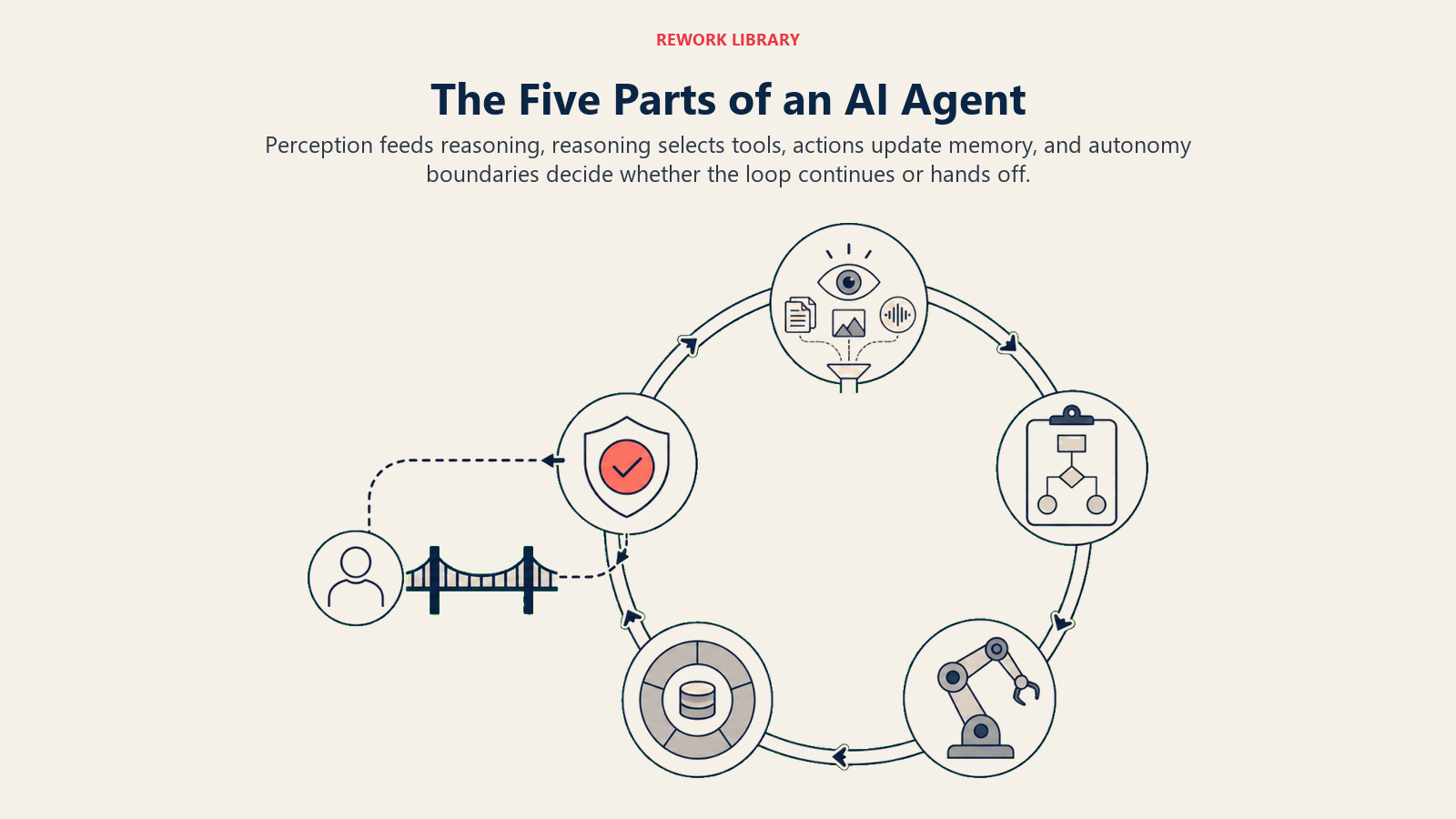
Software earns the "agent" label when it has all five of these, not just the first one. Miss a couple and you have a chatbot or a script, not an agent.
| Part | What it means | Without it you get |
|---|---|---|
| Perception | It reads inputs: a new email, a form submission, a CRM change, a support ticket | Something you have to feed by hand |
| Reasoning and planning | It decides the next step and can sequence several steps toward the goal | A single canned response |
| Tools and actions | It can actually do things in your stack, not just talk about them | A chatbot that suggests but never executes |
| Memory | It recalls the conversation, the account, and what it already tried | An agent that repeats itself and loses the thread |
| Bounded autonomy | It acts freely inside set limits and hands off past them | Either a rigid script or a risky free-for-all |
The order matters. Perception feeds reasoning, reasoning picks a tool, the tool takes an action, memory records what happened, and the boundary decides whether the agent keeps going or taps a human. That loop is the whole idea.
Bounded autonomy is the part people underrate. A good agent isn't the one that does the most on its own. It's the one that knows exactly where its judgment runs out and stops there. Every blueprint in this library spends more words on the handoff than on the automation, and that's on purpose.
Agent vs Model vs Chatbot vs Workflow
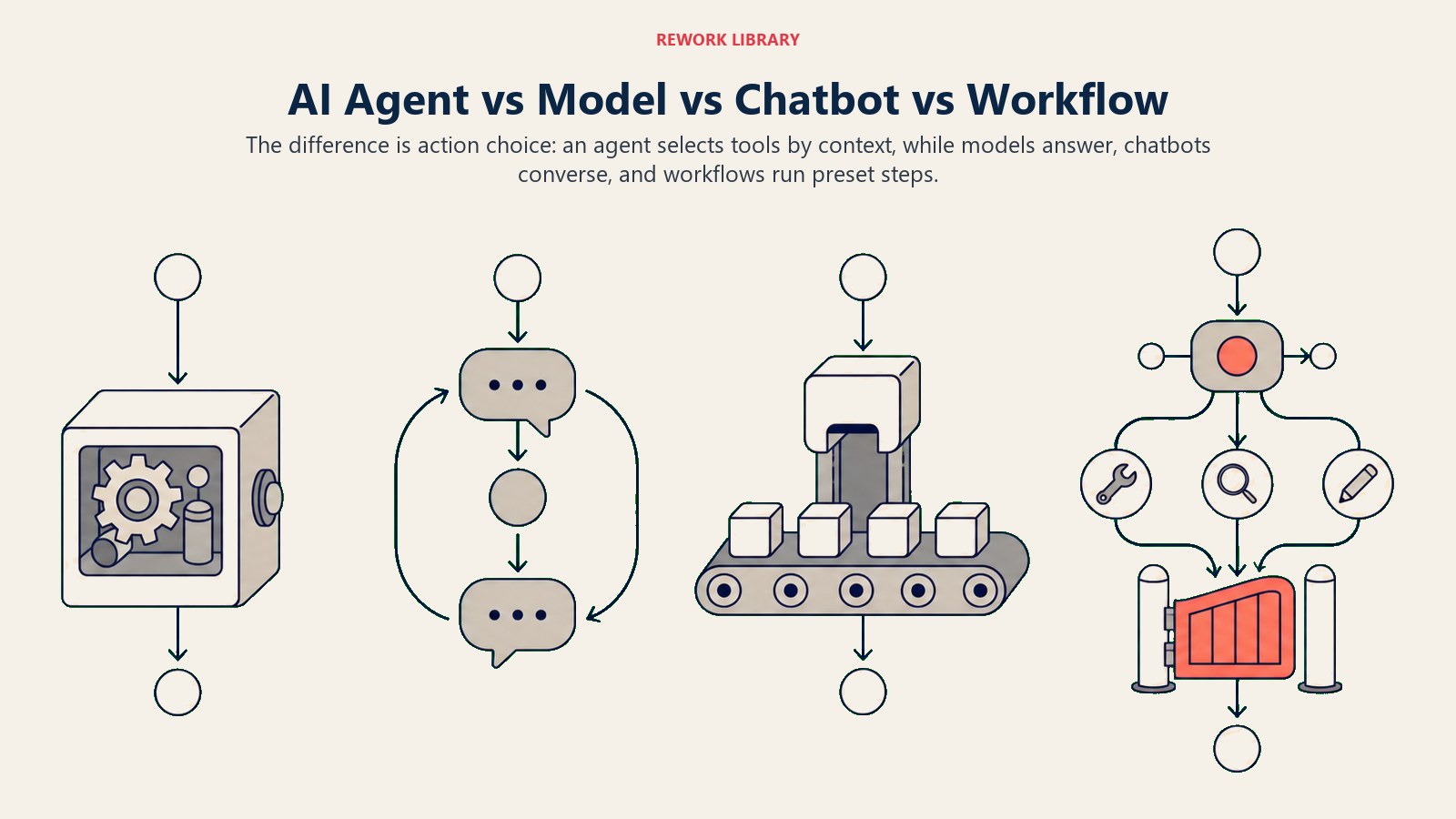
These four get blurred together constantly. Here's how they actually differ.
| Plain LLM / model | Chatbot | Fixed automation / workflow | AI agent | |
|---|---|---|---|---|
| Core job | Answer a prompt | Hold a scripted conversation | Run a preset sequence of steps | Reach a goal, choosing steps as it goes |
| Takes actions in your tools | No | Rarely, and only preset ones | Yes, but only the exact steps coded | Yes, picks the right action for the situation |
| Handles the unexpected | Guesses from text | Falls back to "I didn't get that" | Breaks or skips the case | Reasons about it, then acts or hands off |
| Memory across steps | None by default | Session only | State it's told to track | Working memory of the task and account |
| Best for | Drafting, summarizing, Q&A | FAQ deflection, menus | Repeatable, unchanging processes | Judgment-light work with variation and clear rules |
A plain model is the engine. A chatbot is a conversation wrapper. A workflow is a fixed pipeline that does the same steps every time. An agent is the model plus tools plus memory plus a goal, deciding which steps to run for this specific case.
The fastest test: can it take an action in your systems on its own, and does it choose that action based on the situation rather than a hardcoded path? If yes to both, it's an agent. A rules-based automation still has its place, and often it's the right, cheaper choice. The difference is that an automation follows the map, while an agent reads the terrain.
A Worked Example: The AI SDR Agent
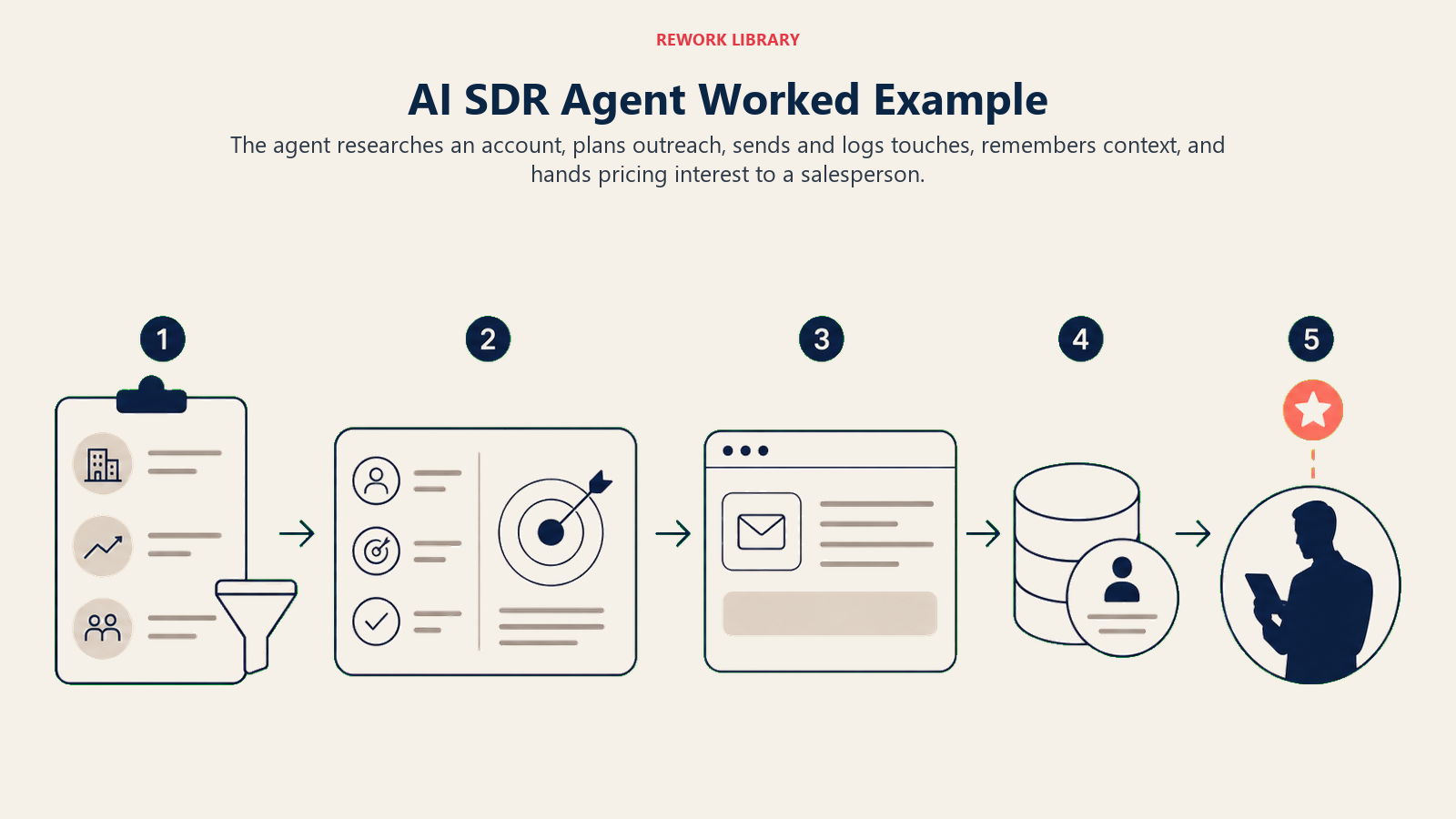
Abstract definitions only get you so far. Here's the loop running on a real business function, an outbound sales development rep, using the AI SDR Agent blueprint.
Goal you set: book qualified discovery calls for the AE team, from a list of target accounts, without a human writing each message.
- Perceive. A new account lands on the target list. The agent reads firmographic and intent data (company size, industry, recent hiring, funding) and finds the right contact by role.
- Reason and plan. It checks the account against your ideal customer profile. Good fit, verified email on file, no existing relationship in the CRM. So the plan is a three-step personalized sequence, leading with the angle that fits this account best.
- Act with tools. It drafts the sequence from real account data, enrolls the contact, and sends step one during the prospect's business hours. Then it logs the touch in the CRM.
- Remember. Three days pass with no reply. The agent recalls that step one already went out and which angle it used, so step two comes from a different hook instead of repeating itself.
- Stay in bounds, then hand off. A reply comes back: "Interesting, can you send pricing?" That's a buying signal and a pricing question, both outside the agent's limits. It stops the sequence, classifies the reply as interested, moves the lead to the "replied" stage, and pings the assigned AE with a five-second summary: who this is, what they said, what the agent already tried. A human takes the pricing conversation from here.
Notice what the agent did and didn't do. It personalized and sent at scale, followed up on time, and read the reply well enough to know it had reached its edge. It did not quote a price, negotiate, or improvise past its rules. That split, high-volume repeatable work automated, judgment calls escalated, is what a well-built agent looks like in production. The same shape holds for an AI Support Triage Agent reading tickets or an AI Reply Agent answering inbound messages: perceive, decide, act, remember, then hand off at the limit.
Where Agents Fit in a Company
Agents don't replace a department. They take the repeatable, rule-bound slice of a role so people can spend their time on the parts that need a human. A useful way to scope one is by function, which is exactly how this library is organized:
- Sales and lead: research accounts, run outbound, qualify inbound, route leads. See the AI SDR Agent and AI Lead Qualifier Agent.
- Support and success: triage tickets, answer from your docs, catch churn risk. See the AI Support Triage Agent.
- Marketing, operations, finance, HR, and IT: draft content, clean CRM data, chase overdue invoices, screen resumes, resolve helpdesk tickets.
The pattern that decides whether an agent fits: high volume, clear rules for the common cases, and a clean handoff for the rest. If every instance needs human judgment, an agent is the wrong tool. If the work is truly identical every time with zero variation, a plain fixed automation is cheaper and more predictable. Agents earn their keep in the middle, where the work repeats but the details vary.
The upside, when the fit is right, is real. McKinsey research on AI-powered marketing and sales reports that AI sales tools can increase leads by more than 50% and cut prospecting costs by up to 60% in mature implementations. On the support side, Gartner (March 2025) predicts that by 2029, agentic AI will autonomously resolve 80% of common customer service issues without human intervention, cutting operational costs by 30%. Those are category-level ceilings, not launch-day numbers. A new agent starts well below them and closes the gap as you tune its rules and handoffs.
If you want to place agents in a bigger picture of how businesses adopt AI, the AI framework foundation collection covers the building blocks that stack up into agents like these.
Key Facts
- An AI agent perceives inputs, decides, and takes actions toward a goal using tools, with memory and bounded autonomy, handing off to a human at its limits.
- The five parts: perception, reasoning and planning, tools and actions, memory, and bounded autonomy. All five, or it's a chatbot or a script.
- The quick test: it takes an action in your systems on its own, and it chooses that action based on the situation, not a fixed path.
- Agents fit high-volume, rule-bound work with a clean human handoff. They do not fit work that needs judgment every time.
Frequently Asked Questions about What Is an AI Agent? A Plain-English Definition
Is an AI agent the same as ChatGPT or a large language model?
No. A language model is the reasoning engine inside an agent. On its own it answers prompts but can't take actions in your tools, remember a task across steps, or work toward a goal. An agent wraps the model with tools, memory, and a goal so it can actually get work done.
How is an AI agent different from a chatbot?
A chatbot holds a conversation, usually from a script, and mostly answers questions. An agent takes actions in your systems (updating a CRM, booking a meeting, routing a ticket) and chooses those actions based on the situation. Many "chatbots" are being relabeled as agents, so use the test above: real actions, chosen by context.
Is an AI agent just automation with a new name?
No. A fixed automation runs the same coded steps every time and breaks on anything unexpected. An agent reasons about each case and picks its next step, which is why it can handle variation an automation can't. When the work truly never varies, plain automation is the better, cheaper choice.
Do AI agents work without a human?
Only inside limits you set. A well-designed agent has bounded autonomy: it acts freely on the common, rule-covered cases and hands off to a person for anything outside those bounds. The handoff isn't a failure, it's the design.
How do I know if my business needs one?
Look for a function with high volume, clear rules for the common cases, and a clean point to escalate the rest. That's where an agent pays off. If every case needs human judgment, or the work never varies at all, an agent is the wrong tool. The blueprints in this library are organized by function so you can find the fit.
Where to Go Next
You now have a definition you can defend and a test you can apply. From here, pick the function you care about and read its blueprint. Each one is built the same way this example was: role, tools, rules, decision logic, and the handoff that keeps the agent honest. The AI SDR Agent, AI Support Triage Agent, and AI Follow-Up Agent are good starting points, and clean lead data is the foundation under most of them, so the lead management basics are worth a look too.
