High Standards Without Burnout: How Leaders Sustain Performance
Turn this article into takeaways for your work.


Each assistant summarizes the article only for you and suggests best practices for your work.
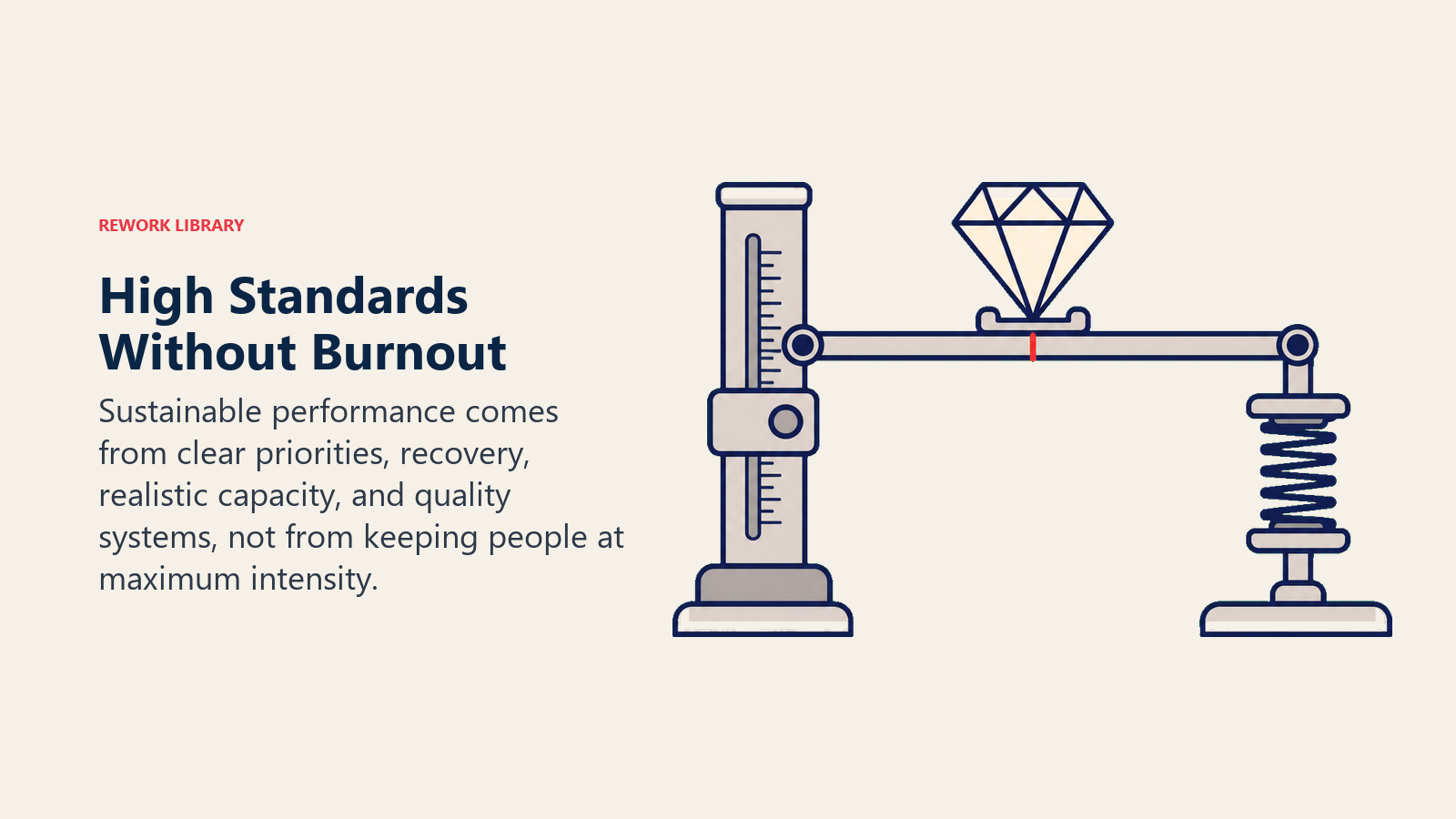
There is a version of "high standards" that destroys the people who carry it. Leaders in this pattern equate urgency with importance, treat rest as weakness, and interpret any pushback on workload as a performance problem. They get results for a while, and then they do not, because the people capable of delivering those results have left, collapsed, or learned to look productive without being productive.
The leaders who sustain high performance over years, not quarters, understand something different: demanding is not the same as destructive, and standards without sustainability are not high standards. They are a debt that eventually comes due.
What High Standards Actually Require
High standards mean the organization consistently does work that is genuinely good: on time, on quality, producing real outcomes. That requires three things that burnout undermines.
Judgment. Good work requires people making good decisions, often in situations the leader cannot anticipate. Burned-out people make worse decisions. Chronic stress narrows cognitive bandwidth, increases risk-aversion in ways that create different risks, and degrades the pattern-recognition that experienced professionals rely on. If a team is running on empty, the first thing that degrades is judgment, and judgment is often the hardest thing to measure before it becomes a problem.
Discretionary effort. The difference between adequate and excellent is usually discretionary effort: the extra thinking someone puts in because they care, not because they were instructed to. Burned-out people conserve effort. They do what is required and nothing more. Standards that depend on people going beyond minimum compliance cannot survive a culture that depletes the will to do so.
Retention. You cannot hold high standards with a revolving door of people who are still learning the job. Burnout accelerates turnover, and turnover forces the organization to perpetually operate below its potential as new people ramp up. The hidden cost of unsustainable standards is not just the burned-out people who leave. It is the institutional knowledge that walks out with them.
The Patterns That Drive Burnout
Most burnout in high-performing organizations is not caused by one extreme event. It is caused by the accumulation of patterns that are individually manageable but collectively corrosive.
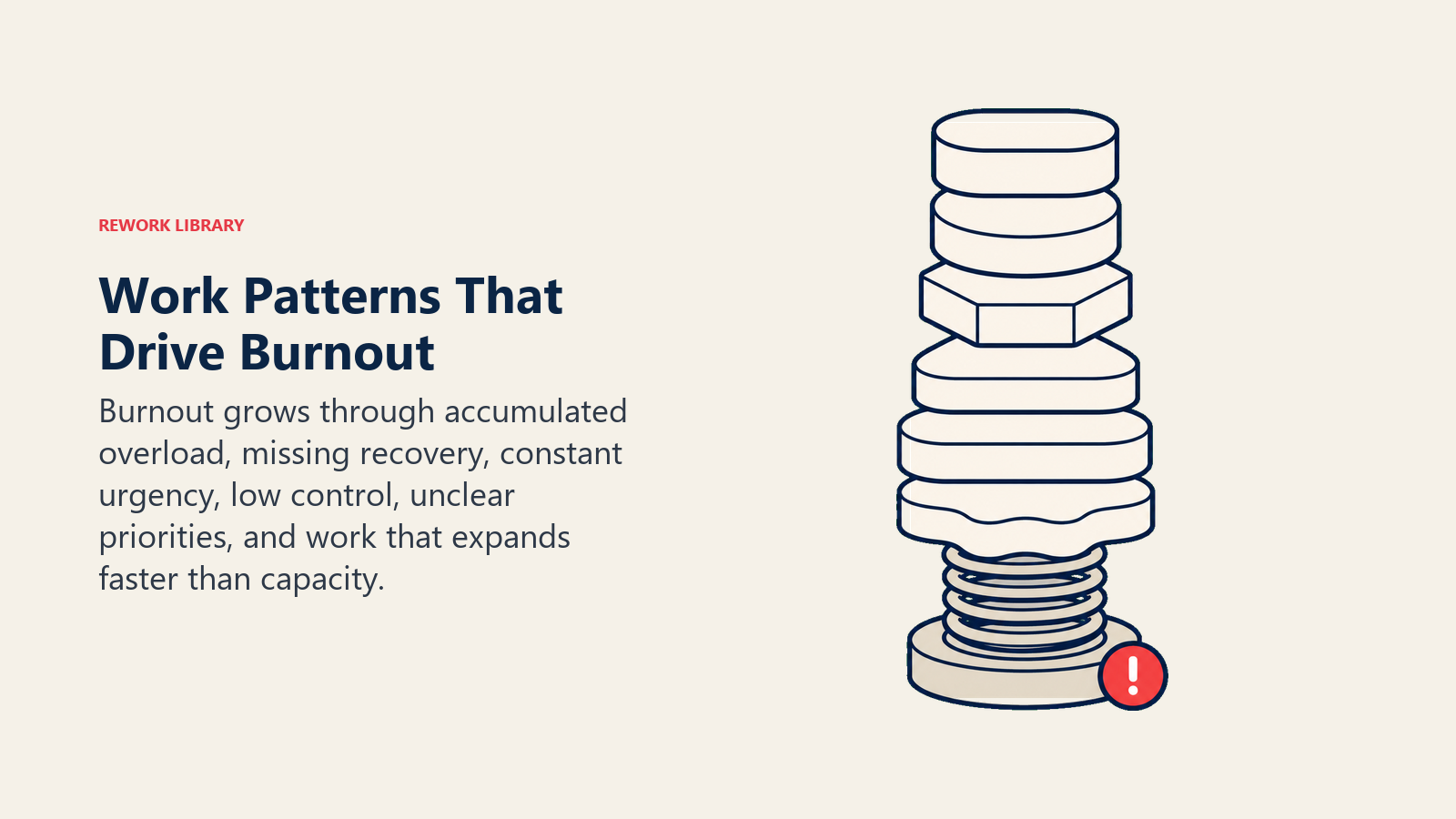
No recovery time between intense periods. Most teams can sustain intense effort for a defined, meaningful push. Product launches, year-end closes, crisis responses. What people cannot sustain is a permanent state of intensity with no acknowledged end point. If every quarter is treated as the most important quarter ever, with no recovery built in afterward, the organization trains people that intensity is the baseline, not a temporary state. Eventually the baseline cannot be maintained.
Vague urgency. Leaders who communicate everything as urgent, without distinguishing between what genuinely needs to happen now and what can wait, create a particular kind of fatigue. The team learns they cannot trust the urgency signal. They are always on high alert because they cannot know which alerts matter. This is cognitively exhausting in a way that genuine, bounded intensity is not.
Conflating presence with performance. Organizations that reward visibility, long hours, and busyness over outcomes create a specific burnout pattern where people work long to signal effort, regardless of whether the hours are productive. The actual output is often lower per hour than it would be with reasonable hours, but the culture punishes anyone who does not demonstrate sacrifice. This is a trap that operates entirely below the level of stated values.
Unavailability of the leader. If the leader is the bottleneck for decisions and is also unavailable because they are overwhelmed, the team is in a holding pattern that burns time without burning progress. People are working hard, but not advancing things that matter, because the things that matter are waiting on a single decision-maker who is stretched too thin.
What Sustainable High Standards Look Like
Clarity on What Matters
The foundation of sustainable high standards is ruthless clarity about what actually needs to be excellent versus what needs to be adequate. Not everything is equally important. An organization that treats every task as high-priority has no high priorities.
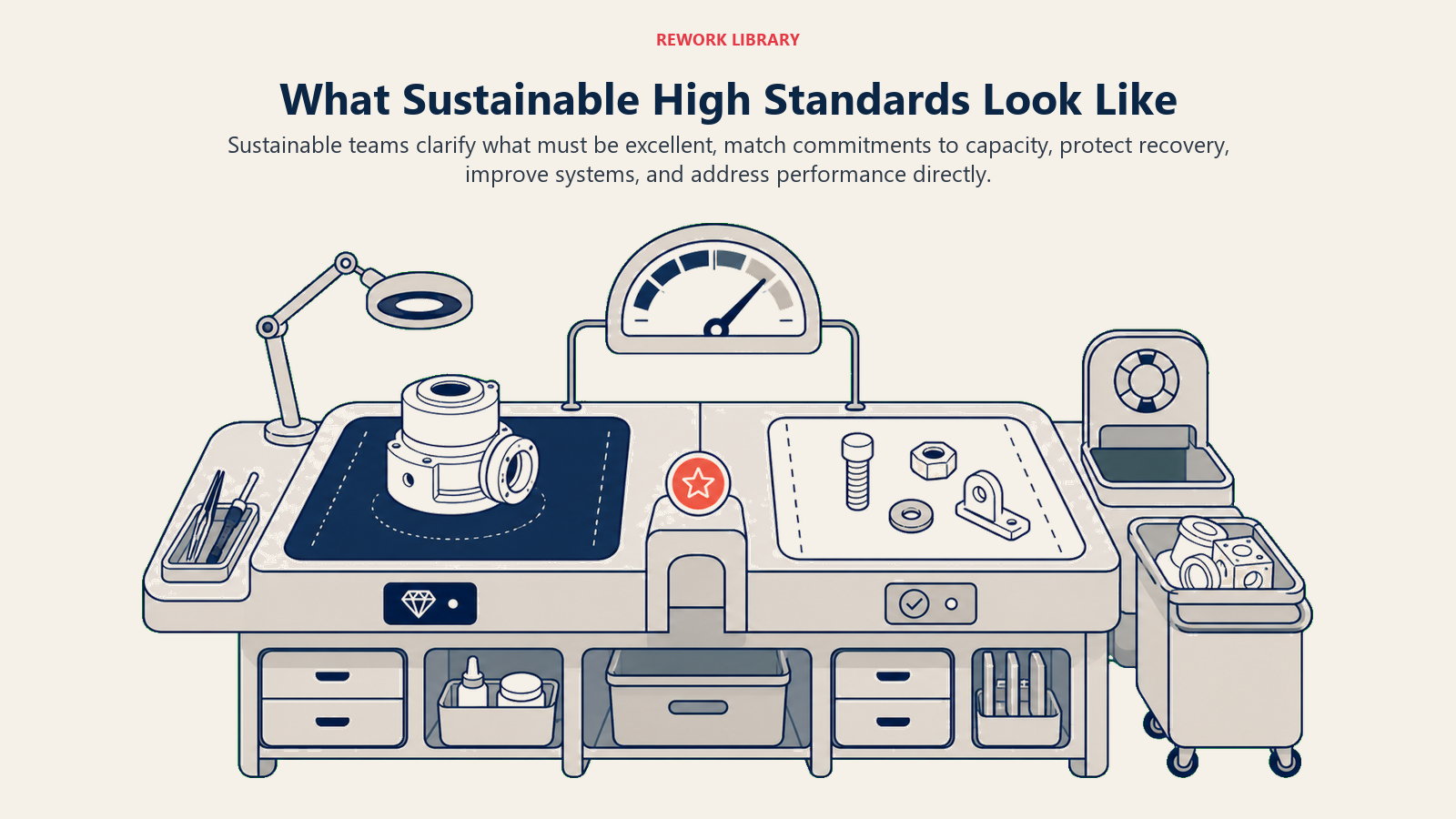
Leaders who sustain high performance are explicit about the distinction. They know which deliverables represent the standard their team is known for, and they protect the energy and time required to do those well. They are also explicit about what is good enough. A good-enough internal process document is not a failure. A good-enough client-facing deliverable might be.
This clarity reduces the diffuse anxiety of feeling like everything is equally critical, which is one of the most draining conditions a team can operate in.
Genuine Recovery After Intensity
The leaders who get the most sustained intensity from their teams are those who acknowledge intensity explicitly and build recovery in afterward. This is not about mandating vacation or running wellness programs. It is about the leader modeling and protecting the expectation that hard sprints are followed by real recovery.
After a major product launch: a lighter week with fewer mandatory meetings. After a brutal quarter-end: explicit permission to deprioritize non-urgent requests. After a crisis: a structured debrief that also serves as a genuine pause before the next push.
Teams that trust recovery is coming can commit more fully during the push. Teams that have learned recovery is never coming have already started rationing effort.
Direct, Early Conversations About Performance
One of the most burnout-inducing experiences is working hard in a context where you do not know if your work is valued or on track. Leaders who avoid difficult performance conversations in the name of protecting morale actually create more anxiety, not less. People who are not sure where they stand fill that uncertainty with worry.
High standards and direct feedback are not in tension. They are the same thing. People who know clearly what is expected of them and receive honest feedback about how they are doing can self-correct and improve. People who receive only vague praise until a sudden performance conversation are blindsided and demoralized.
This is one of the reasons that feedback frameworks (discussed further in Radical Candor Feedback) emphasize the link between candor and care: direct feedback is a form of investment in the person's development, not an attack on their adequacy.
Attention to Energy, Not Just Output
High-performing leaders pay attention to their teams as systems that need maintenance, not just resources to be deployed. This means noticing when a high performer has been running at capacity for too long. It means asking about workload in one-on-ones with genuine curiosity, not as a checkbox. It means not treating a team member's signal that they are overwhelmed as a performance problem to be managed away.
The leaders who do this well are not soft on performance. They are strategic about it. They understand that a team member who raises a workload concern early is far more valuable than one who stays quiet, degrades in quality, and eventually burns out or leaves.
Model What You Expect
If a leader sends emails at midnight and expects responses, the team adjusts their expectations of what is required. If a leader takes a real vacation and does not cc their team on every check-in, the team gets the message that recovery is legitimate. Leaders set the norms for their teams through their own behavior far more than through their stated policies.
This does not mean leaders cannot work intensely or keep unusual hours by personal preference. It means they must be thoughtful about the signals they send. Visible intensity from the leader that does not extend into expectations for the team is very different from intensity that implicitly signals that the team should match it.
Maintaining Standards With a Burned-Out Team
Sometimes the conversation is not about preventing burnout but about recovering from it. A team that is already depleted is a real leadership challenge, because the temptation is to either push through (which accelerates the decline) or back off entirely (which often creates different performance problems).
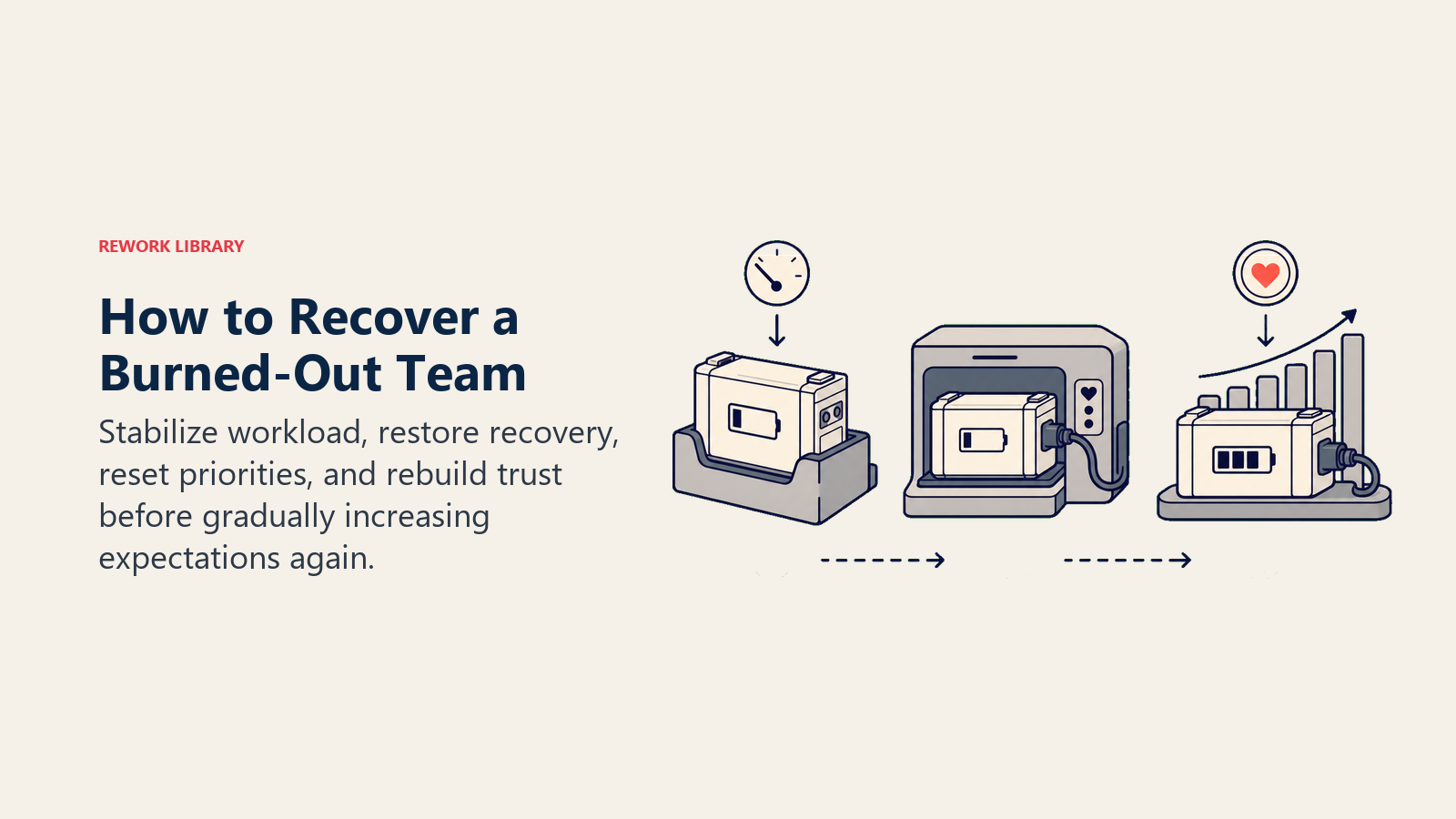
The path through is triage plus signal. Triage: genuinely reduce the load, at least temporarily, by eliminating or deferring lower-priority work. Signal: make it explicit that you are doing this because you see what the team is carrying, and that the standards on what matters are unchanged.
Burned-out teams are often also skeptical teams. They have heard the rhetoric about sustainability before and seen it abandoned when business pressure increased. The only thing that rebuilds trust is consistent behavior over time, not announcements.
Key Facts
- Chronic overwork produces diminishing returns on output and increases the rate of errors, particularly in complex knowledge work where judgment is central to quality.
- Turnover driven by burnout carries significant replacement costs, typically estimated at 50 to 200 percent of annual salary depending on the role's seniority and specialization.
- Organizations that distinguish high-urgency from low-urgency work explicitly, rather than treating everything as urgent, report higher team trust and lower stress without sacrificing output.
- Leaders who model recovery behaviors (real vacations, protected weekends, off-hours communication norms) report lower unsolicited attrition than those who model unlimited availability.
Frequently Asked Questions about High Standards Without Burnout
Can you hold truly high standards without some degree of pressure?
Yes. Pressure and standards are different things. Standards are about the quality and reliability of work. Pressure is about urgency and consequence. Organizations can maintain rigorous standards about quality with a culture that does not rely on fear and overwork as the mechanism. The two are frequently conflated but are genuinely separable.
How do I handle a team member who seems fine with overworking but is pulling others into it?
This is a common team dynamic problem. The individual who thrives on intensity can create a norm that pressures others who do not. Address it directly with the individual: appreciate their energy, but make clear that the team's sustainability is a shared responsibility and that their pacing choices affect others.
What is the difference between a demanding leader and a toxic one?
A demanding leader has high and clear expectations, gives direct feedback, and holds people accountable for outcomes. A toxic leader uses pressure as a control mechanism, takes credit for others' work, is unpredictable in their reactions, and treats the team's wellbeing as irrelevant. Demanding leaders produce high performers. Toxic leaders produce people who are good at managing up while looking for the exit.
Should I tell my team explicitly that burnout is a concern I am managing?
Yes, if it is. Leaders who name the concern and explain what they are doing about it build more trust than those who quietly try to manage it invisibly. Teams can tell when a leader is paying attention to the problem. Making it explicit gives them permission to raise their own concerns.
How do you set high standards during a hiring or growth phase when the team is smaller than the work requires?
Be explicit about the constraint. The team should know what "high standards" means for each priority when the team is stretched. Being transparent about the triage decisions you are making, and involving the team in those decisions where appropriate, is more sustainable than pretending the workload is manageable when it is not.
Related reading: Psychological Safety | Difficult Employee Communications | Radical Candor Feedback | Culture That Scales | Engineering Culture | High-Output Management

Co-Founder, Rework.com
On this page
- What High Standards Actually Require
- The Patterns That Drive Burnout
- What Sustainable High Standards Look Like
- Clarity on What Matters
- Genuine Recovery After Intensity
- Direct, Early Conversations About Performance
- Attention to Energy, Not Just Output
- Model What You Expect
- Maintaining Standards With a Burned-Out Team
- Key Facts