Product Leadership Lessons: What Executives Learn Leading Product Organizations
Turn this article into takeaways for your work.


Each assistant summarizes the article only for you and suggests best practices for your work.
Leading a product organization is one of the more demanding executive roles, because it requires holding together things that naturally pull against each other. Speed and quality. Customer empathy and commercial discipline. Engineering reality and market ambition. Short-term execution and long-term positioning. Innovation and reliability.
The leaders who do it well do not succeed because they are geniuses at product. They succeed because they build systems, teams, and cultures that consistently produce good product decisions, handle the inevitable failures gracefully, and keep a large organization aligned on what matters most.
These are the lessons that tend to take the longest to learn.
Lesson 1: Clarity on What Problem You Are Solving Is More Important Than Having the Answer
The most costly product errors are not in the execution. They are in the definition of the problem. Teams work hard, ship code, and conduct user research, all in the service of solving the wrong problem.
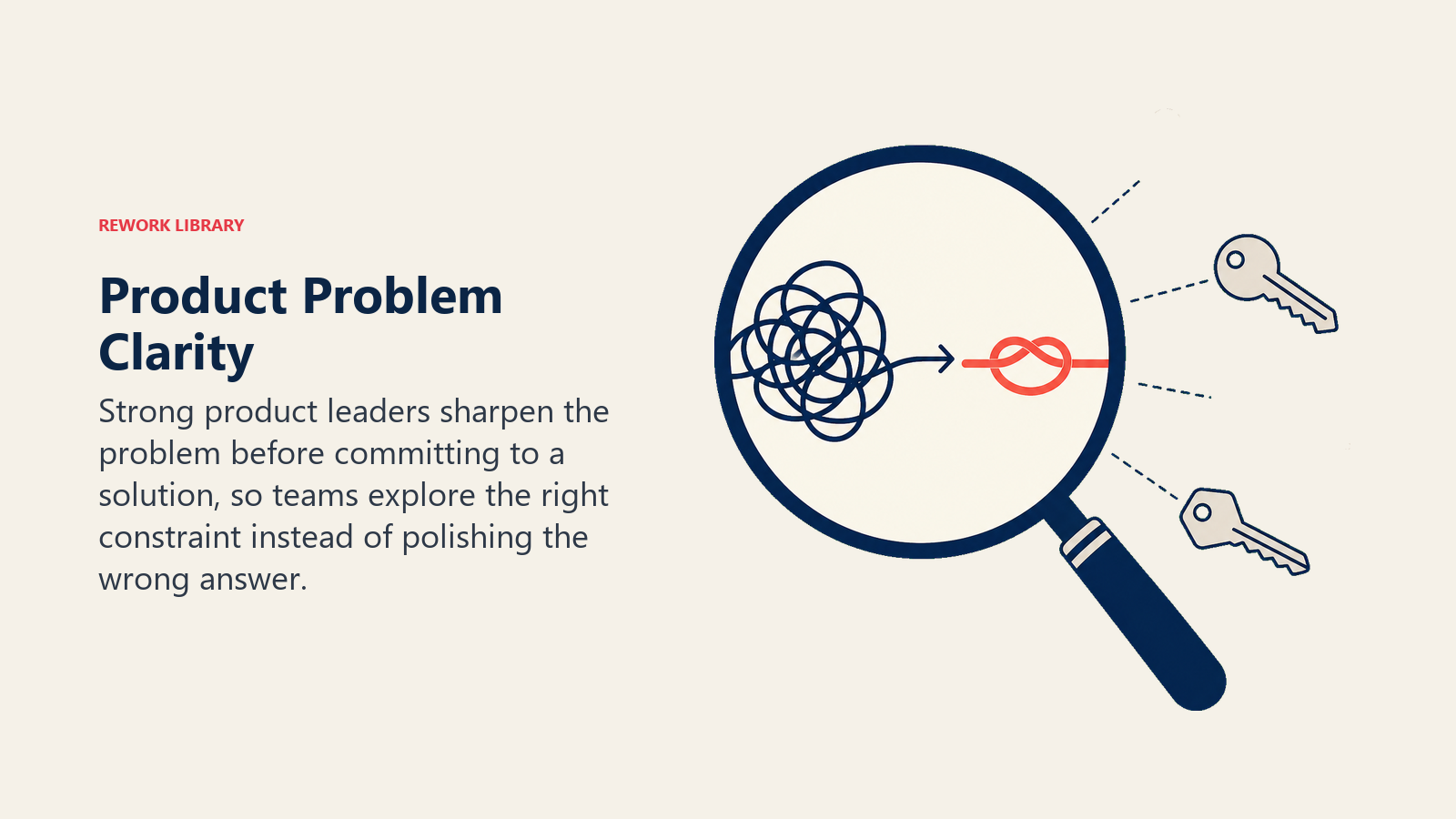
Product leaders who have been around long enough develop a persistent suspicion of solutions that arrive before the problem has been rigorously defined. The question "what problem are we solving, for whom, and how do we know this is their actual problem?" sounds basic, but it is genuinely difficult to answer well, and most organizations answer it poorly.
The practical discipline is making explicit space for problem definition before solution development. This is harder than it sounds because everyone in the organization feels pressure to move quickly, and problem definition does not look like progress. Features ship. Prototypes are tangible. Problem definitions are documents and conversations.
But product leaders who do not create this space consistently find themselves leading organizations that ship quickly and learn slowly, because they are shipping solutions to problems that were defined in a conference room rather than discovered in customer interactions.
What This Means in Practice
Invest in discovery as an ongoing organizational capability, not a pre-project phase. The best product organizations are constantly in conversation with customers, observing actual usage, and testing assumptions. Discovery is not a gate that unlocks development. It is a continuous activity that runs alongside development.
Hold the line on customer interviews before committing to significant feature investments. Not as a ritual, but as genuine information-gathering that has the authority to change the direction.
Push back on feature requests by asking for the problem they are trying to solve. A feature request is a proposed solution. The right question is almost always: what are people trying to do when they would use this?
Lesson 2: Roadmaps Are Communication Tools, Not Commitments
Most product roadmaps are treated as contracts. The team commits to delivering a set of features in a set of quarters. Stakeholders plan around those commitments. When the roadmap changes, it is experienced as a failure or a broken promise.
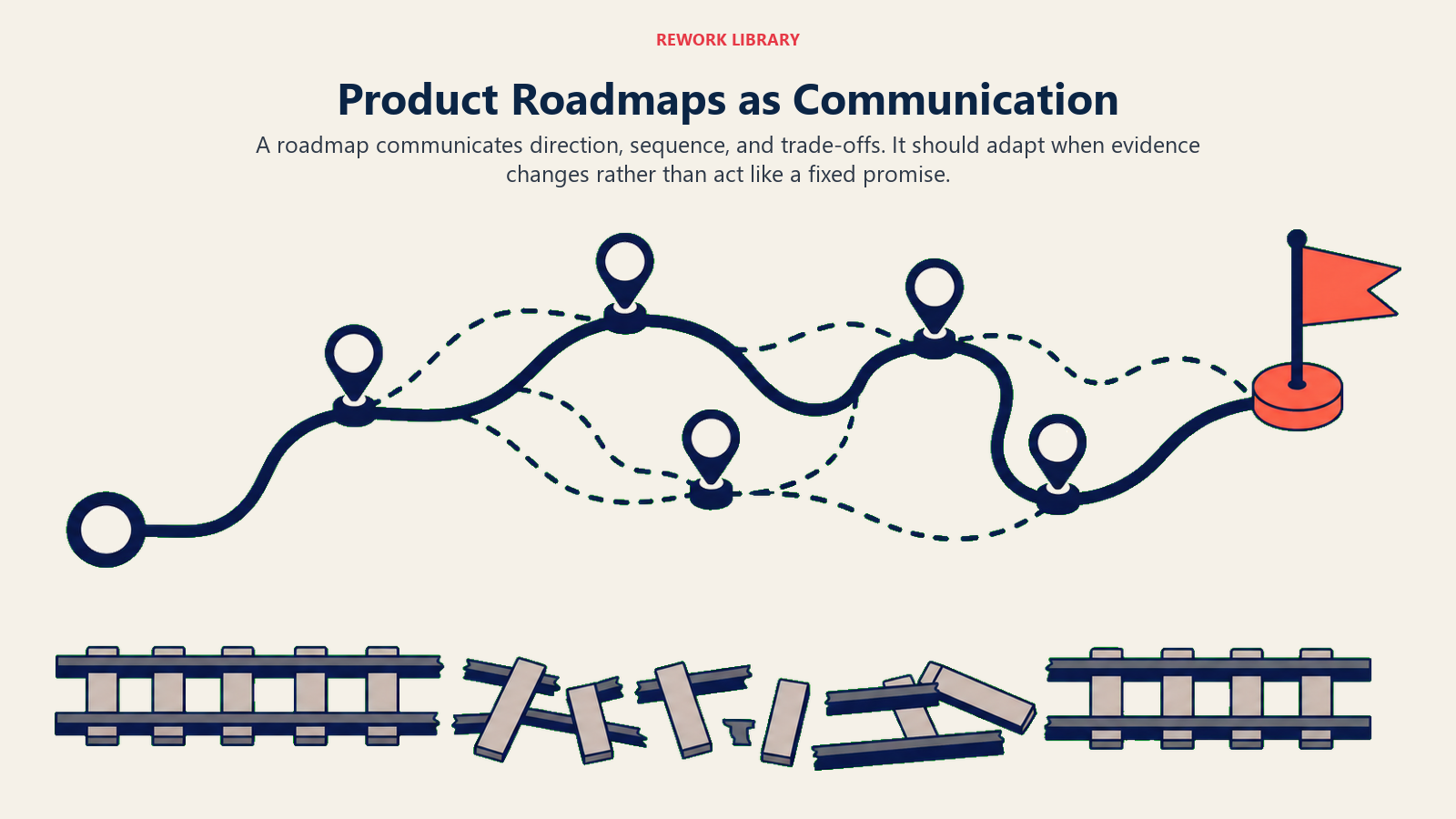
This framing is consistently counterproductive. It pressures teams to ship features on schedule regardless of whether they are solving real problems. It discourages the discovery work that might reveal a better direction. It creates tension between the product organization and stakeholders who have built plans around specific deliverables.
The alternative framing: roadmaps communicate strategic direction and current best thinking, not delivery commitments. What we are working on, why, and what we expect it to achieve. When the evidence changes, the roadmap changes, and that is not a failure.
This shift requires significant stakeholder education, because the expectation of roadmap-as-contract is deeply embedded in most organizations. But it is one of the most valuable shifts a product leader can make, because it frees the team to do the actual work of product development: learning and adapting rather than executing against a fixed plan.
Managing the Tension
The practical challenge is that stakeholders, including engineering teams, sales organizations, and customers, do have legitimate needs for predictability. Complete absence of commitments is not the answer.
The resolution most effective product leaders reach involves:
Distinguishing confidence levels in the roadmap. Near-term work, where the problem is well-defined and the approach is validated, can be communicated with higher confidence. Longer-term work should be communicated as directional, with explicit acknowledgment that it will change as learning continues.
Committing to outcomes rather than features. What the organization is trying to achieve in a given period: reduce time to first value for new customers, improve retention in a specific segment, expand into an adjacent use case. The features that deliver those outcomes are variable.
Regular roadmap conversations, not just roadmap documents. A roadmap that exists as a quarterly document that stakeholders check once is a recipe for misaligned expectations. Regular conversations about what the team is learning and how it is affecting direction are more useful.
Lesson 3: Speed Is a Feature, But Not the Only Feature
The bias for speed in product organizations is almost universally healthy. Shipping faster means learning faster, which compounds over time into a significant competitive advantage. But "move fast" as an operating principle has failure modes that experienced product leaders learn to watch for.
Speed without learning is just iteration theater. If an organization ships quickly but does not have mechanisms to learn from what it ships, the velocity is not generating the compounding return it should. Fast shipping requires fast learning loops: instrumentation that tells you what people are doing with what you built, user feedback channels that generate actionable signal quickly, and the discipline to act on that information.
Speed that creates technical debt compounds in the wrong direction. There is a version of speed that borrows from the future: shipping fast by cutting corners on code quality, test coverage, system architecture, and documentation. This is sometimes the right trade-off. A startup that ships a bad system in three months and validates demand is better positioned than one that ships a perfect system in two years, if the demand question is genuinely open. But organizations that maintain this posture past the point where the demand is validated create a compounding cost structure that eventually limits their speed.
Speed in the wrong direction is not an advantage. An organization that ships the wrong thing quickly has moved fast toward the wrong place. The question is not just how quickly the team can ship, but whether what is being shipped is worth building.
The product leader's job is to maintain the speed bias while also maintaining the learning and quality disciplines that make speed valuable.
Lesson 4: Design for the Business Model, Not Just the User
Good product design serves users. Excellent product design serves users in ways that also work for the business.
Product leaders who have operated primarily in a user-centered design tradition sometimes need to develop a stronger connection between product decisions and business model mechanics. Features that users love but that are costly to support, that cannibalize higher-margin offerings, or that attract users who do not convert to paying customers, create real problems that user satisfaction metrics do not capture.
The discipline is explicitly modeling the business model implications of product decisions. Not as a constraint that overrides user needs, but as a parallel lens. How does this feature affect acquisition? How does it affect retention? What does it do to gross margin? How does it affect our competitive positioning?
This is particularly important for product leaders operating in businesses with complex monetization, multi-sided markets, or significant infrastructure costs per user. The product that is excellent for the user and unsustainable for the business is not actually an excellent product.
Lesson 5: The Team Is the Product
Everything a product leader ships starts with the team that ships it. And the quality, culture, and composition of that team is itself a product leadership responsibility.
The specific team-building lessons that tend to be most durable:
Hire for judgment more than for skills. Skills can be developed. The ability to make good decisions under uncertainty, with incomplete information and competing pressures, is harder to build and much more valuable at the senior levels of a product organization. Interview for judgment explicitly: how did this person decide what to work on? How do they handle disagreement? What have they been wrong about?
Create conditions for engineers and designers to solve problems, not just execute plans. The product organizations with the best track records typically have engineers and designers who are deeply engaged with the problem space, not just handed specifications to execute. This requires trust, clear problem framing, and genuine openness to solutions that were not anticipated by the product leader.
Build explicit feedback loops on product quality. Product quality, including user experience quality, technical quality, and operational quality, degrades when it is not explicitly protected. The pressure to ship new features is persistent. The pressure to maintain and improve existing quality is not. Product leaders who do not actively protect quality investment consistently find themselves managing a mounting quality debt that eventually constrains the whole organization.
Invest in onboarding as a product leadership discipline. How new team members learn the domain, the codebase, the culture, and the product decisions already made determines how quickly they contribute and whether the institutional knowledge of the organization propagates effectively. Product organizations that neglect onboarding pay for it in quality, velocity, and cultural consistency.
Lesson 6: When to Build Versus When to Buy Versus When to Partner
Product leaders regularly face build-versus-buy-versus-partner decisions: should this capability be built internally, purchased through a vendor or acquisition, or developed through a partnership?
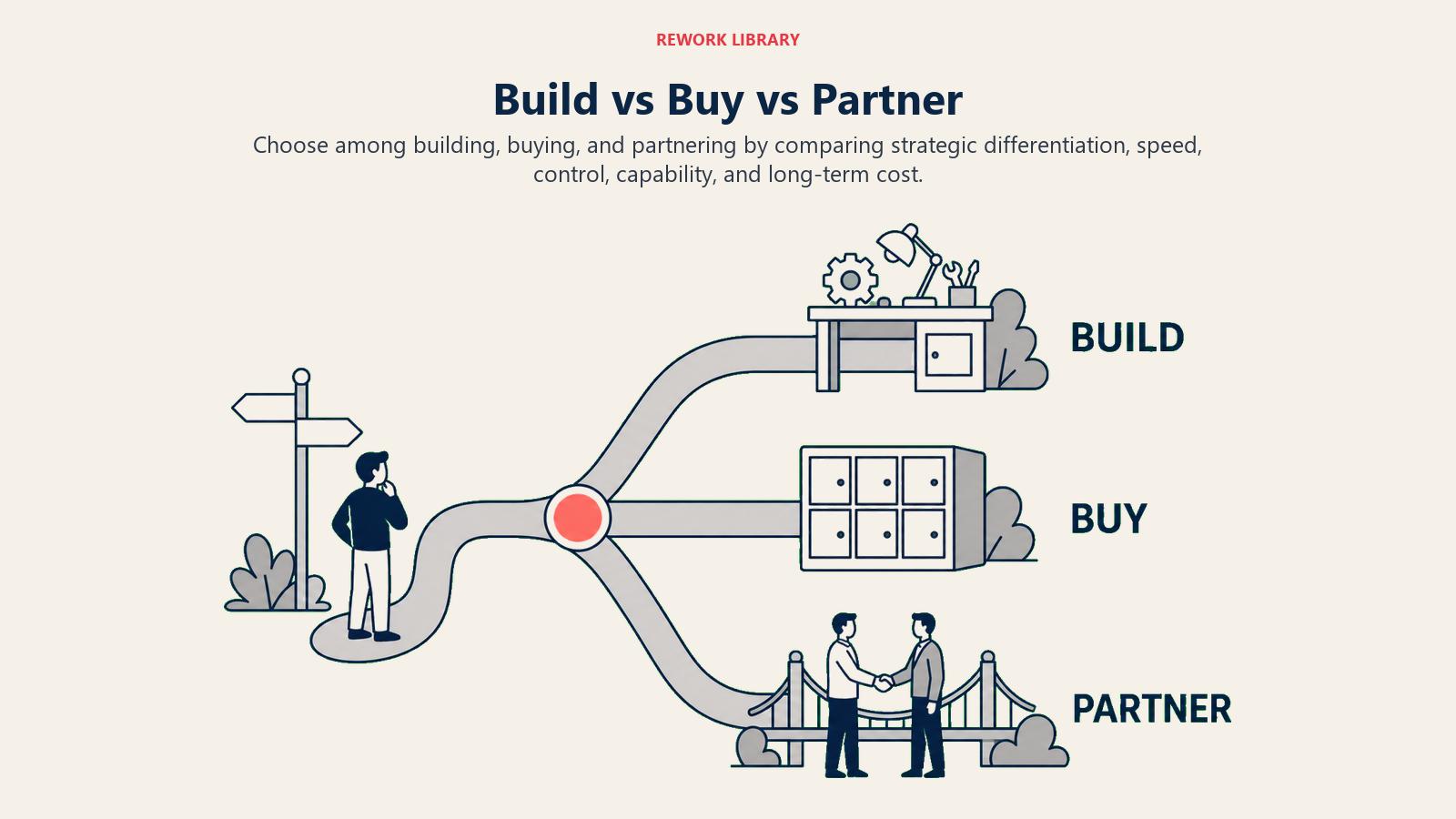
The instinct in product organizations is often to build, because building creates owned capability and feels more like genuine product development. But building everything is rarely optimal. It distributes engineering capacity across areas where the organization is not developing proprietary advantage, and it is frequently slower and more expensive than alternatives.
The framework for deciding is clearer than the decision often feels:
Build when the capability is proprietary, when how it is built is central to the organization's competitive positioning, or when the available alternatives do not meet the quality bar required.
Buy when a vendor or existing product meets the capability requirement at acceptable quality and cost, when the capability is not a source of competitive differentiation, or when the time required to build is competitively relevant.
Partner when the capability requires relationships, distribution, or complementary assets that exist in a partner, or when joint development serves both parties' strategic interests.
The bias toward building is understandable, but it has a real cost. Product leaders who develop discipline around this decision consistently find they can concentrate engineering capacity on the areas that genuinely differentiate the product.
Lesson 7: Simplicity Is a Product Strategy
Complexity accumulates in products the same way it accumulates in organizations: through a series of individually reasonable additions that each solve a real problem, but whose aggregate effect is a product that is hard to learn, slow to maintain, and difficult to evolve.
Product leaders who do not actively resist complexity accumulation consistently find themselves managing products that are full-featured and hard to use, whose long lists of capabilities conceal a lack of coherent design. The complexity also carries internal costs: more features mean more code to maintain, more edge cases to support, more documentation, and a larger surface area for bugs.
Simplicity as a product strategy involves explicit decisions about what not to build, as well as what to build. Feature removal is hard because every feature has users who chose the product partly for that feature. But the discipline of regularly evaluating whether existing features are earning their maintenance cost, and removing those that are not, keeps the product coherent.
It also involves design discipline: ensuring that the core use cases are excellent before building secondary features, and that the overall experience reflects a coherent model of how users accomplish their goals.
Key Facts
- Products that maintain a clear problem-solution connection, with regular customer feedback cycles, report higher retention and net promoter scores than those built primarily from internal feature prioritization.
- The average cost of fixing a defect discovered in production is substantially higher than fixing it at the design stage, making quality investment earlier in development economically rational even when it feels like a speed trade-off.
- Product teams with clear outcome-based roadmaps (committed to results rather than specific features) ship more of the work that produces measurable user outcomes than teams operating on feature-based roadmaps.
- Time-to-market advantage compounds over product generations: organizations that consistently ship earlier have more iterations of learning and product refinement than those that ship more slowly, creating a widening advantage over time.
Frequently Asked Questions about Product Leadership Lessons
How does a product leader balance the needs of current customers with building for future market opportunities?
This is one of the fundamental product tensions. The practical approach is to treat them as separate portfolio decisions rather than trying to optimize for both in every product decision. Allocate explicit capacity to serving current customers well and explicit capacity to exploring future opportunities, and manage those as distinct investments with different success criteria.
How do you handle situations where sales has promised features to customers that the product team has not committed to?
This is primarily a process and governance problem. The root cause is usually that sales lacks clarity on the product roadmap and has incentives to make commitments in order to close deals. The solution involves clearer communication of what is and is not on the roadmap, involvement of product in late-stage sales conversations for complex feature requests, and organizational alignment on the consequences of roadmap commitments made without product agreement.
Should a head of product have an engineering or design background?
Both produce excellent product leaders. The background matters less than the leader's ability to think about problems from user, business, and technical perspectives simultaneously, to earn trust from engineering and design, and to make good prioritization decisions under uncertainty.
How do you manage a product organization through a significant platform change (rewrite, migration)?
With an explicit transition plan that manages the user experience during the migration, honest communication to customers about what is changing and why, and a sequencing strategy that keeps the organization shipping customer-facing value throughout. Large platform changes that go entirely underground, with no user-visible progress, consistently lose organizational momentum and stakeholder confidence.
What is the most important thing a product leader can do to develop strong product managers?
Give them real accountability with real stakes, paired with genuine coaching on how to think about product decisions. The fastest development happens when a product manager is trusted with a domain that matters, given clear success criteria, supported with coaching and feedback, and allowed to make decisions (including ones that the product leader would make differently).
Related reading: Design-Led Leadership | Engineering Culture | Portfolio Discipline | Managing at Scale | High-Output Management | Culture That Scales

Co-Founder, Rework.com
On this page
- Lesson 1: Clarity on What Problem You Are Solving Is More Important Than Having the Answer
- What This Means in Practice
- Lesson 2: Roadmaps Are Communication Tools, Not Commitments
- Managing the Tension
- Lesson 3: Speed Is a Feature, But Not the Only Feature
- Lesson 4: Design for the Business Model, Not Just the User
- Lesson 5: The Team Is the Product
- Lesson 6: When to Build Versus When to Buy Versus When to Partner
- Lesson 7: Simplicity Is a Product Strategy
- Key Facts