Culture That Scales: Maintaining Organizational Culture Through Rapid Growth
Turn this article into takeaways for your work.


Each assistant summarizes the article only for you and suggests best practices for your work.
Organizational culture is easiest to maintain when it is hardest to articulate. In a 20-person company, culture is transmitted through proximity: new people watch how the founders handle conflict, how feedback is given, which trade-offs get made under pressure. No one needs to write it down because everyone can see it live.
Scale breaks this mechanism. At 200 people, most employees have never had a direct conversation with the founders. At 2,000, most senior leaders have never met the CEO. The culture that felt organic and self-sustaining at small scale now requires deliberate architecture, explicit codification, and systematic reinforcement. Organizations that do not make this transition on time do not lose their culture slowly. They lose it in a few hiring cycles, and usually do not notice until the symptoms are obvious.
Why culture breaks at scale
Understanding where culture typically breaks is the starting point for preventing it. The failures are predictable and follow specific patterns.
The indirect management problem. When an organization is small enough that founders or senior leaders interact directly with most employees regularly, culture transmission is personal. The moment that direct interaction is replaced by an extra layer of management, the culture message passes through a filter. If that middle layer of managers was hired for technical competence but never explicitly developed as cultural carriers, what gets transmitted is a diluted or distorted version of the intended culture. Hiring 200 managers who don't understand why the culture works the way it does is the most common route to culture failure at scale.
Hiring speed outpacing cultural integration. High-growth companies often run hiring pipelines that onboard dozens of people per week. At that speed, cultural integration through osmosis is impossible. The informal mechanisms that worked when two new people joined per month (introductions, shadowing, founder conversations) cannot handle twenty. Organizations that do not build explicit onboarding architecture for cultural integration at speed will find their culture steadily diluted by each hiring wave.
Functional silos with different subcultures. As organizations grow, functions develop. Engineering, sales, finance, and customer success may all start with the same cultural foundation, but under different functional leaders with different work rhythms and different incentive structures, they develop distinct subcultures. Left unmanaged, the functional subculture starts to feel more real to employees than the organizational culture. Eventually the cross-functional collaboration that the stated culture is supposed to enable becomes difficult because the actual cultures are incompatible.
The original rules don't generalize. Many early cultural practices are correct responses to early-stage conditions and poor guides for what the organization needs at scale. "Everyone has access to everyone" makes sense at 15 people and creates chaos at 300. "We don't have many processes" is a value that helps early-stage agility and becomes a liability when you need coordination across dozens of teams. Early cultural artifacts that are not examined become organizational constraints rather than assets.
Key Facts
Research on rapidly scaling technology companies finds that cultural coherence, measured by employee alignment on "how decisions actually get made," declines sharply between 100 and 300 employees if no explicit culture-systemization effort is made during that window.
Studies of high-growth companies find that middle manager behavior is the strongest predictor of whether stated culture values are enacted at the team level, more predictive than CEO communication or values documentation.
Analysis of post-IPO organizational data shows that companies with explicit cultural onboarding programs retain high performers at significantly higher rates through rapid-growth periods than companies that rely on informal culture transmission.
The inflection points
Culture crises at scale tend to cluster around specific size thresholds, each triggered by a structural change in how the organization operates.
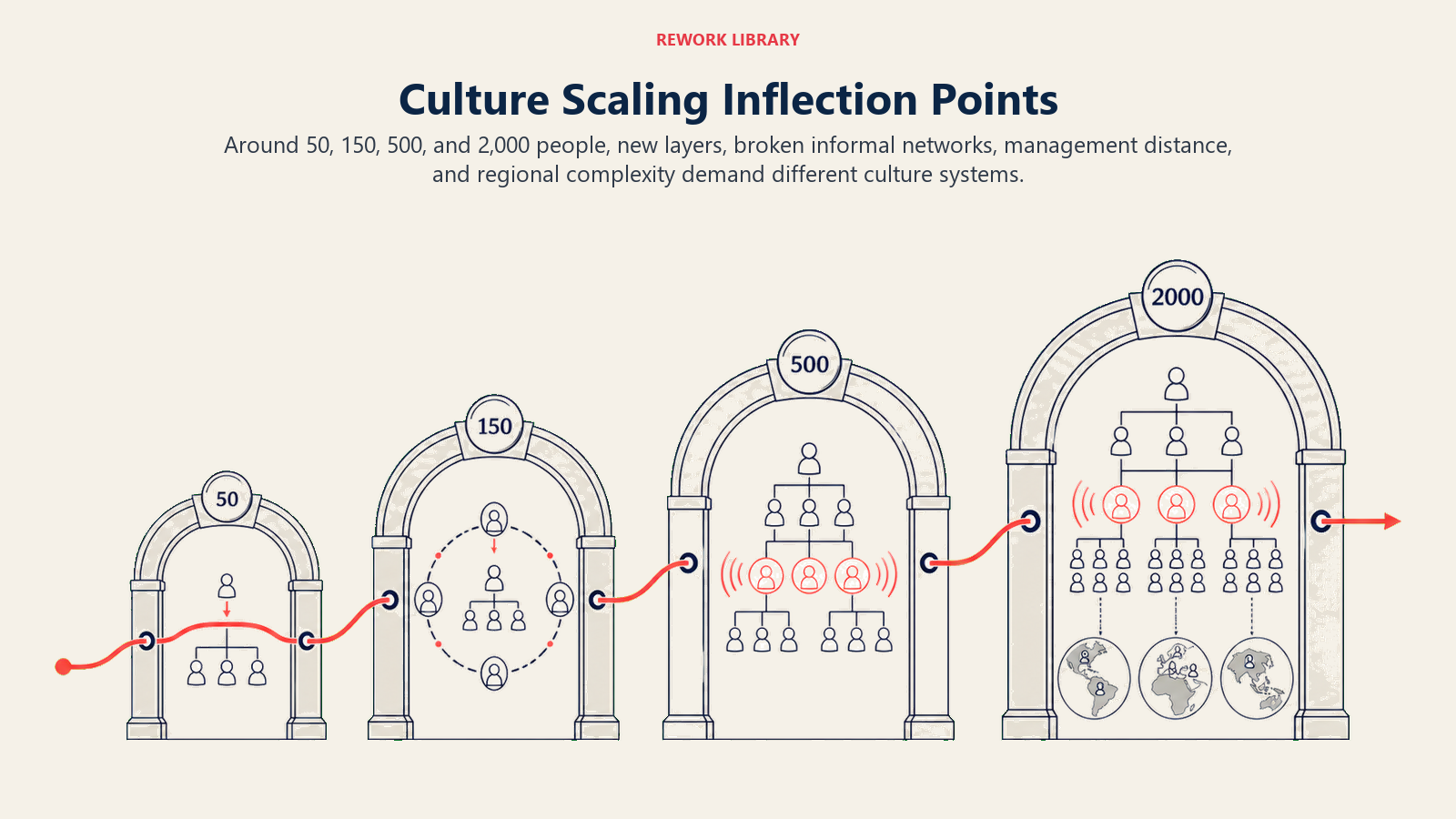
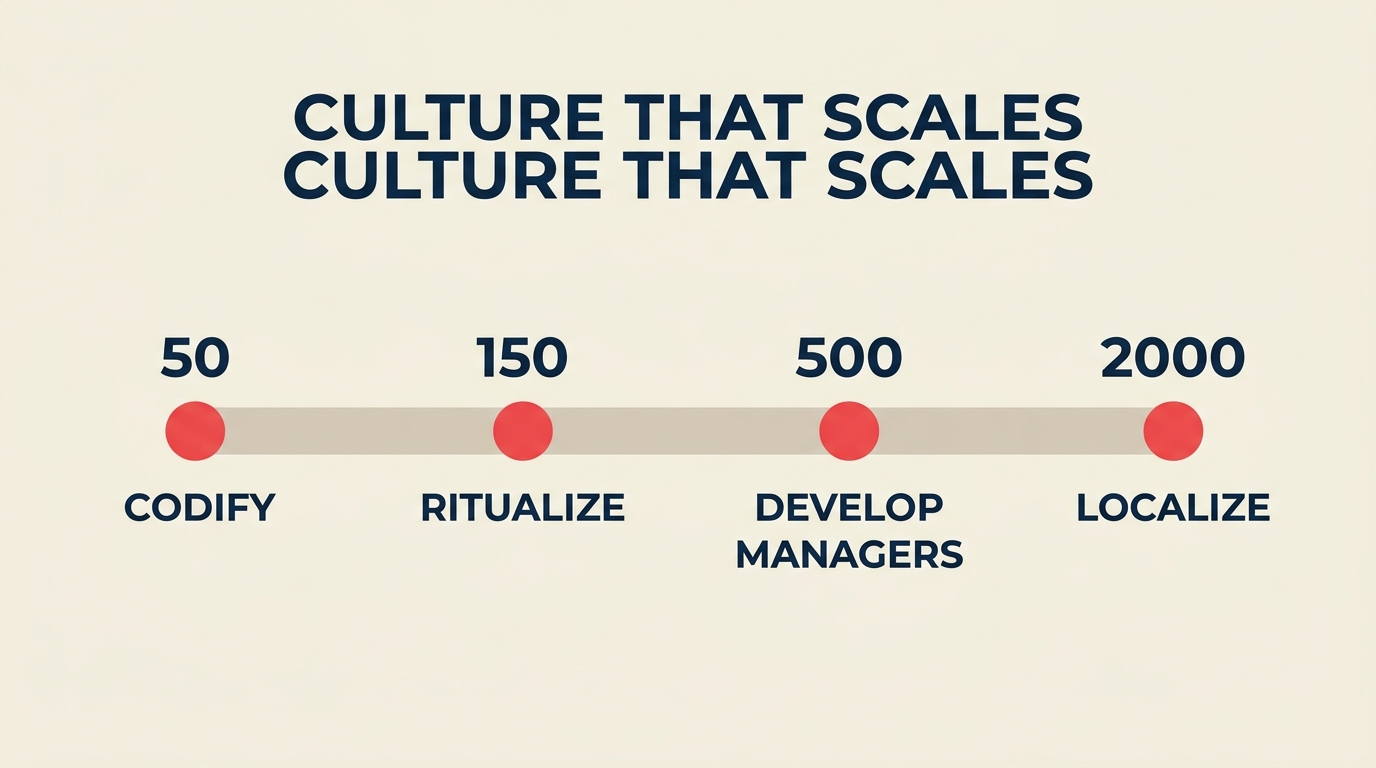
The 50-person threshold. Below 50 people, direct leadership visibility is possible for most employees. Above 50, the organization typically adds a management layer that creates a distance between founders/senior leaders and daily work. This is where explicit values documentation and cultural codification need to happen, before most employees are working primarily with managers rather than directly with founders.
The 150-person threshold. Research on human group dynamics suggests that close social relationships, the informal trust networks that transmit culture naturally, max out at roughly 150 people. Above this size, the informal network breaks down. People stop knowing everyone. The tribal knowledge that carriers of culture rely on becomes inaccessible to newcomers. This is where cultural rituals, storytelling practices, and cross-functional connection programs need to be built.
The 500-person threshold. At this scale, the organization typically has enough layers that the CEO is two to four levels removed from most employees. Cultural consistency now depends almost entirely on the quality of the middle management layer. If those managers were not explicitly developed as cultural leaders, the culture at the team level is whatever each manager's personal style produces.
The 2,000-person threshold. At this scale, regional and international presence often becomes real. Cultural practices that were designed for a single-location, single-timezone, single-language organization may not translate. The leadership challenge becomes distinguishing which cultural elements are universal (and need to be maintained across all contexts) from which are local adaptations (and should be allowed to evolve differently).
What to systemize vs what to preserve
The most important cultural leadership question at scale is knowing which practices to formalize, which to allow to evolve, and which to protect as non-negotiable even when they feel inefficient.
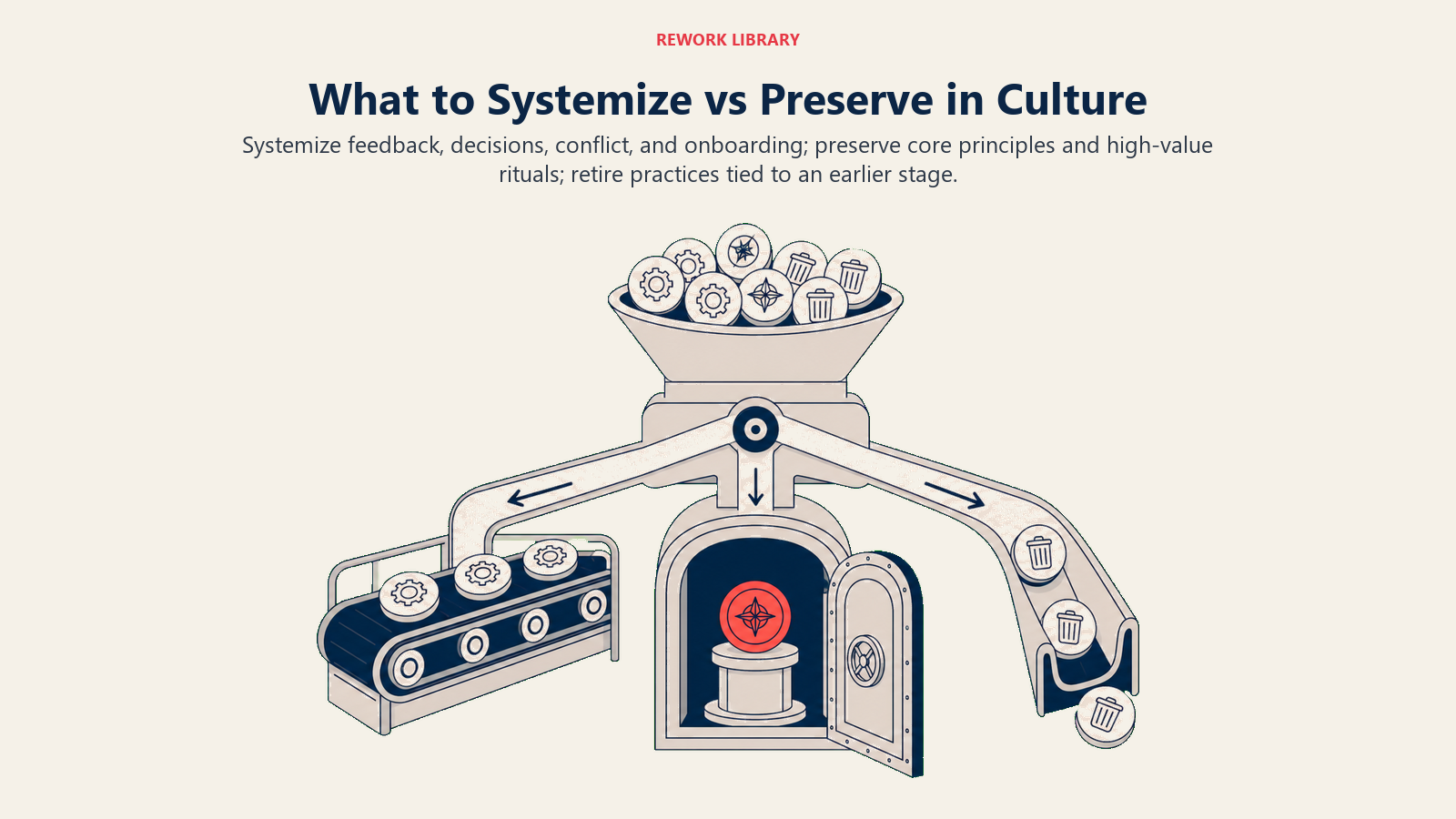
Systemize the mechanisms, not just the message. How feedback is given, how decisions are made, how conflict is resolved, how new employees are integrated: these processes transmit culture more reliably than statements about culture. Leaders who want to scale culture should focus on building the process infrastructure that produces cultural behavior, not on repeating the cultural message more loudly.
Allow local adaptation of practice, not principle. A sales team's culture will feel different from an engineering team's culture. That is appropriate. The practices that help each function do their work well will differ. The underlying principles (how people are treated, how accountability works, how information flows) should be consistent. Culture at scale requires knowing which level to enforce consistency and which level to allow variation.
Protect the practices that seem slow. The cultural practices that are most at risk during rapid growth are usually the ones that feel least efficient: the long onboarding process where new people shadow experienced employees, the senior leader Q&A sessions, the retrospectives where the team examines what went wrong. Under growth pressure, these are the first things cut. They are also often the mechanisms that most reliably transmit culture. The leaders who maintain culture at scale often do so by being almost unreasonably protective of these practices.
Kill the practices that belong to an earlier stage. Some early cultural practices are contingent on conditions that no longer apply. All-hands decision-making works at 15 people. Skip-level access works when there are only two levels. Treating all problems as fixable by putting smart people in a room together works when everyone is in the same room. Scaling culture does not mean freezing it. It means distinguishing what is essential from what is contingent.
Leadership behaviors that maintain culture at scale
Founders and senior leaders who successfully maintain culture at scale tend to share a set of specific behaviors, not just cultural values.
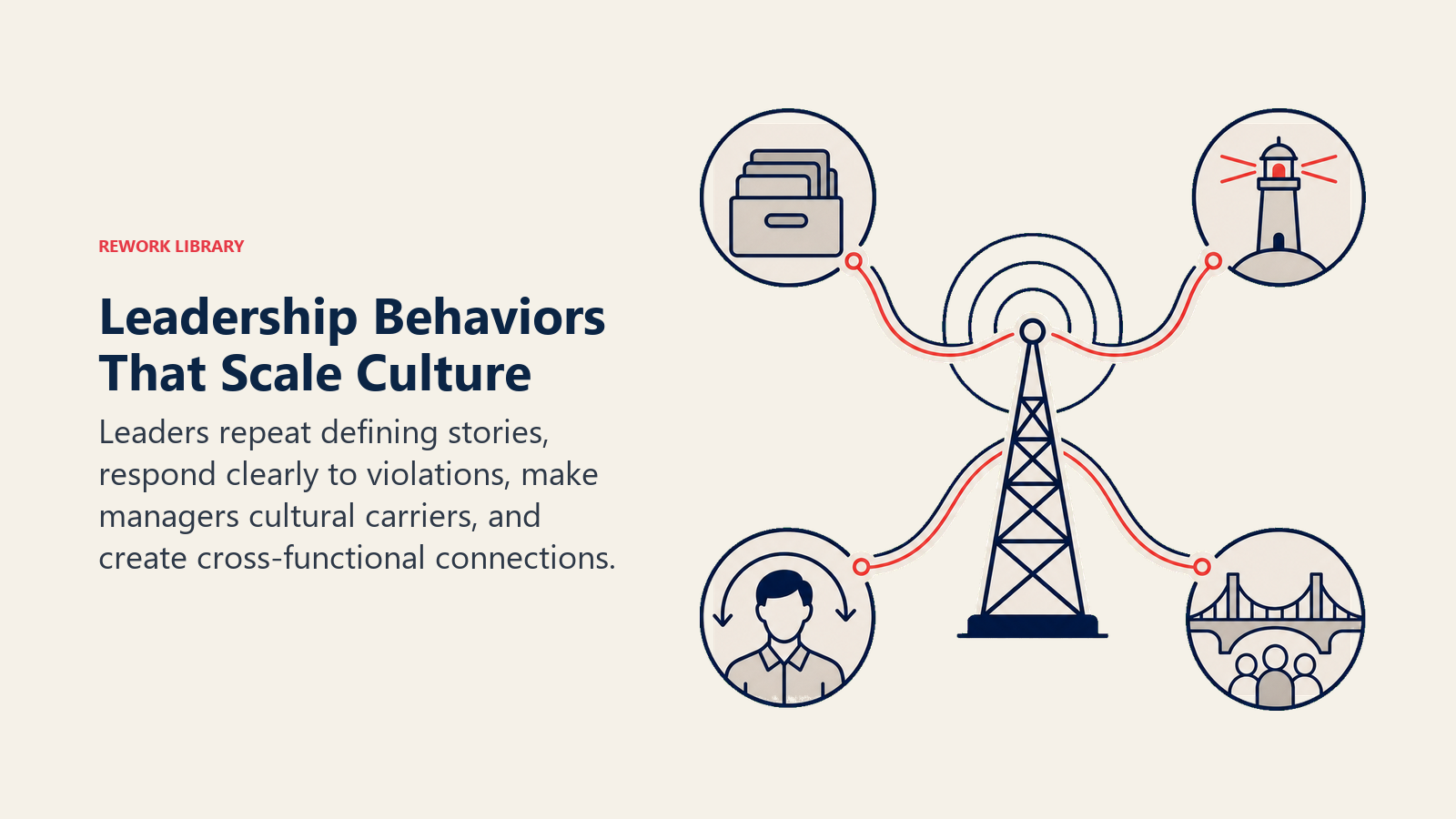
They tell the same stories, in the same detail, repeatedly. Organizational stories are the primary mechanism through which culture is transmitted across distance and time. The story of how the company responded to a major failure, the story of a decision that cost short-term revenue but preserved a long-term principle, the story of a customer interaction that defined what service means at this organization: these stories do not transmit themselves. Leaders have to tell them actively, in every context where culture is being formed, with consistent emphasis on the same details.
They take cultural violations more seriously as the organization scales, not less. The temptation at scale is to let exceptions slide because the organization is complex and exceptions are more common. The reverse should be true. At 15 people, one person violating a cultural value is visible to almost everyone and the leader's response is seen. At 1,500 people, one person violating a cultural value might be invisible except to the 10 people on that team, but those 10 people are watching what happens next. The cultural signal travels as a ratio: the response to violation matters more as the organization gets larger.
They build cultural transmission into role design, not just training. The most effective mechanism for cultural transmission at scale is not an onboarding program. It is what managers do in their daily work. Leaders who build culture at scale define manager role expectations to include cultural modeling and transmission explicitly. They evaluate managers partly on how well their teams reflect the intended culture, not just on what the teams produce.
They create structured cross-functional connection. As organizations scale and silo, the cross-functional trust that enables the stated culture erodes. Leaders who maintain culture at scale build deliberate practices for cross-functional connection: rotational programs, cross-functional project teams, leadership development cohorts that mix functions, leadership off-sites that bring managers from different functions together. These feel like overhead. They are cultural infrastructure.
The culture audit at scale
Leaders who are serious about maintaining culture at scale run periodic cultural audits, not as HR programs but as strategic diagnostics. The questions these audits need to answer are:
What story would a new employee who joined six months ago tell about how things really work here? How does that story compare to what we intend? Where do the stated values and enacted behaviors diverge most? Which management behaviors are most at odds with the cultural values we say we hold? Are there functional or regional pockets where the culture has drifted significantly from the intended direction?
The answers to these questions require data beyond surveys: observation of actual behavior in high-stakes situations, conversations with employees who left recently, and examination of decision patterns over time.
Culture that scales vs culture preservation
There is a meaningful distinction between maintaining culture and preserving culture. Preserving culture is about keeping things as they were. Maintaining culture is about keeping the essential things as they were while allowing the contingent things to evolve appropriately. Leaders who confuse these two often create brittle cultures that resist necessary adaptation, or lose cultures that could have been maintained with more skillful evolution.
The culture architecture work of designing cultural systems deliberately is the foundation for this. You can only maintain what you have explicitly designed. Organizations that never made their culture explicit have nothing to transmit deliberately. They can only hope the next generation of leaders shares the intuitions of the first.
Frequently Asked Questions about Culture That Scales
At what point should an organization start explicitly managing culture?
Before it feels necessary, which is usually around 30-50 people. Most organizations start managing culture explicitly when they notice it breaking, which is typically around 150-300 people. By then, the correction requires undoing established norms rather than building from a clean foundation. Starting early costs less.
How do you maintain culture through an acquisition or major merger?
Acquisitions are high-risk cultural events because they introduce a large group of people with a different cultural history, often under the assumption that the acquired team will simply adopt the acquiring company's culture. The organizations that handle this best treat it as a genuine cultural integration challenge: diagnosing both cultures, being explicit about what will be preserved from each, and building explicit bridging practices rather than assuming organic assimilation.
Is it possible to change culture while scaling at the same time?
It is very difficult. Culture change requires sustained attention and consistent signaling over time. Rapid growth requires a lot of leader attention and produces enormous organizational noise. The two compete. If both must happen simultaneously, the practical approach is to narrow the scope of culture change to the one or two behavioral shifts that matter most and build very explicit systems around those, rather than trying to run a comprehensive culture transformation in parallel with hypergrowth.
How do you maintain culture across remote or distributed teams?
Distributed culture requires more deliberate investment in the mechanisms that co-location makes automatic: shared context, relationship trust, consistent information access. The organizations that maintain strong cultures in distributed settings are those that invest heavily in documentation (what the culture actually is, in behavioral specificity), synchronous connection (regular video touchpoints where culture is modeled and discussed), and equitable inclusion in decisions (so distributed employees experience the culture firsthand rather than just being told about it).
The companies with the strongest cultures at scale are not the ones with the most articulate values statements. They are the ones whose leaders treated culture as infrastructure that requires the same kind of deliberate engineering as their product, their processes, and their go-to-market strategy. That engineering gets more important as the organization grows, not less. See succession planning for how leadership continuity connects to cultural continuity, and managing at scale for the broader leadership challenge of leading large, complex organizations.
