Strategic Pivot Timing: When to Change Direction and When to Stay the Course
Turn this article into takeaways for your work.


Each assistant summarizes the article only for you and suggests best practices for your work.
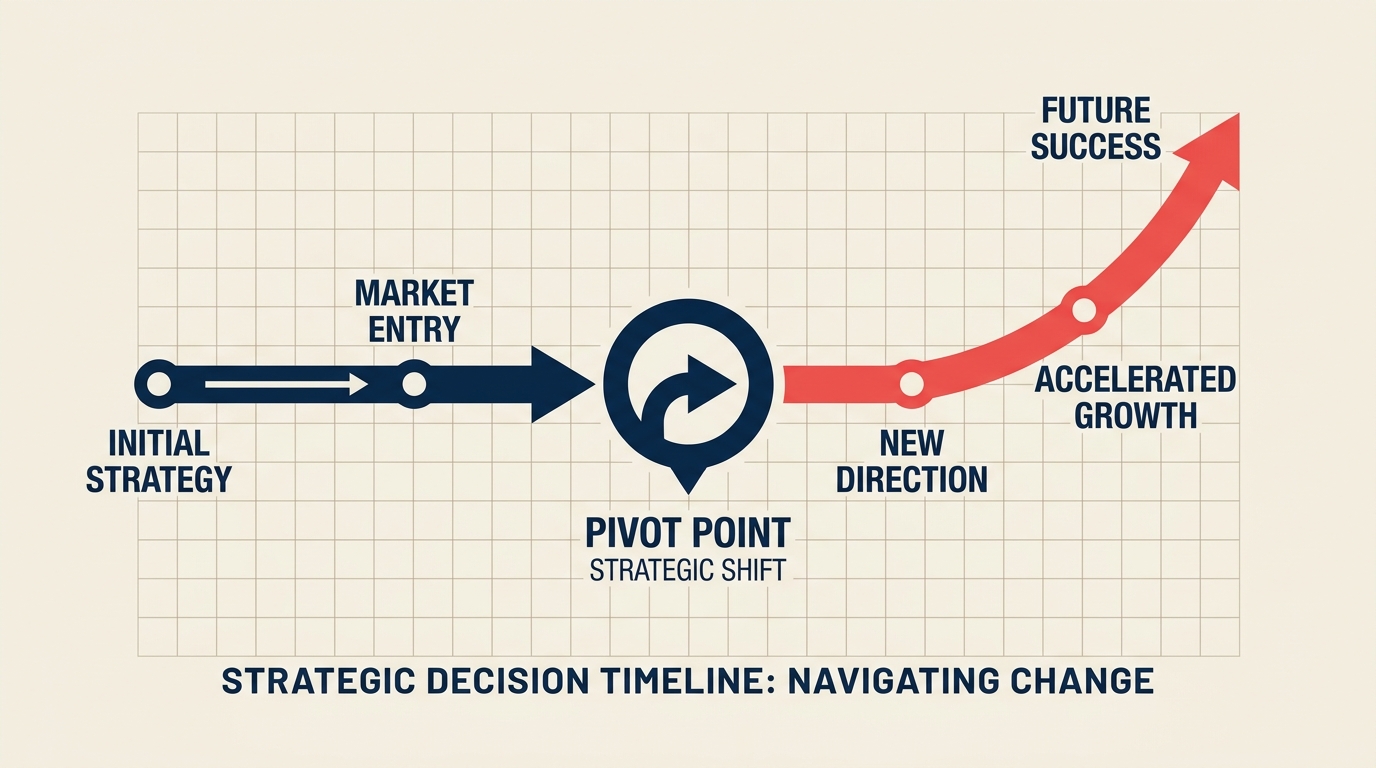
Staying too long with a strategy that is not working is one of the most common and costly leadership mistakes. But pivoting too soon abandons strategies that just needed more time or better execution. The difference between a disciplined pivot and a reactive abandonment of a sound strategy is often the same: interpretation of ambiguous evidence.
Leaders who navigate this well share a few practices. They define in advance what evidence would signal the need to change. They distinguish between fixable execution problems and fundamental strategy flaws. And they create the organizational conditions where honest assessment of performance is possible, even when that assessment is uncomfortable.
What a Strategic Pivot Actually Is
The word "pivot" has been overused to the point of meaning almost anything. A useful definition: a strategic pivot is a deliberate change to one or more core elements of the business model, including the customer segment served, the problem being solved, the product or service delivered, the revenue model, or the go-to-market approach.
A pivot is not a tactical adjustment. Changing the pricing on a product, updating a sales process, or shifting a marketing message is iteration, not pivot. Recognizing this distinction matters because organizations that conflate the two tend to pivot strategically when they should be iterating operationally, or vice versa.
True strategic pivots are high-cost because they require reorienting organizational resources, capabilities, and market positioning. They often trigger talent changes (people who were excellent for the previous strategy may not be for the new one), customer relationship changes (existing customers may not be the right customers for the new direction), and significant re-investment in capabilities that the new strategy requires.
The cost of a genuine pivot means that both the decision to pivot and the decision to stay the course need to be made carefully and with clear reasoning.
The Four Signals That a Pivot May Be Needed
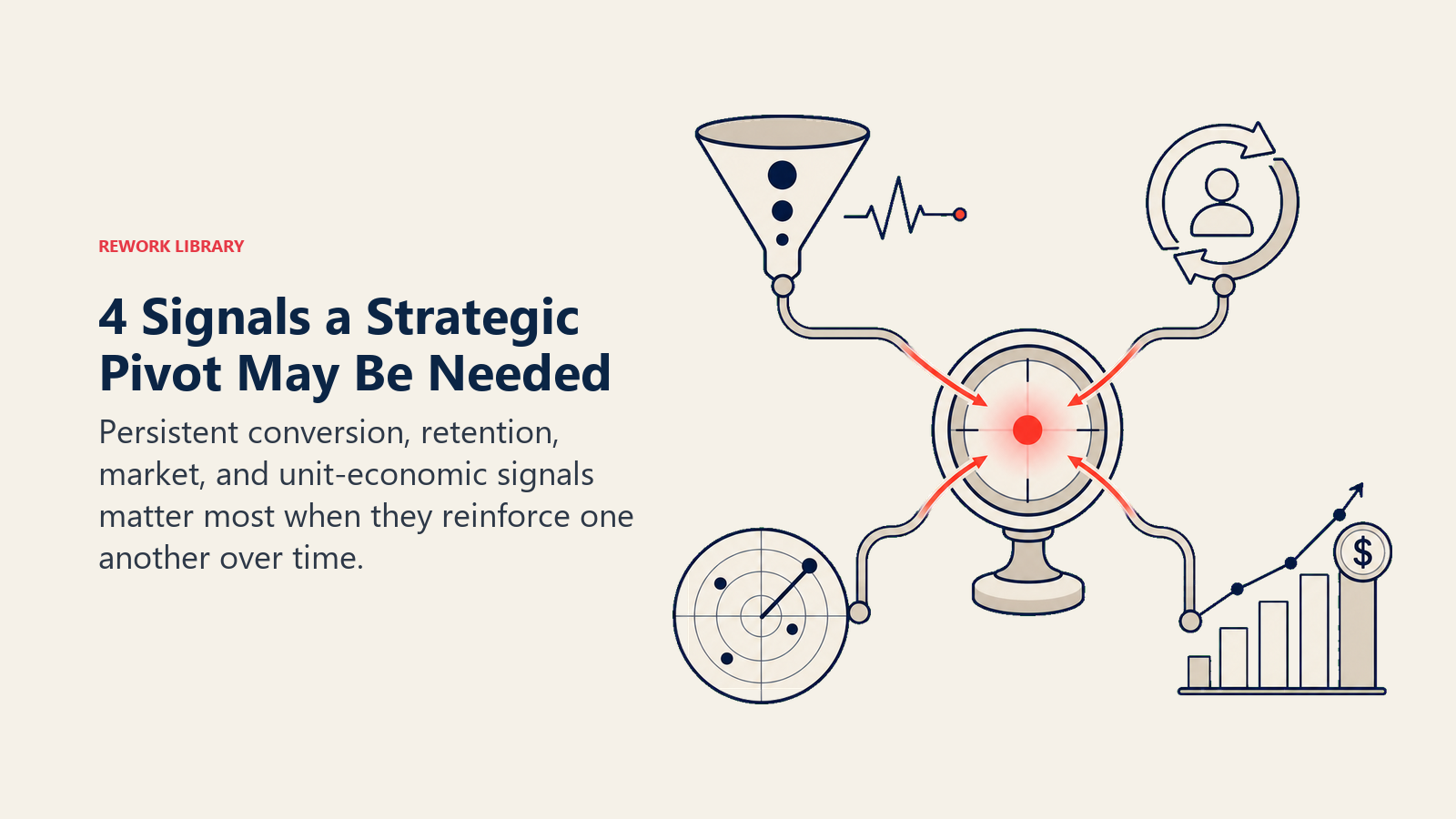
No single signal should trigger a pivot on its own. But combinations of signals, appearing consistently across multiple dimensions, warrant genuine consideration of strategic change.
1. Persistent conversion problems that do not respond to iteration
If you have a compelling product but cannot consistently convert qualified prospects into customers despite multiple iterations of the sales process, pricing, and messaging, the problem may not be execution. It may be that the product is not solving a problem that the target customer experiences as urgent enough to justify the cost and change required to buy it.
The key word is "persistent." All businesses have conversion problems in specific periods, with specific segments, or for identifiable reasons. Persistent conversion failure across a broad base of qualified prospects, after genuine iteration, is a signal that the customer-problem fit needs to be reexamined.
2. High churn or low expansion revenue among customers you have acquired
Getting customers is one test. Keeping them is a different and more definitive test. If customers who signed up are canceling at rates that exceed industry norms, or if you have low expansion revenue (existing customers are not buying more despite continued product development), it suggests the product is not delivering the value customers expected.
Churn analysis is more informative than overall churn rates. If churn is concentrated in a specific customer segment, acquired through a specific channel, or triggered by a specific product behavior, the signal is more targeted and the response can be more surgical. If churn is distributed broadly across the customer base without clear pattern, the problem may be more fundamental.
3. Competitive displacement you cannot defend against
When competitors are taking business from you and you cannot identify a credible path to differentiate, the competitive dynamics of the market may have shifted against your model. This is particularly acute when a new entrant with a structurally different cost structure or technology approach is winning customers that should be well-suited to your product.
Competitive displacement that is concentrated in a specific customer segment may indicate a segmentation strategy revision rather than a full pivot. But pervasive competitive displacement that does not respond to product improvements or pricing adjustments is a signal worth taking seriously.
4. Market signals that invalidate a core assumption
Every strategy rests on a set of assumptions about how the market works, what customers value, and how competitive dynamics will evolve. When evidence accumulates that a core assumption was wrong, the strategy built on it needs reexamination.
This is the hardest signal to act on because admitting that a core assumption was wrong requires intellectual honesty that organizations often resist. The organizational pressure to reinterpret contradictory evidence as an anomaly, a measurement error, or a competitor's temporary advantage is strong. Leaders who want to catch this signal need to make the original assumptions explicit, track them explicitly, and create conditions where contradictory evidence can be surfaced without political cost.
What Is Not a Signal to Pivot
Understanding false signals is as important as recognizing real ones.
Short-term revenue shortfall. Missing a quarterly target is not evidence that the strategy is wrong. Revenue lags the market conditions and execution changes that drive it. A quarter of underperformance, particularly in a challenging macro environment or during a product transition, is not a reliable indicator of strategic failure.
Early-stage churn that reflects product immaturity. In early product stages, some customer attrition reflects product gaps that are fixable through development, not fundamental misalignment between the product and the market. The question is whether the churned customers were representative of the target market and whether the stated reasons for churn indicate problems that product development can address.
Competitor wins that reflect their advantages in a segment you were not targeting. A competitor winning in a segment that you deliberately did not prioritize is not a competitive displacement signal. It may be confirmation that your segmentation is working.
Team and investor pressure toward a trendier direction. When a new market emerges that looks attractive, internal and external pressure to "pivot" toward it often builds regardless of whether the current strategy is failing. The pressure intensifies when competitors appear to be doing well in the new direction. This is one of the most seductive false signals, because it has the appearance of strategic foresight. In practice, pivoting to chase a market where competitors already have a head start rarely produces the desired result.
The Honest Assessment Process
The core problem in pivot decisions is that objective assessment is very difficult when you are inside the organization. Leaders have emotional investment in the current strategy. Teams have built their identity and plans around it. Investors have publicly committed to it.
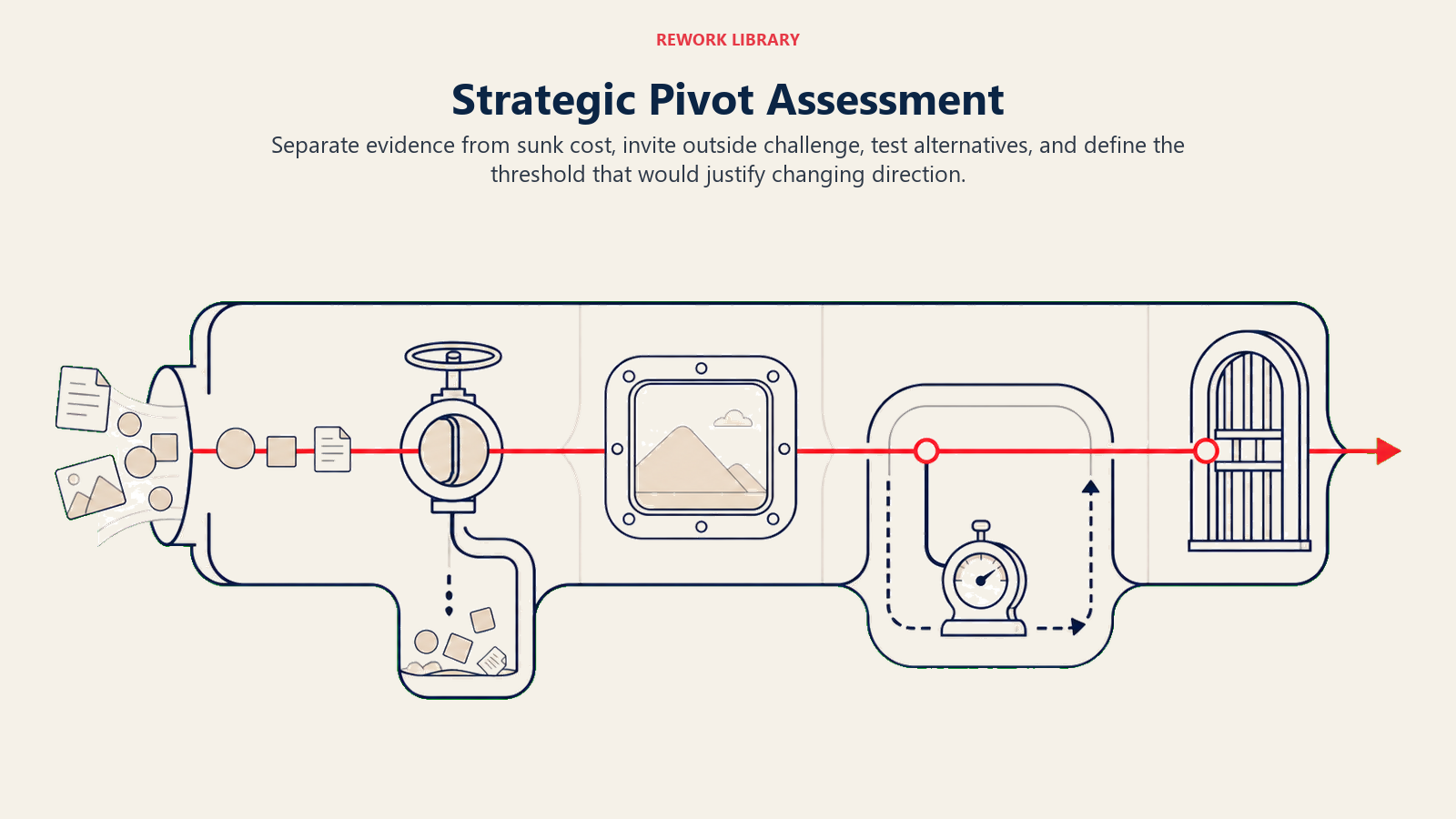
Several practices make honest assessment more possible.
Pre-mortems. Before committing to a strategy, identify the most plausible ways it could fail. Then, at regular intervals, ask: are any of those failure modes beginning to appear? Pre-mortems written before the fact are less susceptible to motivated reasoning than post-hoc assessments.
Explicit assumption tracking. Write down the key assumptions the strategy depends on. Assign someone the responsibility of monitoring each assumption and surfacing evidence that challenges it. When evidence accumulates against an assumption, it should trigger a structured review rather than being absorbed and rationalized away.
Outside-in reality checks. Bring in perspectives that are not invested in the current strategy: advisors who have seen similar situations, potential investors who would evaluate the business with fresh eyes, or customers who can speak candidly about what they need versus what you offer. The information you get from these conversations is often more reliable than what you get from internal sources.
Disaggregate performance metrics. Aggregate revenue or growth numbers can mask important signals. Break performance down by customer segment, cohort, product line, and geography. Often the signal that a specific element of the strategy is failing is visible at a disaggregated level before it appears in the aggregate numbers.
Executing a Pivot
Deciding to pivot is easier than executing one well. The execution challenge includes both the strategic redirection and the organizational impact.
Clarity about what is changing and what is not. A pivot is rarely a complete restart. Usually some capabilities, customer relationships, and organizational knowledge are carried forward. Being specific about what is preserved and what is changing helps the organization make sense of the transition without feeling that everything they built is being discarded.
Speed of commitment. Half-hearted pivots fail. If you have decided to redirect, the organizational energy and resources need to follow. A pivot where the original strategy is still being pursued with significant resources while the new direction is being tested creates confusion and rarely produces the clean signal you need to assess whether the new direction is working.
Communication to stakeholders. Employees, investors, customers, and partners all need to understand the pivot and their role in the new direction. The communication needs to be honest about why the change is being made, what it means for each constituency, and why you believe the new direction is better. Vague or defensive communication about strategic changes amplifies uncertainty and erodes trust.
Performance framework for the new direction. As soon as you pivot, establish what success looks like in the new direction and over what time horizon. Without a clear performance framework, the new strategy is subject to the same uncertain assessment as the old one.
Key Facts
- The majority of strategic pivots happen too late, not too early. The organizational and emotional costs of admitting strategic failure create strong incentives to persist with a failing strategy longer than the evidence warrants. Building explicit decision triggers before the need for a pivot arises makes timely action more likely.
- Pivoting customer segment is typically less disruptive than pivoting the core product. If the existing product solves a real problem but for a different customer than you originally targeted, redirecting the go-to-market to the right customer is a faster and less costly pivot than rebuilding the product for a new problem.
- The team you need to execute a pivot may be different from the team you have. Leaders who have built their expertise and identity around the current strategy sometimes struggle to lead effectively in a genuinely different direction. Honest assessment of leadership fit for the new direction is part of good pivot execution.
Frequently Asked Questions about Strategic Pivot Timing
How do you know if underperformance is a strategy problem or an execution problem?
Ask whether the same strategy with different execution (better sales, better marketing, better product quality) would produce a different result. If the answer is yes, and you have a credible path to better execution, the strategy may not be the problem. If the answer is that even excellent execution would not produce the results you need, the strategy itself is the issue.
How long should you give a strategy before concluding it is not working?
It depends entirely on the time required to get meaningful feedback. In consumer products with rapid purchase cycles, you may have clear signal in 90 days. In enterprise B2B with long sales cycles, meaningful signal may take 18-24 months. The relevant question is: have you run the strategy long enough and at sufficient scale to get a meaningful signal about whether it works?
What is the relationship between a pivot and a shutdown?
A pivot preserves the belief that there is a viable business here, just with different strategic direction. A shutdown acknowledges that no viable path has been identified. Some situations that look like they call for a pivot actually call for a shutdown: if the core team, technology, or customer relationships have no value in a different direction, a pivot may only delay an inevitable outcome.
Can a large organization successfully pivot?
Yes, but the organizational inertia makes it harder and slower. Large organizations have more resources to experiment with the new direction while maintaining the existing business, but they also have more people whose careers and identities are tied to the current strategy. Successful pivots in large organizations typically require senior leader sponsorship, dedicated resources separate from the core business, and clear permission to experiment with approaches that conflict with the organization's established norms.
Related Reading

Co-Founder, Rework.com
On this page
- What a Strategic Pivot Actually Is
- The Four Signals That a Pivot May Be Needed
- 1. Persistent conversion problems that do not respond to iteration
- 2. High churn or low expansion revenue among customers you have acquired
- 3. Competitive displacement you cannot defend against
- 4. Market signals that invalidate a core assumption
- What Is Not a Signal to Pivot
- The Honest Assessment Process
- Executing a Pivot
- Key Facts
- Related Reading