Culture Architecture: How Leaders Design Organizational Culture Deliberately
Turn this article into takeaways for your work.


Each assistant summarizes the article only for you and suggests best practices for your work.
Culture architecture is the discipline of designing organizational culture intentionally rather than inheriting it by default. It treats culture not as a set of values to be declared, but as a system of incentives, norms, rituals, and stories to be engineered. Leaders who practice culture architecture understand that what an organization actually does, under pressure, when no one is watching, is the real culture. Their job is to make that real culture match the stated one.
What is culture architecture?
Most organizational culture is not designed. It accumulates. Early employees model certain behaviors, certain stories get told repeatedly, certain people get promoted, and certain problems get tolerated. Over time these patterns solidify into norms that new employees read and learn to follow, regardless of what the official values statement says.
Culture architecture is the deliberate intervention in this process. It starts from the observation that culture is an output of systems: who gets hired, who gets promoted, what gets rewarded, what behaviors are tolerated when they conflict with stated values, which stories leaders tell about the organization's history. Change those systems, and the culture changes. Leave those systems intact, and the culture stays the same, no matter how many all-hands meetings are held about values.
The discipline draws from organizational psychology, behavioral economics, and systems thinking. The core insight is that culture is not primarily a communication problem. Organizations do not have misaligned cultures because the values were not communicated clearly enough. They have them because the systems that shape daily behavior point in different directions than the values that are stated.
Key Facts
Research on organizational culture change finds that the most reliable predictor of whether a stated cultural change "sticks" is whether the performance management system actually changes, not whether communication about the change was extensive or executive-sponsored.
Studies of high-performing companies across industries find that the cultural attributes most consistently linked to financial outperformance (high accountability, customer orientation, bias for action) are process-level attributes that show up in how decisions are made, not aspirational values on a slide.
Research on new employee socialization finds that newcomers update their understanding of "how things actually work here" within the first 90 days primarily through observing what happens when formal rules and informal norms conflict, not through explicit culture communications.
The components of organizational culture
Before culture can be designed, it needs to be understood as a system with distinct components. Treating culture as a single thing ("we need a better culture") makes it impossible to diagnose or change. Separating it into components makes it actionable.
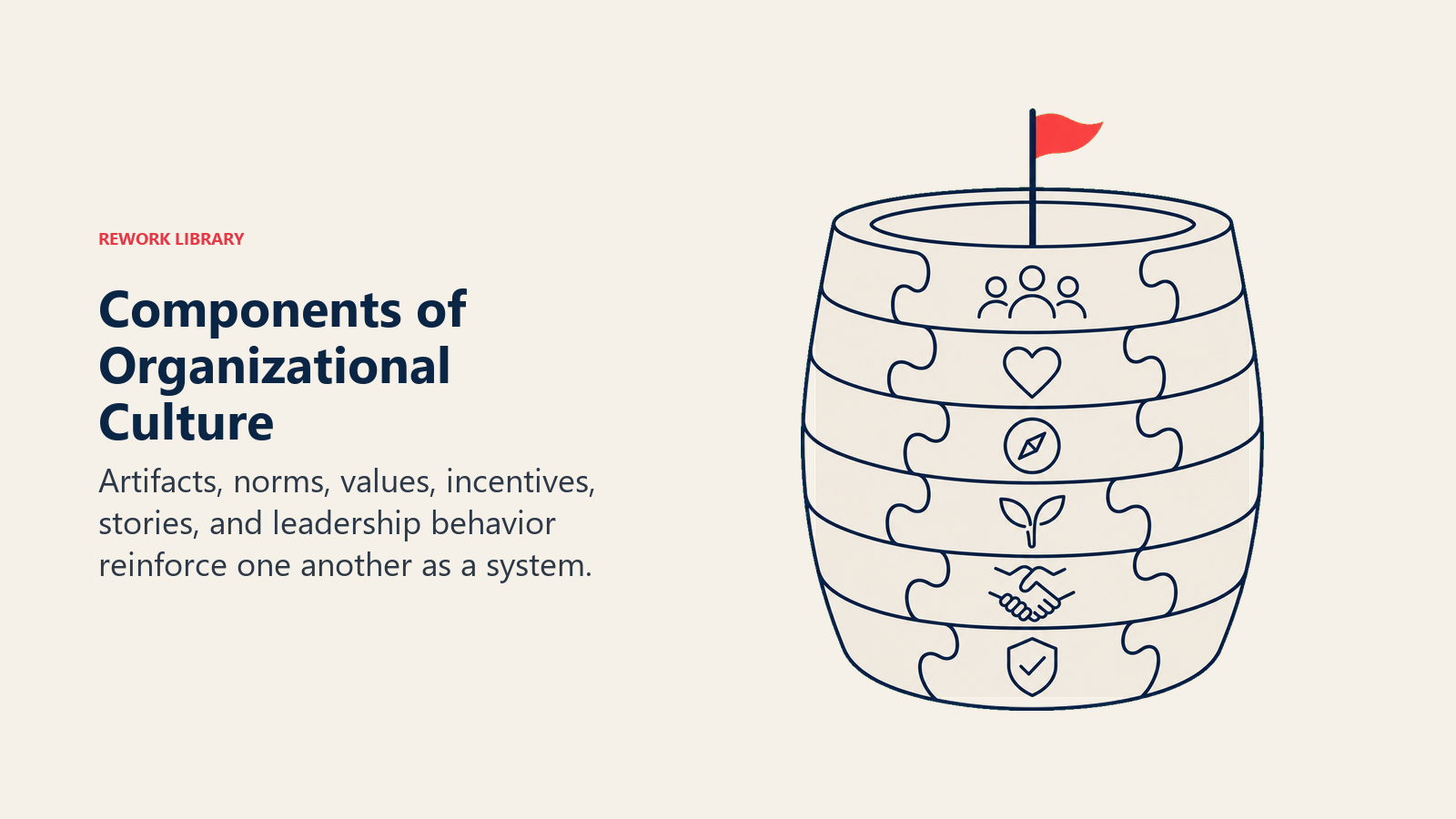
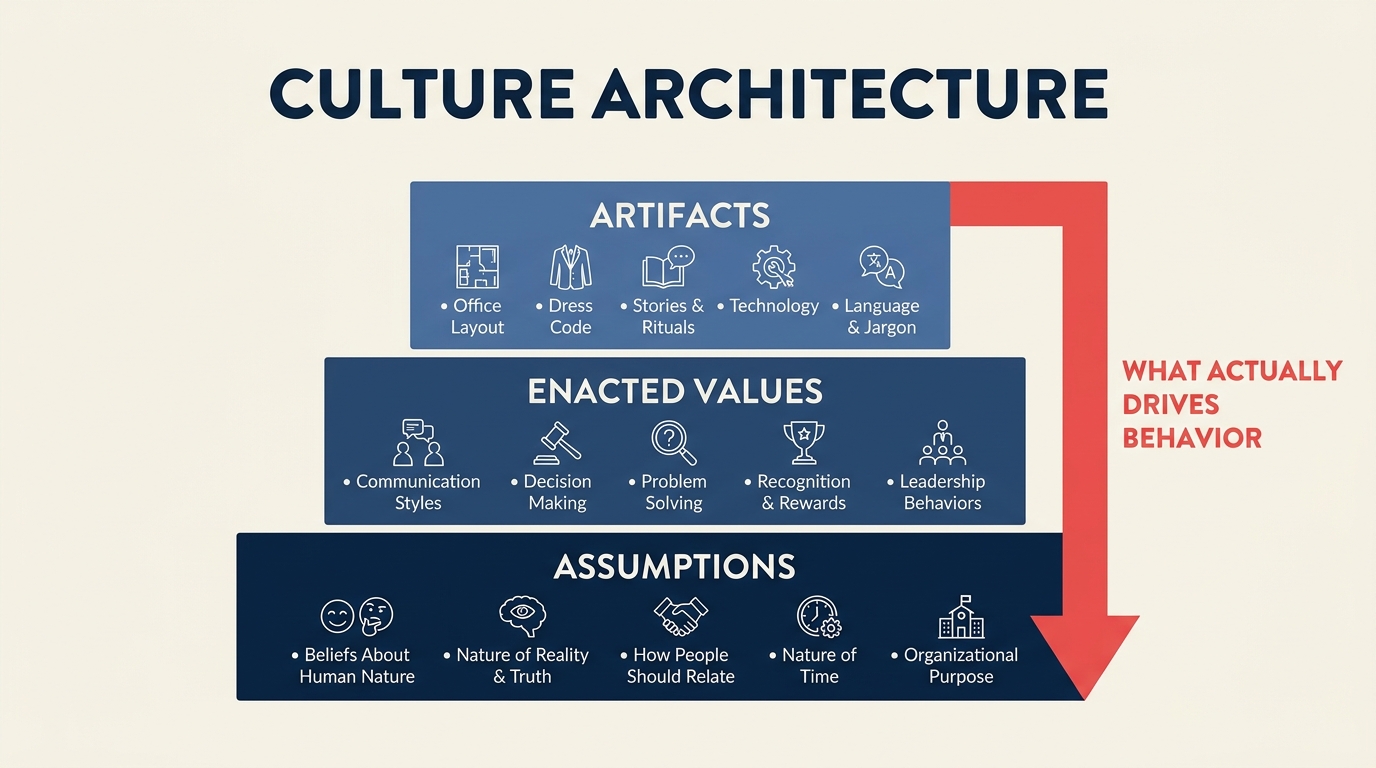
Artifacts. These are the visible, tangible expressions of culture: office layout, meeting rituals, the language people use, what is displayed on walls, how performance reviews are structured, how new employees are onboarded, which metrics are on the main dashboard. Artifacts are the most observable layer of culture and the easiest to change, but changing artifacts without changing the underlying assumptions they express rarely changes culture.
Espoused values. These are the values an organization says it holds: innovation, customer focus, integrity, teamwork. Espoused values are the layer most organizations spend the most time on. They are also the least reliable indicator of actual culture, because they reflect what the organization wishes were true, not necessarily what is true.
Enacted values. These are the values the organization actually demonstrates through behavior, especially under pressure. What happens when a high performer violates a stated value? What gets prioritized when a business target conflicts with a stated commitment? How does the organization respond to failure? Enacted values are often quite different from espoused values, and every employee knows the difference, even if they cannot articulate it explicitly.
Underlying assumptions. These are the deepest layer: the unconscious beliefs about how the world works that shape behavior without explicit discussion. "Customers can't tell us what they want." "Managers cannot be trusted with ambiguous authority." "Risk is a liability, not an asset." These assumptions are often invisible to the people who hold them precisely because they feel like obvious facts rather than beliefs that could be otherwise.
Culture architecture works primarily at the enacted values and underlying assumptions layers, not just the artifacts and espoused values layers.
The culture architecture process
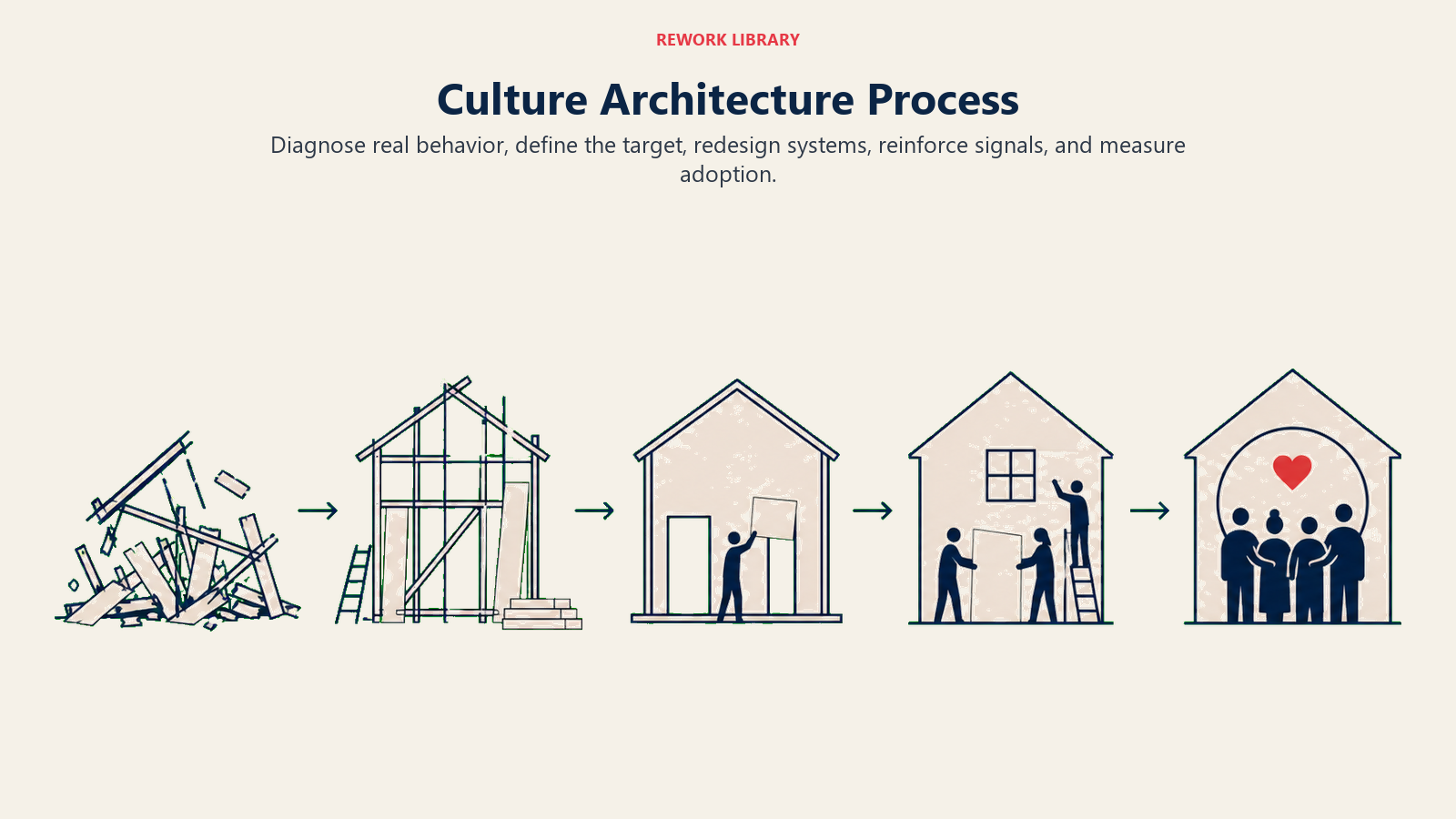
Step 1: Diagnose the real culture. The starting point is an accurate picture of what the culture actually is, not what leadership hopes it is. This requires looking at behavioral data, not just survey responses: who gets promoted and why, what behaviors are tolerated from high performers, how decisions actually get made, what the organization does when short-term results conflict with long-term values.
Useful diagnostic questions include: What story would a new employee learn in their first three months about "how things really work here"? What behavior would someone have to display to get promoted? What would they have to do to get fired? What is the thing that everyone knows is true but no one says in meetings?
Step 2: Define the target culture with behavioral specificity. "We want a high-performance culture" is not useful. "We want managers to give direct, candid developmental feedback to every direct report at least monthly" is useful. Culture architecture requires translating abstract values into specific, observable behaviors. What would someone do differently if they fully embodied the target culture?
Step 3: Map the system gaps. Once you know what behaviors the target culture requires, identify the systems that currently discourage those behaviors. Common gaps include: performance reviews that reward tenure over impact, promotion criteria that are opaque and perceived as political, tolerance of disrespectful behavior from high revenue performers, recognition systems that only celebrate individual achievement when the stated culture is collaborative, and decision-making processes that concentrate authority at the top when the stated culture is empowering.
Step 4: Redesign the systems, not just the communication. The actual work of culture architecture is changing the systems that shape daily behavior. This means modifying performance management criteria to reflect actual cultural values, changing promotion processes to make the evaluative dimensions explicit and consistent, removing tolerance for high-performer exceptions to cultural norms, building recognition practices that reinforce the target behaviors, and changing hiring practices to assess cultural fit on behavioral dimensions rather than general impressions.
Step 5: Model the target culture visibly. Leaders' behavior is the most powerful cultural signal in any organization. When leaders behave consistently with stated values, especially in high-visibility situations and under pressure, they provide a credible behavioral template. When they do not, the gap between stated and enacted values becomes the culture lesson that every employee learns. Culture architecture requires that senior leaders audit their own behavior against the target culture and change what needs to change before asking anyone else to.
Cultural archetypes
Different organizations have different cultural needs depending on their strategy and context. Culture architecture is not about installing a single "right" culture but about building the culture that fits the organization's actual requirements.
| Cultural type | Core emphasis | What it requires | Where it fits |
|---|---|---|---|
| High-accountability | Clear ownership, direct feedback, consequence for missed commitments | Transparent performance data, candid managers, real stakes | Execution-intensive businesses |
| Innovation-oriented | Psychological safety, experimentation, tolerance for productive failure | Protected time, failure analysis, idea-evaluation process | R&D, product development |
| Customer-obsessed | Customer data in all decisions, front-line voice amplified | Direct customer access for all levels, customer metrics primary | Consumer businesses, SaaS |
| Collaborative | Cross-functional trust, information sharing, joint ownership | Shared goals, trust-building rituals, visible coordination | Complex multi-team organizations |
| High-autonomy | Individual ownership, minimal process, result-focus | Strong hiring, clear goals, consequence for chronic underperformance | Professional services, knowledge work |
Most organizations need a blend. The culture architecture challenge is identifying the primary and secondary cultural requirements and building systems that reinforce both without creating contradictions.
Common failures in culture change attempts
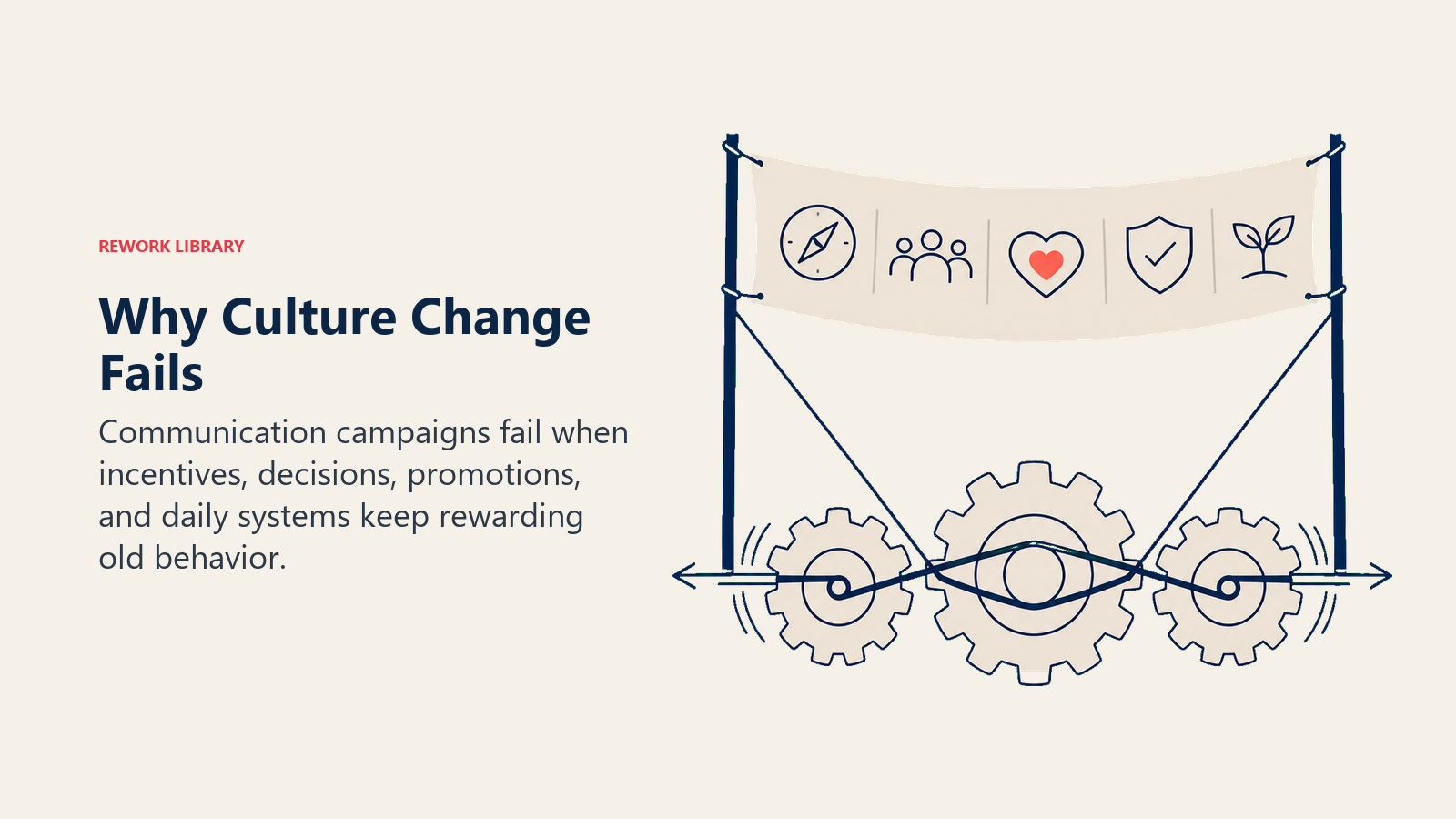
Treating culture as a communication project. The most common failure is addressing culture gaps with communications campaigns. Better values posters, more all-hands culture sessions, and CEO videos about what we stand for do not change culture because they do not change the systems that shape behavior. Communication is necessary but not sufficient. The systems have to change.
Tolerating cultural violations from high performers. Nothing communicates culture more clearly than what an organization tolerates when someone important violates a stated value. When a high-revenue salesperson is allowed to bully junior colleagues because they hit their number, the actual cultural lesson is that results excuse behavior. Every employee learns this, and many adjust their behavior accordingly. Culture architecture requires treating this decision as a high-stakes cultural intervention, because that is exactly what it is.
Trying to change everything at once. Comprehensive culture transformation programs that address every dimension simultaneously usually fail to move any dimension significantly. Effective culture change is usually more targeted: identify the two or three behavioral changes that would have the highest leverage, change the systems that would enable those behaviors, and let the broader culture shift follow.
Mistaking culture fit for uniformity. Culture architecture is not about building an organization where everyone thinks the same way. Cognitive diversity is a strength for most organizations. "Culture fit" that is really "similar background and style" reduces the diversity of perspective that makes organizations resilient and creative. The behavioral dimensions of culture (how people give feedback, how they make decisions, how they handle conflict) can be consistent without requiring homogeneity of thought.
Expecting culture change to be permanent. Cultures drift. Under growth pressure, under leadership change, under market disruption, the systems that support a culture can erode without anyone deciding to abandon it. Culture maintenance is ongoing work, not a project with a completion date. Leaders who treat culture as something established once and then preserved passively will find it has quietly changed into something else.
Culture architecture at different organizational scales
Culture design looks different at different scales. A 20-person company can maintain culture through direct leader modeling and tight feedback loops. A 500-person company needs explicit process design and middle-manager consistency. A 5,000-person company requires systematic measurement, regional and functional adaptation, and distributed leadership development.
Scale is where most culture architecture efforts break down. The practices that worked at 50 people feel performative at 500 and absurd at 5,000. Effective culture architects know that the mechanisms need to evolve with the organization, not be preserved as the organization's "original character."
Culture that scales is the specific challenge of maintaining cultural integrity through rapid growth, and it requires different tools and different leadership behaviors than building culture from scratch.
Frequently Asked Questions about Culture Architecture
How long does it take to change organizational culture?
Meaningful culture change at the level of enacted values and underlying assumptions typically takes two to four years for a sustained effort with aligned systems. Artifact-level changes (new rituals, new meeting formats, new language) can happen in months. But the deeper behavioral patterns change on the timeline of the human systems that reinforce them: performance cycles, promotion cohorts, leadership development programs.
Can culture be changed from the middle of an organization, or does it require top-down leadership?
Significant culture change requires both. Senior leadership alignment is necessary because the systems that most powerfully shape culture (performance management, promotion, resource allocation) are senior decisions. But culture change that is only top-down, without authentic adoption at the middle management layer, produces compliance theater rather than real change. The most effective culture transformations engage middle managers as co-designers, not just implementers.
How do you maintain culture through an acquisition?
The core question in any acquisition is which cultural elements of each organization should be preserved, which should be blended, and which should be changed. This is a strategic decision that needs to happen before integration, not during it. Most post-merger culture failures happen because this decision is not made explicitly, so the default is usually that the acquiring company's culture applies without examination, which typically produces attrition of the acquired company's best people.
How do you know if your culture change is actually working?
The leading indicators are behavioral: what are managers actually doing in performance reviews? Are high-performer exceptions to cultural norms being handled differently? Are the stories people tell about the organization reflecting the target cultural values? The lagging indicators are business outcomes: attrition among high performers, candidate quality, employee survey trends, and the quality of execution on strategic initiatives.
The leaders who build great cultures do not do it by talking about culture more than other leaders. They do it by managing the systems that produce culture with the same rigor they apply to the systems that produce revenue. Hiring, promotion, recognition, feedback, and tolerance decisions are cultural decisions, every time they are made. Culture architecture is the discipline of making them deliberately. See ethical leadership for how values integrity shows up in leadership behavior, and succession planning for how culture continuity depends on deliberate leadership development choices.
