Stakeholder Capitalism in Practice: How Leaders Balance Competing Claims
Turn this article into takeaways for your work.


Each assistant summarizes the article only for you and suggests best practices for your work.
The debate over shareholder primacy versus stakeholder capitalism has become one of the defining business governance discussions of the past decade. But for working leaders, the debate at the theoretical level is less useful than understanding what the shift actually requires in practice.
Stakeholder capitalism, at its core, makes a specific empirical claim: that organizations which attend only to shareholder returns are systematically underinvesting in the relationships, capabilities, and conditions that generate durable value. Employees who are poorly paid or poorly treated eventually leave or stop performing. Suppliers who are squeezed too hard cut corners on quality or switch to other buyers when a better option appears. Communities that see no benefit from a business's presence do not generate favorable conditions for it to operate. Customers who feel exploited by pricing or misled about products stop buying.
The stakeholder capitalism framework asks leaders to see these dynamics not as corporate social responsibility add-ons but as inputs into the long-term performance of the business.
The Origins of the Debate
The traditional doctrine of shareholder primacy, associated most prominently with the argument that a corporation's sole obligation is to maximize returns for its owners, dominated corporate governance thinking for several decades. It shaped executive incentive structures, board composition, and the analytical framework used to evaluate corporate performance.
The critique of this model accumulated from several directions. Investors with long time horizons argued that short-term earnings maximization was destroying value by underinvesting in capabilities, talent, and relationships that would generate returns over longer periods. Environmental economists pointed to externalities (costs borne by communities and the environment that were not captured in corporate financial statements) as evidence that pure profit maximization transferred costs to parties who had no voice in governance. Labor economists noted that real wage stagnation alongside record corporate profits suggested a power imbalance that was politically and economically unstable.
By the late 2010s, major institutional investors and corporate leadership organizations had formally articulated positions that moved beyond pure shareholder primacy. The language of stakeholder capitalism entered mainstream business discourse.
But articulating a commitment to stakeholder capitalism in a public statement and actually managing a business on that basis are very different things. The practical challenge is non-trivial.
Defining the Stakeholder Set
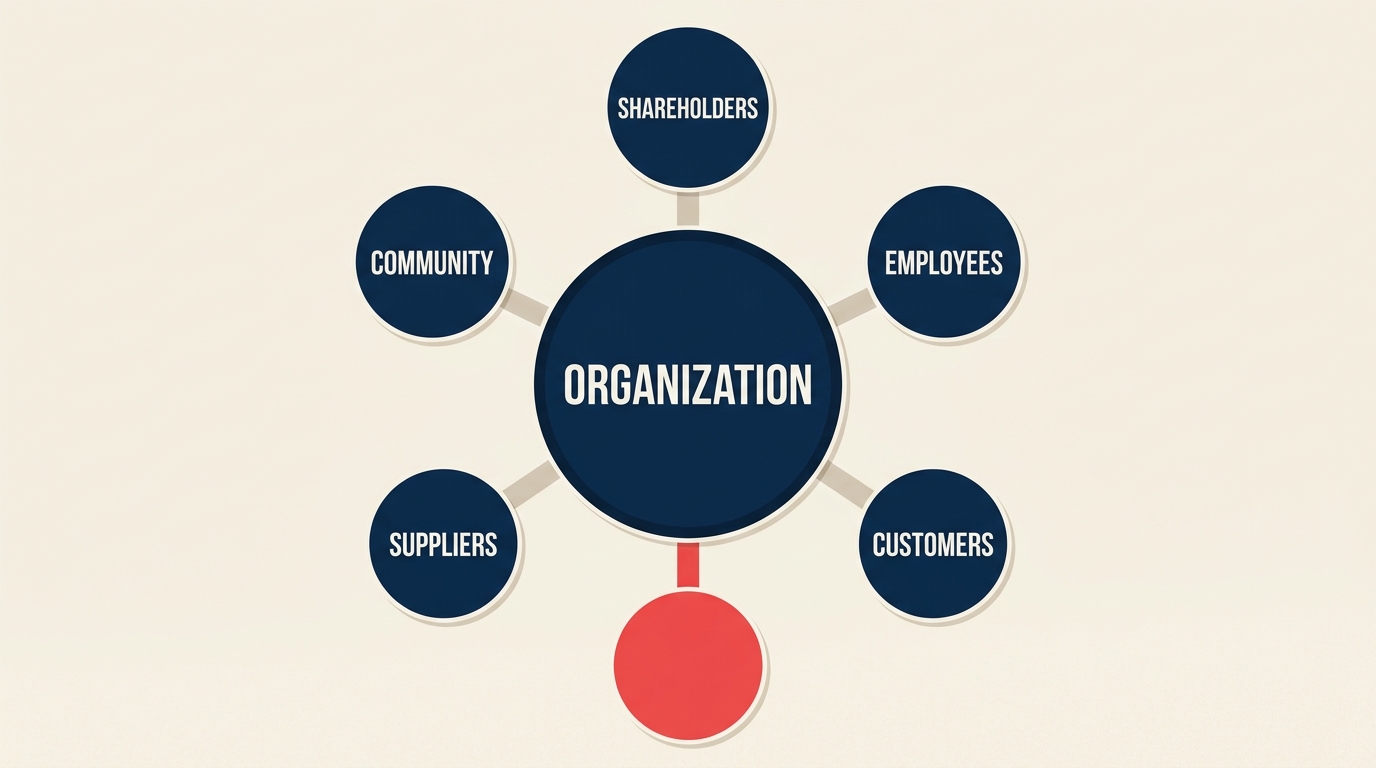
The first practical requirement is to be specific about who the stakeholders actually are. "All stakeholders" is not an actionable concept. For any given decision, the relevant stakeholder set is smaller and more identifiable.

The standard stakeholder categories include:
Shareholders and investors. They provide capital and bear financial risk. Their claim is on financial returns, and they retain significant formal power through governance structures. Even under a stakeholder capitalism framework, their interests are not ignored. The argument is that attending to other stakeholders is a means of generating sustainable returns, not a substitution for returns.
Employees. They provide labor, knowledge, and organizational capability. Their claims include compensation that reflects their contribution, working conditions that are safe and sustainable, development opportunities, and some degree of voice in decisions that affect their work. High employee turnover and engagement problems are leading indicators of future performance problems.
Customers. They provide revenue and validation that what you produce is valuable. Their claims include product quality, honest representation of what you sell, fair pricing, and service responsiveness when things go wrong. Customer relationships that are purely transactional are more fragile than those built on genuine value delivery.
Suppliers and partners. They provide inputs, services, and capabilities. Their claims include fair payment terms, reasonable relationship stability, and clear communication about requirements and changes. Supplier relationships that are exploitative tend to produce supply chain fragility, quality problems, and the loss of preferred access to the best partners.
Communities. They provide operating licenses (formal and informal), infrastructure, talent pipelines, and a social context that either enables or constrains the business. Their claims include employment opportunities for local residents, responsible environmental practices, and some contribution to community well-being. This claim is harder to make specific but is increasingly enforced through regulatory requirements, local political conditions, and reputational effects.
Future stakeholders. The stakeholder capitalism framework, at its most ambitious, extends obligation to future generations who will live with the environmental and social consequences of decisions made today. This is where the framework's connection to long-term sustainability thinking is most explicit.
The Governance Challenge
Recognizing multiple stakeholders creates a governance problem that shareholder primacy sidesteps: how do you weigh competing claims when they conflict?
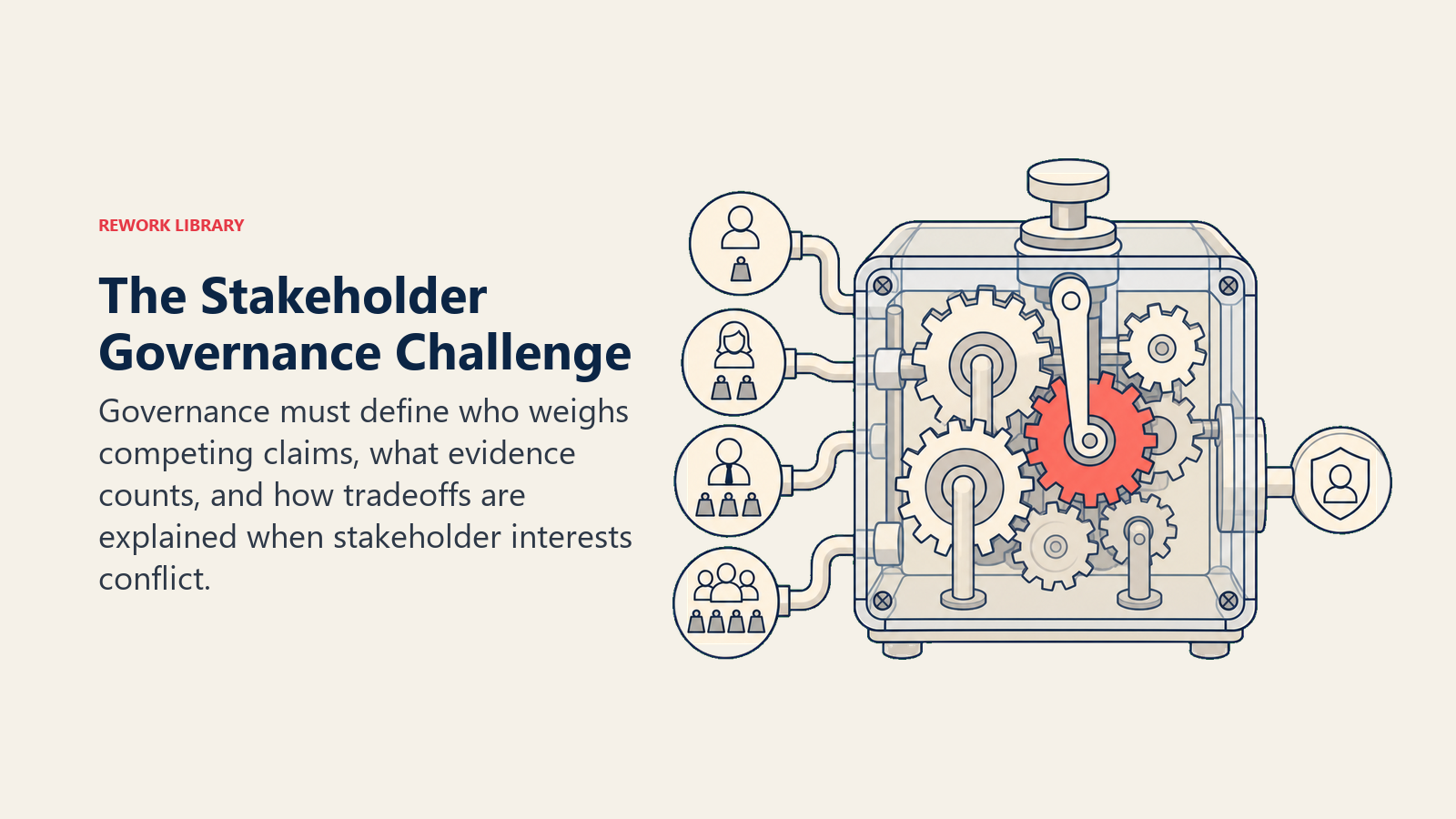
When a decision must be made that benefits shareholders at employees' expense, or benefits customers at suppliers' expense, what is the decision rule?
Stakeholder capitalism does not provide a single clean answer. What it does provide is a set of frameworks for making these tradeoffs more explicit and defensible.
The constituency analysis. Before making a significant decision, systematically map which stakeholder groups are affected, how, and to what degree. This does not resolve the tradeoff, but it makes the full impact visible. Decisions made with full visibility of their stakeholder consequences tend to be better than decisions made while ignoring some of those consequences.
The long-run test. For decisions where short-term and long-term interests conflict, ask explicitly: which choice produces better outcomes over a three-to-five-year horizon? This can reframe apparent conflicts. An employee compensation decision that looks expensive short-term may pay off through retention and engagement. An environmental investment that reduces short-term margins may prevent regulatory costs, reputational damage, or supply chain disruption later.
The reversibility test. Decisions that are hard to reverse deserve more weight given to their full stakeholder impact. Restructuring a supplier relationship in ways that destroy that supplier's business, or making environmental changes that are difficult to remediate, warrant more careful stakeholder analysis than decisions that can be adjusted if consequences emerge.
The materiality filter. Not all stakeholder interests are equally material to business performance. Prioritize those where the connection between stakeholder welfare and business outcomes is strongest. The interests of employees whose work is central to value delivery are more materially connected to performance than the interests of a peripheral supplier for a commodity input.
Practical Implementation
The translation of stakeholder capitalism commitments into management practice is where most organizations fall short. The gap between a public commitment to stakeholder values and the actual day-to-day decisions of the business is often significant.
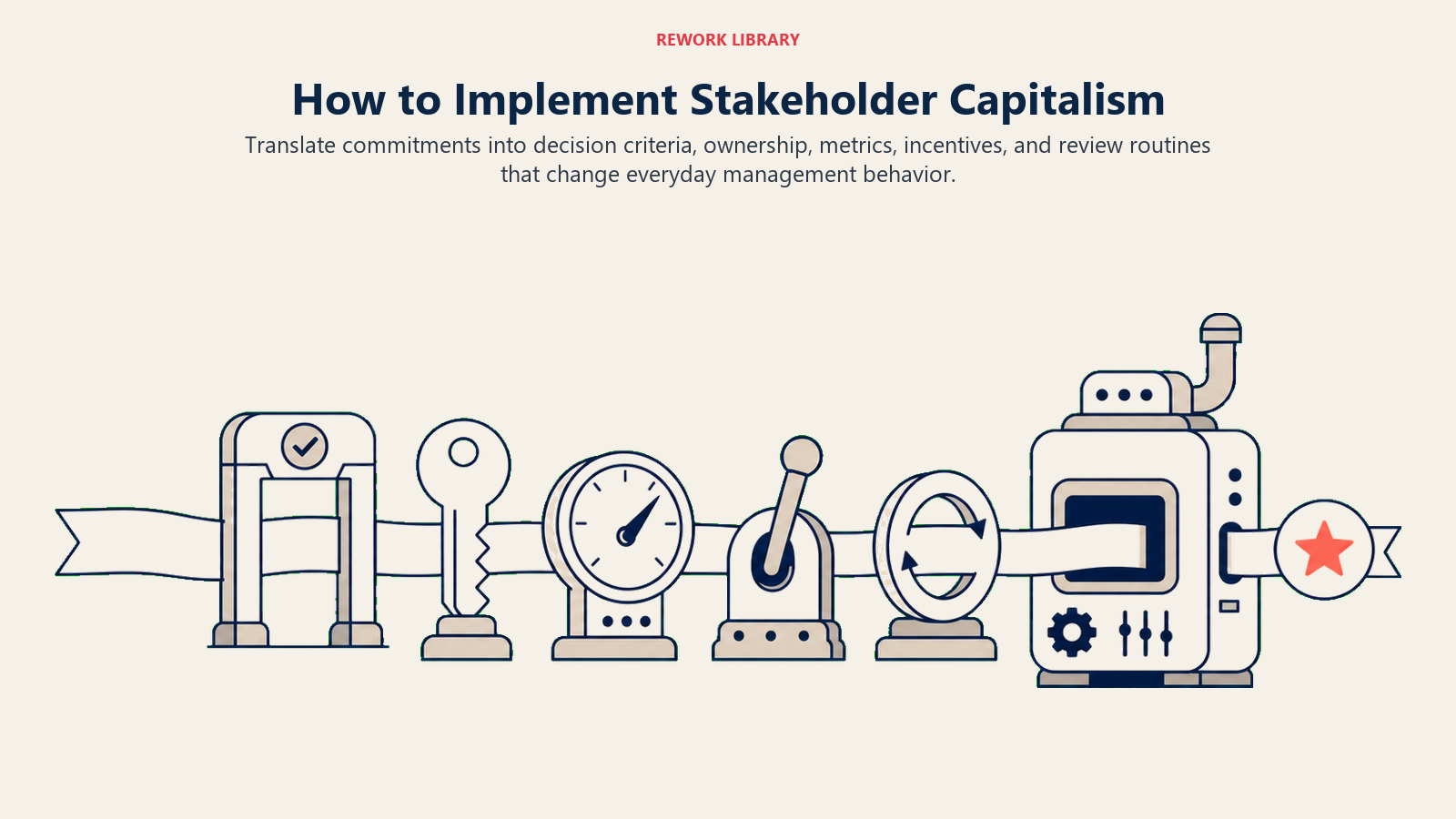
Measure what you claim to care about. If employee wellbeing is a stakeholder commitment, you need measurement systems that track wellbeing indicators: turnover rate, engagement scores, safety incidents, compensation relative to market benchmarks. What gets measured gets managed. Organizations that articulate stakeholder commitments without measurement systems are not managing to those commitments.
Connect executive incentives to stakeholder outcomes. Executive compensation that is entirely tied to short-term financial metrics creates strong incentives to optimize those metrics at the expense of other values. Many organizations that have adopted stakeholder capitalism language have begun including non-financial metrics in executive incentive structures: employee engagement, customer satisfaction, environmental performance, supplier relationship health.
Build decision-making processes that surface stakeholder interests. Most organizational decision processes are designed to optimize financial outcomes. Stakeholder capitalism requires modifying those processes so that relevant stakeholder impacts are systematically surfaced before major decisions are made, not assessed after the fact.
Be honest about tradeoffs. One of the risks of stakeholder capitalism as a communications strategy is that it can create expectations of conflict-free management where every decision benefits every stakeholder. This is not achievable. Leaders who are serious about the framework need to be honest when they make a tradeoff that disadvantages one stakeholder group, explain the reasoning, and be prepared to accept accountability for the outcome.
The ESG Connection
Stakeholder capitalism has a close relationship to ESG (Environmental, Social, and Governance) frameworks that institutional investors use to evaluate corporate risk and governance quality.
Environmental criteria assess how a company manages its impact on and exposure to environmental conditions. Social criteria assess how it manages relationships with employees, suppliers, customers, and communities. Governance criteria assess leadership quality, executive compensation design, audit quality, and shareholder rights.
For public companies, ESG ratings have become a material factor in capital allocation. Large institutional investors integrate ESG criteria into investment decisions, and companies with poor ESG profiles face a higher cost of capital and, increasingly, activist investor pressure.
For private companies, ESG considerations are becoming relevant as private equity firms apply ESG criteria to portfolio management and as regulatory requirements expand.
Leaders who want to understand the practical implications of stakeholder capitalism often find that starting with ESG measurement is a useful entry point. It provides structured frameworks for what to measure and how to report it.
Key Facts
- Stakeholder capitalism does not mean equal weight to all stakeholders in all decisions. It means systematically considering the impact on all stakeholder groups and making tradeoffs transparently rather than ignoring some stakeholders by default. The weights vary by context, materiality, and time horizon.
- Employee turnover is a leading indicator that often reflects governance failure before financial results show it. When voluntary turnover in critical roles is high, stakeholder value is being destroyed even if the current quarter's earnings look fine. Leaders who track this seriously surface governance problems before they become financial problems.
- The most durable criticism of stakeholder capitalism is accountability. If you are accountable to all stakeholders, you are effectively accountable to none in any enforceable way. This is a real governance weakness that serious implementations of stakeholder capitalism must address through specific measurement and incentive structures.
Frequently Asked Questions about Stakeholder Capitalism in Practice
What is the difference between stakeholder capitalism and CSR (corporate social responsibility)?
CSR is typically an add-on: a company pursues profit maximization as its primary goal and allocates some resources to social and community programs as a secondary activity. Stakeholder capitalism claims that stakeholder considerations should be integrated into the core business strategy and decision-making, not separated into a dedicated program. The practical difference is whether social and employee considerations influence major business decisions or just corporate philanthropy budgets.
Does stakeholder capitalism improve financial performance?
The evidence is mixed and contested. Studies that show positive associations between ESG scores and financial performance often struggle with causality (are better-governed companies more profitable because of their governance, or are more profitable companies able to afford better governance?). What the evidence does suggest more clearly is that significant failures in stakeholder management (labor scandals, environmental disasters, governance failures) are associated with meaningful financial damage. The case for stakeholder capitalism rests partly on asymmetry: the downside risk of stakeholder neglect is demonstrably large even if the upside of stakeholder management is harder to quantify.
How does stakeholder capitalism apply to privately held or family-owned businesses?
The formal governance mechanisms (board accountability, ESG reporting, institutional investor pressure) are mostly absent in private businesses. But the underlying logic still applies. Private businesses are embedded in communities, dependent on employees and suppliers, and serving customers. The relational and reputational dynamics that stakeholder capitalism highlights operate in private businesses, even without the governance formalism.
What is the biggest practical challenge in implementing stakeholder capitalism?
Measurement. Most organizations have well-developed systems for measuring financial performance and very underdeveloped systems for measuring employee wellbeing, supplier relationship health, community impact, and environmental footprint. Without credible measurement, stakeholder commitments are aspirational rather than operational.
Related Reading
