Best AI Tools for Market Research in 2026
Turn this article into takeaways for your work.


Each assistant summarizes the article only for you and suggests best practices for your work.
If you're picking an AI tool for market research in 2026, Quantilope and Qualtrics lead automated end-to-end quant platforms, Attest and Poll the People lead fast self-serve survey testing, Synthetic Users and Remesh lead the shift toward AI-run respondents and live qualitative conversations, Dovetail and Speak lead AI-assisted qualitative analysis, Brandwatch leads social and consumer intelligence, and Similarweb, Klue, Exploding Topics, and Perplexity lead competitive and trend research. This guide ranks 14 tools by the specific research job you need done, not by a generic feature score.
This is a different list from a general marketing AI roundup or a data-analysis toolkit. If you're after AI for campaign execution, see best AI marketing tools; if you're after AI that crunches numbers you already have, see best AI tools for data analysis. This guide is specifically about generating new market knowledge: surveying and synthetic respondents, qualitative interview and focus-group analysis, social and consumer listening, and competitive and trend intelligence.
What Changed in 2026
- Purpose-built research AI is overtaking general chat tools. Adoption of AI embedded directly inside research software rose from 62% to 66% year over year, while reliance on general-purpose AI tools for research work dropped from 75% to 67%, per Qualtrics' 2026 Market Research Trends Report.
- Synthetic respondents got a peer-reviewed accuracy benchmark. Stanford HAI's generative-agent study, built from two-hour interviews with 1,052 real people, found the resulting AI agents matched participants' own General Social Survey answers with 85% accuracy, close to how consistently people matched their own answers two weeks later, per Stanford HAI.
- Similarweb moved its business tiers behind a sales quote. Self-serve pricing is now capped at the lower plans, with Team and Business pricing requiring a sales conversation, a sign competitive intelligence platforms are pushing upmarket.
- Fraud detection became table stakes, not a differentiator. Across every research segment, 70% to 88% of teams now run fraud detection on survey responses as standard practice, per the 2026 GRIT Insights Practice Report.
Key Facts
- 53% of researchers now use AI regularly in their work, and nearly nine in ten have experimented with it, per Qualtrics' 2026 Market Research Trends Report.
- Among researchers who've adopted synthetic data, 45% now consider it their most reliable data source, ahead of traditional online panels, per the same Qualtrics report.
- AI generative agents built from real interviews matched individual survey responses with 85% accuracy in a Stanford HAI validation study of 1,052 people, close to human self-consistency over a two-week gap, per Stanford HAI.
- The global market research industry generated an estimated $140 billion in revenue, per ESOMAR data cited in Backlinko's market research statistics roundup.
- 70% to 88% of research teams across every segment now run fraud detection on survey responses as embedded standard practice, per the 2026 GRIT Insights Practice Report.
- Research teams that don't adopt AI are up to four times more likely to see their organizational influence decline, per Qualtrics' 2026 Market Research Trends Report.
Quick Comparison Table
| Tool | Best For | Research Method | Starting Price | Free Tier or Trial? |
|---|---|---|---|---|
| Quantilope | End-to-end automated quant research | Surveys, conjoint, brand tracking | Business $2,000/mo (3 users) | Demo only |
| Qualtrics | Enterprise research on one XM platform | Surveys, qual, AI analysis | Strategic Research ~$420/mo self-serve; enterprise custom | Demo only |
| Attest | Fast, credit-based consumer surveys | Survey research, multi-market | Custom (credit-based) | Demo only |
| Poll the People | Budget concept and brand testing | Survey research, concept testing | Free ($1/response); Plus $50/mo | Yes (Lite tier) |
| Synthetic Users | AI synthetic respondent interviews | Synthetic qualitative interviews | $2-60 per interview, no subscription | 7-day free trial |
| Suzy | On-demand enterprise consumer insights | Survey, voice, trend monitoring | Custom, ~$34K-$187K/yr | Demo only |
| Remesh | AI-moderated live group conversations | Large-group qualitative | Custom (enterprise) | Demo only |
| Dovetail | AI qualitative research repository | Qual analysis, tagging, themes | Free; Professional from ~$29/editor/mo | Yes |
| Speak | AI transcription and interview analytics | Qual transcription and analysis | Pay-as-you-go $71/mo ($57/mo annual) | 7-day free trial |
| Brandwatch | AI social and consumer intelligence | Social listening, consumer intel | Custom, ~$800-2,000/mo entry | Demo only |
| Similarweb | Competitive and traffic intelligence | Competitive analysis | Starter ~$199/mo annual | 7-day trial |
| Klue | Competitive intelligence and battlecards | Competitive analysis | Custom, ~$15K-20K+/yr | Demo only |
| Exploding Topics | AI trend detection | Trend analysis | Free tier; Pro from $39/mo | Yes |
| Perplexity | Fast AI search for desk research | Trend and competitive scanning | Free; Pro $20/mo | Yes |
How to Choose: Decision Framework
| If you need... | Pick... | Why |
|---|---|---|
| One automated platform for advanced quant methods (conjoint, MaxDiff, tracking) | Quantilope | Largest set of automated advanced methodologies with an AI co-pilot built in |
| An enterprise research platform that already runs your CX and EX programs | Qualtrics | One contract spans strategy, research, and AI-driven analysis across the business |
| Fast, credit-based consumer surveys across many markets | Attest | Flat audience fee and access to 150M+ consumers across 59 countries |
| Concept or brand testing on a tight budget | Poll the People | Pay-per-response pricing starts at $1, with AI-generated executive summaries |
| Directional qualitative signal without recruiting real participants | Synthetic Users | Full studies complete in about 2 minutes at $2-60 per synthetic interview |
| One vendor to run surveys, voice interviews, and trend tracking under one license | Suzy | Consolidates multiple research methods and a 1M+ proprietary audience in one contract |
| Real-time qualitative feedback from large groups (50-1,000 people) | Remesh | AI clusters open-ended responses and surfaces consensus live, not after the fact |
| A searchable repository that tags and themes your interview transcripts | Dovetail | Magic AI auto-tags, sentiment-scores, and surfaces themes across stored research |
| Transcribing and analyzing interviews or focus groups without a subscription | Speak | Pay-as-you-go transcription with built-in sentiment and topic analytics |
| Understanding what consumers say about your brand across social and the open web | Brandwatch | Purpose-built consumer intelligence layered on top of social listening |
| Tracking competitor traffic, keywords, and market share | Similarweb | Digital competitive intelligence built specifically for traffic and market-share data |
| Formal competitive intelligence with sales-facing battlecards | Klue | Deepest CRM and sales-enablement integration among competitive intel tools |
| Spotting a category trend before it peaks | Exploding Topics | Crawls Reddit, Google, YouTube, and TikTok to flag emerging trends early |
| A fast first pass on a market, competitor, or trend question | Perplexity | Cited, real-time web search answers a scoping question in minutes, not days |
Framework: By Research Method
| Method | What You're Trying to Learn | Best Fits |
|---|---|---|
| Quantitative surveys | Statistically valid preferences, pricing, brand tracking | Quantilope, Qualtrics, Attest, Poll the People |
| Synthetic respondents | Fast directional signal before committing to fieldwork | Synthetic Users, Quantilope's automated panels |
| Live qualitative / group research | Why customers think what they think, at scale | Remesh, Speak |
| Qualitative repository and analysis | Turning existing interviews and notes into themes | Dovetail, Speak |
| Social and consumer intelligence | What people say about your brand and category online | Brandwatch |
| Competitive intelligence | What competitors are doing, pricing, and winning on | Similarweb, Klue |
| Trend and desk research | What's emerging before it shows up in a brief | Exploding Topics, Perplexity |
1. Quantilope: End-to-End Automated Quant Research
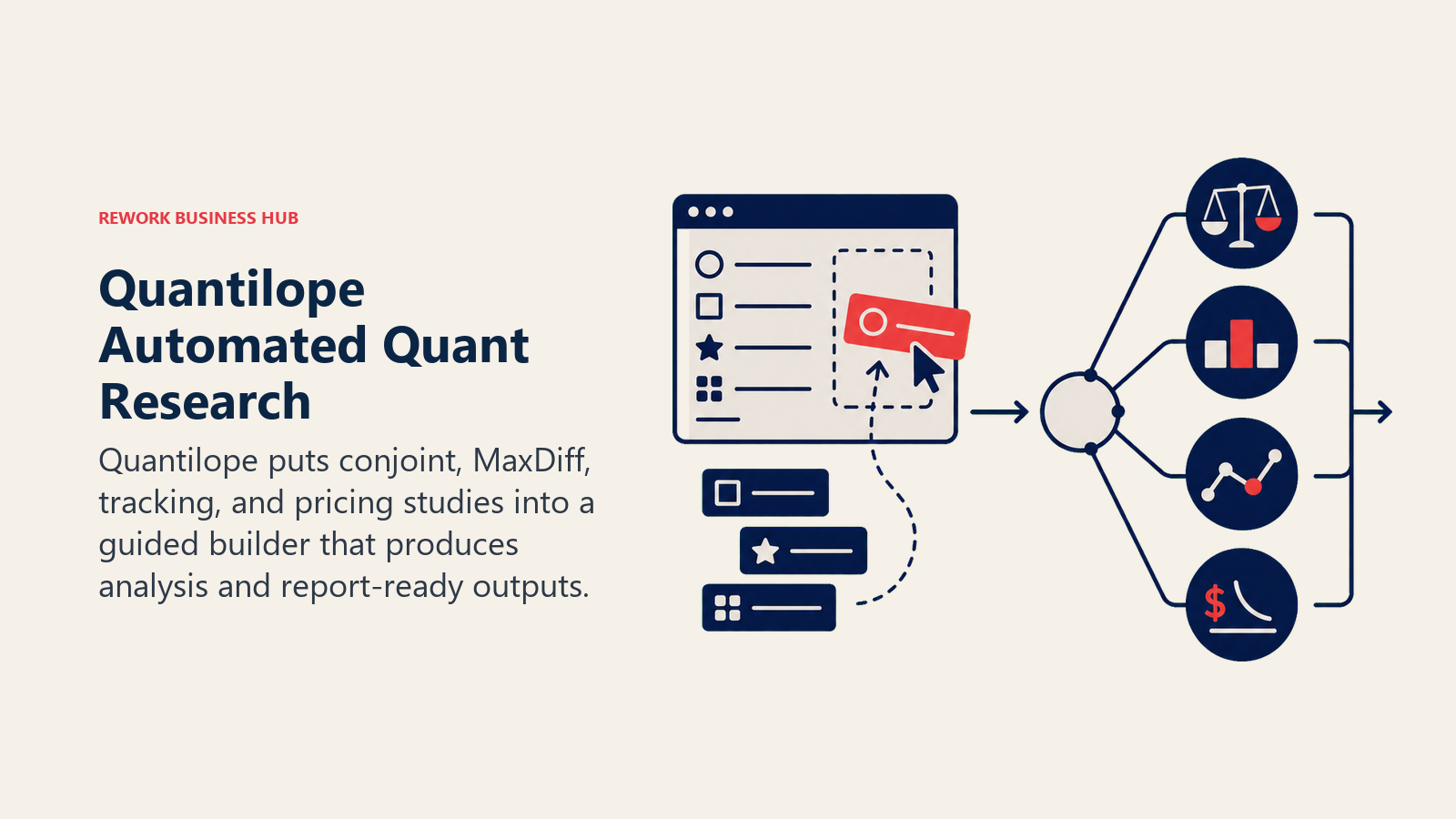
Quantilope's whole pitch is putting advanced quantitative methods, conjoint analysis, MaxDiff, brand tracking, and price sensitivity, into a drag-and-drop survey builder that a marketer, not just a PhD researcher, can run. The AI co-pilot, quinn, suggests survey structure, generates charts, and drafts report summaries as you build, cutting the time between a research question and a shareable answer.
The platform serves over 1,000 brands including Pepsi, Kenvue, and Nestle, so it's built for teams running research as a recurring program, not a one-off project. The tradeoff is that the entry tier splits advanced methods and tracking into separate access, so teams that need both from day one usually land in the Pro tier instead.
Best for: Insights teams that want one automated platform covering advanced quant methodologies without hiring a dedicated methodologist for every study
Key strengths:
- 15 automated advanced methodologies (conjoint, MaxDiff, tracking, pricing) in one drag-and-drop builder
- AI co-pilot quinn assists survey design, chart generation, and report summaries
- Proven at scale with 1,000+ global brand clients
Limitations:
- Business tier splits advanced methods and brand tracking; you often need Pro for both
- Pro and Enterprise pricing is quote-only, so budgeting requires a sales call
- Steeper learning curve than a simple survey tool for teams new to quant methods
Pricing: Business is $2,000/month for 3 users, with a subset of advanced methods or tracking (not both). Pro (5 users) adds combined methods, tracking, implicit and qualitative methods, and multi-language support, priced on request. Enterprise (10 users) adds conjoint, segmentation, PowerPoint export, API access, and SSO, also on request. See quantilope.com/pricing.
| What you get | What you don't |
|---|---|
| Widest set of automated advanced quant methods in one builder | Advanced methods and tracking split across tiers at the entry level |
| AI co-pilot for survey design and report drafting | Pro and Enterprise pricing requires a sales conversation |
| Proven at enterprise scale with major consumer brands | Learning curve for teams unfamiliar with conjoint or MaxDiff |
For a deeper look at how AI fits into market research workflows more broadly, see AI for market research.
2. Qualtrics: Enterprise Research on a Single XM Platform
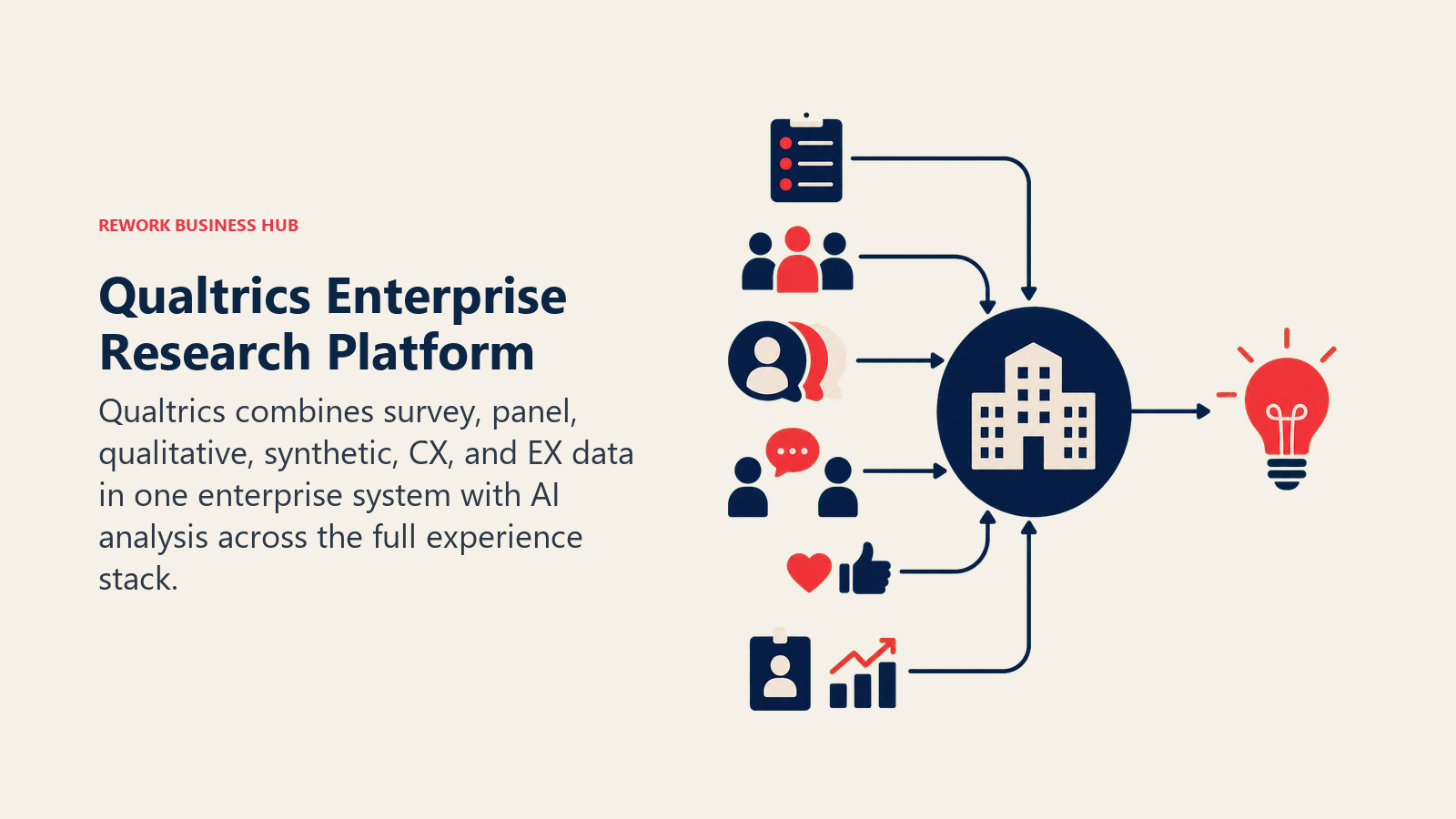
Qualtrics is the platform most enterprises already have a contract with for customer experience or employee experience, and Strategic Research is its answer to standalone market research tools. Qualtrics IQ layers AI analysis, synthetic data generation, and automated summarization on top of survey, panel, and qualitative data collection, all inside the same system that runs CX and EX programs.
That breadth is also the catch. Pricing is almost entirely quote-based, and a full CustomerXM or research contract can run into six figures once seats, response volume, and modules are added. Teams that just need surveys will find the self-serve Strategic Research tier expensive per response compared to a dedicated survey tool.
Best for: Enterprises that want market research on the same platform already running CX, EX, or brand tracking programs
Key strengths:
- AI-driven analysis (Qualtrics IQ) spans survey, synthetic data, and qualitative inputs in one workspace
- Unlimited seats on paid tiers, so research isn't gated to a small licensed team
- Deepest integration if you already run CustomerXM or EmployeeXM on Qualtrics
Limitations:
- Self-serve Strategic Research runs roughly $5 per response, expensive next to dedicated survey tools
- Full enterprise contracts typically run $25,000-$50,000/year and can reach six figures
- No public self-serve checkout above the entry tier; everything else needs a sales conversation
Pricing: Strategic Research self-serve is around $420/month billed annually (about $5,040/year), roughly $5.04 per response. CoreXM enterprise contracts typically run $25,000-$50,000/year for small teams; full CustomerXM or EmployeeXM deployments can reach six figures. See qualtrics.com/pricing.
| What you get | What you don't |
|---|---|
| One platform for research, CX, and EX with AI woven through all of it | Self-serve tier costs about $5 per response, pricier than dedicated tools |
| Unlimited seats included on every paid tier | Full enterprise pricing is quote-only and can reach six figures |
| Deepest fit if you already run Qualtrics for CX or EX | Heavier and more complex than a team needs for simple survey work |
3. Attest: Fast, Credit-Based Consumer Surveys
Attest's model is a flat audience fee regardless of who or where you survey, priced in credits where one credit equals one question answered by one person. That structure makes a 10-question survey to 500 people a predictable 5,000 credits, whether you're targeting a niche B2B buyer or a broad consumer segment across 59 countries.
Every tier includes a designated research expert and human support from the customer success team, a meaningful difference from fully self-serve survey tools where you're on your own for methodology. The catch is that bundling panel access with the platform makes Attest pricier than a standalone survey tool for teams that already have their own customer list or audience source.
Best for: Consumer brands running frequent, multi-market surveys who want predictable, flat pricing with human research support
Key strengths:
- Access to 150M+ consumers across 59 countries and 70+ languages under one contract
- Flat, predictable credit-based pricing with no per-market pricing variance
- Every tier includes a research expert for project oversight and data quality checks
Limitations:
- Bundled panel access costs more than a standalone tool if you already have your own audience
- Specific tier pricing isn't published; you need a demo to see real numbers
- Gets expensive fast for teams running large or frequent survey programs
Pricing: Not publicly listed. Four credit-based tiers scale from Basic (up to 50,000 credits) through Standard, Elite, and Custom (400,000+ credits), all with unlimited team seats. See askattest.com/pricing.
| What you get | What you don't |
|---|---|
| Flat, predictable credit pricing across 59 countries | More expensive than standalone tools if you have your own audience |
| Dedicated research expert included on every tier | Tier-specific pricing not published; requires a demo |
| Unlimited team seats regardless of plan | Costs scale up fast for high-frequency survey programs |
4. Poll the People: Budget Concept and Brand Testing
Poll the People built its product around a specific job: testing how people react to a concept, prototype, brand name, or logo, then using ChatGPT-powered analysis to turn raw responses into an executive summary, thematic codes, and word clouds. For a team that just needs a fast read on a creative direction before it ships, it's a fraction of the cost of a full-service study.
The Lite tier is genuinely usable at $1 per response with no monthly commitment, which makes it one of the cheapest ways to get real human reactions to a concept. Bigger programs step up to a flat monthly fee, and the jump to Enterprise (starting at $10,000/month) reflects a very different buyer than the self-serve tiers.
Best for: Marketing and product teams testing concepts, brand names, or prototypes on a tight budget before committing to a full study
Key strengths:
- Pay-per-response Lite tier starts at $1, with no subscription required
- AI-generated executive summaries, thematic codes, and word clouds included at every tier
- 20+ built-in templates cover brand, concept, and prototype testing out of the box
Limitations:
- Free and Plus tiers cap response volume (250 and 500 respondents per study)
- Advanced targeting costs an extra $0.50 per criteria on top of base pricing
- Enterprise jumps to $10,000/month, a steep step up from the self-serve tiers
Pricing: Lite is free with $1 per response (up to 3 tests/month, 250 respondents max). Plus is $50/month (10 tests, 500 responses). Premium is $100/month (unlimited tests, 2,000 responses). Enterprise starts at $10,000/month. See pollthepeople.app/pricing.
| What you get | What you don't |
|---|---|
| Cheapest per-response entry point on this list ($1/response) | Free and Plus tiers cap respondents per study |
| AI executive summaries and thematic coding built in | Advanced targeting adds $0.50 per criteria on top |
| 20+ ready-made templates for concept and brand testing | Enterprise tier is a big jump from self-serve pricing |
5. Synthetic Users: AI Synthetic Respondent Interviews
Synthetic Users generates AI personas that answer interview questions the way a real research participant would, then lets you ask follow-ups, run the study at scale, and get a saturation score that flags when new "respondents" stop adding new themes. A full study finishes in about a minute without RAG enrichment, or roughly two minutes if you upload your own data to ground the personas in.
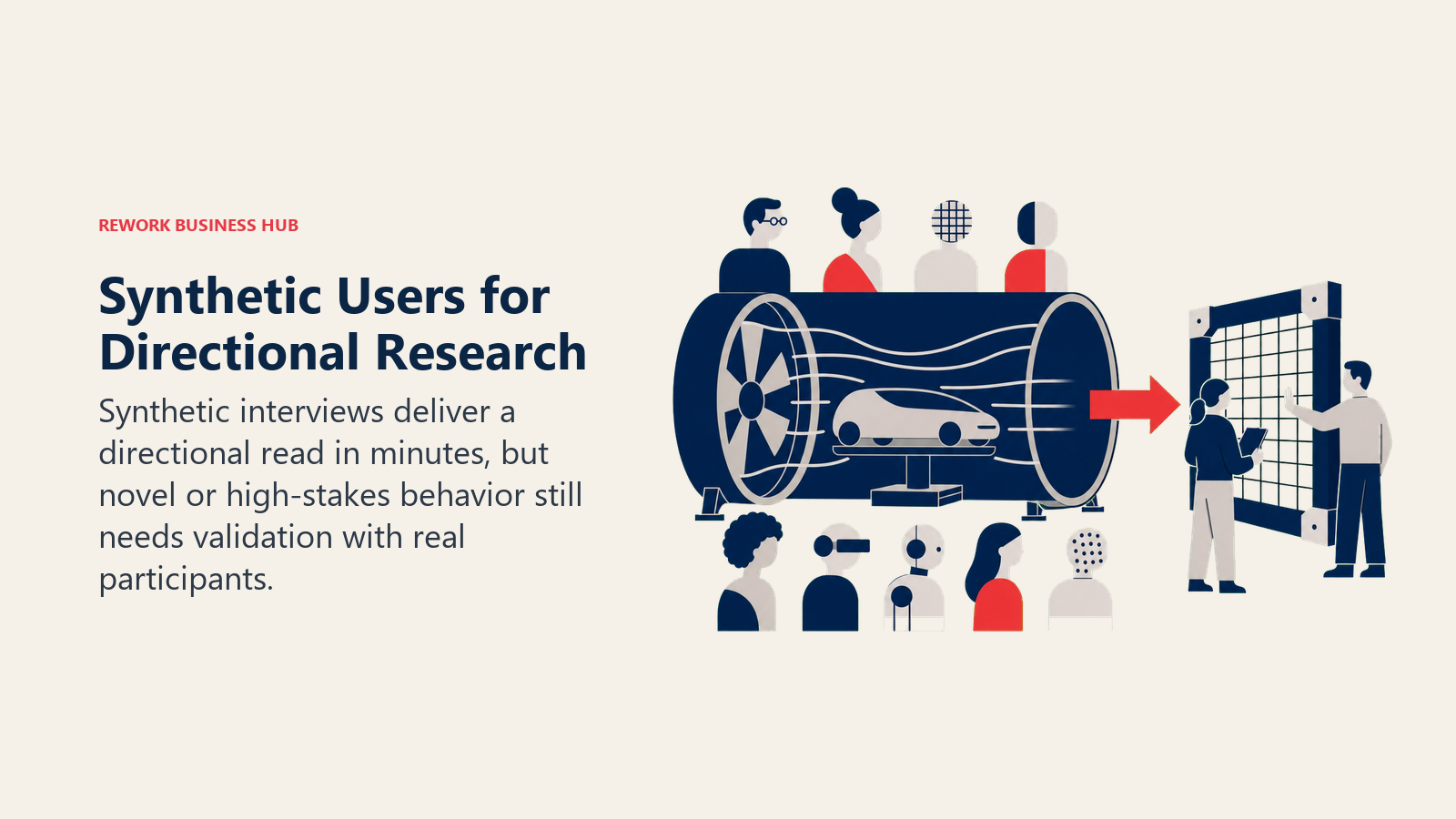
The appeal is speed and cost: $2-60 per synthetic interview against $100-plus per real participant through a traditional agency, with no recruiting, scheduling, or panel fees. The honest limit, backed by Stanford HAI's validation research, is that synthetic responses track real people well on directional questions (concept reactions, message resonance) but get noticeably less reliable for predicting genuinely novel behavior.
Best for: Teams that want a fast directional read before committing budget to a full study with real participants
Key strengths:
- No recruiting or scheduling; a full study completes in 1-2 minutes
- Per-interview pricing ($2-60) with no subscription or per-seat fees
- Saturation scoring shows when additional synthetic interviews stop adding new insight
Limitations:
- Accuracy drops meaningfully for predicting novel or unprecedented behavior
- Not a substitute for real participants on high-stakes, final-decision research
- Enterprise volume, on-premise, and data residency options require a sales conversation
Pricing: $2-60 per synthetic interview depending on volume and RAG enrichment (+$5/interview), no subscription or seat fees. A 7-day free trial is available. Enterprise custom volume and on-premise options require a demo. See syntheticusers.com/pricing.
| What you get | What you don't |
|---|---|
| Studies complete in 1-2 minutes with no recruiting | Weaker accuracy on genuinely novel behavior predictions |
| Per-interview pricing with no subscription commitment | Not appropriate as the sole basis for a high-stakes decision |
| Saturation scoring flags when more interviews add no value | Enterprise and on-premise pricing needs a sales call |
For context on how synthetic and AI-generated respondents compare with real human data, AI vs human intelligence covers where AI reasoning still falls short.
6. Suzy: On-Demand Enterprise Consumer Insights
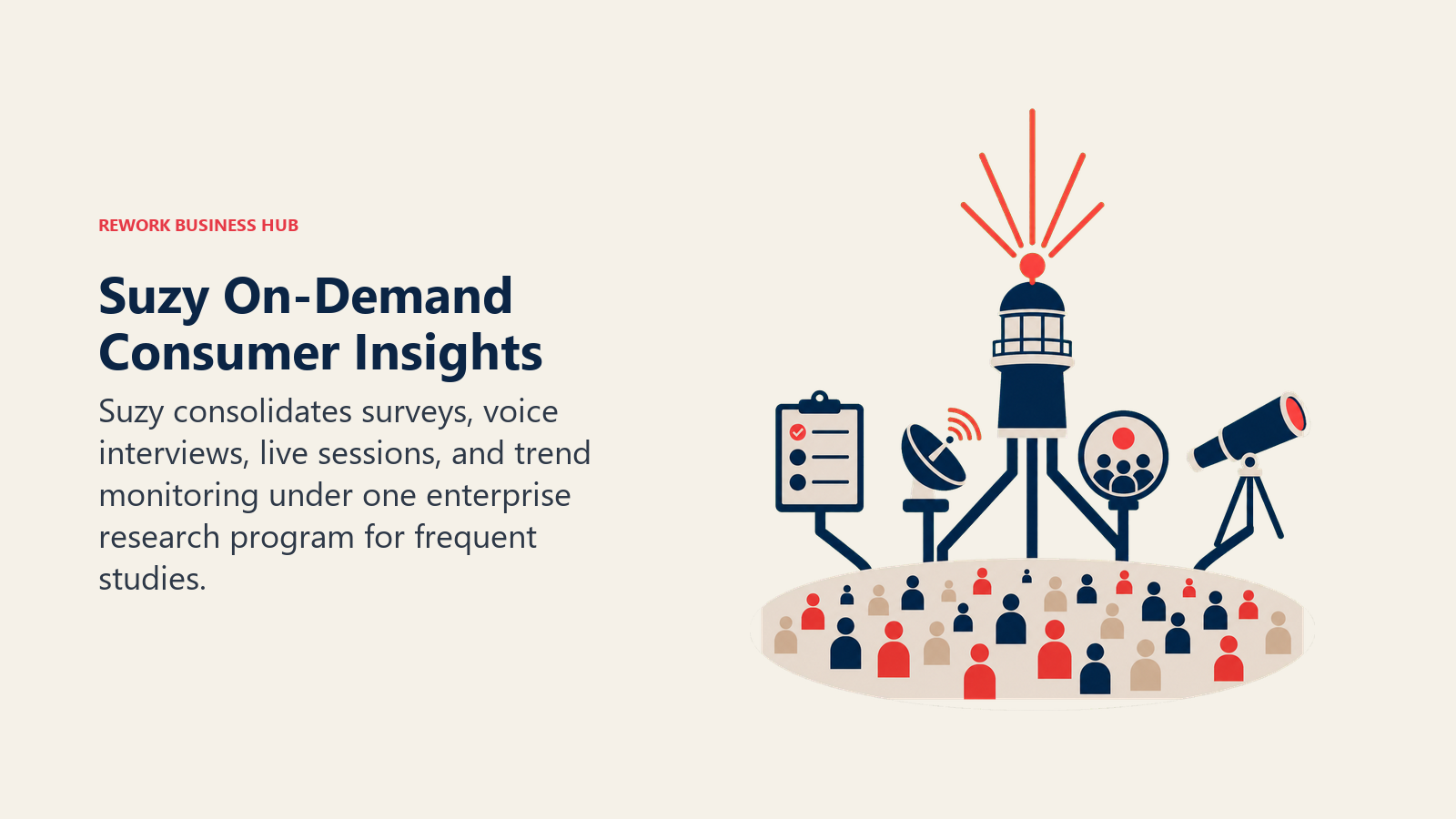
Suzy's pitch is breadth under one contract: surveys, 10-15 minute voice interviews (Suzy Speaks), live moderated sessions, and ongoing trend monitoring, all running against a 1M-plus proprietary audience plus access to 70-plus external panels. For a consumer brand running dozens of research projects a year, consolidating that many methods under one license cuts vendor management overhead significantly.
That consolidation comes at enterprise pricing. Median contracts run around $88,000 a year, ranging from roughly $34,000 for smaller programs to $187,000-plus for brands running heavy survey, voice, and trend-monitoring volume across multiple product lines. It's not built for a team running the occasional survey.
Best for: Consumer brands running frequent, multi-method research programs who want one vendor instead of several
Key strengths:
- Combines surveys, voice interviews, live sessions, and trend monitoring in one platform
- 1M+ proprietary audience plus 70+ external panels for reach
- AI decision engine turns raw responses into recommendations in hours, not weeks
Limitations:
- Enterprise-only pricing with no visible self-serve entry point
- Best value only shows up at high project volume (dozens of studies a year)
- Contract commitment required; not built for occasional or ad hoc research
Pricing: Custom, enterprise-only. Median annual contract is roughly $88,000, ranging from about $34,000 to $187,500 depending on audience credits, methods, and product lines covered. See suzy.com.
| What you get | What you don't |
|---|---|
| Four research methods (survey, voice, live, trend) under one license | No self-serve entry point; every deal is custom |
| 1M+ proprietary audience plus 70+ external panels | Best economics only appear at high project volume |
| AI decision engine turns responses into recommendations fast | Requires an annual contract commitment |
7. Remesh: AI-Moderated Live Group Conversations
Remesh replaces the traditional focus group with a live digital conversation that can run with 50 to 1,000 participants at once. As people respond to open-ended prompts, Remesh's AI clusters similar answers and has participants vote on each other's responses in real time, surfacing consensus and outliers while the session is still live instead of during a week of post-hoc coding.
That scale and speed is the entire value proposition against a traditional 8-to-10-person focus group, but it comes at enterprise pricing with no published rate card. Session economics depend on negotiated rates, included recruitment, and how many sessions are bundled into an annual agreement, so cost only becomes clear after a sales conversation.
Best for: Teams that need qualitative depth from large groups (50-1,000 people) in real time, not a handful of focus-group participants
Key strengths:
- Live AI clustering and consensus-surfacing during the session, not after
- Scales qualitative research to hundreds of participants at once
- Participant voting reveals which responses actually represent the group, not just the loudest voice
Limitations:
- No published pricing; every engagement is a custom, sales-led quote
- Priced more like an enterprise platform than a self-serve research tool
- Best economics depend on bundling multiple sessions into an annual agreement
Pricing: Custom, enterprise-priced. No self-serve tier; contact sales for a quote scoped to session volume and moderator needs. See remesh.ai.
| What you get | What you don't |
|---|---|
| Real-time AI clustering and consensus across up to 1,000 participants | No published pricing or self-serve tier |
| Qualitative depth at a scale traditional focus groups can't match | Enterprise pricing model, not built for small one-off projects |
| Live voting surfaces genuine consensus, not just the loudest voices | Real cost only clear after a scoped sales conversation |
8. Dovetail: AI Qualitative Research Repository
Dovetail's job is turning a growing pile of interview transcripts, notes, and recordings into a searchable, taggable repository the whole team can query instead of a folder nobody revisits. Its Magic AI suite auto-tags content, scores sentiment, detects themes, and powers smart search across everything you've stored, which matters most once a team has months or years of research sitting in it.
The free plan works for a small team just getting started, but AI features and larger storage sit behind paid tiers, and per-editor pricing adds up as a research team grows. Dovetail itself needs no coding to use, but it assumes your team is already conducting qualitative interviews elsewhere and needs somewhere to make sense of them at scale.
Best for: Research teams with a growing archive of interviews and notes who need AI to surface themes instead of manual tagging
Key strengths:
- Magic AI auto-tags, sentiment-scores, and theme-detects across your full repository
- Smart search surfaces relevant past research instantly instead of re-running a study
- Free tier lets small teams start before committing to a paid plan
Limitations:
- AI features and larger storage are gated behind paid Professional and Business tiers
- Per-editor pricing scales quickly for larger research teams
- It's a repository and analysis layer, not a data collection tool; you still need a survey or interview tool alongside it
Pricing: Free plan available with limited storage. Professional starts around $29-39/editor/month billed annually. Business and Enterprise tiers add automated data ingestion (Channels, from ~$50/month) and custom pricing. See dovetail.com.
| What you get | What you don't |
|---|---|
| AI auto-tagging, sentiment, and theme detection across all stored research | Full AI feature set requires a paid Professional tier or higher |
| Smart search turns old research into an instantly reusable asset | Per-editor pricing scales fast for larger teams |
| Free tier for small teams to start without commitment | Analysis layer only; still need a separate collection tool |
9. Speak: AI Transcription and Interview Analytics
Speak's core product is transcription with AI analysis layered directly on top, so a recorded customer interview, focus group, or user testing session comes back not just as text but with automatic keyword extraction, sentiment scoring, topic detection, and named entity recognition already applied. AI Chat then lets you ask questions across a single transcript or a whole batch, using Claude, Gemini, or GPT as the underlying model.
The pay-as-you-go structure (no subscription, no commitment) makes it a low-friction add for a team that runs qualitative interviews occasionally rather than as a full-time research operation. Heavier users will find the flat monthly plans with bundled transcription hours a better fit than paying per use every time.
Best for: Teams that need fast transcription plus AI analysis of customer interviews or focus groups, without a long-term commitment
Key strengths:
- Automatic sentiment, topic, and entity analysis on every transcript, no extra setup
- AI Chat queries across a single interview or a whole batch of research
- Pay-as-you-go pricing means no subscription for occasional qualitative work
Limitations:
- Pay-as-you-go plan caps at basic functionality and one user
- Heavier research programs need the Starter or Enterprise tier to make the economics work
- Primarily a transcription and analysis layer, not a full research repository like Dovetail
Pricing: Pay-As-You-Go is $71/month ($57/month billed annually), 1 user, unlimited storage. Starter includes 15 hours of transcription/month plus 1 million Speak Magic Prompts. Enterprise is custom with unlimited hours and users. A 7-day free trial is available. See speakai.co/pricing.
| What you get | What you don't |
|---|---|
| Automatic sentiment, topic, and entity analysis on every transcript | Pay-as-you-go tier limited to one user |
| AI Chat across single interviews or full research batches | Heavy usage needs Starter or Enterprise to be cost-effective |
| No subscription required for occasional qualitative work | Analysis layer, not a full searchable research repository |
10. Brandwatch: AI Social and Consumer Intelligence
Brandwatch reads what people say about a brand or category across social platforms, forums, news, and the open web, then uses AI to cluster mentions into themes, score sentiment, and flag emerging conversations before they show up in a quarterly report. For market research specifically, it's the tool for understanding unprompted consumer opinion, what people say when nobody asked them a survey question.
Pricing is entirely custom and unpublished, structured around three solutions (Consumer Intelligence, Social Media Management, Influencer Marketing), with cost driven by data sources, query volume, and seats. Multi-year commitments typically earn 15-25% discounts, but monthly billing is rarely available, so budgeting requires a real sales conversation.
Best for: Brand and insights teams that need to understand unprompted consumer sentiment across social and the open web, not just survey responses
Key strengths:
- AI clusters social and web mentions into themes and sentiment automatically
- Surfaces emerging conversations before they hit a formal research cycle
- Purpose-built Consumer Intelligence solution, distinct from generic social media monitoring
Limitations:
- No published pricing; every contract is a custom quote
- Entry pricing (~$800-2,000/month) is steep for a small team's budget
- Contracts typically run 12-24 months with upfront payment, not month-to-month
Pricing: Custom quote only. Consumer Intelligence entry is estimated around $800-2,000/month, mid-range deployments $3,000-10,000/month, enterprise $15,000-plus/month. See brandwatch.com/plans.
| What you get | What you don't |
|---|---|
| AI-clustered social and web sentiment, purpose-built for consumer intelligence | No published pricing; requires a custom quote |
| Surfaces emerging conversations ahead of a formal research cycle | Entry pricing is steep for smaller teams |
| Deep query and data-source flexibility at scale | Long contract terms; monthly billing rarely available |
11. Similarweb: Competitive and Traffic Intelligence
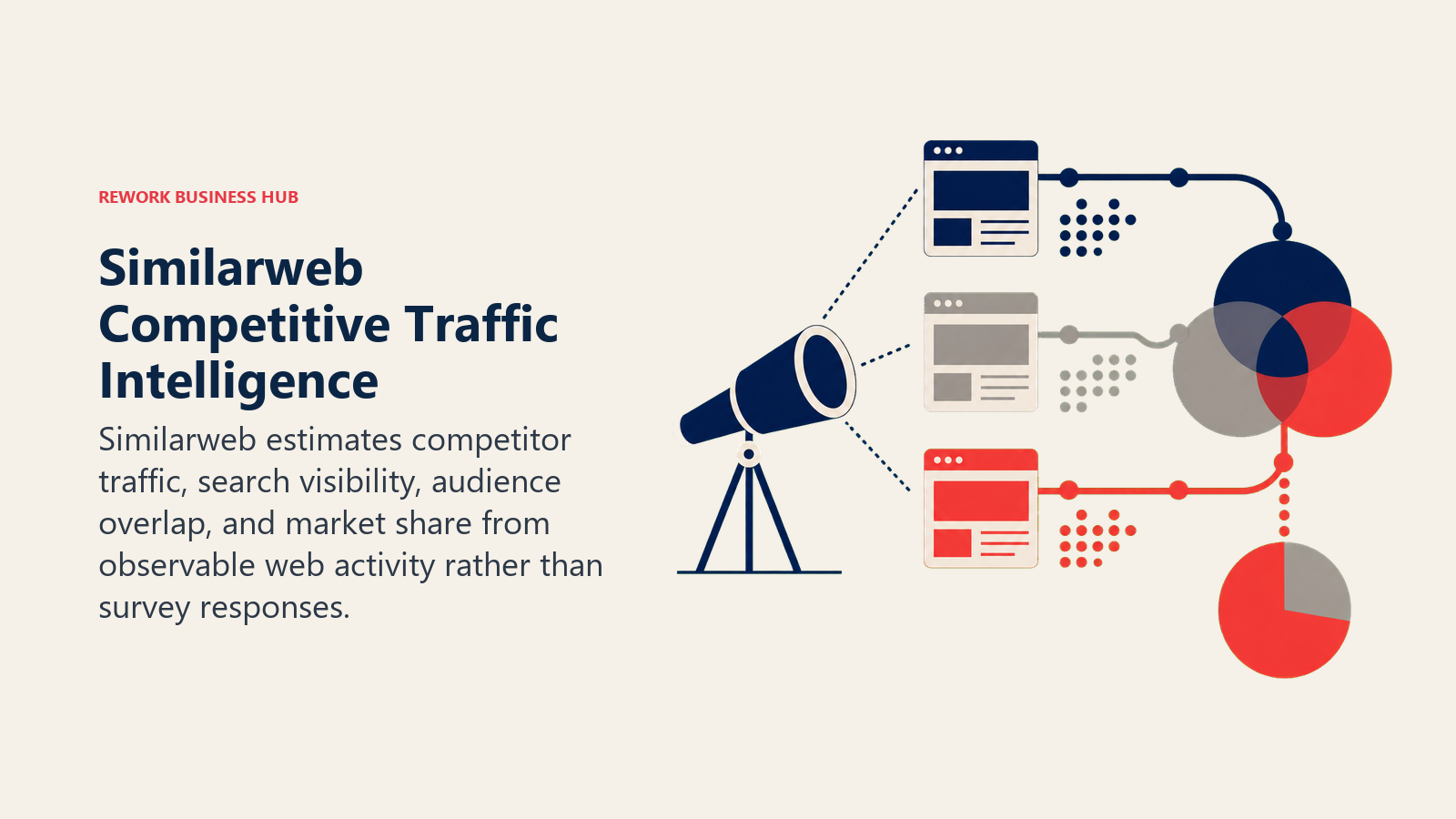
Similarweb answers a different research question than surveys or interviews: what are your competitors actually doing, and how much traffic, search visibility, and market share do they have. It's the closest thing to AI-assisted competitive market intelligence on the web, pulling traffic estimates, keyword rankings, and audience overlap data into one dashboard.
As of 2026, Similarweb pulled its Team and Business tier pricing behind a sales quote, so only the entry-level Starter and Professional plans have visible self-serve pricing. That's a meaningful shift for teams used to seeing exact numbers before talking to sales.
Best for: Teams that need to quantify a competitor's digital footprint (traffic, keywords, market share) as part of a broader research program
Key strengths:
- Traffic, keyword, and audience-overlap data across any public website, not just competitors who share data
- Multiple tiers let you scale from basic competitive checks to full SEO and ads intelligence
- Historical data depth (up to 37 months at Enterprise) supports trend analysis, not just snapshots
Limitations:
- Team and Business tiers now require a sales quote, not published self-serve pricing
- Traffic estimates are modeled, not exact, and can vary from a competitor's actual analytics
- Full feature depth (Ads Intelligence, AEO) requires the top self-serve tier or above
Pricing: Starter (Competitive Intelligence) is around $199/month billed annually. Professional (adds SEO and AEO) is around $399/month annual. Top self-serve tier (adds Ads Intelligence) is around $649/month annual. Team ($14,000/year) and Business ($35,000/year) require a sales quote. A 7-day trial is available; no free plan. See similarweb.com.
| What you get | What you don't |
|---|---|
| Traffic, keyword, and audience data on any public competitor site | Team and Business tiers now require a sales quote |
| Multiple self-serve tiers before you need to talk to sales | Traffic figures are modeled estimates, not exact counts |
| Deep historical data for trend analysis at higher tiers | Full feature set (Ads Intelligence, AEO) needs a higher tier |
For a broader look at how competitive traffic and search data fits into an SEO research stack, see best AI SEO tools.
12. Klue: Competitive Intelligence and Battlecards
Klue focuses on a narrower, sales-facing slice of market research: formal competitive intelligence delivered as battlecards that reps actually open before a deal call. It pulls competitor moves, win-loss patterns, and market signals into a structured system, then pushes the relevant intel into Salesforce or your CRM at the moment a rep needs it.
That sales-enablement depth is exactly why it costs more than a general competitive research tool. Entry-level deployments typically start in the $15,000-20,000-plus per year range, with pricing scaling by seats, competitors tracked, and integration scope, and there's no self-service tier at all.
Best for: Revenue teams that need formal, structured competitive intelligence pushed directly into seller workflows, not just a research report
Key strengths:
- Battlecards and win-loss intelligence built specifically for sales-facing consumption
- Deep CRM and sales-enablement integrations (Salesforce and others)
- Structured competitive tracking, not just ad hoc research notes
Limitations:
- No self-service tier; every deal is a custom, sales-led contract
- Entry pricing ($15,000-20,000+/year) is high relative to general competitive research tools
- Built for sales enablement specifically, less useful for broader consumer or product research
Pricing: Custom, no published rate card. Entry-level deployments (5-15 users) typically start around $15,000-20,000/year, scaling with seats, competitors tracked, and integration depth. See klue.com.
| What you get | What you don't |
|---|---|
| Sales-ready battlecards and win-loss intelligence, not just research notes | No self-service tier; every deal needs a sales conversation |
| Deep CRM and sales-enablement integration | Entry pricing runs well above general competitive research tools |
| Structured, ongoing competitive tracking | Narrower fit if you need consumer or product research, not sales intel |
13. Exploding Topics: AI Trend Detection
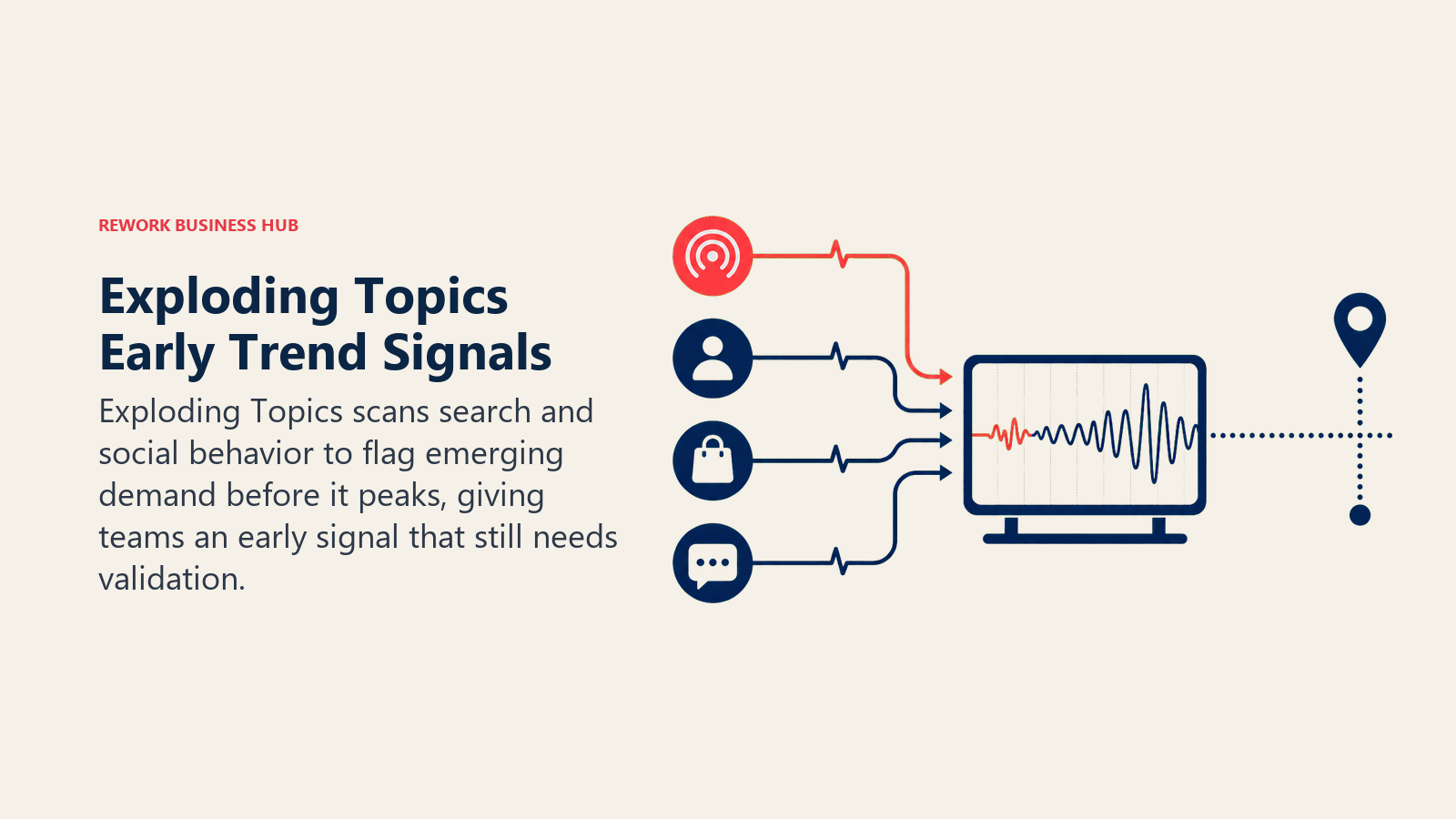
Exploding Topics, now part of Semrush, crawls Reddit, Google, YouTube, and TikTok to spot emerging trends and niches before they peak, which is a meaningfully different job than tracking a known competitor or running a survey. For a research or growth team trying to catch a category shift early, it's built to flag the signal months before it shows up in a quarterly trends report.
The Business plan and API access make it usable for teams that want to build trend data into their own dashboards or products, not just browse a website. The free tier and 7-day Pro trial make it easy to test whether trend-spotting actually changes how your team prioritizes research or content.
Best for: Growth, product, and research teams that need an early signal on emerging trends before competitors catch on
Key strengths:
- Crawls Reddit, Google, YouTube, and TikTok specifically to catch trends in their early stage
- API access lets you pipe trend data into your own dashboards or products
- Backed by Semrush's data infrastructure since the 2024 acquisition
Limitations:
- Trend detection is directional, not a substitute for validating demand with real research
- Business plan ($249/month) is a jump from the entry Pro tier for teams that need more coverage
- API pricing scales quickly at higher request volumes ($1,000-4,000/month for 1,000-25,000 requests)
Pricing: Free tier available. Pro starts at $39/month. Business is $249/month. Trends API is usage-based: $1,000/month for 1,000 requests up to $4,000/month for 25,000 requests. A 7-day free trial is available. See explodingtopics.com.
| What you get | What you don't |
|---|---|
| Early trend signal from Reddit, Google, YouTube, and TikTok | Directional signal only, not a substitute for validation research |
| API access to build trend data into your own tools | Business tier is a real step up in price from entry Pro |
| Free tier and 7-day trial to test fit before committing | API pricing scales fast at higher usage tiers |
14. Perplexity: Fast AI Search for Desk Research
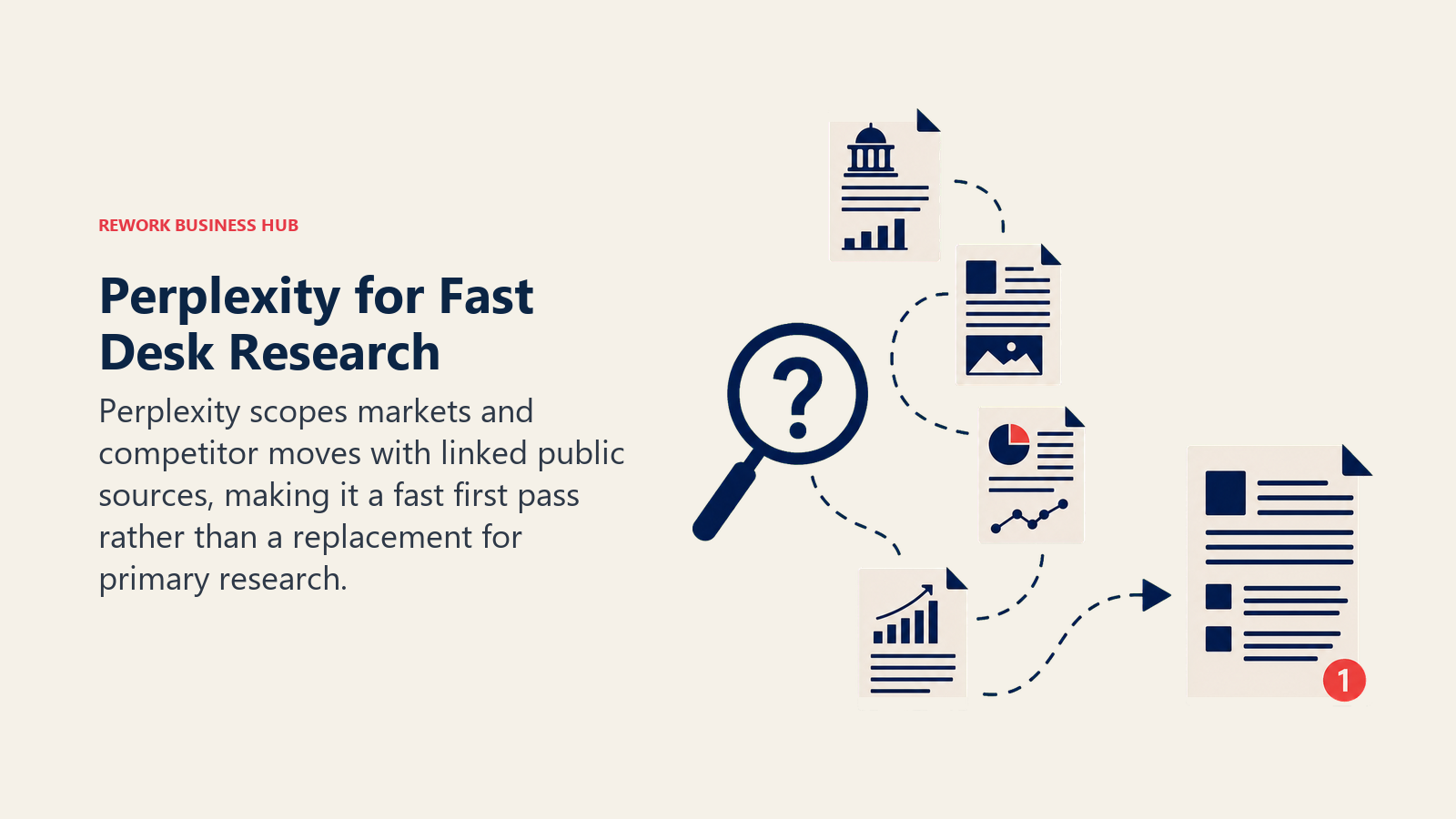
Perplexity isn't a dedicated market research platform, but it's become the fastest way to do the first pass of desk research: scoping a market, checking a competitor's recent moves, or getting a cited summary of a trend before deciding whether it's worth a full study. Every answer comes with linked sources, which matters for research work where you need to trace a claim back to where it came from.
It won't replace a survey tool, a synthetic respondent platform, or a competitive intelligence system for anything you need to defend with primary data. But as a starting point, a market-sizing sanity check, or a way to quickly synthesize public reporting on a competitor, it's hard to beat on speed.
Best for: Fast, cited first-pass research on a market, competitor, or trend question before committing budget to a full study
Key strengths:
- Real-time web search with linked, checkable sources on every answer
- Free tier is genuinely usable for occasional desk research
- Enterprise tiers add higher usage limits and admin controls for research teams
Limitations:
- Not a substitute for primary research; it summarizes what's already public
- No proprietary consumer panel or survey capability of its own
- Answer quality depends on what's indexed and public, which can miss paywalled or niche sources
Pricing: Free tier available. Pro is $20/month. Enterprise Pro is $40/month (or $400/year). Enterprise Max is $325/month (or $3,250/year) for the highest usage limits. See perplexity.ai/enterprise/pricing.
| What you get | What you don't |
|---|---|
| Fast, cited answers for first-pass market and competitor research | No proprietary panel, survey, or synthetic respondent capability |
| Free tier usable for occasional desk research | Not a substitute for primary research on a real decision |
| Enterprise tiers add usage limits and admin controls | Coverage depends on what's public and indexed |
For a closer look at how Perplexity stacks up against other AI search tools for research work, see Perplexity vs ChatGPT Search vs Gemini and Claude vs ChatGPT vs Gemini.
Pricing at a Glance
| Tool | Entry Price | Pricing Model | Free Tier or Trial? |
|---|---|---|---|
| Quantilope | Business $2,000/mo (3 users) | Per-seat tiers | Demo only |
| Qualtrics | Strategic Research ~$420/mo | Per-response self-serve; custom enterprise | Demo only |
| Attest | Custom | Credit-based | Demo only |
| Poll the People | Free ($1/response) | Pay-per-response or flat monthly | Yes (Lite) |
| Synthetic Users | $2-60/interview | Per-interview, no subscription | 7-day trial |
| Suzy | ~$34K-$187K/yr | Custom enterprise contract | Demo only |
| Remesh | Custom | Custom enterprise contract | Demo only |
| Dovetail | Free; Pro ~$29-39/editor/mo | Per-editor tiers | Yes |
| Speak | $71/mo ($57/mo annual) | Pay-as-you-go or flat monthly | 7-day trial |
| Brandwatch | ~$800-2,000/mo | Custom enterprise contract | Demo only |
| Similarweb | ~$199/mo annual | Per-tier, custom above Professional | 7-day trial |
| Klue | ~$15K-20K+/yr | Custom enterprise contract | Demo only |
| Exploding Topics | Free; Pro $39/mo | Flat monthly tiers | Yes |
| Perplexity | Free; Pro $20/mo | Flat monthly tiers | Yes |
Where AI Market Research Tools Are Headed
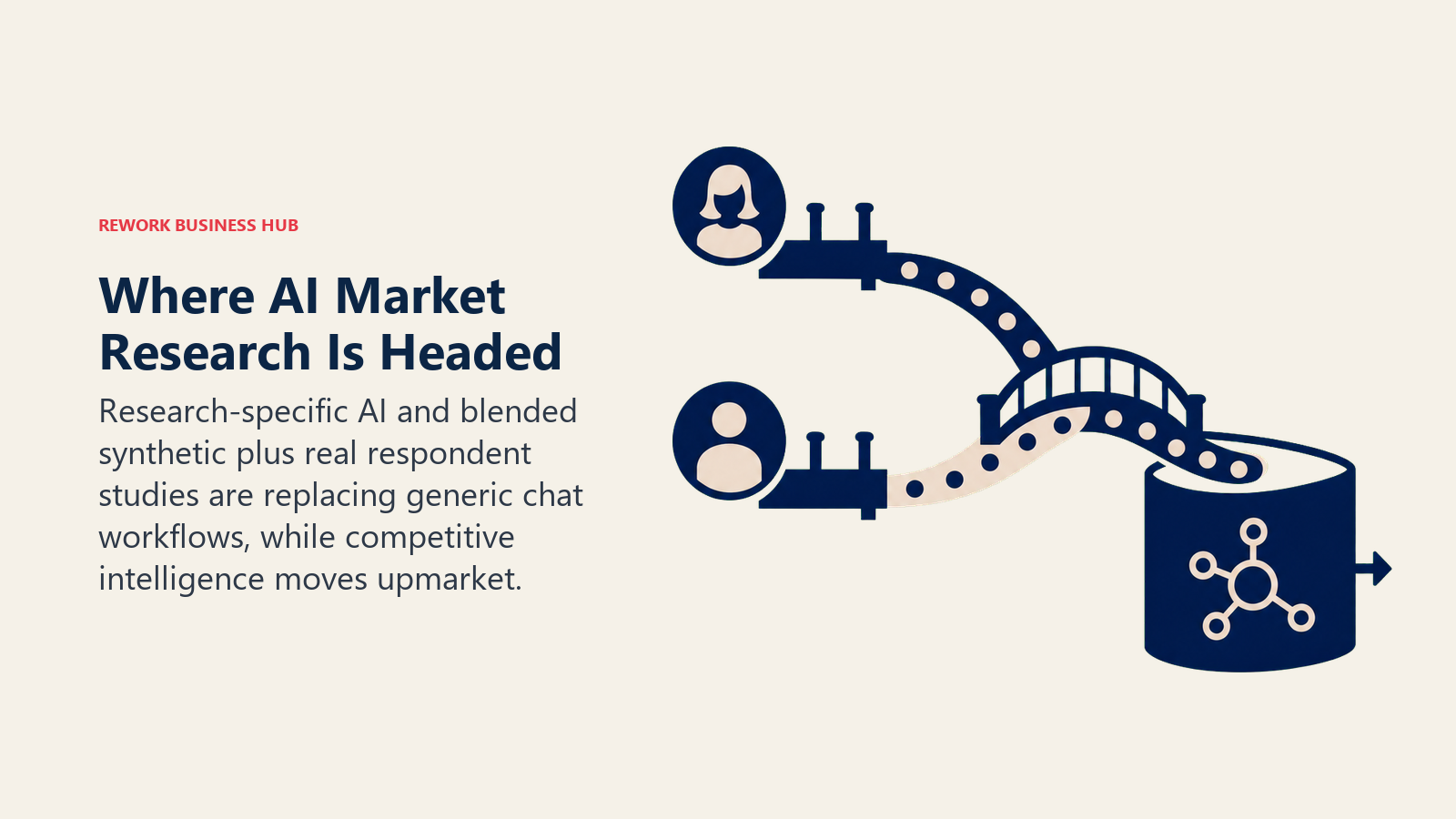
Two shifts are reshaping this category at once. First, purpose-built research AI is pulling ahead of general chat tools: teams are moving analysis and synthesis work out of ChatGPT and Claude and into platforms built specifically for research, per Qualtrics' finding that embedded research AI adoption rose while general-purpose AI usage for research fell. Second, synthetic respondents are graduating from a novelty to a validated first step in the research process, backed now by peer-reviewed accuracy benchmarks rather than just vendor claims, though the accuracy still drops sharply for anything genuinely novel rather than directional. Expect more platforms to blend synthetic and real respondents in the same study, and expect competitive intelligence tools like Similarweb and Klue to keep pushing pricing upmarket as the category consolidates. If your team is building a broader case for AI adoption across research and insights roles, AI for market research is a useful companion read, and if competitive intelligence specifically is becoming a bigger part of your research function, competitive analysis and AI competitive intelligence agent cover how to structure that work.
Frequently Asked Questions about AI Tools for Market Research
What is the best AI tool for market research in 2026?
There's no single best tool. Quantilope and Qualtrics lead automated end-to-end quant platforms, Attest and Poll the People lead fast self-serve survey testing, Synthetic Users and Remesh lead AI-run and live large-group qualitative research, Dovetail and Speak lead qualitative analysis, Brandwatch leads social and consumer intelligence, and Similarweb, Klue, Exploding Topics, and Perplexity lead competitive and trend research. Match the tool to the specific research method you need, not a general ranking.
Are synthetic respondents accurate enough to replace real survey panels?
For directional questions, mostly yes. Stanford HAI's validation study found AI generative agents matched real participants' survey answers with 85% accuracy, close to how consistently people match their own answers over time. But accuracy drops sharply for predicting genuinely novel behavior or products, so synthetic respondents work best as a fast first pass before committing budget to a full study with real participants, not as a full replacement for high-stakes decisions.
What's the difference between AI market research tools and general chat tools like ChatGPT or Perplexity?
General chat tools summarize what's already public and can help with a fast first-pass desk research question, like a market size sanity check. Dedicated market research tools collect primary data, whether from real survey respondents, synthetic AI personas, live qualitative conversations, or social listening, that doesn't exist anywhere on the public web yet. Most research teams use both: a general AI tool for quick scoping, and a dedicated platform for the actual study.
How much do AI market research tools cost?
It varies enormously by method. Self-serve survey tools like Poll the People start under $50/month, and synthetic respondent interviews run $2-60 each with no subscription. Enterprise platforms like Qualtrics, Suzy, Brandwatch, and Klue are largely quote-only and typically run from the low five figures to well into six figures annually, depending on data volume, seats, and methods included.
Can AI tools replace a full-service market research agency?
For fast, directional questions, often yes, especially with synthetic respondents or self-serve survey platforms. For research that needs to withstand scrutiny in a board deck or a major go-to-market decision, most teams still pair AI tools with methodological rigor from an in-house researcher or an agency, particularly for anything predicting genuinely new behavior rather than testing a known concept.
What's the difference between competitive intelligence tools and market research platforms?
Market research platforms (Quantilope, Qualtrics, Attest) collect data directly from consumers or customers through surveys, interviews, or panels. Competitive intelligence tools (Similarweb, Klue) analyze what's already publicly observable about competitors, their traffic, pricing, positioning, and win-loss patterns, without surveying anyone. Many research programs use both together.
How do I choose between a qualitative tool like Remesh or Dovetail and a quantitative tool like Quantilope or Attest?
Start with the question you're answering. If you need to know "how many" or "how much" (pricing sensitivity, feature preference, brand awareness), you need a quantitative survey tool. If you need to know "why" (motivations, objections, language customers use), you need a qualitative tool. Most mature research programs run both: quant to size an opportunity, qual to understand the reasoning behind it.
Is my research data safe with AI-powered market research tools?
Policies vary by vendor and plan. Enterprise platforms like Qualtrics, Attest, and Suzy publish compliance documentation and typically exclude customer data from model training on paid tiers, while smaller or free-tier tools sometimes carry weaker guarantees. Confirm the data-use policy for the specific plan you're on, especially for anything involving customer PII or unreleased product concepts, before uploading sensitive research data.
What to Do Next
Pick the one research question that's actually blocking a decision right now, whether that's "will this concept resonate," "what's our competitor doing differently," or "why are we losing this segment," and shortlist two tools against the decision framework above. If you just need a fast directional read, start with a synthetic respondent tool or a budget survey platform before committing to an enterprise contract. If your team is formalizing a research function as it scales, the competitive positioning and competitive advantage references are useful companions for turning research output into a strategy the rest of the business can act on.

Principal Product Marketing Strategist
On this page
- What Changed in 2026
- Key Facts
- Quick Comparison Table
- How to Choose: Decision Framework
- Framework: By Research Method
- 1. Quantilope: End-to-End Automated Quant Research
- 2. Qualtrics: Enterprise Research on a Single XM Platform
- 3. Attest: Fast, Credit-Based Consumer Surveys
- 4. Poll the People: Budget Concept and Brand Testing
- 5. Synthetic Users: AI Synthetic Respondent Interviews
- 6. Suzy: On-Demand Enterprise Consumer Insights
- 7. Remesh: AI-Moderated Live Group Conversations
- 8. Dovetail: AI Qualitative Research Repository
- 9. Speak: AI Transcription and Interview Analytics
- 10. Brandwatch: AI Social and Consumer Intelligence
- 11. Similarweb: Competitive and Traffic Intelligence
- 12. Klue: Competitive Intelligence and Battlecards
- 13. Exploding Topics: AI Trend Detection
- 14. Perplexity: Fast AI Search for Desk Research
- Pricing at a Glance
- Where AI Market Research Tools Are Headed
- What to Do Next