Sales Discovery Best Practices: How to Run Conversations That Win Deals
Turn this article into takeaways for your work.


Each assistant summarizes the article only for you and suggests best practices for your work.
Most sales reps think discovery is the part of the call before the demo. It is not. Discovery is the entire conversation. It is how you understand what is actually broken for your prospect, what they have already tried, what a solution would need to do to be worth the effort and the cost, and whether this deal is real.
Done well, discovery is the single highest-leverage skill in B2B sales. The reps who win consistently are not necessarily the best presenters or the most persuasive closers. They are the ones who ask better questions and listen more carefully to the answers.
This is how to do it.
Key Facts: Sales Discovery
- Top-performing sales reps talk 46% less than average performers during discovery calls, spending more time listening and asking follow-up questions. (Gong.io, 2024 State of Conversation Intelligence)
- Discovery calls that include 11-14 questions close at significantly higher rates than calls with fewer than 8 or more than 20 questions. Quality and pacing matter more than raw number. (Gong.io Research)
- Reps who use multi-threading in discovery (talking to 3 or more stakeholders before presenting a solution) win deals at 1.8x the rate of reps who rely on a single contact. (Salesforce State of Sales, 2024)
- 72% of buyers say they are more likely to buy from a rep who demonstrates understanding of their specific business challenges than one who leads with product features. (LinkedIn State of Sales, 2024)
- The average sales rep asks only 4-6 questions on a first discovery call before moving to the pitch. Reps who ask 15-20 questions (spread across topics rather than in sequence) see 30-40% higher conversion rates. (HubSpot Sales Research, 2025)
What Discovery Actually Is (and Is Not)
Discovery is not a checklist you run through before pitching. It is not "ask a few questions to seem interested and then show the demo." And it is not just about qualifying whether the prospect can buy.
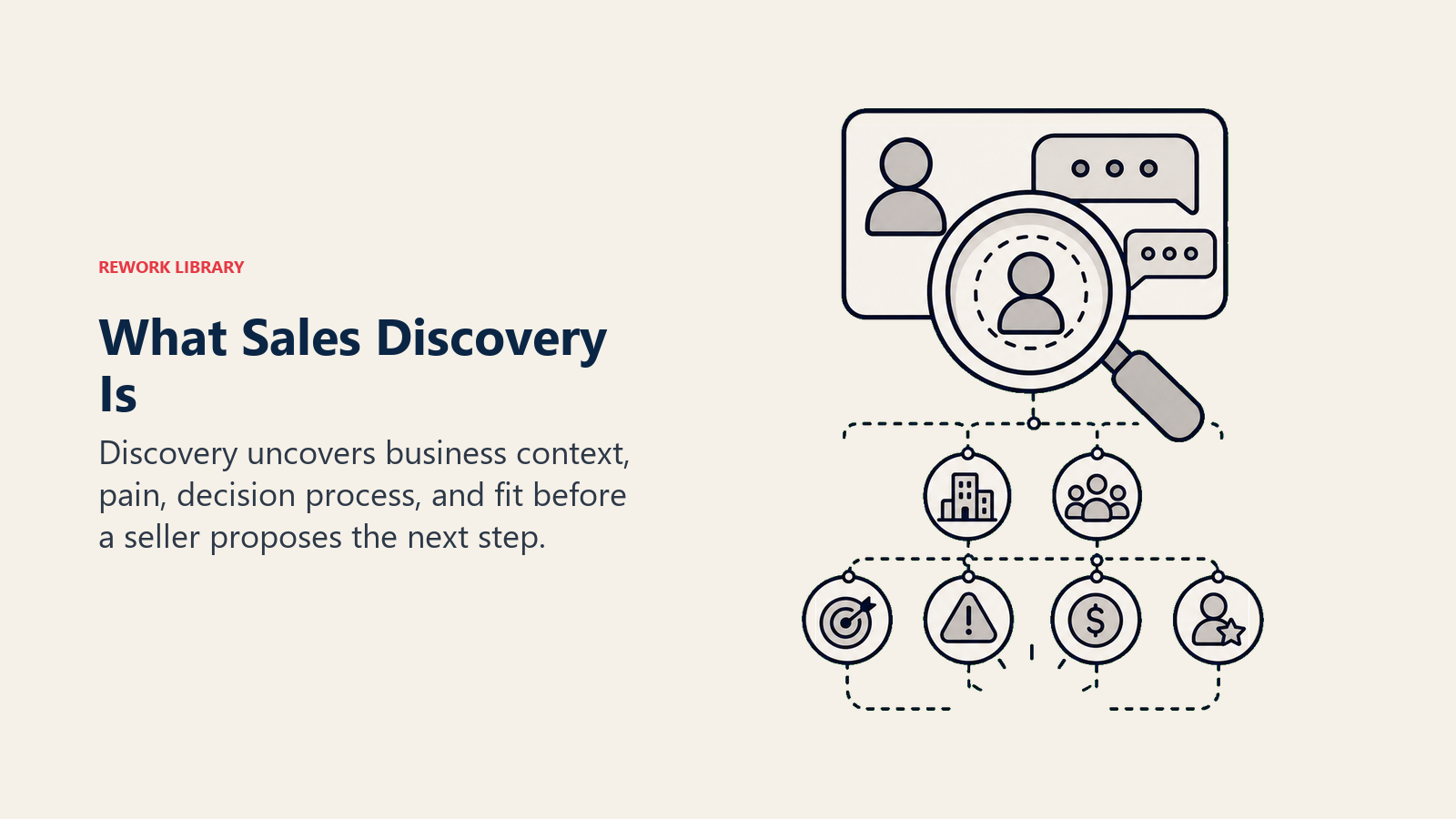
Real discovery is a structured investigation into your prospect's world. What are they trying to accomplish? What is getting in the way? What have they tried? What does failure look like? What does success look like? Who else is affected? What happens if they do nothing?
The information you gather in discovery does three things:
First, it tells you whether this is a real opportunity worth pursuing. Not every conversation should become a deal in your pipeline. Good discovery surfaces disqualifiers early.
Second, it shapes how you position your solution. The demo you run after a thorough discovery will look nothing like the demo you would run without it. You show what matters to this specific prospect based on what you learned, not a standard feature tour.
Third, it builds the relationship. Prospects who feel heard and understood are more likely to trust you with access to other stakeholders, more likely to share information that helps you understand the deal, and more likely to champion your solution internally.
Discovery is not something you do to prospects. It is something you do with them.
Before the Call: Preparation
Good discovery starts before the prospect picks up the phone.
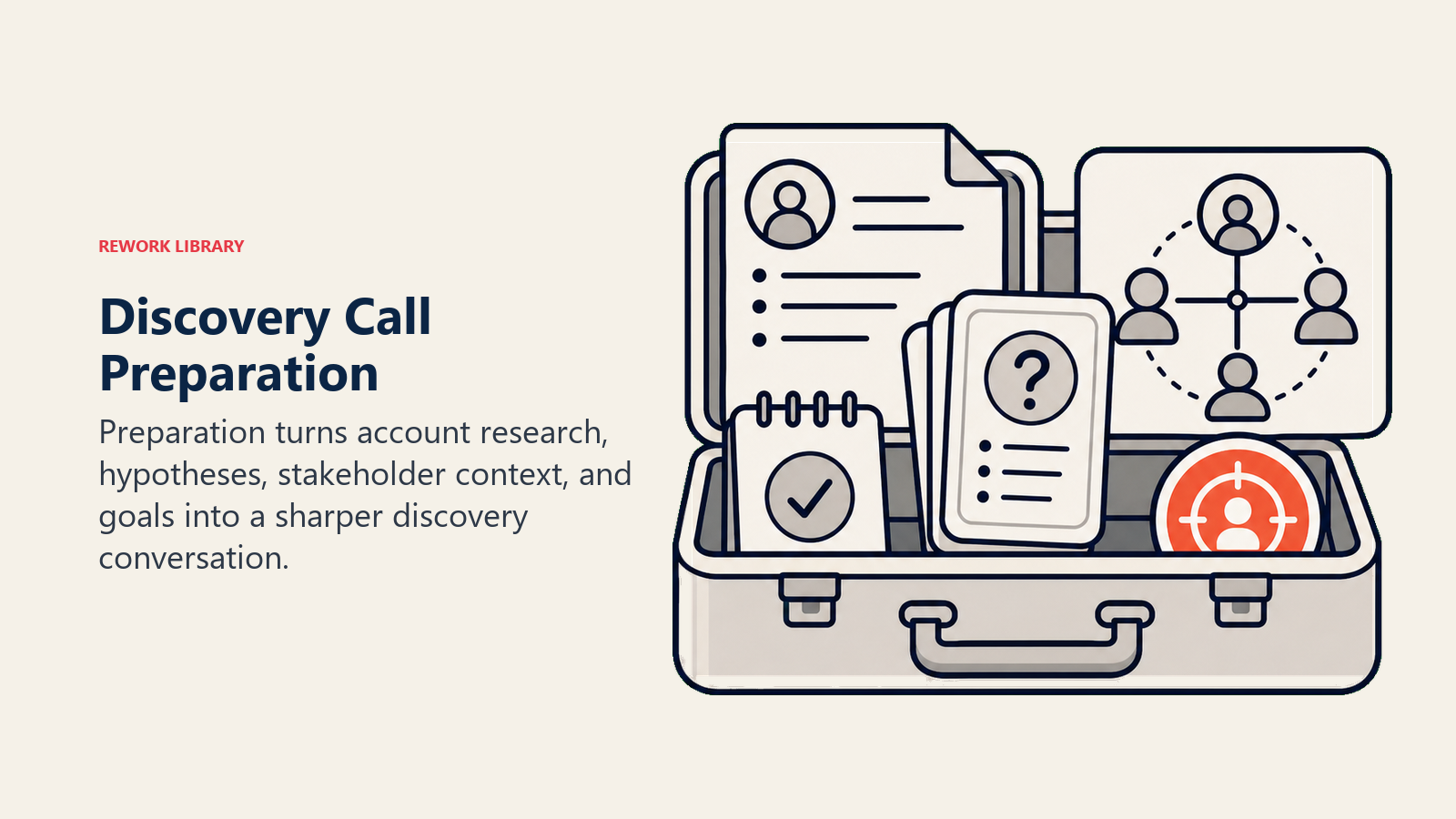
Research the company. Spend 15-20 minutes before a discovery call understanding who they are, what they do, what their recent news looks like, and what their likely challenges are given their size and stage. Look at their LinkedIn page for recent announcements. Check Crunchbase for funding history. Read any press releases or blog posts from the last 6 months.
Research the contact. Look at their LinkedIn profile. What is their background? How long have they been at this company? What did they post or share recently? Are they vocal about specific challenges? This background tells you what they care about and how they think about problems.
Review your CRM. If this company has interacted with your marketing content, attended a webinar, or had any prior contact with your company, know that context before the call. A prospect who attended a webinar about lead routing six months ago is probably dealing with lead distribution challenges. A prospect who came in through a specific piece of content has already told you what they care about.
Prepare your hypothesis. Based on your research, what do you think the prospect's main challenge is? You will validate or refute this in the first 10 minutes of the call. Having a hypothesis prevents you from going in blank and makes your questions more targeted.
Prepare your questions. Write out 10-15 questions before the call. You will not ask all of them. The conversation will take you in directions you did not anticipate. But having them ready means you never find yourself stuck and defaulting to "tell me about your business."
The Discovery Call Structure
A well-run discovery call has a clear shape. It is not a meandering conversation. It moves through specific territory with intention.
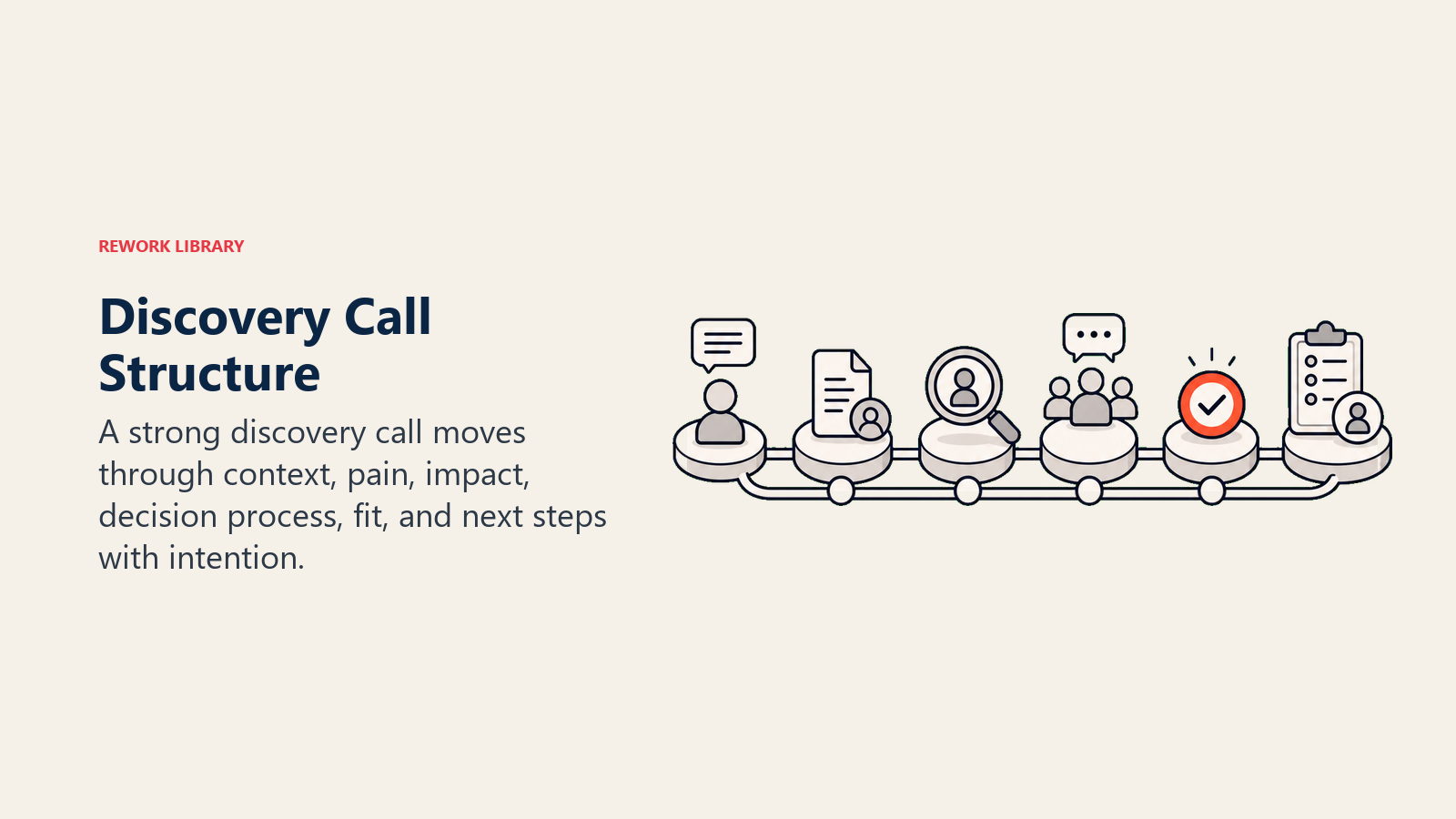
Opening: Set the Stage (5 minutes)
Start by confirming the agenda and asking the prospect what they want to get out of the conversation. This is not a formality. You want to know: what brings them to this call? What would make this worth their 45 minutes?
A simple way to open: "I've done some research on your company and have some ideas about where we might be able to help, but I'd rather hear from you first. What made you want to take this call?"
That single question often reveals more about the deal than 20 minutes of standard discovery questions. Let them tell you where the pain is.
Current State Exploration (10-15 minutes)
Understand how they are operating today before you tell them how your product can help. Questions in this section focus on what they do, how they do it, who is involved, and what tools or processes they currently use.
Examples:
- "Walk me through how your team currently handles [relevant process]."
- "How many people are involved in that process on a day-to-day basis?"
- "What tools do you use for that today?"
- "How long has that been your approach?"
Listen for the gap between how they describe the process and how it actually works. People often describe the ideal process, not the actual one. When you hear "we're supposed to do it this way," probe further. "What actually happens in practice?"
Problem Identification (15-20 minutes)
This is the core of discovery. What is broken, what does it cost them, and how much does it matter?
Surface the problem through questions, not statements:
- "Where does that process break down?"
- "What happens when [specific scenario]?"
- "What is the manual work you are doing to work around this?"
- "How much time does your team spend on this each week?"
- "What are the downstream effects when this goes wrong?"
When you surface a problem, probe the impact. Not just "that sounds frustrating" but "what does that cost you in concrete terms?" Revenue impact, time wasted, headcount, customer churn, missed deadlines. You need numbers, not adjectives.
Then probe the urgency. "How long has this been a problem?" "Why now? What changed that made this a priority?" "What happens if you don't solve this in the next six months?"
Problems without urgency are interesting but not sales opportunities. If the status quo is tolerable, deals stall. Urgency means the cost of inaction is higher than the cost of change.
Desired Outcome (10 minutes)
Once you understand the problem, understand what success looks like. Not "what features do you need" but "what outcome are you trying to achieve?"
- "If we could solve this completely, what would that look like six months from now?"
- "How would you measure success? What metrics would tell you this worked?"
- "Who else would notice the improvement?"
- "What would that change about how your team operates?"
These questions accomplish two things. They help you understand whether your solution can actually deliver what they need. And they help you frame your pitch in terms of their goals, not your features.
Decision Process Exploration (5-10 minutes)
Near the end of discovery, surface how a decision would actually get made. This is qualification for the process, not the problem.
- "Assuming this looked like a good fit, who else would be involved in the decision?"
- "What does your evaluation process typically look like for something like this?"
- "Have you bought similar software before? How did that process go?"
- "Is there budget allocated for this, or would that need to be created?"
- "What timeline are you working with?"
This section is less conversational and more direct. The answers tell you whether this is a deal you can close in a reasonable timeframe and what your path to decision is.
The Art of Follow-Up Questions
The difference between a mediocre and excellent discovery call is almost always follow-up questions. The first answer to any question is rarely the whole story.
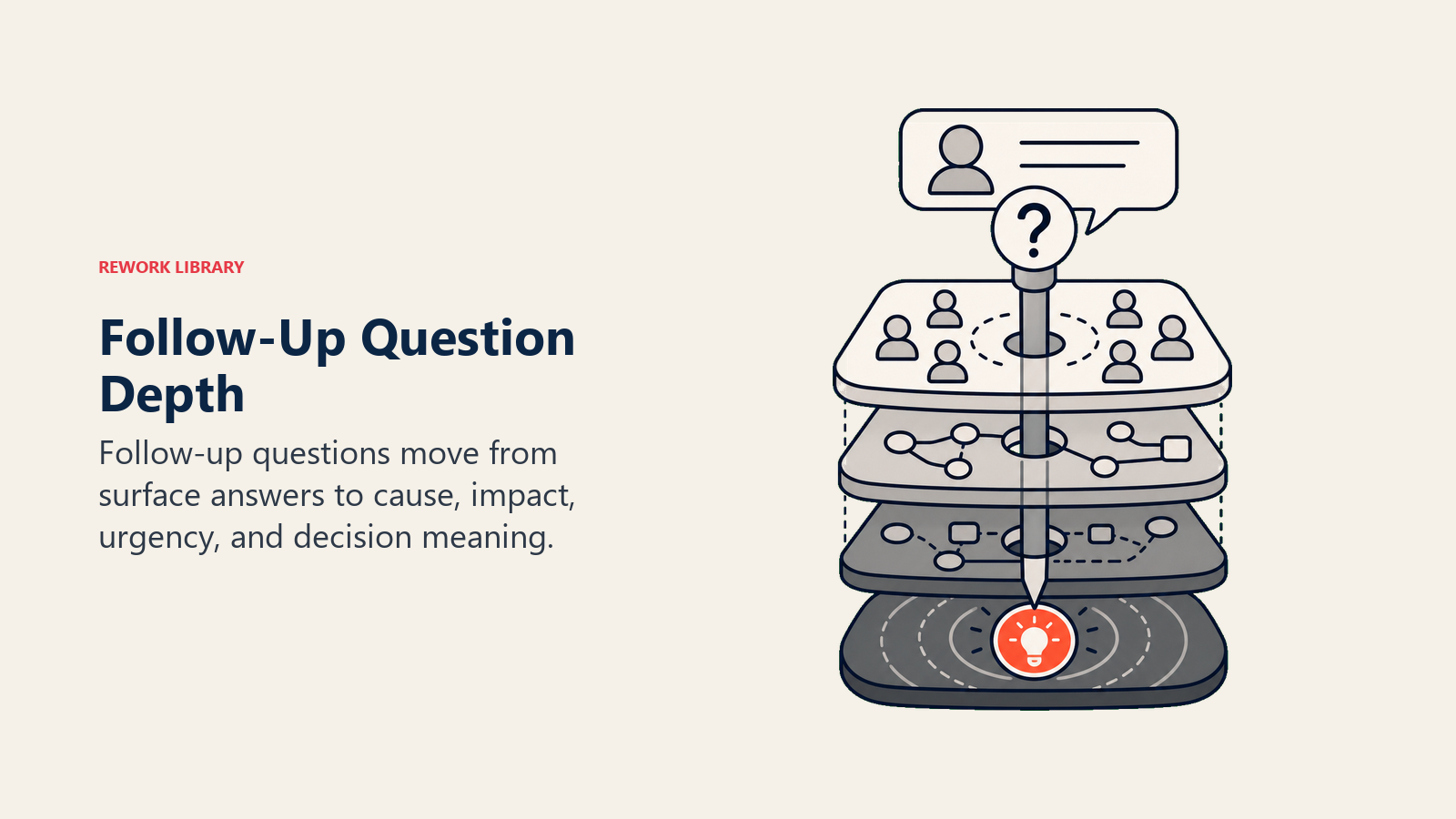
When a prospect says their biggest challenge is "managing the pipeline," do not move on. Probe it.
"What specifically about pipeline management is the issue?" "Is that a data quality problem, a visibility problem, or something else?" "When you say it's hard to manage, what does a bad week look like?" "How does that affect your forecast accuracy?" "What have you tried to fix it?" "Why didn't that work?"
Each follow-up question gets you closer to the root cause and the real cost. Surface-level pain is easy to solve in a 30-second product feature mention. Root-cause pain requires your full solution and justifies the price.
Listen for what is NOT said as much as what is. If a prospect describes their lead management process in detail but never mentions their CRM, that is interesting. Either they do not use one, they use it badly, or there is a story there. Ask.
Handling Prospects Who Do Not Want to Answer Questions
Some prospects resist discovery. They want to jump straight to "just show me the product."
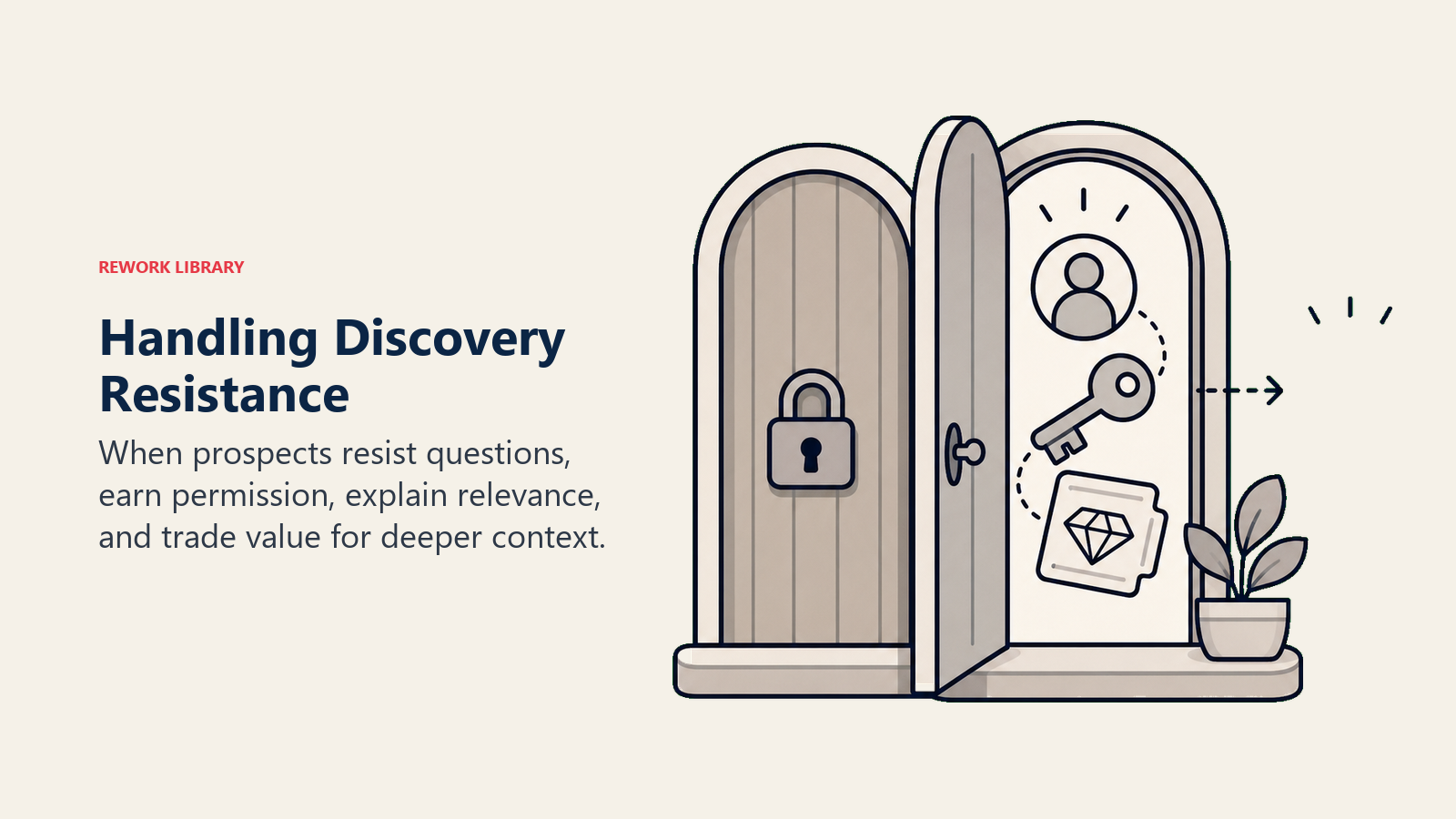
Do not fight this. And do not skip discovery either.
A good response: "I would love to show you the product. To make the best use of your time, it helps me to know which parts are most relevant to your situation. Can I ask just a few quick questions so I'm not showing you things that don't matter to you?"
Most prospects say yes. They do not want to sit through an irrelevant demo any more than you want to give one.
If a prospect is still resistant after two or three questions, give a brief overview of the product and watch their reaction carefully. Genuine interest shows up in follow-up questions and engagement. A prospect who is only going through the motions will be disengaged regardless of how good your demo is. That information is itself useful discovery.
Multi-Threading in Discovery
The best discovery talks to more than one person. Relying on a single contact means you are getting one perspective, and that perspective is colored by that person's role, their relationship with the problem, and their internal politics.
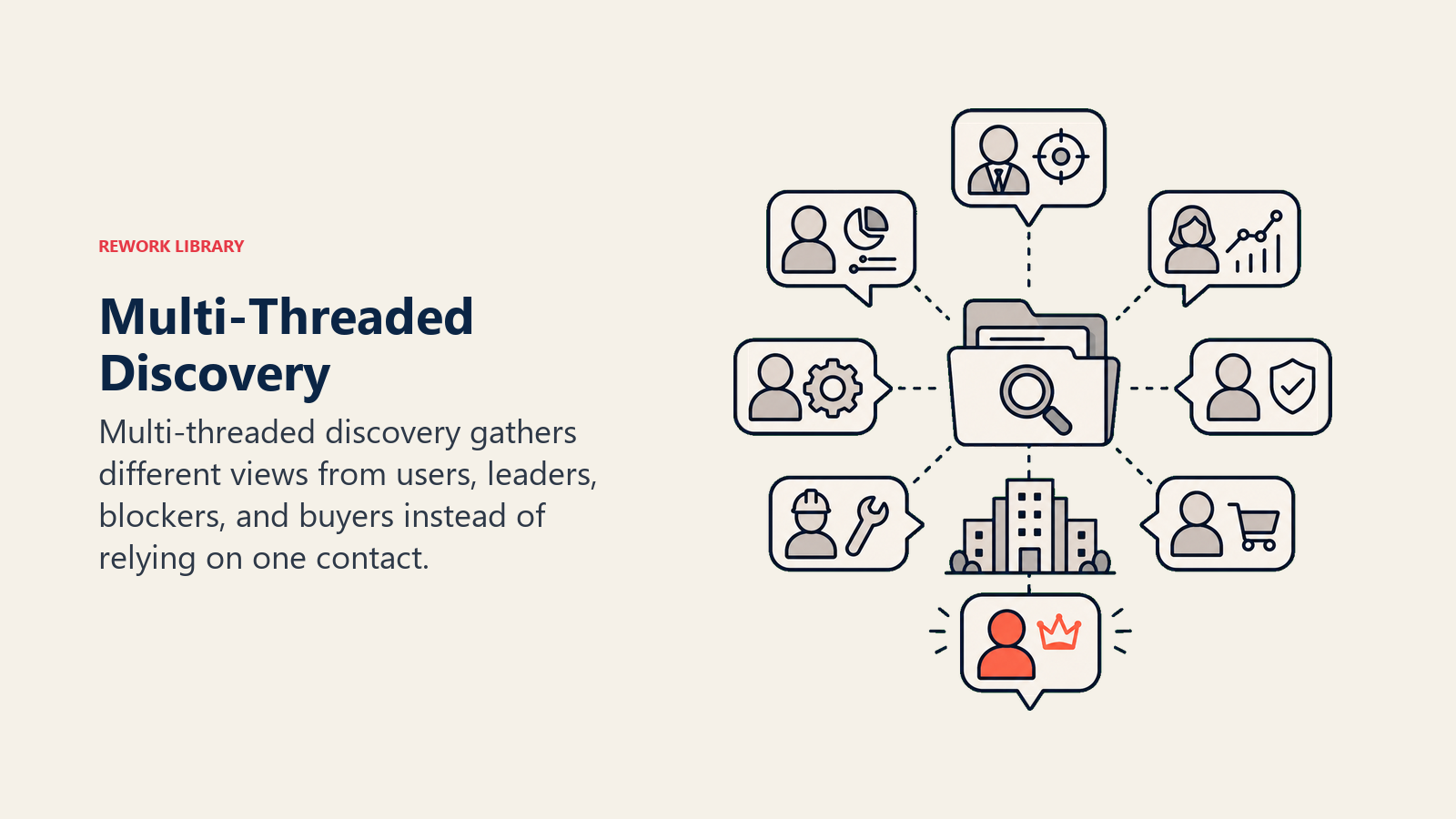
For deals above a certain threshold, plan to run discovery with at least two or three stakeholders:
- The practitioner who lives with the problem daily (most detail on current pain)
- The manager who owns the outcome and has budget visibility
- A colleague in an adjacent function who is affected by the problem (sometimes the most revealing conversation)
Different stakeholders will describe the same problem differently. The practitioner says the process is too manual. The manager says the team is spending too much time on non-revenue activities. The adjacent stakeholder says the data they receive from this team is unreliable. These are three angles on the same problem, and each one gives you a different way to position your solution.
Multi-threading is also how you avoid the single-point-of-failure risk. If your only discovery contact leaves the company or goes quiet, a deal with multiple relationships inside the organization is far more resilient than one with a single contact.
Connecting Discovery to Qualification
Discovery and qualification are not separate activities. Every good discovery question is also a qualification question.
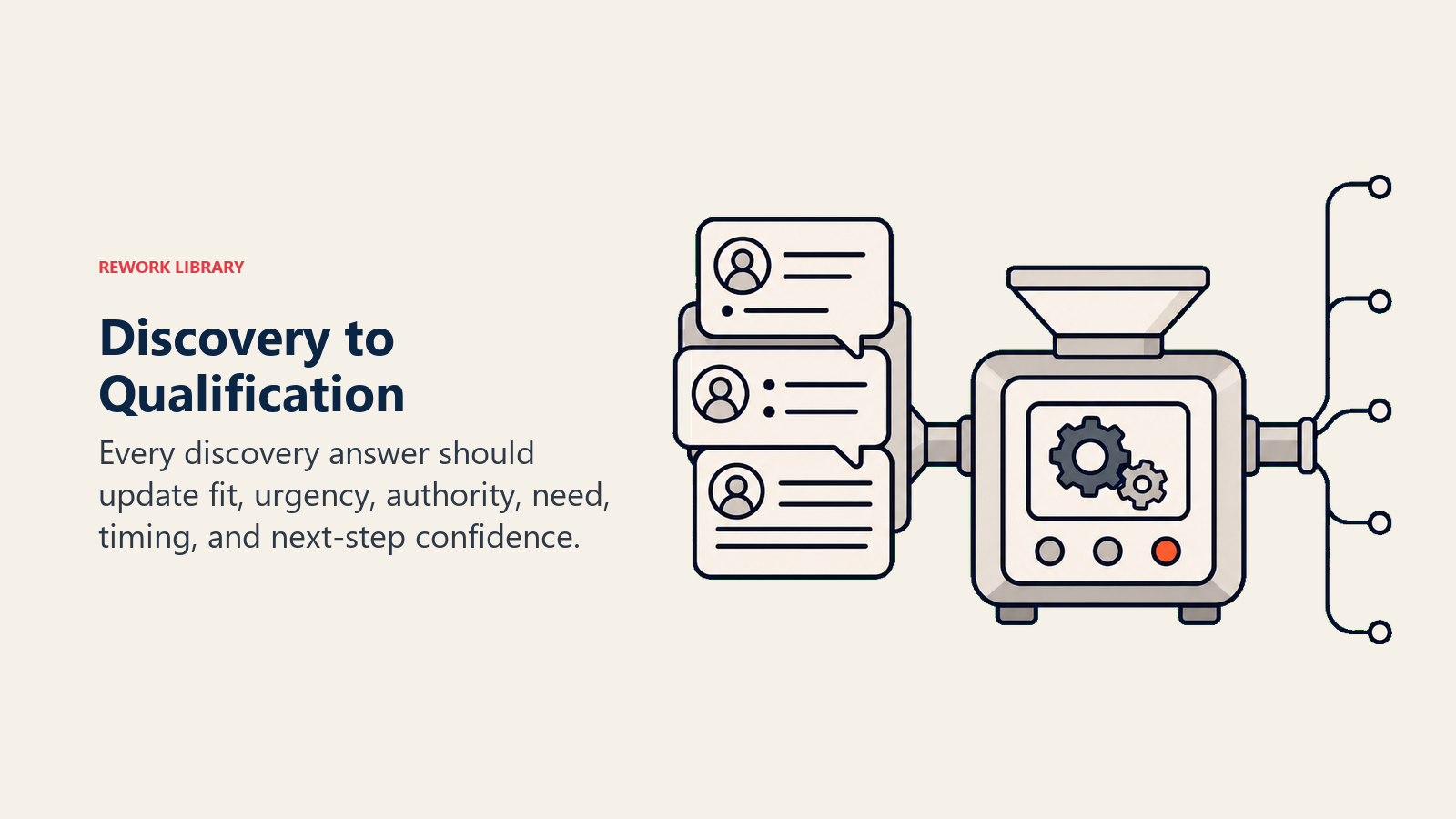
When you ask "what does this cost you in concrete terms," you are qualifying pain depth. When you ask "who else would be involved in the decision," you are qualifying access and authority. When you ask "what timeline are you working with," you are qualifying urgency. When you ask "is there budget for this," you are qualifying financial viability.
Your lead qualification frameworks should map directly to your discovery question library. Every dimension you need to qualify (BANT, MEDDIC, or whichever framework your organization uses) should have two or three questions that surface the information naturally in conversation.
Never ask qualification questions as a list. "Do you have budget? Is there urgency? Who is the decision maker?" comes across as interrogation. Work the same information into a conversation that feels natural and reveals depth.
After a discovery call, you should be able to answer: Does this prospect have a real problem I can solve? Is the problem urgent enough to buy? Can they afford my solution? Who has to approve the decision? What is the timeline? If you cannot answer those questions confidently, you did not do enough discovery.
Feed these insights into your lead scoring systems to ensure deals only advance in the pipeline when discovery is genuinely complete.
After the Call: Documentation and Follow-Up
Discovery does not end when the call ends. What you do in the 30 minutes after the call determines how well you carry what you learned into the next steps.
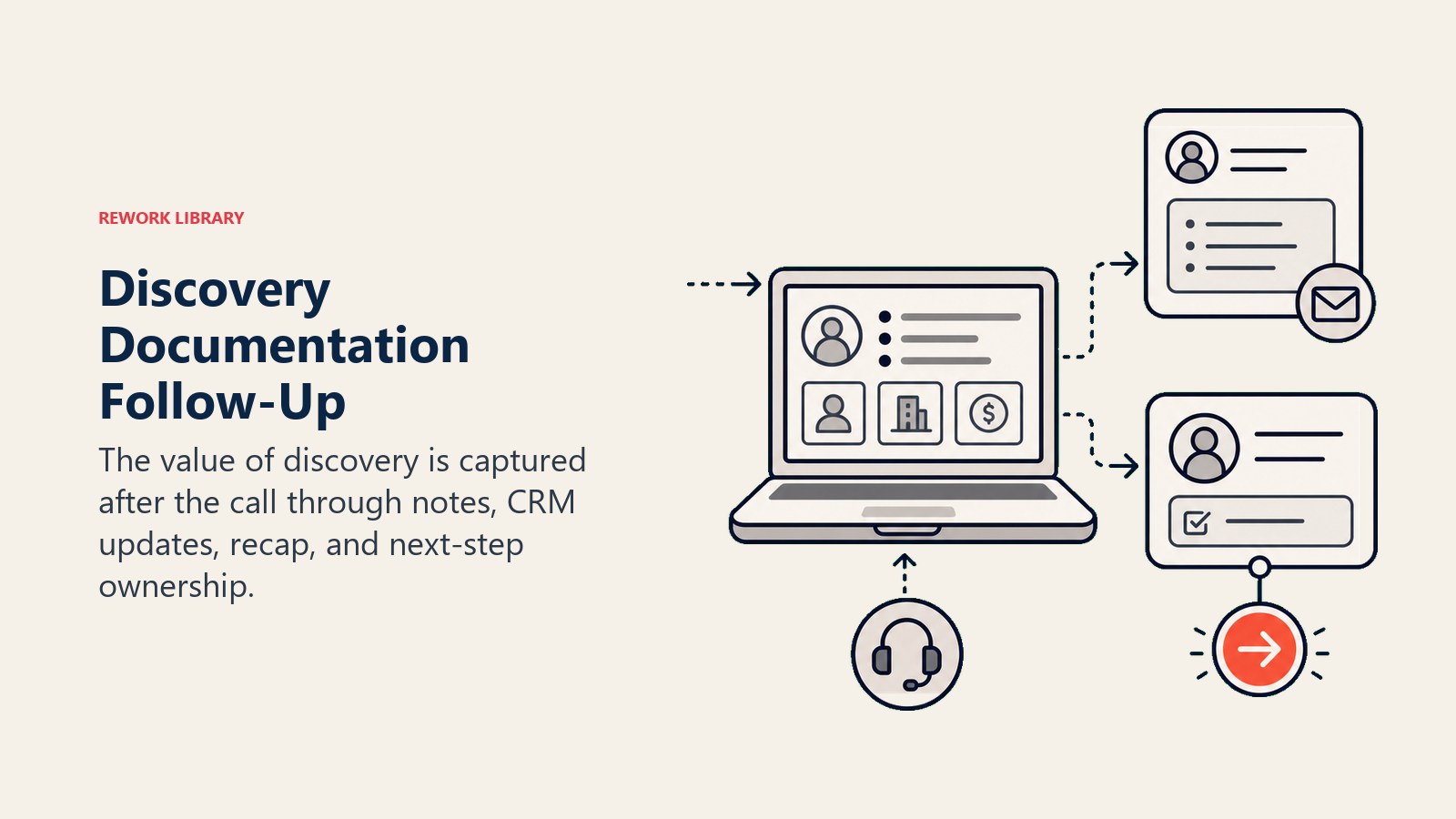
Document while the conversation is fresh. Write up the specific pains, the business context, the stakeholder names and roles, the timeline, the budget situation, and any commitments made. Put this in your CRM, not your notes app. It needs to be visible to your manager and accessible to customer success when the deal closes.
Send a follow-up email within two hours. Summarize what you heard (not what you said), confirm the next steps you agreed to, and attach anything you promised to send. A good follow-up email also subtly validates your understanding: "Based on what you described, it sounds like the core challenge is X, and the goal is Y. Does that capture it?"
This serves two purposes. It shows you listened. And it gives the prospect a chance to correct any misunderstanding before it carries forward into a demo that misses the point.
The follow-up email should also propose a specific next step. Not "let me know if you want to proceed" but "I'll send you a calendar invite for next Tuesday at 2 PM to walk through how we've solved this for [similar company]. Does that work?"
The Link to Lead Status Management
After discovery, you should have enough information to make a clear call on deal status. Is this a qualified opportunity that moves into your pipeline with a defined next step? Is it a deal that needs more discovery with additional stakeholders before you can qualify it? Or is it not a fit right now and should move to a lead nurturing programs track?
Make the call explicitly. Do not leave discovery calls in an undefined state where they might be an opportunity or might not. That ambiguity leads to pipeline inflation, inaccurate forecasts, and wasted follow-up effort.
Update your lead status management records the same day you run discovery. If the deal is moving forward, set the next stage and document the qualification evidence that supports it. If you are still gathering information, flag what is missing and what your plan is to get it. If it is not a fit, mark it appropriately and route it to a nurture sequence so it is not lost but not cluttering your active pipeline.
Good discovery, properly documented and acted on, is the foundation of a healthy pipeline and a reliable forecast.
Frequently Asked Questions about Sales Discovery Best Practices
How long should a sales discovery call be?
Most effective discovery calls run 30-45 minutes. That is long enough to go deep on two or three key problems and complete the qualification questions, but short enough that the prospect stays engaged. Calls under 20 minutes typically produce surface-level pain identification that does not support strong positioning later. Calls over 60 minutes often lose focus and drift into topics that do not advance the deal.
Should you demo during discovery?
Generally, no. Running a full product demo during discovery shortcuts the qualification process and often shifts the conversation from the customer's problems to your product's features. Save the demo for a dedicated meeting where you can structure it around the specific problems discovery revealed. A brief "let me show you one relevant thing" during discovery is occasionally useful, but it should be the exception.
How do you get prospects to open up during discovery?
Ask questions that invite stories rather than yes/no answers. "Walk me through how that process works" produces more information than "do you have a process for that." Pause after answers and let silence sit for a second before your next question. Silence prompts elaboration. Validate what you hear with brief acknowledgments ("that makes sense," "I've heard that from other ops leaders") before following up with the next question. And make it clear through your tone and questions that you are trying to understand their situation, not just qualify them for your pipeline.
What is the biggest mistake sales reps make in discovery?
Talking too much. Specifically, pitching too early. Gong data shows that top performers talk 46% less on discovery calls than average performers. The moment a prospect describes a pain and a rep responds with "great, that's exactly what we solve" and pivots to a pitch, the quality of discovery drops sharply. Hold the pitch. Keep asking questions. The more complete your picture of the prospect's situation before you position your solution, the more relevant and compelling that positioning will be.
How do you handle a discovery call when the prospect has already done a lot of research and just wants pricing?
Acknowledge that they have done their homework and make it easy to have a quick conversation before pricing. "I can absolutely get you pricing information. It would help me to understand your specific situation so I can give you the right package, not just a range. Can I ask two or three questions first?" Most prospects will agree. And often the pricing question is a way of testing whether the rep will just respond defensively or treat them as an informed buyer. Treat them as an informed buyer.

Principal CRM Strategist
On this page
- What Discovery Actually Is (and Is Not)
- Before the Call: Preparation
- The Discovery Call Structure
- Opening: Set the Stage (5 minutes)
- Current State Exploration (10-15 minutes)
- Problem Identification (15-20 minutes)
- Desired Outcome (10 minutes)
- Decision Process Exploration (5-10 minutes)
- The Art of Follow-Up Questions
- Handling Prospects Who Do Not Want to Answer Questions
- Multi-Threading in Discovery
- Connecting Discovery to Qualification
- After the Call: Documentation and Follow-Up
- The Link to Lead Status Management