Founder CEO Return: When Founders Come Back to Lead

Turn this article into takeaways for your work.


Each assistant summarizes the article only for you and suggests best practices for your work.
There is a specific kind of business story that recurs often enough to be its own archetype: a founder who built a company, handed leadership to a professional CEO, watched the company struggle or stagnate, and then came back to run it again.
This scenario carries enormous public and internal drama. It raises genuine questions about board governance, about the previous CEO, about whether the founder learned anything in the interim. And it carries a distinct set of leadership challenges that are different from both the original founder-led phase and from a typical CEO succession.
This article covers what makes founder returns work, what makes them fail, and what both boards and returning founders need to think through carefully.
Why Founders Return
The circumstances that prompt a founder return vary, but a few patterns are common.
Performance degradation. The company the founder handed off is performing materially worse than it was, or worse than comparable companies in the same period. Revenue growth has stalled, margins have compressed, key talent has left, or competitive position has eroded. The board looks at the situation and concludes that the original founder, who built something real, represents the most credible path to recovery.
Cultural drift. Some companies lose their distinctiveness under professional management. What made the product interesting or the team excellent gets rationalized away in the name of scalability or process. The board recognizes that what is being lost is harder to name than it is to feel, and concludes that the only person who can restore it is the person who created it.
Strategic inflection. The company is facing a major strategic decision, a new technology platform, a significant acquisition, a market shift that requires rethinking the core model, and the board believes the founder's original vision and product instincts are the right guide for that decision.
Crisis. A reputational, financial, or operational crisis has made the current CEO untenable, and the founder is the most credible figure available to stabilize confidence with customers, employees, and investors.
What Is Different the Second Time
A founder returning as CEO is often talked about as if the clock is being reset. It is not. The company is different, the team is different, the market is different, and the founder is different.
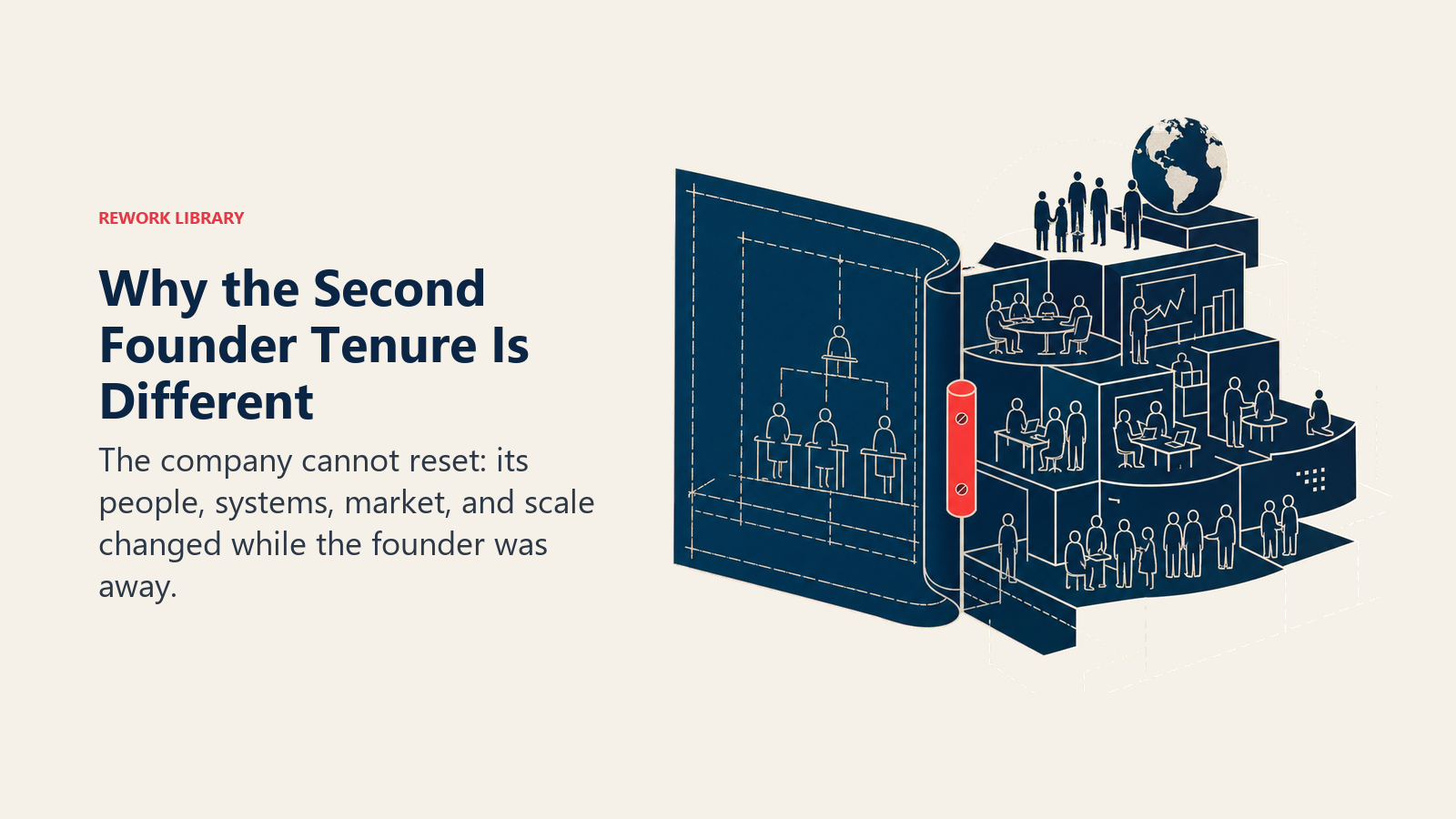
The team did not build the company with you. Many of the early employees who were there for the first chapter are gone. The people now in senior roles joined under a different leader, built their relationships within a different cultural context, and have loyalty structures that are different from the original team's. A returning founder who assumes they can just re-establish the old dynamic will find that it does not exist.
The organization is more complex. Companies that have scaled past a few hundred people operate differently than the early-stage company the founder ran. There are more layers, more process, more coordination cost, more regulatory obligation. The founder's informal operating style that worked at fifty people may need significant adaptation at five hundred.
The predecessor CEO left something behind. Whether the previous CEO was effective or not, they made decisions that the organization is now living with. Product choices, customer commitments, organizational structures, talent decisions. The returning founder inherits all of those. Managing them with fairness and without reflexive contempt for the predecessor matters for the organization's confidence in the founder's judgment.
You know the company's weaknesses clearly now. One advantage of the second stint is that the founder often comes in with a much more honest assessment of what the company's underlying challenges are. The first time, it is easy to underestimate operational gaps, talent gaps, or market position weaknesses because you are close to the origin story. The second time, the evidence is harder to ignore.
What Boards Need to Get Right
A founder return that is impulsive or poorly structured often makes things worse rather than better. A board that returns to a founder out of desperation, without having done the governance work, hands the organization a new set of problems.
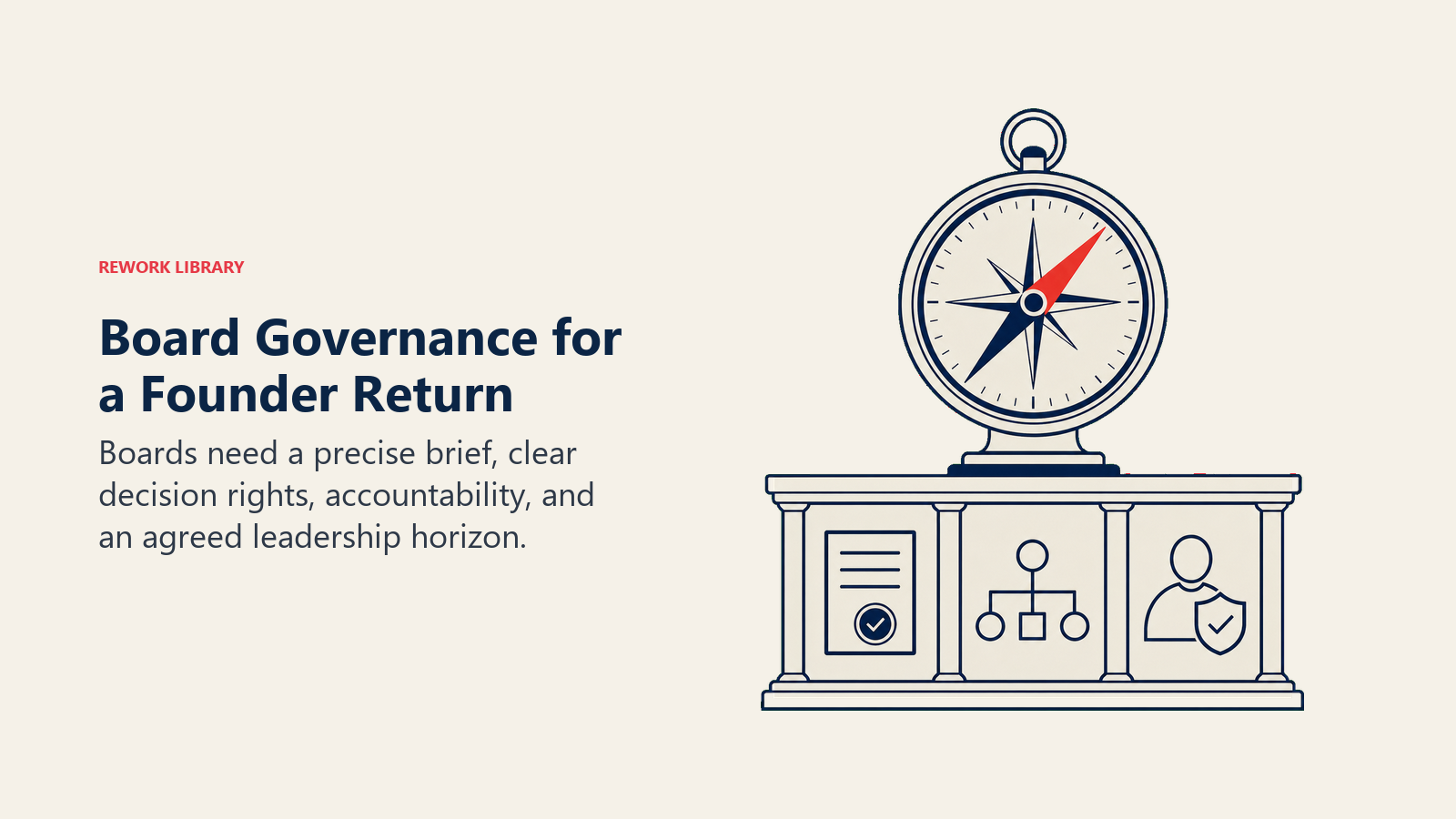
Define what you are solving for. Is this a turnaround? A strategic pivot? A cultural restoration? The clarity of the brief matters. A founder who comes back to "fix things" without a specific brief will improvise in ways that may or may not address the actual problem.
Establish clean authority. The previous CEO needs to be clearly transitioned out before the founder comes in. Ambiguity about who is really in charge, even for a short period, is corrosive. The announcement and the handoff need to leave no space for the organization to be uncertain.
Set expectations for the transition period. A founder return often comes with high internal hope that the founder will restore something that was lost. That hope is fragile. The board and the founder need to align on what "success" looks like at six months and twelve months, and communicate that clearly.
Address the governance questions. If the board's oversight contributed to the original choice of the departing CEO, or to conditions that allowed the company to drift, the returning founder and the board need to have an honest conversation about what changes in governance are warranted. A founder who returns and finds the same board with the same blind spots that produced the problem is not starting from a clean slate.
What the Returning Founder Needs to Do
Assess before acting. The temptation on return is to move immediately and decisively. Some decisive action may be necessary and visible. But the first instinct to "get back to the way we did things" is almost always premature. The company changed while the founder was gone, and not all of those changes were bad. Honest assessment comes before remedy.
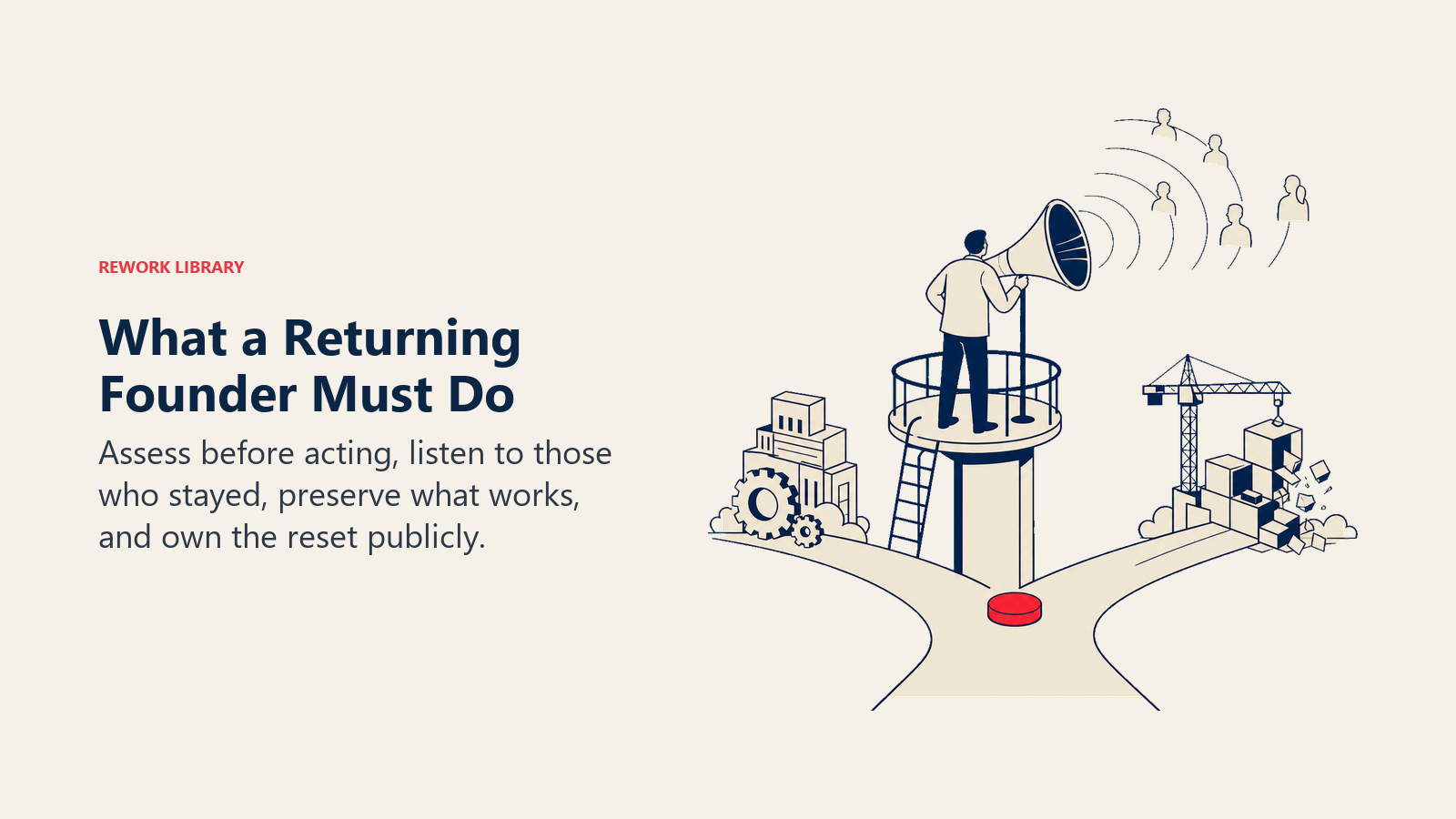
Listen to the people who stayed through the previous regime. The employees who remained through the transition are a critical resource. They have institutional knowledge of both what the company was and what it became. Their loyalty is valuable and, if the founder treats them with contempt for having survived under a different leader, it will be lost.
Be transparent about why you came back. The organization wants to understand why this is happening. They want to know whether the founder is coming back because they believe in the company's future, or because they are trying to recover something personal. The former energizes people. The latter makes them nervous. The founder needs to be honest with themselves about the answer, and then communicate it clearly.
Handle the outgoing CEO with dignity. Regardless of how the previous CEO performed, the way the founder handles their departure signals something important about the founder's character to the whole organization. A departure managed with unnecessary public criticism poisons the well for whoever the founder eventually needs to hire next.
Build new relationships rather than restoring old ones. The people who are now in senior roles are not the original team. The founder needs to invest in building genuine working relationships with the current leadership, which means curiosity and patience rather than assumption.
What Makes Returns Work
The founder returns that work share a few common characteristics.
The founder has genuinely changed. The skills and habits that made the founder great in the early stage are partly the same and partly different from what the current company needs. Founders who return and are willing to do the developmental work, to be more process-oriented than they were before, to be more patient in building consensus with a larger leadership team, have a much higher success rate.
The mandate is clear. The clearest turnaround situations give the returning founder a sharp brief: recover growth, restore culture, navigate a specific strategic inflection. Vague briefs produce unfocused responses.
The board provides genuine support and genuine accountability. A board that cheers the return but does not ask hard questions about performance creates conditions for drift. Founder returns work best when the board is genuinely engaged as a thought partner in the first six months, not just as a governance rubber stamp.
The founder addresses organizational trust directly. The organization has been through a leadership change. Some people are uncertain, some are relieved, some are cynical. The returning founder needs to address that emotional reality directly, not just through actions but through explicit conversation about what happened and what comes next.
Common Failure Modes
Nostalgia as strategy. The founder who returns with a primary agenda of restoring the old culture rather than addressing the current competitive challenge. What made the company great at twenty people may have limited relevance at two hundred, and the market it operates in has moved.
Avoiding accountability for the transition decision. If the founder had a role in choosing the outgoing CEO, in defining the transition, or in governance during the CEO's tenure, pretending otherwise damages credibility with the people who know the real history.
Moving too fast on organizational changes. The urgency that often prompts a founder return creates pressure to restructure quickly. But rapid restructuring before honest assessment often removes things that were working along with things that weren't.
Underestimating the cultural cost of the leadership change. Two leadership transitions in a short period is disruptive. Employees who were uncertain after the first transition are more uncertain after the second. The returning founder needs to invest specifically in restoring confidence, not just in solving the operational problem.
Key Facts
- Founder returns tend to produce stronger outcomes in turnaround and product-repositioning scenarios than in operational scaling scenarios, where the skills required are least aligned with the founder's typical strengths.
- The time between a founder stepping back and returning matters: returns within two years carry more continuity; returns after five or more years face a significantly different organization.
- Board governance quality is the strongest predictor of whether a founder return stabilizes or further disrupts the organization.
Frequently Asked Questions about Founder CEO Return
Does a founder returning as CEO signal that the company has failed?
Not necessarily. It signals that the previous CEO chapter did not produce the outcomes the board expected, and that the board sees more value in the founder's return than in conducting a new external search. That is a board judgment call, not a verdict on the company's viability.
How long should a returned founder expect to lead before handing off again?
It depends heavily on the reason for the return. A turnaround-focused return might be structured as a three to five year intensive period followed by a deliberate succession. A return focused on a specific strategic inflection may be shorter. Boards and returning founders should agree on a time horizon at the outset.
What happens to the departing CEO?
The departing CEO typically receives a severance arrangement per their contract and exits. How the board and returning founder characterize the departure publicly matters for organizational culture. Unnecessarily critical public characterizations tend to backfire.
Can a founder and a former CEO maintain a productive relationship after the return?
Yes, though it requires effort and goodwill on both sides. In cases where the previous CEO left constructively and the transition was handled well, ongoing advisory relationships have sometimes been productive.
Related reading: Founder-to-CEO Transition | Succession Planning | Crisis Leadership | Authentic Leadership | The Leadership Pipeline Model
