Risk-Based Decision-Making: How Leaders Choose Under Uncertainty
Turn this article into takeaways for your work.


Each assistant summarizes the article only for you and suggests best practices for your work.
Every strategic decision involves incomplete information. The job is not to eliminate uncertainty before deciding. It is to make the best possible choice given what you know, what you do not know, and what is at stake.
Risk-based decision-making is the discipline of doing exactly that. Instead of defaulting to instinct, deferring to consensus, or waiting for certainty that never arrives, leaders who practice this approach follow a structured process: define the decision, identify key uncertainties, estimate likely outcomes, and choose with eyes open.
This is not a complicated framework. But it does require intellectual honesty about what you know versus what you assume, and discipline not to let the most confident voice in the room drive the outcome.
Why Leaders Make Poor Decisions Under Pressure
Most organizational decisions go wrong in predictable ways. Common failure patterns include:
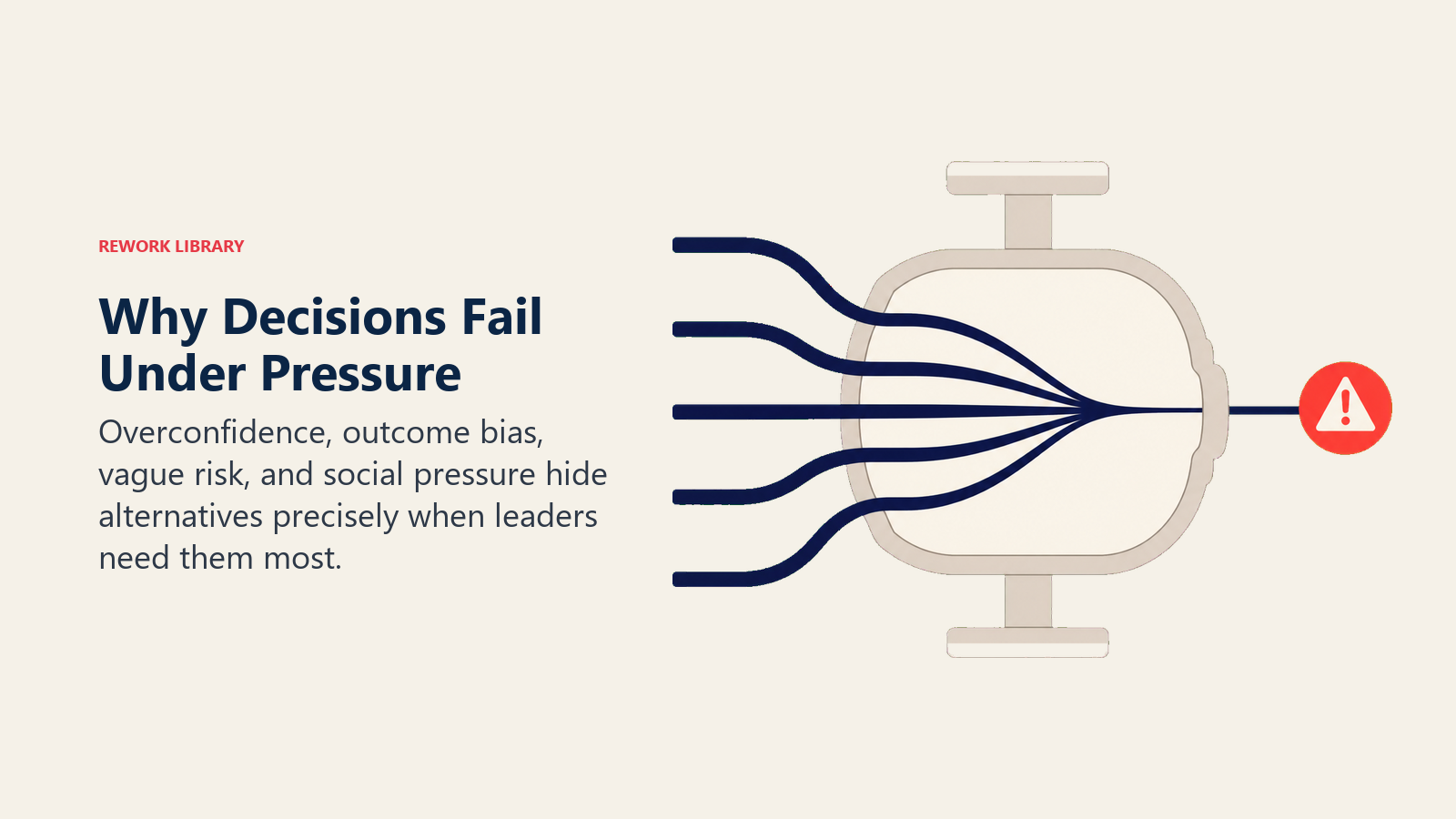
Overconfidence in the base case. Leaders present one scenario as "the plan" and treat alternative outcomes as unlikely edge cases. When the base case does not materialize, the organization is caught flat-footed because no one prepared for anything else.
Outcome bias. A decision that worked out well gets credited as a good decision. A decision that went badly gets labeled a mistake. But a good decision process can produce a bad outcome due to factors beyond your control, and a poor process can get lucky. Judging decisions by outcomes alone teaches the wrong lessons.
Failure to disaggregate risk. Leaders lump "risk" into a single vague category rather than distinguishing between risks that are quantifiable, risks that are knowable but not yet known, and genuine uncertainty where probability estimation is not possible.
Social pressure toward consensus. In group settings, the natural tendency is to converge on a view that everyone can live with. But the decision that creates the least conflict is not always the best choice.
Risk-based decision-making creates a structure that counteracts each of these failure modes.
The Core Process
The process moves from framing the choice to recording the reasoning so leaders can test both the decision and what they assumed.
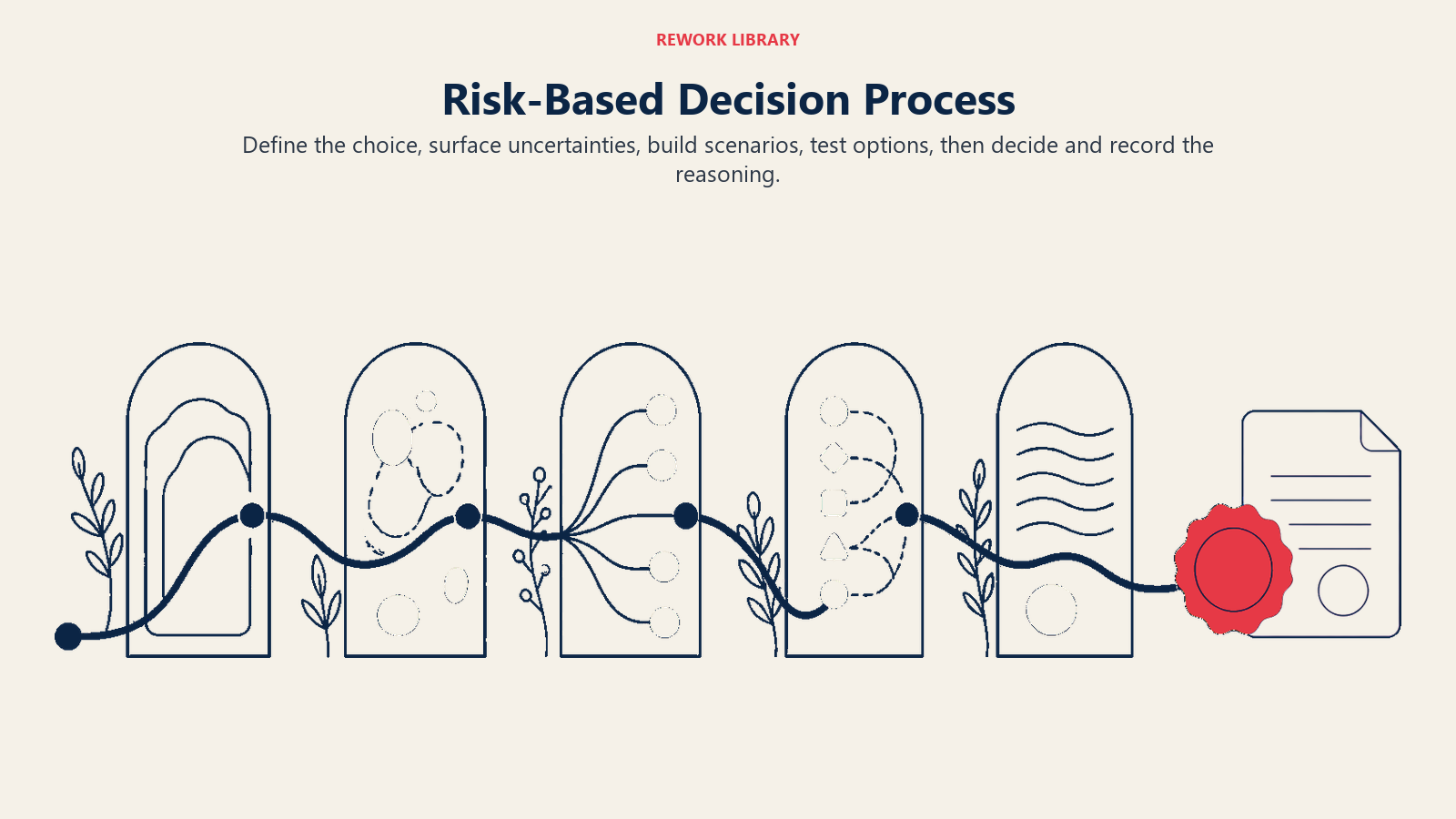
Step 1: Define the actual decision
Before evaluating options, be specific about what you are deciding and what you are not. Poorly framed decisions produce low-quality deliberation because participants are arguing about different questions.
A useful framing specifies: the choice (what are we selecting between), the timing (by when must we decide), the reversibility (how hard is this to undo), and the decision owner (who makes the final call after input).
Reversibility matters more than most leaders acknowledge. A highly reversible decision with a tight deadline can be made quickly with available information. A nearly irreversible decision with a long consequence horizon deserves far more analytical rigor.
Step 2: Identify key uncertainties
Not all uncertainties are equal. Some assumptions in a decision are highly uncertain and have large effects on the outcome. Others are uncertain but relatively immaterial. Focus analysis on uncertainties that are both important and genuinely unknown.
A useful technique: list the assumptions behind each option, then rank them by how much the decision would change if the assumption turned out to be wrong. Assumptions that are both high-impact and uncertain deserve the most scrutiny.
This is different from listing risks. A risk register catalogs things that could go wrong. Identifying key uncertainties focuses specifically on the factors that most affect which option is best.
Step 3: Develop scenarios, not just a base case
Rather than picking one "most likely" outcome and planning for it, develop three to five distinct scenarios that represent the plausible range. Each scenario should have an internal logic: a consistent story about how the world develops that makes sense on its own terms.
Common scenario structures: optimistic (the tailwind case), base (the expected case), stressed (a meaningful downside), and tail-risk (a severe but survivable outcome). For some decisions, adding a "second-order surprise" scenario is valuable, one where an assumption you treated as stable turns out to be wrong.
Scenario thinking is not about predicting which scenario will occur. It is about testing whether your preferred option is robust across multiple futures, or whether it only works well if the world cooperates in a specific way.
Step 4: Evaluate options against scenarios
Map each option against each scenario and estimate the outcome. The goal is not precise numerical prediction. It is directional clarity: which option holds up best across the range of futures you can envision?
Look for options that are robust across scenarios rather than optimal in the base case. An option that performs reasonably well across all scenarios is often more valuable than one that performs brilliantly in the optimistic case but fails badly in the stressed case.
This is where the concept of expected value applies. Weight outcomes by their likelihood and compare the expected results. But do not follow expected value mechanically. A very bad tail outcome may be unacceptable regardless of its probability if it would threaten the organization's survival or your core obligations.
Step 5: Decide and document
Make the decision and record the reasoning. The written record serves two purposes: it holds the decision-making process accountable (you cannot retroactively revise the reasoning after seeing the outcome), and it accelerates learning because you can compare what you expected to happen with what actually happened.
Document the key assumptions, the scenarios you considered, the option you chose and why, and what would cause you to revisit the decision.
Calibrating Risk Appetite
Risk-based decision-making requires knowing your organization's actual risk appetite, not the theoretical one in the risk policy document.
Risk appetite is not uniform. Most organizations can tolerate more risk on small reversible decisions and require much more caution on large, hard-to-reverse ones. They also have different tolerances for different types of risk: financial risk, reputational risk, operational risk, and regulatory risk often have different thresholds.
A practical way to reveal actual risk appetite: ask leaders to rate how comfortable they are with a range of specific hypothetical decisions. The divergence between leaders often reveals where explicit alignment is needed.
And risk appetite should be influenced by capacity to absorb loss. An organization with strong cash reserves and multiple revenue streams can survive a decision that goes badly. One operating with thin margins and a single customer concentration cannot afford the same bet.
Common Decision Types and Their Risk Profiles
Resource allocation decisions (where to invest, which projects to fund) carry risk of opportunity cost. The relevant question is not just "what could go wrong with this investment?" but "what are we giving up by making this choice rather than another?"
Talent decisions (hiring, promotion, reorganization) carry risk that is often underestimated. A wrong hire in a senior role can cost 18 months of suboptimal performance plus the cost of replacement. The risk-adjusted value of patience in senior hiring is usually higher than it appears.
Strategic entry and exit decisions (entering a new market, exiting a business line) are often nearly irreversible. They deserve the most rigorous scenario analysis because you cannot easily undo them if they turn out to be wrong.
Crisis decisions (made under acute time pressure with limited information) require a compressed version of the same process. Even under pressure, you can spend ten minutes defining the decision, naming the key uncertainties, and stress-testing the leading option against one bad scenario before committing.
Building a Decision Culture
Individual discipline in risk-based decision-making matters less than organizational culture. If the culture rewards confident-sounding calls and treats uncertainty as weakness, leaders will present false certainty rather than genuine analysis.
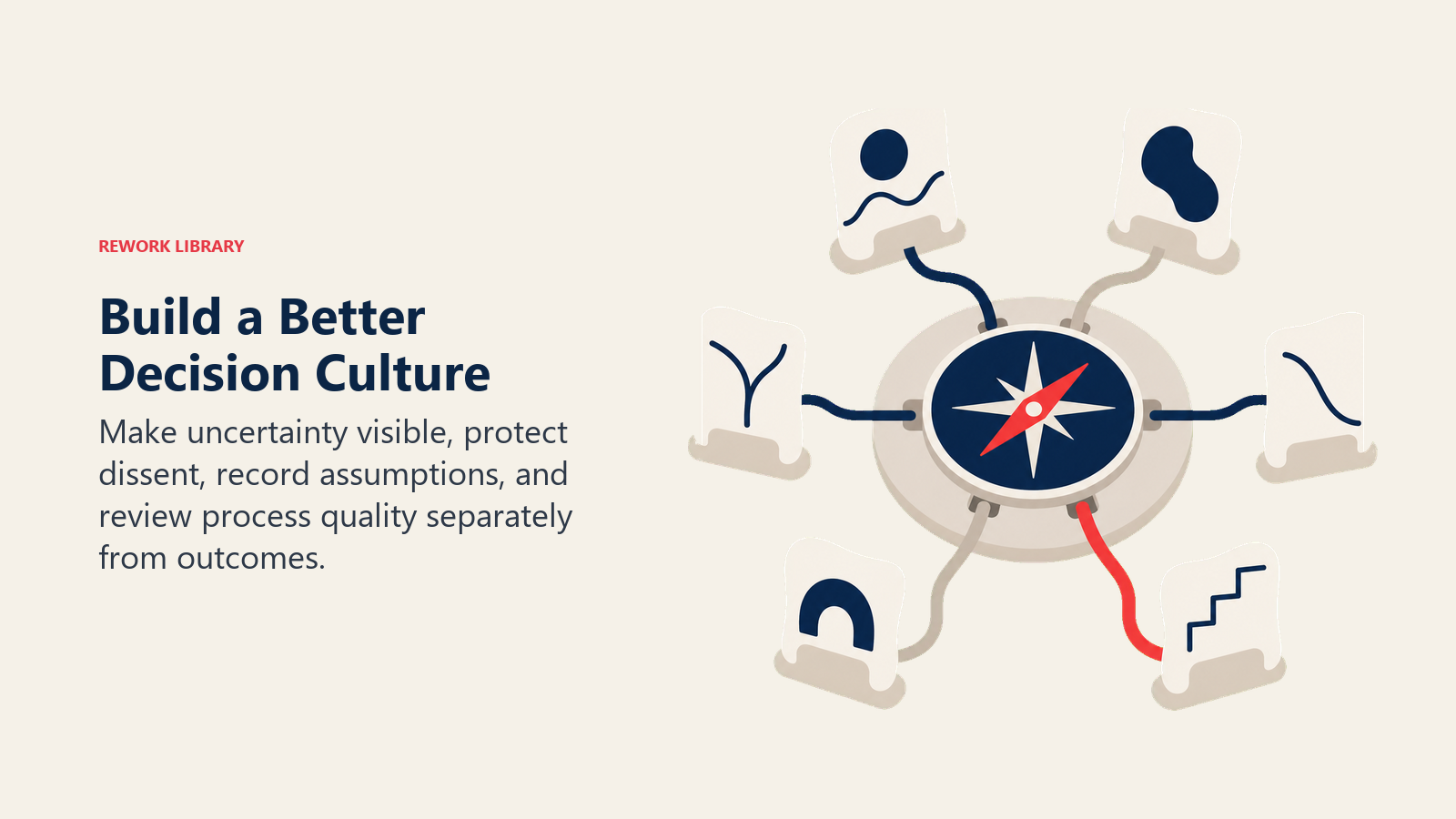
Leaders who want to build better decision culture do several things consistently:
They ask questions that make uncertainty visible. "What would have to be true for this to work?" and "What is the bear case?" and "What assumption are you least confident in?" signal that acknowledging uncertainty is valued, not penalized.
They track decisions and outcomes. When a team revisits decisions six months later and compares predictions to outcomes, they learn quickly which of their assumptions tend to be reliable and which tend to be wishful.
They separate process quality from outcome quality. A decision that followed a rigorous process and still produced a bad outcome is not a failure of judgment. Treating it as one discourages the discipline you are trying to build.
They protect dissenting views. If everyone agrees quickly, that is a signal that something is wrong. A good risk-based process surfaces the strongest objections to each option before committing, not after.
Key Facts
- Reversibility is the most underused decision filter. Before applying any analytical framework, ask: how hard is this to undo? High-reversibility decisions can be made faster and with less certainty. Low-reversibility decisions deserve proportionally more rigor.
- The "best-case scenario" problem. Research in decision science consistently shows that people overestimate the probability of favorable outcomes and underestimate variance. Building explicit stressed and tail-risk scenarios into the process directly counters this bias.
- Document the reasoning, not just the decision. Organizations that track their decision rationale before the outcome is known develop calibrated judgment faster than those that reconstruct reasoning after the fact.
Frequently Asked Questions about Risk-Based Decision-Making
What is risk-based decision-making in simple terms?
It is the practice of making choices by explicitly identifying what you do not know, estimating how different outcomes would affect the result, and picking the option that holds up best across a realistic range of futures rather than only the expected one.
How is it different from ordinary decision-making?
Ordinary decision-making often treats uncertainty implicitly. You pick the most likely outcome and plan for it. Risk-based decision-making makes uncertainty explicit: you name the key unknowns, build scenarios, and evaluate options across those scenarios. The difference shows up most sharply when the base case does not materialize.
When is risk-based decision-making most valuable?
It is most valuable for decisions that are large (high stakes), slow-to-reverse (hard to undo), and uncertain (many plausible outcomes). It is less critical for small, reversible, routine decisions where the cost of elaborate analysis exceeds the value.
What is a simple way to start?
Before any significant decision, write down three things: the key assumption you are most confident in, the key assumption you are least confident in, and what the outcome would be if your least confident assumption turns out to be wrong. That exercise alone improves decision quality meaningfully.
How do I handle a decision where I genuinely cannot estimate probabilities?
Focus on robustness rather than optimization. Ask: is there an option that avoids catastrophic outcomes across all scenarios, even if it is not the best option in any single scenario? Under genuine deep uncertainty, the option that avoids the worst outcomes often has more value than the one that maximizes the expected case.
Related Reading

Co-Founder, Rework.com
On this page
- Why Leaders Make Poor Decisions Under Pressure
- The Core Process
- Step 1: Define the actual decision
- Step 2: Identify key uncertainties
- Step 3: Develop scenarios, not just a base case
- Step 4: Evaluate options against scenarios
- Step 5: Decide and document
- Calibrating Risk Appetite
- Common Decision Types and Their Risk Profiles
- Building a Decision Culture
- Key Facts
- Related Reading