Six Sigma for Leaders: What Executives Need to Know About Process Excellence
Turn this article into takeaways for your work.


Each assistant summarizes the article only for you and suggests best practices for your work.
Six Sigma is one of the most widely deployed quality improvement methodologies in business history. It has been applied across manufacturing, financial services, healthcare, logistics, and technology companies. It has produced documented improvements in defect rates, processing times, and cost structures.
It has also produced some of the most cynical organizational culture damage in recent memory, when it was applied to the wrong problems, by undertrained practitioners, with inadequate senior commitment.
Leaders who want to use Six Sigma well need to understand both what the methodology does and the conditions that determine whether it succeeds or fails.
What Six Sigma Is
Six Sigma is a structured, data-driven approach to identifying and eliminating the causes of defects and variation in business processes. The name comes from a statistical concept: a process operating at six sigma produces fewer than 3.4 defects per million opportunities. In practical terms, this is a very high level of consistency.
The methodology has two core frameworks. The first, DMAIC, is used to improve existing processes. The second, DMADV (also called DFSS, Design for Six Sigma), is used to design new processes or products that need to meet quality specifications from the start. For most leaders, DMAIC is the relevant framework.
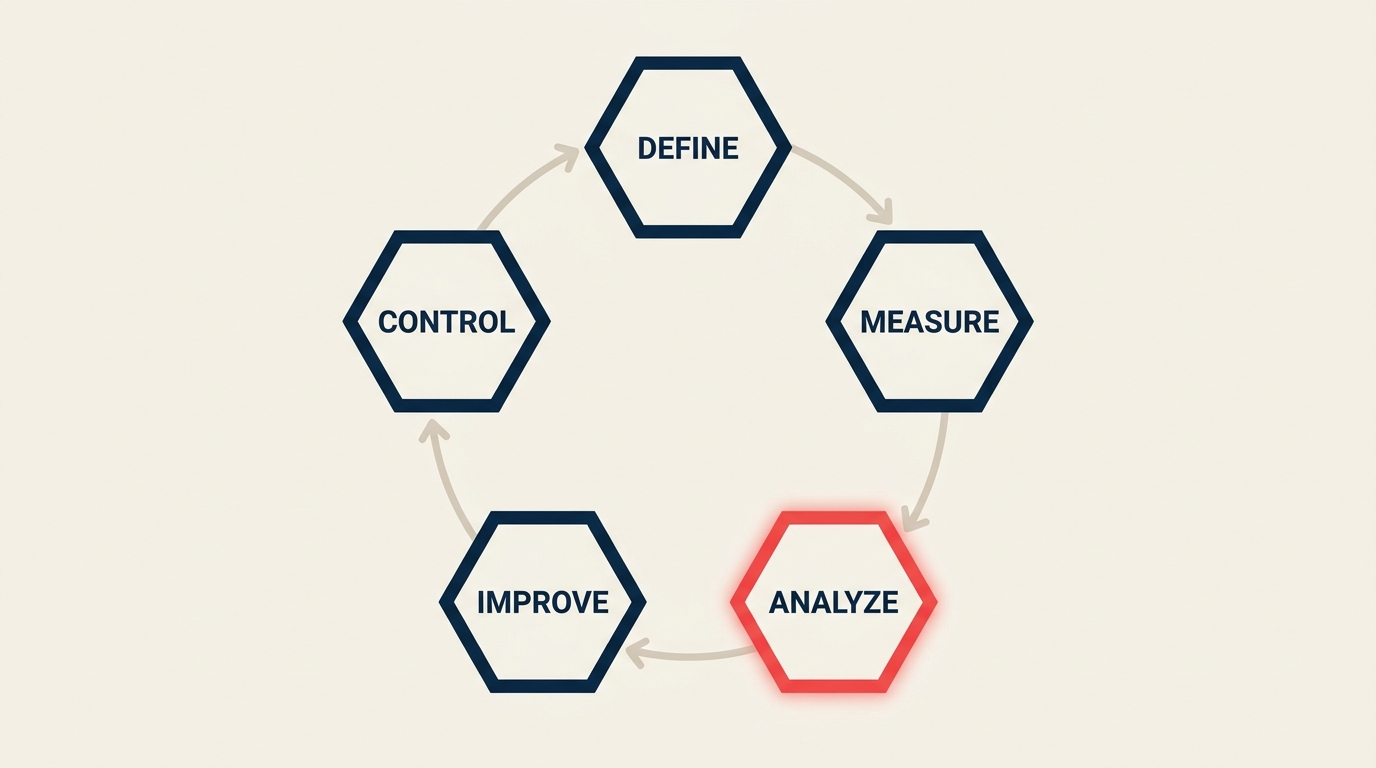
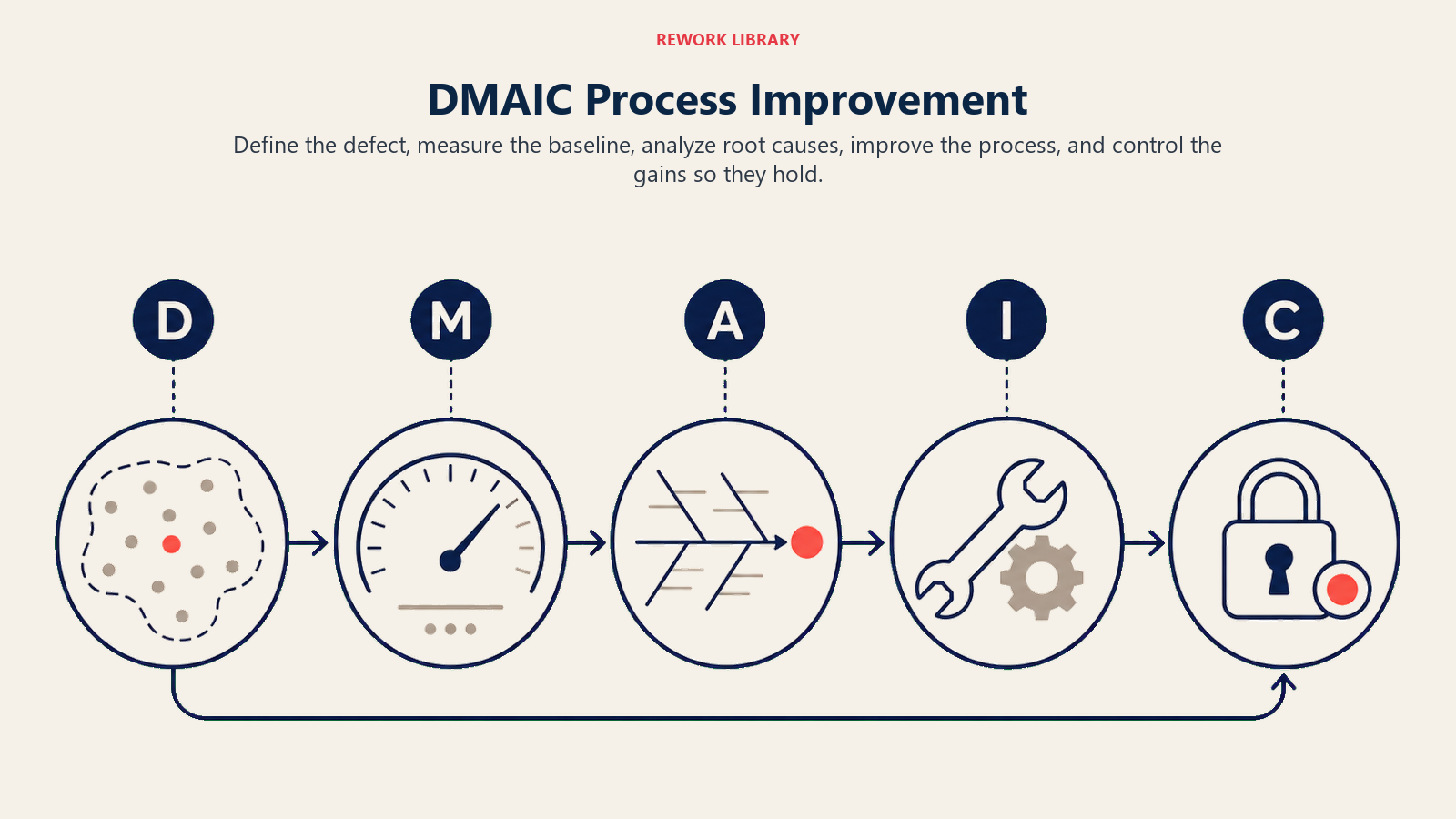
DMAIC stands for:
- Define: Identify the problem, the affected process, the customers, and what constitutes a defect or failure from their perspective.
- Measure: Collect data on the current state. How often does the defect occur? What is the current process capability? What are the key input and output variables?
- Analyze: Use statistical and process analysis tools to identify the root causes of the defect. Not symptoms. The actual causes.
- Improve: Design and implement solutions that address the root causes identified in the analysis phase.
- Control: Put in place monitoring systems and process controls that sustain the improvement and prevent regression.
The key feature of DMAIC that distinguishes it from generic problem-solving is the emphasis on data and statistical rigor at the Measure and Analyze phases. The goal is to identify causes based on evidence rather than assumption or experience-based intuition, both of which are frequently wrong.
Belt Levels and Organizational Structure
Six Sigma uses a belt classification system to indicate practitioner competency, borrowed from martial arts. Understanding these levels helps leaders calibrate what expertise they are deploying and what to expect from it.
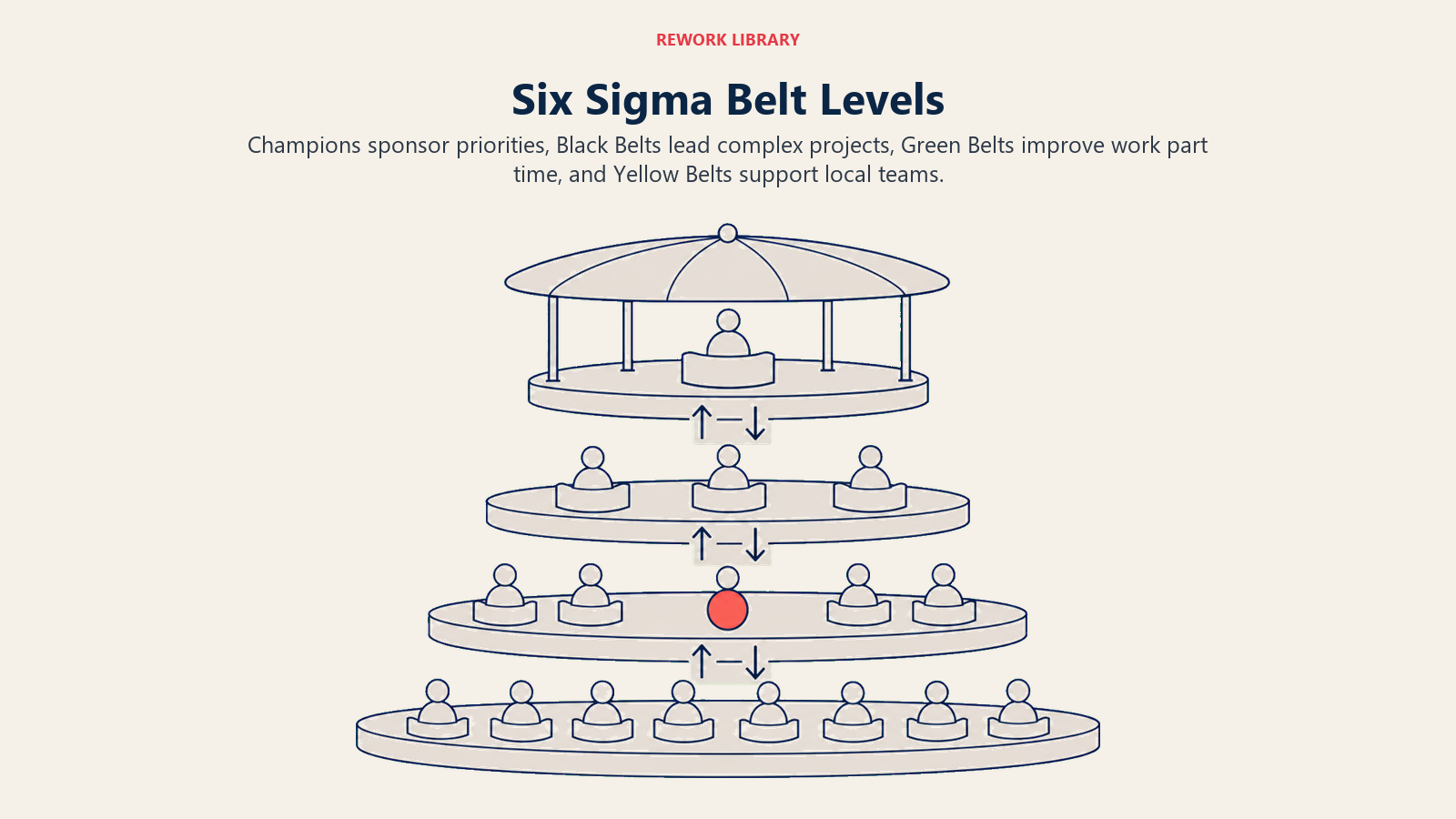
Yellow Belt: Foundational awareness. Yellow Belts understand the basic concepts and can contribute to project teams but do not lead improvements. This is the level appropriate for frontline employees who will participate in Six Sigma projects.
Green Belt: Practical competence. Green Belts can lead smaller improvement projects while continuing in their regular role. They understand the DMAIC methodology and can apply the core statistical tools with appropriate support. Most organizations want a meaningful share of their operational management layer at Green Belt level.
Black Belt: Full-time practitioners. Black Belts dedicate most or all of their time to leading significant Six Sigma projects. They have deep competence in statistical methods and project leadership. A Black Belt is typically the person running a DMAIC project on a complex process.
Master Black Belt: Strategic advisors and trainers. Master Black Belts define the methodology for the organization, train and mentor Black Belts, and work on the highest-complexity improvement programs. Most organizations have relatively few Master Black Belts.
The belt structure is not just administrative. It defines who does what work and who mentors whom. Organizations that deploy Six Sigma without clarifying these roles typically get inconsistent results because project leadership is unclear.
What Six Sigma Is Good For
Six Sigma performs well in specific conditions:
Repetitive, high-volume processes with measurable outputs. The methodology was developed in manufacturing, where the same operation is performed thousands of times and defects can be precisely counted. It transfers well to any operational process with similar characteristics: order processing, loan origination, call center operations, supply chain logistics.
Problems with unclear root causes. When a process is performing poorly and the team already knows why, you do not need DMAIC. You need a solution and the organizational will to implement it. DMAIC adds the most value when the root cause is genuinely uncertain and multiple hypotheses exist. The Analyze phase is designed specifically to distinguish real causes from plausible but incorrect ones.
Processes where variation is the enemy. In some contexts, the problem is not the average outcome but the inconsistency. A manufacturing process that produces acceptable output most of the time but fails occasionally in ways that are expensive or dangerous needs to reduce variation, not just improve the average. Six Sigma tools are specifically designed to identify and reduce variation sources.
Organizations with the data discipline to measure accurately. DMAIC is only as good as the data that feeds it. If your Measure phase relies on data that is incomplete, inconsistently collected, or not connected to the actual defect you care about, the analysis phase will produce incorrect conclusions. Organizations with poor data infrastructure often need to invest in measurement capability before Six Sigma can deliver its benefits.
What Six Sigma Is Not Good For
Leaders create problems when they apply Six Sigma to situations where it is not appropriate.
Creative or innovation-dependent processes. Six Sigma reduces variation. That is its purpose. But some organizational activities require variation as a feature. Product ideation, strategic planning, and customer experience innovation depend on generating diverse options and experimenting. Applying Six Sigma logic to these processes systematically reduces the exploratory behavior you need.
Highly unique, non-repeatable work. DMAIC assumes the process you are analyzing runs enough times to collect meaningful data and to test whether improvements actually changed the outcome. For genuinely one-off projects or low-volume strategic activities, the sample size required for statistical confidence does not exist.
Problems that are social or cultural rather than process-related. If the root cause of a quality problem is that people do not care, do not have the right incentives, or are working in a culture that tolerates poor performance, DMAIC will not fix it. Statistical analysis will reveal that defects cluster around certain people, teams, or periods, but the solution requires leadership intervention, not process redesign.
Organizations without senior commitment to act on findings. A DMAIC project that produces a well-supported root cause analysis and a clear recommended solution, and then sits on a shelf, is worse than no project at all. It exhausts the people who did the work, signals that the organization does not actually use evidence for decisions, and often destroys the organizational appetite for future improvement work.
What Leaders Need to Do
Six Sigma is not a self-running system. Leadership behavior determines whether it succeeds.
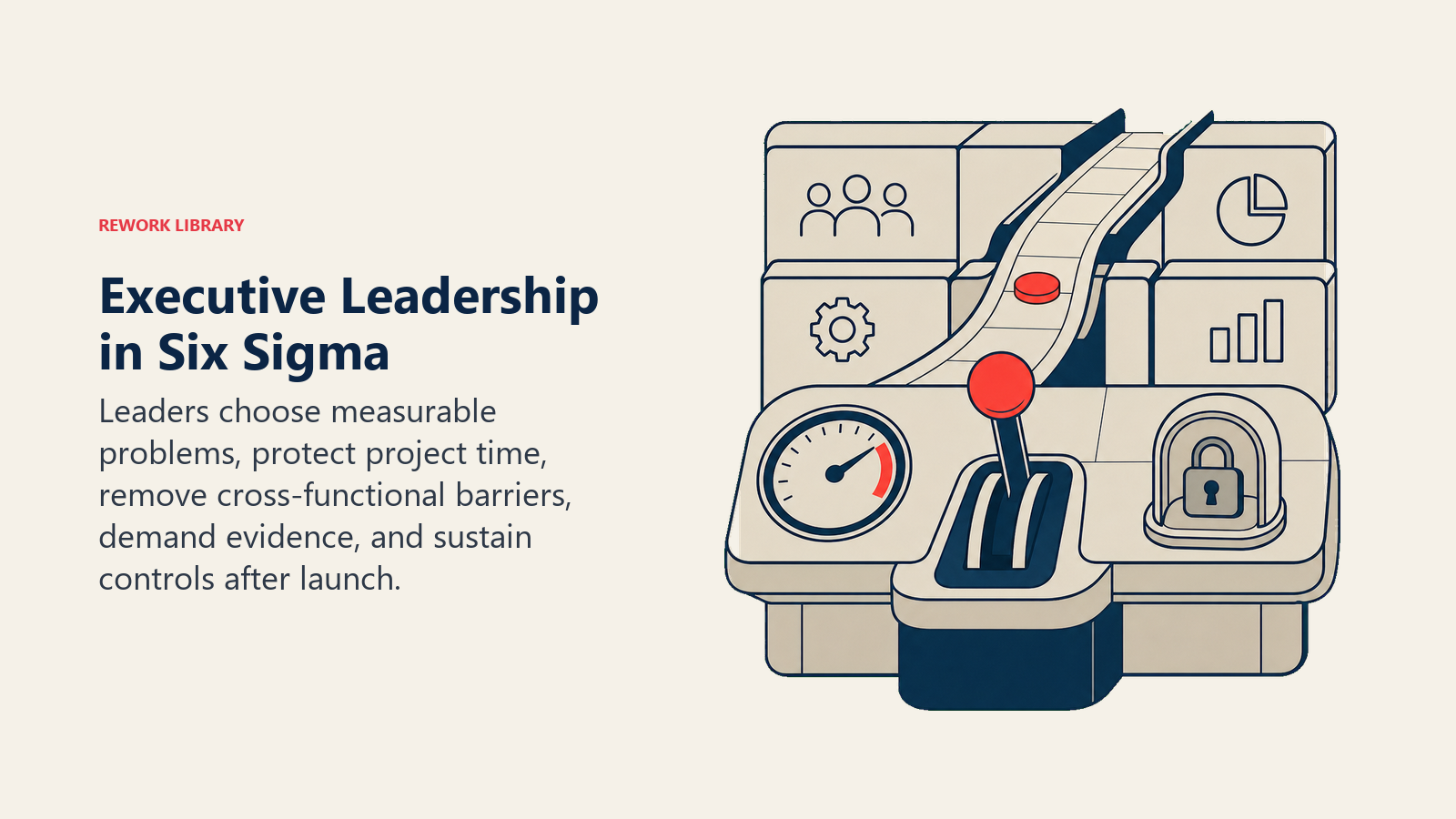
Sponsor projects, not programs. Declaring that your organization is "doing Six Sigma" without connecting it to specific, high-priority business problems is a way to generate activity without impact. Effective deployment starts with identifying three to five problems where the methodology is appropriate and the business impact of solving them is clear.
Protect project time. DMAIC projects take time. Black Belts need substantial dedicated bandwidth. Green Belt project leaders need protected time from their regular responsibilities. Organizations that ask people to run improvement projects on top of a full operational workload produce slow, superficial projects that do not deliver results.
Remove barriers to change. A well-executed DMAIC project typically produces a recommendation that requires someone to change how they work. That change often encounters organizational resistance. Leaders who sponsor Six Sigma projects need to be prepared to use their authority to implement findings, even when implementation is disruptive.
Connect projects to strategy. Six Sigma produces the most value when applied to processes that are directly connected to strategic priorities. Projects that optimize peripheral processes consume significant organizational energy and produce modest business impact. The selection of which problems to attack should reflect strategic priorities, not just operational convenience.
Be honest about results. Some Six Sigma deployments produce transformational improvements. Others produce modest gains at high cost. Leaders who adopt the methodology need to be willing to assess its impact objectively and adjust their investment accordingly, rather than defending the methodology because abandoning it would feel like failure.
Lean and Six Sigma Together
In most current deployments, Six Sigma is combined with Lean manufacturing principles into an approach often called Lean Six Sigma. The two methodologies are complementary.
Lean focuses on eliminating waste: unnecessary steps, waiting time, excess inventory, unnecessary movement, over-processing, defects, and underused talent. It uses a different set of tools (value stream mapping, 5S, kanban, kaizen events) to identify and remove activities that consume resources without adding value.
Six Sigma focuses specifically on reducing defects and variation using statistical methods.
The combination works because: Lean makes processes faster and simpler by removing waste, while Six Sigma makes them more consistent by reducing variation. A process that is both streamlined and consistent outperforms one that is only one of those things.
Leaders evaluating process improvement investment should consider whether the primary problem is waste (Lean is more effective) or variation (Six Sigma is more effective), or both (Lean Six Sigma).
Key Facts
- The belt structure is an organizational design element, not just a training classification. Deciding how many Green Belts and Black Belts your organization needs, and where to place them, is a strategic workforce decision that determines whether you have the human capital to execute improvement work at scale.
- Most Six Sigma projects fail in the Control phase. The DMAIC methodology is front-loaded toward analysis and solution design. But improvements that are not institutionalized through monitoring systems and process controls revert to the prior state within months. Leaders who fund DMAIC projects need to fund the Control infrastructure too.
- Data quality is a prerequisite, not a byproduct. Organizations that want to get value from Six Sigma often discover that their first investment must be in measurement systems and data governance, before any DMAIC project can produce reliable results.
Frequently Asked Questions about Six Sigma for Leaders
Is Six Sigma still relevant?
Yes, where the conditions for it are right. The methodology's statistical rigor and structured problem-solving remain valuable for high-volume, repetitive processes with measurable defect rates. What has changed is that fewer organizations try to apply it universally. The current consensus is that Six Sigma is a targeted tool for specific problem types, not an operating system for the entire organization.
How long does a DMAIC project take?
A typical Green Belt-led DMAIC project runs three to six months from Define through Control. Black Belt-led projects on more complex problems may take six to twelve months. Projects that take longer than this often indicate scope problems (the problem is too broadly defined) or resource constraints (the project team does not have enough dedicated time).
What is the difference between Six Sigma and continuous improvement (CI)?
Continuous improvement is a broad philosophy of ongoing, incremental improvement across all processes. Six Sigma is one methodology within that philosophy, characterized by its statistical rigor and DMAIC structure. Other CI methodologies include Lean, the Theory of Constraints, Kaizen, and PDCA (Plan-Do-Check-Act). Six Sigma is the most analytically intensive; it is not always the most appropriate tool.
Does Six Sigma apply outside manufacturing?
Yes. It has been successfully applied in financial services (loan processing, compliance), healthcare (patient safety, billing), logistics (order fulfillment), and technology (software release quality). The requirement is that the process be repetitive enough to generate meaningful data and the defect be measurable. Many service processes meet these criteria.
Related Reading
