Engineering Culture: What It Is and How Leaders Build It Deliberately
Turn this article into takeaways for your work.


Each assistant summarizes the article only for you and suggests best practices for your work.
Engineering culture is the set of norms, practices, and values that shape how a software engineering organization does its work. It determines how engineers approach problems, how they collaborate, how they handle quality and technical debt, how they respond to failure, and what they are willing to say out loud in meetings. Strong engineering cultures produce software that is reliable, maintainable, and built by teams that can keep improving. Weak ones produce software that nobody is proud of and teams that cycle through engineers because the good ones leave.
What engineering culture actually is
Culture in engineering organizations is visible in the decisions engineers make when no one is watching: how thoroughly they test before pushing to production, whether they flag a concern when they see a design decision they think is wrong, how carefully they leave code for the next person who will maintain it, and whether they admit what they do not know or perform confidence they do not have.
These behaviors are not primarily personality traits. They are learned responses to the environment. Engineers who work in organizations that reward thorough testing (through reduced incidents, positive recognition, and avoidance of weekend outages) test thoroughly. Engineers who work in organizations that reward shipping speed above everything else learn to ship fast and let the next team deal with the consequences. Culture shapes behavior through the feedback loops it creates, not through the values written in an engineering handbook.
This means engineering culture is primarily a leadership responsibility, not a hiring problem. The same engineer who writes careful, well-tested code in one organization will write rushed, untested code in another. The environment determines more than the person.
Key Facts
Research on DevOps practices, particularly the annual State of DevOps report series, consistently finds that the highest-performing engineering organizations are distinguished from average organizations primarily by cultural and process factors, including team-owned deployment, psychological safety for reporting errors, and fast feedback loops, rather than by technology choices or team size.
Organizational research on engineering team performance finds that psychological safety, the ability to raise technical concerns without fear of judgment or blame, is the strongest team-level predictor of engineering quality outcomes, including defect rates and incident recovery time.
Studies of technical debt accumulation find that the primary driver is not poor individual engineering judgment but organizational incentive structures that create pressure to deliver features on a timeline that forecloses adequate technical quality work.
The components of strong engineering culture
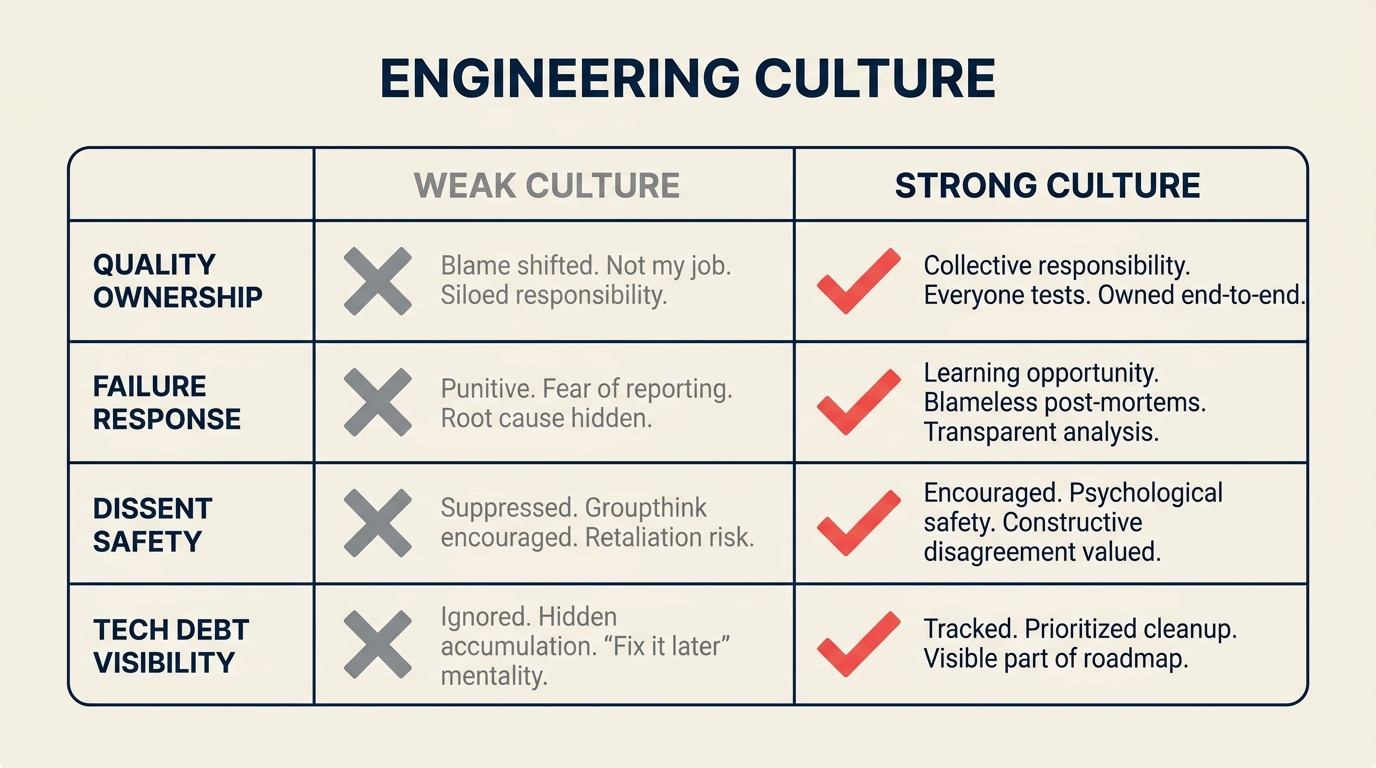
Technical excellence as a real value. Organizations that say they value technical excellence but consistently prioritize feature delivery over quality teach engineers that technical excellence is optional. Strong engineering cultures make the trade-off between quality and speed explicit, make it a real conversation with real stakes, and do not systematically resolve it in favor of speed. This does not mean slow. It means quality is actually in the decision, not just in the stated values.
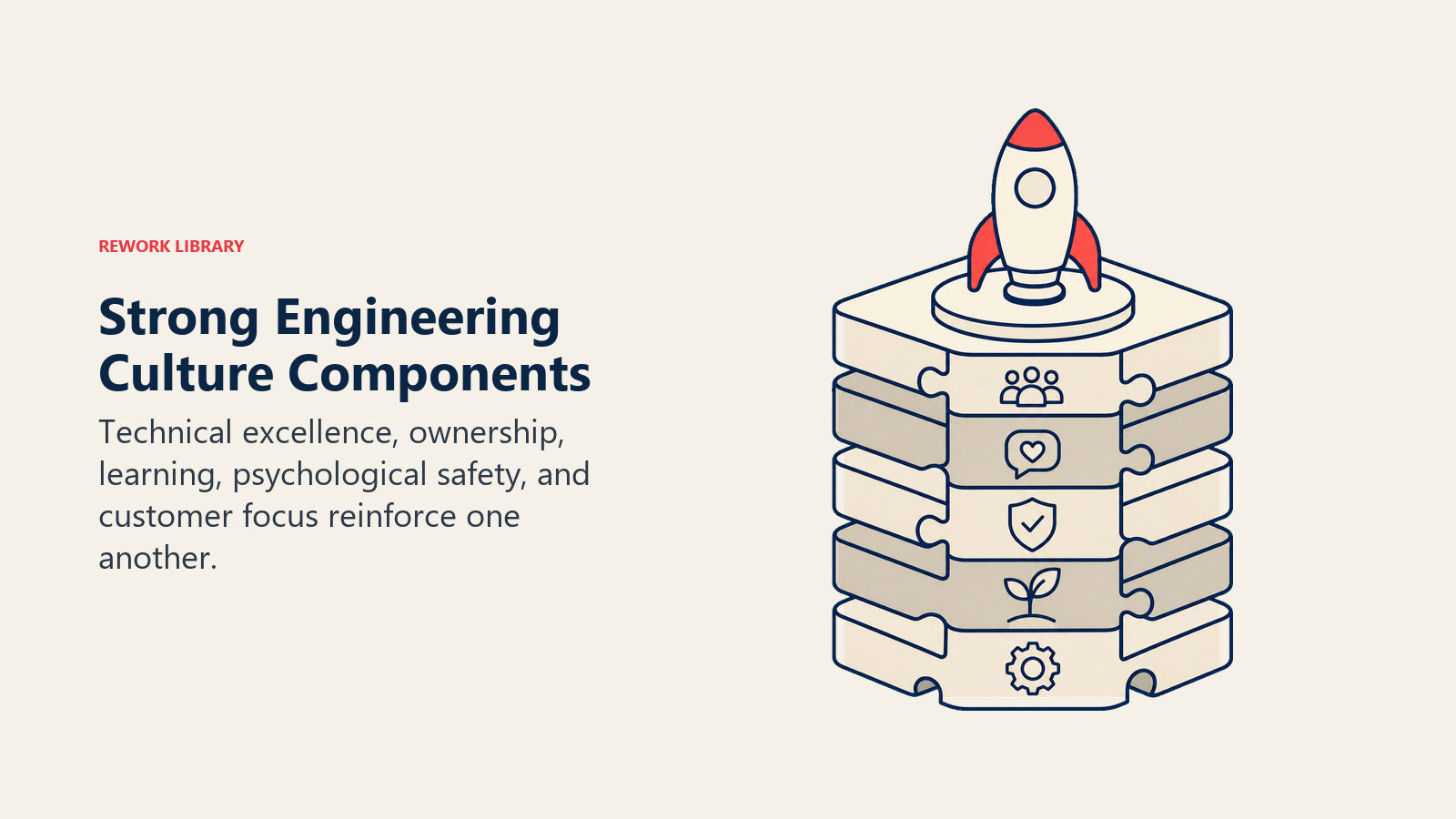
Psychological safety for technical dissent. Experienced engineers know when a technical decision is wrong. But in many organizations, saying so is risky: the decision was made by someone senior, the timeline is fixed, the business case has been built around the assumption. Engineers in these environments learn to comply without objecting, which is one of the most reliable paths to expensive technical problems downstream. Strong engineering cultures explicitly protect dissent, particularly technical dissent, and have processes for surfacing concerns before commitments are made.
Shared ownership of quality. In some engineering organizations, quality is the QA team's problem. Developers write code; a separate function validates it. This structure systematically reduces the quality of what developers write, because they do not own the consequences. Strong engineering cultures locate quality ownership in the engineers building the product: they design for testability, write tests, review each other's code, and take responsibility for what they ship.
Learning from failures without blame. Every engineering organization has failures: outages, defects, security incidents, missed estimates, wrong architectural decisions. The culture is defined by what happens next. Blameful postmortems, where the conversation focuses on finding the person who caused the problem, produce engineers who hide problems and avoid the edge cases that might expose them. Blameless postmortems, where the conversation focuses on what conditions made the failure possible and how to prevent similar failures, produce engineers who surface problems early and learn from them publicly. The practical operational difference between these two cultures is significant: blameful cultures have more incidents, higher severity, and longer recovery times.
Autonomy within clear constraints. Engineering work is knowledge work that benefits from high autonomy: engineers who understand the problem and have the authority to solve it in the way they think is best. But autonomy without constraints produces inconsistency, integration problems, and systems that are technically interesting but hard to maintain. Strong engineering cultures define the constraints clearly (architectural standards, security requirements, operational expectations) and give engineers genuine latitude within them. The constraint is not how to solve the problem, but what the solution needs to be compatible with.
Direct technical communication. Code review, architectural review, and technical discussion all require the ability to give and receive critical technical feedback clearly. Engineering cultures that have adopted the indirect feedback norms of some corporate environments produce code reviews that do not actually identify problems, architectural discussions that do not surface real concerns, and incidents that were visible to multiple engineers who said nothing. Strong engineering cultures develop norms of direct, specific technical communication that is not personal and is not softened to the point of uselessness.
What engineering leaders do
Technical and engineering leaders shape culture through specific behaviors, not just through their stated values.
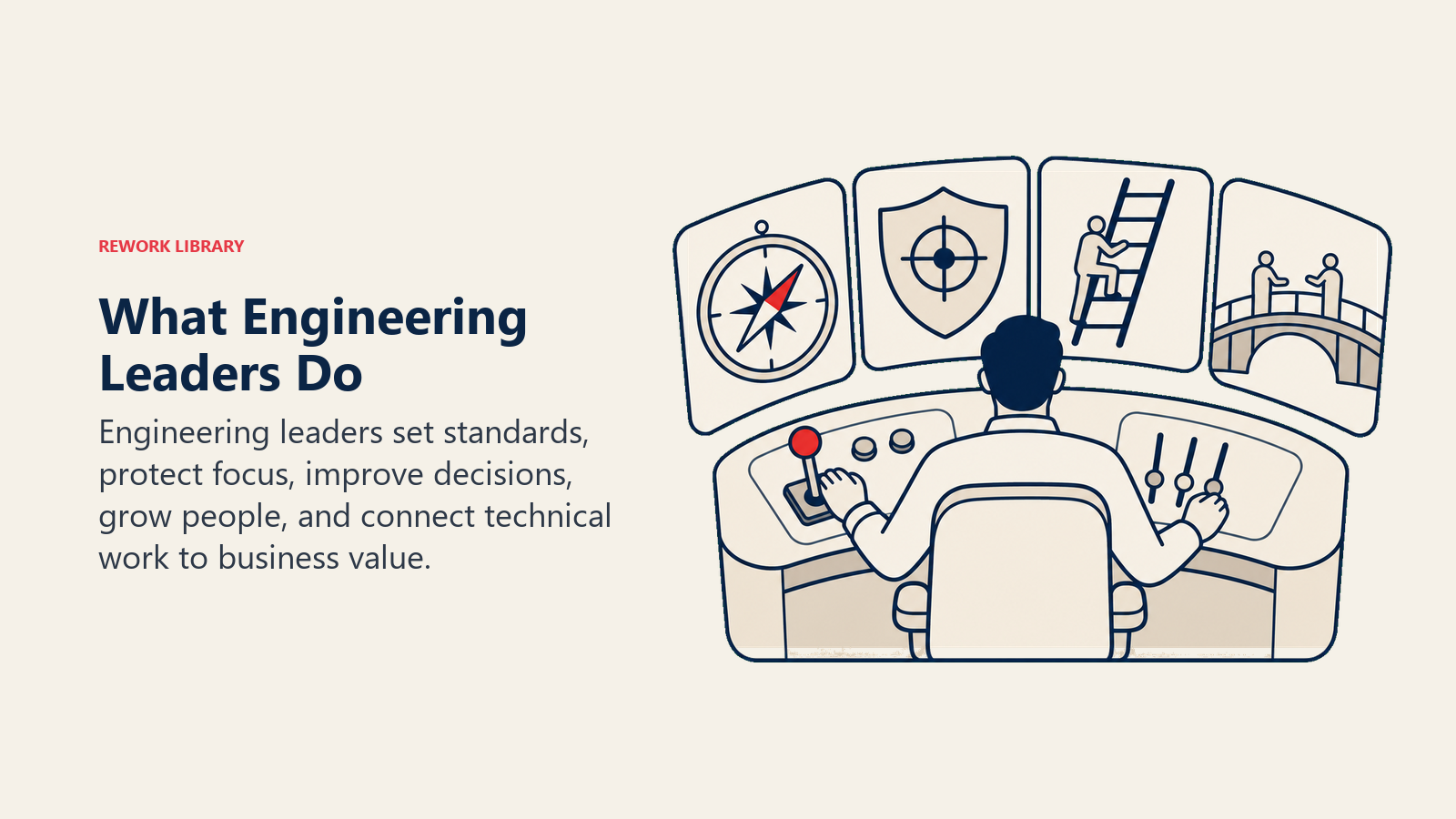
They model the behaviors they want. Engineering leaders who write production code, participate in code reviews, conduct postmortems with genuine intellectual curiosity about the failure, and admit technical uncertainty set a behavioral template that the team learns from. Leaders who say they value technical excellence but do not engage with the technical work leave the culture to be shaped by whoever is most influential on the team.
They protect engineering time. One of the most consistent complaints in engineering organizations is that constant meetings, frequent context-switches, and unclear priorities make it impossible to do deep technical work. Leaders who protect blocks of uninterrupted time for engineering work, reduce meeting overhead, and help engineers manage context-switch costs communicate that deep technical work is real work worth protecting.
They make technical debt visible and manageable. Technical debt, the accumulated cost of past shortcuts and quick fixes, is a leadership problem as much as a technical one. Strong engineering leaders maintain visibility of debt levels, make explicit decisions about when to incur it and when to pay it down, and resist the organizational pattern of treating technical debt as invisible until it causes an incident. The classic failure mode is "we'll fix it later" repeated enough times that later never comes.
They hire for and develop engineering judgment. Technical skill is necessary but not sufficient for strong engineering culture. Judgment, specifically the ability to assess trade-offs, communicate technical risks clearly, and make decisions under uncertainty, is equally important and harder to develop. Leaders who hire purely for technical capability and do not invest in developing judgment produce teams of technically excellent engineers who make poor architectural decisions and communicate poorly with the rest of the organization.
They build bridges to non-technical leadership. Engineering culture problems are often compounded by a separation between engineering and the business functions it serves. When product managers, executives, and engineers do not share a working understanding of technical constraints and trade-offs, the result is business requirements that are technically unrealistic, engineering work that serves the wrong priorities, and chronic tension between functions. Engineering leaders who build these bridges, who help non-technical leaders understand the costs of technical shortcuts and the value of technical investment, change the inputs their teams receive.
Engineering culture in different organizational contexts
Engineering culture looks different depending on organizational size, product maturity, and the role engineering plays in the business.
Early-stage organizations. In startups, engineering culture is often the founder's engineering culture. The norms are set by the first few engineers, and the decisions they make about code quality, testing, and architecture become the defaults the next hires inherit. Early-stage engineering leaders who invest in good foundations, even under pressure to ship, save enormous remediation costs later. The most expensive engineering culture decisions are made before anyone recognizes them as culture decisions.
Scaling organizations. As engineering organizations grow from 10 to 100 to 1,000 engineers, the informal mechanisms that maintained culture in the early days become inadequate. Cultural transmission through proximity and shared context breaks down as teams multiply and tenure diversifies. Leaders at this stage need to make the engineering culture explicit: document the standards, build the processes, and develop a management layer that carries and models the culture rather than diluting it.
Enterprise organizations. Large engineering organizations face the additional complexity of legacy systems, legacy cultures, and the challenge of maintaining relevance as newer tools and practices emerge. Engineering leaders in these contexts often operate in tension between the culture the organization has and the culture it needs. The practical path is usually to build strong cultures in contained units (teams, product areas) while working incrementally to change the broader organizational conditions.
Engineering culture and business outcomes
The connection between engineering culture and business outcomes is well-documented. Organizations with strong engineering cultures ship more frequently, recover from incidents faster, and have lower rates of change failure. Their engineers report higher job satisfaction and stay longer. Their systems are more reliable and cost less to maintain.
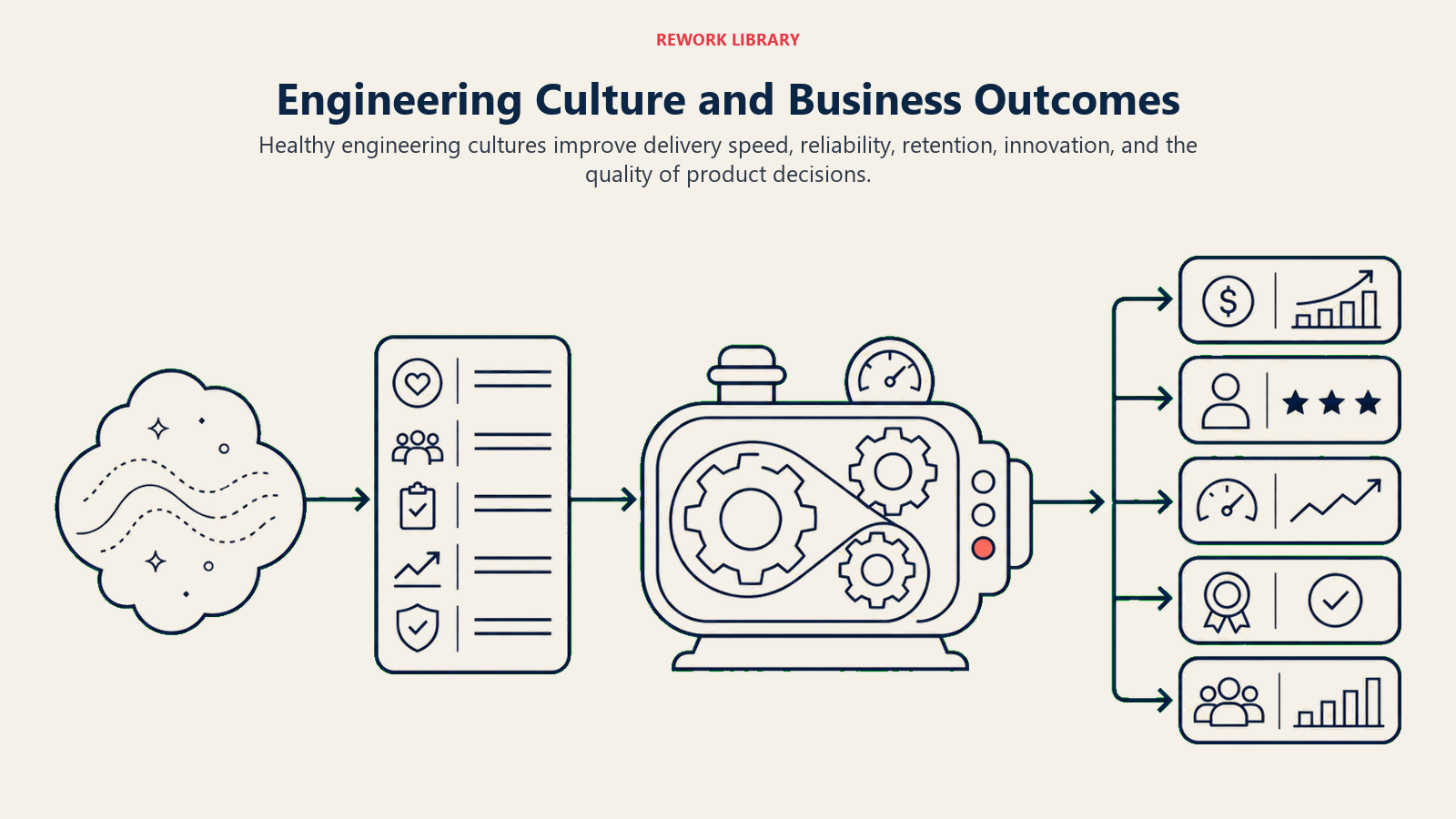
But the connection is not always obvious to non-engineering leaders, particularly when the culture investment is being made and the payoff is still ahead. The strongest engineering leaders can explain the business case for cultural investment: reliability is customer trust, deployment speed is competitive responsiveness, and technical debt is a balance sheet liability that accrues interest.
Frequently Asked Questions about Engineering Culture
What is the difference between engineering culture and engineering process?
Process is the formal structure of how work gets done: the release cycle, the code review requirements, the incident response protocol. Culture is the set of norms and values that determine how engineers behave within and around those processes. A strong process in a weak culture is often gamed or ignored. A strong culture with weak processes can function but loses efficiency and consistency. Both matter; they are not substitutes for each other.
How do non-technical leaders influence engineering culture?
Substantially. Non-technical leaders control organizational priorities, resource allocation, and the business pressures that shape what engineering teams are asked to optimize for. A CEO who consistently prioritizes feature delivery over reliability creates engineering culture pressure toward shortcuts, regardless of what the engineering manager says about quality. Non-technical leaders who develop enough technical literacy to understand trade-offs, and who make explicit decisions about them rather than implicitly forcing the engineering team's hand, create conditions for better engineering culture.
How do you rebuild engineering culture after a period of high technical debt or poor practices?
Slowly. The norms that produce technical debt are deeply embedded in the feedback loops the organization has created. Rebuilding requires changing those feedback loops: explicitly prioritizing reliability over features for a defined period, running blameless postmortems visibly, celebrating quality as well as speed, and giving engineers the experience of working differently and getting better outcomes. A few quarters of consistent priority signals can shift engineering culture meaningfully, but only if the business pressure changes to match the stated values.
Should engineering culture be the same across different engineering teams in a large organization?
The foundational elements should be consistent: technical quality standards, psychological safety for dissent, blameless incident review, and shared ownership of reliability. The specific practices that express those elements can vary by team, product area, and technical domain. A mobile team's culture will feel different from a platform team's culture, even if both share the same underlying values. Forcing cultural uniformity in areas where diversity is appropriate undermines the autonomy that makes engineering work well.
The best engineering cultures are not built by accident. They are built by leaders who understand that the feedback loops they create, whether through incentives, behaviors, or decisions under pressure, shape what engineers do more powerfully than any written value ever could. See psychological safety for the foundational research on why safety to speak matters for team performance, and creative leadership for the related principles on building organizations where original solutions can emerge.
