Purpose-Driven Business Strategy: How Leaders Build Organizations That Mean Something
Turn this article into takeaways for your work.


Each assistant summarizes the article only for you and suggests best practices for your work.
Every organization has a mission statement. Few have a purpose that actually shapes decisions.
The gap is not about language. Organizations with memorable, well-crafted purpose statements frequently make decisions that contradict them without noticing. And organizations with awkward, generic purpose statements sometimes make genuinely purpose-driven decisions because the actual intent is clear even if the words are not.
The distinction between a purpose statement and purpose-driven strategy is this: a purpose statement is an aspiration expressed in words. Purpose-driven strategy is an aspiration that is operationalized, that constrains real choices, guides resource allocation, shapes what the organization will and will not do for money, and holds up under the pressure of a bad quarter.
Most organizations have the first. Few build the second.
Why Purpose Has Strategic Value
Purpose-driven strategy is not primarily a values exercise. It is a competitive and operational strategy, and it has specific performance properties that make it worth pursuing seriously.
Talent Alignment
The organizations that attract and retain the strongest talent in competitive markets are increasingly those where people understand why the work matters beyond the financial return. This is not a generational quirk. It is a feature of markets where talented people have options: they choose organizations whose work they find meaningful, and they stay where that meaning is sustained.
A clear, operationalized purpose gives the recruiting and retention function something real to work with. But it only works if the purpose is genuine. Candidates who join because of a stated purpose and then find that decisions consistently contradict it leave faster than those who never had the expectation. The credibility of the purpose matters more than its appeal.
Decision-Making Clarity Under Ambiguity
Most strategic decisions involve genuine ambiguity. The financially optimal choice is often unclear, the market data is incomplete, and reasonable people can interpret the evidence differently. Purpose provides a tiebreaker that operates when the data does not resolve the question.
An organization whose purpose is about serving a specific customer segment has an anchor point for ambiguous decisions: which option is better for those customers? An organization whose purpose is about a specific kind of impact in the world has a question it can ask when deciding between two strategies with similar financial profiles: which one advances that impact?
This is not a substitute for financial analysis or strategic rigor. It is an additional lens that is especially valuable when the financial analysis does not clearly distinguish between options.
Customer Trust and Brand Coherence
Organizations that behave consistently with their stated purpose over time build a form of trust with customers that is difficult to replicate through product features or price alone. Customers who trust that an organization's decisions are guided by genuine values, not just short-term profit, extend more loyalty, more forgiveness for occasional failures, and more willingness to pay premium prices.
This only works when the purpose is real. Organizations that claim purpose-driven values and then make decisions that obviously contradict them damage trust faster than organizations that make no purpose claims at all. The implicit promise of a stated purpose creates an expectation that organizational behavior will honor it.
What Purpose-Driven Strategy Actually Requires
Purpose becomes strategic when it shapes what the organization funds, rejects, measures, and protects under pressure.

Specificity of Purpose
The first failure mode in purpose work is vagueness. "To make the world better" or "to help people succeed" are not purposes in any useful strategic sense. They do not exclude anything, constrain anything, or help anyone make a decision they would not have made without them.
Useful organizational purpose is specific enough to generate clear guidance on what the organization will and will not do. It names a real customer or community, a specific kind of impact, or a particular approach to creating value. And it is specific enough that a thoughtful employee could use it to make a decision without asking for clarification.
The specificity test: if a specific business opportunity is described to an employee, can they use the stated purpose to determine whether it fits? If yes, the purpose is specific enough to be useful. If not, it needs sharper definition.
Consistency Between Purpose and Resource Allocation
The most credible test of organizational purpose is the budget. What the organization invests in, and what it does not, reveals the real priorities far more accurately than any statement of values.
An organization that says its purpose is to serve a specific customer segment but allocates 80 percent of its product development budget to features that serve a different, higher-revenue segment has revealed its actual purpose. An organization that says it is committed to long-term environmental sustainability but consistently makes short-term resource decisions that create environmental externalities has not actually operationalized that commitment.
Leaders who are serious about purpose-driven strategy regularly audit the alignment between the stated purpose and the actual resource allocation. This audit often reveals gaps that are uncomfortable to acknowledge but essential to close.
Purpose Must Constrain Real Choices
Purpose that never says no to anything is not a strategic principle. It is decoration.
The test of whether a purpose is genuinely operationalized is whether it has ever caused the organization to decline a profitable opportunity, exit a market, or make a financially suboptimal decision because the opportunity or decision was inconsistent with the stated purpose.
This is a high bar. It requires leaders who are willing to leave money on the table in order to maintain strategic coherence. And it requires that the board and ownership structure support that approach, which is not always the case.
But the organizations that have done this consistently report that the credibility it creates, with employees, customers, and partners, has compounding strategic value that more than offsets the short-term cost of the specific decision.
Alignment Across the Leadership Team
Purpose-driven strategy cannot be a solo exercise. If the CEO is committed to a specific organizational purpose and several members of the leadership team are indifferent or quietly skeptical, the purpose will be applied inconsistently across the organization, which is worse than not having it.
Building genuine alignment among the leadership team on what the purpose means and how it applies to real decisions is foundational work that is often rushed or skipped. It requires honest conversation about cases where the purpose would constrain choices that some leaders would prefer to make, and genuine agreement (not just formal endorsement) on the implications.
The test of alignment is how the leadership team handles edge cases: the deal that is financially attractive but ethically marginal, the customer segment that offers volume but requires compromising product integrity, the short-term decision that conflicts with the long-term purpose. If different members of the leadership team apply the purpose differently in these cases, the purpose is not actually shared.
Operationalizing Purpose Across the Organization
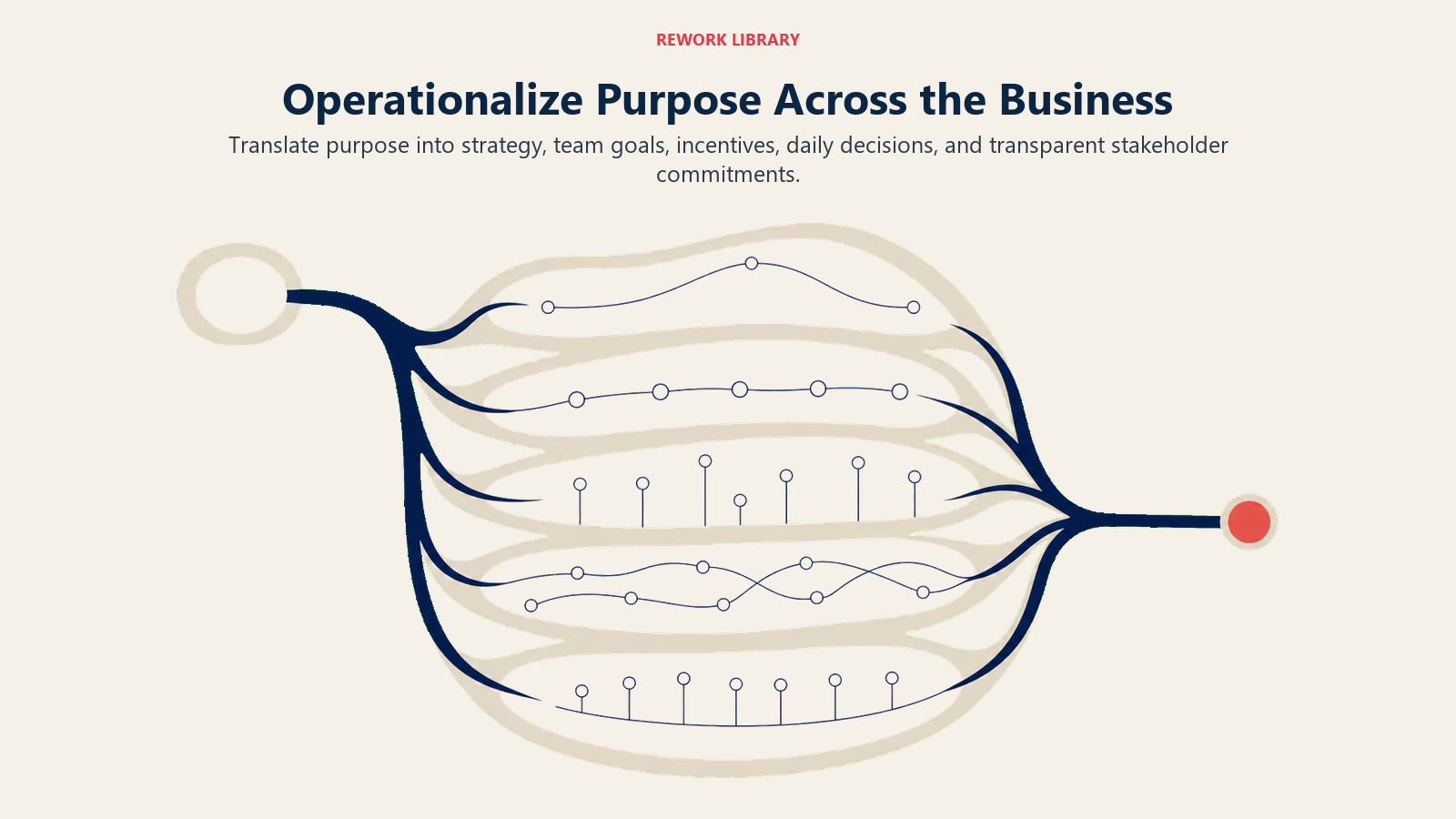
Operationalization connects the organization's purpose to the layers where people set goals, allocate resources, and make daily trade-offs.
Connecting Purpose to Roles and Work
One of the most effective things a leader can do to operationalize purpose is to explicitly connect the organization's purpose to the specific work that individuals and teams do. Not through abstract statements about how every role contributes to the mission, but through specific, concrete articulations of how this team's particular work advances the purpose.
The customer support team that understands exactly how their work protects and advances a specific customer commitment is more motivated and makes better decisions than the team that knows the company has a mission statement. The engineering team that can articulate the specific user problem their system solves is more aligned than one that understands the codebase but not the customer.
This is a communication and management discipline, not a values intervention. It requires that leaders understand the purpose well enough to articulate its connection to varied specific activities, and that they do so regularly rather than once in an all-hands meeting.
Surfacing Purpose Conflicts Early
In any real organization, there will be decisions where the purpose-aligned choice and the financially optimal choice are not the same. How the organization handles these conflicts when they arise small determines whether it can handle them when they are large.
Leaders who create forums and practices for naming and discussing purpose-purpose conflicts build the organizational muscle to resolve them wisely. Leaders who pretend the conflicts do not exist, or who resolve them invisibly in favor of financial optimization without acknowledging the trade-off, undermine the purpose's credibility gradually.
The skill is not in avoiding the conflicts. It is in handling them transparently, explaining the reasoning, and being honest when financial considerations overrode the purpose and why that was or was not the right call.
Purpose and Stakeholder Communication
Purpose-driven strategy requires consistent and honest communication with stakeholders about what the purpose means and how it is being applied. This includes investors, who may or may not share the organization's purpose priorities. Customers, who are watching whether the stated values match the observed behavior. And employees, who are testing daily whether the purpose is genuine.
The communication must be matched by behavior. Stakeholders who have seen organizations claim purpose and then make decisions that contradict it are rightly skeptical. The only thing that builds genuine credibility is consistent behavior over time, paired with transparent explanation of purpose-related decisions when they are not obvious.
This is particularly important when the organization makes a decision that is consistent with its purpose but commercially suboptimal. Those are the moments that build or destroy stakeholder trust in the purpose as a real operating principle.
Purpose and Strategic Pivots
One of the harder questions for purpose-driven organizations is how to handle strategic pivots. When the market changes, when the original approach is not working, or when new opportunities arise, does commitment to a stated purpose mean the organization cannot adapt?
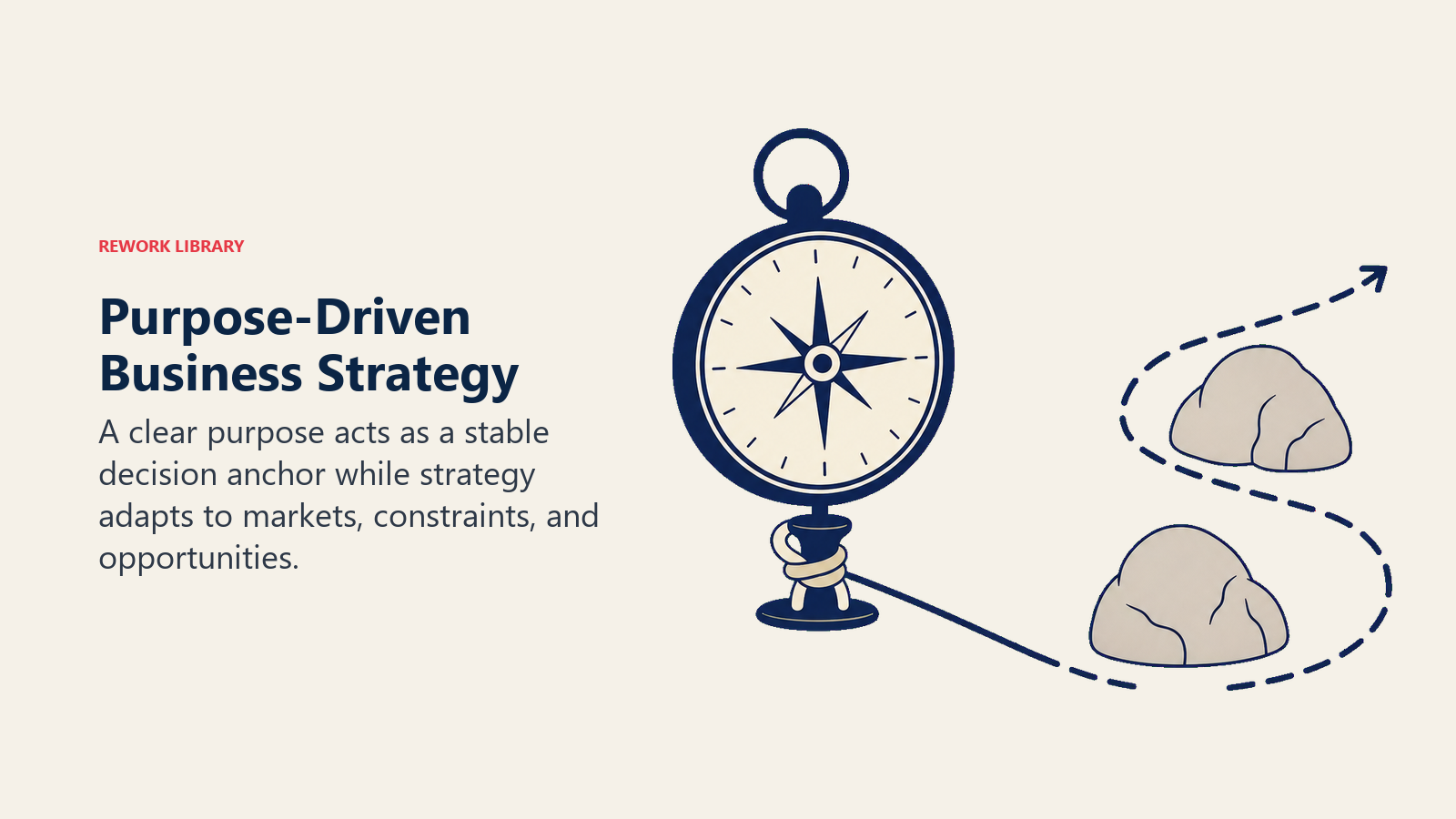
The answer is that purpose and strategy are different levels of the organization. Purpose is about why the organization exists and for whom. Strategy is about how it pursues that purpose in a given market context. The strategy can and should adapt as circumstances change. The purpose, to be meaningful, must be more stable.
An organization whose purpose is to make a specific kind of financial service accessible to underserved markets can pursue that purpose through many different strategic approaches as the market evolves. Pivoting from one distribution approach to another is consistent with the purpose. Abandoning the underserved market focus to pursue a more profitable premium segment is not.
This distinction gives leaders flexibility to adapt the strategy while maintaining the purpose coherence that gives the organization its identity and competitive advantage.
Key Facts
- Employees who report a strong sense of organizational purpose are substantially more likely to stay, report higher engagement scores, and rate their own performance higher than those who do not.
- Organizations that explicitly link purpose to strategic decision criteria make faster decisions in ambiguous situations, because the purpose provides a framework for resolving trade-offs.
- Customer trust, measured by loyalty and willingness to pay premium prices, is higher for organizations that demonstrate consistent purpose-aligned behavior over time compared to those with equivalent product quality but less consistent values expression.
- The most common failure mode in purpose-driven strategy is not insincerity but inconsistency: leaders who genuinely hold the purpose but allow organizational pressures to override it in enough specific decisions that the purpose loses credibility.
Frequently Asked Questions about Purpose-Driven Business Strategy
How do you know if your organization's purpose is genuine versus aspirational marketing?
The test is whether it has ever caused you to decline something you could have done. If the purpose has never cost the organization anything, it probably is not guiding decisions. Genuine purpose shows up most clearly in what an organization says no to.
How do you handle investors or board members who do not share the organization's purpose orientation?
With transparency, before they are investors or board members. Alignment on the long-term purpose orientation is a material consideration for governance relationships and should be established explicitly, not discovered in a conflict. For existing board members who are misaligned, the work is honest conversation about how the purpose affects specific decisions and why leadership believes the purpose-aligned approach is in the long-term interest of the organization.
Can purpose-driven strategy coexist with aggressive financial targets?
Yes. Purpose-driven and financially ambitious are not in conflict in most cases. The conflicts arise in specific decisions, not as a general operating mode. Organizations with strong purposes often have strong financial performance because the purpose aligns talent, builds customer trust, and provides strategic clarity.
How do you communicate purpose to new employees without it sounding like corporate theater?
By connecting it to specific, real decisions the organization has made. Abstract statements of purpose are easy to dismiss. Examples of situations where the purpose actually guided a difficult decision, especially one that had a real cost, are credible. The more specific and honest the examples, the more the purpose lands as genuine.
Should the purpose ever change?
Rarely, and with very high deliberateness. If the organization's fundamental understanding of who it serves or why it exists has genuinely changed, a purpose revision may be warranted. More often, what needs to change is the strategy or the expression of the purpose, not the purpose itself. Treating purpose as variable undermines its function as a stable strategic anchor.
Related reading: Culture Architecture | Ethical Leadership | Contrarian Strategy | Portfolio Discipline | Stakeholder Management | Authentic Leadership

On this page
- Why Purpose Has Strategic Value
- Talent Alignment
- Decision-Making Clarity Under Ambiguity
- Customer Trust and Brand Coherence
- What Purpose-Driven Strategy Actually Requires
- Specificity of Purpose
- Consistency Between Purpose and Resource Allocation
- Purpose Must Constrain Real Choices
- Alignment Across the Leadership Team
- Operationalizing Purpose Across the Organization
- Connecting Purpose to Roles and Work
- Surfacing Purpose Conflicts Early
- Purpose and Stakeholder Communication
- Purpose and Strategic Pivots
- Key Facts