Sales Process Training: Building a Curriculum That Gets New Hires Selling Faster - 2026 Guide
Turn this article into takeaways for your work.


Each assistant summarizes the article only for you and suggests best practices for your work.
Two dollars spent on a great modern sales process are wasted if nobody's trained to run it. Most dealerships hand a new hire a product binder, pair them with a senior consultant for a few days, and call it onboarding. Then they're surprised when the new hire takes four months to hit average production, or quits before they get there.
The gap between what a well-defined process can produce and what an untrained team actually produces is larger than most GMs assume. Dealerships routinely convert phone calls to appointments at 20 to 40% when the math says 70%+ is achievable, and internet leads at 20 to 25% when 50%+ is realistic. That gap isn't a talent problem. It's a training problem, and training is one of the few levers a dealership fully controls.
This guide covers how to build a training curriculum for new hires and a coaching cadence for your existing team, not the sales process itself. For the process being trained, see Automotive Sales Process.
Why Untrained Process Costs More Than You Think
A dealership with an excellent documented process but no training discipline still leaks revenue at almost every stage. Weak phone process alone accounts for roughly half of lost phone opportunities at dealerships that haven't invested in structured training, and phone handling is the single highest-leverage skill in the building because it determines whether a lead ever becomes an appointment.
Walk-in show rates for scheduled appointments tell a similar story. Below-60% show rates are common where 75%+ is achievable with disciplined confirmation and expectation-setting, and closing ratios on appointments that actually show often sit in the 25 to 35% range when the underlying math supports 50%+.
None of these gaps close by hiring "better" people. They close by training the people you have, consistently, against a defined standard, rather than hoping tenure alone produces skill.
The 30-Day New Hire Curriculum
A structured first 30 days buys you a shorter ramp time, consistent skill benchmarks across every hire, and a way to measure progress instead of guessing at it.
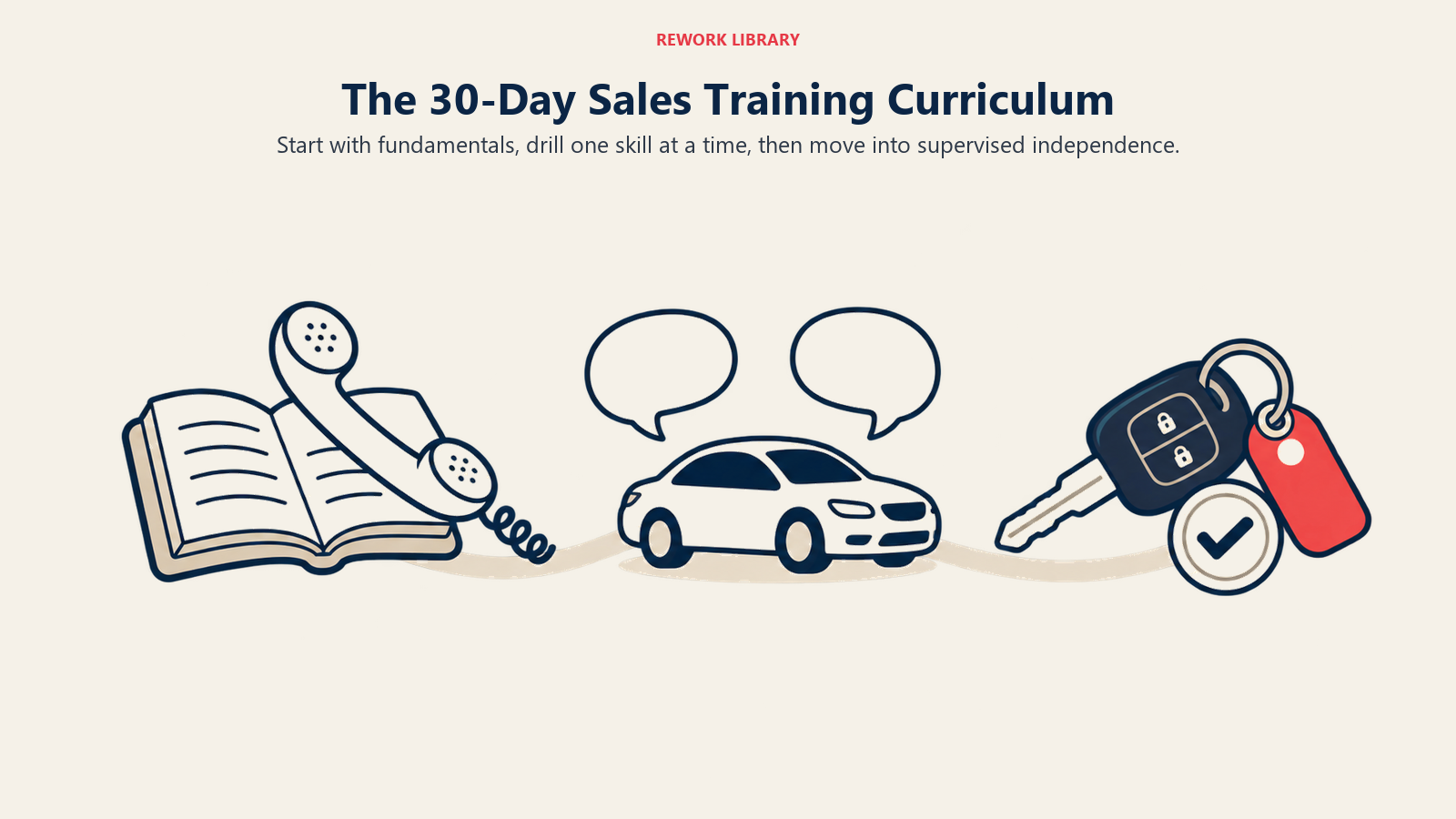
Days 1-7: Foundation. New hires learn product knowledge, dealership process, and phone fundamentals. By day 5, they should be handling live calls under direct supervision, not just observing. Passive shadowing for a full week without any hands-on practice wastes the highest-retention period of a new hire's training.
Days 8-21: Skill building. This phase emphasizes daily role play, one skill at a time, practiced to competency before moving to the next. Cover incoming calls, objection handling, vehicle walkarounds, and desk handoffs in sequence rather than all at once. By day 10, new hires should be scoring their own calls with a manager in weekly review, building self-assessment skill alongside execution skill.
Days 22-30: Supervised independence. The manager stays available without hovering. Daily debriefs replace live, in-the-moment coaching. By day 30, a new hire should be running full incoming calls, walkarounds, and desk handoffs with only periodic check-ins, not constant supervision.
Volume of practice matters more than volume of instruction in this window. New hires in their first 30 to 60 days benefit disproportionately from repetition-based drilling over lecture-style training, because sales skill is closer to a physical skill than a knowledge skill. Understanding an objection-handling framework intellectually and being able to execute it smoothly under pressure are different things, and only repetition closes that gap.
Coaching Cadence for New Hires
A curriculum without a coaching rhythm decays fast. Structure coaching in three tiers: a daily 5-minute session covering one call, one fix, and one rep; a weekly 30-minute session reviewing one win call and one fix call with a specific skill focus; and a monthly 45-minute full-team calibration session.
The daily cadence matters most for new hires because it catches bad habits before they calcify. A new hire who develops a weak opening line in week one and doesn't get corrected until a monthly review has practiced that weak habit dozens of times by the time anyone addresses it.
Key Facts: The Training Gap
- Weak phone process accounts for roughly half of all lost phone opportunities at dealerships without structured training (Proactive Training Solutions, 2026)
- Untrained teams convert internet leads to appointments at 20-25%, versus a realistic target of 50%+ (Proactive Training Solutions, 2026)
- Metric-level improvements (phone show rate, appointment-set rate) typically appear within the first 30 days of structured training, with fuller dealership-level results in 60 to 90 days (Proactive Training Solutions, 2026)
Role-Play and Certification Design
Role-play only works when it mirrors real objections your customers actually raise, not generic scenarios pulled from a training manual written for a different market. Pull your five most common objections from recorded calls and CRM notes, and build role-play scenarios around those specific situations.
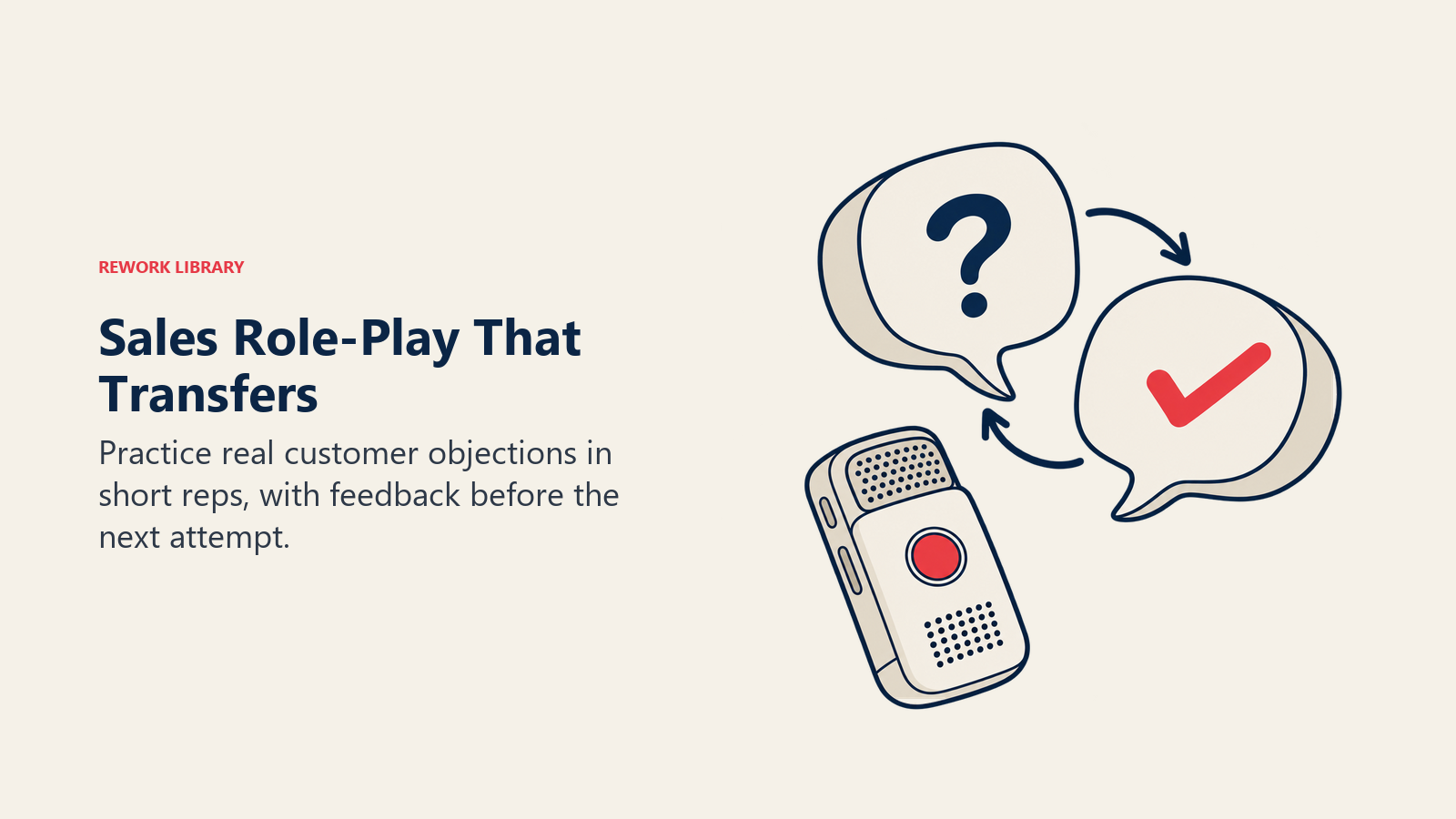
Run role-play in short, focused reps rather than long sessions. Five minutes on one specific objection, repeated with feedback between attempts, builds more retained skill than a 45-minute session covering ten different scenarios once each.
Consider a tiered certification structure that ties to compensation or floor rotation privileges: a foundational certification after the 30-day curriculum, an intermediate certification after 90 days covering needs assessment and negotiation, and an advanced certification tied to independent F&I handoff quality. Third-party credentials matter too. A formal industry sales certification can carry hiring weight and gives new hires an external benchmark beyond your internal training.
Ongoing Coaching for Tenured Consultants
Training doesn't stop at 30 days, and tenured consultants who stop developing plateau or slowly decline. Knowledge gained through ride-along or shadowing style training has a roughly six-month average lifespan before it decays without reinforcement, which means an annual training event isn't enough to sustain skill.
Mystery shop your own floor quarterly, using either an internal manager posing as a customer or a third-party service. This surfaces gaps that self-reported performance data misses entirely, particularly around discovery quality and the test drive experience, which are hard to measure from CRM data alone.
Use recorded calls and video-recorded walkarounds for peer learning, not just manager critique. Consultants often accept feedback from a top-performing peer more readily than the same feedback from a manager, and hearing exactly how a colleague handles a specific objection is more actionable than an abstract coaching note.
Track ramp time and time-to-first-sale by hire cohort to measure whether your training program is actually improving over time. If new hires from your most recent curriculum revision are ramping faster than hires from a year ago, the investment in training design is paying off. If ramp time hasn't moved, revisit the curriculum itself rather than assuming the people are the problem.
Measuring Training ROI
Track four numbers by training cohort: time to first sale, 90-day production versus tenured average, 12-month retention, and close rate on assigned appointments. Compare each new curriculum revision against the cohort before it.
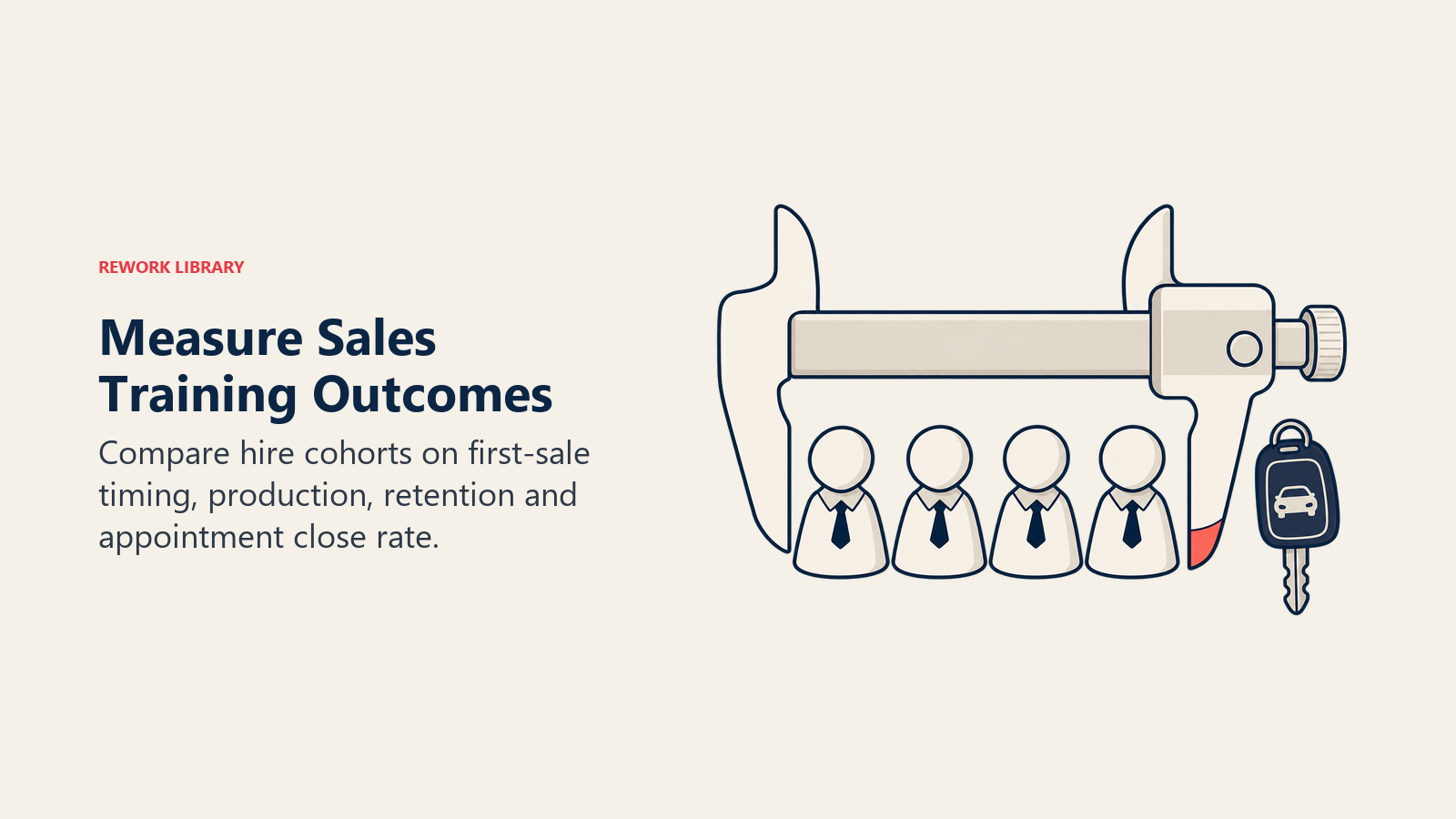
Retention is often the most overlooked training metric. New hires who don't build competence quickly get discouraged and leave, and turnover in the first 90 days is expensive to replace, both in direct hiring costs and in lost momentum on the floor. A curriculum that shortens ramp time and builds early confidence tends to reduce early turnover as a side effect, even when retention wasn't the primary design goal.
Tie training investment directly to the metrics from Sales Consultant Performance tracking so training isn't evaluated in isolation from actual production results. A training program that consultants enjoy but that doesn't move close rate or ramp time isn't working, regardless of satisfaction scores.
Building the Training Function
Someone needs to own this as a defined responsibility, not an informal task assigned to whichever manager has time. In larger stores, a dedicated trainer role that splits time between new hire onboarding and ongoing coaching pays for itself quickly given the conversion gaps described above. In smaller stores, the sales manager can own it, but only if training time is explicitly protected on their calendar rather than squeezed in around desk duties.
Whoever owns training needs access to call recordings, CRM data, and floor observation time. Training built purely from theory, without grounding in what's actually happening on your calls and your floor, produces generic advice that doesn't address your specific gaps.
Build the curriculum once, then revise it quarterly based on what coaching sessions reveal. If every new hire struggles with the same step in the process, that's a curriculum gap, not a series of individual skill gaps. Fix the training material, not just the individual reps hitting the same wall.
For the process this curriculum trains consultants to execute, see Automotive Sales Process, Meet & Greet Techniques, Objection Handling in Automotive, and Vehicle Presentation & Demo. For related team development, see Phone Skills for Automotive and Trade-In Appraisal Process.
Frequently Asked Questions about Sales Process Training
How long should a new automotive sales hire's onboarding take?
Plan for a structured 30-day curriculum: foundation and phone basics in week one, daily role play on specific skills in weeks two and three, and supervised independence in week four. New hires should handle full incoming calls, walkarounds, and desk handoffs by day 30 with only periodic manager check-ins.
What's the biggest gap structured training closes?
Phone handling. Weak phone process accounts for roughly half of all lost phone opportunities at dealerships without structured training, and phone skill directly determines whether a lead ever becomes a scheduled appointment.
How often should tenured consultants get retrained, not just new hires?
Knowledge from shadowing or ride-along training decays within about six months without reinforcement. Run quarterly refresher training, quarterly mystery shops, and monthly team calibration sessions to keep skill from decaying between formal training events.
What's the fastest way to see results from a new training program?
Metric-level improvements like phone show rate and appointment-set rate typically appear within the first 30 days of structured training. Full dealership-level production improvements usually take 60 to 90 days to materialize as new habits solidify.
Should role-play use generic scenarios or real objections?
Real objections pulled from your own recorded calls and CRM notes. Generic scenarios from a training manual written for a different market miss the specific objections your customers actually raise, which makes the practice less transferable to live calls.
How do I measure whether a training program is actually working?
Track time to first sale, 90-day production versus your tenured average, 12-month retention, and close rate on assigned appointments by hire cohort. Compare each curriculum revision against the cohort before it rather than judging training success by satisfaction scores alone.