Test Drive Best Practices: Converting Rides to Buyers - 2026 Guide
Turn this article into takeaways for your work.


Each assistant summarizes the article only for you and suggests best practices for your work.
Here's a stat that should change how you think about test drives: 75% of customers who test drive a vehicle properly end up buying within a week. But there's a catch in that word "properly." A mediocre test drive where you talk the entire time and drive past the same strip malls you see every day converts at maybe 30%. An exceptional test drive that creates emotional connection and lets the customer experience the vehicle converts at 75% or higher.
Recent findings from Cox Automotive's Car Buyer Journey Study show that higher customer satisfaction scores are being fueled by streamlined processes and personalized experiences. The difference is technique. Most salespeople treat test drives as a formality, something you do between presentation and negotiation. The best salespeople understand that the test drive is where logic meets emotion, where spec sheets become experiences, and where "I'm just looking" becomes "let's talk numbers."
Test Drive Planning and Preparation: The Foundation
Test drives don't start when you hand over the keys. They start when you plan your route, prep your vehicle, and review what you learned during needs assessment.
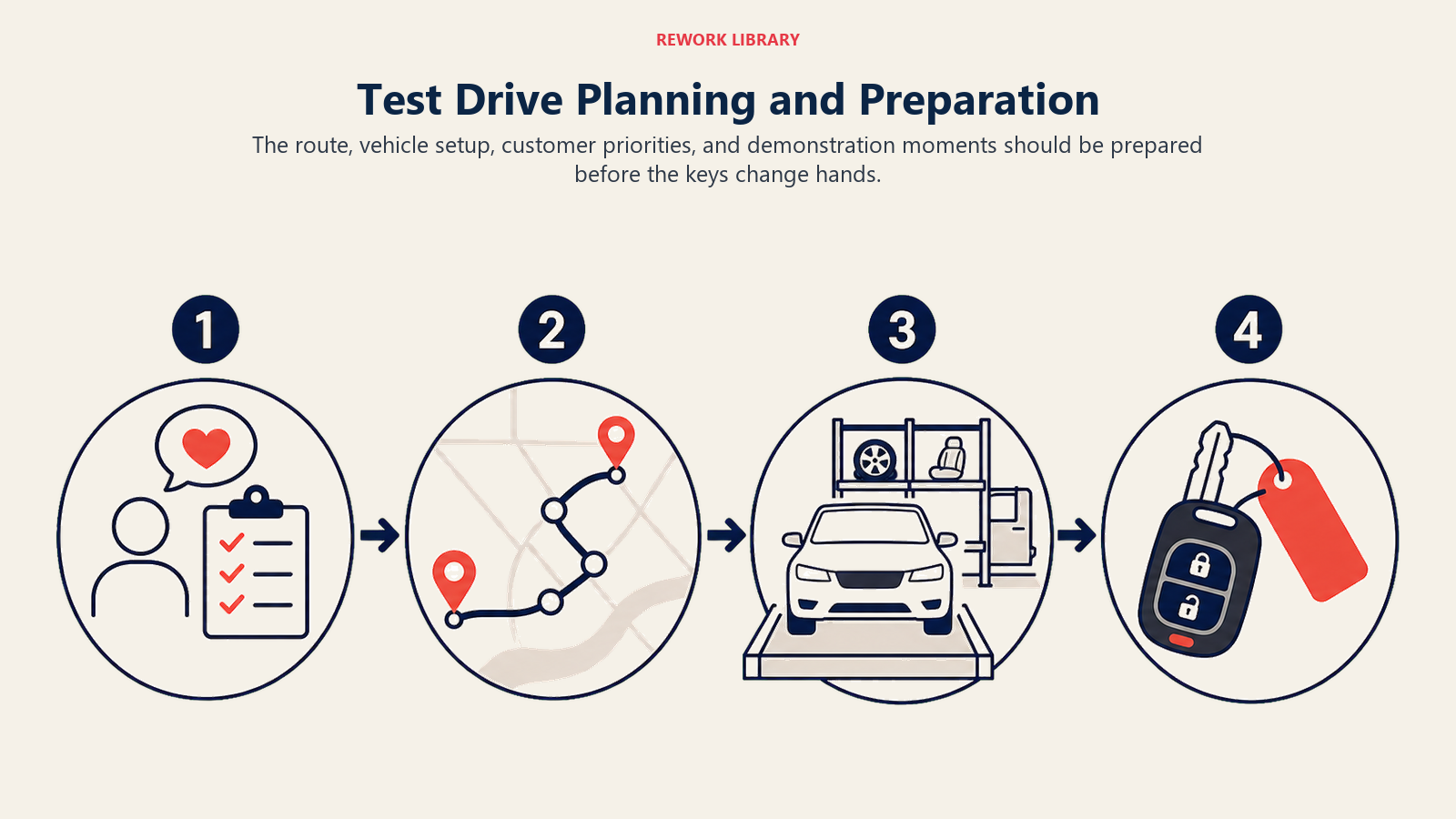
Route selection is strategic, not random. You need a route that showcases what the customer cares about. If they mentioned highway commuting during needs assessment, your route needs a highway on-ramp where they can feel the acceleration and merging power. If they mentioned city parking challenges, you need to include a parking lot where you can demonstrate parking assist.
Your route should take 15-20 minutes. Shorter than that and you don't build enough connection. Longer than that and you risk losing momentum. The route should flow naturally without complicated directions. You don't want to spend the drive saying "turn left at the next light, no wait, the one after that."
Think about what you want to avoid, too. Construction zones, school zones during pickup time, areas with heavy police presence, roads with terrible surfaces that make the vehicle feel rougher than it is. These aren't deal-killers, but they're distractions from the experience you're trying to create.
Vehicle prep matters more than you think. The vehicle should be clean, fueled, and staged. Set the climate to a comfortable temperature. If it's a hot day, cool the vehicle before the customer gets in. Set the radio to a neutral station or turn it off. Clear out any personal items, coffee cups, or paperwork. These details contribute to automotive customer experience quality.
Check the tire pressure. Low tire pressure affects handling and fuel economy displays. Make sure all the fluids are topped off. You don't want a low washer fluid warning popping up during the drive.
Review your notes from needs assessment. What did the customer say matters to them? What are they comparing this vehicle to? What concerns did they express? Your automotive sales process test drive should address these points specifically.
If the customer mentioned they're worried about the vehicle being too big, plan to demonstrate parking assist and the 360-camera system. If they mentioned they need power for towing, plan a section where you can demonstrate acceleration. If they mentioned fuel economy concerns, make sure the trip computer is reset so they can see real-time fuel economy.
Pre-Drive Setup: Setting Expectations and Building Anticipation
Before you leave the lot, take 2-3 minutes to set up the drive properly. This isn't the time for a full safety briefing that kills excitement. But you do need to cover basics and build anticipation for what they're about to experience.
Start with a quick overview: "We're going to take a route that includes some highway driving so you can feel the acceleration and passing power, some curves where you can experience the handling, and we'll stop in a parking lot where you can try the parking assist feature. The whole drive takes about 15 minutes. I'll ride along to answer any questions and show you features as we go. Sound good?"
Show them key controls they'll need: how to adjust the seat, where the gear selector is, how to adjust mirrors, where the lights and wipers are. Keep it simple. They don't need a full tutorial on every button. They need enough to drive safely and comfortably.
Build anticipation by previewing features they'll experience: "Once we get on the highway, I'll show you how to activate the adaptive cruise control. It's really impressive how it maintains your speed and distance from the car ahead. Makes highway driving much more relaxing."
This preview serves two purposes. It builds excitement for features they're about to experience, and it ensures you don't forget to demonstrate the features that matter most.
Get them in the driver's seat. You're in the passenger seat. Some salespeople insist on driving first to "demonstrate the vehicle." That's backwards. The customer needs to experience driving, not watch you drive. The only exception is if they're extremely nervous about driving an unfamiliar vehicle. In that case, offer to drive first, but transition to them driving as soon as they're comfortable.
During the Drive: First Half - Guided Discovery
The first 5-7 minutes of the test drive should be mostly quiet. Let the customer focus on driving, getting comfortable with the vehicle, and forming their own impressions.
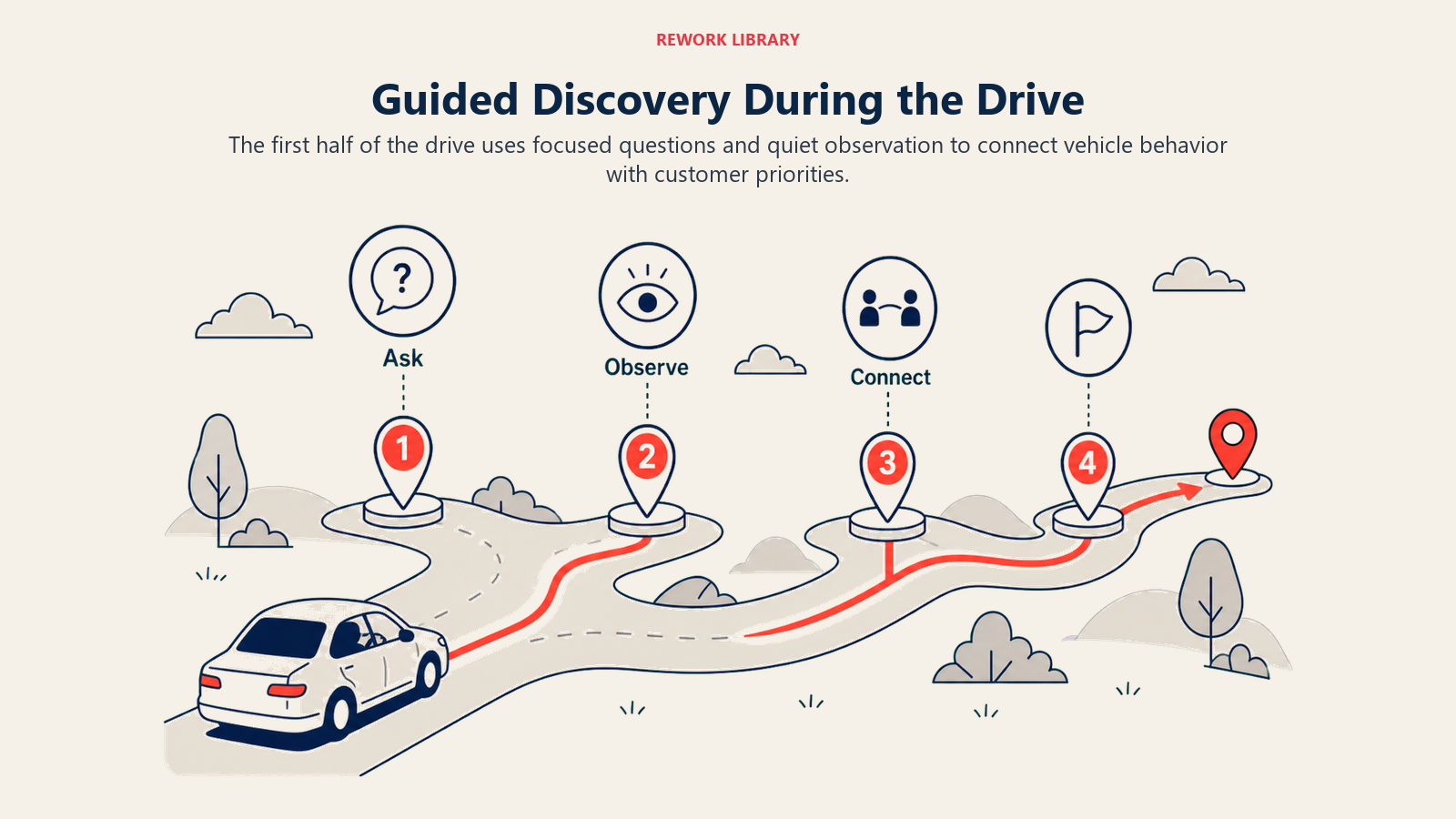
This is hard for salespeople. We're trained to talk, to demonstrate, to engage. But silence is powerful here. The customer is processing a flood of sensory information: how the seat feels, how the steering responds, how the acceleration feels, what they can see from the driver's seat. If you're talking through all of this, you're interfering with their experience.
That doesn't mean complete silence. You should guide them through the route: "At the next light, go ahead and turn left onto Highway 50." You should make occasional observations: "Notice how quiet the cabin is even at highway speed. That's the acoustic glass and sound deadening."
But resist the urge to fill every moment with talking. Let the vehicle sell itself.
Watch the customer's body language and reactions. Are they smiling when they accelerate? That's a buying signal. Are they gripping the steering wheel tightly and looking tense? They might be nervous about the vehicle size or unfamiliar with the controls. Are they constantly adjusting the seat or mirrors? They might not be comfortable yet.
Use strategic questions to engage without overwhelming: "How does the acceleration feel compared to what you're driving now?" "What do you think of the visibility?" "Is the seat comfortable?"
These questions serve multiple purposes. They get the customer talking, which helps you gauge their interest. They direct the customer's attention to specific aspects of the vehicle. And they give you insight into concerns you might need to address.
J.D. Power research emphasizes that dealership best practices blend insights with measurable, actionable recommendations to improve customer satisfaction. During highway driving, let them experience passing power. "Go ahead and accelerate to pass this car. Feel how much power you have available." This is where turbocharged engines and V6s shine. The customer feels confidence and capability.
During the Drive: Second Half - Feature Demonstration
The second half of the test drive is where you demonstrate specific features that match the customer's needs. You've let them get comfortable with the vehicle. Now you show them what makes it special.
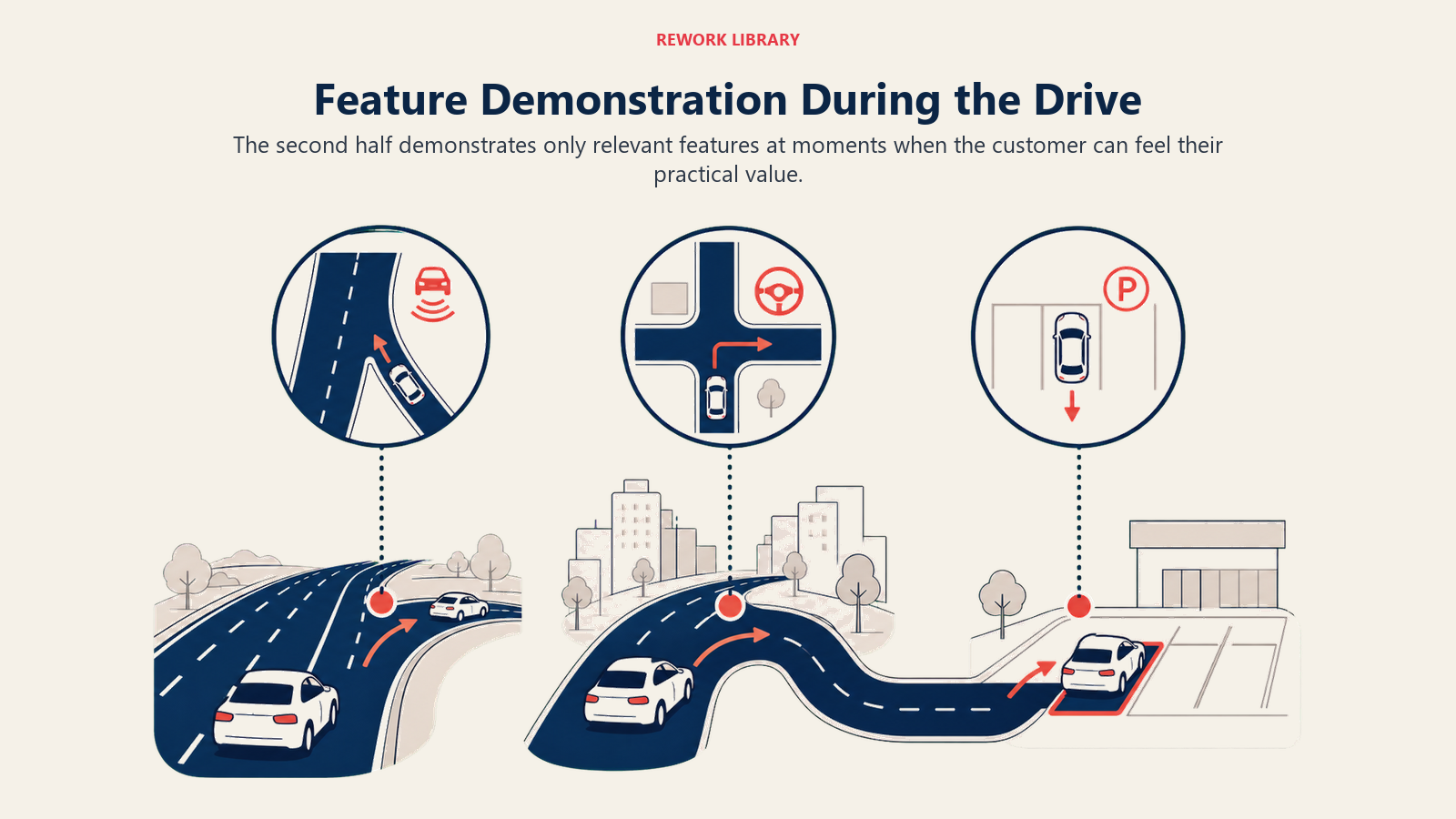
If the vehicle has adaptive cruise control, have them activate it on the highway. "Go ahead and press the cruise button, then use this button to set your following distance. The vehicle will maintain your speed and slow down if traffic ahead slows down. Just steer."
Most customers are amazed the first time they experience adaptive cruise. They see traffic ahead slow, they tense up ready to brake, and the vehicle does it automatically. That moment of "wow" is worth more than any spec sheet explanation.
Lane keeping assist is another feature that creates memorable moments. "See how the vehicle is gently guiding itself to stay centered in the lane? You're still in control, but it's helping. This is why highway drives become so much less tiring."
For parking assist and 360-camera systems, stop in an empty parking lot and demonstrate. "Let's try the parking assist. Just drive slowly past these spaces and the system will find one that fits and then handle the steering while you control the speed. This is incredibly helpful in tight city parking."
Let the customer try it. Don't just demonstrate it yourself. When they successfully park the vehicle with assistance, they feel capable and confident. That confidence makes them more likely to buy.
If the customer mentioned concerns about size or visibility, this is when you address them directly. "You mentioned you were worried about parallel parking something this size. Let's find a spot and try it with the parking assist."
Addressing concerns during the test drive is powerful because you're providing immediate evidence that the concern isn't a deal-breaker.
Post-Drive Debrief: Capturing Emotion and Addressing Concerns
The parking lot immediately after the test drive is the most important 3-5 minutes of the sales process. The customer is feeling the full emotional impact of the experience. They're imagining themselves owning this vehicle. Their logical defenses are lowered. This is when you move toward close.
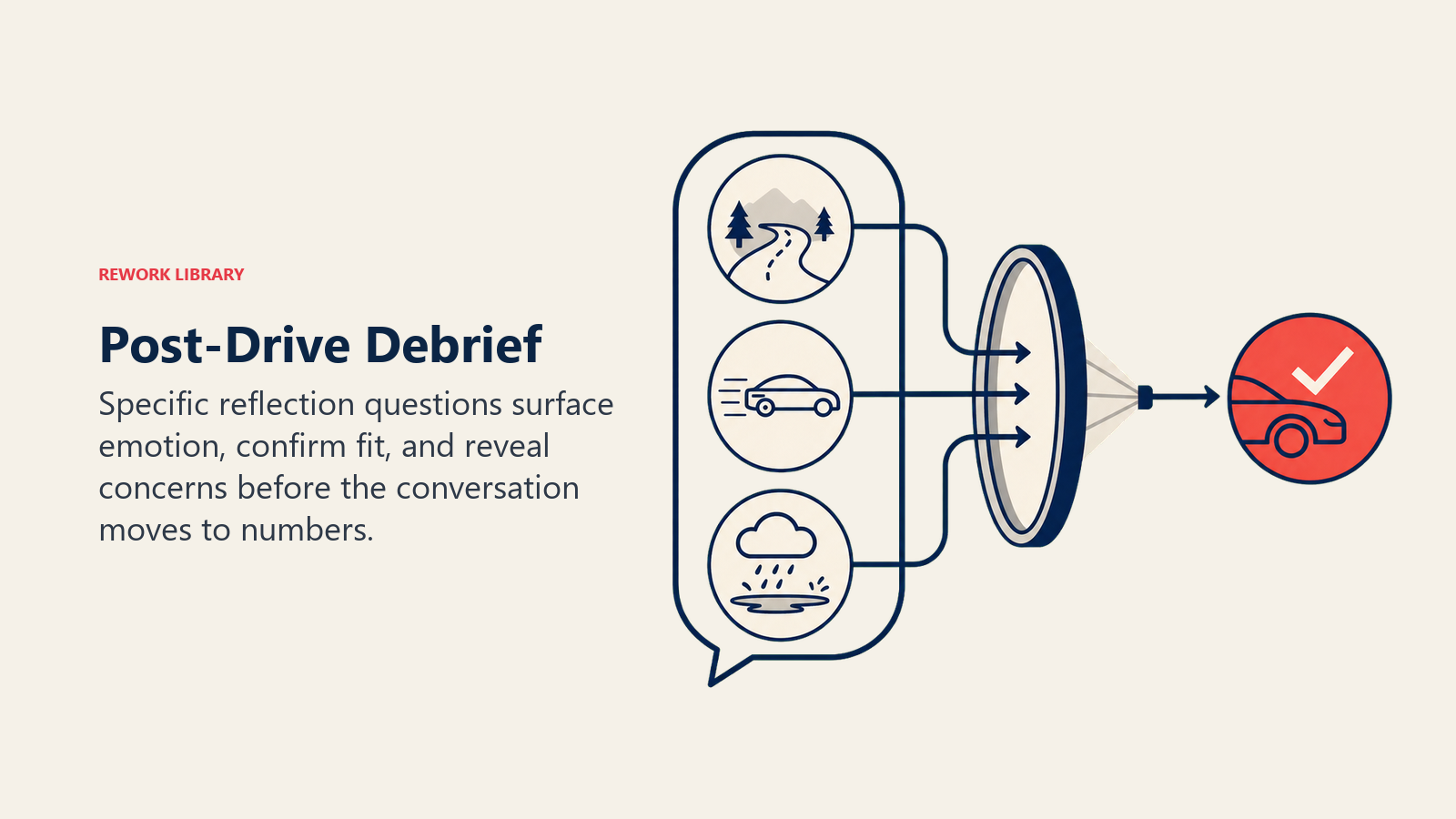
Don't rush back inside. Stay in the parking lot and debrief.
Start with an open-ended question: "So, what did you think?"
Then shut up and listen. The customer's first response tells you everything. Are they excited? Are they hesitant? Are they comparing it to something else?
If they're excited, reinforce it: "I could tell you were enjoying the power when you merged onto the highway. That turbo engine really delivers, doesn't it?"
If they're hesitant, isolate the concern: "You seem a little uncertain. What's on your mind?"
Most concerns that come up after the test drive are addressable. They're worried about the payment. They're not sure about the color. They want to compare it to one more vehicle. These are negotiation issues covered in objection handling, not reasons to walk away.
But you need to address them now, while the emotional connection is strong. If you go inside and start talking numbers without addressing the concern, it will grow into a bigger obstacle.
Use a trial close: "If we can work out the numbers to fit your budget, is this the vehicle you want?"
This question isolates payment from other concerns. If they say yes, you know the only obstacle is price or payment. If they say no or hedge, there's something else you need to uncover.
Another powerful trial close: "On a scale of 1 to 10, with 10 being perfect, how does this vehicle fit your needs?"
Anything 7 or above is very promising. If they say 7 or 8, ask: "What would make it a 10?" This tells you exactly what you need to address.
Don't fear the comparison: "You mentioned you're also looking at the Toyota RAV4. How does this compare to what you drove there?"
This question forces them to verbalize the comparison, which often makes your vehicle look better than they initially thought. Or it reveals specific concerns you need to address.
Special Scenarios: Handling Unique Situations
Some test drives require different approaches.
Trade-in comparison drives are incredibly effective. After they've driven the new vehicle, say: "Let's take your current vehicle for a quick spin so you can directly compare them." Then you drive their trade-in with them as a passenger.
This is powerful for two reasons. First, it reminds them of everything they don't like about their current vehicle. The worn seats, the engine noise, the old technology. Second, you're in control, so you can point out these differences: "Notice how much louder your engine is compared to the new vehicle?" "See how much effort it takes to parallel park without the camera system?"
You're not insulting their trade. You're highlighting progress.
Family test drives require managing multiple opinions. If kids are present, make sure they're comfortable and engaged. "What do you think, guys? Pretty cool, right?" Kids love technology features, sunroofs, and rear entertainment systems. When kids are excited, parents are influenced.
If a spouse or partner is present, address both people equally. Don't make the mistake of focusing on the person you think is the decision-maker. Both people need to feel heard and excited.
Extended test drives and overnight demos are increasingly common. Some dealerships offer 24-hour or weekend test drives for serious buyers. These dramatically increase close rates because the customer experiences the vehicle in their real life, not just a 15-minute loop. This approach reflects modern automotive digital retailing strategies.
If you offer extended drives, set expectations and protect your inventory: "We're happy to let you take it for the weekend. We just need a credit card on file and proof of insurance. How does that sound?"
Common Test Drive Mistakes That Kill Sales
Over-talking is the biggest mistake. You should speak for maybe 20-30% of the test drive. The rest is the customer experiencing the vehicle and you listening to their reactions.
When you talk constantly, you prevent the customer from forming their own emotional connection. They're focused on you instead of the vehicle. And you miss important buying signals in their body language and spontaneous comments.
Poor route selection undermines the experience. If your route is stop-and-go traffic through congested areas, you can't demonstrate acceleration or handling. If your route is all highway, you can't demonstrate city maneuverability. If your route is residential streets at 25 mph, you can't show what the vehicle is capable of. Strategic route planning is essential for showroom traffic conversion.
Missing the emotional moment after the drive is a costly mistake. Don't rush inside. Don't immediately start talking about numbers. Stay in that moment, capture their enthusiasm, address their concerns, and trial close.
Not customizing the drive to the customer's needs is lazy. If they told you they're worried about parking during meet and greet, demonstrate parking assist. If they told you they do a lot of highway commuting, spend time on the highway showing cruise control and fuel economy. Generic test drives produce generic results.
Failing to demonstrate key features means missing opportunities to create wow moments. The customer doesn't know the vehicle has automatic parking or adaptive cruise unless you show them. These features differentiate your vehicle from the competition and are key elements in vehicle presentation.
Being defensive about concerns kills trust. If the customer says "it feels a little bigger than I expected," don't say "you'll get used to it." Instead, acknowledge and address: "I understand. That's why the 360-camera and parking assist are so helpful. They make a vehicle this size as easy to park as something smaller. Want to try it?"
Creating the Experience That Sells
Test drives aren't transportation from point A back to point A. They're experiences that transform prospects into buyers. They're where the customer imagines their life with this vehicle, where they feel the satisfaction of new technology and the confidence of safety features.
Your job isn't to demonstrate the vehicle. It's to facilitate an experience where the customer sells themselves. You do that by planning strategically, demonstrating thoughtfully, staying quiet when appropriate, and capturing the emotional momentum after the drive.
When done right, the test drive makes the rest of the sales process feel like a natural progression rather than a negotiation battle. The customer wants to buy. You just need to work out the details through desking and deal structure. Understanding phone skills for automotive and appointment setting best practices helps ensure qualified buyers arrive ready for successful test drives.
As McKinsey research confirms, putting customer experience in the driver's seat is the new key to automotive success. That's the power of a great test drive. It transforms "I'm thinking about it" into "how soon can I take delivery?"

Senior Implementation Consultant
On this page
- Test Drive Planning and Preparation: The Foundation
- Pre-Drive Setup: Setting Expectations and Building Anticipation
- During the Drive: First Half - Guided Discovery
- During the Drive: Second Half - Feature Demonstration
- Post-Drive Debrief: Capturing Emotion and Addressing Concerns
- Special Scenarios: Handling Unique Situations
- Common Test Drive Mistakes That Kill Sales
- Creating the Experience That Sells