Vehicle Presentation & Demo: Creating Emotional Connection Through Feature-Benefit Selling - 2026 Guide
 Your customer can research 0-60 times and cargo capacity on their phone. They came to your dealership to experience a vehicle, to sit in it, to imagine themselves behind the wheel. Yet 65% of sales presentations still consist of feature lists read from spec sheets. The best presenters don't deliver information. They create experiences that lead to test drives and purchases.
Turn this article into takeaways for your work.


Each assistant summarizes the article only for you and suggests best practices for your work.
The difference between a $40,000 sale and a "let me think about it" often comes down to those 15 minutes between greeting and test drive. Your presentation isn't about what you say. It's about what the customer feels, imagines, and experiences.
Research from McKinsey found that 70% of buying experiences are shaped by how customers feel they are being treated, not just what features you demonstrate.
Presentation Philosophy: Experience Over Information
Most salespeople approach presentations backwards. They start with what they know about the vehicle and try to download that information into the customer's brain. They walk through every feature, explain every spec, demonstrate every button. It's boring. And it doesn't sell cars.
Effective presentations start with what you learned during needs assessment. If your customer mentioned they have two kids in car seats and a dog, you don't need to show them how the third row folds. You need to show them how easy it is to install car seats in the second row and whether their dog fits comfortably in the cargo area. This targeted approach is a core principle of the automotive sales process.
Feature-benefit selling isn't new. But most salespeople get stuck on features and advantages without ever reaching benefits. They say "this vehicle has adaptive cruise control" (feature) and "it maintains your set speed and distance from the car ahead" (advantage). They stop there. The benefit is "so you can relax during your commute instead of constantly adjusting your speed in traffic."
That's what the customer actually cares about.
According to recent research, 73% of customers expect personalized experiences from automotive companies. Your presentation should deliver that by being tailored, interactive, and filled with trial closes. You're not giving a lecture. You're having a conversation that happens to take place around and inside a vehicle. The goal isn't to cover everything. It's to build enough excitement and confidence to move to the test drive.
Pre-Presentation Preparation: Setting Yourself Up to Win
Great presentations start before the customer sees the vehicle. You need 5-10 minutes of preparation. First, vehicle selection. Based on your needs assessment, you should know which vehicle or vehicles you're presenting. Pull that vehicle to your presentation area. Check that it's clean, inside and out. Look for bird droppings, dust, or fingerprints on the exterior. Check for trash, receipts, or coffee cups in the interior. These details kill the ownership fantasy you're trying to create.
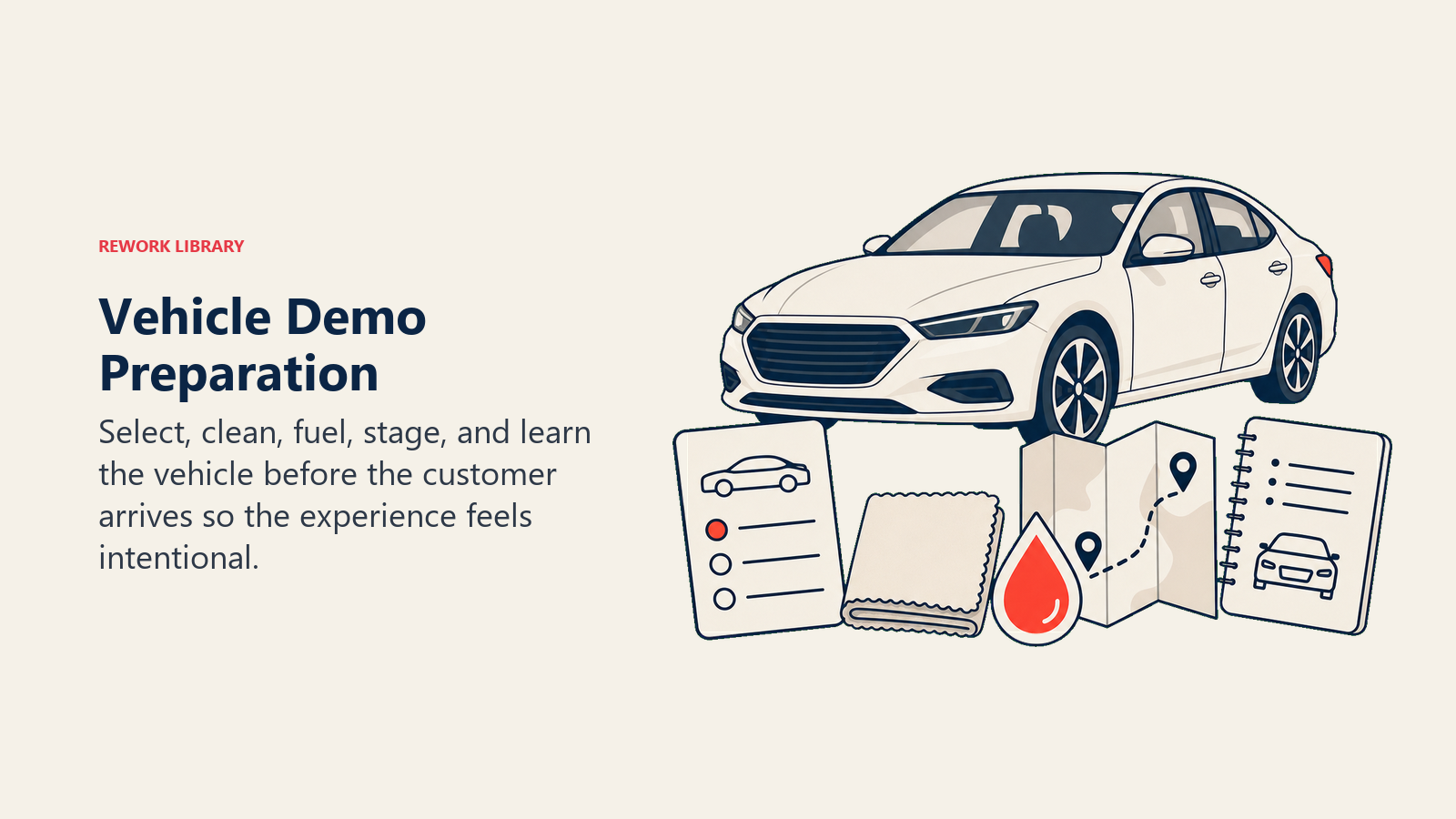
Fuel it. Nothing kills momentum like "sorry, we need to put gas in this before we can test drive it." Your test drive route should be pre-planned. If you're presenting an SUV to a family, your route should include turns that showcase handling, a section where they can test acceleration, and preferably a parking lot where you can demonstrate parking assistance features.
Know your competition. If your customer mentioned they're also looking at a Toyota RAV4 during your meet and greet, you should have a mental file of how your vehicle compares. Not to bash the competition, but to highlight areas where your vehicle excels. "You mentioned you were looking at the RAV4. Both are excellent vehicles. This one has more cargo space and comes standard with the 360-camera system that's optional on the RAV4." Understanding conquest marketing strategy helps you position against competitors effectively.
Familiarize yourself with the technology. There's nothing more damaging to credibility than fumbling with the infotainment system or saying "I'm not sure how this works." You don't need to know every obscure menu setting, but you should be able to demonstrate key features smoothly.
Stage the vehicle for impact. If it's a convertible, have the top down. If it has a panoramic sunroof, have it open. If it has ambient lighting, have it set to an attractive color. First impressions matter.
Exterior Walkaround: Building Anticipation and Excitement
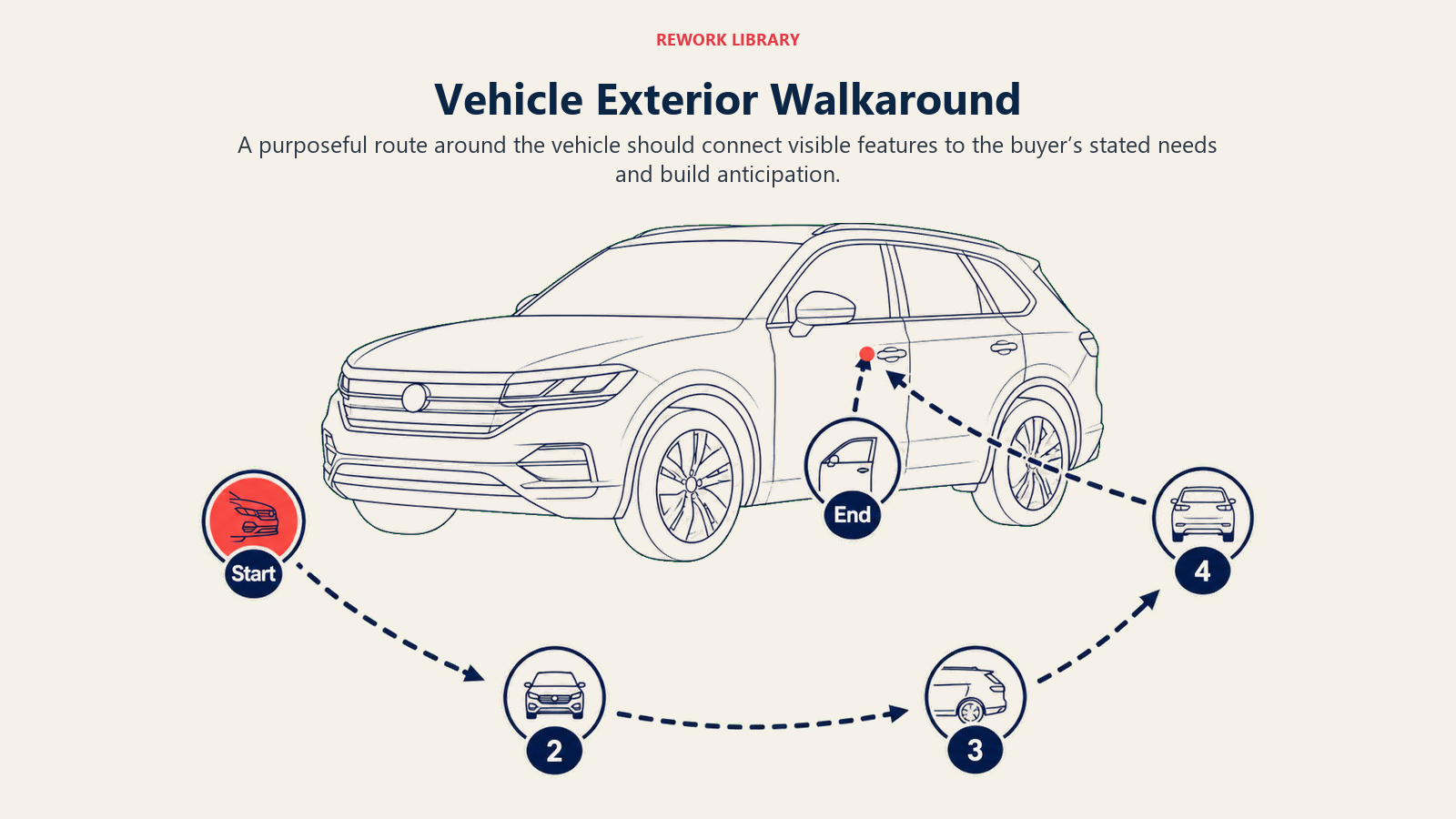
Your walkaround isn't a lap around the vehicle pointing out body lines and wheel sizes. It's a strategic journey that builds excitement and connects features to the customer's stated needs. Start at the front corner of the vehicle, positioned so you can gesture at both the front and side. Don't stand between the customer and the vehicle. They should have a clear view. Your job is to direct their attention, not block their view.
Here's what doesn't work: "This vehicle has LED headlights, a chrome grille, and 18-inch alloy wheels."
Here's what does work: "You mentioned you do a lot of highway driving at night. These LED headlights provide 40% better visibility than standard halogens, and they last the life of the vehicle so you never need to replace a bulb."
See the difference? You connected a feature to a stated need and explained the benefit in terms the customer cares about.
As you move around the vehicle, highlight 3-4 features that directly relate to what the customer told you they care about. If they mentioned safety, point out the backup camera, blind spot monitoring, and automatic emergency braking. If they mentioned style, talk about the design elements and paint quality. If they mentioned practicality, show cargo space and roof rails.
Don't feel compelled to mention every feature. You're building anticipation for the interior and test drive, not trying to cover everything in the walkaround.
Handle competitive comparisons naturally using objection handling techniques. If your customer says "the Honda we looked at had more cargo space," don't get defensive. "The Honda is a great vehicle. This one has 2 cubic feet less cargo space, but it has a lower load height which makes it easier to lift heavy items, and the rear seats fold completely flat which the Honda's don't. Let me show you."
Trial close throughout the walkaround. "Can you see yourself pulling into your driveway in this?" or "What do you think of the color?" These small questions get the customer talking and help you gauge their interest.
Interior Presentation: Creating the Ownership Fantasy
Open the driver's door and invite the customer to sit in the driver's seat. Not the passenger seat. They need to experience the vehicle from where they'll spend 99% of their time. This is where the ownership fantasy begins. Once they're in the driver's seat, adjusting the seat, gripping the steering wheel, looking through the windshield, they start to imagine this is their vehicle.
Before you start demonstrating features, let them get comfortable. "Go ahead and adjust the seat and mirrors like you normally would." Give them 30 seconds to fiddle with controls and get situated. They're mentally taking possession.
Now start your interior presentation, but remain focused on what matters to them. If they mentioned they use their phone for navigation and music, demonstrate smartphone integration first. Pair their phone if time allows. Show them how easy it is to access their music and send texts hands-free.
If they mentioned they have kids, show them the second-row space, demonstrate how easy the child seat anchors are to access, show them the rear climate controls and sunshades.
Safety features deserve special attention. Most customers care deeply about safety, even if they didn't explicitly mention it. Show them the 360-degree camera system, demonstrate lane keeping assist, explain automatic emergency braking. Frame these features in terms of peace of mind: "This system can detect if you're drifting out of your lane and will gently steer you back. It's like having a co-pilot watching out for you." This value proposition contributes to customer lifetime value in automotive.
Technology can be overwhelming. You don't need to demonstrate every menu and sub-menu of the infotainment system. Hit the highlights: "This is where you access your apps and settings. It's very intuitive, similar to your smartphone. We'll also schedule a vehicle delivery experience where we spend 30 minutes going through everything in detail."
That last sentence is important. It removes the pressure to learn everything right now and signals that you expect them to buy this vehicle.
Feature-Benefit Translation: Speaking Customer Language
This is where most presentations fail. Salespeople get stuck on features and forget to translate them into benefits. Here's the framework: Features describe what the vehicle is or has. Advantages describe what those features do. Benefits describe what those features mean to the customer specifically.
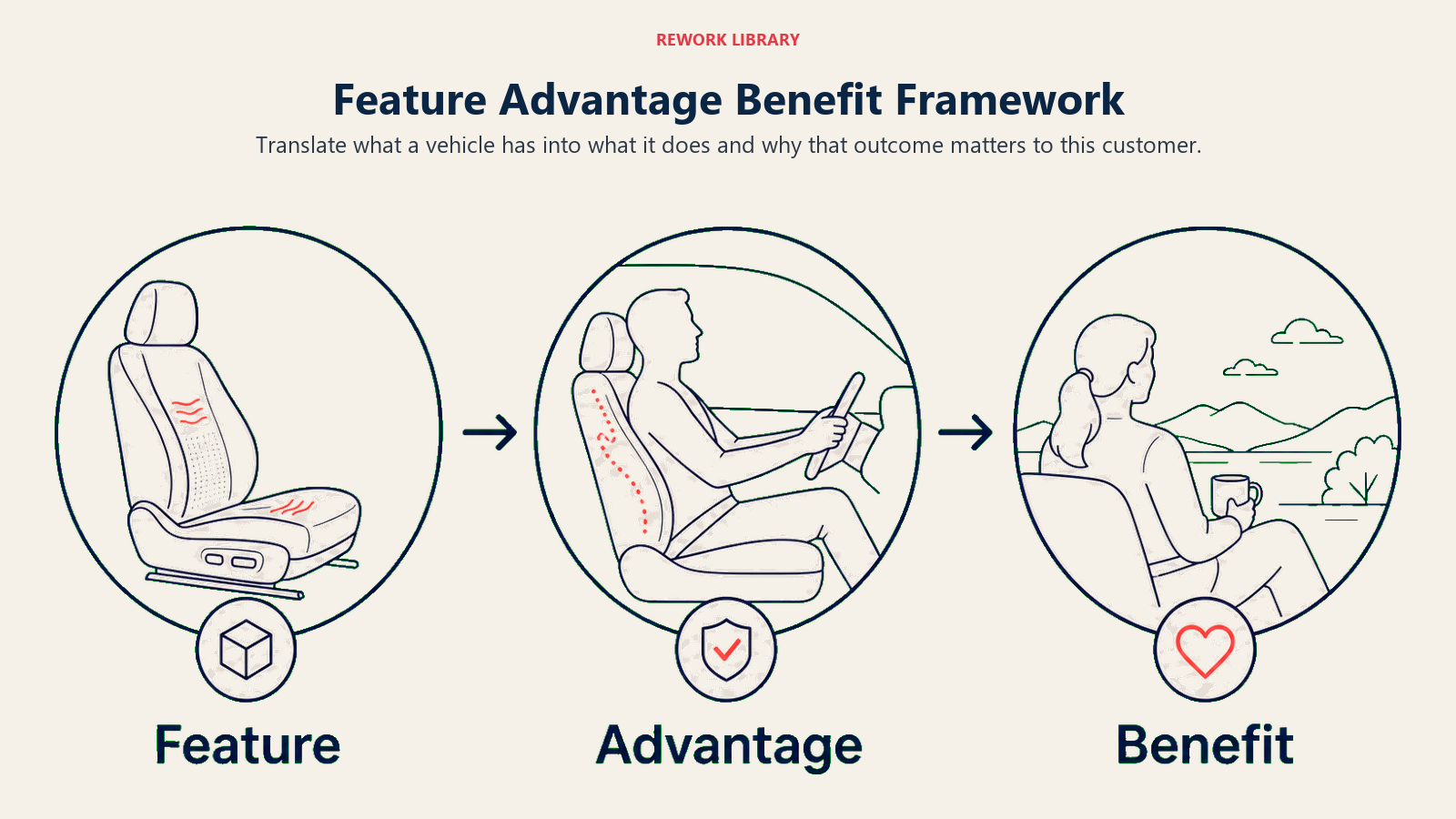
Feature: "This vehicle has a 2.0-liter turbocharged engine." Advantage: "It produces 250 horsepower and gets 32 MPG highway." Benefit: "So you get the power you need for highway merging and passing, but you'll still only fill up once a week with your commute."
That last part, customized to their specific situation, is what matters.
Another example: Feature: "This vehicle has tri-zone automatic climate control." Advantage: "The driver, passenger, and rear passengers can each set their own temperature." Benefit: "So you can stay comfortable while your kids keep the back seat cooler, and nobody argues about the temperature."
The benefit always ties back to what you learned in the needs assessment. If you don't know their situation, you can't deliver meaningful benefits. This is why rushing through needs assessment to get to presentation is a mistake.
Avoid technical jargon unless you know the customer appreciates it. Most customers don't care about torque figures or compression ratios. They care about whether the vehicle will do what they need it to do.
When you do need to explain something technical, use analogies. "The continuously variable transmission is like having infinite gears. It always keeps the engine at the most efficient RPM, which is why you get such great fuel economy."
Technology and Systems Demo: Managing Complexity
Modern vehicles have more computing power than the Apollo spacecraft. They can park themselves, detect pedestrians, remember driver preferences, and connect to 47 different apps. It's impressive and overwhelming. Your job isn't to demonstrate everything. It's to demonstrate enough to build confidence without creating confusion.
Start with the features that solve the customer's stated problems. If they mentioned they're frustrated with their current vehicle's Bluetooth, show them how easy it is to connect their phone in this vehicle. Actually do it if time permits.
If they mentioned parallel parking stress, demonstrate the parking assistance system. Pull up a video on the screen if the vehicle has it. "This system identifies parking spaces as you drive by, and then handles the steering while you control the gas and brake. Would you like to try it during the test drive?"
For complex systems like adaptive cruise control or lane keeping assist, explain the concept and promise a demonstration during the test drive. "This vehicle can practically drive itself on the highway. During our test drive, I'll have you activate the adaptive cruise and lane keeping, and you'll see how it maintains your speed and stays centered in the lane. It makes long drives much less tiring." These demonstrations are critical elements of showroom traffic conversion.
Don't apologize for complexity. Frame it as sophistication: "There's a lot of technology in here, and we don't expect you to learn it all today. That's why we schedule a delivery tutorial where we go through everything step-by-step. Today, I just want to show you the features that matter most for your situation."
This approach removes pressure, builds confidence, and again assumes the sale.
Transition to Test Drive: Closing the Presentation Phase
Your presentation should naturally flow into the test drive. You've been trial closing throughout: "What do you think so far?" "Can you see yourself using this feature?" "How does the space compare to what you're driving now?" Now it's time for the assumptive test drive invitation.
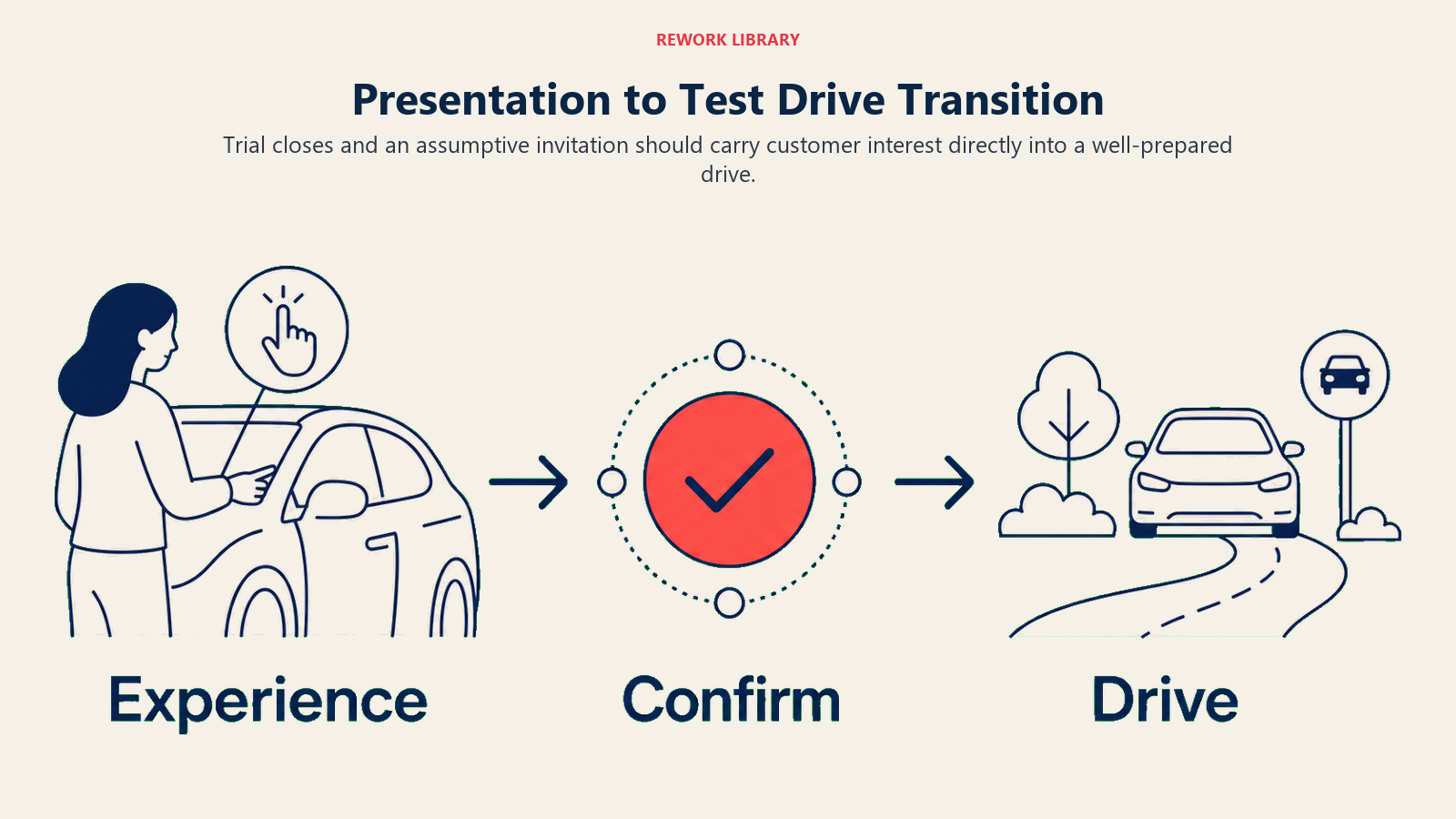
Not: "Would you like to take it for a test drive?"
Instead: "Let's take it out so you can experience the power and handling. Do you have your driver's license with you?"
You're assuming they want to drive through your automotive sales process. The only question is logistics.
If they hesitate, isolate the concern. "What would you like to know before we drive?" Often, they just need one more question answered or one more feature explained.
Some customers are nervous about driving an unfamiliar vehicle or worried about wasting time if they're not serious buyers. Address this head-on: "I know driving a new vehicle can feel a little strange at first. That's normal. I'll be right here to answer questions and help you get comfortable with the controls. And don't worry about the time. Test drives are what we're here for. That's how you know if it's the right vehicle for you."
Set expectations for the test drive. "We'll take a route that lets you experience highway acceleration, handling through some curves, and we'll stop in a parking lot so you can try the parking assist feature. The whole drive takes about 15 minutes. Sound good?"
This preview builds anticipation and ensures you hit the points that matter most.
Common Presentation Mistakes to Avoid
Feature dumping is the most common mistake. Listing every spec and feature without connecting them to customer needs is boring and ineffective. It positions the vehicle as a commodity with a long list of checkboxes. Talking too much is a close second. Your presentation should be interactive, with the customer asking questions and making observations. If you're doing 90% of the talking, you're doing it wrong.
Skipping the trial closes is a mistake that costs sales. Trial closes throughout the presentation help you gauge interest and build momentum. They get the customer saying "yes" repeatedly, which makes the final close easier.
Not tailoring the presentation is lazy and obvious. If you're giving the same presentation to everyone regardless of their needs, you're wasting their time and yours. A family with three kids needs a different presentation than a single person looking for a commuter vehicle.
Apologizing for features or price is deadly. If you say "I know the price is a little high, but..." you've just validated their concern. If you say "The infotainment system is a bit complicated, but you'll get used to it," you've planted a seed of doubt. Be confident in the value you're presenting.
Not sitting the customer in the driver's seat is a missed opportunity. That's where the ownership fantasy happens. Get them behind the wheel as soon as possible. This psychological moment is central to automotive customer experience.
Creating Memorable Experiences
The best presentations create moments that customers remember and talk about. Maybe it's the moment they saw the cargo space and realized all their camping gear would fit. Maybe it's when they connected their phone and their favorite playlist started playing through the premium sound system. Maybe it's when they sat in the driver's seat and said "wow, this feels right."
Your job is to create those moments. You do that by listening during needs assessment, preparing the vehicle properly, presenting features as benefits tailored to their situation, and creating opportunities for them to experience and interact with the vehicle.
This isn't manipulation. It's good salesmanship. You're helping customers understand how a vehicle fits into their life. You're answering the question they're really asking, which isn't "what are this vehicle's specs?" It's "will this vehicle make my life better?"
Accenture research emphasizes that utilizing consumer data and strengthening dealer relationships are critical steps automotive professionals can take to improve sales and increase customer loyalty. When you can confidently answer yes and show them why, the test drive and close become natural next steps in a process that feels collaborative rather than adversarial.
The presentation is where you earn the right to ask for the sale. Do it well, and the rest of the negotiation and closing process becomes significantly easier. Your ability to present effectively directly impacts dealership revenue streams and gross profit optimization.

Senior Implementation Consultant
On this page
- Presentation Philosophy: Experience Over Information
- Pre-Presentation Preparation: Setting Yourself Up to Win
- Exterior Walkaround: Building Anticipation and Excitement
- Interior Presentation: Creating the Ownership Fantasy
- Feature-Benefit Translation: Speaking Customer Language
- Technology and Systems Demo: Managing Complexity
- Transition to Test Drive: Closing the Presentation Phase
- Common Presentation Mistakes to Avoid
- Creating Memorable Experiences