Parts Department Optimization - Drive Profitability Beyond the Service Lane - 2026 Guide
Turn this article into takeaways for your work.


Each assistant summarizes the article only for you and suggests best practices for your work.
Most dealerships treat their parts department as a support function for the service lane. But high-performing dealers recognize something different: parts operations can generate 25-35% of total fixed ops gross profit while creating multiple revenue streams beyond internal service needs.
The difference isn't just about having parts on the shelf. It's about optimizing inventory turns, building a wholesale business, implementing strategic pricing, and creating tight integration between parts and service operations. When you optimize parts operations properly, you improve service department capacity, reduce customer wait times, and create profitable revenue streams that complement your core business. The National Automobile Dealers Association (NADA) publishes detailed financial profiles twice yearly showing how top-performing parts departments achieve these results across their 16,500+ member dealerships.
Yet many dealers let their parts departments operate on autopilot. They stock what the OEM recommends, price based on old matrices, and focus exclusively on serving their own service customers. The result? Excess inventory, poor turns, missed wholesale opportunities, and parts gross profit that falls far below potential. For broader fixed operations strategy, understanding dealership revenue streams helps position parts within your overall profitability model.
Parts Department Revenue Streams
Your parts department shouldn't depend on a single revenue source. Top-performing dealers develop five distinct streams:
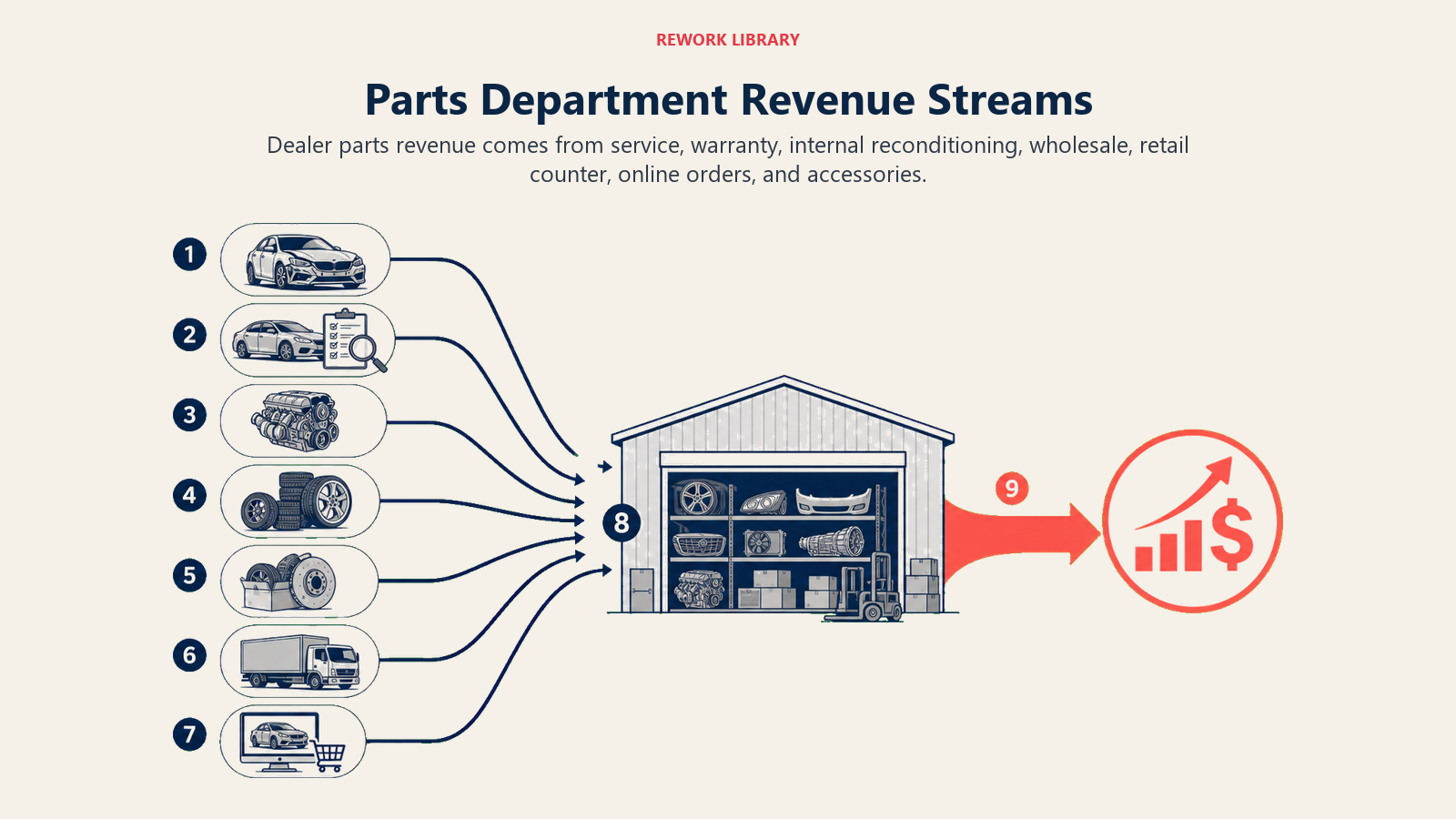
Service department parts form the foundation. This includes customer pay work, warranty claims, and internal reconditioning. But relying exclusively on your own service lane limits growth potential. You're capped by service capacity and market share. For strategies to grow service volume, see Service Marketing Campaigns.
Wholesale parts to independent shops represents untapped opportunity. Most markets have dozens of independent repair facilities that need OEM parts. They're currently buying from aftermarket suppliers or other dealers. With competitive pricing and reliable delivery, you can capture this business, often at margins exceeding your internal service work.
Over-the-counter retail sales bring walk-in customers who want to do their own work. While this represents smaller volume, it's often cash business with minimal overhead. And these customers frequently transition to service customers when they realize the job is more complex than expected.
Online parts sales and accessories expand your geographic reach. Enthusiasts and DIY customers across the country search for specific OEM parts. Setting up online ordering with shipping capabilities opens markets far beyond your service area.
Body shop parts create another channel if you have collision facilities in your market. Many body shops prefer OEM parts for insurance work and high-end repairs. Building relationships with these shops generates consistent volume.
Most dealers do 70-80% of their parts business with their own service department. Top performers reduce this to 55-65% by developing wholesale and retail channels. This diversification reduces dependence on service volume and creates stability during seasonal fluctuations.
Parts Inventory Management
Inventory turns separate average parts departments from exceptional ones. The math is simple: parts that sit on shelves tie up capital and eventually become obsolete. Parts that move generate profit and free up cash for reinvestment.
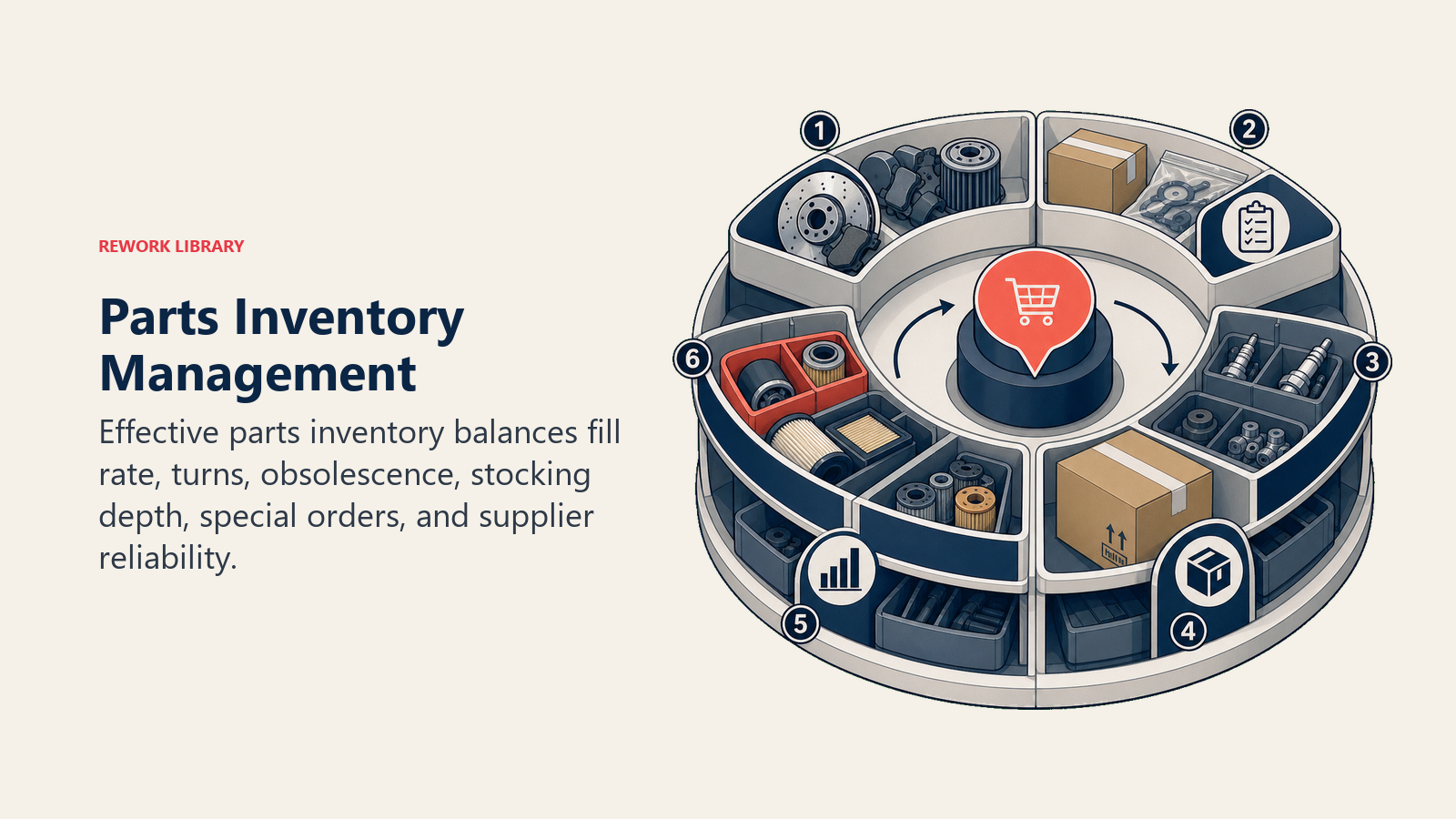
Most manufacturers recommend 4-6 inventory turns annually. But this varies significantly by brand, market, and vehicle population. Luxury brands typically turn slower (3-5×) due to specialized parts and lower volumes. High-volume domestic brands might achieve 6-8 turns with proper management. NADA's industry data provides detailed benchmarks by brand and dealership size to help parts managers assess their performance.
Stocking based on service demand patterns requires analyzing what your service department actually uses. Don't just follow OEM recommendations blindly. Pull your parts usage data from the past 12-24 months. Which parts move weekly? Which sit for months?
Fast-moving maintenance items, filters, wiper blades, brake pads for common models, should be stocked deep. You want 90%+ fill rates on these items because service advisor productivity depends on immediate availability. Nothing kills efficiency like waiting for parts to arrive.
Slow-moving specialized components need different treatment. Stock one if usage data supports it, otherwise order as needed. The carrying cost of having a $300 part sit for 18 months destroys the margin on the eventual sale.
Obsolescence management requires aggressive action. Set clear policies: parts with no movement in 12 months get returned to the manufacturer if possible. Items beyond return eligibility get priced to move. Holding obsolete inventory hoping for an eventual sale guarantees losses.
Track your obsolescence rate monthly. It should be under 3% of total inventory value. Anything higher indicates stocking problems that need immediate attention.
Fill rate targets measure how often you have parts when service needs them. Top departments maintain 90%+ fill rates for parts requested by their service advisors. But chasing 100% fill rates leads to overstocking and poor turns. There's a point where the last 5% costs more to achieve than the lost sales.
Use vendor stock order capabilities strategically. For specialized or slow-moving items, having reliable next-day delivery from regional warehouses effectively extends your inventory without the carrying cost. Similar to new vehicle inventory management principles, parts inventory requires balancing availability with carrying costs.
Parts Pricing Strategy
Matrix pricing based on part category and customer type maximizes gross profit while staying competitive. You shouldn't charge the same margin on a $12 oil filter and a $1,200 transmission component. And your wholesale accounts shouldn't pay the same prices as retail customers.
Service customers represent your highest-margin opportunity. They're paying for completed repairs, not shopping part prices. Your service pricing should include appropriate parts margins, typically 40-50% on maintenance items, 30-40% on repair components.
But don't assume customers don't notice. Excessive parts pricing creates sticker shock that damages trust. When a customer researches prices after their visit and finds you charged double for parts, they won't return for service.
Wholesale pricing tiers should reflect volume and relationship. Establish clear levels: tier one for small accounts buying occasionally, tier two for regular customers, tier three for high-volume accounts. Price each tier to be competitive with aftermarket alternatives while maintaining acceptable margins.
Most dealers find they can maintain 25-35% gross margins on wholesale parts while beating aftermarket pricing on many items. OEM parts command premiums when you emphasize quality, warranty, and reliability differences.
OEM vs. aftermarket positioning matters more for retail and wholesale than internal service. Service customers expect OEM parts on newer vehicles. But wholesale accounts and DIY customers often price shop.
Know your competition. What do local auto parts stores charge? What about other dealers? Price to win the business you want while maintaining margins. If you're trying to build wholesale volume, being 10% higher than aftermarket suppliers kills growth.
Real-time pricing adjustments respond to cost changes. When your parts cost increases, update matrices promptly. Delayed price updates eat margin. Most DMS systems support matrix updates that automatically adjust thousands of part prices based on new cost data.
Wholesale Parts Business Development
Building wholesale parts business takes dedicated effort. It won't grow by accident. You need systematic customer development, competitive pricing, reliable delivery, and relationship management.
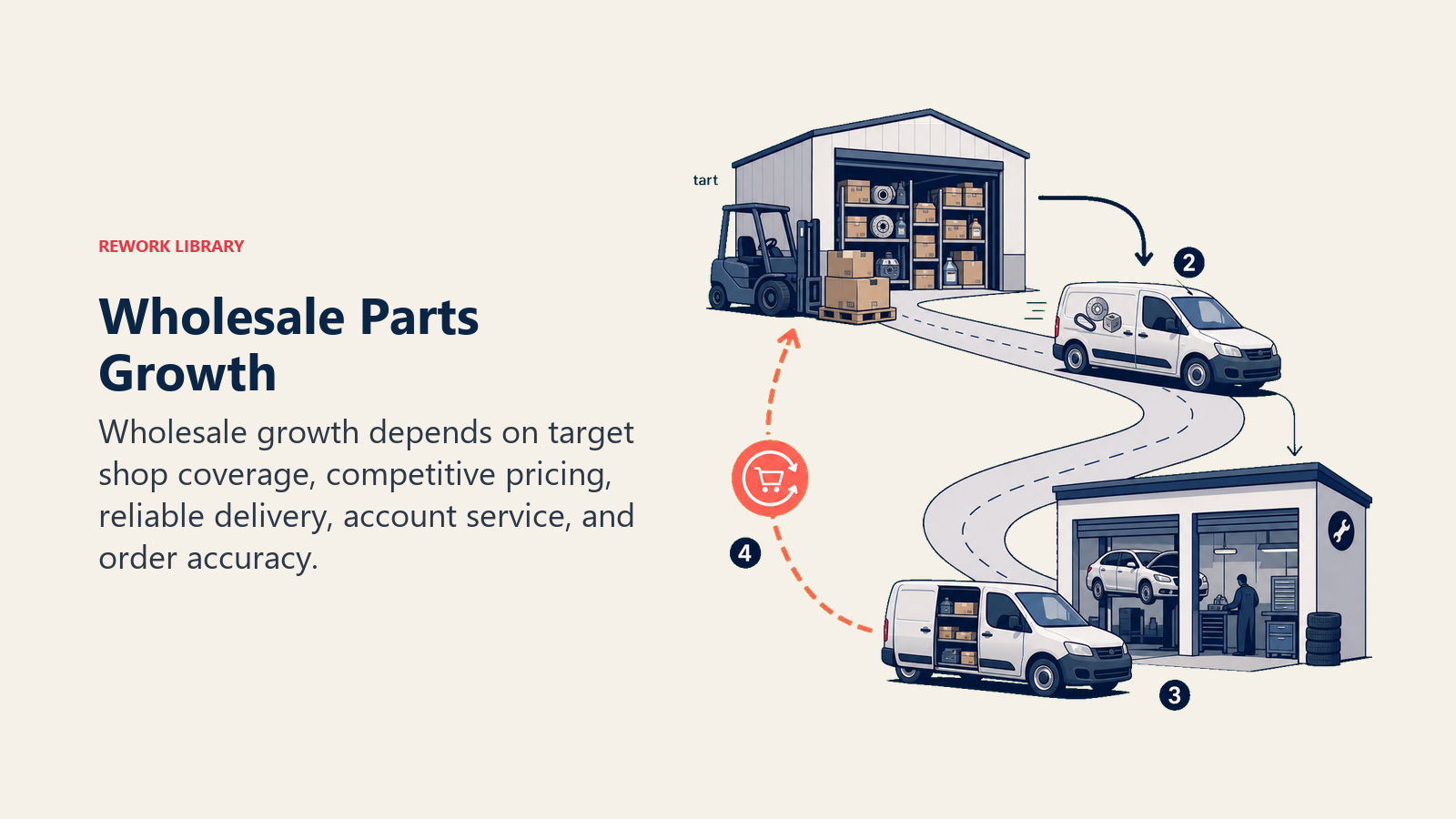
Targeting independent repair shops starts with identifying prospects. Who's working on your brand in your market? Look for shops that specialize in or frequently service your makes. These shops already have customer demand for your parts.
Start with shops within a 15-mile radius. Closer customers appreciate faster delivery and emergency service. As you build capability, expand your range.
Make personal contact. Don't rely on email or phone. Visit shops, introduce yourself, leave pricing sheets and contact information. Offer to set up accounts with competitive terms. Many shops are dissatisfied with current suppliers and open to alternatives, if you make it easy.
Delivery route optimization enables competitive service. Independent shops need parts quickly. If they order at 8 AM and you deliver at 3 PM, you're not helpful. Top dealers run morning and afternoon delivery routes with consistent schedules.
Consider same-day delivery for morning orders and stock orders for next-day pickup. Shops that can rely on your delivery schedule will shift purchasing to your dealership.
Delivery is a cost center, but it drives volume. Track delivery cost as a percentage of wholesale sales. Most dealers find 2-3% acceptable for profitable wholesale business.
Credit terms and relationship management differentiate you from cash-only suppliers. Offering net-30 or net-45 terms to qualified shops improves your competitive position. Yes, it creates receivables risk. But wholesale customers with established businesses and good payment history rarely default.
Manage relationships actively. Don't just take orders. Visit accounts quarterly, ask about their business, identify service issues, and resolve problems quickly. The parts manager or wholesale coordinator should know your top 20 accounts personally.
Competitive pricing against aftermarket requires understanding value proposition. You won't win on price alone. Aftermarket suppliers often beat OEM pricing on many items. But you can compete on:
- Immediate availability of hard-to-find parts
- Warranty and return policies
- Technical support and VIN-specific fitment
- Relationship and reliability
Price to be competitive where you can. Make up margins on specialized parts where OEM is the only viable option. The goal is growing volume that covers overhead and contributes profit, not maximizing margin on every part.
Parts-to-Labor Ratio Optimization
The parts-to-labor ratio measures how much parts revenue you generate relative to labor sales. It's one of the clearest indicators of service department health and parts department performance.
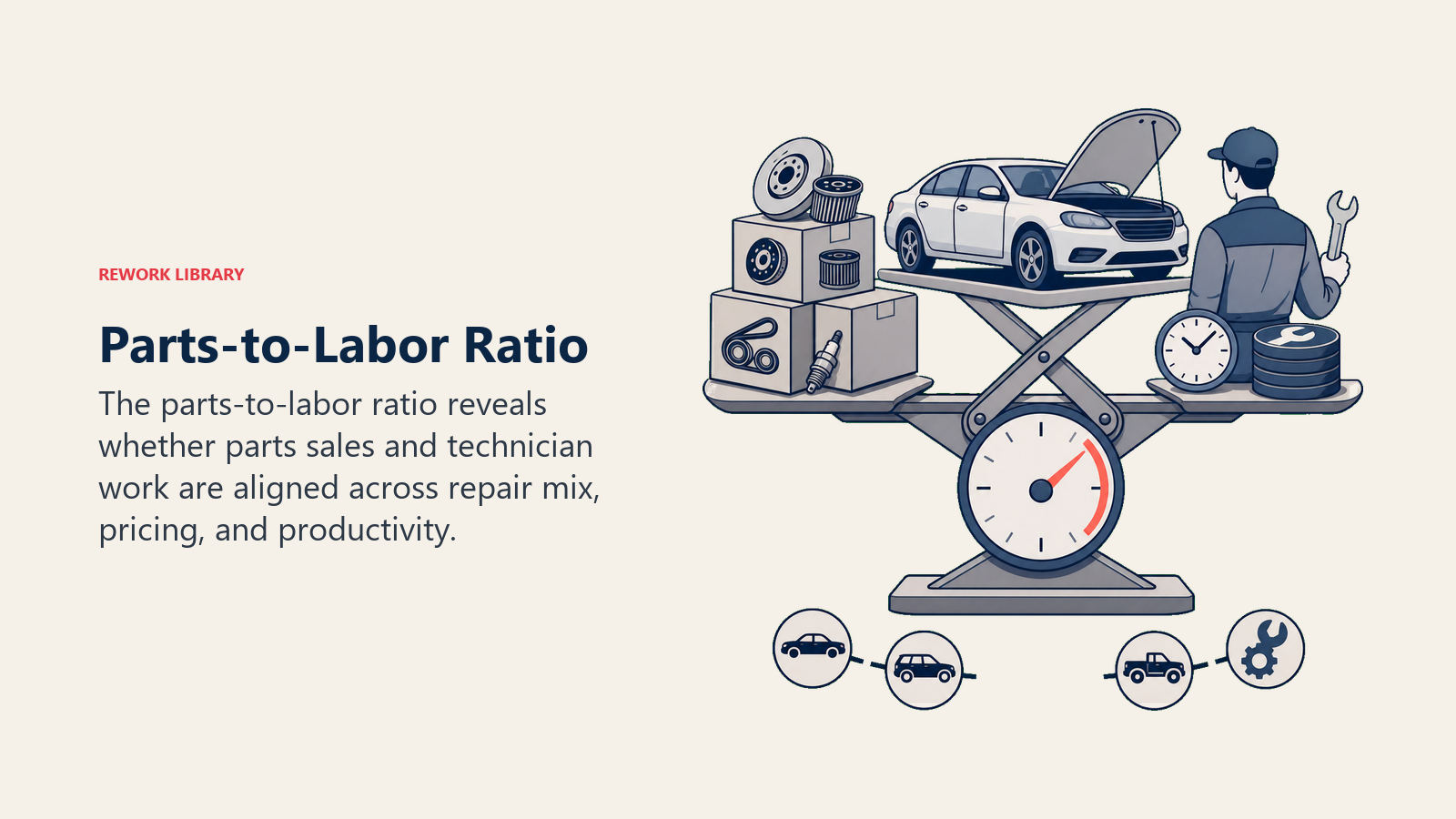
Target ratio sits between 0.85 and 1.0 for most dealers. This means for every dollar of labor sales, you should generate $0.85-$1.00 in parts sales. Ratios significantly below this range indicate problems.
Identifying underperformance causes requires analysis. Pull your service department data. What types of work generate lower parts ratios? Oil changes naturally run lower, mostly labor and fluids. But major repairs should run higher as parts costs typically exceed labor.
Are service advisors selling maintenance? Multi-point inspections should identify needed services that include parts, brakes, tires, batteries, filters, belts. If advisors only write what customers request, parts ratios suffer.
Check your pricing. If labor rates are exceptionally high relative to parts pricing, ratios shift. But don't artificially inflate parts prices to fix ratios, that damages trust and long-term retention.
Service advisor training on parts recommendations directly impacts ratios. Advisors need to understand how recommending appropriate services and parts benefits customers. A customer who declines brake service today because the advisor didn't explain the condition clearly will have unsafe brakes and poor CSI later. For comprehensive service selling techniques, see Service Advisor Selling Skills.
Train advisors to walk customers through multi-point inspections, explain findings using photos and videos, and make professional recommendations. The goal isn't pushing unnecessary work, it's ensuring customers understand their vehicle's condition and make informed decisions.
Multi-point inspection integration creates the foundation for parts sales. If technicians aren't thoroughly inspecting vehicles and documenting conditions, advisors have nothing to recommend. Your inspection process should:
- Check all major systems on every visit
- Document conditions with photos where relevant
- Flag upcoming maintenance based on mileage and time
- Provide clear red/yellow/green status indicators
Then advisors must use this information. Inspections without communication don't drive sales.
Technology & Systems
Your DMS parts module capabilities probably exceed your current usage. Most dealers use 40-50% of available functionality while manual processes waste hours daily. Like automotive CRM implementation, optimizing DMS usage requires training, configuration, and ongoing refinement.
DMS parts management optimization starts with proper setup. Are your part categories configured correctly? Stock status codes current? Pricing matrices updated? Vendor links established? Many dealers inherit DMS configurations from previous staff and never optimize them.
Invest time in training. Your parts manager should be an expert in the system. They should know how to run inventory reports, identify obsolescence, update pricing, manage special orders, and analyze performance metrics.
Use exception reports daily. Which parts are below minimum stock? Which have excessive quantity on hand? What special orders are overdue? These reports prevent problems before they impact service operations.
Parts catalog and ordering efficiency improves with proper VIN decoding. Modern systems can decode VINs and identify exact parts for specific vehicles. This reduces ordering errors and returns.
Integrate catalogs with your service writing system so advisors can identify and price parts without calling the parts counter. This speeds estimate creation and improves accuracy.
Inventory forecasting and auto-ordering capabilities exist in most DMS systems but get underutilized. Properly configured, the system can analyze usage patterns and automatically generate stock orders based on min/max levels and lead times.
Start with fast-moving items. Let the system manage routine replenishment while you focus on strategic inventory decisions. As confidence builds, expand automation to broader categories.
Online parts sales platforms extend your reach beyond the counter. Several vendors offer integration with dealer parts inventory, enabling customers to order online for pickup or shipping.
Start simple. Make your high-demand maintenance items available online. As you gain experience, expand catalog coverage. The goal isn't competing with Amazon on customer experience, it's making it easy for local customers to order parts after hours and creating incremental revenue from outside your normal service area.
Track online sales separately. Measure conversion rates, average order values, and margin. Optimize based on data, not assumptions.
Measuring Parts Department Performance
What gets measured gets managed. Track these metrics monthly:
Inventory turns: Total parts sales / average inventory value. Target: 4-6× annually depending on brand. Track alongside inventory turn optimization metrics for vehicles.
Obsolescence percentage: Obsolete parts value / total inventory value. Target: under 3%.
Fill rate: Parts available when needed / total parts requested. Target: 90%+.
Parts-to-labor ratio: Parts sales / labor sales. Target: 0.85-1.0.
Wholesale sales percentage: Wholesale / total parts sales. Growth target: 20-30%.
Gross profit margin: By channel (service, wholesale, retail, online). Compare to benchmarks and track through your dealership benchmarking process.
Days to pay suppliers: Measure working capital efficiency. Target: 30-45 days.
Review these metrics in monthly fixed ops meetings. Identify trends before they become problems. Celebrate wins when you hit targets.
Implementation Roadmap
Start with inventory optimization. Clean up obsolete stock, adjust stocking levels based on actual usage, and improve turns. This frees up capital for growth initiatives. Apply principles similar to used vehicle acquisition strategies, buy what sells, not what sits.
Next, develop wholesale business. Identify target shops, establish competitive pricing, and set up delivery routes. Start small with 5-10 accounts and expand as you build capability. This requires the same disciplined approach as dealership data analytics, measure, refine, scale.
Then optimize pricing matrices. Review margins by category and customer type. Ensure you're competitive where it matters while maximizing profit where you have advantages.
Finally, integrate technology. Implement online ordering, optimize DMS usage, and automate routine processes. Technology enables scale without proportional staff increases.
Parts department optimization isn't about one big change. It's about systematic improvement across inventory, pricing, sales channels, and operations. Dealers who invest in parts operations see returns throughout their fixed ops performance, higher service capacity, better customer satisfaction, and significantly improved profitability.
Your parts department can be a profit center that rivals or exceeds service department contribution. But it requires treating parts as a strategic business, not just a support function for the service lane. For performance measurement across all departments, implement a Dealership KPI Dashboard. To optimize overall profitability, see Gross Profit Optimization.