Extended Warranty Sales - VSC Strategy for Maximum PVR & Customer Value
Turn this article into takeaways for your work.


Each assistant summarizes the article only for you and suggests best practices for your work.
A strong automotive sales response to extended warranty objections positions the vehicle service contract as protection the customer needs, not a product you are pushing. Match coverage to ownership length and repair risk, then compare a small monthly payment against a likely four or five figure repair. That single move is what lifts VSC penetration from 40% to 75%.
Vehicle service contracts represent the single most profitable F&I product you'll sell. With commission rates typically running 40-60% and average PVRs exceeding $1,000, VSC sales directly impact your bottom line. But here's the thing, profitability and customer value aren't mutually exclusive. When positioned correctly, extended warranties protect customers from financial shock while generating substantial backend revenue.
The difference between 40% VSC penetration and 75% penetration? About $600 per vehicle in additional gross profit. That's $60,000 per month on 100 units. The gap isn't about pushy sales tactics or manipulation. It's about understanding your product, matching coverage to customer needs, and communicating value effectively.
This guide breaks down the complete VSC selling strategy, from product fundamentals to objection handling to integration with your broader F&I menu.
VSC Fundamentals - Understanding the Product
Let's start with terminology. A vehicle service contract isn't insurance, it's a service agreement covering mechanical breakdowns. This legal distinction matters for licensing, regulation, and customer explanation. Don't call it "warranty insurance" or "extended insurance." It's coverage, protection, or a service contract.
Coverage Types:
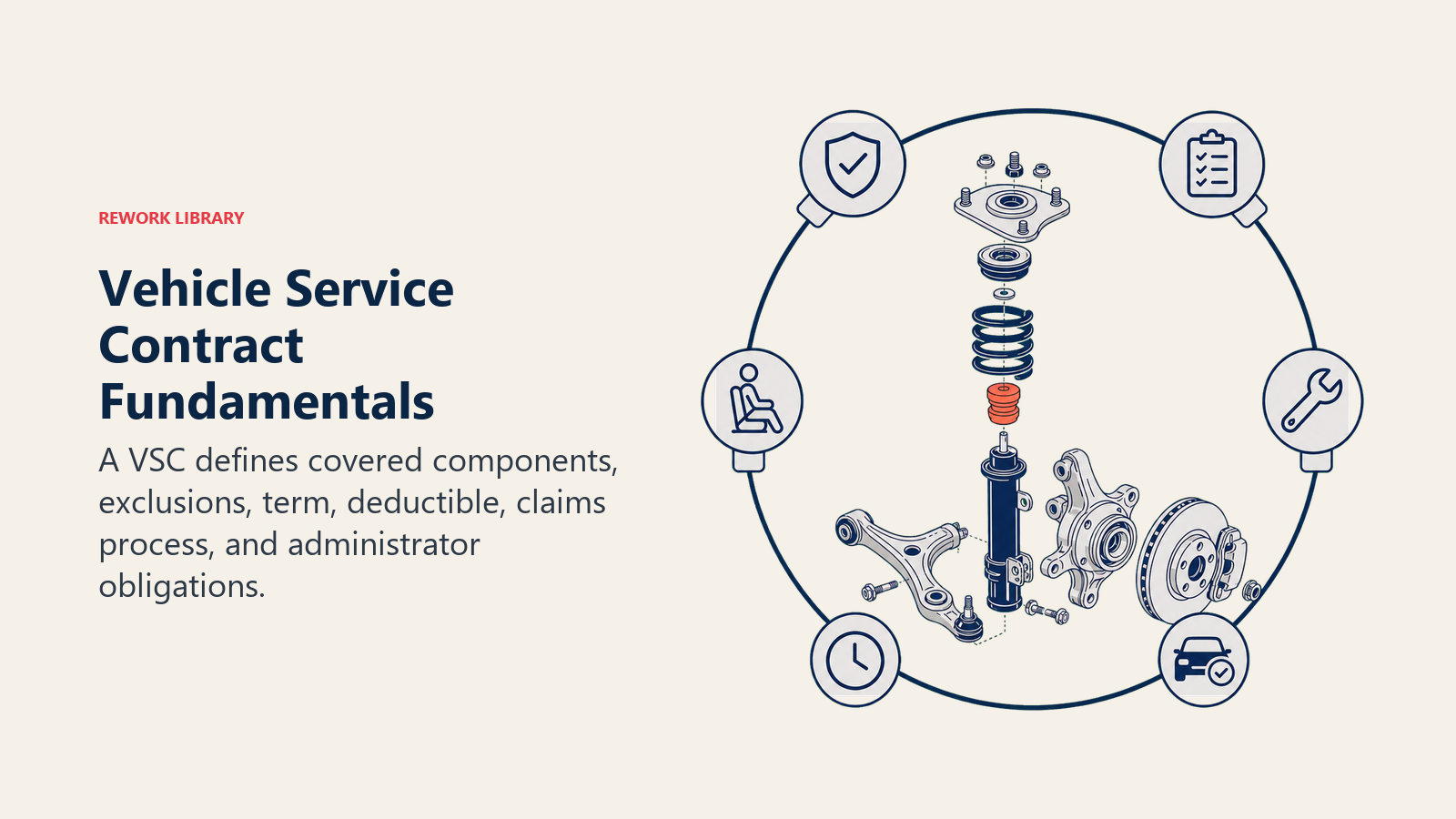
Stated Component Coverage lists specific parts and systems covered. The contract explicitly names what's included, engine components, transmission parts, electrical systems, etc. If it's not listed, it's not covered. This mid-level option works well for customers who want comprehensive coverage at a moderate price point.
Exclusionary Coverage (also called "wrap" coverage) takes the opposite approach. It covers everything except what's explicitly excluded, wear items, maintenance, glass, etc. This premium option provides the most comprehensive protection and works particularly well on luxury vehicles or technology-heavy models where repair costs run high.
Powertrain Coverage represents your budget option. It covers engine, transmission, drive axle, and related components. That's it. Positioning this as the "basic" tier helps customers understand they're choosing minimal protection, not comprehensive coverage.
Term and Mileage Options:
Coverage duration combines time and mileage limits. A 7-year/100,000-mile contract expires at whichever comes first. New vehicle customers typically buy coverage extending beyond manufacturer warranty (5 years/60,000 miles extending factory 3/36 coverage, for example). Used vehicle customers often start coverage immediately with terms matching expected ownership.
Deductible Structures:
$0 deductible contracts cost more but eliminate out-of-pocket expense at claim time. $100 deductible reduces price while maintaining strong value. $200 deductible drops price further but introduces resistance from customers who see it as "paying twice" for repairs. I've found $100 deductible hits the sweet spot for most customers.
VSC Providers and Pricing - Administrator Selection
Not all VSC providers offer equal value. Your choice of administrator affects pricing, claims experience, customer satisfaction, and your commission.
OEM/Captive Programs come directly from manufacturers. Ford ESP, GM Protection Plan, Toyota Extra Care, etc. These carry manufacturer backing, use dealer networks for repairs, and provide customer confidence. Pricing runs higher, but penetration rates often follow because customers trust the brand. Commission margins are typically lower than aftermarket options.
Aftermarket Administrators offer better dealer profitability and flexibility. Companies like Zurich, Assurant, JM&A, and EFG provide competitive coverage at lower dealer cost, meaning higher commission. The key differentiator is administrator rating and reputation. A-rated administrators pay claims reliably. Unrated or lower-tier companies create customer headaches and damage your reputation.
Cost Structure:
Dealer cost for VSC typically ranges from $600-$1,200 depending on coverage level, vehicle, and term. Retail pricing runs $1,500-$3,500. That gap represents your gross profit, split between dealership and F&I manager commission.
Reserve programs allow additional profit participation based on claims performance. If customers don't file claims, you receive additional backend profit. But poor quality vehicles or overly aggressive coverage can flip reserves negative.
Reinsurance Opportunities:
Large dealer groups sometimes establish reinsurance companies, retaining more profit in-house while maintaining an administrator for claims processing. This requires substantial capital and volume but dramatically increases profitability over time.
New vs. Used Vehicle VSC - Different Selling Approaches
Your selling strategy changes based on vehicle type and existing warranty coverage.
New Vehicle Factory Warranty Extension:
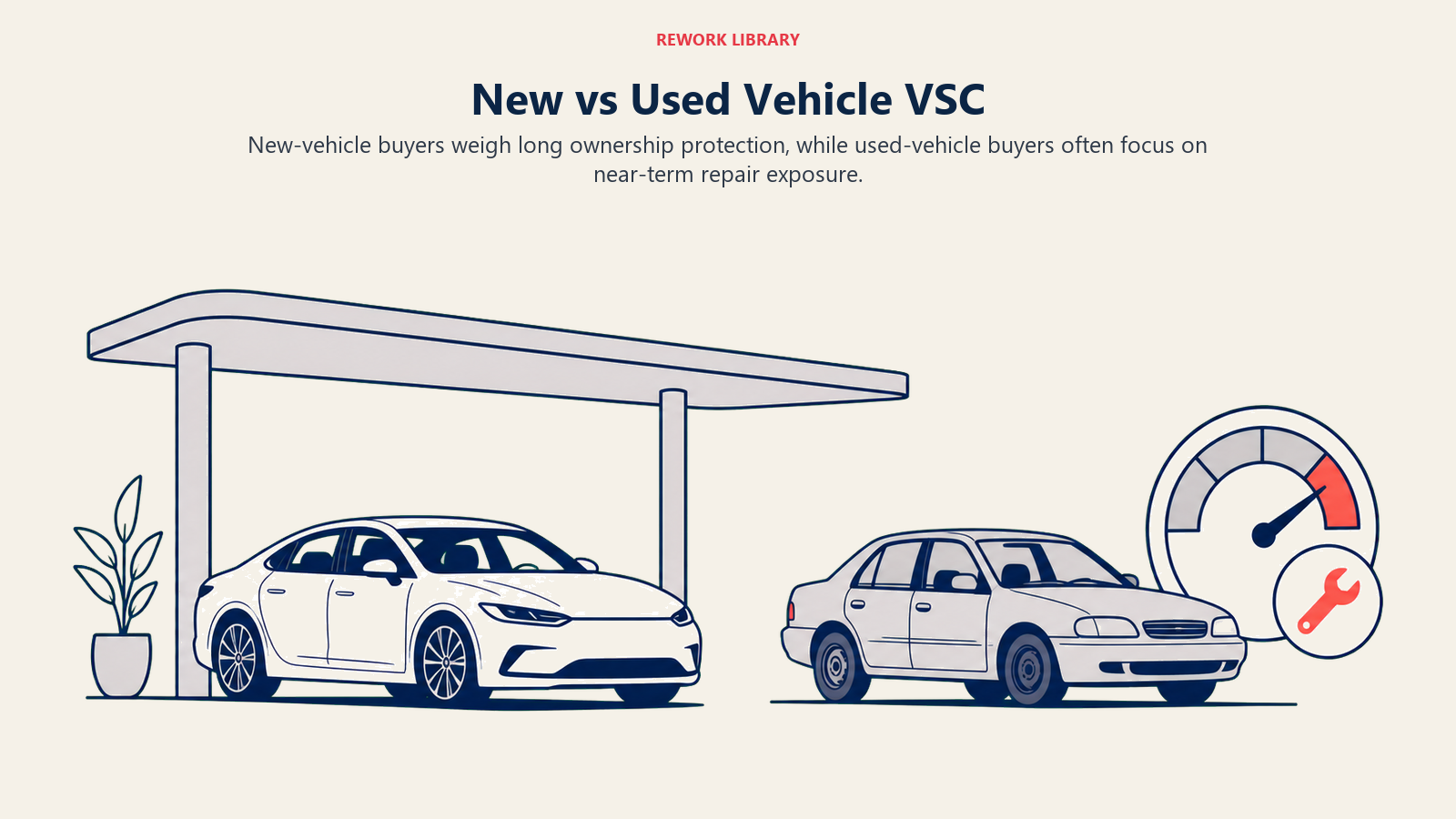
New cars come with manufacturer warranty (typically 3 years/36,000 miles bumper-to-bumper and 5 years/60,000 miles powertrain). Your VSC extends beyond that coverage. Position VSC as "continuing your factory protection" rather than buying something new. The value conversation focuses on repair costs after year three and keeping vehicles 5+ years.
Example: "Your factory coverage ends at 36,000 miles. Average transmission replacement costs $5,500. This coverage continues that protection for the full seven years you're keeping the vehicle."
CPO Manufacturer Coverage Considerations:
Certified Pre-Owned programs include manufacturer-backed limited warranty (often 1 year/12,000 miles beyond remaining factory warranty). You're selling extension beyond CPO coverage. Emphasize that CPO warranty is limited-term and comprehensive aftermarket coverage picks up where it ends.
Used Vehicle Higher Risk Positioning:
Used vehicles without remaining factory warranty carry immediate exposure. A 2018 model with 60,000 miles? Factory warranty is done. Any breakdown comes out of pocket. This creates urgency and justification for VSC purchase.
Position VSC on used inventory as essential protection, not optional coverage. Repair probability increases with age and mileage. Modern vehicle complexity means expensive repairs. Without coverage, a single failure could cost more than the VSC itself.
Coverage Recommendation by Age/Mileage:
- 0-30K miles: Optional, but valuable for long-term owners
- 30-60K miles: Strongly recommended, factory coverage expiring
- 60-100K miles: Essential coverage, high breakdown probability
- 100K+ miles: Critical evaluation required, pricing may exceed value
Needs-Based Selling Approach - Customer Profiling
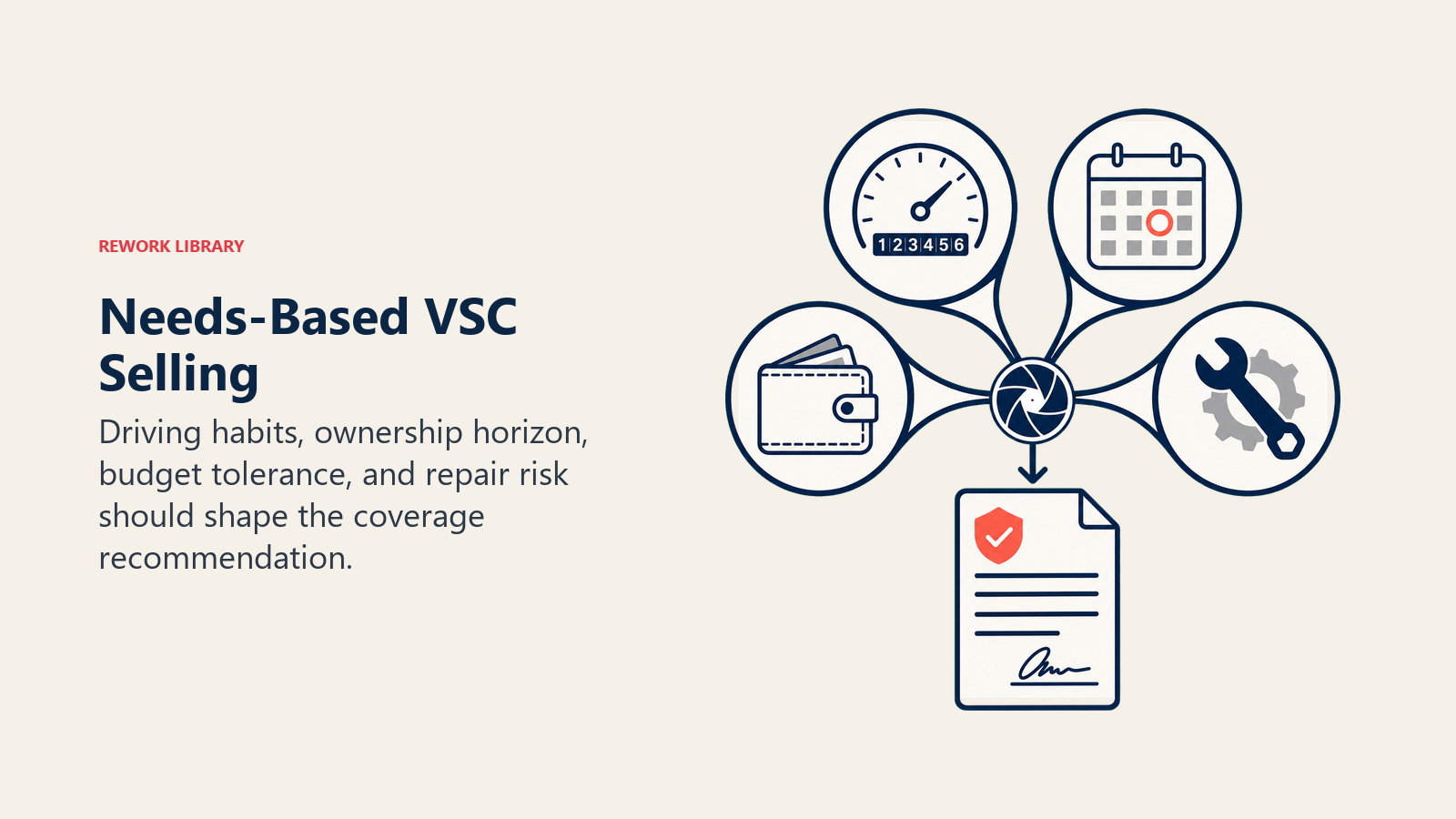
Effective VSC selling starts with understanding who needs coverage most. Some customers represent perfect VSC candidates. Others don't fit the profile. Don't waste time pushing coverage on someone who won't keep the vehicle or plans to trade in 18 months.
Long-Term Ownership Plans (Keep 5+ Years):
Question: "How long are you planning to keep this vehicle?" If they say five years or more, VSC becomes valuable. They'll drive beyond factory warranty and face repair exposure. If they trade every two years, coverage adds little value and you'll fight objections all day.
Budget Consciousness (Repair Cost Aversion):
Some customers have $5,000 sitting around for unexpected repairs. Most don't. Ask about unexpected repair concerns. If they express worry about surprise costs, VSC directly addresses that concern. Position coverage as budget protection.
Vehicle Complexity (Luxury, European, Technology-Heavy):
Modern vehicles carry expensive repair bills. Adaptive cruise radar module? $2,500. Blind spot monitoring calibration? $800. Infotainment screen replacement? $1,800. Luxury and European vehicles amplify this, a Mercedes transmission repair runs $8,000. Technology-heavy vehicles justify premium VSC coverage.
Driving Patterns (High Mileage Drivers):
Customer driving 20,000+ miles annually accelerates wear and breakdown probability. They'll hit mileage limits quickly. Recommend higher mileage coverage (100K or 125K miles) for adequate protection. Their usage pattern makes VSC particularly valuable.
Previous Repair Experience:
If a customer mentions previous vehicle repair expenses or breakdown frustration, you've got a natural VSC candidate. They've experienced the pain you're preventing. Reference their experience: "You mentioned spending $3,500 on transmission work with your last vehicle. This coverage eliminates that exposure."
Value Presentation Techniques - Risk and Peace of Mind
Customers don't buy VSC because they understand coverage details. They buy because you've effectively communicated value and positioned risk they want to avoid.
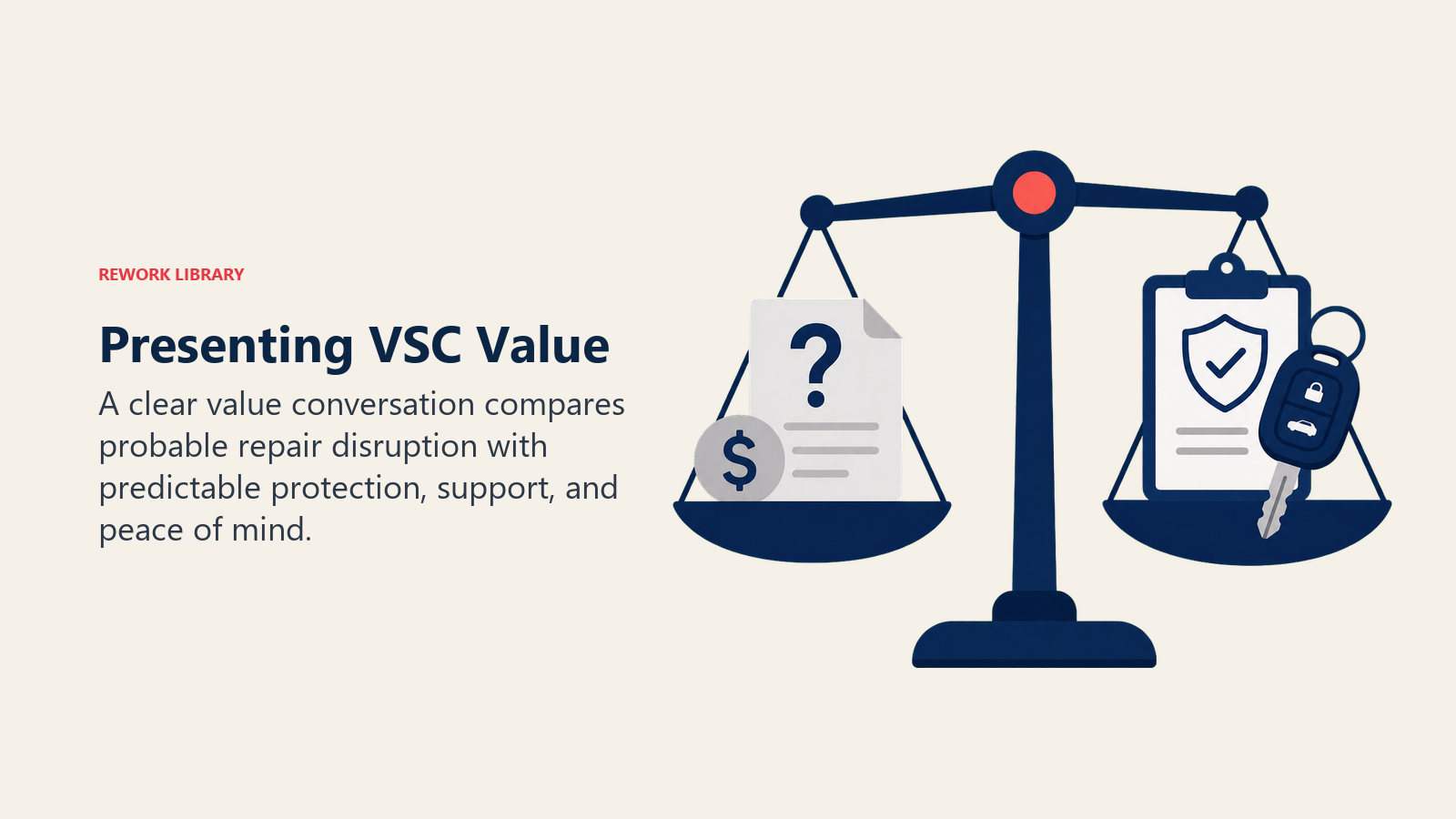
Modern Vehicle Repair Cost Examples:
Today's repair costs shock customers unfamiliar with modern vehicle complexity. Provide specific examples:
- Transmission replacement: $5,000-$8,000
- Engine repair: $4,000-$12,000
- Turbocharger replacement: $2,500-$4,000
- Hybrid battery: $3,000-$6,000
- Electronics/infotainment: $1,500-$3,000
- Adaptive cruise module: $2,000-$3,500
These aren't hypotheticals. Pull service department ROs showing actual customer pay repair costs. Nothing communicates value like real invoices.
Coverage Length Beyond Factory Warranty:
Visualize the timeline. Draw it out: "Factory coverage ends here at 36 months. You're keeping the vehicle for seven years. That's four years of complete exposure. This coverage eliminates that gap."
Most breakdowns occur after factory warranty expires. That's not coincidence, it's wear and mileage accumulation. Coverage during ownership years 4-7 provides maximum value.
Payment vs. Out-of-Pocket Cost Comparison:
Monthly payment increase for VSC typically runs $15-$30. Position this against potential repair: "You're looking at $22 per month for this coverage. A single transmission repair costs $5,500. One failure pays for 20 years of coverage."
The math is irresistible when presented correctly. Small monthly investment protecting against massive one-time expense resonates with customers.
Transferability Value for Resale:
VSC with remaining term transfers to the next owner. This adds resale value and marketability. Private party buyers especially value vehicles with transferable coverage. Mention this for customers planning eventual resale.
Coverage Level Selection - Guiding the Decision
Don't ask "do you want warranty coverage?" Present coverage options and guide customers toward appropriate protection level.
Powertrain-Only Positioning (Budget Option):
"This covers your engine, transmission, and drivetrain components. Basic protection at the lowest price point. It won't cover electronics, climate control, or other systems. Most customers find this too limited, but it's available if budget is your primary concern."
By positioning powertrain as minimal protection, you encourage customers to choose higher coverage levels.
Stated Component (Mid-Level):
"This mid-level plan covers all major systems, engine, transmission, electrical, fuel, cooling, air conditioning. It lists every covered component. Provides solid protection at a moderate price. This is our most popular option."
Stated component serves as your anchor. Good coverage, reasonable price, popular choice.
Exclusionary/Comprehensive (Premium):
"This is complete protection covering everything except wear items and maintenance. If something breaks, it's covered. This eliminates guesswork about what's included. For luxury vehicles or technology-heavy models, this provides true peace of mind."
Premium coverage works best on expensive vehicles where comprehensive protection justifies higher cost.
Term and Mileage Recommendation:
Match coverage to ownership plans and driving habits:
- Keeping 5 years, driving 12K annually? 5 years/60K coverage.
- Keeping 7 years, driving 15K annually? 7 years/100K coverage.
- Keeping 10 years, driving 20K annually? 8 years/125K coverage.
Align recommendations with customer circumstances. Don't oversell coverage they won't use.
Deductible Impact on Price and Value:
Show pricing for $0, $100, and $200 deductible options. Let customers see the cost difference. Most choose $100 deductible as the balance between price savings and out-of-pocket exposure.
Common Objections - "I'll Take My Chances"
VSC objections fall into predictable patterns. Prepare responses in advance.
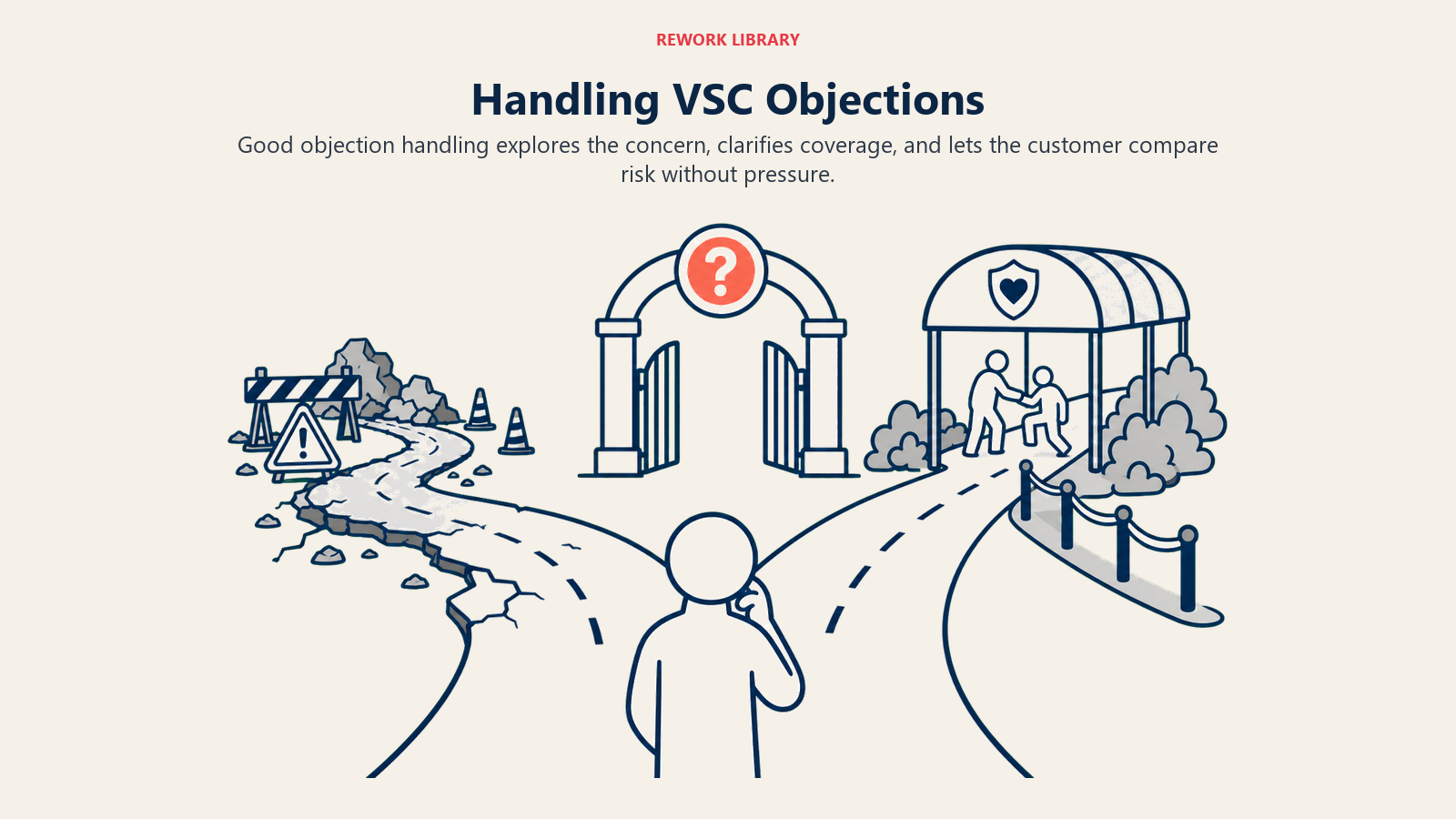
"I'll take my chances / I'll self-insure"
"I understand that approach. Many people have $5,000-$8,000 set aside specifically for vehicle repairs. Most of my customers prefer the certainty of $22 per month over the possibility of a $7,000 transmission replacement. Which approach works better for your situation?"
This reframes "self-insurance" as requiring substantial savings. Few customers have dedicated repair funds.
"Vehicles are reliable now"
"You're absolutely right, modern vehicles are well-built. The challenge isn't reliability, it's complexity. Today's vehicles have more electronics, sensors, and technology than ever before. When something fails, repair costs are significantly higher than older vehicles. This coverage protects against expensive technology repairs, not basic reliability issues."
Acknowledge their point, then redirect to the real concern, repair cost, not failure probability.
"I'll buy it later / I'll wait and see"
"A few things to know about purchasing later: First, coverage price increases based on vehicle age and mileage. Buying today at 5,000 miles costs less than buying at 30,000 miles. Second, once a component fails, it's uninsurable. You can't buy coverage after problems appear. Third, many administrators won't sell coverage on vehicles past certain age or mileage thresholds. If you want this protection, today is your best opportunity."
Waiting costs more or eliminates eligibility entirely. Now is optimal timing.
"I can cancel anytime / What's the cancellation policy?"
Be completely transparent. State law determines cancellation terms. Most VSC contracts allow cancellation with pro-rated refund (some deduct claims and administrative fees). Don't hide cancellation terms or make them sound more favorable than they are. Honesty builds trust.
"You can cancel with 30 days' notice and receive a pro-rated refund minus any claims filed. The refund is calculated based on time or mileage remaining. I'm providing full cancellation terms in your contract documents."
Integration with Other Products - Package Selling
VSC rarely sells in isolation. It's part of your complete F&I menu alongside GAP, maintenance plans, tire and wheel protection, etc.
VSC + Maintenance Plan Bundling:
These complement perfectly. Maintenance plan covers scheduled service (oil changes, filters, inspections). VSC covers breakdowns. Together they provide complete vehicle ownership protection. Bundle pricing creates additional value: "Maintenance plan separately is $895. VSC separately is $2,495. Together we're pricing them at $3,190, you're saving $200 with the package."
VSC + Tire & Wheel Package:
Another natural pairing. VSC covers mechanical breakdowns. Tire and wheel covers road hazard and cosmetic damage. Present as comprehensive vehicle protection: "This package covers mechanical issues and tire/wheel damage. Complete protection for $42 per month."
Payment Impact of Multiple Products:
As you add products, payment increases. Manage this carefully. Show total monthly cost for various packages:
- VSC only: +$22/month
- VSC + GAP: +$29/month
- VSC + GAP + Maintenance: +$42/month
- VSC + GAP + Maintenance + Tire/Wheel: +$51/month
Customers often accept higher payment when products are packaged and presented as comprehensive protection.
Removing Products vs. Reducing Coverage:
If customers resist payment increase, offer coverage reduction rather than product removal. "Rather than remove VSC entirely, we could reduce coverage from exclusionary to stated component. That saves $12 per month while maintaining solid protection."
This preserves product sale at lower PVR rather than losing the sale entirely.
Post-Sale Support - Ensuring Customer Satisfaction
VSC satisfaction depends on post-sale execution, not just the sale itself.
Coverage Explanation and Documentation:
Before customers leave, explain coverage clearly: "Your coverage begins today with zero deductible. It covers all mechanical and electrical components listed in your contract. Coverage runs for 7 years or 100,000 miles, whichever comes first. If something breaks, you're protected."
Provide contract documents, administrator contact card, and coverage summary. Don't hand over a stack of papers without explanation.
Claim Process Walkthrough:
Explain claim filing: "If something needs repair, take the vehicle to any licensed repair facility, our service department or any shop you prefer. Call this administrator phone number to open a claim. They'll verify coverage and authorize repair. The shop bills the administrator directly for covered repairs. You won't pay for covered components."
Knowing the process beforehand prevents customer confusion during claim time.
Participating Repair Facility Network:
Some administrators restrict repairs to network shops. Others allow any licensed facility. Clarify this clearly. If network-restricted, provide the shop locator information and explain the requirement.
Administrator Contact Information:
Provide administrator phone number, website, and mobile app information (if available). Program the number in the customer's phone before they leave. Make accessing service easy.
Cancellation Terms (As Required):
Clearly state cancellation policy and provide written terms. Include pro-ration method, fee structure, and notice requirements. Don't hide this information or make cancellation difficult.
Implementation Worksheet
VSC Provider Evaluation:
- Administrator financial rating verified
- Claims reputation researched
- Dealer cost structure reviewed
- Commission rate confirmed
- Coverage terms compared to competitors
- Reserve program evaluated
Customer Needs Assessment:
- Ownership timeline discussed
- Driving mileage estimated
- Repair cost concern level assessed
- Vehicle complexity considered
- Previous repair experience noted
Value Presentation Checklist:
- Modern repair costs example provided
- Coverage timeline visualized
- Monthly payment vs. repair cost compared
- Transferability value mentioned
- Coverage level options presented clearly
Coverage Recommendation:
- Powertrain option shown (budget baseline)
- Stated component positioned (popular choice)
- Exclusionary presented (premium option)
- Term/mileage matched to customer usage
- Deductible options compared
Common Objections - Prepared Responses:
- "I'll take my chances" → self-insurance reality
- "Vehicles are reliable" → complexity and repair costs
- "I'll buy later" → price increase and insurability
- Cancellation policy → transparent disclosure
Post-Sale Support Execution:
- Coverage explanation provided
- Claim process walkthrough completed
- Administrator contact information given
- Repair facility network clarified
- Cancellation terms disclosed in writing
Vehicle service contracts represent your highest-margin F&I product. Approach them ethically, position coverage to customers who genuinely benefit from protection, explain terms transparently, and ensure claim support delivers on the promises made during sale. Done correctly, VSC sales generate substantial profit while protecting customers from financial hardship when breakdowns occur. That's sustainable business built on mutual value.
And when your penetration rate climbs from 40% to 75%, that extra $60,000 per month in gross profit proves that value-based selling works better than pressure tactics ever did.
External Resources
- Vehicle Service Contracts Explained - Consumer Affairs - Comprehensive consumer guide to VSCs and how they work
- Guide to Automobile Service Contracts - California Department of Insurance - Official state guidance on service contracts and extended warranties
- NADA Compliance Resources - Industry compliance standards and best practices for automotive dealers

Senior Implementation Consultant
On this page
- VSC Fundamentals - Understanding the Product
- VSC Providers and Pricing - Administrator Selection
- New vs. Used Vehicle VSC - Different Selling Approaches
- Needs-Based Selling Approach - Customer Profiling
- Value Presentation Techniques - Risk and Peace of Mind
- Coverage Level Selection - Guiding the Decision
- Common Objections - "I'll Take My Chances"
- Integration with Other Products - Package Selling
- Post-Sale Support - Ensuring Customer Satisfaction
- Implementation Worksheet
- External Resources