Automotive Customer Journey - 2026 Guide
Turn this article into takeaways for your work.


Each assistant summarizes the article only for you and suggests best practices for your work.
The customer who walks into your showroom today has already made 85% of their purchase decision. They've researched vehicles for weeks, compared pricing across multiple dealers, read reviews, watched YouTube videos, and probably know more about your inventory than your newest sales associate.
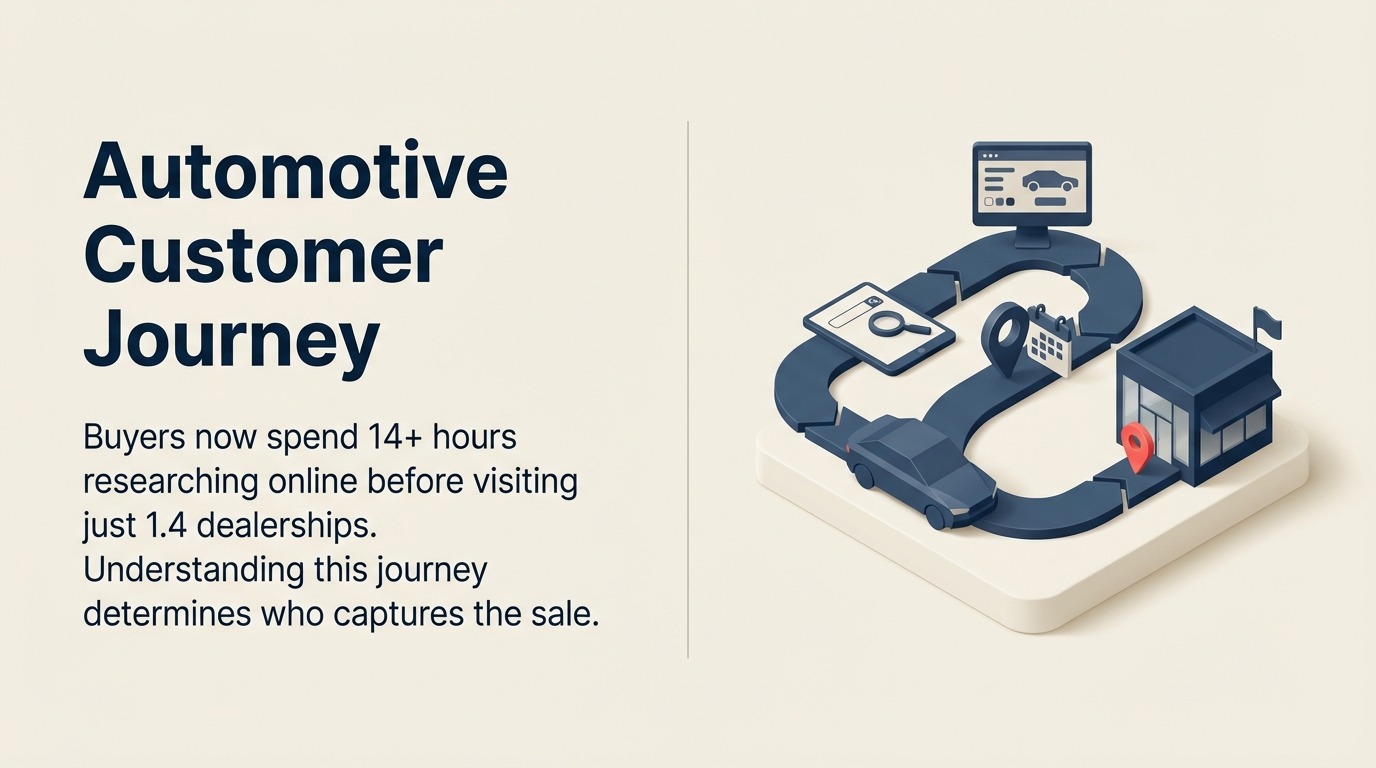
That's not an exaggeration - that's data. According to the Cox Automotive Car Buyer Journey Study, the average car buyer spends 14+ hours online researching before they visit a single dealership, and when they do visit, they're going to an average of just 1.4 locations. In 2005, that number was 5+ dealership visits.
The customer journey changed completely, and dealers who still think it starts when someone walks through the door are losing sales before they even know they were in competition.
The Modern Journey Overview
Understanding how radically the buying process shifted helps explain why traditional sales tactics don't work anymore.
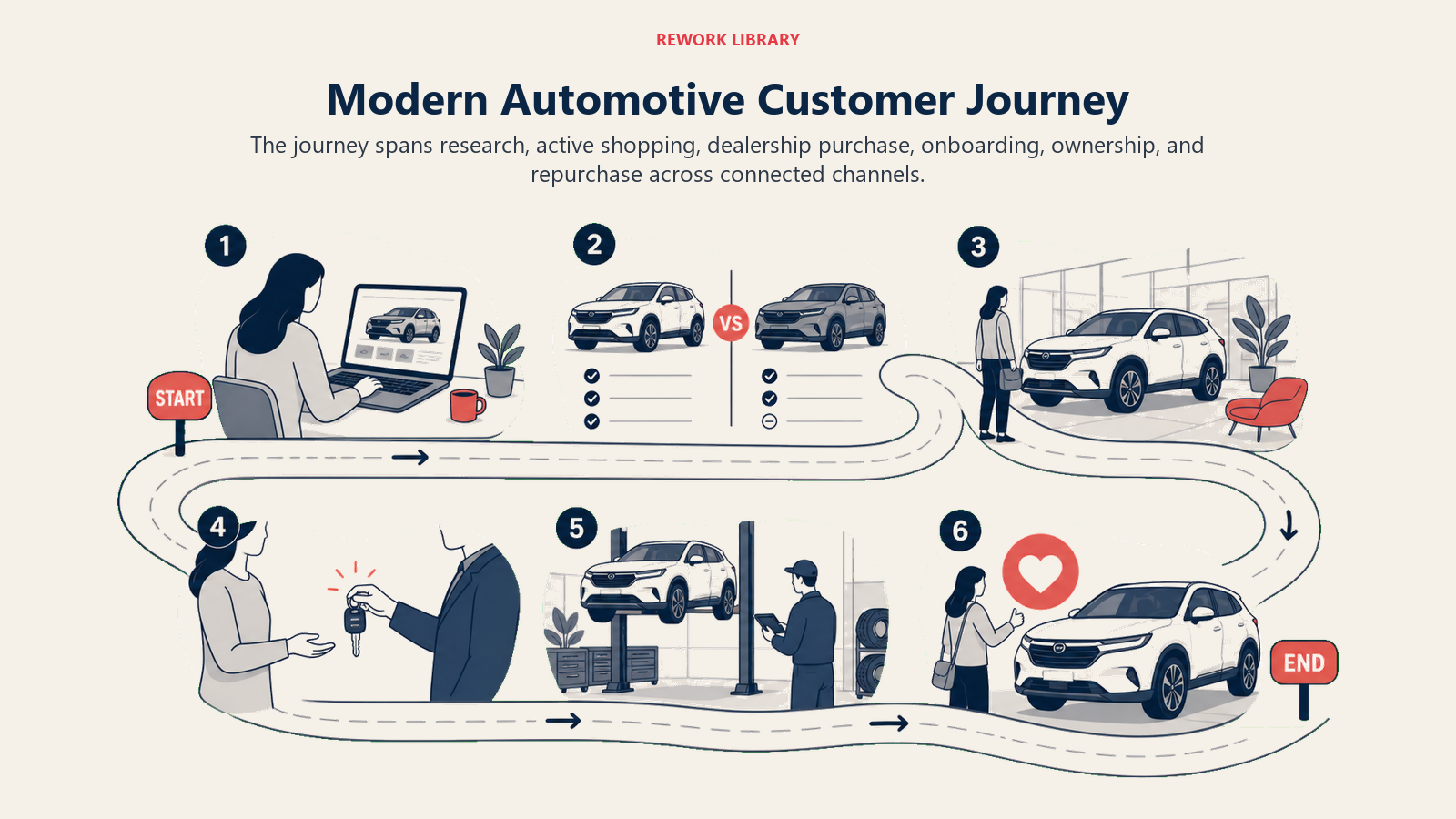
Pre-2010 vs 2026 journey comparison shows the transformation:
2005: Customer drives past dealerships, sees inventory, walks into 5-7 locations, test drives multiple vehicles, negotiates with several sales managers, makes decision based on in-person experience and relationship with salesperson.
2026: Customer researches online for 3-6 weeks, visits dealer websites 4-8 times, reads third-party reviews, watches YouTube comparisons, uses online calculators and trade-in tools, narrows to 2 finalist dealerships, schedules appointment at preferred location, test drives 1-2 vehicles, negotiates minimally (already knows pricing), closes same day or within 48 hours.
The journey moved from physical to digital, from dealer-controlled to customer-controlled, and from relationship-driven to information-driven.
Research-heavy, visit-light behavior defines the modern buyer. They're spending 15x more time researching online than visiting dealerships. They're consuming content from third-party review sites, manufacturer websites, dealer inventory pages, social media, and YouTube before they ever contact you.
By the time they reach out, they've already decided which vehicle they want, what features matter, what they should pay, and which dealerships meet their criteria.
Average 1.4 dealership visits (down from 5+ in 2005) means you don't get multiple chances to make an impression. If the customer visits your competitor first and has a good experience, you probably won't see them. If they visit you first and the experience is mediocre, they're going to your competitor.
Every touchpoint matters because you have so few of them.
Digital-first decision making shifted power from the dealership to the customer. You used to control information access - only dealers had invoice pricing, inventory data, and financing options. Now customers access all of this online before they talk to you.
Your value proposition can't be information access anymore. It has to be experience, trust, convenience, and service quality.
Stage 1: Awareness & Consideration (Weeks 1-4)
The journey starts long before you know the customer exists, and what happens in these early weeks determines whether you even make the consideration set.
Third-party research sites like Edmunds, KBB (Kelley Blue Book), Cars.com, and Consumer Reports dominate early research. Customers compare vehicle specs, read expert reviews, check reliability ratings, and research ownership costs.
They're learning which vehicles meet their needs before they care which dealership sells them. Your brand matters here (manufacturer marketing), not your specific dealership.
YouTube reviews and comparisons influence purchase decisions enormously because customers trust independent reviewers more than dealer marketing. Video content showing real-world performance, interior quality, and feature demonstrations helps customers visualize ownership.
Smart manufacturers and dealers create comparison videos addressing customer concerns directly rather than just highlighting features.
Social media influence comes from friends sharing purchase experiences, automotive influencers posting reviews, and manufacturer advertising targeting specific demographics. A positive post from someone the customer trusts carries more weight than 10 professional advertisements.
Negative experiences also spread faster on social media than through any other channel.
Manufacturer website research happens after customers narrow their consideration set to 2-4 vehicles. They're using configurators to build their ideal spec, comparing trim levels, exploring available features, and checking manufacturer incentives.
At this stage, they're often favoring one vehicle but validating their decision through detailed research.
Dealer touchpoints at this stage are minimal unless you're running brand awareness campaigns or showing up in third-party inventory aggregators. Most customers don't care which specific dealership they buy from yet - they're focused on which vehicle to buy.
But if you can capture attention through content marketing (helpful buyer's guides, comparison content, ownership cost calculators), you start building relationship before they actively shop.
Stage 2: Active Shopping (Weeks 5-8)
This is where customers shift from research mode to shopping mode, and your digital presence determines whether you're in the consideration set.
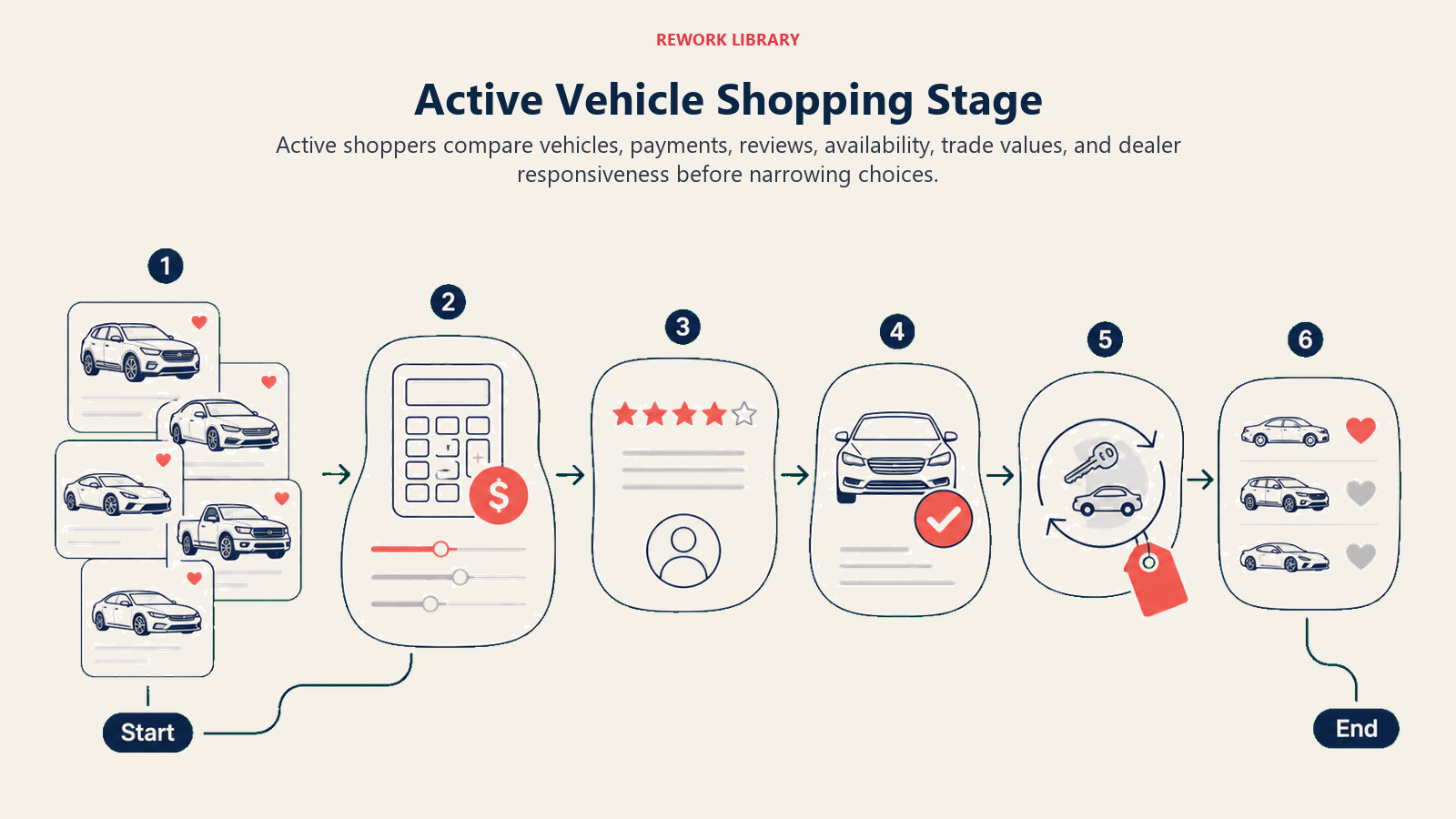
Dealer website visits average 4.2 per buyer according to industry data. They're checking your inventory, comparing pricing, reading vehicle descriptions, and assessing whether you stock what they want. Research shows that 81% of car buyers use the internet for research before visiting a dealership, making your digital presence critical to initial consideration.
If your website loads slowly, displays poorly on mobile, or makes it hard to find inventory, you're eliminated before you know they existed.
VDP views and photo galleries are the digital equivalent of walking around a vehicle on your lot. Customers spend 2-4 minutes per VDP (Vehicle Detail Page) examining photos, reading descriptions, checking features, and comparing pricing against other dealers.
Low-quality photos, missing information, or inaccurate pricing all damage credibility and reduce the likelihood they contact you.
Online pricing tools and calculators help customers understand total purchase cost including taxes, fees, trade-in credit, and monthly payments. Transparency builds trust. Hidden fees or "call for price" creates suspicion and sends customers to competitors who publish pricing openly.
Digital retailing platforms let customers configure their deal online - selecting vehicle, estimating trade-in value, choosing financing terms, and calculating payments. They can complete 70-80% of the transaction before visiting your dealership. The Deloitte Global Automotive Consumer Study shows growing consumer openness to completing more of the purchase process digitally.
Customers who use digital retailing tools close at 40-50% higher rates because they're eliminating uncertainty before the visit.
Trade-in appraisal tools let customers enter vehicle information and get instant trade-in estimates. These tools aren't perfectly accurate, but they set expectations and start the trade discussion before the customer visits your lot.
Customers arriving with realistic trade expectations negotiate faster and close more frequently than those with unrealistic trade values.
Email and chat inquiries represent high-intent customers ready to engage. They've researched enough to have specific questions, and they're comparing how quickly and thoroughly different dealerships respond.
Response time under 5 minutes increases appointment-set rate by 10x compared to response time over 30 minutes. Most dealers take 45-90 minutes to respond, which is why they lose so many internet leads.
Stage 3: Dealership Visit & Purchase (Week 9-10)
After weeks of digital research, customers finally visit your dealership. What happens in the next 2-3 hours determines whether you earn the sale.
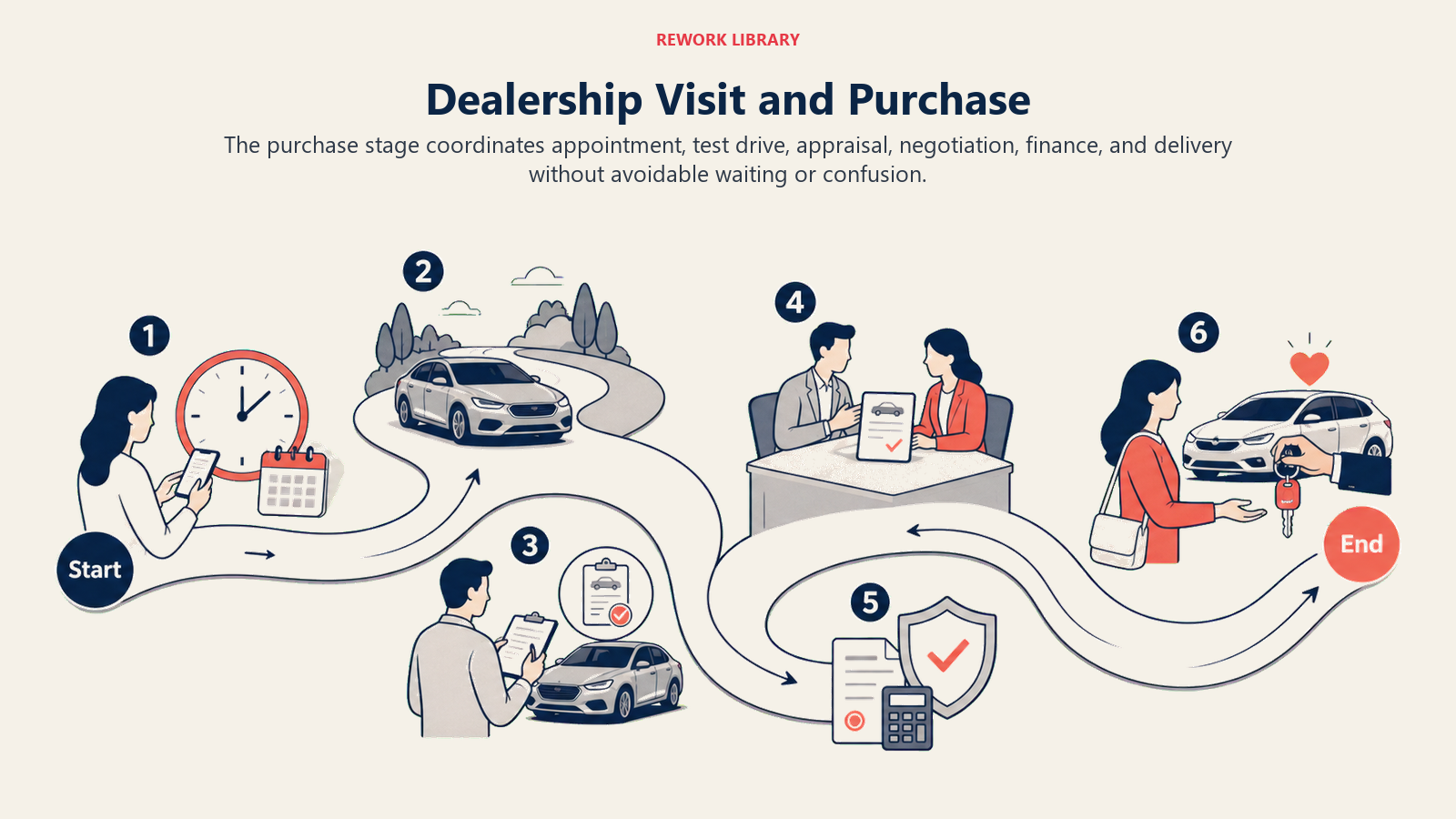
Appointment scheduling vs walk-ins represents a major shift. In 2026, 60-70% of dealership visits are scheduled appointments compared to 20-30% in 2010. Appointments close at much higher rates (35-45%) than walk-ins (18-25%) because they represent higher intent and better-qualified customers.
Your BDC's job is converting digital inquiries into scheduled appointments, not just answering questions and hoping customers show up.
Test drive experience expectations changed because customers already know vehicle specs and features. They're not asking "what can this vehicle do?" - they're validating "does this vehicle feel right for me?"
Keep test drives focused on experience, comfort, and real-world use cases. Let the customer drive the route they'll actually use (highway commute, city parking, school pickup). Make it personal, not scripted.
Sales process interactions need to move faster than they did 10 years ago. Customers researched pricing, configured their deal online, and understand financing options. They don't want a 3-hour sales process that repeats information they already know.
Best-performing salespeople qualify needs quickly, present the right vehicle, facilitate test drive, and move to numbers within 45-60 minutes if the customer is ready.
F&I presentation remains the profit center where expertise and customer education drive value. Customers haven't researched extended warranties, GAP insurance, or maintenance plans the way they researched vehicle pricing.
Professional F&I managers who explain coverage, demonstrate value, and help customers make informed decisions sell products on 65-75% of deals. Poor F&I presentation gets 30-40% penetration because it feels like a price presentation rather than protection planning.
Delivery experience sets the tone for the entire ownership relationship. Rushed delivery creates buyer's remorse and reduces service retention. Professional delivery (vehicle walk-around, feature demonstration, service scheduling, personalized welcome) builds excitement and loyalty.
Take 30-45 minutes for delivery. Introduce the customer to your service team. Schedule their first service appointment before they leave. Make them feel like they joined a community, not just bought a product.
Stage 4: Post-Purchase & Onboarding (Days 1-90)
The sale doesn't end when the customer drives off your lot. The first 90 days determine whether they become a long-term service customer or disappear to independent shops.
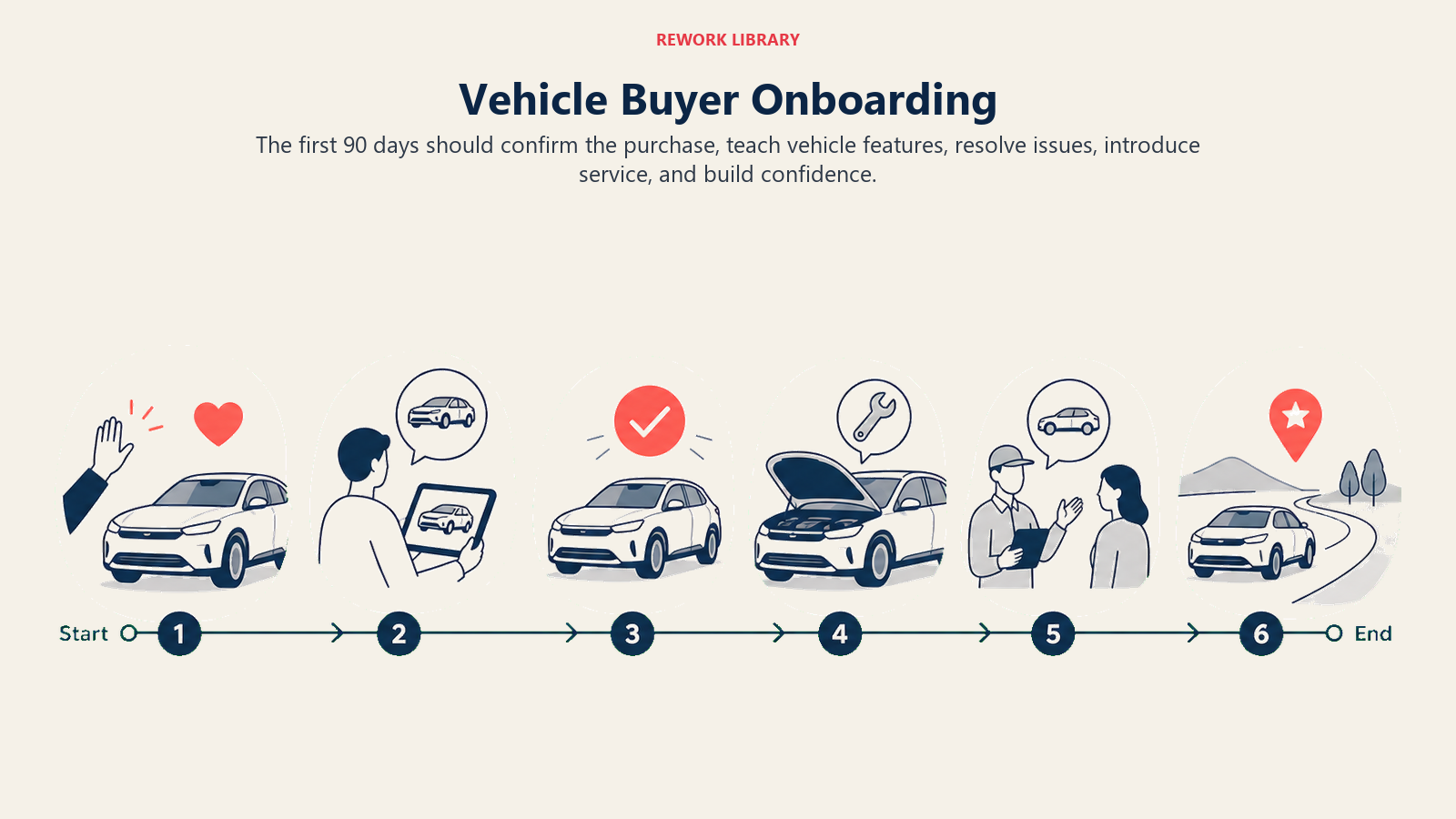
Delivery follow-up within 24-48 hours addresses buyer's remorse, answers questions that arise after the excitement wears off, and reinforces their purchase decision. A simple phone call or personalized video message from their salesperson builds connection.
Ask if they have questions about vehicle features. Remind them about your service commitment. Make them feel supported, not sold.
First service reminder should arrive around 5,000 miles or 3-6 months (depending on service interval). Don't wait for the customer to remember - proactive outreach drives 60-80% first-service retention compared to 35-40% without reminders.
Include service value proposition: certified technicians, OEM parts, convenient scheduling, comfortable waiting area, and warranty protection that requires manufacturer-approved service.
Review requests help build your online reputation and provide feedback on customer experience. Send review requests 7-10 days post-purchase when excitement is high but they've had time to experience the vehicle.
Make it easy: direct links to Google, Facebook, and manufacturer review platforms. Personalize the request from their salesperson, not a generic automated email.
Early ownership touchpoints include welcome emails with helpful resources (owner's manual links, feature tutorial videos, maintenance schedules), invitations to owner events, and check-ins at 30 and 60 days.
These touchpoints keep your dealership top-of-mind and build relationship beyond the transaction.
Stage 5: Ownership & Retention (Months 4-36)
This stage generates more profit than the initial vehicle sale if you execute retention properly. Most dealers focus all their energy on new sales and neglect the customers already in their database.
Service appointment scheduling needs to be frictionless. Online scheduling tools, text message confirmations, automated reminders, and flexible appointment times all reduce friction and improve retention.
Customers who can schedule service online at 9pm on Sunday are more likely to service with you than customers who have to call during business hours.
Maintenance reminders based on mileage, time, and manufacturer recommendations keep customers on proper service intervals. Automated reminder systems (email, text, app notifications) maintain engagement without requiring manual outreach.
Include educational content: why this service matters, what happens if skipped, how it protects their investment.
Recall notifications demonstrate you're monitoring their vehicle health and prioritizing their safety. Don't wait for customers to hear about recalls from news reports - proactive outreach builds trust and drives service visit opportunities.
Equity updates inform customers when their vehicle builds significant trade value or when market conditions favor upgrading. If a customer owes $22,000 on a vehicle worth $29,000, that's a trade conversation opportunity.
Proactive equity mining converts 8-12% of service customers to vehicle sales annually.
Loyalty program engagement rewards customers for service visits, referrals, and repeat purchases. Points toward service discounts, exclusive events, or priority service access all build stickiness and increase lifetime value.
The best loyalty programs make customers feel valued, not just marketed to.
Stage 6: Repurchase & Loyalty (Months 36+)
The longest-lasting customer relationships generate the highest profitability because acquisition costs drop to nearly zero and trust is already established.
Lease maturity outreach starting 120 days before lease end captures customers before they start shopping competitors. You already have their lease details, payment history, and vehicle condition information.
Present upgrade options, current incentives, and lease-end alternatives (buyout, return, trade) in a helpful framework rather than pushy sales pitch.
Equity mining campaigns target customers who've owned vehicles for 3+ years and have built equity. Market conditions, new model releases, and customer life changes all create upgrade opportunities.
Monthly equity reports to sales managers identifying customers with $5,000+ equity and 50,000+ miles drive proactive trade conversations.
Trade-in opportunities arise when customers bring vehicles for service and mention repair costs, reliability concerns, or changing needs. Service advisors trained to recognize these signals and route qualified leads to sales create hidden profit opportunities.
A customer facing $2,800 in repair costs on a 7-year-old vehicle with 95,000 miles is a trade candidate, not just a service ticket.
Referral program activation incentivizes satisfied customers to send friends and family to your dealership. Referral customers close at 55-65% rates (compared to 25-35% for conquest leads) and generate 30% higher gross profit because they trust the recommendation.
Offer meaningful incentives: $500 toward service, accessories, or next purchase. Make referring easy with digital referral cards, simple online forms, and immediate confirmation.
Critical Journey Metrics
You can't optimize what you don't measure. These metrics tell you where the journey breaks down.
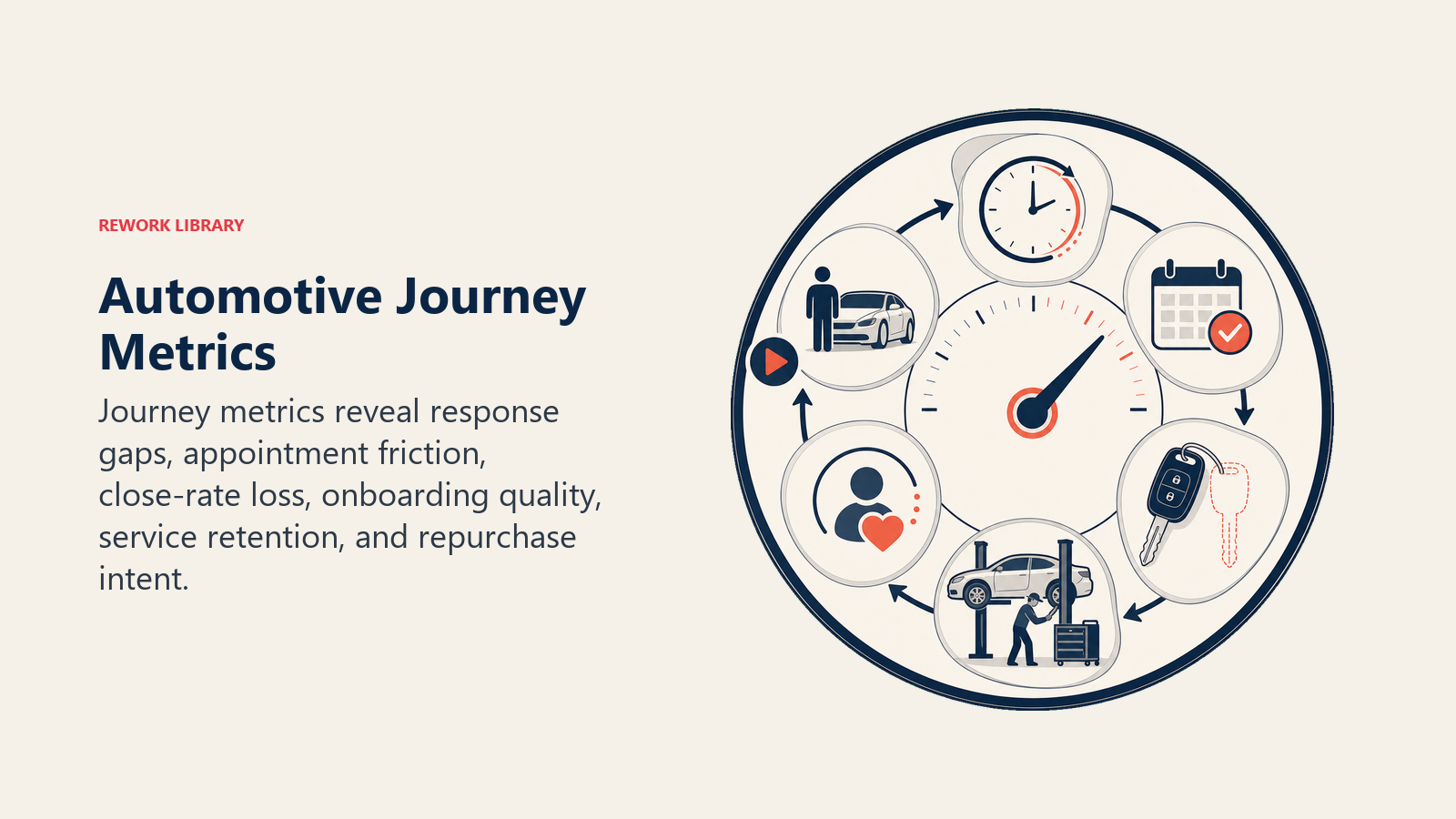
Bounce rate on VDPs measures how many visitors land on vehicle detail pages and leave immediately. High bounce rates (over 60%) indicate poor page quality, slow load times, or pricing issues.
Target: 35-45% bounce rate on VDPs.
Lead-to-appointment conversion shows how effectively your BDC converts inquiries into scheduled showroom visits. Industry average is 15-25%, but top performers hit 35-45% through fast response time and professional phone skills.
Track by lead source to identify which channels generate highest-quality leads.
Appointment show rate measures no-shows vs confirmed appointments. Average show rate is 55-65%, but best practices (confirmation calls, text reminders, personalized outreach) drive 75-85% show rates.
Each 10% improvement in show rate equals 10% more sales without additional marketing spend.
Test drive-to-sale conversion indicates sales team effectiveness. If customers test drive and don't buy, something broke - vehicle didn't meet expectations, pricing wasn't competitive, sales process failed, or F&I presentation fell flat.
Target: 65-75% test drive to sale conversion (meaning 65-75% of customers who test drive eventually purchase, not necessarily same-day).
Service retention rate at 12 months shows how many customers return for first service. Target 65-75% first-service retention. At 36 months, target 40-50% retention (customers who continue servicing with you through warranty period).
Service retention drives lifetime value and repeat sales opportunity.
Repurchase rate measures how many customers buy their next vehicle from you. Industry average is 30-40%, but dealerships with strong service retention and customer relationship programs hit 55-65%.
Each 10% improvement in repurchase rate compounds profitability because you're eliminating acquisition costs on repeat sales.
Optimizing Each Stage
Different journey stages require different investments and optimization strategies.
Technology investments by stage:
- Awareness: SEO, content marketing, social media management
- Active shopping: Website optimization, digital retailing platform, CRM with lead routing
- Dealership visit: CRM with sales process tracking, F&I presentation software
- Post-purchase: Automated follow-up sequences, review management platform
- Ownership: Service scheduling platform, maintenance reminder system, loyalty program software
- Repurchase: Equity mining tools, lease maturity tracking, referral management system
Team training priorities focus on skills that impact conversion at each stage:
- BDC: Response speed, appointment-setting scripts, objection handling
- Sales: Needs qualification, product knowledge, test drive facilitation, negotiation
- F&I: Product presentation, value communication, compliance excellence
- Service: Customer communication, upselling recommended services, sales lead identification
Content needs support customers at each decision point:
- Awareness: Buying guides, comparison articles, ownership cost calculators
- Active shopping: Detailed VDP content, video walkarounds, transparent pricing
- Post-purchase: Feature tutorials, maintenance guides, welcome videos
- Ownership: Service value content, upgrade opportunity communications
Automation opportunities reduce manual work and improve consistency:
- Lead routing and response (instant assignment to BDC)
- Appointment reminders (text/email 24 hours before)
- Service reminders (mileage and time-based triggers)
- Equity updates (monthly for customers with $5,000+ trade value)
- Review requests (7-10 days post-purchase)
- Lease maturity outreach (120, 90, 60, 30 days before end)
The dealers who win don't just understand the customer journey - they build systems that optimize each stage, measure what matters, and continuously improve conversion rates from awareness to repurchase. That's how you turn a one-time transaction into a lifetime relationship worth $50,000+ in total gross profit.

Senior Implementation Consultant
On this page
- The Modern Journey Overview
- Stage 1: Awareness & Consideration (Weeks 1-4)
- Stage 2: Active Shopping (Weeks 5-8)
- Stage 3: Dealership Visit & Purchase (Week 9-10)
- Stage 4: Post-Purchase & Onboarding (Days 1-90)
- Stage 5: Ownership & Retention (Months 4-36)
- Stage 6: Repurchase & Loyalty (Months 36+)
- Critical Journey Metrics
- Optimizing Each Stage