Trade-In Appraisal Process: Maximizing Gross While Winning Deals - 2026 Guide
Turn this article into takeaways for your work.


Each assistant summarizes the article only for you and suggests best practices for your work.
The trade-in appraisal is the step in the automotive sales process where a dealership values a customer's current vehicle and presents an offer. A professional process follows five stages: understand the economics, set expectations early, inspect systematically, value against multiple sources, then justify and negotiate the offer. Done well, it protects gross on the majority of deals.
The average dealership books 60% of deals with trade-ins. The average backend gross on those trades is $2,500. That means trade-in appraisal directly impacts the majority of your deals and a massive portion of your dealership revenue streams profitability. Yet many stores approach appraisals reactively, making up numbers based on gut feel and hoping customers accept them.
Professional appraisal isn't guessing. It's a systematic process that balances competitive market values with gross profit objectives. It's showing customers why your offer is fair even when it's lower than they hoped. It's knowing when to over-allow on a trade to win a deal and when to walk away from negative equity that will come back to haunt you.
Trade-In Economics: Understanding the Numbers Behind the Offer
Before you can appraise trades effectively, you need to understand the economics. There are three key numbers for every trade: wholesale value, retail value, and your offer.
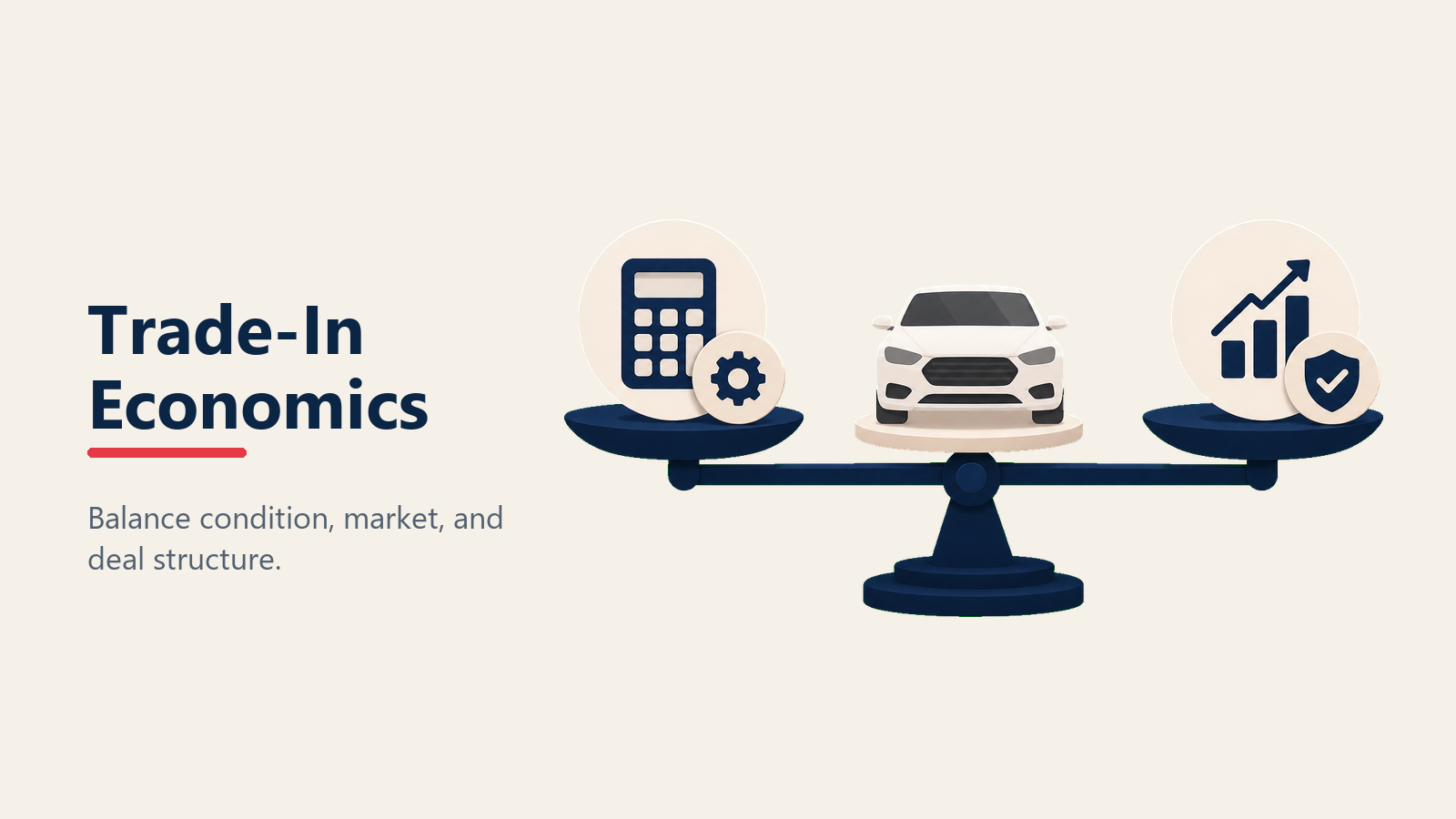
Wholesale value is what you could sell the vehicle for at auction or to another dealer tomorrow. This is your floor. If you pay more than wholesale value, you're taking a guaranteed loss unless you retail the vehicle and make up the difference.
Retail value is what you could sell the vehicle for on your used lot after reconditioning. This is typically $2,000-$4,000 above wholesale for average vehicles. The gap represents reconditioning costs, holding costs, and profit potential.
Your offer falls somewhere between wholesale and retail, depending on several factors: how badly you want the deal, how the trade fits your inventory needs, how much gross you have in the front end, and what you think the customer will accept.
Book values from Black Book, KBB, and Manheim Market Report are starting points, not gospel. The market doesn't care what a book says a vehicle is worth. It cares what buyers are actually paying. A vehicle might book at $15,000 wholesale, but if there are 47 of them sitting on the ground in your market, the real wholesale value is closer to $13,500.
Kelley Blue Book, founded in 1926, and NADA Guides, established in 1933, remain the industry standards for vehicle valuation. Black Book, serving dealers since 1955, provides wholesale data that helps set competitive trade-in offers. Market demand varies dramatically by segment and seasonality. Convertibles are worth more in spring than winter. Four-wheel-drive trucks are worth more in northern markets than southern markets. Popular colors move faster and command higher prices than odd colors. Understanding these patterns is essential for inventory pricing and aging management.
Reconditioning costs eat into the wholesale-to-retail spread. Every trade needs some level of reconditioning: detail, inspection, minor repairs, fresh fluids. Budget $500-$800 minimum. If the vehicle needs tires ($800), brakes ($500), or has cosmetic damage, those costs come out of your gross. Proper vehicle merchandising requires investment to maximize retail value.
That $2,500 average backend gross gets eaten quickly. Take a trade-in that wholesales for $15,000. Add $2,500 and your offer is $17,500. Spend $1,200 on reconditioning. Retail it for $19,900. After costs, you're at maybe $1,200 gross, and that's if it sells within 30 days.
This is why over-allowing on trades is expensive. Every $500 you over-allow costs you $500 in backend gross. That might be the right play to win a deal with strong front-end gross, but you need to make that decision consciously, not accidentally.
Initial Trade Assessment: Setting Expectations Early
Trade-in assessment starts when the customer mentions they have a trade, not when you finally get around to looking at it.
During needs assessment, gather basic information: year, make, model, trim, mileage, condition. "Tell me about your current vehicle. What year and model is it? How many miles? How's the condition overall?"
This gives you enough information to pull preliminary book values while the customer is testing the new vehicle. You're not committing to a number yet, but you're getting a baseline.
Set expectations early. If the customer says "I think it's worth $18,000," and your books show $14,000-$15,000, you need to manage expectations before they get attached to that $18,000 number.
"I appreciate you sharing that. Let me do some research on current market values while you test drive the new vehicle. The market has been shifting quite a bit lately, so I want to make sure I give you accurate information."
This language does several things. It doesn't contradict the customer directly. It introduces the concept that the market determines value, not wishful thinking. And it buys you time to do proper research.
Some dealerships do online appraisals before the customer visits through automotive lead generation tools. This is double-edged. It gets customers in the door with a ballpark number, but it also creates expectations that are hard to walk back when you see the vehicle in person and discover it has 150,000 miles, not the 100,000 miles they entered in the online form.
If you use online appraisal tools, include clear disclaimers: "This estimate is based on the information provided and is subject to vehicle inspection. Final offer may vary based on actual condition."
The Appraisal Walk-Around: Systematic Vehicle Inspection
Professional appraisal follows a systematic process. You're not casually glancing at the vehicle and making up a number. You're documenting condition in a way that supports your offer.
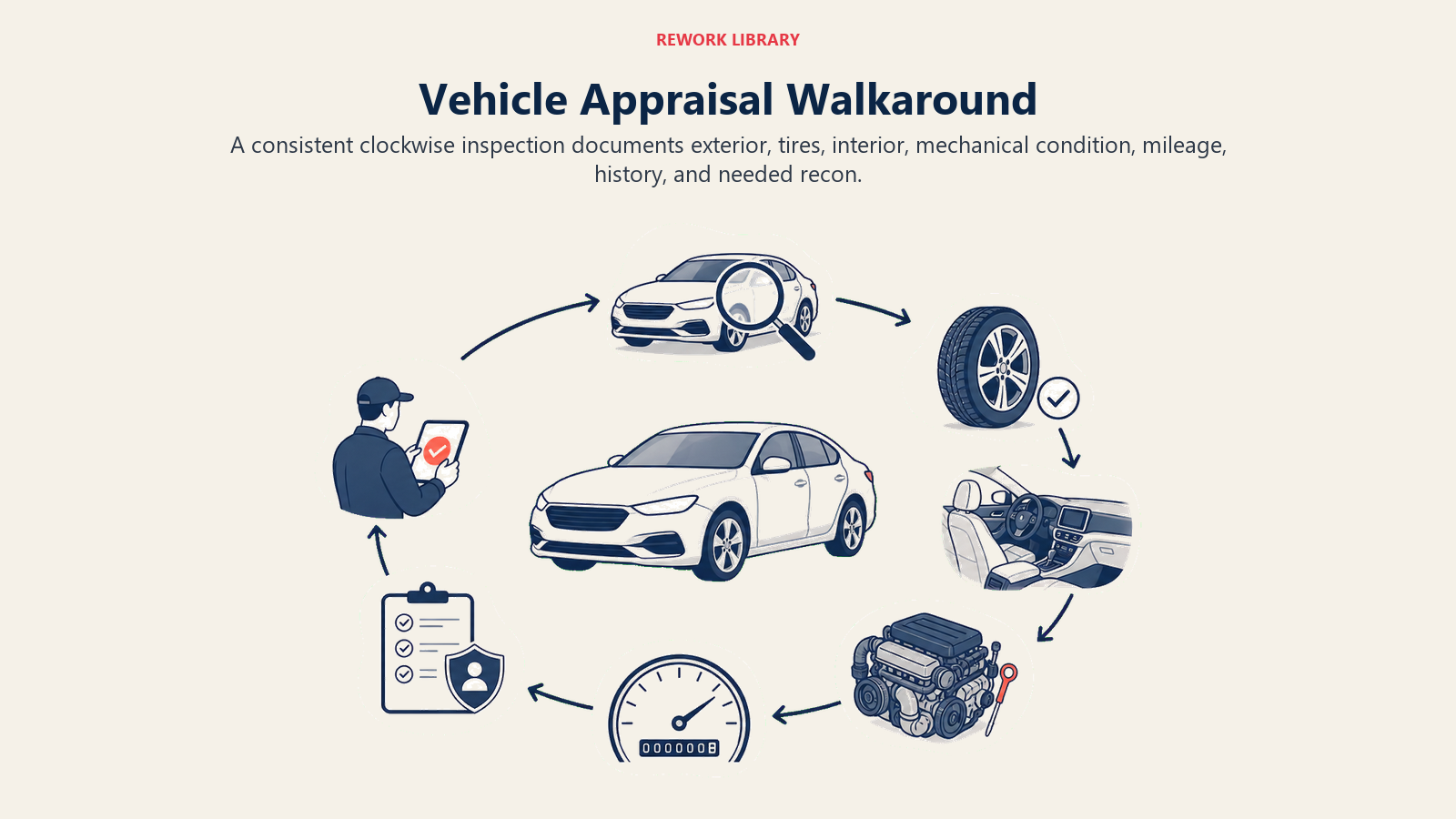
Start with the exterior. Walk around the vehicle clockwise, starting at the driver's front corner. Look for dents, scratches, paint damage, rust, mismatched paint (indicating accident repair), damaged wheels, worn tires, and cracked glass.
Document everything with photos if your process includes it. Photos aren't just CYA. They're proof you can show the customer when they question your offer. "You mentioned you thought the condition was excellent, but let me show you what I found during inspection."
Rate the exterior condition: Excellent (like new), Good (minor imperfections), Fair (visible wear), or Poor (significant damage). Most trades are Good or Fair. Excellent is rare and commands premium values. Poor requires explanation and deep discounts.
Check the tires. Tires are expensive. If the trade needs tires ($800-$1,200 for a set), that cost comes directly out of your offer. Use a tread depth gauge. Anything below 4/32nds needs replacing.
Move to the interior. Look for stains, tears, excessive wear on the driver's seat and steering wheel, smoke smell, pet smell, damaged trim, malfunctioning power seats or windows, and cleanliness overall.
Smells are deal-breakers. Smoke smell and pet smell are nearly impossible to eliminate completely and significantly reduce retail value. Budget $300-$500 for deep cleaning and ozone treatment, and even then, you might need to wholesale the vehicle.
Check all the technology. Does the infotainment system work? Do the cameras function? Does the Bluetooth pair? Does the air conditioning blow cold? These aren't small issues. A $1,500 AC compressor repair destroys your gross.
Under the hood, look for obvious red flags: fluid leaks, worn belts, corroded battery terminals, low fluids, and check engine lights. You're not doing a full mechanical inspection during the initial appraisal, but you're looking for expensive problems.
Document the mileage. High mileage kills value. A vehicle with 120,000 miles might wholesale for $3,000 less than the same vehicle with 60,000 miles, even if condition is similar.
Valuation Process: Arriving at Your Offer
Now you have inspection notes. Time to determine your offer.
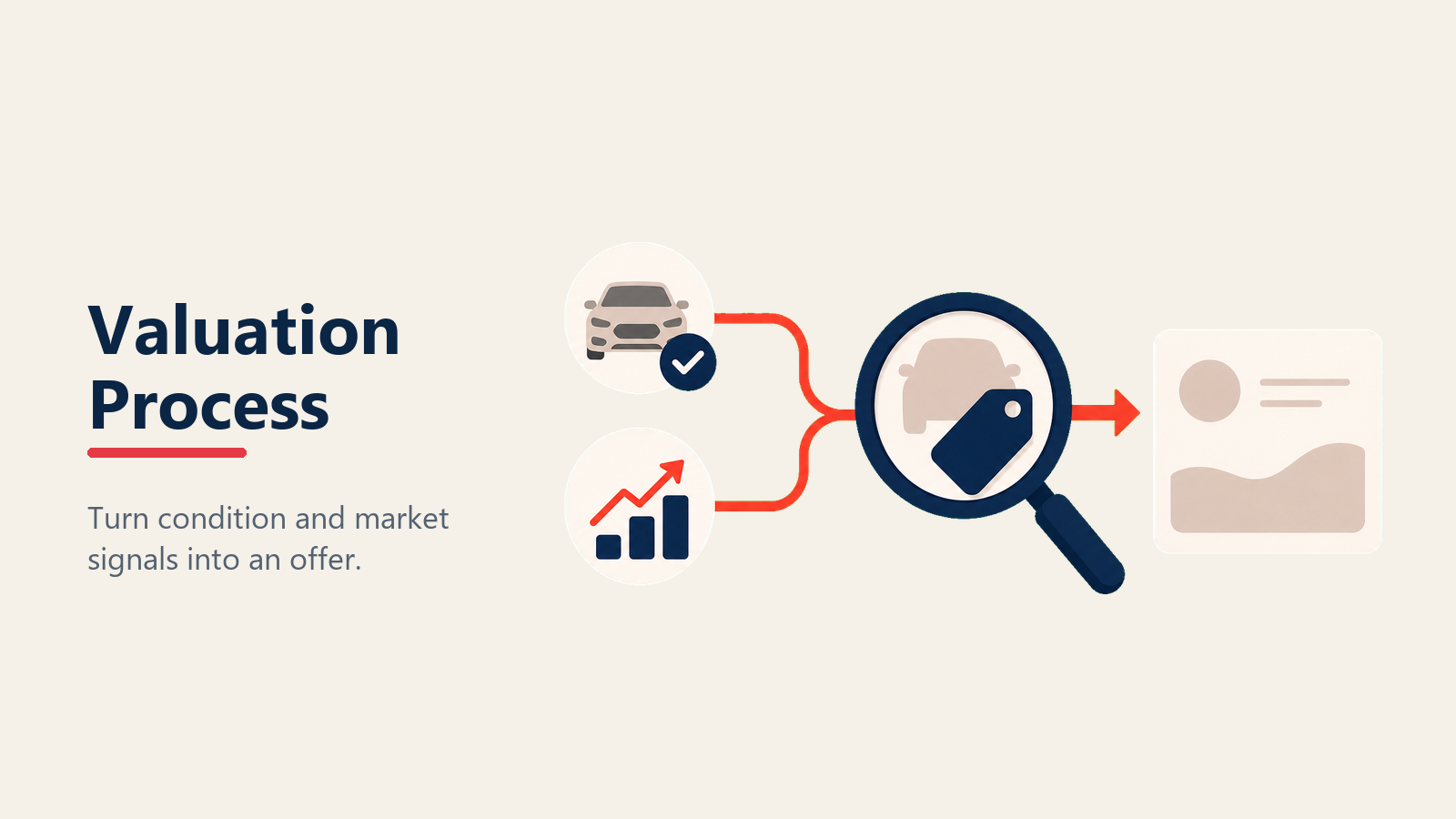
Start with multiple valuation sources. Pull Black Book wholesale and retail. Pull KBB trade-in value. Check Manheim Market Report if you have access. Look at what similar vehicles are selling for on your lot and competitors' lots. Check recent auction results if available.
These sources give you a range. For example: Black Book wholesale $14,200, KBB trade-in $14,800, Manheim MMR $14,000. Your wholesale baseline is around $14,000-$14,200.
Now apply condition adjustments. Use a deduct chart if your dealership has one. If not, create your own based on reconditioning costs:
- Tires needed: -$800 to -$1,200
- Minor dent repair: -$200 to -$500 per panel
- Paint correction: -$300 to -$800
- Interior detailing (heavy): -$300 to -$500
- Smoke smell: -$500 to -$1,000
- Mechanical issues: depends on repair cost
Let's say the trade has some door dings ($400), needs tires ($800), and has a coffee stain on the passenger seat ($200). Your adjustments are -$1,400. Wholesale baseline $14,200 minus $1,400 equals $12,800 real wholesale value.
Now decide what you're offering. If you want to retail this trade and it fits your inventory, you might offer closer to retail value. If you're planning to wholesale it, you offer at or slightly above wholesale. If you desperately need the deal, you might over-allow $500-$1,000 above retail and accept lower gross.
Let's say you decide to offer $14,000. That's $1,200 over your real wholesale value of $12,800. You're building in $1,200 gross potential on the trade if you retail it, minus reconditioning costs.
Presenting the Trade Value: Psychology and Justification
How you present the trade value matters as much as the number itself.
Timing is strategic. Some managers prefer to present trade value before discussing the new vehicle price. Others prefer to work the deal together. There's no universal right answer, but presenting the trade value first means the customer can't use it as a negotiation tool later.
"I've completed the appraisal on your vehicle. Based on current market conditions and the condition of your vehicle, we can offer $14,000. Let me show you how I arrived at that number."
Then walk them through your research. Show them the valuation sources you used. Show them photos of the condition issues you found. Show them what similar vehicles are selling for on Autotrader or CarGurus.
You're not being defensive. You're being transparent. Most customers have never appraised a vehicle professionally. They're guessing based on what they paid years ago, what they saw online, or what their brother-in-law said it's worth. Your job is to educate them on real market value.
"I understand this might be lower than you were expecting. The market for this particular model has been soft lately because of high inventory levels, and there are a few condition items we'd need to address before we could retail it. But this offer is competitive with what other dealers would offer, and it's based on real market data."
This language acknowledges their potential disappointment without apologizing for your offer. You're stating facts.
If they mention online valuations like KBB or Edmunds, address it directly: "Those sites are helpful for ballpark estimates, but they don't account for actual condition or local market factors. They also show retail pricing, which is what you'd sell it for private party after cleaning it, photographing it, listing it, dealing with inquiries, and handling all the paperwork. Our offer reflects the convenience of trading it in today without any of that hassle."
According to industry research, KBB provides private party, trade-in, suggested retail, and CPO values with four condition levels, while NADA focuses on trade-in and retail values with three vehicle states. Frame the trade value in terms of payment impact: "The trade value of $14,000 plus your $2,000 down payment gives you $16,000 total down payment on the new vehicle. That brings your payment to $465 per month." This approach aligns with effective desking and deal structure techniques.
This shifts the conversation from "is my trade value high enough?" to "does this payment work for me?"
Trade-In Negotiation: Handling Common Objections
"I can sell it myself for more than that."
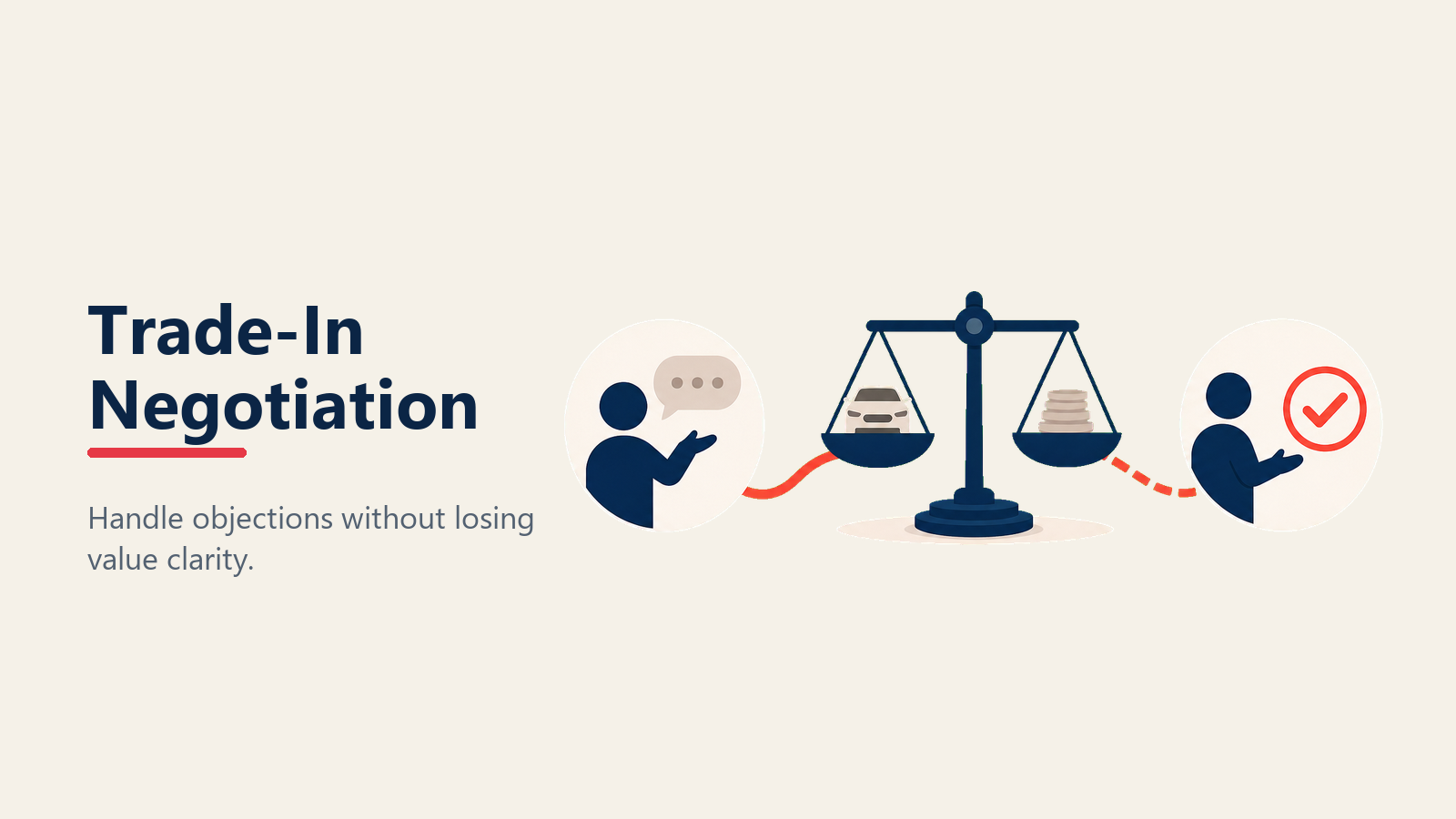
Maybe they can. Probably they won't. "You absolutely could try selling it yourself. Based on retail market values, you might get $17,000-$18,000 if you find the right buyer. But that typically takes 30-60 days, you'll need to handle advertising, tire-kickers, test drives, and paperwork. Most people value their time and the convenience of trading it in. But if you'd prefer to sell it privately, I understand. We can structure a deal without the trade and you can bring us the payoff amount when you sell it."
This acknowledges their option without begging them to trade it. Sometimes they'll realize the hassle isn't worth the extra $3,000. Sometimes they'll commit to selling it privately. Either way, you move forward.
"That's way too low. I paid $24,000 for it three years ago."
Purchase price doesn't determine current value. Depreciation is real. "I understand. Depreciation can be frustrating. Unfortunately, vehicles lose value over time based on age, mileage, and market demand. What you paid three years ago doesn't reflect what buyers are willing to pay today. I'm basing this offer on what similar vehicles are actually selling for right now in our market."
"The dealer across town offered me $16,000."
This is either true, untrue, or partially true with conditions. "That's great if they put that in writing. I'd encourage you to take that offer if it's firm. If it was just a verbal estimate, I'd suggest getting it in writing before making your decision. Our offer of $14,000 is firm and available right now. If you have a better offer, I completely understand if you go with them."
Sometimes this is a bluff and they'll back down. Sometimes it's real and you need to decide if matching is worth it. Sometimes there's missing information, like the other dealer's offer being contingent on buying a specific vehicle at full price.
"I'm upside down. I owe $18,000."
Negative equity is common and manageable up to a point. "I understand. Being upside down is frustrating. We can work with negative equity in most cases. The $4,000 difference between your payoff and our offer can be rolled into the new loan. That adds about $70 per month to your payment. The question is whether the new vehicle is worth that extra $70 per month to you. Let's look at total payment and see if we can make it work."
Be honest about negative equity limits. If they owe $25,000 and the trade is worth $15,000, rolling $10,000 negative equity into a new loan is problematic. The customer will be deeply underwater on the new vehicle immediately, and you're setting them up for trouble when they want to trade again in 2-3 years.
Digital Trade Tools: Online Appraisal Integration
Many dealerships now offer online trade appraisal tools on their websites. Customers enter their vehicle information and get an instant estimate. These tools are lead generation machines, but they create challenges.
Online estimates are based on what the customer enters. If they say the condition is "excellent" and mileage is "average" but the reality is "fair" condition and "high" mileage, your in-person appraisal will be significantly lower. This creates conflict.
Set expectations in the online tool itself: "This is a preliminary estimate based on the information provided. Final offer will be determined after vehicle inspection and may vary based on actual condition."
When the customer arrives, reference the online estimate but don't be bound by it: "I see you received an online estimate of $15,500. Let me do a complete inspection and I'll see what we can do."
Then do your inspection and make your offer based on reality, not the online estimate. If there's a significant difference, explain why: "The online tool estimated $15,500 based on good condition, but I found several items during inspection that affect the value: the tires are worn, there's a dent in the rear door, and the interior shows heavier wear than average. My offer of $13,800 reflects those condition factors."
Instant Cash Offer programs like Carvana, CarMax, and Vroom have changed the game. Customers can get legitimate offers online in minutes through automotive digital retailing platforms. These offers are sometimes competitive with dealer trade values, sometimes higher.
Don't bash these services. "Those services are convenient and their offers are firm. If you'd like to sell to them, I understand. Keep in mind that their offers are typically good for 7 days, they require you to deliver the vehicle to their location, and you'll still need to arrange financing and insurance for your new vehicle separately. If you prefer the convenience of trading it here and driving away in your new vehicle today, we can make that happen."
Sometimes you need to match or beat these offers to win the deal. Sometimes the customer values convenience enough to accept a slightly lower offer from you. Sometimes you lose the deal. That's business.
When to Walk Away: Protecting Your Profit
Not every trade makes sense. Some situations require walking away or structuring the deal differently.
If the trade needs $3,000 in repairs to be retail-ready and you can't offer wholesale or below, you're better off passing. "Based on the condition and the repairs needed, I don't think we can make this work with a trade. Have you considered selling it privately or to a service like CarMax?"
If the negative equity is extreme ($10,000 or more), think carefully about rolling it into a new loan. You're setting the customer up to be even more upside down, which creates future problems. "I want to be honest with you. Rolling $10,000 of negative equity into a new loan means you'll be significantly upside down from day one. If anything happens to the vehicle or you need to trade in the next few years, you'll be in a worse position than you are now. Have you considered waiting until you've paid down more of your current loan?" This is where understanding finance source management becomes critical.
This might lose the deal today, but it builds long-term trust and prevents the customer from blaming you later.
If the trade is branded title, flood damage, or has major undisclosed issues, protect yourself. These vehicles have limited resale value and high liability potential. Your offer should reflect the reality that you'll probably wholesale it for very little.
Maximizing Both Satisfaction and Profit
The best trade-in appraisers aren't the ones who offer the highest values. They're the ones who offer fair values, justify those values effectively, and structure deals where customers feel good about the outcome even if the trade value is less than they hoped.
You do this through transparency, education, and framing. Show customers how you arrived at your offer. Educate them on market realities. Frame the trade value in terms of total deal, payment, and convenience rather than as an isolated number.
Trades represent massive profit potential for dealerships: $2,500 average backend gross multiplied by hundreds of deals per year. But that profit only happens when you appraise systematically, justify professionally, and negotiate confidently. This backend profit is essential to automotive dealership growth and overall automotive sales economics.
The goal isn't to steal trades from customers or to pay retail value for everything. It's to find the fair middle ground where you win deals, make profit, and create satisfied customers who refer their friends and come back in three years to trade again.

Senior Implementation Consultant
On this page
- Trade-In Economics: Understanding the Numbers Behind the Offer
- Initial Trade Assessment: Setting Expectations Early
- The Appraisal Walk-Around: Systematic Vehicle Inspection
- Valuation Process: Arriving at Your Offer
- Presenting the Trade Value: Psychology and Justification
- Trade-In Negotiation: Handling Common Objections
- Digital Trade Tools: Online Appraisal Integration
- When to Walk Away: Protecting Your Profit
- Maximizing Both Satisfaction and Profit