Automotive Lead Generation: 7 Channels Ranked (2026)
Turn this article into takeaways for your work.


Each assistant summarizes the article only for you and suggests best practices for your work.
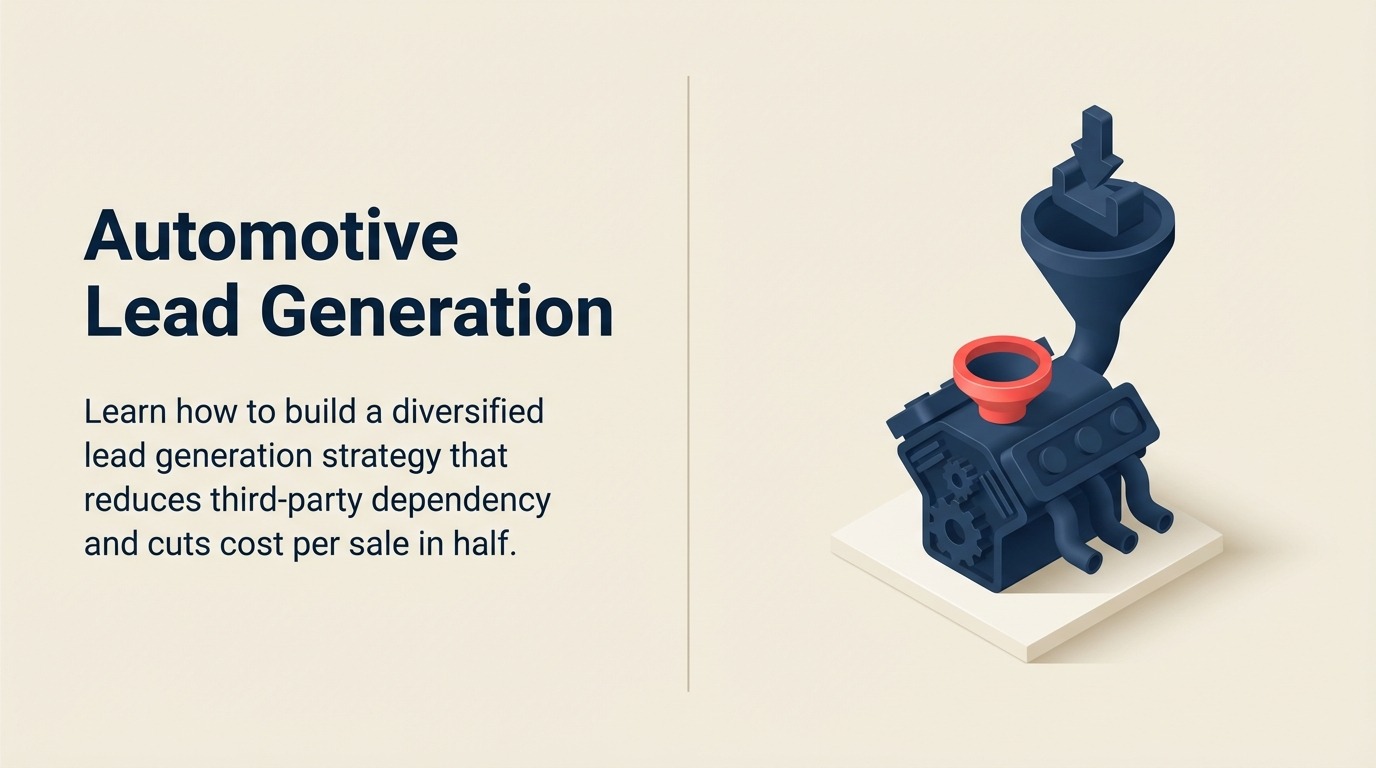
Here's the uncomfortable truth: 65% of dealerships get most of their leads from third-party providers like Autotrader and Cars.com. But those $50 leads? They're costing you $850 per sale when you factor in duplicates, low quality, and conversion rates that hover around 12%.
The dealerships winning right now aren't buying more leads. They're building owned assets that generate leads at half the cost.
This isn't about abandoning third-party sources completely. It's about building a diversified lead generation strategy where no single source controls your pipeline. When you own the channels, you control the economics.
The Lead Generation Landscape
The automotive lead generation ecosystem breaks into three categories, each with distinct economics according to NADA research:
Owned channels include your dealership website, SEO traffic, email database, and service customer base. These cost the most upfront to build but deliver the lowest cost per sale long-term. A well-optimized owned channel typically costs 50-70% less per sale than third-party leads.
Paid channels cover Google Ads, Facebook advertising, YouTube, and display campaigns. You control the spend and targeting, with costs typically ranging from $30-80 per lead depending on market competitiveness. Your conversion rates will be higher than third-party because you're capturing intent at the source.
Third-party channels include Autotrader, Cars.com, CarGurus, and TrueCar. These deliver volume quickly but at premium costs ($40-100 per lead) with significant quality issues. Industry data shows 30-40% of third-party leads are duplicates or low-quality submissions.
The conversion funnel tells the real story. Owned channel leads convert to sales at 25-35%. Paid channel leads convert at 18-25%. Third-party leads convert at 12-18%. That's not a small difference. It's the difference between a profitable lead strategy and bleeding money.
Owned Digital Channels
Your dealership website is either a lead generation machine or an expensive digital brochure. The difference comes down to optimization.
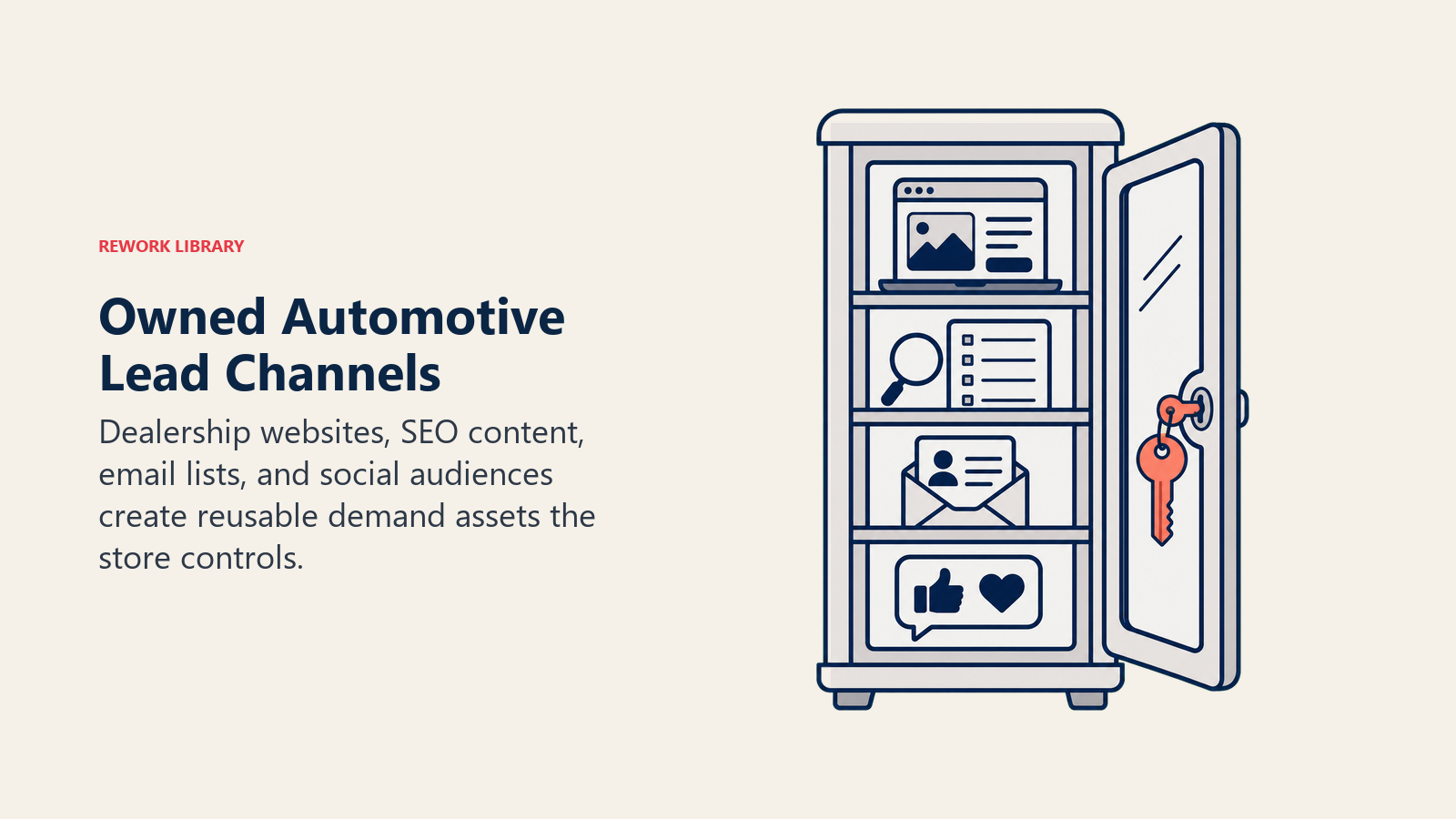
Start with your homepage. Most dealer sites fail here by showcasing inventory without capturing visitor intent first. Put a value proposition front and center: "3,000+ Vehicles in Stock" or "Same-Day Approval, Any Credit." Use a search bar that's actually usable, with year, make, model filters at minimum.
Your vehicle detail pages (VDPs) need serious attention because 70% of your website traffic lands here. High-quality photos (minimum 20 per vehicle), 360-degree views, video walkarounds, and clear pricing convert visitors to leads. Include multiple conversion points: payment calculator, trade-in value tool, schedule test drive, check availability.
SEO deserves its own dedicated effort because organic traffic converts better than any paid channel. When someone searches "Honda CR-V dealer near me," they're ready to buy. If you're not ranking in the top three local results, you're invisible. Investment in automotive SEO strategy pays back within 6-12 months through zero-cost-per-click traffic.
Digital retailing tools aren't optional anymore. Customers expect to start the purchase process online: trade-in value, credit application, monthly payment calculation, vehicle reservation. The dealers who make this frictionless through automotive digital retailing capture leads at 3x the rate of those forcing phone calls.
Your owned channels require upfront investment, but here's the math that matters: A third-party lead costs $60 and converts at 15% = $400 cost per sale. An owned channel lead costs $15 in hosting/maintenance and converts at 30% = $50 cost per sale. Scale that across 200 monthly sales and you're looking at $70,000 monthly savings.
Paid Digital Advertising
Google dominates paid automotive advertising for good reason. 85% of car shoppers start there according to Think with Google research. But throwing money at automotive PPC advertising without strategy is like buying leads at twice the price.
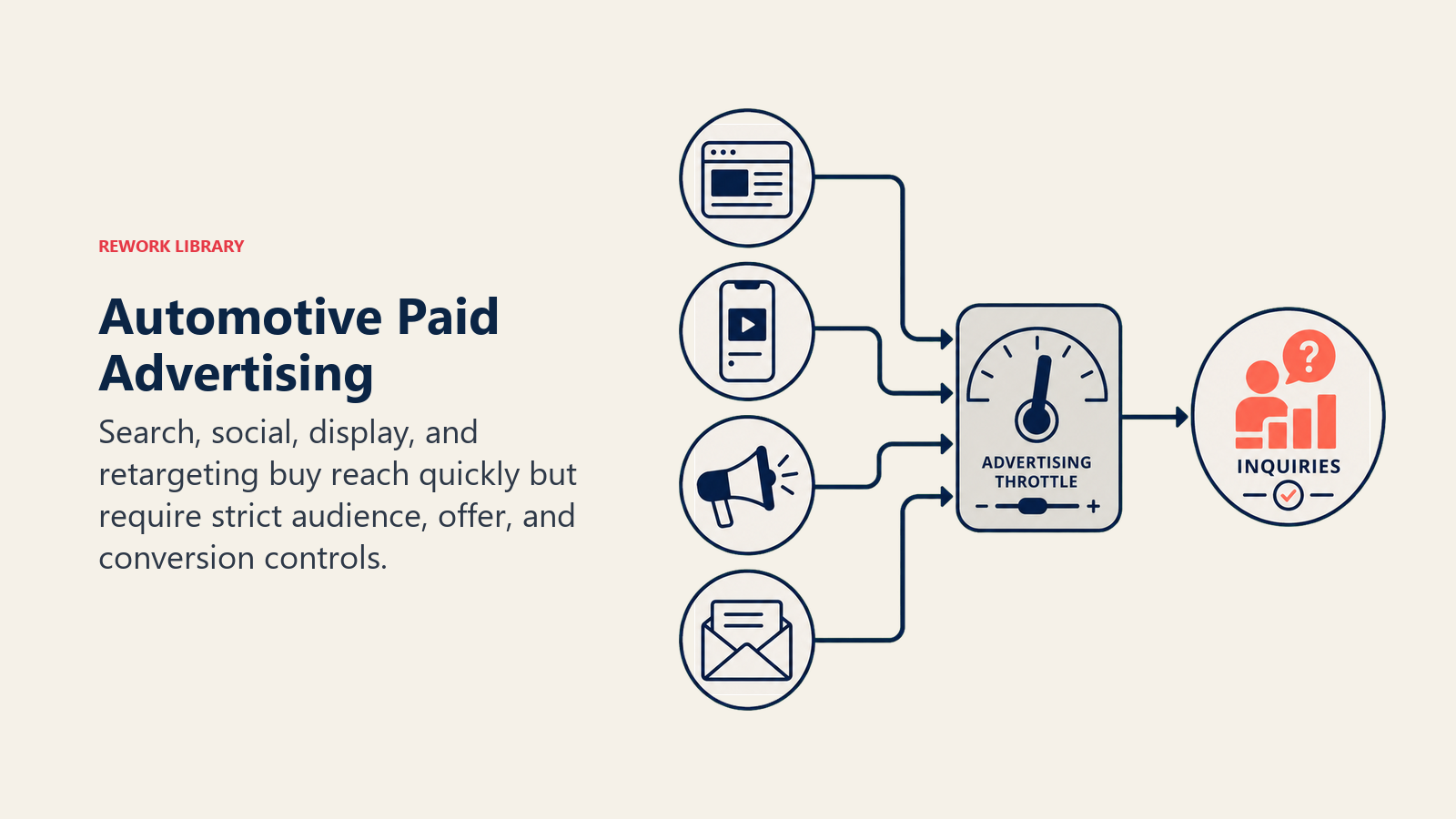
Search campaigns need surgical targeting. Branded terms (your dealership name) should capture 100% impression share at low cost. Competitor conquest marketing campaigns (bidding on other dealer names) can work but require aggressive response processes. Model-specific campaigns ("2026 Honda Pilot near me") capture high intent at moderate cost.
Google Shopping campaigns for vehicle inventory changed the game. Your entire inventory can appear in search results with photos, pricing, and specs. The setup requires a clean inventory feed from your DMS, quality photos, and competitive pricing. Done right, Shopping campaigns deliver leads at 40% lower cost than standard search campaigns.
Display and retargeting campaigns work differently. Someone visits your VDP for a specific vehicle but doesn't submit a lead? Retarget them across the web for the next 30 days with that exact vehicle. Conversion rates on retargeting campaigns run 3-5x higher than cold traffic campaigns.
Facebook and Instagram advertising excel at awareness and conquest. You can target by demographics, interests, behaviors, and remarkably, by competitors' customers. Someone who likes "Toyota of Springfield" Facebook page? Target them with your Honda or Nissan offers through social media for dealerships. This sounds aggressive, and it is, but it works.
YouTube advertising is underutilized in automotive. Pre-roll ads before automotive content, comparison videos, or local entertainment can deliver quality leads at $40-60 each through automotive video marketing. The format allows storytelling that static ads can't match.
Budget allocation across paid channels should follow performance, not provider preference. A baseline distribution: 40% Google Search, 25% Google Shopping, 20% Facebook/Instagram, 10% Retargeting, 5% YouTube. Test, measure, shift budget to winners.
The critical metric isn't cost per lead, it's cost per sale. A $30 lead that converts at 10% costs $300 per sale. A $60 lead that converts at 25% costs $240 per sale. Track conversion rates by source weekly, and move budget aggressively toward higher converters.
Third-Party Lead Providers
Let's talk about the elephant in the showroom. Third-party lead providers aren't evil, but they're also not the solution to sustainable growth.
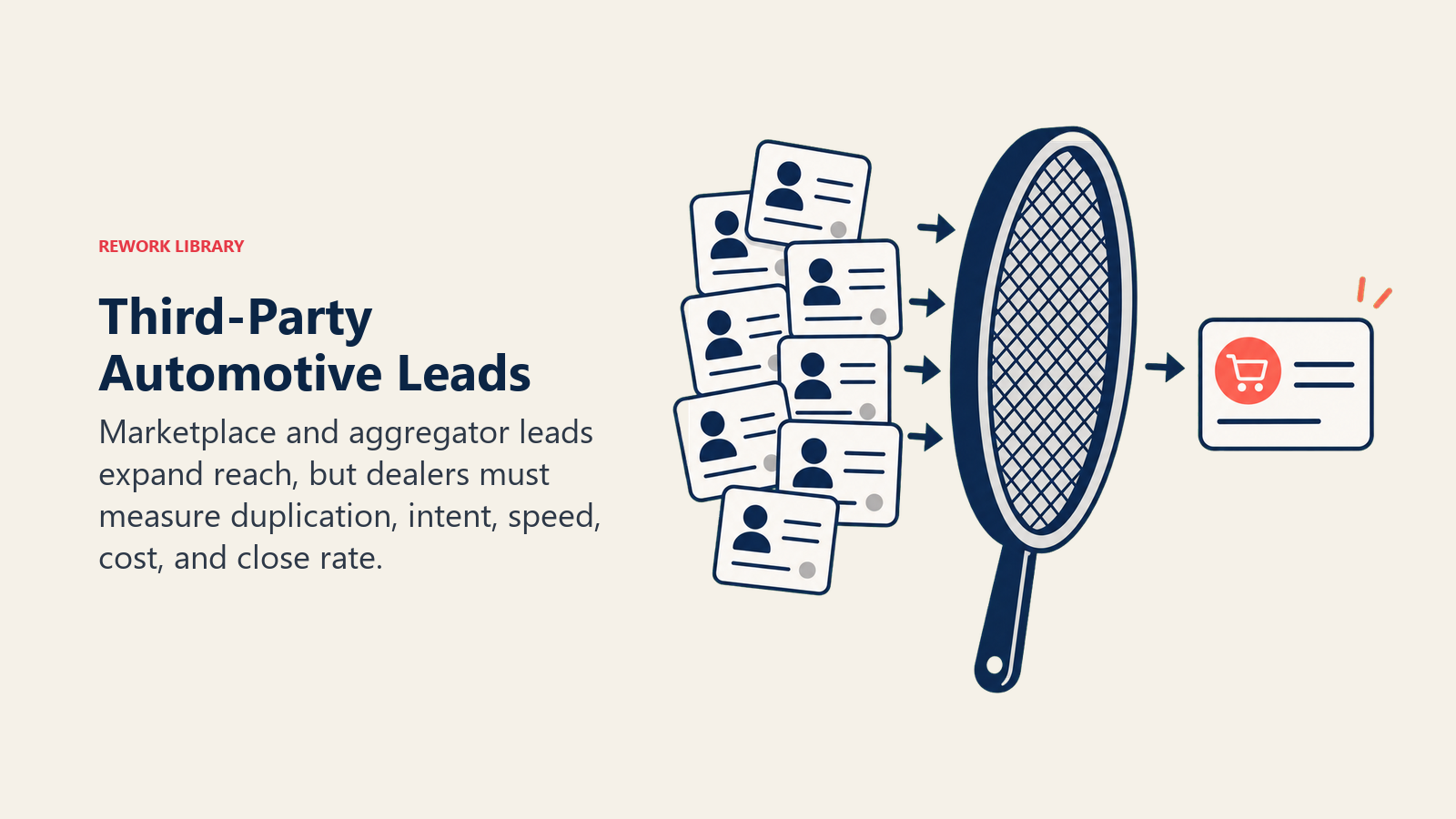
Autotrader, Cars.com, and CarGurus aggregate millions of shoppers. That traffic has value. But you're not buying exclusive access, you're buying a chance to compete for a shared lead along with 3-5 other dealers according to Cox Automotive industry data. The person who submitted that lead on Saturday night? They've already gotten calls from four of your competitors by Monday morning.
The economics are brutal. A typical third-party package runs $5,000-15,000 monthly for 100-200 leads. Sounds reasonable until you dig into the math. Of those 200 leads: 30% are duplicates from your other channels, 20% are information-gathering with no purchase intent, 10% are outside your market area. That leaves 80 legitimate leads. At a 12% close rate, you're getting 10 sales from $10,000 spend = $1,000 cost per sale.
Compare that to owned channels at $50-150 cost per sale or paid digital at $250-400 cost per sale. The only scenario where third-party makes economic sense is when you can't generate sufficient volume from owned and paid sources, typically new dealerships or markets where you lack brand awareness.
Third-party lead providers do have strategic uses: testing a new franchise without major marketing investment, moving aged inventory where you need immediate volume, or supplementing existing channels during peak seasonal demand.
But here's the rule: No single lead source should represent more than 30% of your total volume. If Autotrader generates 40% of your sales, you don't have a lead generation strategy, you have a dependency problem. And dependencies get expensive fast.
Traditional and Emerging Channels
Digital dominates the conversation, but traditional channels still produce quality leads at reasonable costs when executed correctly.
Your service department is sitting on the most underutilized lead source in your dealership. You've got 1,000+ customers monthly bringing vehicles in for maintenance. These people own cars, they trust you enough to service with you, and 20% of them will be in-market within the next 12 months. A structured service-to-sales pipeline can add 20-40 monthly sales at nearly zero acquisition cost.
Start with equity mining. Pull service customers who've owned their vehicle 3+ years, calculate current equity, and make proactive offers. "Your 2023 Accord has $8,000 equity. That's $400/month toward a new 2026 model." Your service advisor hands them the calculation with their keys. Follow up within 48 hours.
Referral programs work when you make them stupid simple. "Refer a buyer, get $500" sounds good but requires too much tracking. Better: "Your friend mentions your name, you both get $250 off your next service." The service department can track this in their DMS without sales team involvement.
Direct mail isn't dead, it's just expensive and slow. Conquest mailers to competitor owners in your zip codes can work for luxury brands. Equity mining mailers to your existing customer base perform better. But expect 0.5-1% response rates. A $10,000 mailing to 5,000 households might generate 25-50 leads.
Event marketing creates local awareness but rarely generates immediate sales. Sponsoring little league, participating in community events, hosting charity drives, these build brand equity that pays off in consideration when someone is ready to buy. Don't expect ROI in 90 days; expect it over 12-24 months.
Community partnerships with employers, credit unions, and local organizations create member purchase programs. These take months to establish but deliver consistent monthly lead flow once active.
Content Marketing for Automotive
Content marketing isn't about blogging for the sake of blogging. It's about answering the questions your buyers are searching for and positioning your dealership as the obvious choice.
Educational content addresses the research phase through automotive content marketing. "2026 Honda Pilot vs Toyota Highlander comparison," "What credit score do I need to finance a car," "How to negotiate a trade-in value", these are all high-volume searches that your content should capture.
Video content outperforms text 10:1 in engagement. A 2-minute video walkaround of new inventory, a comparison between trim levels, or a customer testimonial builds trust faster than any written content. Post these on YouTube, embed them in your dealership website, share them on social media.
Social media organic reach is declining, but it still matters for local brand awareness. Your Facebook page isn't going to generate 50 leads monthly, but it will influence consideration when someone is ready to visit a dealership. Share inventory, highlight team members, celebrate customer stories, participate in local conversations.
Email nurture campaigns are where content marketing converts to sales through dealership email marketing. Someone downloads your SUV comparison guide, that's a lead signal. Nurture them over 30-60 days with relevant content: financing options, current incentives, trade-in value tools, test drive invitations. Most dealerships send one email and give up. The buyers are closing at the dealer who sent six value-driven emails.
Build an email database from every customer interaction: sales, service, parts, website visits. That database is an asset that generates leads forever through automotive CRM implementation. A monthly email to 20,000 past customers highlighting new inventory, special offers, or service promotions will generate 50-100 leads monthly at $0 cost.
Lead Generation Metrics
You can't optimize what you don't measure. Most dealerships track total leads and cost per lead. That's not enough.
Cost per lead (CPL) varies wildly by source. Website organic leads might cost $5 in hosting and maintenance. Google Ads leads might cost $50. Third-party leads might cost $80. But the next metric matters more.
Lead-to-appointment rate tells you lead quality. Owned channel leads should set appointments at 30-40%. Paid channel leads at 20-30%. Third-party at 15-25%. If you're below these benchmarks, you've got a quality problem or a response process problem.
Appointment show rate reveals your sales process effectiveness. Industry average is 55-60%. Top performers hit 70%+. The gap? Confirmation process, value communication, convenience factors. Someone who drove 40 minutes to your dealership is showing up. Someone who set an appointment at the closest of six dealers might not.
Lead-to-sale conversion rate is your ultimate quality metric. Owned channels should close 25-35%. Paid channels 18-25%. Third-party 12-18%. These benchmarks account for no-shows and be-backs. If your numbers are significantly lower, diagnose whether it's lead quality, sales process, or competitive pricing issues.
Total cost per sale combines CPL with conversion rates to show real economics through cost per sale analysis. Calculate this by source monthly: Total spend on source ÷ Total sales from source = Cost per sale. This number should drive every budget allocation decision.
Track these metrics weekly by source in a dealership KPI dashboard. When Google Ads CPL increases 20% but conversion rate drops 15%, you know you've got a targeting or landing page issue. When third-party cost per sale exceeds $800 while owned channels sit at $150, you know where to shift budget.
Building Your Lead Mix Strategy
A diversified lead generation strategy protects you from dependency and optimizes for cost efficiency. Here's how to build yours.
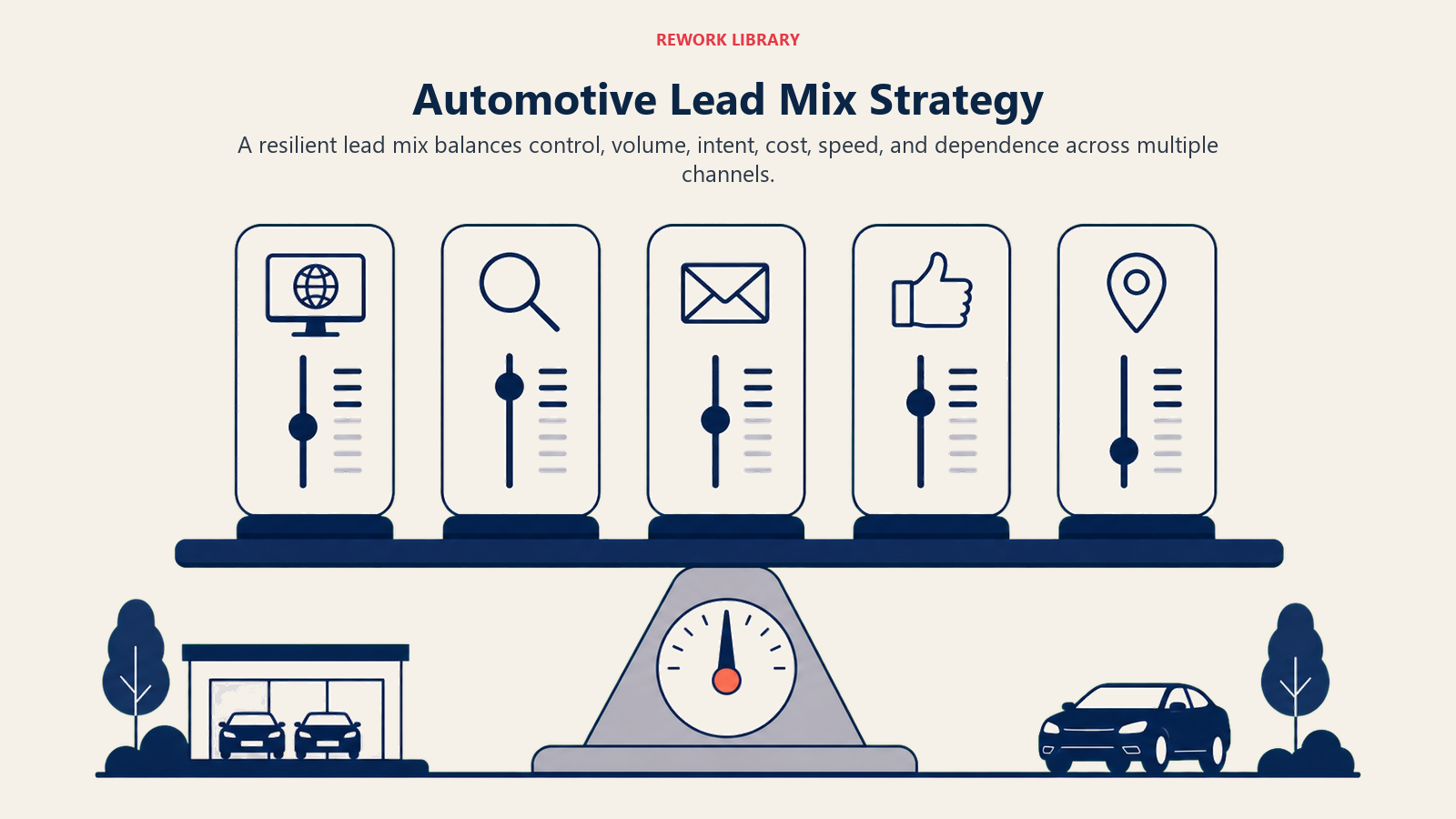
Start with the 30% rule: No single source should generate more than 30% of your total sales volume. If you're at 50% third-party, you've got a strategic vulnerability. Suppliers raise prices when they know you're dependent.
The optimal lead mix for a mature dealership typically looks like this: 35% owned channels (website organic, database, service-to-sales), 30% paid digital (Google, Facebook, YouTube), 25% third-party (Autotrader, Cars.com, CarGurus), 10% other (referrals, direct mail, events).
New dealerships and those in growth markets might run 50% third-party initially while building owned assets. The goal is reducing that to 25% within 12-24 months through SEO investment, paid digital optimization, and database building.
Budget allocation should follow a test-and-optimize approach. Start with industry benchmarks, but shift aggressively based on your data. If Facebook leads are converting at 28% while Google Shopping converts at 19%, increase Facebook spend until returns diminish.
Seasonal adjustments matter in automotive. Tax refund season (January-April) drives credit-challenged buyers, increase paid social targeting value offers. End-of-model-year (August-October) drives deal hunters, increase search campaigns highlighting clearance pricing. Holiday season (November-December) drives family buyers, increase content marketing for SUVs and minivans.
Testing protocol should be systematic. Test one variable at a time: landing page design, ad copy, offer messaging, targeting criteria, budget allocation. Run tests for minimum 30 days or 1,000 clicks before declaring winners. Small sample sizes produce misleading results.
The path forward is clear: build owned assets, optimize paid channels, strategically supplement with third-party. The dealers crushing it in 2026 started this shift three years ago. You can't change the past, but you can start now.
Your automotive customer journey starts with awareness. Whether that comes from organic search, paid advertising, or third-party sites, the goal is the same, get them into your CRM and onto your showroom floor.
Lead generation isn't about finding a magic channel that solves everything. It's about building a diversified engine that delivers consistent volume at sustainable costs. Start with owned channel optimization, layer in paid digital, and strategically use third-party as a supplement, not a foundation.
The economics improve every month you invest in owned assets. The dealer spending $15,000 monthly on third-party leads today could spend $8,000 on owned channel development and generate the same volume within 12 months, but own the asset forever.
Calculate your current cost per sale by source. Build a 12-month plan to reduce third-party dependency by 20%. Invest in SEO, website optimization, and database marketing. Your future self will thank you when you're generating leads at half the cost with better quality.