Bold Growth Strategy for Auto Inventory (2026)
Turn this article into takeaways for your work.


Each assistant summarizes the article only for you and suggests best practices for your work.
A bold growth strategy for dealership inventory treats every vehicle as a capital allocation decision, not just a car to sell. The goal is to balance four levers (days supply, inventory turn, gross profit per unit, and floorplan cost) so your capital earns a strong return instead of sitting on the lot losing value. This guide walks through the framework for new and used.
Every million dollars in inventory costs you $5,000-8,000 per month in floorplan interest and holding costs. That's $60,000-96,000 annually just to own the privilege of having cars on your lot. And that doesn't include depreciation, obsolescence risk, or opportunity cost of capital.
Most dealers treat inventory as "the cars we need to sell." Elite dealers treat inventory as capital allocation decisions that directly impact ROI. The difference shows up in profitability margins that separate top-performing stores from the rest.
Inventory as Capital Investment
When you buy a vehicle, whether from the factory or an auction, you're making an investment decision. That $35,000 purchase ties up capital that could be deployed elsewhere. Floorplan interest typically runs 5-7% annually, though rates fluctuate with the prime rate. On a $35,000 vehicle held for 45 days, that's roughly $470 in interest expense. Hold it for 90 days, and you're at $940. Every extra day costs money. But interest is just one cost. Opportunity cost matters more. That $35,000 could be invested in marketing that generates more traffic, facility improvements that boost closing rates, or even S&P index funds returning 10% annually. When you choose inventory over those alternatives, you're betting that vehicle will return better than 10% on your capital.
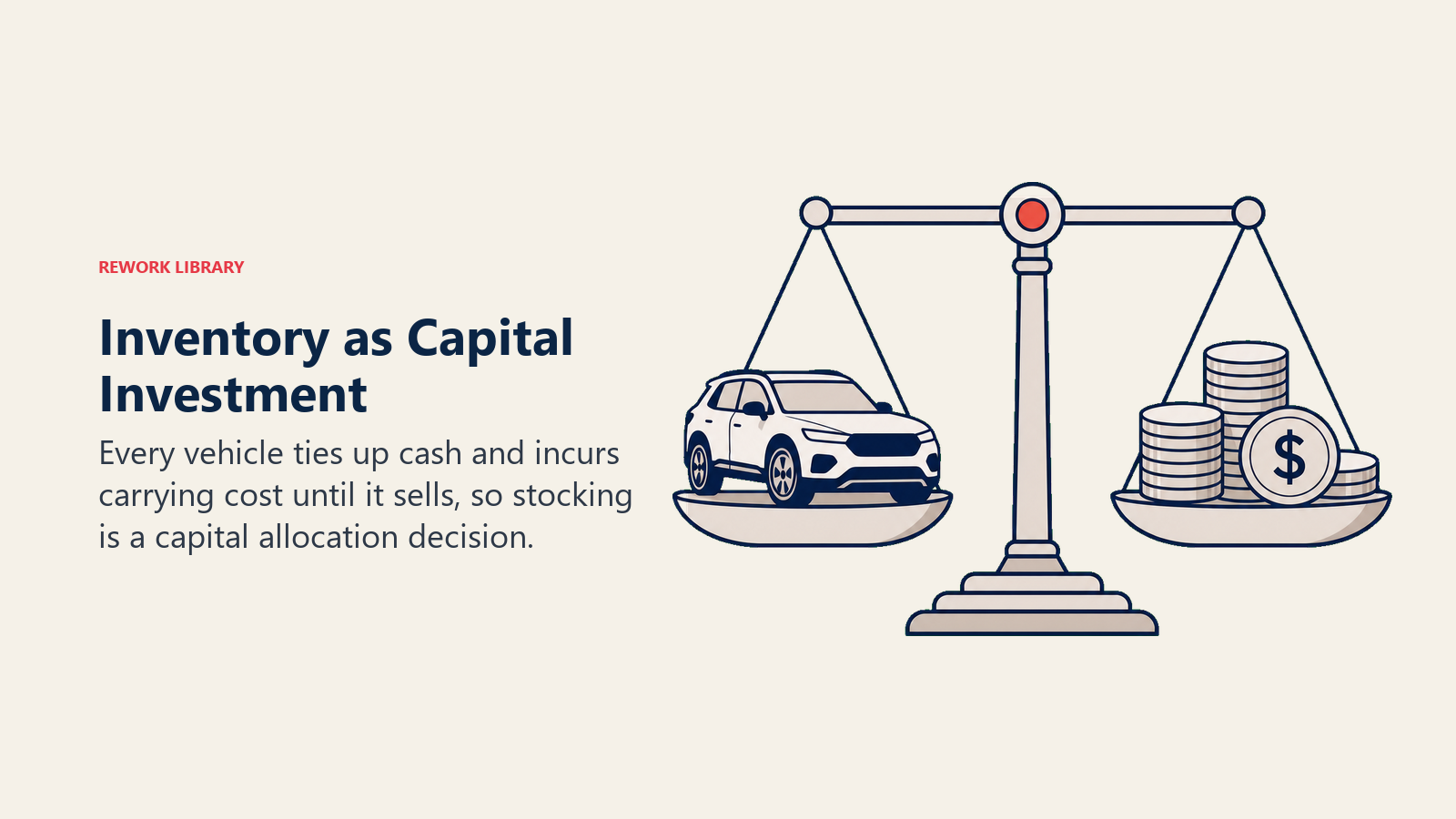
Depreciation and market risk add another layer. Used vehicles depreciate 1-2% monthly depending on age and market conditions. New vehicles don't depreciate on your books, but market incentive changes can make your inventory worth less overnight. When the factory adds $3,000 in customer cash, your 30-day-old inventory just lost $3,000 in relative value.
Working capital requirements matter more than most dealers realize. If you want to carry 120 used vehicles at $22,000 average cost, you need $2.64 million in floorplan availability. Add 150 new vehicles at $38,000 average cost, and you need $5.7 million in total floorplan capacity. That assumes you're using manufacturer floorplan assistance, paying down aged units, and managing curtailment requirements.
ROI comparison against other investments forces honest conversations. If your inventory returns 18% annually after all costs, that's solid. If it returns 6%, you should question why you're tying up capital in depreciating assets instead of more profitable uses.
Inventory Strategy Framework
Strategy starts with fundamental allocation decisions. New vs. used mix varies by franchise and market. A volume domestic franchise might run 60% new, 40% used. A luxury franchise might run 40% new, 60% used. Independent dealers are 100% used. Your mix should reflect customer buying patterns, front-end gross profit by category, and capital efficiency.
Days supply targets provide your north star. For new vehicles, 45-60 days supply gives you selection without excess. Below 45 days, you're constantly out of stock on popular models. Above 60 days, you're carrying too much inventory and paying excessive floorplan interest. Used vehicles should turn faster, 30-45 days supply for most franchised dealers, 25-35 days for high-volume independents.
Age distribution goals keep you disciplined. For new vehicles, 80% should be 0-60 days old, 15% should be 61-90 days old, and only 5% should exceed 90 days. Used vehicle age distribution should be tighter: 70% at 0-30 days, 25% at 31-60 days, and only 5% past 60 days.
Price point and segment coverage ensures you're not leaving money on customers' tables. If your market buys 30% trucks, 25% SUVs, 25% sedans, and 20% crossovers, your used inventory mix should roughly match those proportions. Don't stock what you like. Stock what sells.
Make and model diversification matters for used vehicle portfolios. Franchised dealers should carry 60-70% same-brand vehicles to support brand loyalty and CPO programs. The remaining 30-40% should be competitive brands that appeal to cross-shoppers. Independent dealers need broader diversification, so no single make should exceed 20% of inventory.
New Vehicle Inventory Strategy
New vehicle inventory is both simpler and more constrained than used. Understanding factory allocation systems is critical. Manufacturers allocate vehicles based on sales history, market share, CSI scores, and facility standards compliance. If you sold 80 F-150s last year, you'll get allocation for roughly 80-90 F-150s this year. Want more? Increase sales or improve other allocation factors. Order bank management gives you control within allocation constraints. Every vehicle you stock starts as an order, either a customer sold order or a dealer stock order. Smart dealers keep 70-80% of orders as stock units and 20-30% as sold orders. This mix provides floor traffic inventory while fulfilling customer requests.
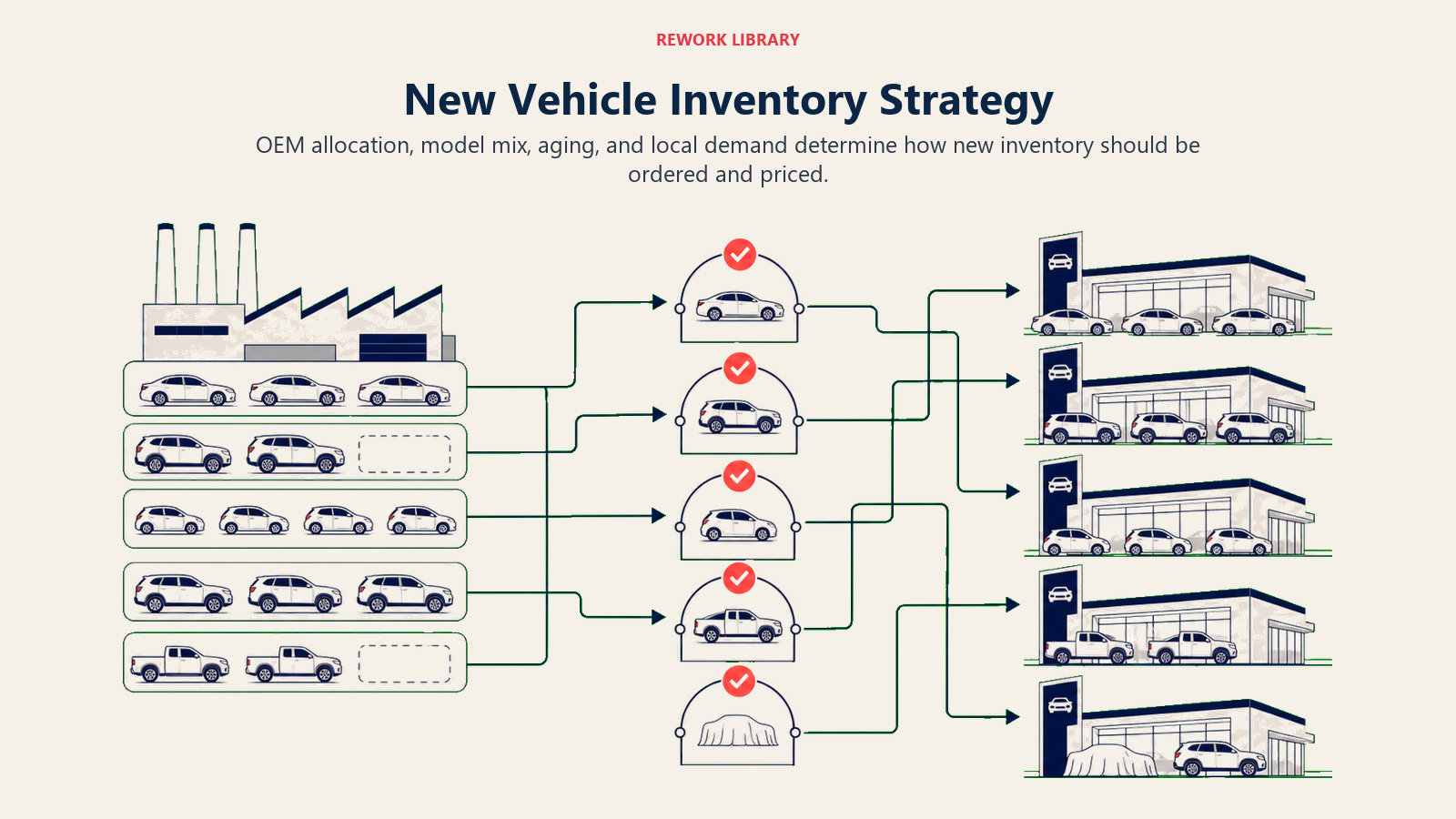
In-transit visibility lets you pre-market arriving vehicles before they hit the lot. If you've got three F-150 Lariats in transit arriving in 10 days, start marketing them now. Use window stickers and "reserve this vehicle" campaigns. The goal is to have a customer committed before it arrives, turning a stock unit into a sold unit instantly.
Balancing factory pressure and market demand creates tension every month. Manufacturers push you toward models with extra incentives or slow sales. Your market wants popular models with limited allocation. You can't ignore factory pressure entirely, because allocation depends on cooperation. But you can't stock vehicles your market doesn't want either. The balance is accepting some factory push while keeping 70-80% of inventory market-driven.
Special order vs. stock is a philosophical question. Some dealers stock heavily and rarely special order. Others maintain minimal inventory and special order most sales. The right answer depends on your market. Urban markets with heavy competition require robust stock. Rural markets with less competition can operate with smaller inventories and longer special order timelines.
Demo and loaner vehicle strategy impacts inventory allocation. Most dealerships allocate 1-2% of new vehicle sales to demo vehicles for managers and salespeople. Service loaner fleets might represent 5-8% of annual sales. These vehicles provide utility, but they tie up capital and allocation. Keep demo and loaner allocation lean, since every demo is a retail unit you can't sell.
Used Vehicle Inventory Strategy
Used vehicle inventory offers more control but requires more active management. Trade-in retention decisions happen dozens of times per month. Not every trade belongs on your lot. Age, mileage, condition, brand, and market demand determine retail vs. wholesale decisions. Retail the clean, popular units. Wholesale the rough, slow-turning ones. Most franchised dealers retail 40-60% of trade-ins. Auction acquisition criteria should be documented and disciplined. Define your age and mileage sweet spots (typically 2-5 years old, under 60,000 miles for franchised dealers). Set condition standards (no frame damage, no salvage titles, minimal cosmetic needs). Establish make and model preferences based on your market's buying patterns.
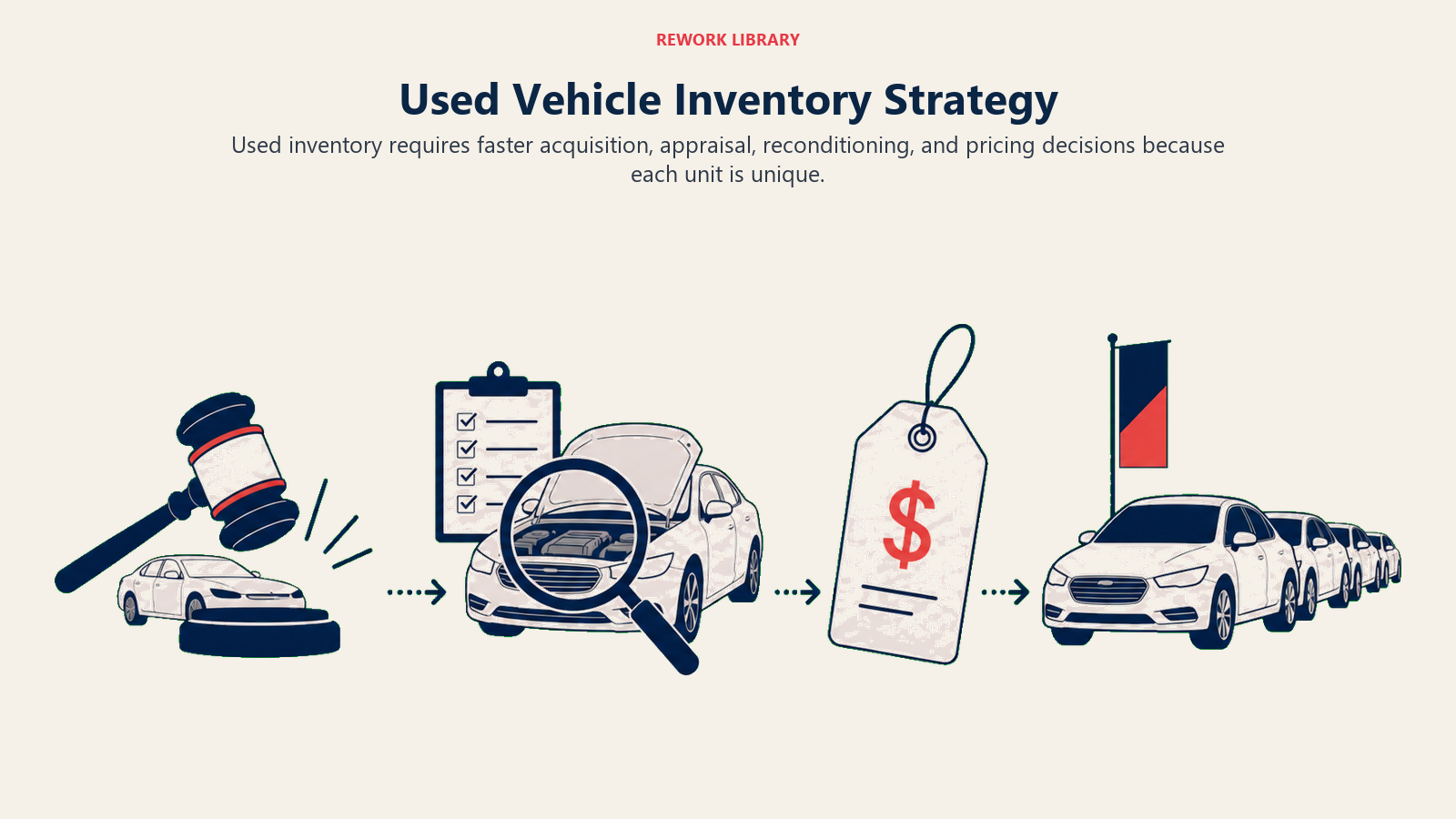
Direct purchase from consumers creates acquisition opportunities beyond trades and auctions. "We Buy Cars" programs, instant cash offer websites, and targeted direct mail can generate acquisition volume. The key is having appraisal tools and processes that let you buy quickly while maintaining margin discipline.
Certified pre-owned allocation matters for franchised dealers. CPO vehicles command $1,500-3,000 premiums and carry factory-backed warranties that ease customer concerns. But CPO vehicles also require inspection costs, certification fees, and reconditioning to factory standards. Allocate 20-40% of same-brand used inventory to CPO depending on market demand.
Age and mileage sweet spots vary by brand and market. Luxury brands can retail 5-7 year old vehicles successfully. Mass-market brands struggle past 6-7 years old. High-mileage vehicles (100,000+) require aggressive pricing and turn quickly or sit forever. Know your market's tolerance and stay within those parameters.
Price point distribution should ladder from entry-level to premium. If your market's median income supports $25,000 used vehicles, stock inventory from $15,000 to $40,000. Don't cluster everything at $22,000-28,000. Create options for budget buyers, mainstream buyers, and premium buyers.
Market Demand Analysis
Data-driven inventory decisions require understanding what your market actually buys. Local market preferences override national trends. If your market buys 40% trucks and 10% sedans, that's your reality, even if national statistics show sedans at 25%. Stock what sells locally, not what the industry average suggests. Seasonal trends impact inventory mix throughout the year. Convertibles sell in spring and summer, not fall and winter. Four-wheel drive trucks and SUVs sell better in snow-belt states during winter. Plan inventory purchases 60-90 days ahead of seasonal demand peaks.

Local market preferences override national trends. If your market buys 40% trucks and 10% sedans, that's your reality, even if national statistics show sedans at 25%. Stock what sells locally, not what the industry average suggests.
Competitive inventory monitoring shows you what's working for other dealers. If your competitor just stocked eight Honda Accords and they're turning in 20 days, that's a signal. Don't blindly copy competitors, but pay attention to what moves quickly at other stores.
Days to turn by segment reveals which categories are hot and which are cold. If your trucks turn in 22 days but sedans take 58 days, you should weight inventory toward trucks. Measure days to turn monthly and adjust purchasing accordingly.
Gross profit by category matters as much as turn rate. A segment that turns in 35 days at $3,500 front-end gross beats a segment that turns in 25 days at $1,800 gross. Calculate profit per day: a $3,500 gross over 35 days is $100/day. An $1,800 gross over 25 days is $72/day. The slower-turning vehicle is more profitable.
Online shopping and search behavior predicts demand before it shows up in sales data. If your website gets 500 searches per month for "used Toyota Camry" but only 50 searches for "used Nissan Altima," that tells you which sedans to stock. Use website analytics, third-party shopping sites, and search trends to anticipate demand.
Inventory Turn Optimization
Speed matters, but not at any cost. Turn rate calculation is simple: 365 days ÷ average days in inventory = annual turns. If your average vehicle sits 40 days, you turn inventory 9.1 times annually. Industry benchmarks target 8-10 turns for used, 6-8 turns for new, with top performers achieving 12 turns (30-day inventory cycles). Age-based pricing strategies accelerate turn on aging inventory. Price aggressively in the first 30 days to move vehicles before they become problems. Don't chase market pricing down on aged units, price to sell and move on. Every dollar you lose on an aged unit is offset by reduced floorplan interest and freed capital for fresh inventory.
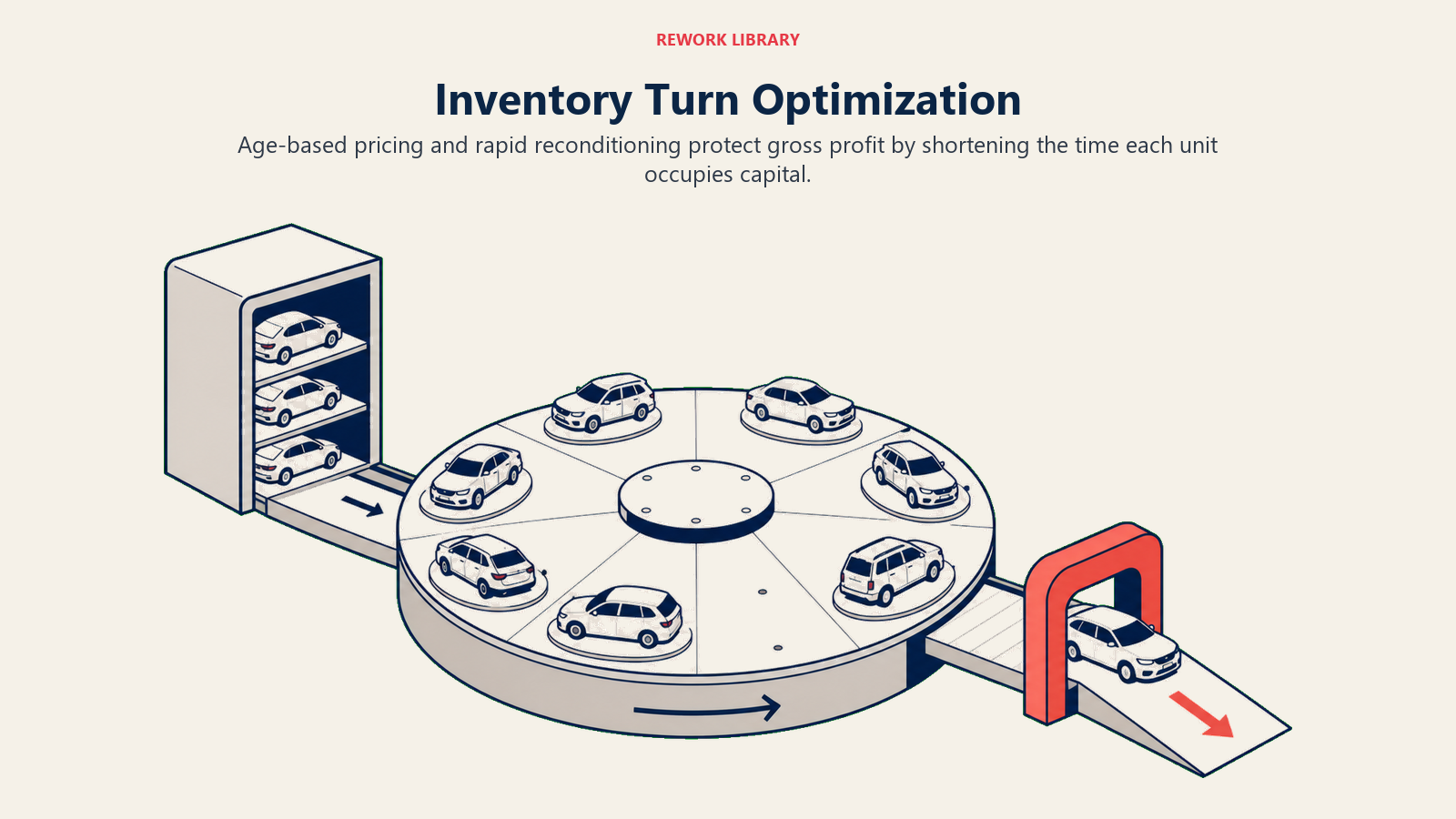
Age-based pricing strategies accelerate turn on aging inventory. Price aggressively in the first 30 days to move vehicles before they become problems. Don't chase market pricing down on aged units, price to sell and move on. Every dollar you lose on an aged unit is offset by reduced floorplan interest and freed capital for fresh inventory.
Marketing budget allocation should weight toward fresh inventory. Spend 70-80% of your marketing dollars on vehicles 0-30 days old. These are your profit vehicles. The remaining 20-30% gets allocated to aged units that need help. Don't waste marketing budget on 90-day-old vehicles, price them to wholesale or give them away retail.
Wholesale vs. retail decisions should be made at 60-75 days depending on your turn goals. If a vehicle hasn't sold retail in 60 days despite proper pricing and marketing, it's telling you something. Wholesale it, take the loss, and move on. Holding it another 30-60 days costs more in interest and opportunity cost than you'll recover.
Reconditioning speed impacts turn rate more than most dealers realize. A vehicle that sits 14 days in recon is 14 days that could be selling. Fast recon (3-5 days) requires service department prioritization, parts availability, and workflow discipline. Slow recon kills turn rate regardless of acquisition quality.
Technology and Tools
Manual inventory management doesn't scale past 60-80 vehicles. DMS inventory management provides foundational tracking, what you own, what you owe, what it costs, how long you've had it. But most DMS systems don't provide market-based pricing, predictive analytics, or turn optimization guidance. Cox Automotive research shows that dealers using advanced inventory management tools achieve significantly faster turn rates and higher profitability.
vAuto and ProfitTime GPS dominate used vehicle inventory tools. These systems provide market-based pricing, days-to-turn predictions, acquisition guidance, and ROI tracking. They're not cheap ($800-1,500 monthly), but they pay for themselves by preventing aged inventory and optimizing pricing.
Market-based pricing tools eliminate guesswork. Instead of using book values or gut feel, these tools analyze actual sold listings, current market supply, and days-to-turn data to recommend optimal pricing. Kelley Blue Book and Edmunds provide comprehensive market data backed by hundreds of thousands of transactions monthly. When the tool says "price at $24,900 for 25-day turn" or "$26,400 for 45-day turn," you make informed decisions.
Predictive analytics use historical data to forecast which vehicles will turn quickly and which will sit. Machine learning models analyze hundreds of variables (make, model, year, trim, mileage, price, season, market conditions) to predict turn probability. This helps you buy smarter at auction and avoid problem vehicles.
Real-time turn and age reporting creates accountability. Daily reports showing days-in-inventory by vehicle, age distribution by category, and turn rate by manager force attention on problem areas. What gets measured gets managed.
Inventory Financing Strategy
Floorplan management is as important as inventory selection. Floorplan provider selection involves more than interest rates. Service quality, audit flexibility, curtailment requirements, and credit terms matter. Most dealers use manufacturer-captive floorplan for new vehicles (Toyota Financial, Ford Credit, etc.) and independent floorplan companies for used vehicles (NextGear, AFC, Automotive Finance Corporation).
Interest rate negotiation happens at contract signing and renewal. Rates typically float with prime plus 2-3%. But volume dealers with strong payment history can negotiate better terms. A 0.25% rate reduction on $4 million in average floorplan balance saves $10,000 annually.
Curtailment requirements force periodic paydowns. Most floorplan agreements require paying down 10-20% of outstanding balance quarterly. This disciplines inventory management and reduces lender risk, but it also requires cash flow management. Plan for curtailment requirements in your working capital forecasts.
Audit compliance keeps your floorplan line available. Lenders audit periodically to verify you actually have the vehicles you're financing. Missing vehicles, title issues, or vehicles "out of trust" (sold but not paid off) cause audit failures and line reductions. Maintain tight title management and daily reconciliation.
Days out of trust minimization reduces audit risk and potential fraud issues. When you sell a vehicle, you have 2-3 days to pay off the floorplan loan before the vehicle is "out of trust." Too many out-of-trust vehicles indicate cash flow problems, title management failures, or worse. Monitor daily and resolve immediately.
Performance Metrics
You can't manage what you don't measure.
Days supply and turn rate are your primary inventory health metrics. Calculate these weekly by category (new, used, CPO) and by segment (trucks, SUVs, sedans). Benchmark against your targets and investigate variances.
Aged inventory percentage above 90 days should never exceed 5% of total inventory. If 10-15% of inventory is aged, you've got a purchasing problem, pricing problem, or both. Aged inventory kills profitability through interest expense, depreciation, and opportunity cost.
Gross profit per vehicle by age reveals the cost of slow turn. Fresh inventory (0-30 days) should generate your target gross ($3,000 for used, $2,000 for new is typical). Inventory 31-60 days old generates 15-25% less gross. Inventory past 60 days generates 40-50% less gross. This math forces pricing discipline.
Market day supply vs. dealership day supply shows competitive positioning. If your market's day supply is 35 days but you're carrying 65 days, you're overstocked. If market day supply is 55 days but you're at 30 days, you're potentially understocked. Match or slightly exceed market supply.
Capital efficiency ROI calculates return on inventory investment. Take annual gross profit from vehicle sales (front and back end), subtract inventory holding costs (interest, depreciation, personnel), divide by average inventory value. Target 18-25% ROI. Below 15%, you're not generating sufficient return on capital to justify the investment.
Inventory strategy isn't sexy. It doesn't have the adrenaline of sales or the immediate gratification of closing deals. But it's the foundation of sustainable profitability. Get inventory right (mix, turn, pricing, financing) and everything else gets easier.
Frequently Asked Questions about A Bold Growth Strategy for Dealership Inventory (2026)
What is a good inventory turn rate for a car dealership?
Most franchised dealers target 8 to 10 turns per year on used vehicles and 6 to 8 on new, with top performers hitting 12 turns (a 30-day inventory cycle). You calculate it by dividing 365 by your average days in inventory, so a vehicle that sits 40 days on average equals 9.1 turns annually.
What is a healthy days supply of inventory?
For new vehicles, 45 to 60 days supply gives you selection without excess floorplan cost. Used vehicles should move faster, 30 to 45 days for most franchised dealers and 25 to 35 days for high-volume independents. Match or slightly exceed your local market's day supply rather than the national average.
How much does it cost to hold dealership inventory?
Every million dollars in inventory costs roughly $5,000 to $8,000 per month in floorplan interest and holding costs, or $60,000 to $96,000 a year. That figure excludes depreciation, market-incentive risk, and the opportunity cost of capital tied up in vehicles instead of marketing or facilities.
When should a dealer wholesale an aged unit instead of holding it?
Make the wholesale-versus-retail call at 60 to 75 days. If a vehicle has not sold despite correct pricing and marketing, holding it another 30 to 60 days usually costs more in interest and opportunity cost than you would recover. Take the loss, free the capital, and replace it with fresh inventory.
How do you balance factory pressure against market demand?
Accept some factory push to protect your allocation, but keep 70% to 80% of inventory market-driven. Manufacturers reward sales volume and cooperation with future allocation, yet stocking models your market does not want kills turn rate. The discipline is ordering mostly what sells locally while taking enough incentivized units to stay in good standing.