Automotive SEO Strategy: Dominating Local Search to Reduce Lead Costs 50% - 2026 Guide
Turn this article into takeaways for your work.


Each assistant summarizes the article only for you and suggests best practices for your work.
The #1 organic result in local search gets 33% of clicks. The #2 result gets 18%. The #3 gets 12%. After that, you're fighting for scraps. But here's what matters: every one of those clicks costs you $0.
Meanwhile, the same search term in Google Ads costs $8-15 per click. If you're ranking organically, you're generating leads at zero acquisition cost. If you're not ranking, you're paying premium rates for traffic your competitors get free.
SEO isn't quick. It takes 6-12 months to see meaningful results. But once you're ranking, that position generates leads month after month with minimal ongoing cost. A paid ad stops working the moment you stop paying. An organic ranking keeps delivering.
The Automotive SEO Opportunity
92% of car buyers start their search online according to Think with Google research. The majority land on Google first, searching for dealerships, specific models, inventory, or pricing. If you're not visible in those searches, you don't exist.
"Honda dealer near me" gets 1,300 monthly searches in a typical metro market. "Used cars for sale near me" gets 2,400. "Toyota service near me" gets 800. Multiply this across hundreds of relevant search terms, and you're looking at 10,000-20,000 monthly searches in your market.
The economics tell the whole story. A third-party lead from Autotrader costs $60 and converts at 15% = $400 cost per sale. A paid Google Ad lead costs $45 and converts at 22% = $205 cost per sale. An organic SEO lead costs $0 and converts at 28% = $0 cost per sale (excluding the sunk cost of SEO investment).
But it's the long-term ROI that makes SEO compelling. You invest $20,000 over six months building your SEO foundation. That generates 200 monthly organic leads starting month seven. At a 25% conversion rate, that's 50 monthly sales from a one-time investment. The payback happens in 4-6 months, then it's pure profit.
The dealerships ignoring SEO are paying that $20,000 every month in automotive PPC advertising costs instead. Forever.
Local SEO Foundations
Local SEO determines whether you appear when someone searches for dealerships in your area. Get this wrong and nothing else matters.
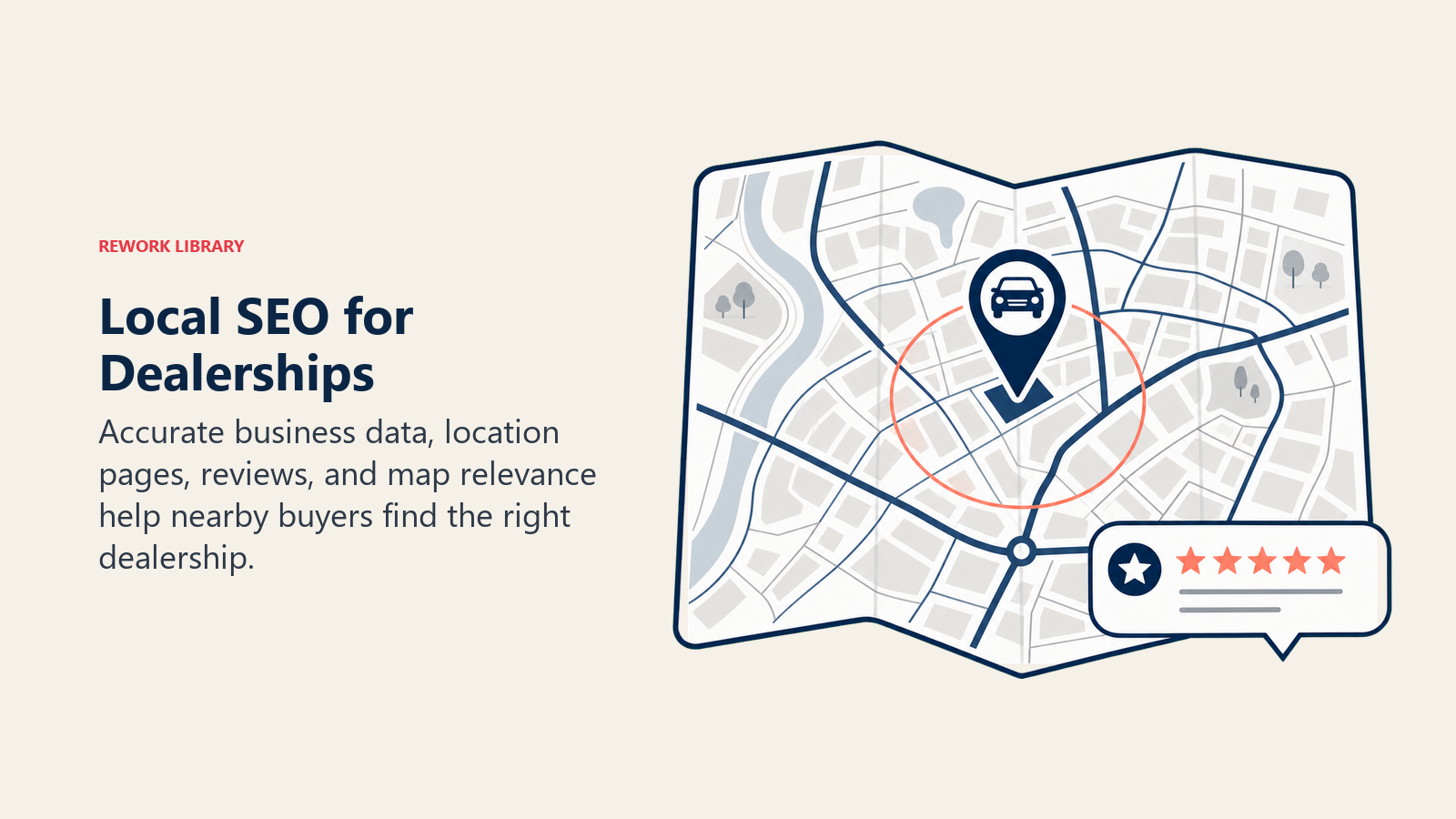
Your Google Business Profile is the foundation. This is the listing that appears in Google Maps and the local pack (the three businesses shown above organic results). You need to claim it, verify it, and optimize it.
Start with the basics: accurate business name, address, phone number, hours, website URL. Add your primary category ("Car Dealer") plus secondary categories ("Used Car Dealer," "Auto Repair Shop," "Car Leasing Service"). Upload 50+ high-quality photos, exterior, interior, inventory, team members, service bays.
The description section allows 750 characters. Use it. "Family-owned Honda dealer serving Springfield since 1987. New Honda inventory, certified pre-owned vehicles, full-service department, genuine Honda parts. Same-day financing approval. 500+ vehicles in stock. Open Monday-Saturday with Sunday service hours."
Posts, Q&A, and reviews all impact your local ranking. Post weekly updates about new inventory, special offers, or service promotions. Answer common questions proactively. Generate reviews systematically (more on this later).
NAP consistency (Name, Address, Phone) must be identical across every online citation. If your Google Business Profile says "123 Main St" but your website says "123 Main Street," Google sees conflicting signals. Same with phone number formatting. Pick one format and use it everywhere.
Local citations are mentions of your business on other websites, Yelp, Yellow Pages, Bing Places, industry directories, local chamber of commerce sites. The more consistent citations you have, the more Google trusts your location data. Aim for 50+ citations across major directories and local business sites.
Multi-location groups need individual pages for each dealership with unique content. Don't duplicate the same homepage across three locations. Each needs its own location-specific content, local photos, area information, and unique value propositions.
On-Page SEO for Dealerships
Every page on your dealership website needs optimization for specific search terms. Most dealer sites ignore this completely, letting the website vendor handle it (they don't).
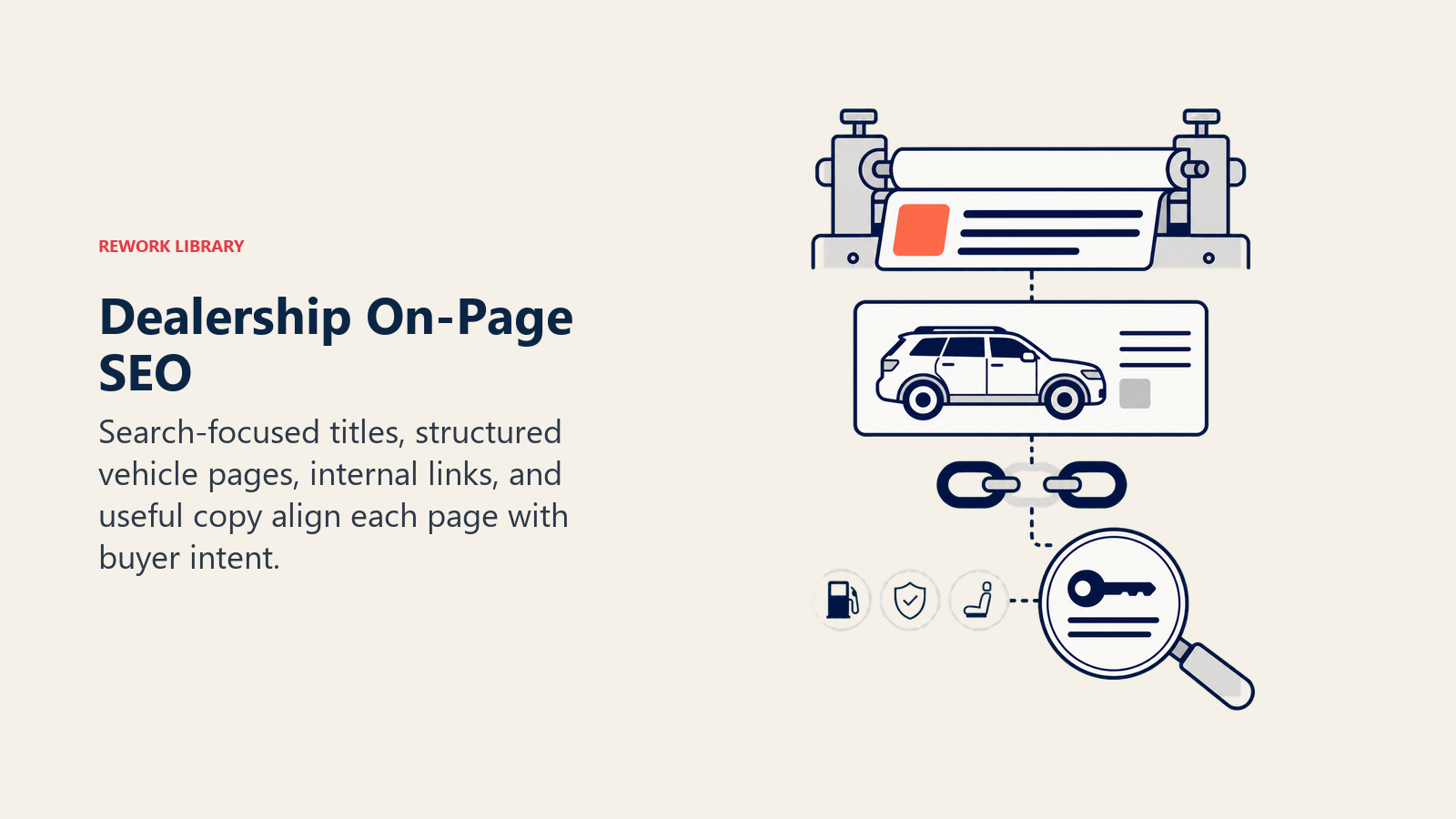
Your homepage should target your primary brand + location terms: "Honda Dealer Springfield" or "Springfield Honda Dealership." Include these in your title tag (the text that appears in search results), H1 heading, and naturally throughout the content. Don't keyword stuff, write for humans first, search engines second.
New and used inventory pages need separate optimization through new vehicle inventory management and used vehicle acquisition. Your new inventory page targets "New Honda Springfield" or "New Honda for sale." Used inventory targets "Used cars Springfield" or "Pre-owned vehicles near me." Include filtering options (by make, model, price, year) and make sure they're crawlable by search engines.
Vehicle detail pages (VDPs) are your highest-traffic pages. Each one should be optimized for "Year Make Model Location" terms through vehicle detail page optimization. The 2026 Honda CR-V VDP should target "2026 Honda CR-V Springfield." Include this in the page title, H1, and description. Add unique content describing features, specifications, available colors, trim levels. Don't rely solely on OEM-provided descriptions, add local context.
Service pages need optimization for maintenance and repair terms through service appointment scheduling: "Honda service Springfield," "oil change near me," "brake repair Springfield." Create individual pages for common services rather than one generic service page. Each service page should answer common questions, explain the process, list pricing (if possible), and include a clear call-to-action.
Department pages for sales, service, parts, and F&I should target role-specific searches. Your F&I department page should target "auto financing Springfield" or "car loans bad credit." Your parts page should target "genuine Honda parts" or "OEM auto parts near me."
Every page needs a meta description (the text snippet below the title in search results). This doesn't directly impact rankings but affects click-through rate. Make it compelling: "Shop 500+ new & used Honda vehicles at Springfield Honda. Same-day financing approval, all credit types welcome. Family-owned since 1987. Visit us today."
Internal linking connects pages and spreads ranking authority. Your homepage should link to main category pages. Category pages link to sub-pages. Every VDP should link back to inventory pages and relevant service pages. This helps search engines understand your site structure and improves user navigation.
Technical SEO Requirements
Technical SEO is the infrastructure that allows search engines to crawl, understand, and rank your website. Most dealer websites have serious technical issues because they're built by automotive vendors, not SEO experts, according to Search Engine Journal best practices.
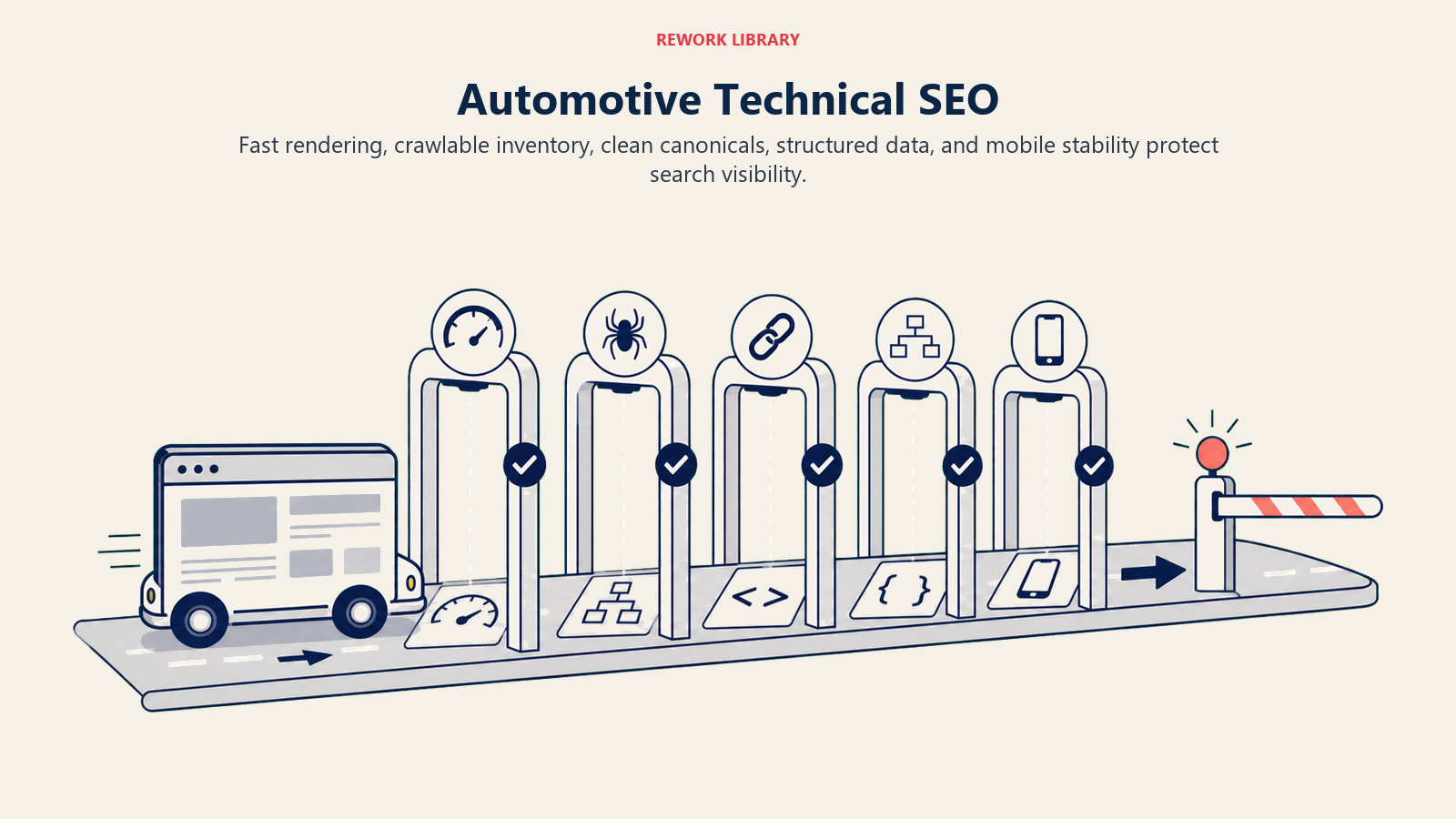
Site speed is critical through dealership website optimization. Google considers page load time a ranking factor, and users abandon slow sites. VDPs with 40 photos that take 8 seconds to load are killing your rankings and conversions. Compress images, implement lazy loading, minimize JavaScript, use content delivery networks (CDNs). Target under 3 seconds for desktop, under 4 seconds for mobile.
Mobile responsiveness isn't optional through mobile experience for buyers. 70% of dealership website traffic comes from mobile devices. Google uses mobile-first indexing, they evaluate your mobile site to determine rankings. If your site looks broken or functions poorly on mobile, you won't rank. Test every page on multiple devices and screen sizes.
Schema markup is structured data that helps search engines understand your content. DealerShip schema tells Google you're a car dealer, LocalBusiness schema provides address and hours, Vehicle schema marks up your inventory. This data powers rich snippets in search results, the extra information that makes listings stand out.
XML sitemaps list all pages on your site for search engines to discover. Your inventory turns over constantly, vehicles sell, new ones arrive. An automated sitemap that updates daily ensures search engines find new VDPs quickly. Submit your sitemap through Google Search Console.
Indexation issues happen when search engines can't access pages. Blocked robots.txt, noindex tags, or redirect chains prevent pages from ranking. Use Google Search Console to identify crawl errors and indexation problems. A common issue: VDPs with sold vehicles remain indexed, creating thousands of dead pages. Implement 301 redirects or noindex tags on sold inventory.
HTTPS security is a ranking factor and a trust signal. If your site still uses HTTP, fix it immediately. SSL certificates cost under $100 annually. No excuse for not having one.
Duplicate content hurts rankings. Many dealer websites create duplicate pages for the same vehicle, one in new inventory, one in Honda inventory, one in SUV inventory. Use canonical tags to tell search engines which version is primary, or better yet, fix your site structure to eliminate duplicates.
Content Strategy for Rankings
Content is what ranks in search results. Product pages (VDPs) alone won't capture all relevant searches. You need content that addresses buyer questions and research topics.
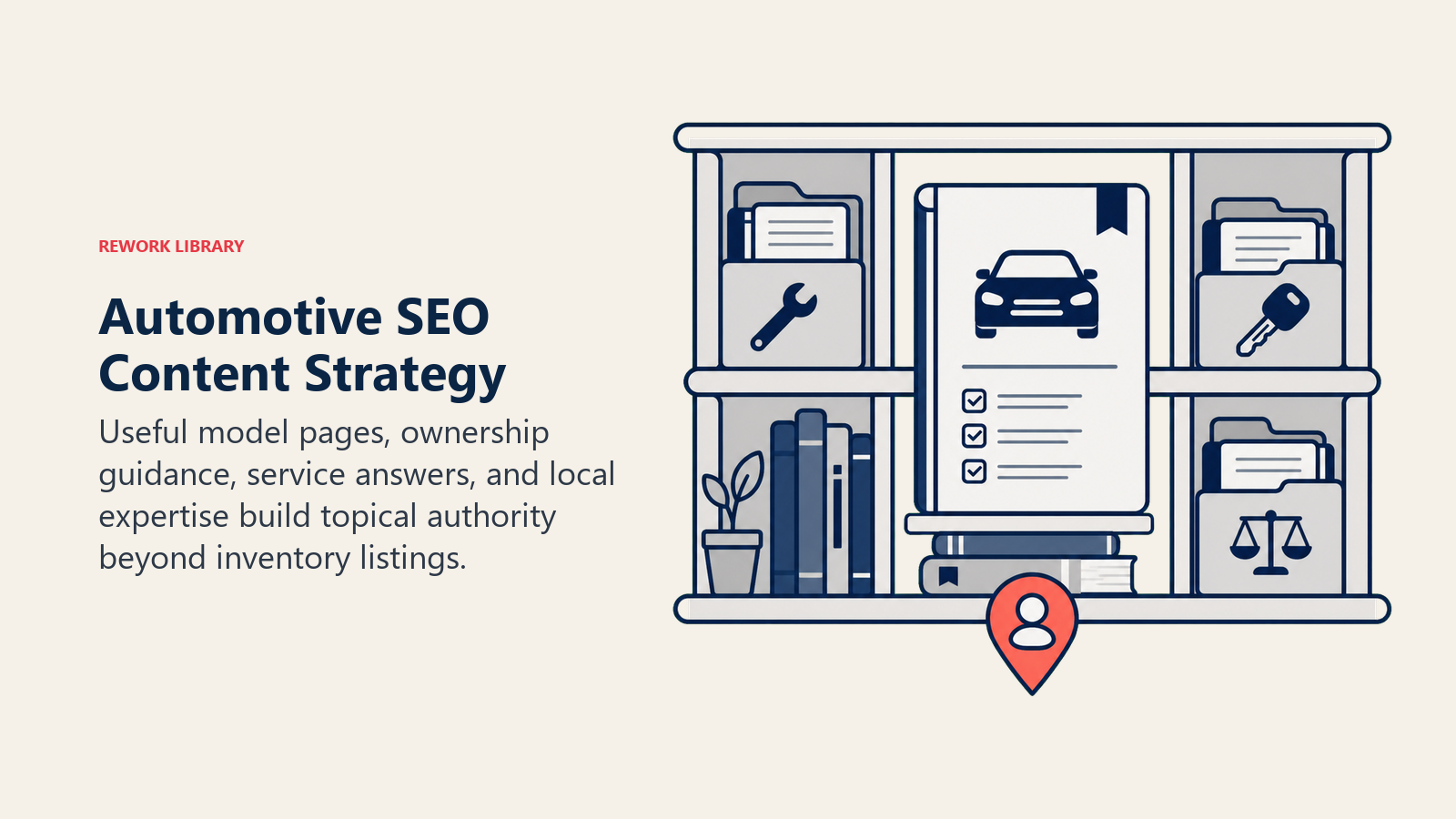
Model research pages target comparison searches: "2026 Honda CR-V vs Toyota RAV4," "Best midsize SUVs 2026," "Honda CR-V review." Create comprehensive guides that answer these questions. Don't just regurgitate manufacturer specs, add local insights, real-world testing, ownership costs, resale value data.
Local area pages help you rank for location-specific searches beyond your immediate city. If you're in Springfield but serve five surrounding towns, create pages for "Honda dealer Shelbyville," "Used cars Centerville," etc. Include genuine local content, not just find-and-replace text with different city names. Mention local landmarks, explain why customers from that area choose your dealership, show inventory that appeals to that market.
Blog content addresses top-of-funnel research questions through automotive content marketing: "How to negotiate a car purchase," "What credit score do I need to finance," "New vs used car: which is better," "How to check a used car for problems." These aren't directly converting searches, but they build authority and capture early-stage buyers. Publish 2-4 posts monthly, 1,500+ words each, genuinely helpful.
FAQ pages can rank for question-based searches. Create pages that answer 20-30 common buyer questions. "Do you accept trade-ins?" "What financing options are available?" "Can I buy online and have the vehicle delivered?" "What's included in your vehicle inspection?" These pages rank for long-tail, specific searches.
Video content has its own search results in Google and YouTube through automotive video marketing. Create video content answering common questions, comparing models, or showcasing inventory. Optimize video titles, descriptions, and tags for relevant keywords. Embed videos on your website pages to increase engagement and dwell time (ranking factors).
Update content regularly through vehicle merchandising. A blog post from 2019 won't rank well in 2026. Refresh old content annually, update statistics, add new sections, improve formatting. Google favors fresh, updated content over outdated pages.
Link Building for Dealerships
Links from other websites signal authority and trust to search engines. The more high-quality websites linking to you, the higher you'll rank. But automotive link building is challenging because most dealers don't create content other sites want to link to.
Local partnerships offer the easiest link opportunities. Sponsor local sports teams, schools, or nonprofits, they'll list you as a sponsor on their website. Join the chamber of commerce and local business associations, you'll get listed in member directories. Participate in community events and get mentioned on event pages.
OEM co-op programs sometimes include link opportunities. Your manufacturer's certified pre-owned program, service specials, or regional campaigns might link back to your site. Ask your OEM rep what's available.
Industry directories like DealerRater, Edmunds, and Cars.com provide links. While these are often paid placements, they're relevant, authoritative sources that pass SEO value.
Press releases for significant events, new franchise announcements, major expansion, charity initiatives, awards, can generate media coverage and links from local news sites. Don't spam press releases for routine events. Save them for genuinely newsworthy occasions.
Guest content on automotive blogs or local business publications can earn links, but it requires creating genuinely valuable content. An article about "5 Mistakes First-Time Car Buyers Make" for a local lifestyle blog, with a link back to your financing page, works better than obvious self-promotion.
Broken link building involves finding broken links on other websites and suggesting your content as a replacement. Use tools like Ahrefs or SEMrush to find broken links pointing to competitors or outdated resources, then reach out offering your page as an alternative.
Don't buy links from link farms or PBNs (private blog networks). Google penalizes these tactics aggressively. A penalty can drop your rankings to page 10+ overnight, taking months to recover. Not worth the risk.
Review Management and SEO Impact
Reviews aren't just for reputation, they're a significant local SEO ranking factor. Google considers review quantity, review frequency, review ratings, and review responses when determining local rankings.
Quantity matters. A dealership with 1,200 Google reviews will outrank one with 200, all else equal. Build systematic review generation into your sales and service processes. After every vehicle delivery, the salesperson asks for a review. After every service visit, the advisor sends a review request.
Quality matters too. A 4.6-star average with 800 reviews beats a 4.9-star average with 50 reviews. You can't control every review, but you can improve the ratio by delivering exceptional experiences that generate 5-star reviews consistently.
Review frequency signals active business. Getting 50 reviews this month and zero next month looks suspicious. Steady review flow (20-40 monthly) appears more organic and trustworthy.
Responding to reviews improves rankings and reputation. Respond to every review, positive and negative. For positive reviews, a simple "Thank you for choosing Springfield Honda! We appreciate your business and hope to serve you again." For negative reviews, acknowledge the issue, apologize, and offer to resolve it offline. Never argue or get defensive publicly.
Review content provides keyword signals. Reviews mentioning "friendly staff," "great prices," "quick service" reinforce your positioning. Reviews mentioning specific models, services, or features add relevant content to your profile.
Multi-platform presence extends beyond Google. Reviews on Yelp, DealerRater, Cars.com, Edmunds, and Facebook all contribute to your overall online reputation. Monitor all platforms and respond consistently.
Review generation tactics that work through online review management: automated email/SMS requests 24-48 hours post-purchase, QR codes on service receipts linking directly to your Google review page, incentivized reviews (though Google technically prohibits this), making it incredibly easy by providing direct links.
Don't buy fake reviews. Google identifies and removes them. A sudden spike of 50 generic reviews in one week triggers manual review. Real reviews from real customers through customer loyalty programs are the only sustainable approach.
Measuring SEO Performance
SEO without measurement is guesswork. You need to track progress and ROI to justify continued investment.
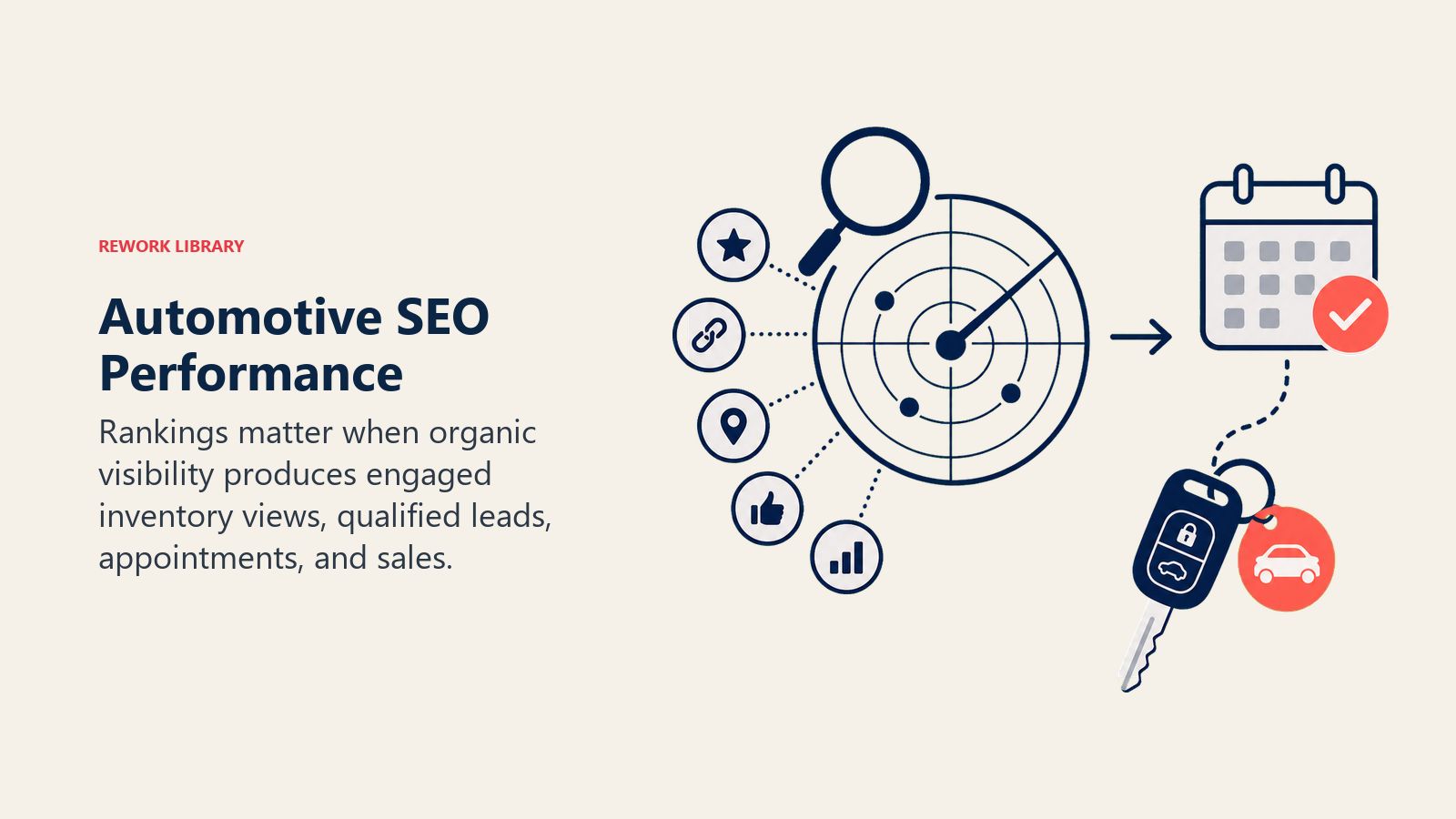
Keyword ranking tracking shows position changes for target terms through dealership data analytics. Track 50-100 important keywords weekly: brand terms, model terms, local terms, service terms. Tools like SEMrush, Ahrefs, or Local Falcon provide automated tracking. Watch for trends, a steady climb from position 8 to position 3 over six months validates your strategy.
Organic traffic growth measures the volume of visitors from search engines. Google Analytics 4 shows organic sessions and users through your dealership KPI dashboard. Track monthly trends. Expect 10-20% month-over-month growth during active SEO campaigns. Plateau after 12-18 months is normal, that's when you shift to maintenance mode.
Lead attribution from organic traffic connects SEO to revenue. Use UTM parameters or CRM source tracking to identify leads that originated from organic search. Calculate conversion rates and cost per sale. This is how you prove ROI to management.
Cost per lead comparison shows SEO economics versus other channels. Paid leads cost $40-80. Third-party leads cost $50-100. SEO leads cost $0 (after accounting for sunk investment). Build a dashboard comparing CPL across all sources to demonstrate SEO value.
Traffic-to-lead conversion rate reveals website effectiveness. If you're getting 10,000 monthly organic visitors but only 50 leads, you've got a website conversion problem, not an SEO problem. Benchmark at 2-4% conversion rate. Below that, optimize your forms, calls-to-action, and user experience.
Local visibility tracking shows your presence in the Google local pack (the three businesses shown in local search results). Tools like Local Falcon or BrightLocal provide heat maps showing where you rank across your market area. The goal is top-three positioning across your service area.
Google Search Console provides direct data from Google: impressions, clicks, average position, click-through rate. Review this monthly to identify ranking opportunities and technical issues.
Common SEO Mistakes in Automotive
Most dealership websites make the same mistakes repeatedly. Avoid these and you'll outrank 70% of competitors by default.
Poor VDP optimization is the biggest mistake. Dealerships treat VDPs as templated inventory pages with zero unique content. Every VDP should have unique, descriptive text beyond manufacturer specifications. Add local context, describe key features in plain language, answer common questions about that model.
Duplicate content across inventory happens when the same vehicle appears on multiple URLs or multiple dealerships in a group copy the same content. Use canonical tags, write unique descriptions, and implement proper URL structures.
Slow-loading pages kill rankings and conversions. VDPs with 50 uncompressed photos taking 10 seconds to load won't rank well. Compress images to 100KB each. Implement lazy loading so images load as users scroll. Minimize JavaScript that blocks rendering.
Ignoring mobile experience is suicide. Test your entire site on actual mobile devices, not just desktop browser resize. Can users easily navigate inventory? Do forms work properly? Are call buttons prominent? Can users see photos clearly? Fix mobile issues immediately.
Neglecting local signals means missing easy ranking opportunities. Incomplete Google Business Profile, inconsistent NAP information, zero local citations, no location-specific content, these are all fixable quickly and improve rankings noticeably.
Thin content on service pages hurts rankings. A service page with 50 words describing "oil changes" won't rank. Write 500-1,000 words explaining oil change intervals, synthetic vs conventional, pricing, what's included, how to schedule. Answer every question a customer might have.
No internal linking structure makes it hard for search engines to understand your site hierarchy. Link from your homepage to main categories. Link from categories to sub-pages. Link from blog posts to relevant product pages. This spreads authority and improves crawling.
Your dealership website optimization extends beyond SEO, conversion rate optimization, user experience, and lead capture all matter. But SEO gets people to your site in the first place.
SEO is the long game in automotive lead generation. You won't see results in 30 days. But at the six-month mark, you'll be generating 100+ monthly leads at zero acquisition cost. At 12 months, that's 200+ monthly leads. The dealers who started SEO in 2023 are now crushing it with organic traffic while competitors pay $50+ per click.
Start with technical foundations. Fix site speed, mobile responsiveness, and indexation issues. Then build out local SEO, optimize Google Business Profile, build citations, generate reviews. Layer on content creation and link building over time. Track progress monthly and adjust based on data.
The investment pays back within 6-12 months, then generates positive ROI forever. Your future self will thank you for starting today.

Senior Implementation Consultant