CSI Score Improvement Strategy - Drive Manufacturer Bonuses and Blue Sky - 2026 Guide
Turn this article into takeaways for your work.


Each assistant summarizes the article only for you and suggests best practices for your work.
CSI scores directly impact dealership profitability through manufacturer bonuses (worth $100K-$500K+ annually) and blue sky valuation multiples. Yet many dealers treat CSI as an annoyance rather than a strategic asset. That's a costly mistake.
The reality is simple: a dealership consistently hitting manufacturer CSI targets can earn an extra half-million dollars in annual bonuses. And when it's time to sell, strong CSI scores can add 20-30% to your blue sky valuation. The math works out to millions of dollars over the life of a dealership.
But improving CSI isn't about gaming the system or begging customers for perfect scores. It's about systematically fixing the friction points in your operation that frustrate customers and create negative survey responses.
Let's break down how to build a CSI improvement strategy that actually works.
Understanding CSI Measurement
Before you can improve CSI, you need to understand exactly what you're being measured on. Each manufacturer uses slightly different methodologies, but the core structure is consistent across brands.
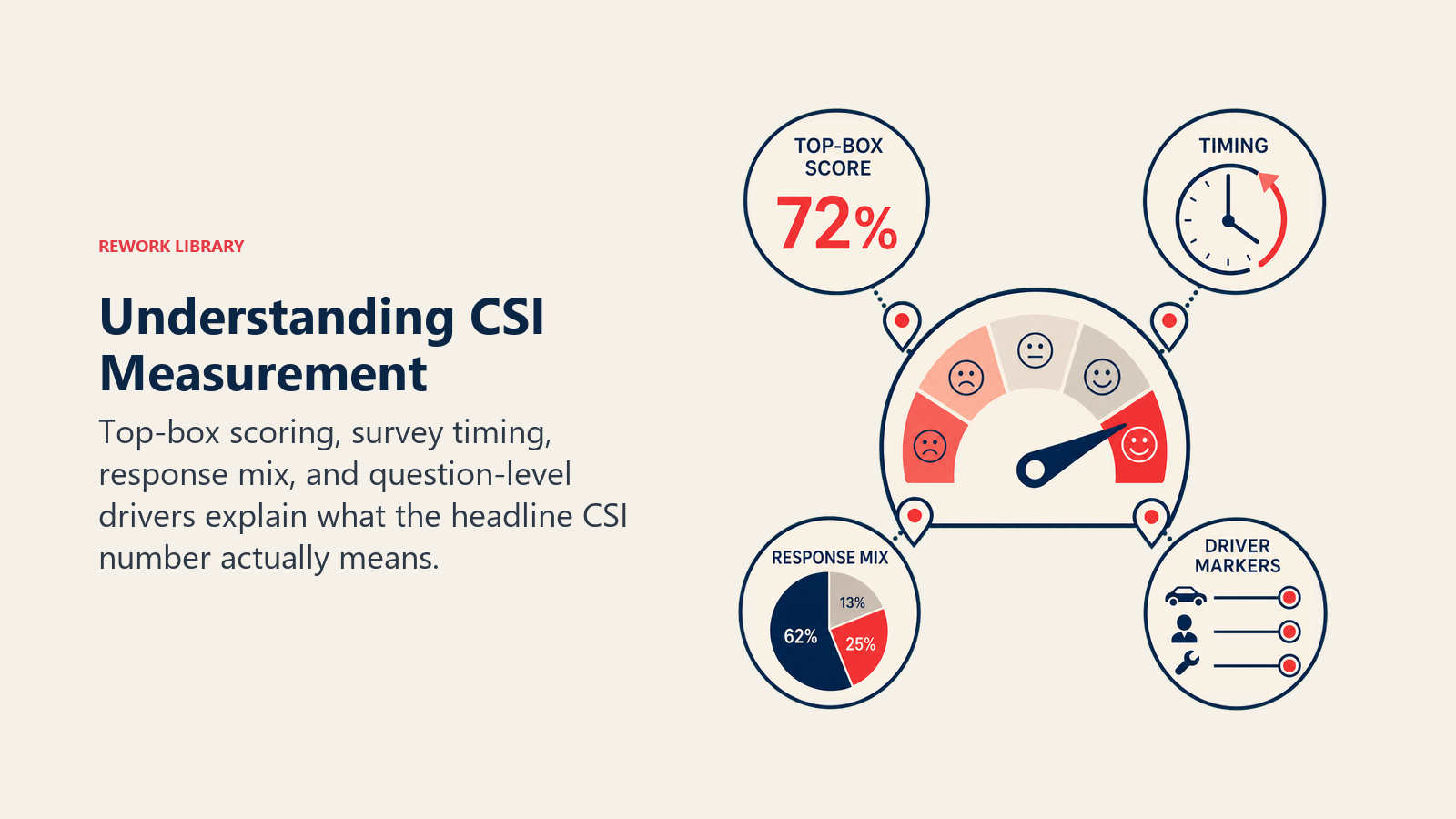
OEM surveys typically go out 3-7 days after delivery for sales CSI (SSI) and immediately after service visits for service CSI. The surveys usually contain 15-25 questions covering different aspects of the customer experience. Customers rate each question on a scale of 1-10, with some manufacturers also using 5-point scales.
According to J.D. Power's Customer Service Index (CSI) Study, which surveys owners of 1 to 3-year old vehicles, the methodology measures five key factors: service quality, service advisor interaction, vehicle pickup experience, service facility quality, and service initiation. Understanding these standardized measurement factors helps dealerships align their improvement efforts with industry benchmarks.
Here's what matters: most manufacturers use "top-box" scoring. That means only the highest scores count as successes. If you're on a 10-point scale, only 10s count. On a 5-point scale, only 5s count. Everything else is a failure in the manufacturer's eyes.
This creates a binary outcome. You're either perfect or you're not. A customer who rates you 9 out of 10 on every question counts the same as a customer who rates you 1 out of 10. Zero points.
Response rates vary by brand but typically run 15-30%. That means if you delivered 100 vehicles last month, you'll probably get 15-30 completed surveys. With top-box scoring, you need nearly perfect scores from nearly everyone who responds. The margin for error is razor-thin.
The surveys measure different dimensions of the experience: sales consultant professionalism, delivery process quality, facility cleanliness, pricing fairness, and overall satisfaction. For service CSI, key areas include appointment scheduling, service advisor communication, repair quality, wait times, and value perception.
Each manufacturer also weights questions differently. Some put heavy emphasis on likelihood to recommend. Others focus more on the delivery experience or specific process steps. You need to know which questions carry the most weight in your brand's formula.
Sales CSI (SSI) Improvement Drivers
Let's start with the sales side. Sales CSI scores are typically harder to control than service CSI because the stakes are higher, emotions run hotter, and customers are spending more money. But you can still systematically improve performance.
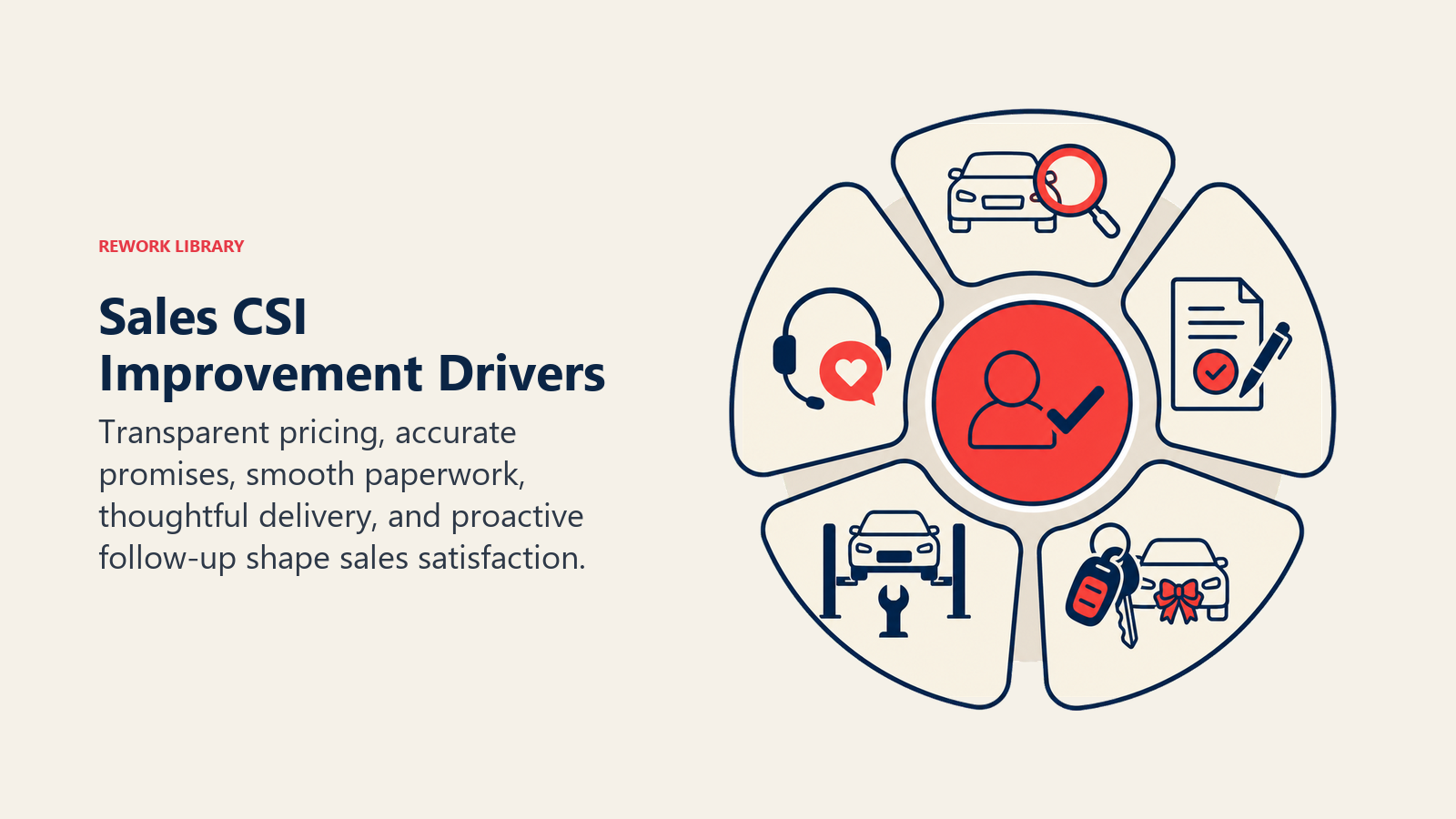
The biggest driver of SSI is the sales consultant's professionalism and product knowledge. Customers need to trust that their salesperson knows what they're talking about and has their best interests at heart. That means ongoing training on vehicle features, competitive products, and consultative selling techniques. It also means hiring people who genuinely enjoy helping customers rather than just closing deals. To understand the full automotive sales process, including best practices for customer interactions, explore our comprehensive guide.
The delivery experience is critical. This is where most dealerships drop the ball. A rushed delivery where the customer gets a 10-minute walkthrough and a stack of papers to sign will kill your CSI. You need a structured, unhurried delivery process where the customer feels celebrated and educated, not processed and dismissed. For comprehensive delivery best practices, see Vehicle Delivery Experience.
A proper delivery takes 45-60 minutes minimum. The customer should sit in the vehicle with the delivery specialist and go through every major feature. Bluetooth pairing, navigation setup, safety system explanations, trunk organization, all of it matters. The customer should drive off confident and excited, not confused and overwhelmed.
Pricing transparency affects CSI more than most dealers realize. Customers who feel they got a fair deal score higher than customers who feel they got squeezed. You don't have to give the car away, but you do need to present pricing clearly and justify your numbers. The negotiation process should feel collaborative, not adversarial. Learn more about online pricing transparency and how it affects customer perception.
Time efficiency matters enormously. Every hour a customer spends in your dealership increases the chance they'll score you poorly. Long waits for appraisals, financing, or delivery create frustration that shows up in survey responses. You need to measure and optimize cycle times at every stage of the process.
Facility cleanliness and comfort are easy wins. A clean showroom, comfortable furniture, good coffee, and fast WiFi won't make up for a bad sales experience, but they'll enhance a good one. And they're completely within your control.
Service CSI Improvement Drivers
Service CSI is often easier to control because the interactions are shorter and the emotional stakes are lower. But it's still challenging because you're dealing with customers who didn't want to bring their vehicle in at all. Nobody wakes up excited about an oil change.
Appointment scheduling sets the tone. Make it easy. Online scheduling should work seamlessly. Phone scheduling should be quick and friendly. Same-day appointments should be available when possible. And when a customer makes an appointment, you need to honor it, not make them wait 30 minutes past their scheduled time. For comprehensive appointment strategies, see Service Appointment Scheduling.
Service advisor communication is the single biggest driver of service CSI. The advisor is the face of your service department. They need to explain what's wrong, what it will cost, and when the vehicle will be ready, all in language the customer can understand. No jargon, no condescension, no surprises. Improve your team's effectiveness with service advisor selling skills training.
Proactive communication during the service process makes a huge difference. If the repair takes longer than expected, call the customer before they call you. If you find additional needed work, explain it clearly and give the customer a real choice, not a guilt trip. If the vehicle will be ready early, let them know.
Wait time and on-time pickup are major friction points. If you tell a customer their vehicle will be ready at 2 PM, it needs to be ready at 2 PM. Not 2:30. Not "almost done." Ready. Customers who have to wait past their promised pickup time score lower, period.
Quality of repair and first-time fix rate directly impact CSI. If the customer has to bring the vehicle back for the same issue, you're going to get a bad survey. Invest in technician training, diagnostic equipment, and quality control processes. Get it right the first time. For broader service strategies, explore our guide on fixed operations overview.
Value perception vs. cost is tricky. You can charge premium prices and still get good CSI if customers feel they received premium service. But if you charge premium prices and deliver average service, you'll get hammered in surveys. The price-to-value relationship has to make sense to the customer.
Process Improvements for CSI
CSI improvement comes down to eliminating friction points and standardizing excellent experiences. You can't just hope for good CSI. You have to engineer it into your processes.
Start with the delivery experience. Create a delivery checklist that covers every feature the customer needs to know about. Train dedicated delivery specialists who do nothing but deliveries all day long. Give them time to do it right. Celebrate the delivery as a special moment, because it is. The customer just bought a $50,000 vehicle. Act like it matters.
Reduce friction in the sales process by streamlining paperwork, improving trade appraisal speed, and making financing decisions faster. Map out your entire sales process and identify every point where customers wait or get frustrated. Then fix those points one by one.
Service advisor training should focus on communication skills as much as technical knowledge. Role-play common scenarios. Practice explaining complex repairs in simple terms. Learn to deliver bad news (expensive repairs) without making customers defensive. The advisor's ability to build trust and communicate clearly will make or break your service CSI.
Managing customer expectations proactively prevents most negative surveys. If a repair might take two days, tell the customer it will take three days. If it might cost $800, tell them it could be up to $1,000. Then when you deliver on time and under budget, you're a hero. Underpromise and overdeliver isn't just a cliché, it's a CSI strategy.
Follow up on every potential issue before the customer leaves. If something went wrong during the sale or service visit, address it immediately. Apologize, make it right, and confirm the customer is satisfied before they walk out the door. A problem resolved immediately rarely shows up as a bad survey. A problem ignored always does. Implement systematic post-sale follow-up process to catch issues early.
Survey Management Best Practices
Let's talk about survey management, and the fine line between proactive customer care and inappropriate survey coaching. OEMs have strict rules about what you can and cannot do to influence survey responses. Violate those rules and you'll face penalties that make bad CSI look like a minor problem.
You can follow up with customers after delivery or service to ensure they're satisfied. That's called customer care, and it's not only allowed but encouraged. What you can't do is tell customers how to answer specific survey questions or offer incentives for perfect scores. The line is clear: fix problems and ensure satisfaction (good), coach survey responses (bad).
Pre-survey customer follow-up should happen 1-3 days after delivery or service. Call every customer. Ask if they're happy with their vehicle or service experience. If they mention any issues, no matter how small, fix them immediately. This isn't about the survey. It's about customer satisfaction. But satisfied customers tend to give good scores.
Identify at-risk surveys early by tracking who responds and when. If you notice a survey response come in from a customer who had a rough experience, check the results immediately. If it's a bad score, you have a brief window to reach out, understand what went wrong, and try to make it right. Some customers will update their survey responses if you genuinely resolve their concerns.
Rapid response to negative feedback shows customers you care. When you get a bad survey, don't ignore it or get defensive. Call the customer, apologize for whatever went wrong, and fix the problem. Even if the survey score can't change, you might save the customer relationship and prevent them from bad-mouthing your dealership online. Learn how to manage public feedback through online review management.
Address issues before survey completion when possible. If you know something went wrong during a transaction, don't wait for the survey to tell you. Fix it immediately. The customer might never mention it in the survey if you've already made it right.
OEM compliance with survey practices is non-negotiable. Read your manufacturer's CSI policies thoroughly. Train every employee who interacts with customers on what's allowed and what's not. One employee making an inappropriate comment about surveys can result in significant penalties. Protect your team by making the rules crystal clear.
Creating a CSI-Focused Culture
Improving CSI isn't a one-time project. It's a cultural transformation that requires buy-in from every employee who touches customers. You need to build a culture where customer satisfaction isn't a metric to be managed, it's a value to be lived.
Tie compensation to CSI performance at every level. Sales consultants, service advisors, managers, and even administrative staff should have a portion of their pay connected to CSI results. When paychecks depend on customer satisfaction, people pay attention. Make the incentives meaningful enough to drive behavior change. Track individual performance using a dealership KPI dashboard.
Daily CSI metric visibility keeps scores top of mind. Post current CSI scores in sales meetings, service meetings, and high-traffic areas. Celebrate good scores immediately. Address bad scores quickly. Make CSI as visible as unit sales or gross profit. What gets measured and displayed gets improved.
Celebrate CSI wins as a team to reinforce the importance of customer satisfaction. When you hit manufacturer CSI targets, make a big deal out of it. Share the bonus with the team. Recognize individuals who delivered exceptional experiences. Create a culture where CSI success feels as important as sales success, because it is.
Continuous improvement mindset means never being satisfied with current performance. Even if you're hitting targets, there's always room to get better. Review customer feedback regularly. Ask employees for ideas. Test new processes. Measure results. Iterate. The best dealerships treat CSI improvement as an ongoing journey, not a destination.
Employee engagement in customer experience initiatives gets more buy-in than top-down mandates. Ask your team what frustrates customers. They know. They hear the complaints every day. Involve them in designing solutions. When employees feel ownership over CSI improvement, they'll work harder to make it happen.
Building Your CSI Action Plan
Here's how to actually implement CSI improvement in your dealership. You need a structured plan with clear ownership, timelines, and accountability.
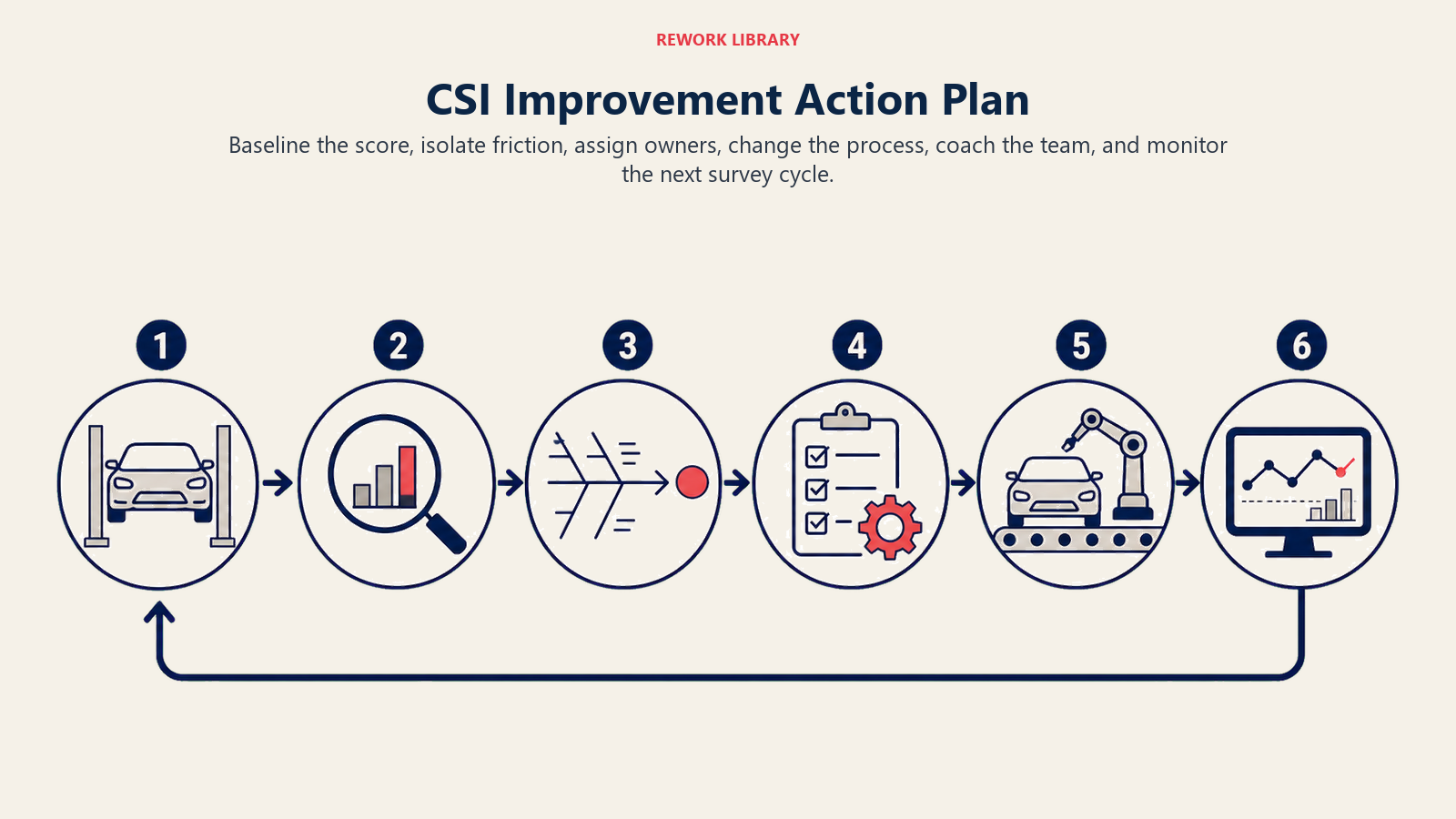
Start by establishing baseline metrics. Pull the last 12 months of CSI data and identify your current performance by department, by consultant/advisor, and by specific survey questions. This tells you where you are and what needs the most attention.
Identify your biggest opportunity areas. Look for patterns in low-scoring questions. Are customers consistently rating your delivery process poorly? Is service wait time a recurring complaint? Pick the 2-3 areas that will have the biggest impact if improved and focus there first.
Assign ownership for each improvement initiative. Someone needs to be responsible for fixing the delivery process. Someone else owns service advisor training. Clear ownership prevents initiatives from stalling because everyone thought someone else was handling it.
Set 30-60-90 day goals that are specific and measurable. "Improve delivery scores from 85% to 92% within 60 days" is a real goal. "Get better at deliveries" is not. Create a project plan for each initiative with specific action steps and deadlines.
Review CSI data weekly in management meetings. Don't wait for monthly reports. Pull data weekly and discuss what's working and what's not. Make quick adjustments. The faster you can respond to problems, the faster you'll see improvement.
Track leading indicators in addition to CSI scores. Things like delivery time, customer wait time, first-time fix rate, and appointment compliance are predictive of future CSI performance. If you improve these operational metrics, CSI scores will follow.
Invest in training and tools that support CSI improvement. Your people need the skills and resources to deliver great experiences. Budget for training programs, upgrade your facility, buy better diagnostic equipment, whatever it takes to eliminate the root causes of customer dissatisfaction. Consider broader strategies in automotive customer experience.
Remember: CSI improvement isn't about tricks or shortcuts. It's about genuinely delivering better customer experiences through better processes, better training, and better culture. Do that consistently, and the scores, and the bonuses, will take care of themselves. For long-term customer relationships, implement customer loyalty programs that reward satisfaction.
The dealerships winning at CSI have figured out something important: customer satisfaction and profitability aren't in conflict. They're directly connected. Happy customers buy more, refer more, and cost less to retain. CSI scores are just the measurement of how well you're executing on the fundamentals of customer experience.
Build your operation around making customers genuinely satisfied, and CSI success becomes a natural byproduct, along with all the financial rewards that come with it.