Digital Retailing Implementation: A Step-by-Step Rollout Plan for Dealerships - 2026 Guide
Turn this article into takeaways for your work.


Each assistant summarizes the article only for you and suggests best practices for your work.
Buying a digital retailing platform is the easy part. You sign a contract, a vendor schedules a kickoff call, and within a few weeks you have a working tool on your website. The hard part starts after that: getting your sales floor, F&I office, and BDC to actually use it instead of quietly routing everyone back to the old process.
That failure pattern isn't unique to dealerships. Across retail broadly, up to 70% of change initiatives fail, and the cause is almost never the technology itself, it's insufficient capability building and adoption support. Dealerships have an added complication: staff already log into a CRM, a DMS, and an inventory system every day, and a new digital retailing tool is one more login competing for attention against processes people already know how to do without thinking.
If you've read Automotive Digital Retailing, you already understand what the platform should do and which vendors are worth evaluating. This guide covers the part that determines whether the investment actually pays off: the implementation project itself, from vendor selection through the first 90 days of live use.
Vendor Selection and Requirements Gathering
Before evaluating a single vendor, get specific about integration requirements. A digital retailing platform that can't talk to your DMS and CRM will create manual re-entry work that your team abandons within weeks.
Build a requirements checklist covering: real-time DMS integration for inventory and pricing, CRM integration so digital sessions create or update existing customer records rather than duplicate ones, lender network connectivity for credit decisioning, e-signature and document management compliant with your state's requirements, and single sign-on so staff aren't juggling separate logins.
Request references from dealers of similar size and franchise mix, and ask specifically about integration friction, not just feature satisfaction. A platform with excellent customer-facing design but poor DMS integration will frustrate your team daily even if customers love the interface.
Involve the people who'll actually use the platform in the selection process. Making the decision process inclusive of salespeople, F&I managers, the GM, and desk managers surfaces objections and integration gaps before signing a contract, not after go-live when it's expensive to reverse course.
Building the Implementation Timeline
Treat this like a project with a defined timeline, not an open-ended rollout. Dealer management system upgrades typically run around 90 days from planning to full transition, and digital retailing implementation follows a similar arc when done properly.
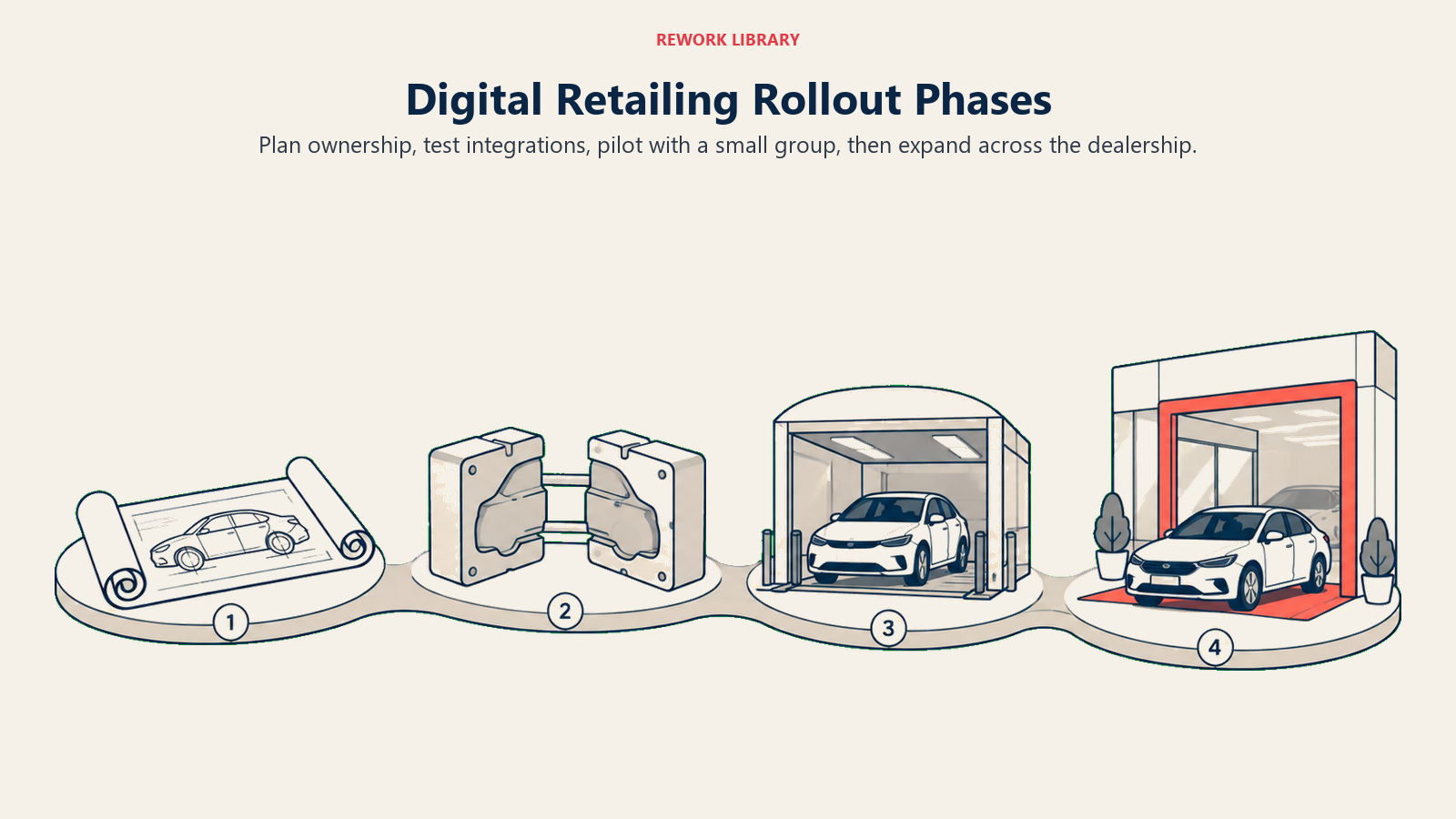
Weeks 1-2: Planning and stakeholder mapping. Identify who owns which piece: IT or your vendor's implementation team handles technical integration, sales management owns floor process changes, F&I leadership owns the digital product presentation piece described in Digital F&I Process, and marketing owns the customer-facing launch. Document the current process end to end so you know exactly what's changing.
Weeks 3-6: Technical integration and sandbox testing. This is where DMS integration, credit bureau connectivity, and e-signature setup actually happen. Have your team access training in a sandbox environment, a safe practice space using real-world scenarios without operational risk, before the system goes live. Staff who never practice before launch day will learn on live customers, which is where trust in the new system erodes fastest.
Weeks 7-9: Pilot phase. Enable digital retailing for a limited subset, specific inventory, specific customer segments, or specific staff volunteers, before promoting it dealership-wide. Test internally with employees and friends first to catch obvious bugs and workflow gaps.
Weeks 10-12: Phased rollout and marketing launch. Expand from pilot to full sales floor, then add prominent website placement, email campaigns, and phone team scripts offering digital retailing as an option.
The Champions Strategy
The single most effective adoption lever isn't a training deck, it's peer proof. Ask for two or three volunteers across sales, F&I, and BDC to be program champions, then track their specific success metrics, transaction time, gross profit, and CSI scores, over 90 days and share the results with the rest of the team.
Champions work because skeptical staff trust a colleague's real results more than a vendor's sales pitch or a manager's mandate. What decides adoption on the floor is whether a respected team member visibly uses the tool in front of everyone else, not whether a memo announced it.
Pair the champions program with concrete personal framing when introducing the change to the rest of the team. Instead of talking about "digital transformation," translate it into individual impact: "Today you're selling 10 cars a month. This can help you sell 20." "If you could prepare a deal in one hour instead of three, how many more customers could you take care of?" Concrete, personal stakes move behavior faster than abstract efficiency arguments.
Key Facts: Digital Retailing Rollout
- Up to 70% of retail change initiatives fail from insufficient adoption support, not the technology itself (TruRating)
- DMS and platform transitions typically run about 90 days from planning to full implementation (Cox Automotive)
- Successful dealerships track champion metrics (transaction time, gross, CSI) over a 90-day window before declaring a rollout successful (Auto Dealer Today)
Training That Actually Sticks
A single training session at launch is not a training program. Insist on a minimum of two training sessions a month for the first several months, not a one-and-done kickoff. Skills that aren't reinforced within weeks of learning them decay, and staff quietly revert to the process they already know.
Structure training by role rather than running one generic session for everyone. Your BDC agents need to know how to assist customers who start a session online and pick up the conversation partway through. Sales consultants need to understand how to continue deals that began digitally without redoing work the customer already completed. F&I managers need training specifically on presenting products to customers who've already built payment scenarios online, since the menu presentation approach shifts when a customer arrives pre-informed.
Maintain open, visible communication throughout the rollout: town hall style updates and regular check-ins keep staff informed instead of hearing about changes secondhand. Silence during a rollout breeds rumors, and rumors breed resistance.
Process Re-Engineering
The technology is rarely the hardest part of implementation. Re-engineering the processes around it usually is.
Your desking process needs adjustment when customers arrive having already structured a deal online. Managers need clear rules for how much of a digitally-built deal is honored versus renegotiated, and that policy needs to be consistent across every desk manager, not decided case by case.
Your credit submission workflow changes when soft-pull pre-qualification happens online before a customer ever sets foot in the store. Define exactly when a soft pull converts to a hard pull and full application, and make sure F&I and sales agree on the handoff point.
Your vehicle delivery procedures need a defined path for customers who complete everything online and choose home delivery versus those who complete steps online but still want an in-person delivery experience. Document both paths so delivery coordinators aren't improvising.
Document every process change clearly and get sign-off from department managers before rolling out to the full team. A process change announced in a hallway conversation gets forgotten. A process change written down, reviewed by managers, and referenced in training sticks.
Common Implementation Failures to Avoid
Launching without integration testing. Going live with a digital retailing platform that hasn't been tested end to end against your live DMS and CRM guarantees data errors, duplicate customer records, or pricing mismatches in front of real customers during week one.
Skipping the pilot phase. Rolling out dealership-wide on day one because leadership wants fast results almost always backfires. A rushed launch that frustrates the first wave of customers creates a bad first impression that's expensive to reverse.
Treating training as a single event. One kickoff session followed by silence guarantees skill decay and reversion to old habits within a month, exactly the pattern that undermines most retail technology rollouts.
No visible leadership sponsorship. If the GM doesn't reference the platform, doesn't use it in front of staff, and doesn't ask about adoption numbers in manager meetings, staff correctly read that as "this isn't actually a priority" and deprioritize it too.
No feedback loop from staff back to management. Frontline staff spot integration gaps and awkward customer moments faster than anyone. If there's no channel for that feedback to reach whoever owns the platform relationship, small problems calcify into permanent workarounds.
Measuring Implementation Success
Track adoption, not just platform activity, in the first 90 days. Digital retailing session starts tell you whether customers are engaging. Staff-reported usage and CSI scores among digitally-assisted customers tell you whether your team has actually adopted the new workflow rather than treating it as a parallel process they tolerate.
Compare champion-group metrics against the rest of the floor at 30, 60, and 90 days. If champions are outperforming on transaction time and gross profit while the rest of the floor lags, that gap tells you exactly where additional coaching or peer pairing needs to happen next.
Revisit your requirements checklist from the vendor selection phase at the 90-day mark. Integration issues that seemed minor during sandbox testing sometimes surface only under real transaction volume. Catching them at 90 days, with a structured review, is far cheaper than discovering them a year in when workarounds have already become habit.
Digital retailing implementation is a change management project with a technology component, not the other way around. Dealers who staff it accordingly, with clear ownership, a phased timeline, visible champions, and recurring training, see the platform actually used. Dealers who treat it as a website feature to flip on end up with an expensive tool that customers occasionally find and staff quietly avoid.
For the strategic foundation this implementation builds on, see Automotive Digital Retailing, Automotive Customer Journey, and Automotive CRM Implementation. For adjacent components worth implementing alongside your core platform, see Online Trade-In Tools, Online Pricing Transparency, Chat & Messaging for Dealerships, and DMS Integration Best Practices.
Frequently Asked Questions about Digital Retailing Implementation
How long does digital retailing implementation take at a typical dealership?
Plan for roughly 90 days from initial planning to full dealership-wide rollout, following a sequence of stakeholder mapping, technical integration and sandbox testing, a limited pilot, and then a phased launch with marketing support.
Why do digital retailing rollouts fail even with good technology?
Across retail, up to 70% of change initiatives fail from insufficient adoption support rather than broken technology. Dealerships specifically struggle because staff already manage several daily logins, and a new platform competes with processes people already know how to run without thinking.
What is a champions program and why does it help adoption?
A champions program asks two or three respected staff volunteers to use the new platform first, with their results (transaction time, gross profit, CSI scores) tracked and shared over 90 days. Peer proof from a trusted colleague changes behavior faster than a mandate from management or a vendor's sales pitch.
Should we roll out digital retailing to the whole dealership at once?
No. Start with a pilot covering limited inventory or a volunteer group of staff, work out integration and workflow issues while the stakes are low, then expand in phases. A dealership-wide launch on day one usually surfaces problems in front of real customers instead of during internal testing.
How much training does staff actually need after launch?
Plan for a minimum of two training sessions a month for the first several months, not a single kickoff session. Skills decay without reinforcement, and staff will quietly revert to familiar manual processes if training stops after week one.
What process changes matter most during implementation?
The desking process, credit submission workflow, and vehicle delivery procedures all typically need adjustment because customers arrive having already completed steps online. Document the new versions of each process clearly and get manager sign-off before training the full team.