Service Appointment Scheduling Optimization - Fill the Bays and Maximize Productivity - 2026 Guide
Turn this article into takeaways for your work.


Each assistant summarizes the article only for you and suggests best practices for your work.
Optimal scheduling transforms service department economics, dealers who master appointment density and show rate achieve 15-20% higher technician utilization and eliminate the peaks/valleys that waste capacity.
Most service departments operate in chaos mode. Seven customers show up at 7:30 AM demanding immediate service. By 10 AM, three bays sit empty. At 2 PM, someone walks in with a warranty repair that'll take three hours, but you've already scheduled a 3 PM express service appointment. By 4 PM, two technicians are standing around with nothing to do while another is buried in work until 7 PM.
That's not bad luck. That's bad scheduling. And it's costing you thousands of dollars in lost productivity every single week. Effective scheduling is a critical component of fixed operations management that directly impacts profitability.
The difference between a service department running at 95% efficiency and one at 75% efficiency is systematic appointment scheduling. Let's fix yours.
Understanding Your True Service Capacity
Before you can schedule effectively, you need to know how much capacity you actually have. This isn't guesswork, it's math.
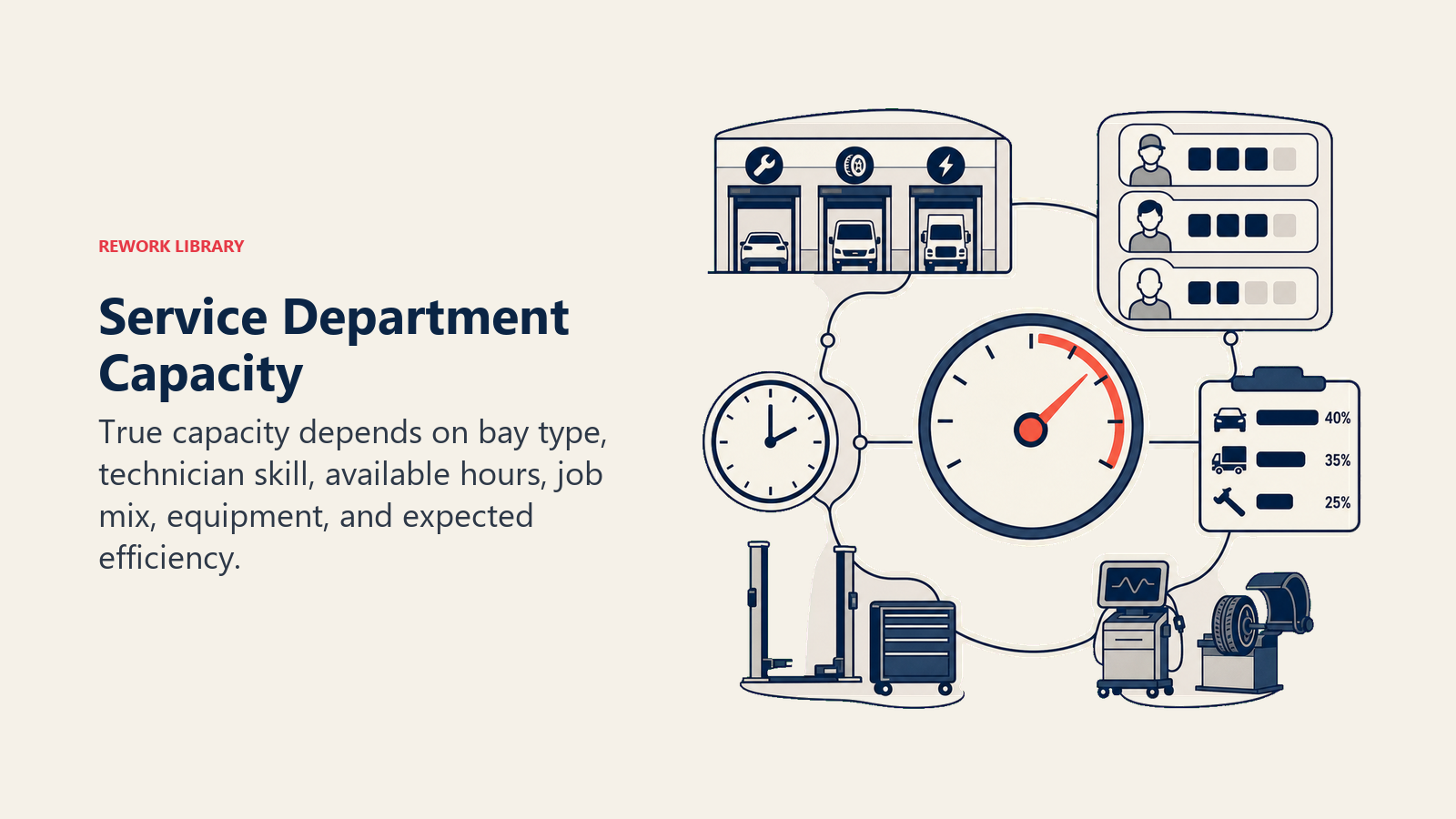
Start with your physical constraints. How many service bays do you have? Not all bays are equal. A quick-lube bay designed for oil changes can't handle a transmission replacement. A bay equipped with an alignment rack serves a specific purpose. Count your general repair bays separately from specialized bays.
Next, count your productive technicians. Not the total headcount, the number of techs actually producing billable hours. Your shop foreman might be on payroll, but if he's spending 60% of his time on administrative tasks, he's not full-time productive capacity.
Then calculate available hours. If you're open 7 AM to 6 PM Monday through Friday and 8 AM to 5 PM Saturday, that's 61 hours per week. Multiply by your bay count and tech count. A 12-bay shop with 10 productive technicians has 610 available tech-hours per week.
But capacity isn't just about availability, it's about utilization. Industry benchmarks suggest 80-85% is realistic when accounting for tool time, parts delays, diagnostic work, and administrative tasks. Your 610 available hours become 488-518 productive hours in reality.
Now divide that by your average repair order time. If your typical RO takes 1.8 hours, you have capacity for roughly 270-288 completed repair orders per week. That's your ceiling before you need to add bays, hire technicians, or extend hours.
Most service managers never do this math. They schedule by feel, book appointments until "it looks full," and wonder why they're constantly overwhelmed or underutilized.
Appointment Density Targets by Service Type
Not all services require the same time commitment or generate the same revenue. Your scheduling strategy should reflect that reality.
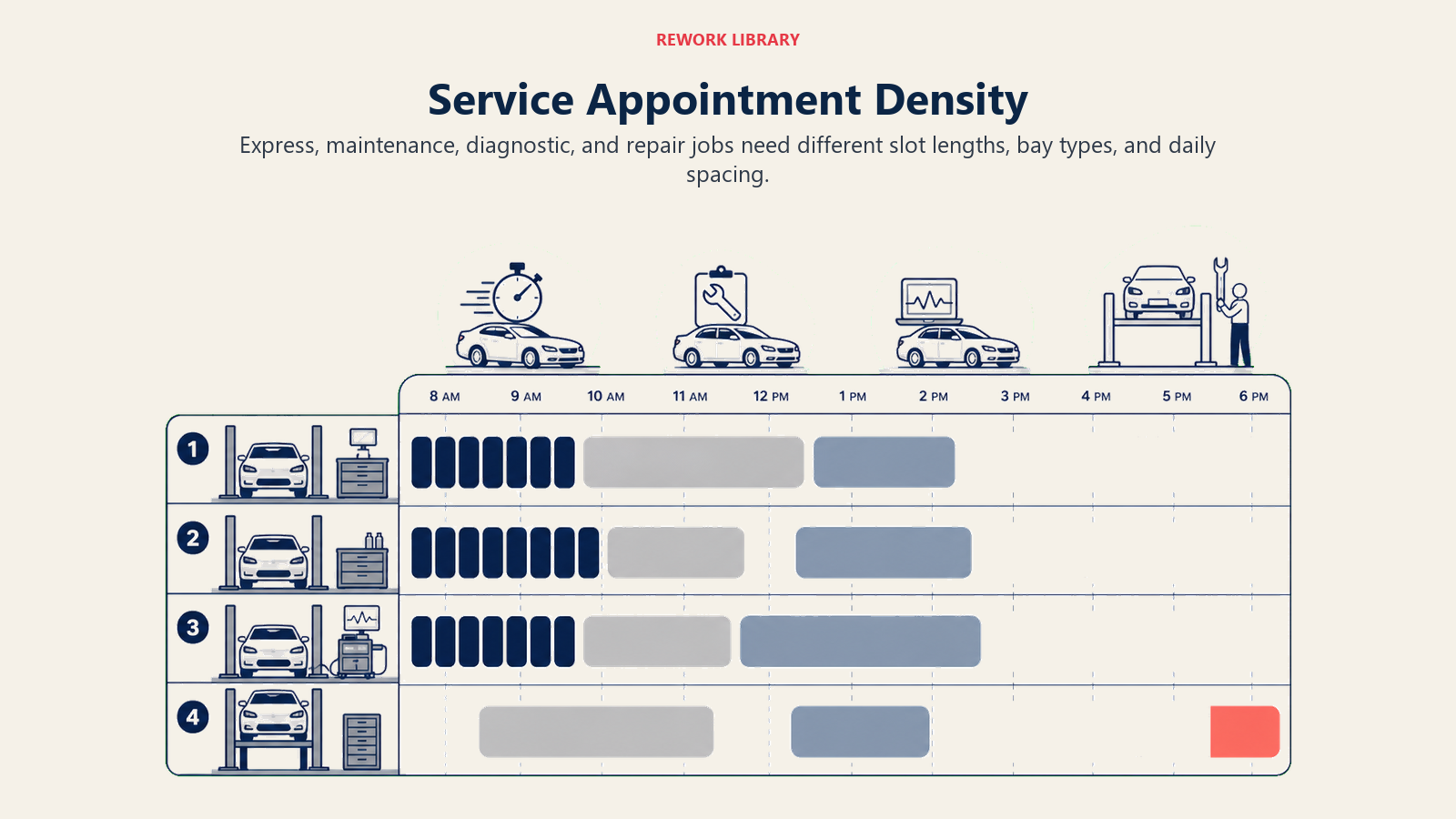
Express services, oil changes, tire rotations, basic inspections, should take 30-45 minutes in a dedicated express lane. You can stack these appointments tightly because they're predictable and quick. A well-managed express operation should handle 8-12 vehicles per bay per day.
General maintenance appointments, brake service, fluid exchanges, filter replacements, battery installations, typically run 1.5-3 hours. These are your bread-and-butter customer pay services that drive service absorption rates. You want to fill 60-70% of your daily capacity with these appointments.
Complex repairs and diagnostics are unpredictable. An electrical diagnosis might take 30 minutes or 4 hours depending on what you find. Schedule these with buffer time and don't pack your calendar so tight that one complicated repair throws off your entire day.
Warranty work should be scheduled strategically. It keeps technicians busy during slow periods, but it doesn't pay as well as customer pay. If you're booked solid with customer pay appointments, don't bump them for warranty work unless it's a customer loyalty situation.
The best service departments separate their scheduling by service type. Express lane operates on 30-minute intervals. General repair bays book in 1-hour or 2-hour blocks. Complex diagnostics get afternoon slots when there's more flexibility to extend if needed.
Online Scheduling Systems That Actually Work
Customers expect to book service appointments online, 67% of service customers prefer digital booking over phone calls. According to Cox Automotive's 2025 Service Industry Study, 74% of dealers now offer online appointment scheduling, with 91% of vehicle owners who schedule online reporting high satisfaction. But online scheduling only works if it's integrated properly and managed actively.
Your dealer website should have a prominent "Schedule Service" button that leads to a real-time scheduling tool. Not a form that someone reviews tomorrow morning. Real-time availability showing actual open slots.
The best systems integrate directly with your DMS so appointments flow automatically into your service schedule. When a customer books online at 9 PM, your service advisors see it first thing in the morning without manual entry.
Service package selection during booking drives higher revenue. Instead of "I need an appointment," the customer chooses from your maintenance menu packages, express oil change, 30K service, brake inspection, or general repair. This pre-qualifies the appointment and sets expectations on time and cost.
Mobile optimization isn't optional. More than 60% of service appointments are booked from smartphones. If your scheduling page doesn't work seamlessly on mobile devices, you're losing appointments to competitors who figured this out five years ago.
But here's what most dealers get wrong: they implement online scheduling and never monitor it. Your service manager should review online bookings daily. Are customers selecting the right service types? Are they booking at optimal times? Is the system leaving too many gaps or creating too much density?
The goal isn't to let the system run on autopilot. It's to give customers convenience while maintaining control over your schedule.
Inbound Call Scheduling Process
Phone calls still generate 50-60% of service appointments in most dealerships. How you handle those calls determines your show rate and customer satisfaction.
The first decision is who answers service appointment calls. Some dealerships route them to a BDC (business development center) that specializes in appointment setting. Others have service advisors handle their own scheduling. Both can work, what matters is training and consistency.
BDC scheduling works well for high-volume stores where service advisors are constantly interrupted. The BDC team pre-qualifies the customer, captures contact information, determines service needs, and books the appointment in the DMS. Then they pass detailed notes to the assigned service advisor.
Service advisor direct scheduling builds customer relationships but can reduce availability. If your top advisor is on the phone scheduling appointments, he's not walking the drive or presenting recommendations to customers in the shop. Balance matters.
Every inbound scheduling call should follow a consistent process. Greet the customer, capture their name and contact information, ask about the service needed, review their service history in the DMS, suggest the appropriate service package or inspection, book the appointment, and confirm with email or text.
The upsell opportunity during booking is massive and underutilized. When a customer calls to schedule an oil change, your scheduler should ask when their last tire rotation was, whether they've had a multi-point inspection recently, and if they'd like to include those services. You're not being pushy, you're being helpful. This consultative approach is detailed in service advisor selling skills.
Recall and campaign opportunities should flag automatically in your DMS. If the customer calling has an open recall or manufacturer campaign, mention it during scheduling. "While we have your vehicle in for the oil change, you're also eligible for a recall repair at no charge. Would you like us to take care of that same visit?" Most customers say yes.
Driving Appointment Show Rates Above 85%
Industry average appointment show rate hovers around 75-80%. That means one out of every four or five appointments is a no-show. That's unacceptable.
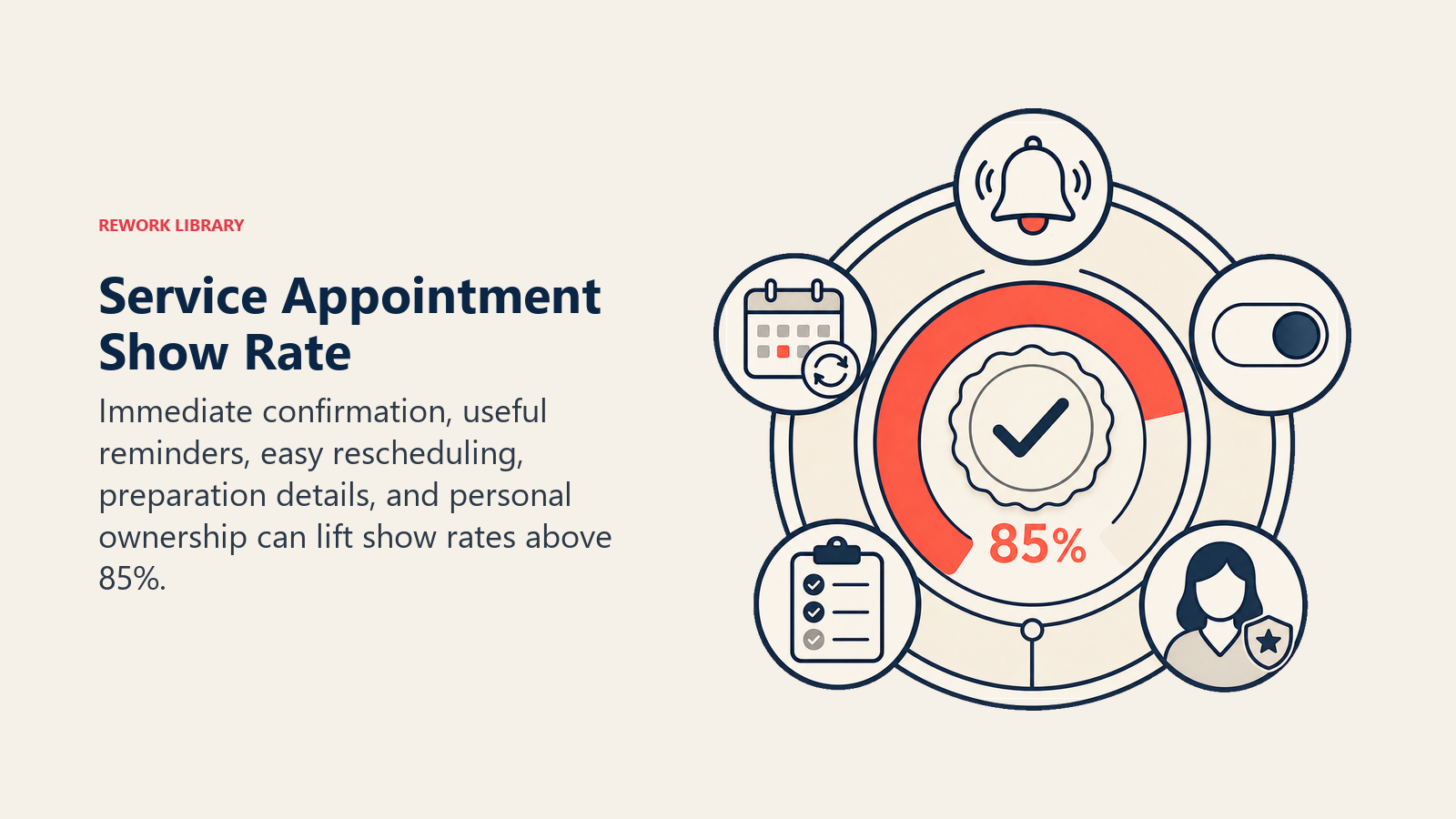
Top-performing service departments maintain 85-92% show rates through systematic confirmation and reminder processes. Here's exactly how they do it.
Same-day confirmation starts immediately after booking. Within 5 minutes of scheduling an appointment, the customer should receive an automated confirmation email or text with the date, time, service advisor name, and estimated service time. This confirms they successfully booked and gives them something to reference.
Day-before reminders are your primary defense against no-shows. 24 hours before the appointment, send another text or email reminder. "Looking forward to seeing you tomorrow at 8 AM for your scheduled oil change. Reply YES to confirm or NO if you need to reschedule."
The two-way texting is critical. When customers reply "YES," you have confirmation. When they reply "NO" or don't respond, you can follow up with a phone call to reschedule or fill that slot with another customer.
Morning-of final confirmation for early appointments. If someone is scheduled at 7 AM, a text at 6 AM saying "See you in an hour!" serves as a final reminder for people who might have forgotten.
No-show follow-up process separates professional operations from amateur ones. When someone doesn't show, don't just delete the appointment and move on. Call within 2 hours to reschedule. "Good morning, we had you scheduled at 8 AM today and wanted to make sure everything's okay. Can we reschedule your service?"
Most no-shows are honest mistakes, not intentional cancellations. People forget, they get busy, something came up. Deloitte's 2026 Global Automotive Consumer Study found that 57% of U.S. vehicle owners choose dealerships for service primarily based on quality of work, highlighting the importance of maintaining strong appointment relationships. When you follow up professionally and helpfully, they'll reschedule and actually show up next time. This proactive approach is part of effective service customer retention strategy.
The service departments with the highest show rates also have the tightest scheduling windows. If you're booking appointments three weeks out, you'll have terrible show rates. Life changes in three weeks. But appointments booked 3-5 days out have 90%+ show rates because they're fresh in the customer's mind.
Managing Workflow and Capacity Throughout the Day
Even with perfect scheduling, service flow requires active management. Your service manager or dispatcher should be monitoring workflow hour by hour.
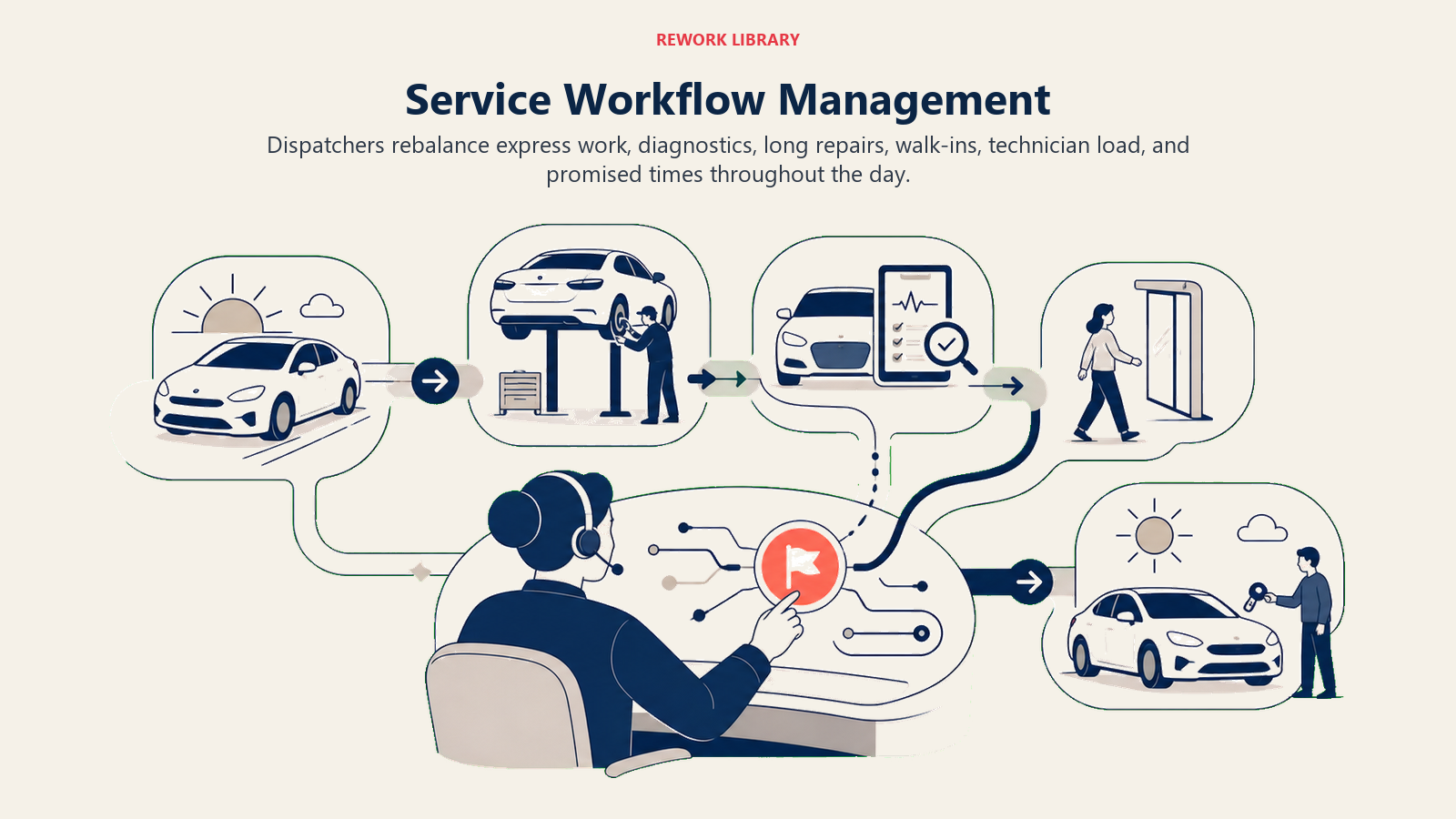
Time blocking by service type creates predictable rhythm. Block 7-9 AM for express services and quick maintenance. Block 9 AM-3 PM for general repairs and longer services. Block 3-5 PM for diagnostics and services that can extend into evening if needed.
This prevents the chaos of having three quick oil changes scheduled at 2 PM when your express bays are sitting empty at 10 AM and you're backed up at the end of the day.
Technician specialization should influence scheduling decisions. If you have a tech who's exceptional at electrical diagnostics, schedule those repairs to him. If another tech is fast and efficient at brakes and routine maintenance, load him up with those services. Matching the work to the technician's strengths improves efficiency and quality.
Buffer time for walk-ins and emergencies is essential. Don't schedule to 100% capacity. Leave 15-20% of your daily slots open for walk-in customers, tow-ins, and customers who call with urgent needs. These appointments often generate high customer pay revenue because they're not shopping around, they need help now.
Seasonal demand planning prevents getting caught off-guard. Winter prep services spike in November. Spring maintenance peaks in March and April. Summer road trip services concentrate in June and July. Cox Automotive research shows that dealerships using AI-powered scheduling tools and predictive maintenance algorithms can boost service efficiency significantly. When you know the patterns, you can staff accordingly and market proactively.
Smart service managers look at their schedule two weeks out and actively fill gaps. If Thursday in two weeks looks light, that's when you launch a text campaign to customers due for service. "We have limited appointment availability this Thursday, schedule your service now and receive a complimentary tire rotation."
The goal is smooth, consistent workflow that keeps technicians productive without overwhelming them or leaving them idle.
Technology and Tools That Improve Scheduling
Your DMS scheduling module is the foundation, but most dealers are using about 40% of its capabilities. Take the time to fully configure it.
Set up appointment types that match your service packages. Instead of generic "service appointment," create specific categories: Express Oil Change (30 min), Bronze Maintenance (1 hour), Silver Maintenance (1.5 hours), Gold Maintenance (2 hours), Brake Service (2 hours), Diagnostic (flexible).
This enables appointment density management. Your DMS should prevent double-booking bays and technicians, flag scheduling conflicts, and show visual capacity indicators.
Two-way texting platforms integrated with your DMS enable automated confirmations and allow customers to reply directly. When a customer texts "I need to reschedule," that message routes to your service BDC or advisor for immediate follow-up.
Automated reminder systems should run on autopilot once configured. You set the rules, confirmation within 5 minutes, reminder 24 hours before, morning-of reminder for early appointments, and the system handles execution. These tools are part of your broader automotive CRM implementation strategy.
Appointment scheduling analytics reveal patterns you'd otherwise miss. Which appointment slots have the highest show rates? Which service advisors have the best scheduling efficiency? What services are most commonly booked online vs. phone?
The technology exists to transform your scheduling operation. Most dealers just haven't implemented it systematically.
Making Scheduling a Competitive Advantage
When your appointment scheduling runs smoothly, customers notice. They can book online easily. They get immediate confirmation. They receive helpful reminders. They're greeted on time when they arrive. Their vehicle is ready when promised.
That's not typical in this industry. That's exceptional. And exceptional service creates loyalty.
Track your scheduling metrics monthly through your dealership KPI dashboard: appointment show rate, online booking percentage, average lead time from booking to appointment, schedule utilization rate, and customer satisfaction scores related to appointment experience.
When you improve scheduling, everything else in your service department gets easier. Technicians work consistently. Parts ordering becomes predictable. Workflow smooths out. Customer satisfaction increases. Revenue grows.
Most service managers treat scheduling as an administrative task. The best ones treat it as strategic capacity management that directly impacts profitability.
Fill the bays systematically. Manage show rates obsessively. Balance workflow strategically. That's how you turn your service department into a profit machine.

Senior Implementation Consultant
On this page
- Understanding Your True Service Capacity
- Appointment Density Targets by Service Type
- Online Scheduling Systems That Actually Work
- Inbound Call Scheduling Process
- Driving Appointment Show Rates Above 85%
- Managing Workflow and Capacity Throughout the Day
- Technology and Tools That Improve Scheduling
- Making Scheduling a Competitive Advantage