Automotive Lead Providers: Cost & ROI Compared 2026
Turn this article into takeaways for your work.


Each assistant summarizes the article only for you and suggests best practices for your work.
That $50 third-party lead actually costs you $850 when you calculate true cost per sale. Here's the math most dealers ignore: $50 lead cost, 30% are duplicates from other sources, 15% are information-gatherers with no purchase intent, 10% are outside your market. That leaves you with 45 legitimate leads per 100. At a 12% close rate on third-party leads, you're getting 5.4 sales per 100 leads. $5,000 spend ÷ 5.4 sales = $925 cost per sale.
Compare that to owned digital channels at $50-150 cost per sale or paid search at $250-400 cost per sale, and the economics become clear. Third-party leads aren't cheap leads, they're expensive leads disguised by low sticker prices.
This doesn't mean third-party providers have no place in your strategy. It means understanding true costs, quality dynamics, and strategic use cases. The dealers getting value from third-party sources know exactly what they're paying and why.
The Third-Party Landscape
The major players control most third-party lead flow: Autotrader (40% market share), Cars.com (30%), CarGurus (20%), and TrueCar (10%). Each operates differently and delivers different quality.
Autotrader aggregates the largest inventory database and generates the highest traffic volume. They monetize through listing fees, featured placement, and lead generation. The value proposition: massive audience reach you couldn't build independently. The challenge: you're competing with every other dealer for the same leads.
Cars.com functions similarly to Autotrader but positions itself as more consumer-friendly. They emphasize dealer reviews and ratings more prominently. Featured dealer status provides advantages in search results and consumer consideration. Their lead quality is comparable to Autotrader, moderate quality, high volume.
CarGurus differentiates with algorithmic pricing transparency. Vehicles get labeled "Great Deal," "Good Deal," or "High Price" based on market data. This forces competitive pricing to gain visibility. Lead quality is slightly higher than Autotrader/Cars.com because the platform attracts price-conscious, ready-to-buy shoppers. The trade-off: lower volume and pressure to price aggressively.
TrueCar uses a certificate program, consumers get pre-negotiated pricing certificates, then choose a TrueCar-certified dealer to honor it. This delivers high-intent leads but at compressed margins. You're competing on price, not value or experience. Lead volume is lower but conversion rates are higher (18-25%) because pricing is already agreed upon.
Business model differences matter. Lead generation platforms (TrueCar, some Autotrader programs) charge per lead delivered. Lead aggregation platforms (Cars.com, CarGurus) charge for visibility/placement and generate leads as a byproduct. The former gives you more control over lead volume; the latter requires optimizing your listings to generate leads organically.
The landscape is consolidating. Autotrader and Kelley Blue Book are owned by Cox Automotive. Cars.com operates independently. CarGurus acquired Car360 and expanded services. TrueCar faces margin pressure and declining volume. Expect continued consolidation and pricing pressure as these platforms compete for dealer dollars.
Understanding Lead Pricing Models
Third-party pricing seems simple but hides complexity that impacts your true costs.
Pay-per-lead (PPL) is the dominant model. You pay $40-100 per lead depending on the provider, vehicle type, and market competitiveness. Luxury brands cost more ($80-150 per lead) than mass market ($40-70). New vehicle leads cost more than used vehicle leads. Competitive markets (major metros) cost more than smaller markets.
But here's what they don't tell you: that "lead" might also go to 2-4 other dealers. You're not buying a lead, you're buying a chance to compete for a lead.
Shared vs exclusive leads changes economics dramatically. Shared leads (sent to multiple dealers) cost $30-60. Exclusive leads (sent only to you) cost $100-200. The close rate on exclusive leads is 3-4x higher than shared leads because you're not competing with immediate responses from four other dealers.
Calculate the true cost: A $40 shared lead that closes at 10% costs $400 per sale. A $120 exclusive lead that closes at 35% costs $343 per sale. Exclusive costs less per sale despite higher lead cost.
Most dealers buy shared leads without realizing it. The pricing looks attractive, but the conversion economics don't work.
Package pricing and minimums lock you into spending levels regardless of performance. "Get 200 leads monthly for $10,000" sounds like $50 per lead. But if only 120 of those leads are legitimate (after duplicates and junk), you're actually paying $83 per real lead. And if the contract has a 12-month minimum, you can't exit when performance doesn't justify cost.
Hidden fees and requirements inflate true costs. Setup fees ($500-2,000), listing fees for inventory ($300-800 monthly), photo enhancement fees ($50-200 monthly), featured placement fees ($500-2,000 monthly), and integration fees for DMS connectivity ($300-600 monthly). A $10,000 monthly lead package becomes $13,000 when you account for these add-ons.
Read contracts carefully. Many include automatic renewals with 90-day cancellation requirements. You think you're canceling in December, but the contract renews in January and you're locked in until April.
Pricing is negotiable. The rate card is a starting point. Multi-location groups, high-volume dealers, and those willing to commit long-term can negotiate 20-40% discounts. But you need leverage, either volume or competitive alternatives.
True Cost Analysis
Most dealers track cost per lead and stop there. That's the wrong metric. True cost per sale tells the complete story.
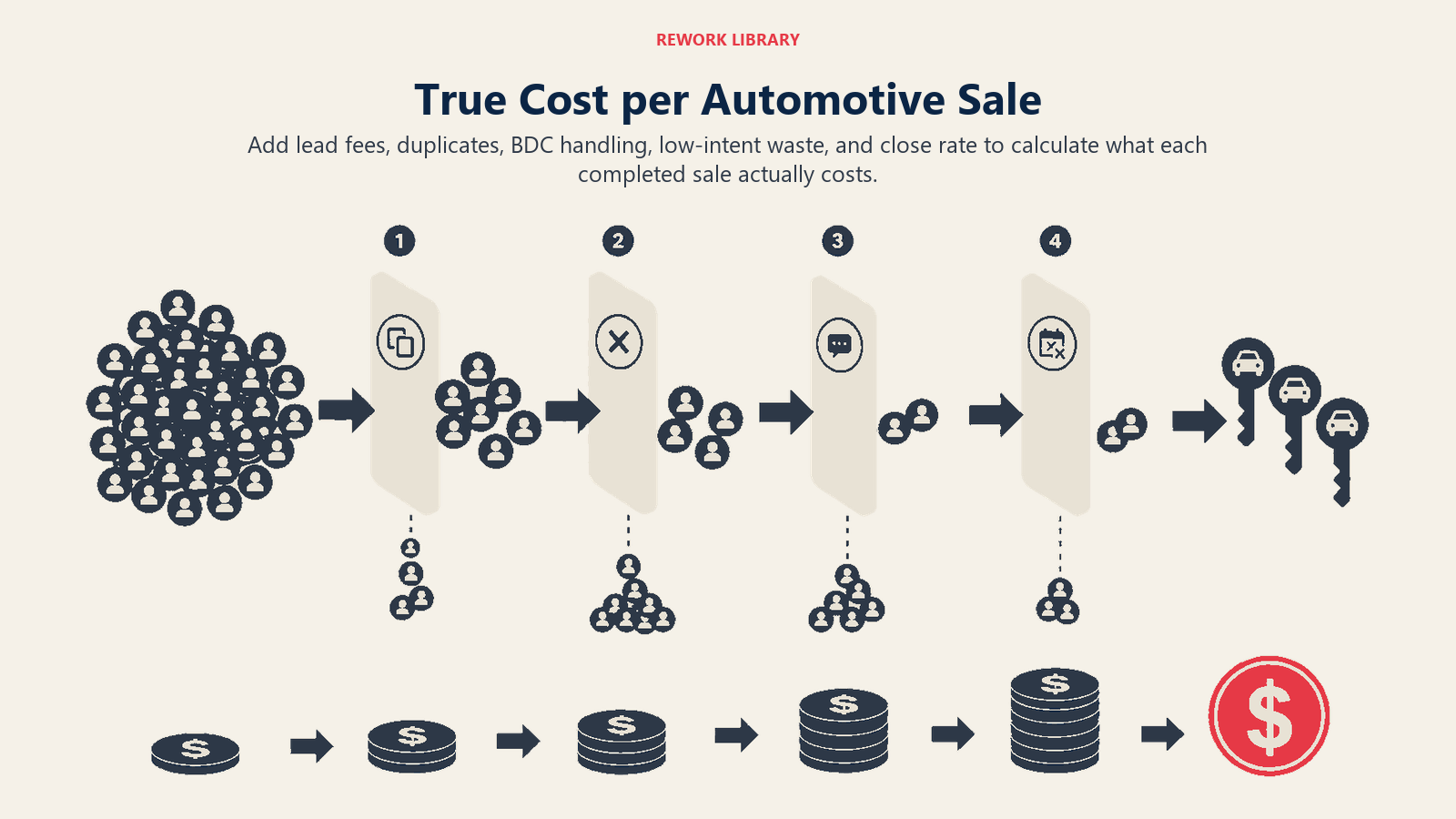
Start with the lead cost. $60 per lead seems straightforward. But now add your BDC handling cost. If your BDC costs $100,000 annually (salary, benefits, overhead) and handles 10,000 leads annually, that's $10 per lead in handling cost. Your true lead cost is $70, not $60.
Duplicate lead rates run 30-40% in our data. A customer submits inquiries on Autotrader, Cars.com, and your website within 24 hours. You paid for three leads, but it's one customer. Unless you're de-duplicating in your CRM, you're counting, and paying for, the same lead multiple times.
Lead quality scores and filtering separate legitimate buyers from information gatherers. Third-party leads typically score lower on quality metrics: incomplete contact information, broad inquiries ("any SUV under $400/month"), unrealistic expectations, credit challenges they haven't disclosed. Grade leads A/B/C and track conversion by grade. Third-party leads skew heavily toward C-grade (50-60%) vs owned channels (20-30% C-grade).
Lead-to-appointment conversion on third-party leads averages 8-12% compared to 25-35% for owned channels. Why? Lower intent, multiple dealers competing for response, price-shopping behavior, poor qualification. Your BDC spends more time per lead for lower conversion.
Appointment show rate runs 50-60% on third-party leads vs 65-75% on owned channel appointments. The person who submitted a lead to five dealers will show at the one offering the best price or fastest response, not necessarily you.
Close rate on third-party leads averages 12-18% (of those who show) compared to 25-35% for owned channels. You're competing against other dealers who got the same lead, the customer is more price-focused, and they have less brand loyalty.
Total cost per sale calculation accounts for all these factors:
100 third-party leads at $60 = $6,000
- 30 duplicates = 70 real leads
- 70 leads × $10 BDC cost = $700
- Total cost = $6,700
70 leads × 10% appointment rate = 7 appointments 7 appointments × 55% show rate = 3.85 shows 3.85 shows × 15% close rate = 0.58 sales
$6,700 ÷ 0.58 sales = $11,552 cost per sale
Now you're seeing the true economics. That $60 lead costs over $11,000 per sale when you factor in quality, duplication, and conversion rates.
Run this calculation for each provider monthly. When Autotrader costs $8,000 per sale and Cars.com costs $12,000 per sale, you know where to allocate budget. When both exceed $10,000 per sale while your owned channels cost $150 per sale, you know you have a dependency problem.
Lead Quality by Provider
Not all third-party leads are created equal. Quality varies by platform, and understanding these differences helps optimize your mix.
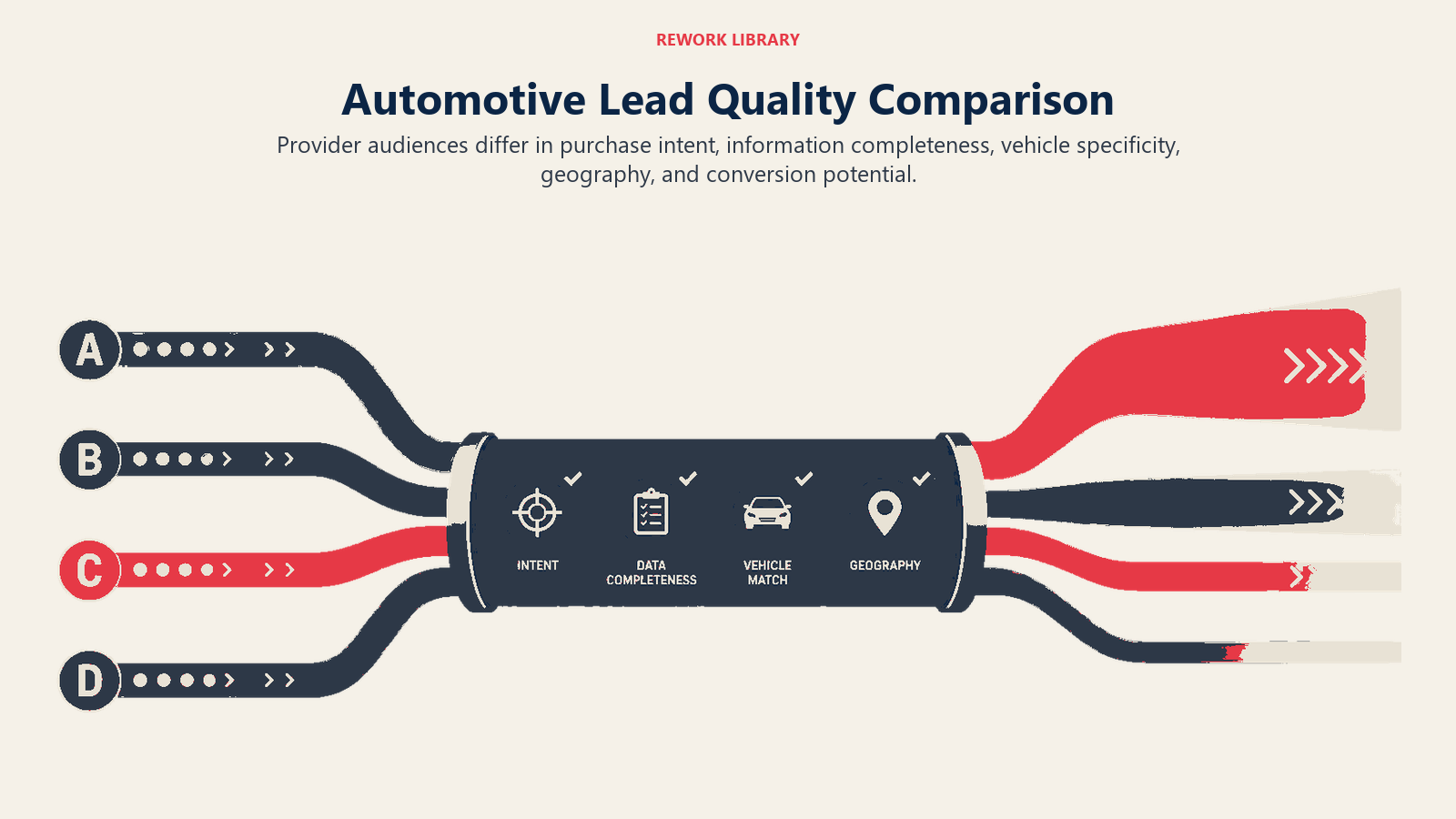
Consumer intent levels differ by platform through automotive customer journey tracking. CarGurus attracts price-focused, ready-to-buy shoppers because the platform highlights deals. According to third-party research, CarGurus vehicles sell 16% faster than on Autotrader and 22% faster than on Cars.com. Conversion rates run 15-20%, above industry average. TrueCar delivers high-intent buyers with pre-negotiated pricing, conversion rates hit 18-25%. Autotrader and Cars.com skew toward earlier-stage shoppers, conversion rates run 10-15%.
Information completion rates measure how thoroughly customers fill out inquiry forms through automotive lead scoring. High-quality leads include name, phone, email, preferred contact method, specific vehicle interest, and timeframe. Low-quality leads include minimal information, email only, vague vehicle interest, no timeframe.
Third-party leads often have incomplete information because forms are short to maximize conversion. The platforms optimize for lead volume (they get paid per lead), not lead quality (you bear that cost).
Response expectations affect conversion through lead response time optimization. TrueCar customers expect immediate response with certificate pricing. CarGurus shoppers expect quick response with confirmation of availability. Generic Autotrader leads have lower urgency. Match your response process to platform expectations, TrueCar and CarGurus require sub-15-minute response for optimal conversion.
Geographic relevance impacts quality through BDC operations setup. Leads should come from your primary market area (PMA). If you're receiving 20% of leads from 50+ miles away, you're paying for low-probability conversions. Request geo-fencing from providers to limit leads to your serviceable area.
Credit quality indicators would be valuable but are rarely provided. Third-party platforms don't pre-qualify credit, so you don't know if the lead is A-credit (fast close) or subprime (requires specialized lenders). This uncertainty adds handling time and reduces conversion rates.
Track quality metrics by provider weekly:
- Information completeness (% with full contact data)
- Geographic fit (% within PMA)
- Duplicate rate (% already in CRM)
- Response rate (% who answer calls/emails)
- Appointment rate (% who schedule showroom visits)
- Show rate (% of appointments who show)
- Close rate (% who purchase)
These metrics reveal which providers deliver quality vs volume. Quality providers justify higher costs through better conversion. Volume providers only work at discounted pricing.
Provider-Specific Strategies
Each platform has optimization levers that improve lead volume and quality.
Autotrader rewards premium placement through automotive inventory strategy. Featured listings appear at the top of search results and category pages. This costs $1,000-3,000 monthly depending on market but can double lead volume. The math works if incremental leads convert at similar rates to base leads.
Inventory freshness matters on Autotrader through inventory turn optimization. Stale listings get deprioritized. Update inventory daily, rotate photos monthly, and refresh descriptions quarterly to maintain visibility.
Photo quality dramatically impacts engagement. Professional photos (20+ per vehicle, multiple angles, clean backgrounds) generate 40% more leads than phone photos. Invest in photography if you're spending $10,000+ monthly on Autotrader.
Cars.com emphasizes dealer ratings and reviews through online review management. Featured Dealer status includes prominent review display and premium placement. If your reviews are strong (4.5+ stars, 500+ reviews), invest in Featured Dealer. If reviews are weak (below 4.0), fix reputation before buying premium placement.
The Shop-Click-Drive program on Cars.com allows online transactions through automotive digital retailing. Enabling this generates leads from customers who prefer digital retailing. Setup requires integration work but captures a growing segment.
Pricing competitiveness affects visibility on Cars.com. Their algorithm surfaces attractively-priced inventory higher in search results, similar to inventory pricing strategy. If you're overpriced for the market, you won't get leads regardless of placement level.
CarGurus uses algorithmic pricing badges, Great Deal, Good Deal, Fair Price, High Price, or Overpriced through inventory pricing and aging. Only Great Deal and Good Deal badges generate significant leads according to the platform's Instant Market Value (IMV) system. This forces competitive pricing.
The IMV (Instant Market Value) calculation factors in mileage, condition, features, and market comps through automotive pricing strategy. Understanding how IMV works allows you to price strategically. Vehicles $500 below IMV earn Great Deal badges and flood with leads. Vehicles at IMV earn Good Deal badges with moderate lead flow. Anything above IMV gets minimal leads.
CarGurus optimization is primarily about pricing strategy. If you can't or won't price aggressively, CarGurus won't deliver volume. If you have aged inventory or high-mileage units where aggressive pricing makes sense, CarGurus works well.
TrueCar certificates lock in pricing before the lead arrives through online pricing transparency. You commit to certificate pricing through TrueCar's network, then receive leads from customers who've already seen and accepted that price.
The advantage: high conversion rates (20-25%) because pricing is agreed upon through negotiation and closing techniques. The disadvantage: compressed margins, you're competing on price, not value. TrueCar works best for dealers with high volume targets, manufacturer incentives that offset margin compression, or inventory that's aged and needs movement.
TrueCar is increasingly integrated with USAA, Consumer Reports, and other affinity programs. These channels deliver higher-quality leads than generic TrueCar certificates.
Maximizing Third-Party ROI
If you're investing in third-party leads, optimize aggressively to improve return on investment.
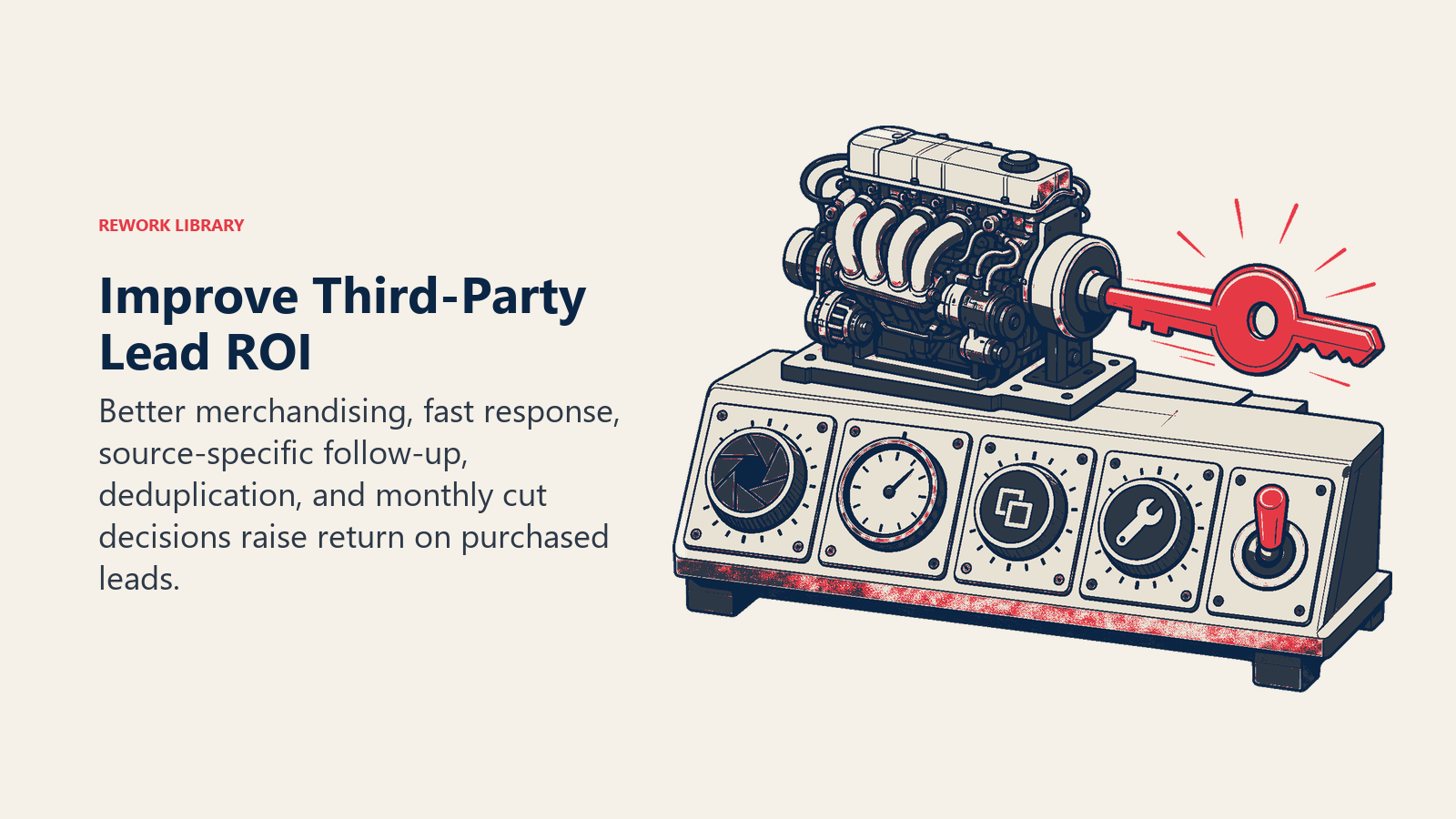
Inventory merchandising impacts lead volume dramatically. Professional photos (20-30 per vehicle), detailed descriptions (300+ words), accurate pricing, complete specifications, and condition disclosure all increase engagement.
Most dealers provide 8-12 low-quality photos and OEM-supplied descriptions. That's the baseline. Differentiate with walkaround videos, feature callouts, pricing transparency, and reconditioning disclosure.
Pricing strategy determines visibility on most platforms. Overpriced inventory won't generate leads regardless of how much you spend on placement. Use pricing tools (vAuto, ProfitTime, CarGurus IQ) to price competitively for the market.
Strategic repricing can optimize lead flow. If you have 50 units in inventory and want to generate 100 third-party leads monthly, price your 10 most-attractive units (low miles, popular colors, clean history) aggressively to earn "deal" badges. These units will generate 70-80% of your leads. Price the remaining 40 units at market or above for margin protection.
Badge and ratings optimization improves visibility. CarGurus badges require competitive pricing. Cars.com ratings require strong reviews. Autotrader visibility improves with inventory freshness. Focus on the metrics each platform rewards.
Rapid lead response (5-minute rule) improves conversion 3-5x on third-party leads because you're competing with multiple dealers. The first dealer to respond captures the customer's attention and sets the tone. The fifth dealer to respond 2 hours later gets ignored, which is why lead response time is critical.
Implement automated responses (text/email) within 60 seconds acknowledging receipt and setting expectations: "Thanks for your interest in the 2025 Honda CR-V! I'm checking availability and will call you within 10 minutes to answer questions and schedule your test drive."
Then actually call within 10 minutes. Speed is your competitive advantage on shared leads.
Lead routing and BDC process should prioritize third-party leads due to time sensitivity. Round-robin routing delays response. Direct routing to available agents ensures immediate contact. Your automotive lead management system should flag third-party leads as high-priority for instant response.
Track response time by source. If your average response time on owned leads is 45 minutes but third-party leads is 15 minutes, you're optimizing correctly. If it's reversed, you're wasting money.
When Third-Party Makes Sense
Third-party leads aren't universally bad, they have strategic use cases where economics work.
New dealerships building awareness lack the brand recognition to generate sufficient owned channel volume through automotive dealership growth model. A dealership opening in a new market might need 18-24 months to build SEO rankings, social media presence, and local awareness. Third-party fills the gap during this period. Plan to reduce dependency by 25% annually as owned channels mature.
Excess inventory situations where you need immediate volume benefit from third-party through inventory pricing and aging. Aged inventory (90+ days old), excess trade-ins, or end-of-model-year clearance can justify third-party costs because you need movement now. The margin hit from competitive pricing plus third-party fees might still be better than flooring costs for another 60 days.
Testing new franchise/market reduces risk through third-party validation. If you're considering adding a new brand or opening a satellite location, test with third-party leads before committing to full infrastructure. A 6-month test with $5,000 monthly third-party spend tells you if demand exists before investing $500,000 in facility and staff.
Supplementing owned channel efforts makes sense when owned channels are optimized but still don't deliver sufficient volume. If you've maxed out SEO (ranking #1 for all key terms), optimized PPC (efficient spend at scale), and built a robust database (high email engagement) but still need 30% more lead volume to hit sales targets, third-party supplementation works.
The rule: Third-party should supplement, not replace, owned channels. If third-party represents 60-70% of your lead volume, you have a strategic vulnerability. Suppliers raise prices when they know you're dependent. Your cost per sale will trend up over time as they extract more value.
The optimal mix for most dealers: 35% owned channels (website, SEO, database, service-to-sales), 30% paid digital (Google Ads, Facebook, YouTube), 25% third-party (Autotrader, Cars.com, CarGurus), 10% other (referrals, events, direct mail). This diversification protects against dependency and optimizes for cost efficiency.
Reducing Third-Party Dependency
The strategic goal should be reducing third-party dependency over time while maintaining or growing total lead volume.
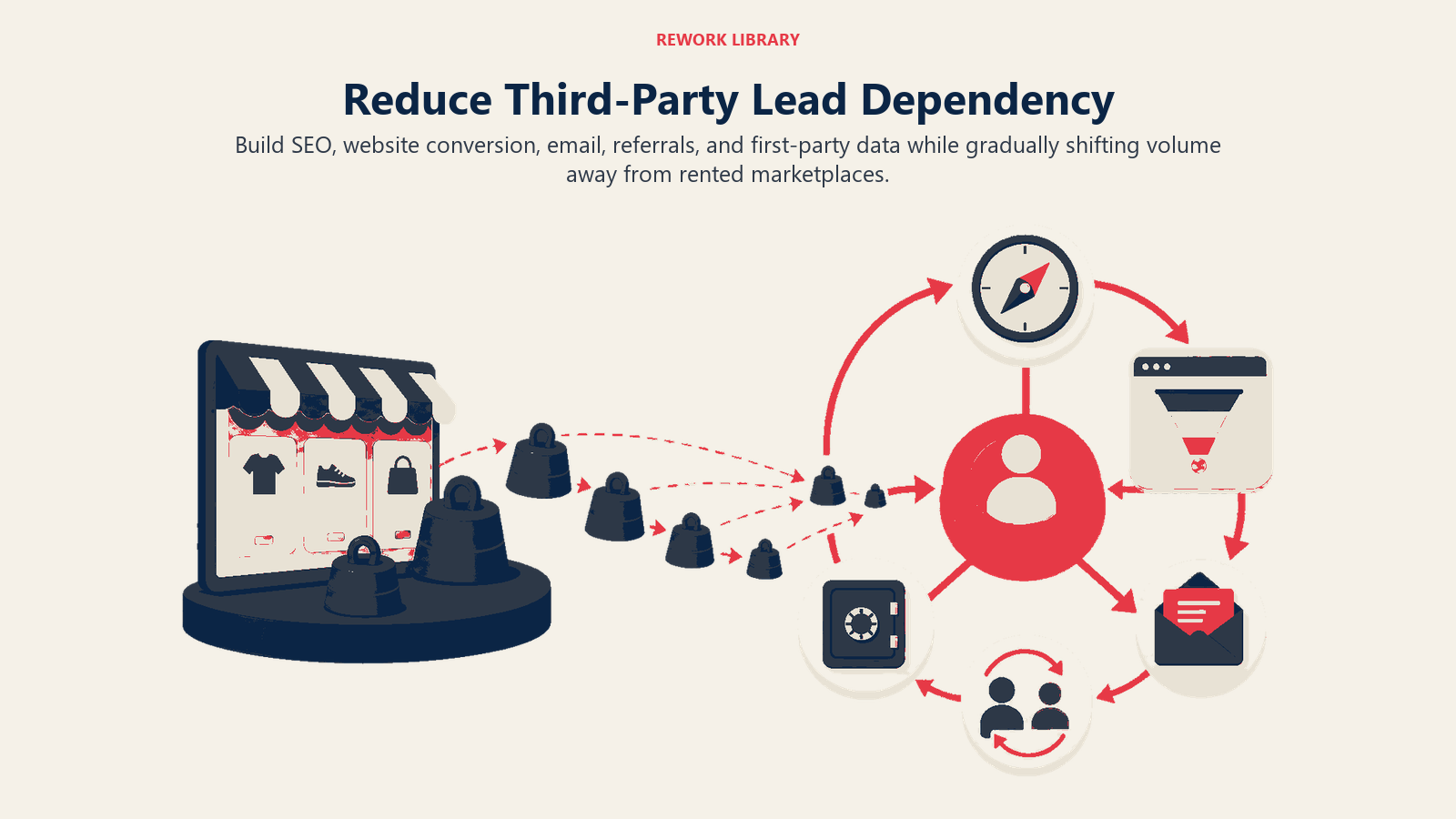
Building owned channel alternatives requires upfront investment but pays back through dramatically lower cost per sale according to NADA research. Invest in automotive SEO strategy to capture organic search traffic. Optimize your dealership website to convert visitors efficiently. Build your email database to 20,000+ contacts for monthly nurture campaigns.
A $30,000 investment in SEO over 12 months generates 150-200 monthly organic leads by month 18. Those leads cost $0 per click and convert at 25-35%. That's 35-70 monthly sales at near-zero acquisition cost. The ROI obliterates third-party leads.
Service-to-sales pipeline development taps your existing customer base. You have 1,000-2,000 service customers monthly. These people own vehicles, trust you for service, and will be in-market for their next purchase. A structured service-to-sales pipeline can add 20-40 monthly sales at zero acquisition cost.
Equity mining, service lane intercepts, and proactive outreach to customers with 3+ year-old vehicles all convert service customers to sales customers. The best part? You've already paid to acquire them. This is pure incremental revenue.
SEO and PPC investments deliver predictable lead volume at known costs. Unlike third-party platforms that change pricing annually, you control paid digital spend. A $5,000 monthly Google Ads budget might deliver 100 leads at $50 each. That's transparent, trackable, and optimizable. Third-party platforms deliver opaque pricing, variable quality, and limited optimization control.
Build owned assets first. Supplement with paid digital second. Use third-party strategically third. The sequence matters because it creates pricing leverage. When you can generate 200 leads monthly from owned/paid channels, you can negotiate aggressively with third-party providers because you don't need them, you're choosing to supplement.
Target: No single source >20% of volume. This rule protects against dependency and supplier pricing power. If any single source (including third-party providers) exceeds 30% of lead volume, you're vulnerable. Diversify intentionally.
Negotiation Strategies
Third-party pricing is negotiable. The published rate card is a starting point, not a final offer.
Contract terms and flexibility should be negotiated through dealership benchmarking. Push for 6-month terms instead of 12-month terms for new providers. Request 30-day cancellation instead of 90-day cancellation. Negotiate month-to-month extensions after the initial term instead of automatic annual renewal.
Volume discounts apply for multi-location groups or high-spend dealers through gross profit optimization. If you're spending $15,000 monthly across three locations, consolidate negotiations and request 20-30% volume discounts. Providers prefer large accounts, use that leverage.
Performance clauses protect against quality degradation. Negotiate minimum lead quality standards: maximum 20% duplicate rate, minimum 75% in-market geographic fit, minimum 50% information completeness. If quality falls below thresholds, trigger price reductions or exit clauses.
Exit strategies matter for poor-performing providers. Contracts should allow performance-based exits without penalty. "If cost per sale exceeds $X for two consecutive months, dealer may terminate without penalty." This protects you from being locked into contracts that don't deliver value.
Negotiate from a position of strength. Run pilots before signing long-term contracts. Track performance meticulously. When renegotiating existing contracts, bring data: "Our cost per sale is $9,500, which is 3x our owned channel cost. We need 40% pricing reduction or we're shifting budget to better-performing channels."
Third-party providers would rather reduce pricing than lose accounts. Use that reality to negotiate aggressively.
The fundamental truth about third-party leads: they're expensive convenience. You're paying a premium for immediate lead volume without building owned assets. This makes sense in specific situations, new markets, short-term inventory challenges, volume supplementation. But it shouldn't be your foundation.
Your automotive lead generation overview should emphasize owned channel development, paid digital optimization, and strategic third-party supplementation, in that order.
Calculate your true cost per sale by provider monthly. When third-party costs exceed $800-1,000 per sale while owned channels deliver $100-200 per sale, the strategic priority becomes clear: reduce third-party dependency through owned asset investment.
The dealers crushing it in 2026 started building owned channels in 2023. They use third-party leads at 20-25% of total volume, strategically, not desperately. They negotiate aggressively. They track performance religiously. And they continuously shift budget toward higher-performing channels.
You can't change past decisions, but you can start now. Calculate true costs. Build an owned channel investment plan. Set a goal to reduce third-party dependency by 25% over 12 months. Your future self will thank you when you're generating leads at 50% lower cost.