Inventory Pricing & Aging Strategy - Optimize Turn and Profitability - 2026 Guide
Turn this article into takeaways for your work.


Each assistant summarizes the article only for you and suggests best practices for your work.
The fastest way to lift automotive sales is to pair market-based pricing with disciplined aging response: price each unit to its real market, then reprice on a schedule at 30, 45, 60, and 90 days. Dealers who do this turn inventory in 45 days while competitors sit at 75+, because every extra day a vehicle ages burns floorplan interest and depreciation.
Walk into any successful dealership and you'll find one thing in common: they've mastered the delicate relationship between pricing and aging velocity. These dealers average 45-day inventory turns while competitors struggle at 75+ days. That difference isn't luck, it's strategy.
Every extra day a vehicle sits on your lot costs real money. Floorplan interest accumulates. Market values depreciate. And worst of all, you've got capital tied up that could be working harder somewhere else. Dealers who understand this relationship between market-based pricing and strategic price adjustments consistently outperform their market.
The Two Pricing Philosophies
Most dealers fall into one of two camps when it comes to initial pricing. The first uses cost-plus: they buy a unit, add their desired margin, and list it. Simple math. The second uses market-based pricing: they analyze comparable vehicles, assess local demand, and price to move at target velocity. Cost-plus feels safer because you're protecting margin from day one. But it ignores market reality. A 2021 F-150 with 35K miles might have cost you $32K at auction, and your target margin says you should list at $39,995. But if three dealers within 50 miles have similar units at $37,500, you're dead in the water. You'll hold that truck for 90 days before capitulating to market reality anyway.
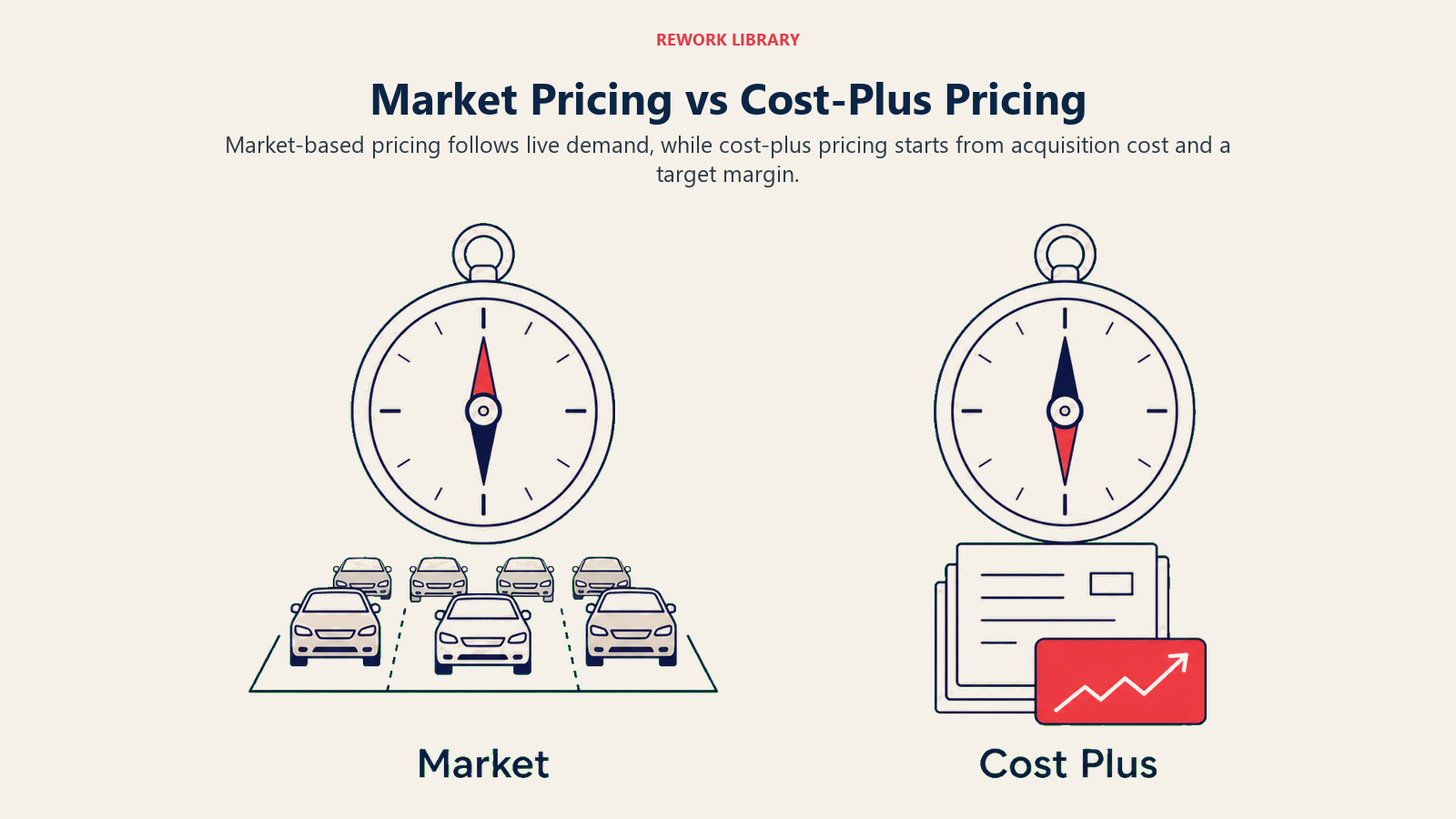
Market-based pricing starts with reality. What are shoppers seeing when they search? What's the days supply in your segment? Which units are moving fast and which are sitting? Tools like vAuto and ProfitTime aggregate this data, but you need to interpret it correctly within your used vehicle acquisition and automotive inventory strategy. A 95 pricing confidence score doesn't mean you'll sell at that price, it means you're competitively positioned if the market cooperates.
The best dealers use a hybrid approach. Start with market data to understand competitive positioning, then make strategic decisions about whether to lead or follow on specific units. High-demand vehicles with low market supply? Price at the top of the range and hold. Common units with plenty of competition? Price to move and capture the early shopper.
The Premium Pricing Window
The first 30 days on the lot represent your best opportunity for premium pricing. The vehicle is fresh. Online listings are new. And if you've acquired right, you've got a clean unit that photographs well and compares favorably to market alternatives. But premium pricing only works if you're actually competitive. Some dealers confuse premium with overpriced. Premium means you're $500-$1,000 above market leaders but justified by condition, history, or included value. Overpriced means you're $2,000 above comparable units with no differentiator. The market punishes overpricing brutally, you'll get views but no engagement.
During this premium window, monitor your VDP views and SRP impressions closely through vehicle detail page optimization. A well-priced vehicle should generate engagement within 48-72 hours of listing. If you're getting impressions but no clicks to your VDP, your pricing is likely off. Shoppers see you in search results but pass you over for better-priced alternatives.
The 0-30 day window is also when you should be most resistant to negotiation. You've got time on your side. The vehicle is fresh. Market conditions haven't changed significantly since acquisition. Hold your number and let the market come to you. You won't sell every unit in this window, but the ones that do sell will deliver your best gross.
Understanding the Aging Curve
Everything changes at 31 days. This is when smart dealers start watching market signals more carefully. Your vehicle is no longer fresh in online algorithms. Shoppers who sort by "newest listings" skip right past you. And if competing dealers have listed similar units at lower prices during your premium window, you're now facing tougher competition. The 31-60 day window is when you should implement your first strategic price adjustment. This doesn't mean panic. It means analyzing market changes since acquisition. Have similar units sold around you? At what prices? Has days supply in your segment increased? Has a competing dealer dropped price significantly on comparable inventory?
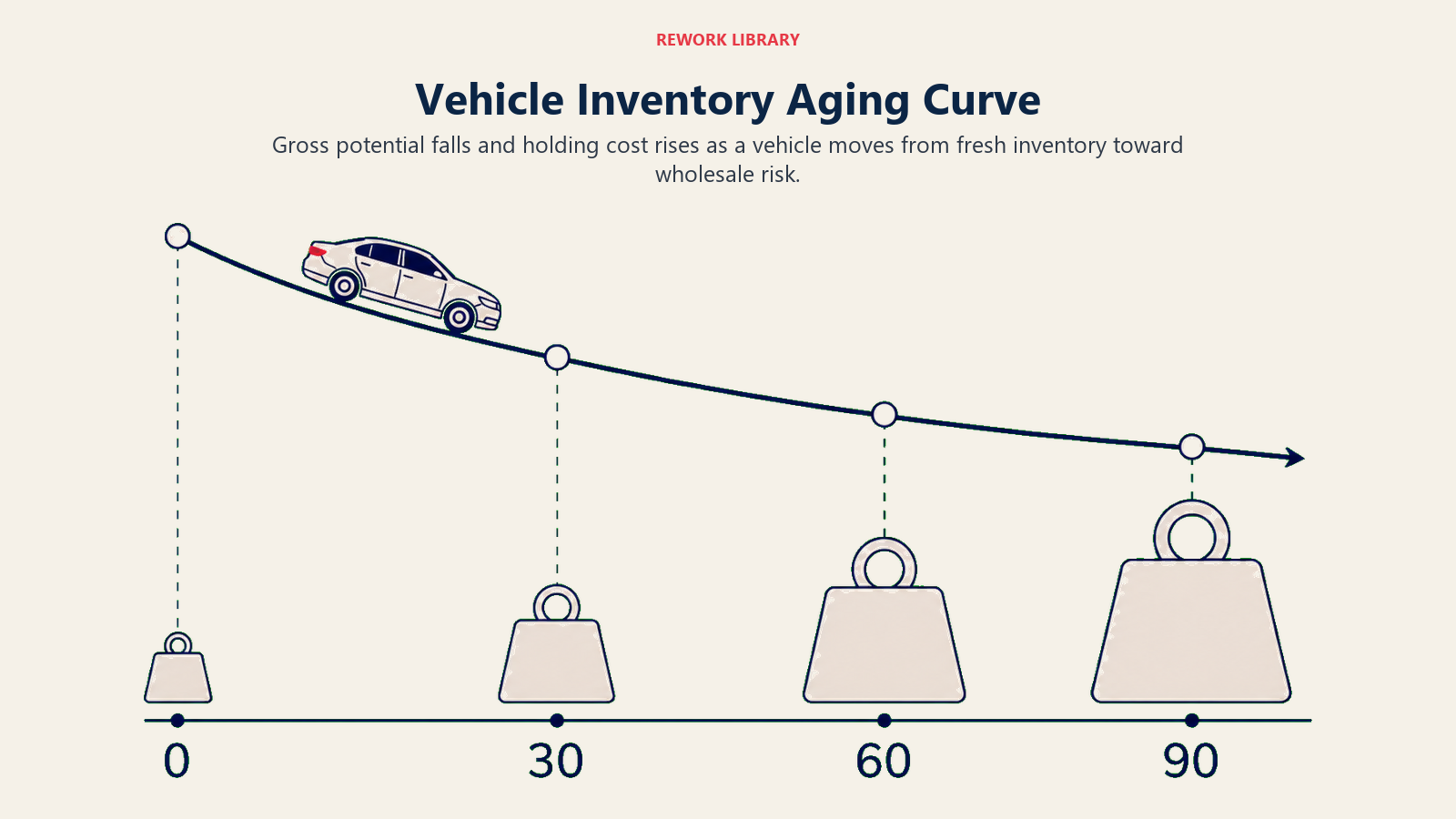
A $500-$1,000 adjustment at 45 days often makes the difference between a 60-day sale and a 90-day disaster. Some dealers resist this, thinking it signals weakness. But shoppers don't care about your timeline, they care about value. And a unit that's been on the market for 45 days at $27,995 feels overpriced compared to a unit listed 10 days ago at $27,495, even if yours is nicer.
At 61-90 days, you're in aggressive repositioning territory. This vehicle is now a problem. It's costing you $100-200 per month in floorplan interest. Market value has depreciated from where you started. And you've passed on newer, better inventory opportunities because your capital is tied up. Time to make real decisions.
An aggressive repositioning might mean dropping $1,500-$2,500 below current market leaders. It might mean adding reconditioning dollars you were reluctant to spend. Or it might mean wholesale evaluation. What you can't do is keep it at the same price and hope. Hope isn't a strategy at 70 days.
The 90-Day Wholesale Decision
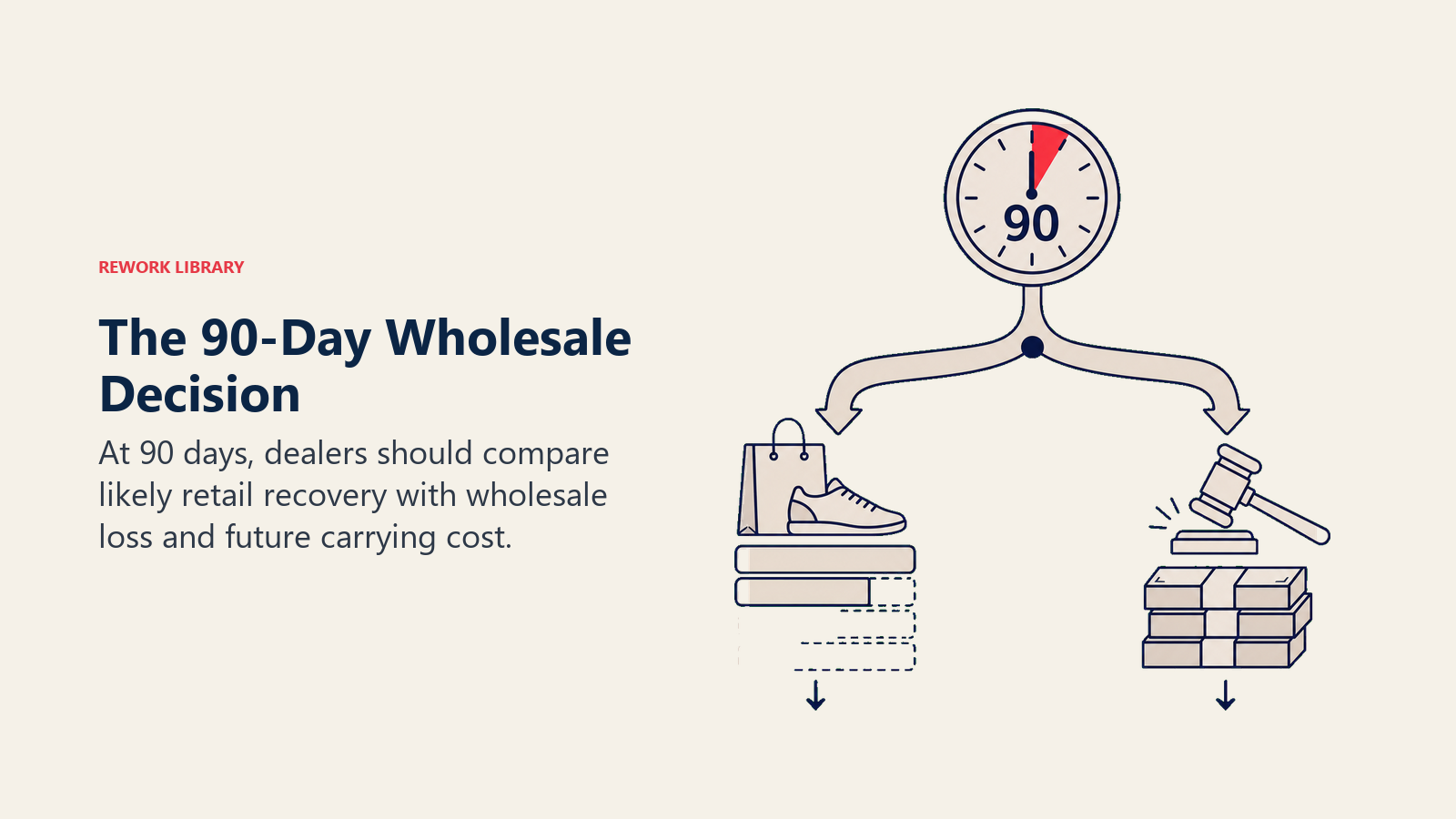
At 90 days, every dealer faces the same question: wholesale now or continue retail? The math usually tells you to wholesale. Your total cost to own has grown by $500-800 in floorplan interest and depreciation. You're competing against fresher units that didn't exist when you acquired this vehicle. And psychologically, you're anchored to your original price expectations even though market reality has shifted. But some units deserve a stay of execution. High-margin specialty vehicles. Units where you've got $5K+ in potential gross and reasonable market activity. Vehicles where the wholesale bid is so weak that the retail gamble makes sense. These deserve another 30 days with fresh marketing spend and aggressive pricing.
The mistake dealers make is letting emotion drive the decision. "I've got too much in this one to wholesale." "The market will come back." "Someone will pay my number." Maybe. But probably not. And every week you wait is another week of carrying costs and missed opportunities.
Establish wholesale triggers at day 90 and stick to them. If wholesale bid is within $1,000 of your breakeven, take it. If you haven't had serious buyer interest in 30 days, take it. If you've dropped price twice without moving the unit, take it. These rules protect you from emotional decision-making that keeps bad inventory aging on your lot for months.
Market-Based Pricing Factors
Effective pricing requires understanding the specific factors that drive your local market. Days supply is the starting point, how many vehicles in your segment are currently available to shoppers in a 50-mile radius? If there are 200 used F-150s and only 20 used Tacos, your pricing strategy needs to reflect that imbalance. NADA industry data shows that optimal inventory management targets 30-day supply levels, though actual performance varies significantly by brand and market conditions. Competition analysis goes deeper than just counting similar units. You need to understand competitive pricing by condition, mileage, and features. A 2020 RAV4 XLE with 40K miles priced at $24,995 isn't comparable to your 2020 RAV4 Limited with 32K miles at $27,995. But a shopper who doesn't understand trim differences might see a $3,000 gap and choose the XLE.
Seasonal patterns matter more than most dealers realize. Four-wheel-drive trucks and SUVs command premium pricing in October-February. Convertibles move faster March-August. Recognize these patterns and adjust acquisition timing and pricing accordingly. Don't buy convertibles in June expecting premium pricing, you've missed the window.
Your vAuto pricing confidence score is a starting point, not a final answer. An 85 confidence score might mean you're priced right if market conditions are stable. But if a competing dealer just listed three similar units $1,000 below market, that 85 becomes meaningless. Use the tools but interpret the data through current market conditions and analytics.
Price-to-Market Automation
The best-performing dealers don't just set initial prices, they implement automated repricing strategies that respond to market changes in real time. When a competing dealer drops price on a similar unit, your pricing should automatically adjust. When your VDP views drop below threshold levels, trigger a price review. When a unit hits 45 days with low engagement, schedule an automatic market repricing analysis. Most DMS platforms and third-party tools support rule-based repricing. Set parameters that protect your gross profit goals while ensuring you remain competitive. A simple rule: if three or more competing vehicles in my segment drop below my price point, alert me for review. Or: if VDP views drop 50% week-over-week, trigger repricing analysis.
Automated repricing doesn't mean abandoning judgment. It means creating systems that surface problems before they become disasters. The dealers who wait until monthly inventory meetings to adjust pricing are already too late. By the time you notice that 2021 Camry has been sitting for 60 days, you've missed two repricing opportunities that could have moved it at 45 days with better gross.
Monitor shopper engagement metrics religiously. VDP views tell you if shoppers are seeing your vehicle. Time on page tells you if they're interested. Comparison tool usage tells you if they're actively evaluating. Lead submissions tell you if you're priced competitively enough to drive action. These metrics should inform pricing decisions at every stage of the aging curve.
The Real Cost of Aging Inventory
Too many dealers focus only on purchase price and target gross, ignoring the accumulating costs of aging inventory. Floorplan interest runs $150-300 per month depending on your capital costs and the vehicle's value. That's real money coming off your bottom line every day a vehicle sits. Cox Automotive floor plan finance formulas help dealers calculate the true cost of holding inventory. Depreciation impacts vary by segment and market conditions, but figure $100-200 per month for most used vehicles. Some segments depreciate faster, trucks and SUVs in summer, sedans year-round, electric vehicles in volatile markets. According to the Manheim Used Vehicle Value Index, 2026 forecasts call for normal depreciation patterns after several years of unusual market behavior. This depreciation is opportunity cost even if you eventually sell the unit.
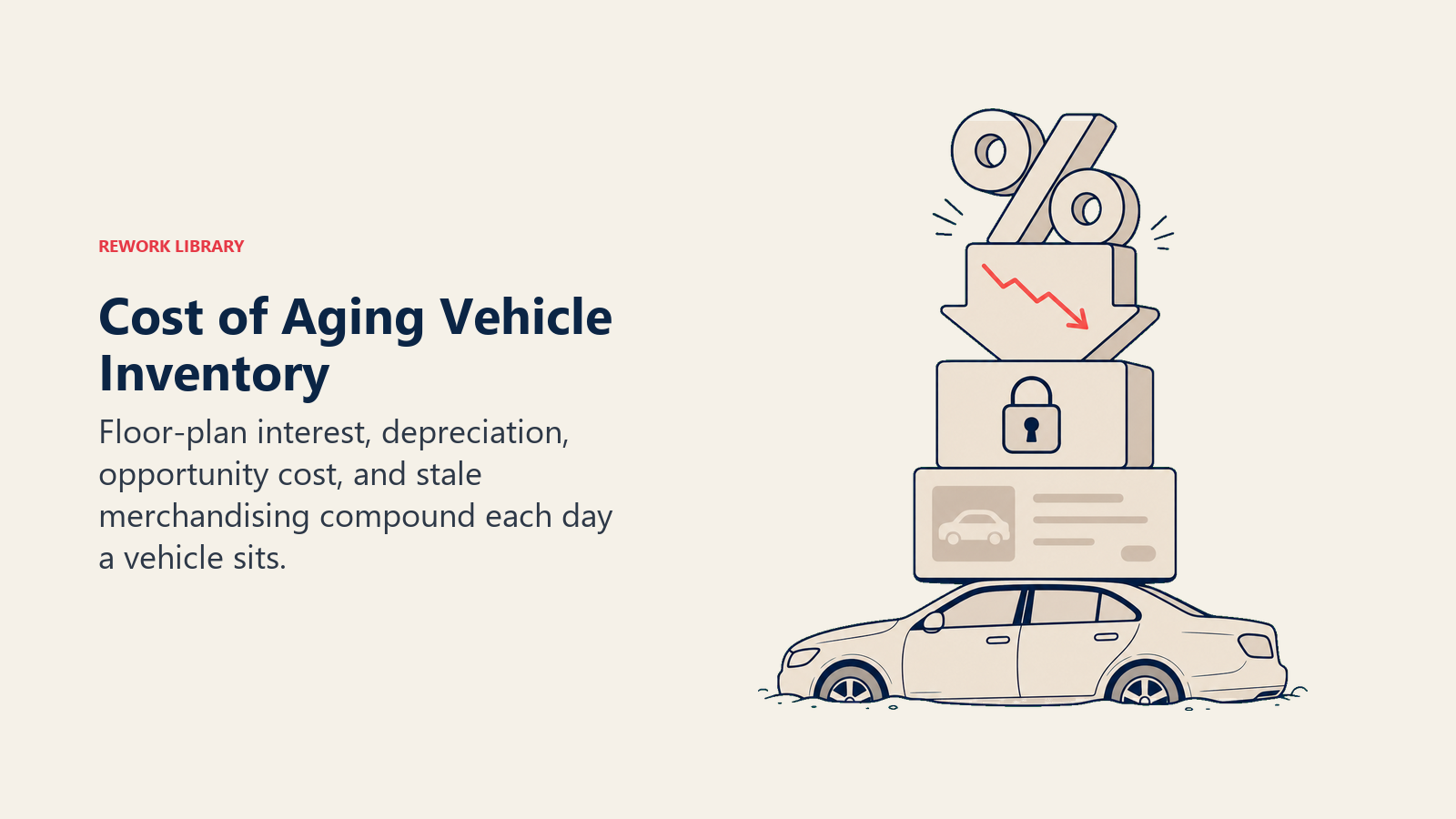
Depreciation impacts vary by segment and market conditions, but figure $100-200 per month for most used vehicles. Some segments depreciate faster, trucks and SUVs in summer, sedans year-round, electric vehicles in volatile markets. According to the Manheim Used Vehicle Value Index, 2026 forecasts call for normal depreciation patterns after several years of unusual market behavior. This depreciation is opportunity cost even if you eventually sell the unit.
Then there's the capital opportunity cost. If you've got $150K tied up in five aged units sitting 90+ days, that's $150K you can't deploy toward fresh inventory that would turn in 45 days through smart new vehicle inventory management. Run the math: $150K in aged inventory sitting 90 days generates maybe $8K gross if you eventually retail them. That same $150K in fast-turn inventory cycled three times in 90 days could generate $15K-18K gross.
Calculate your total cost to own by age bucket. A unit that cost $25K at acquisition has a true cost of $26,200 at 60 days when you factor in floorplan interest, depreciation, and reconditioning. If market value has dropped to $27,500, you're not making $2,500 anymore, you're making $1,300. And if you wait another 30 days, you might be breakeven or upside down.
Building Your Technology Stack
Modern inventory pricing requires modern tools. Your DMS integration and reporting provides the foundation, configure aging reports to highlight units approaching critical thresholds at 30, 60, and 90 days. Set up automated alerts that email you when units cross these boundaries. Too many dealers only review aging in monthly manager meetings, missing critical repricing windows. Third-party pricing tools like vAuto, ProfitTime, or FirstLook integrate market data that your DMS lacks. These tools analyze thousands of competing vehicles, tracking pricing changes, days on market, and sales velocity. The best dealers check these tools daily, not weekly. Market conditions change fast, and you need current data to make accurate pricing decisions.
Integration is key. Your DMS should feed data to your pricing tools, which should feed repricing recommendations to your merchandising systems, which should update your dealership website and third-party listings automatically. Manual processes create delays and errors. Automated workflows ensure your pricing strategy executes consistently.
Implement a weekly pricing review cadence that's actually meaningful. Don't just review aged inventory, review all inventory against current market conditions. Are you still competitively priced on units listed two weeks ago? Have competing dealers made pricing moves that impact your positioning? Has market demand shifted in ways that require repricing?
Making It Work
The dealers who master inventory pricing and aging share common traits. They make decisions based on data, not emotion. They recognize that time is the enemy and velocity is the goal. And they understand that protecting gross profit matters less than optimizing total profitability including carrying costs.
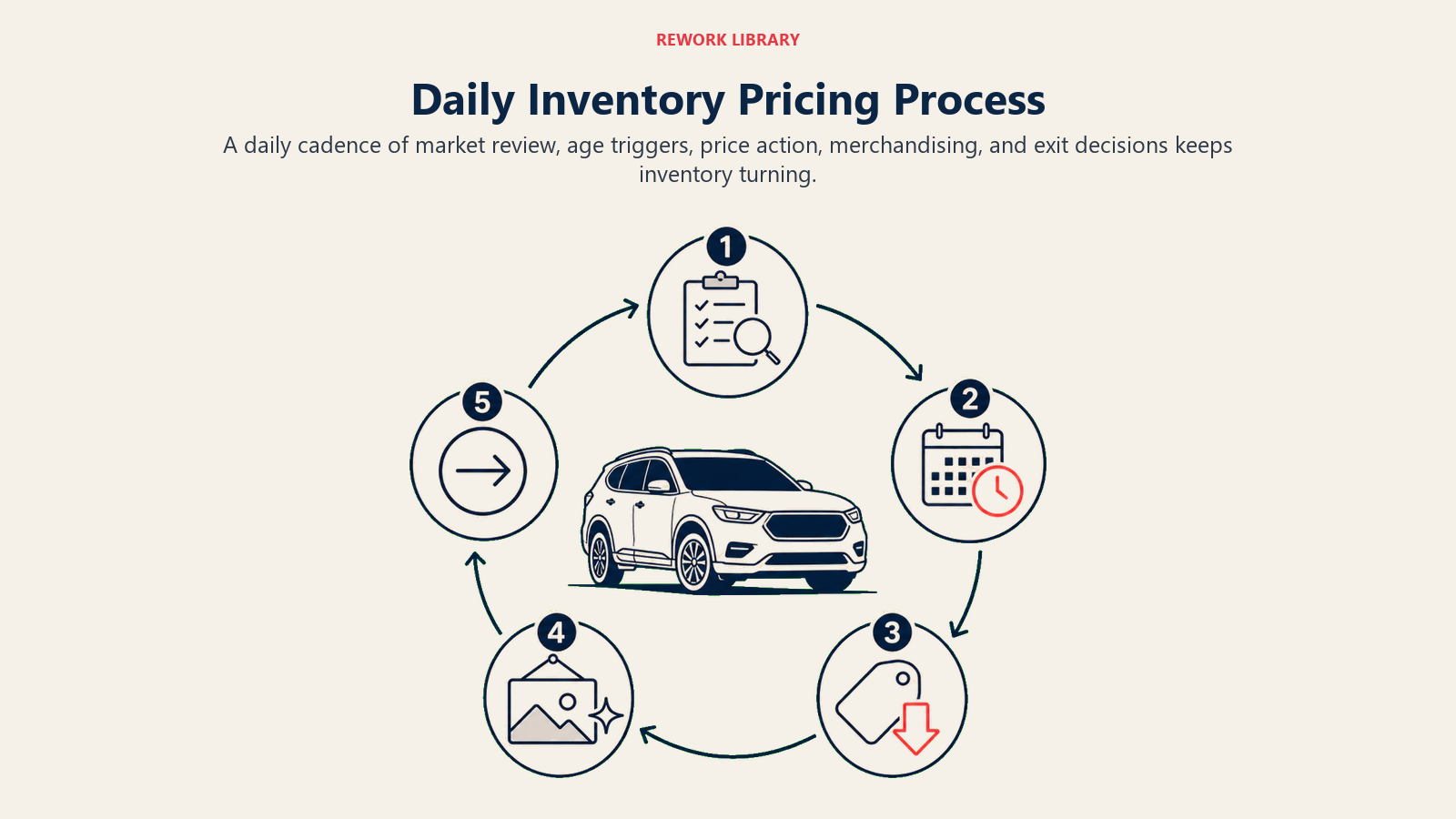
Start by establishing clear aging thresholds and the actions triggered at each threshold. At 30 days, review market positioning and engagement metrics. At 45 days, implement first strategic price adjustment if needed. At 60 days, aggressive repricing or additional merchandising investment. At 90 days, wholesale evaluation with clear decision criteria.
Train your team to think in terms of total cost to own, not just purchase price and target margin. When your used car manager wants to hold a unit another month hoping for full gross, run the numbers on floorplan interest, depreciation, and opportunity cost through your dealership KPI dashboard. Often you're better off moving it today at lower gross than holding it 30 more days hoping for higher gross.
Finally, create accountability around turn rate metrics. Every manager should know their current turn rate and how it compares to target. Aged inventory should be visible on daily reports, with clear ownership of action plans. The dealers who treat aging inventory as a crisis instead of a statistic consistently outperform their market.
Your market won't reward perfect pricing, it'll reward smart pricing that balances gross profit with turn velocity. Master that balance and you'll turn inventory in 45 days while competitors watch their capital depreciate for 75+ days. That's the difference between dealerships that thrive and dealerships that merely survive. For comprehensive strategies, explore inventory turn optimization, vehicle merchandising, auction buying strategy, and certified pre-owned programs.
Car Inventory Pricing and Aging FAQ
What is a good inventory turn rate for a car dealership?
Top-performing dealers turn used inventory in about 45 days, while many competitors sit at 75+ days. Faster turns reduce floorplan interest and depreciation and free up capital for fresh, faster-moving units.
When should I drop the price on an aging vehicle?
Reprice on a schedule, not on emotion. Keep premium pricing for the first 0 to 30 days, make a first strategic adjustment of $500 to $1,000 at 31 to 60 days, move to aggressive repositioning at 61 to 90 days, and evaluate wholesale at 90 days.
What does aging inventory actually cost?
Roughly $150 to $300 per month in floorplan interest plus $100 to $200 per month in depreciation, before counting opportunity cost. A $25K unit can carry a true cost near $26,200 by day 60, which quietly erases gross you assumed was locked in.
What is market-based pricing for used cars?
It sets price from current market reality, comparable listings, days supply, and local demand, rather than cost plus a fixed margin. Tools like vAuto and ProfitTime aggregate the data, but you interpret it against your acquisition cost and turn goals.
When should I wholesale a vehicle instead of retailing it?
Set wholesale triggers at day 90: take the bid if it is within $1,000 of breakeven, if you have had no serious buyer interest in 30 days, or if you have dropped price twice without movement. Clear rules prevent emotional decisions that keep dead inventory aging.