Online Trade-In Tools: Capturing Equity Information Before Showroom Visits - 2026 Guide
Turn this article into takeaways for your work.


Each assistant summarizes the article only for you and suggests best practices for your work.
The average dealership knows that 75% of their customers will have a trade-in vehicle. But here's what most don't realize: they're capturing trade information on less than 30% of internet leads before the customer shows up. That means the desk is working blind on equity position, negative equity concerns, and acquisition opportunities until the customer is sitting across from them.
Online trade-in tools change that equation completely. They pull the equity conversation forward into the digital experience, giving your team the information they need to qualify leads, prepare for appointments, and source inventory, all before the customer sets foot in your showroom.
Strategic Value of Online Trade Tools
The immediate benefit most dealers see is faster desk cycles. When a customer arrives with their trade already valued, you're not spending 20 minutes inputting VIN data and pulling comparables. But that's just the surface value. Lead qualification jumps significantly when you know equity position upfront. A customer with $8,000 in positive equity isn't the same lead as someone buried $5,000 underwater. Your BDC can tailor the conversation, your sales team can prepare the right inventory, and your desk knows whether they're working a payment buyer or an equity buyer before the handshake.
Inventory acquisition becomes systematic instead of opportunistic. When you're capturing 200+ trade valuations per month through your website, you're essentially running a constant appraisal pipeline. Your used car manager can spot wholesale opportunities, identify vehicles worth retail prep, and even reach out proactively on high-demand units before the customer commits to a purchase. According to NADA's research on dealership operations, systematic trade-in acquisition has become a critical component of used vehicle inventory strategy.
Competitive conquest opportunities reveal themselves in the data. When someone's valuing their Toyota on your Chevy store's website, that's a conquest signal worth pursuing differently than a loyalty trade. The tool tells you what they're driving before you know what they want to buy.
And negative equity identification early in the process prevents wasted appointments and frustrated customers. If someone owes $12,000 more than their vehicle is worth, you need to know that before they drive across town expecting to trade even. It doesn't kill the deal, but it changes how you structure the conversation.
Trade Tool Options & Technology
Third-party valuation providers dominate the market for good reason, they've invested millions in data accuracy and consumer trust. KBB's Instant Cash Offer drives recognition and credibility, Black Book provides dealer-trusted wholesale values, and vAuto powers many OEM-backed tools with real market data. But proprietary dealership tools give you more control. You set the algorithm, adjust for local market conditions, and decide whether you want to lead aggressive or conservative on valuations. The tradeoff is consumer trust, your tool doesn't carry the KBB brand weight.
Photo-based appraisal platforms add a layer of condition assessment that pure VIN decoders miss. Customers upload 6-8 photos of their vehicle, and the system uses AI to flag body damage, tire wear, and interior condition. It's not perfect, but it's more accurate than assuming every vehicle is in "good" condition.
VIN decoder integration is non-negotiable regardless of which platform you choose. Manual entry creates friction and abandonment. A customer should paste their VIN once and watch the tool populate make, model, trim, and even options data automatically.
Mileage and condition assessment separate tools that deliver real value from ones that generate garbage leads. If your tool doesn't force mileage input and some form of condition selection, you're getting fantasy valuations that won't match your appraisal when the customer shows up.
Implementation on Website & VDPs
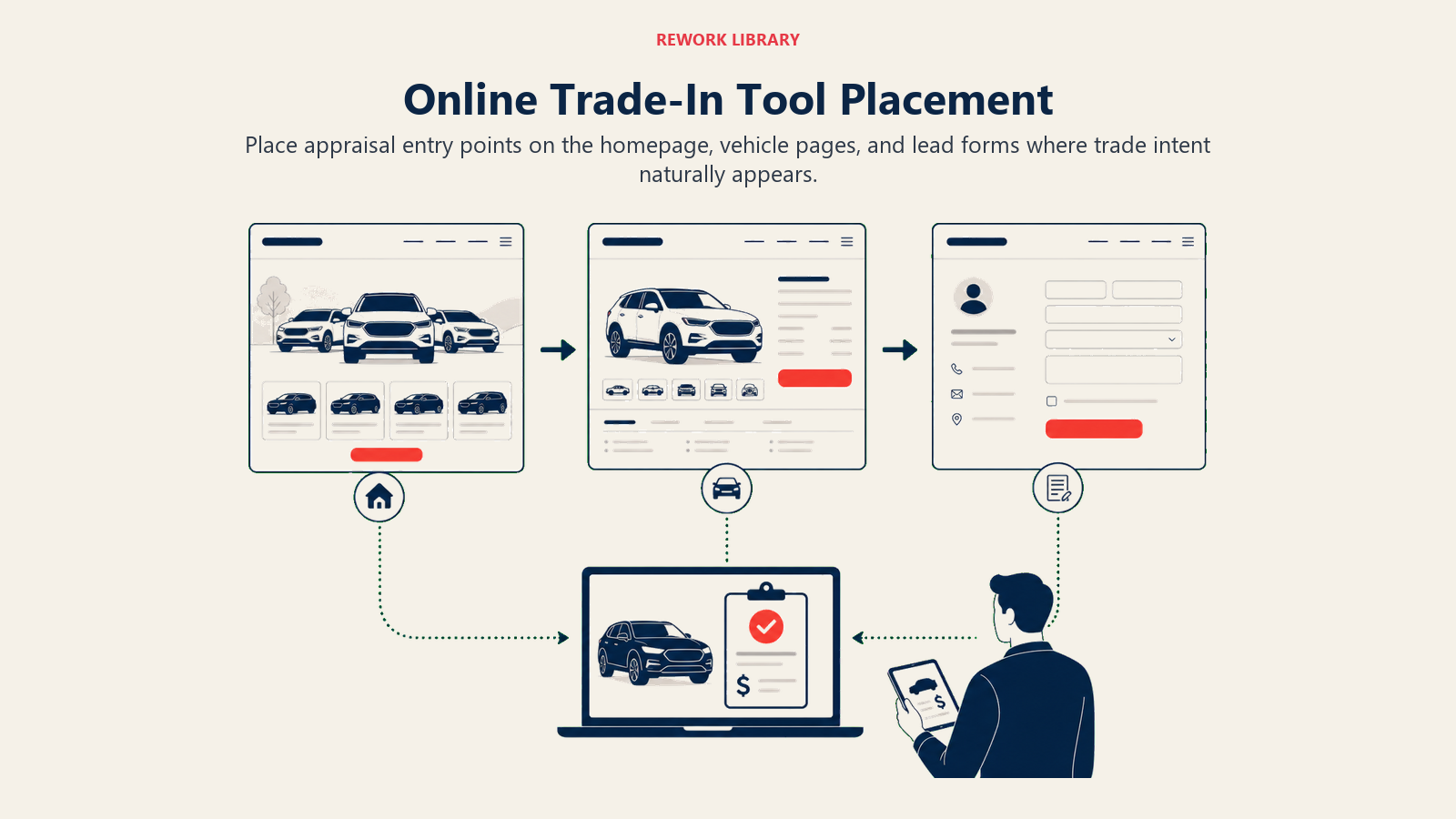
Placement strategy determines whether anyone uses your tool. Homepage placement catches early research traffic but may feel premature to browsers who haven't picked a vehicle yet. VDP placement capitalizes on high-intent moments, "I found the car I want, now what's my current car worth?" Most high-performing stores use both. Homepage for general research traffic, sticky VDP widgets for inventory shoppers, and form integration for lead submissions. The goal isn't to force every visitor through the tool, it's to make the tool available when trade information becomes relevant to their decision. User experience and flow design make the difference between 45% completion rates and 8% abandonment. Start with VIN input, not year/make/model dropdowns. Show progress indicators so customers know they're 3 steps from a valuation, not 15. And keep the path to value under 90 seconds, longer than that and you're competing with KBB.com directly.
Required fields vs optional information is a constant tension. You want mileage, condition, and contact information at minimum. Everything else, service records, accident history, aftermarket additions, improves accuracy but kills completion. Test both approaches: instant valuation with minimal fields, then progressive disclosure to refine the number.
Instant valuation vs scheduled appraisal determines what happens after submission. Instant creates urgency and completion ("See your car's value in 30 seconds"), but scheduled appraisal allows for photo upload and more accurate numbers. Many dealers split the difference: instant range with scheduled appraisal for firmer offers.
Mobile optimization isn't optional when 70% of your traffic is on smartphones. The VIN scanner needs to work from mobile camera, condition buttons need to be thumb-friendly, and the form can't require pinch-and-zoom to complete. Test on actual devices, not just responsive preview mode, following best practices for mobile experience.
Valuation Strategy
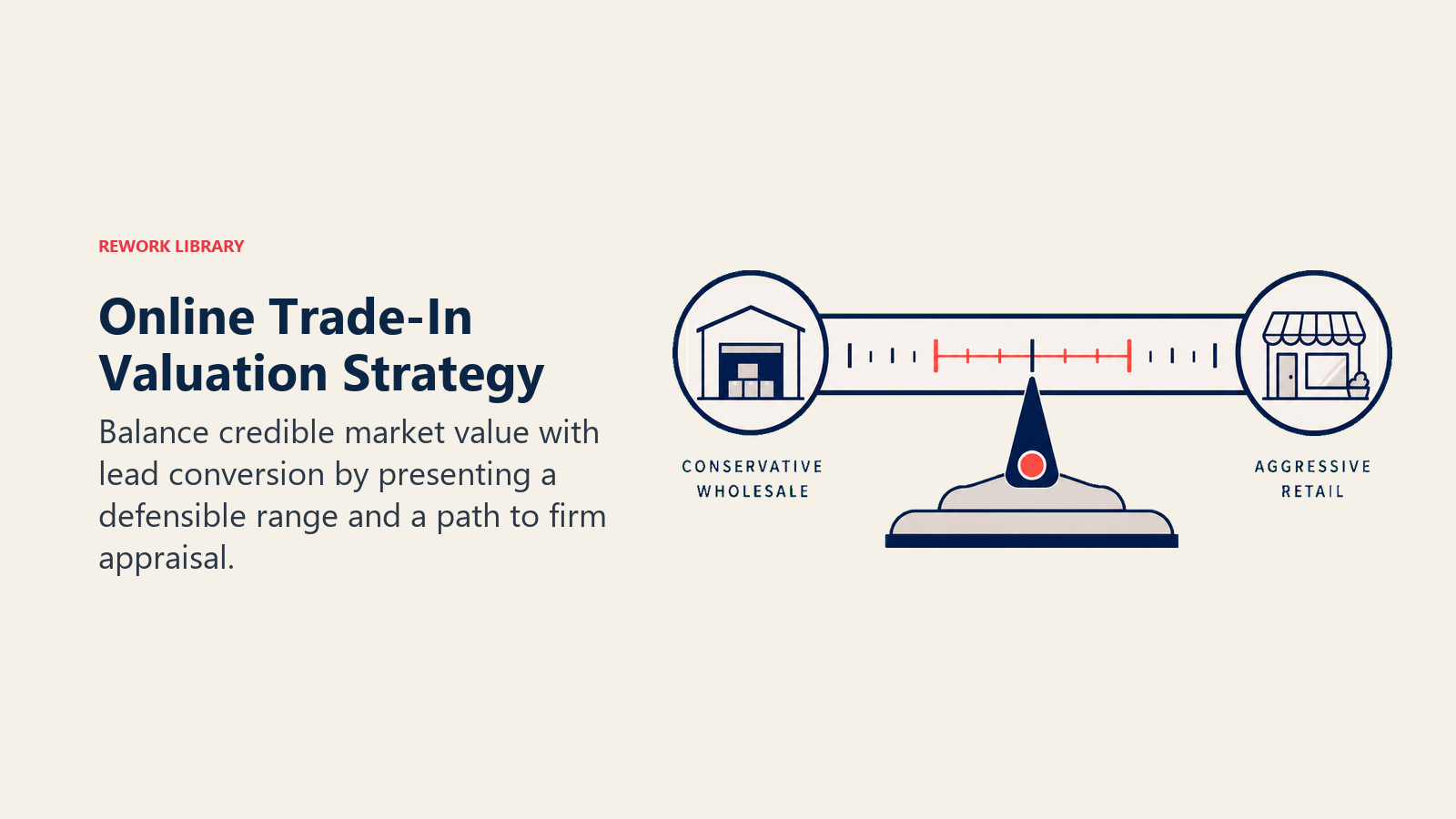
Conservative vs aggressive trade values is your most important strategic decision. Conservative protections (showing wholesale book) prevent negative reactions when customers get to the store, but they also reduce tool usage and damage credibility. Aggressive positioning (retail or strong retail) drives leads but creates friction at the desk when reality hits. Most successful stores land somewhere between wholesale and retail book, positioning the tool as "starting point" rather than "final offer." The messaging matters as much as the number: "Based on your information, we'd value your trade between $14,500 and $17,200. Schedule an appointment for a firm offer." Market-based algorithms beat static book values every time. If 2019 Honda Civics with under 50,000 miles are selling $2,000 over book in your market, your tool should reflect that reality. vAuto's ValueMiner data and live auction results feed into the smart tools that actually mirror current conditions.
Condition adjustments separate fantasy from reality. A "good" condition 2018 F-150 might book at $28,000, but if it's got 90,000 miles, needs tires, and has a check engine light, wholesale reality is closer to $23,000. Your tool needs to apply real deductions or you're setting up disappointment.
Competitive positioning depends on your market strategy. If you're trying to source inventory aggressively, lead with higher values and faster cash offers than CarMax. If you're focused on acquisition cost control, match market rates and win on convenience and trade-in tax savings.
Handling negative equity scenarios determines whether these leads die or convert. When the tool calculates a $5,000 deficit, you can't just show "Your car: $12,000, You owe: $17,000, Sorry!" Instead: "Many customers owe more than current value, we have financing options to help. Let's discuss your goals."
CRM & DMS Integration
Lead routing based on equity position transforms random lead assignment into strategic opportunity distribution. Positive equity leads go to your best closers who can maximize margin. Negative equity leads need consultants skilled at overcoming obstacles and restructuring deals. Wholesale acquisition targets can route directly to your used car manager. Automatic appraisal alerts tell your team when hot opportunities arrive. A 2022 4Runner with $12,000 equity that you can retail for $45,000? That deserves immediate attention and a phone call within 5 minutes. A 2015 Sentra at wholesale might wait for the BDC queue.
Used car acquisition workflow needs to separate potential retail units from straight wholesale. When someone values a vehicle you'd actually want to stock, that lead should hit both sales and your used car manager. You're not just trying to sell them, you're trying to buy their trade even if they don't purchase from you.
Trade walk analysis comes from integrated data. If your tool generates 200 valuations monthly but only 30 customers show up, you've got a 15% pull-through rate. Compare that to lead source performance, and you'll see whether your trade tool actually improves show rates or just generates more unqualified activity.
Wholesale vs retail decision triggers should be systematic, not gut-based. Set parameters in your CRM: vehicles under 10 years old with under 100,000 miles and no accidents get retail consideration. Everything else gets wholesaled unless your used car manager manually overrides. Your appraisal team shouldn't guess, the system should tell them.
Follow-Up Process
BDC response protocols for trade leads need different scripts than standard internet inquiries. You're not asking "What can I help you find?", you already know they have a specific vehicle and a trade. The opening is: "I see you valued your 2020 Accord at around $18,500. Are you looking to upgrade, or would you consider a cash offer even if you're not purchasing today?" Trade value disclosure timing is controversial. Some stores reveal the range immediately to build credibility. Others hold the number until appointment confirmation to maintain control. Test both, conversion data will tell you which approach works in your market.
Appointment setting around trade creates commitment using proven appointment-setting techniques. "Let's schedule 30 minutes Thursday at 4:00 PM. Bring your Accord, your driver's license, and your payoff information if you have it. We'll give you a firm written offer whether you buy from us or not." That's concrete and removes uncertainty.
In-person appraisal scheduling for high-value opportunities deserves special handling. When someone values a $60,000 truck on your website, you don't assign that to the BDC rotation, your used car manager or a senior consultant calls personally within the hour.
Competitive trade offers handling requires finesse. When customers mention CarMax offered them $16,000, don't argue about valuation methodologies. Instead: "CarMax does a good job on appraisals. If we can match or beat their offer and save you the sales tax on your purchase, does that make us your first choice?"
Performance Tracking
Tool completion rates reveal friction points in your flow. Industry average is 35-40% from start to submission. If you're below 25%, your form is too long or your value proposition isn't clear. Above 50% means you've nailed the user experience and messaging. Equity position distribution shows what you're working with. The typical dealership sees 40% positive equity, 35% negative equity, and 25% roughly even. If your mix is heavily negative, you might be attracting subprime customers or your valuation algorithm is too aggressive.
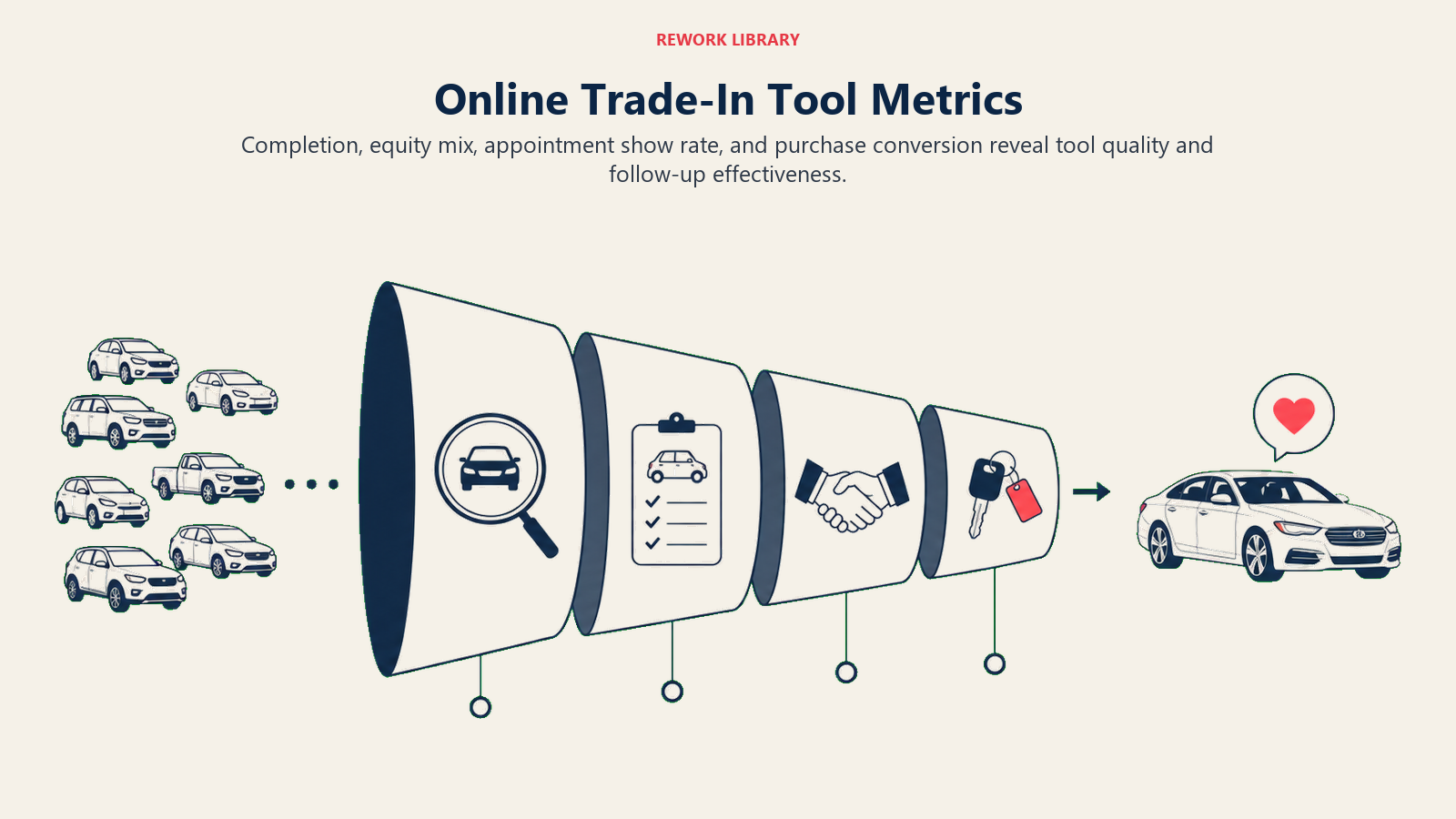
Trade-in show rates separate qualified interest from research activity. A 15-20% show rate from trade tool submissions is solid. Below 10% means either your valuations are fantasy numbers that don't hold up, or your BDC isn't converting valuations to appointments effectively.
Conversion to purchase is the ultimate metric. You should see 30-40% of customers who show up with trade tool submissions actually buy. That's higher than typical lead source conversion because these customers have done more research and self-qualified on monthly payment impact.
Acquisition cost per unit for retail-worthy trades sourced through your tool should run $800-1,200 when you factor in tool costs, BDC time, and recon. Compare that to auction acquisition costs of $400-600, but remember you're getting local one-owner vehicles with full history instead of mystery wholesale units.
The dealerships winning with online trade tools aren't just installing software, they're restructuring their entire lead qualification process around equity information. When you know what customers drive before you know what they want to buy, you can't help but sell smarter. Your desk works faster, your used car manager sources better inventory, and your customers show up to appointments with realistic expectations instead of wishful thinking about trade value.
For more on connecting trade tools with broader digital retail strategy, see Automotive Digital Retailing. To optimize where trade tools appear on your site, reference Vehicle Detail Page (VDP) Optimization. For turning trade leads into sourcing opportunities, explore Used Vehicle Acquisition. And to connect trade information with your broader lead management workflow, review Automotive Lead Management and Automotive Lead Scoring.