Dealership Data Analytics: Turning Numbers into Profitable Action
Turn this article into takeaways for your work.


Each assistant summarizes the article only for you and suggests best practices for your work.
Walk into most dealerships and ask the GM about yesterday's performance. You'll likely watch them shuffle through multiple systems, pull five different reports, and still struggle to answer basic questions about what's working and what isn't.
The average dealership generates more than 50 reports monthly from their DMS, CRM, website analytics, and marketing platforms. But here's the problem: they make most decisions based on gut feel, past experience, or whoever complains the loudest. Leading dealers take a different approach. They use data to predict problems before they happen, identify hidden opportunities, and optimize every profit center systematically.
The difference between data-rich and insight-poor dealers versus truly data-driven operations can mean millions in annual profitability.
The Dealership Data Landscape
Modern dealerships sit on top of enormous data assets, but that data lives in disconnected silos. Understanding what's available is the first step toward putting it to work.
Your DMS contains the most comprehensive operational data: every sale, service visit, parts transaction, and accounting entry. It tracks inventory movement, customer interactions across departments, and financial performance down to the penny. But most DMS platforms have clunky reporting interfaces that make extracting insights painful.
CRM and marketing platforms track lead sources, customer communications, campaign performance, and sales pipeline movement. They know which leads came from where, who's nurturing them, and what's happening at each stage. The problem? CRM data doesn't automatically sync with DMS sales data, creating gaps in attribution and ROI analysis.
Website and digital analytics tell you what customers do before they ever contact your store. Which inventory pages get views, how visitors navigate your site, where they come from, and what makes them submit a lead or leave. Google Analytics, heat mapping tools, and chat platforms generate massive behavioral datasets that rarely get connected to actual sales outcomes.
Inventory management systems track vehicle aging, market pricing, appraisal data, and reconditioning cycles. They know which units are hot, which are sitting, and what market conditions look like. But this data often stays trapped in the used car manager's laptop instead of informing broader dealership strategy.
Third-party data sources provide external context: market trends, competitor pricing, trade-in values, and demographic insights. Companies like J.D. Power, Kelley Blue Book, and industry consultants offer benchmarking data that helps you understand whether your performance is good in absolute terms or just good relative to your own history.
The real opportunity isn't in any single data source, it's in connecting these systems to create a complete picture.
Essential Sales Metrics and Dashboards
Sales performance starts with the funnel. You can't manage what you don't measure, and the sales process breaks down into clear stages: leads generated, appointments set, customers who show up, and vehicles delivered.
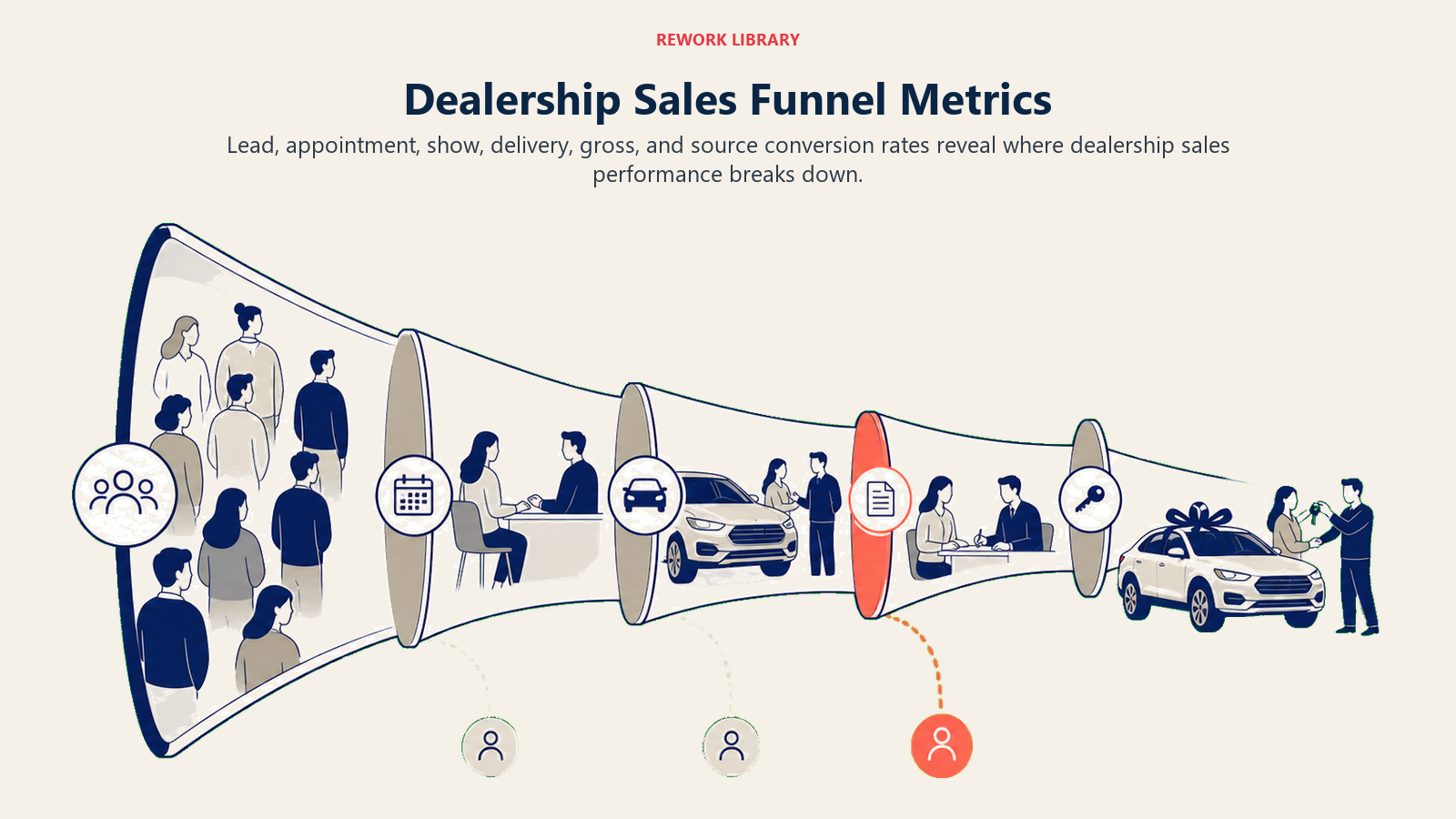
Most dealers track unit sales obsessively but pay little attention to conversion rates between funnel stages. A dealer selling 100 cars from 1,000 leads has a 10% overall conversion rate. But that top-line number hides whether the problem is appointment setting (leads to appointments), show rate (appointments to shows), or closing rate (shows to sales). Each requires different interventions.
Lead source ROI and attribution determine where to invest marketing dollars. Your CRM might report that internet leads convert at 8% while phone-ups convert at 20%, but without knowing cost per lead, you can't make smart budget decisions. A $500 cost-per-sale from expensive digital ads might still beat a $400 cost-per-sale from cheap leads if the digital customers buy more profitable vehicles or have better CSI scores.
Sales consultant scorecards make individual performance transparent. Track units sold, gross profit delivered, conversion rates, CSI scores, and activity levels for each salesperson. Publicize rankings. Top performers thrive on recognition, and underperformers either improve or self-select out when they can't hide anymore.
Gross profit metrics by vehicle type and department reveal where money comes from. Are you making $3,000 per new car but only $1,500 per used? Is your truck department crushing it while cars lose money? Does F&I deliver $1,800 PVR or $1,200? These differences point to specific coaching opportunities, inventory strategy shifts, or process improvements.
Finance penetration and PVR require daily tracking. If your F&I department produces $1,500 per vehicle one month and $1,900 the next, what changed? Product penetration rates by type (warranty, maintenance, GAP, VSC) tell you whether all F&I managers sell effectively or just one. Reserve income per financed unit shows whether you're optimizing lender relationships.
Customer satisfaction and retention rates connect to long-term profitability. A dealer with 85% CSI and 40% service retention prints money over time. A dealer at 75% CSI with 25% service retention constantly churns through customers and spends heavily on acquisition. Track CSI by salesperson, by department, and over time. Watch service retention rates by original selling consultant and by service advisor.
Service Department Analytics
Fixed operations separate profitable dealers from struggling ones, and service data analytics drive that profitability.
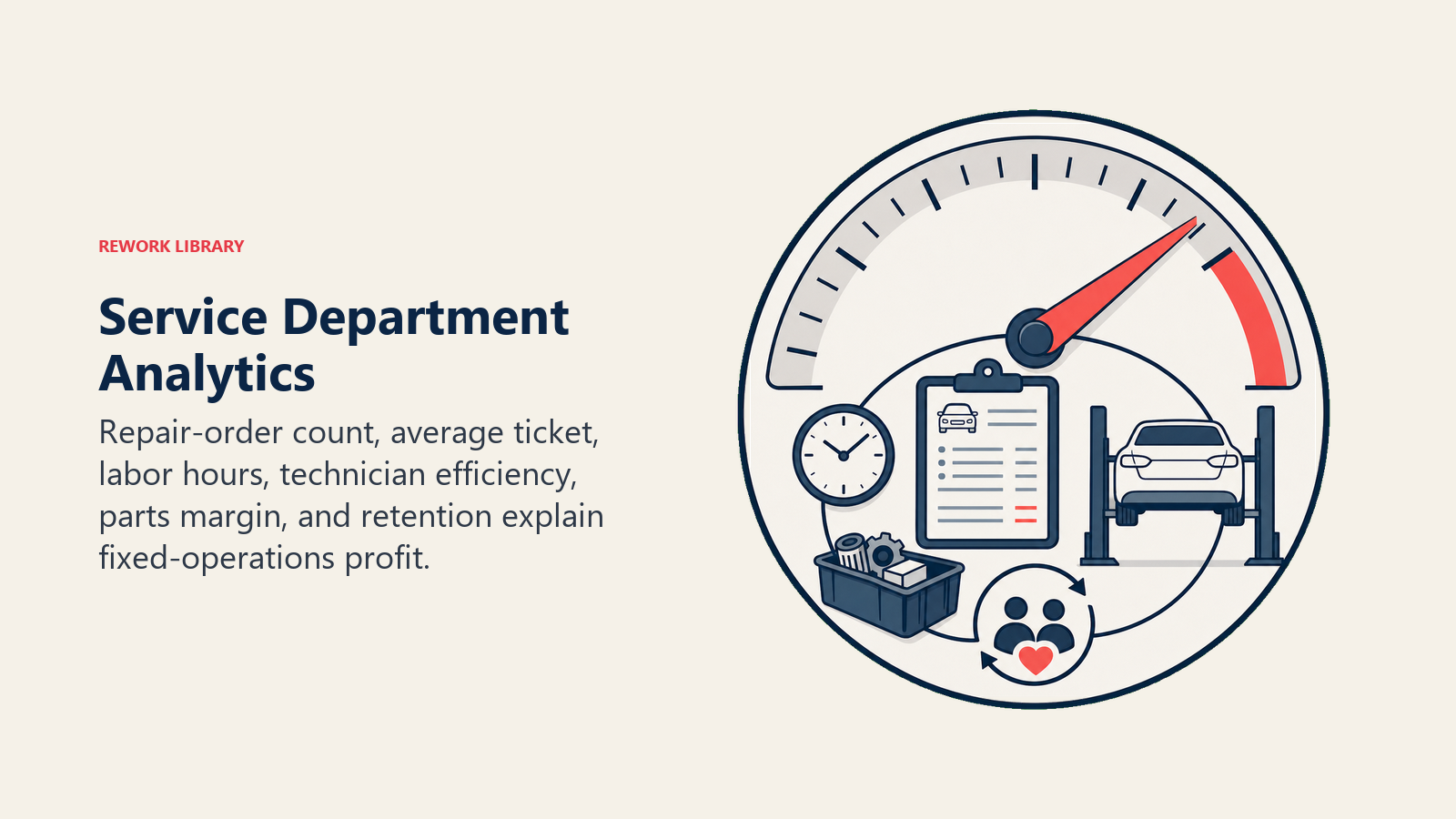
Customer pay RO count and average ticket are your service department's equivalent to unit sales and gross profit. Track daily customer pay RO counts against goals. A dealership averaging 50 customer pay ROs per day at $350 average ticket generates $17,500 daily. Boost that to 60 ROs at $375 and daily revenue jumps to $22,500, an extra $1.5 million annually.
Labor utilization and technician productivity measure efficiency. If you pay technicians for 8 hours but they only flag 6.2 hours of work, you've got 22.5% unused capacity. Leading dealers run at 95%+ efficiency, meaning techs flag nearly as many hours as they're paid. Track by individual technician, identify training needs, and ensure your service advisors sell the work your technicians can perform.
Parts margin and obsolescence impact profitability directly. Most dealers target 40-45% parts margin, but effective management can push this higher without losing competitiveness. Obsolescence, parts that sit unsold for 12+ months, kills cash flow and margin. Monthly reports on aging parts inventory, return rates to manufacturers, and fill rates from primary suppliers keep parts departments healthy.
Service retention and defection rates predict future revenue. A customer who bought a vehicle from you should service with you for the first 3-5 years minimum. If only 40% do, you're leaving millions on the table. Track retention by vehicle age, by original sales consultant, and by customer segment. Identify defection patterns and build win-back campaigns.
First-time fix rate and comeback ratio measure quality. Customers who return within 30 days for the same issue cost you money and damage trust. Track comebacks by technician and by service type. A 95%+ first-time fix rate should be standard. Anything less indicates training issues, diagnostic problems, or parts quality concerns.
Hours per RO and effective labor rate reveal pricing strategy success. Your door rate (posted labor rate) might be $175, but if efficiency and discounting bring your effective rate to $148, you're leaving money on the table. Track both metrics and work systematically to close the gap.
Marketing Performance Analysis
Marketing spending without analytics is just hope dressed up as strategy. Data separates effective campaigns from wasteful spending.
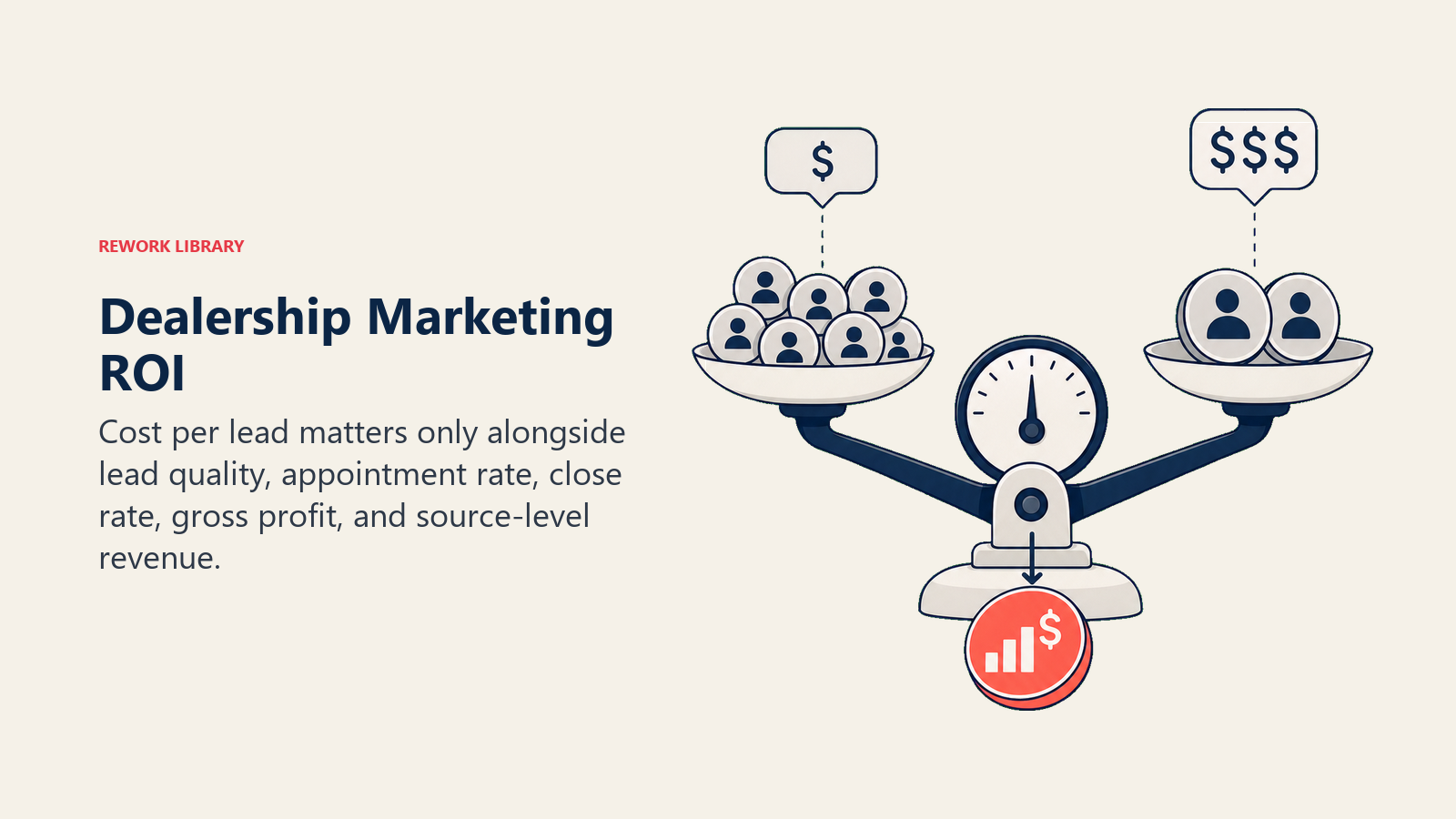
Cost per lead and cost per sale by source are the foundation of marketing ROI. If Google Ads cost $45 per lead and third-party sites cost $120, but Google leads convert at 6% while third-party converts at 15%, your cost per sale from third-party might actually be lower. Track both metrics together.
Website traffic and conversion funnel analysis reveal digital performance. Monthly visitors matter less than conversion rate. A site with 10,000 monthly visitors and 2% lead conversion (200 leads) outperforms one with 15,000 visitors and 1% conversion (150 leads). Use Google Analytics to track entrance pages, navigation paths, form abandonment, and conversion triggers.
Email marketing performance, open rates, click rates, and conversion, tells you whether your messaging resonates. Industry benchmarks suggest 20-25% open rates and 3-5% click rates for automotive marketing. Significantly lower numbers indicate list quality issues, subject line problems, or irrelevant content. Track conversion to appointment and to sale, not just opens.
Digital advertising ROI across search, display, and social requires platform-specific tracking. Search campaigns should generate leads at 5-10% conversion rates with clear ROI tracking. Display advertising works for awareness and retargeting, not direct response. Social media generates engagement but rarely drives immediate sales, measure it accordingly.
Attribution modeling and multi-touch analysis solve the "last touch" problem. Your CRM might credit the sale to the phone call, but that customer saw three display ads, visited your website twice, opened two emails, and clicked a retargeting ad before calling. Multi-touch attribution distributes credit across touchpoints, giving a realistic view of marketing impact.
Customer acquisition cost versus lifetime value determines sustainable growth. If acquiring a customer costs $800 and their lifetime value (including service, future purchases, and referrals) is $4,500, you can aggressively invest in acquisition. But if CAC is $1,200 and LTV is only $2,000, you need to improve retention before scaling acquisition spending.
Inventory Analytics
Inventory represents your largest asset and biggest risk. Smart dealers use data to optimize both.
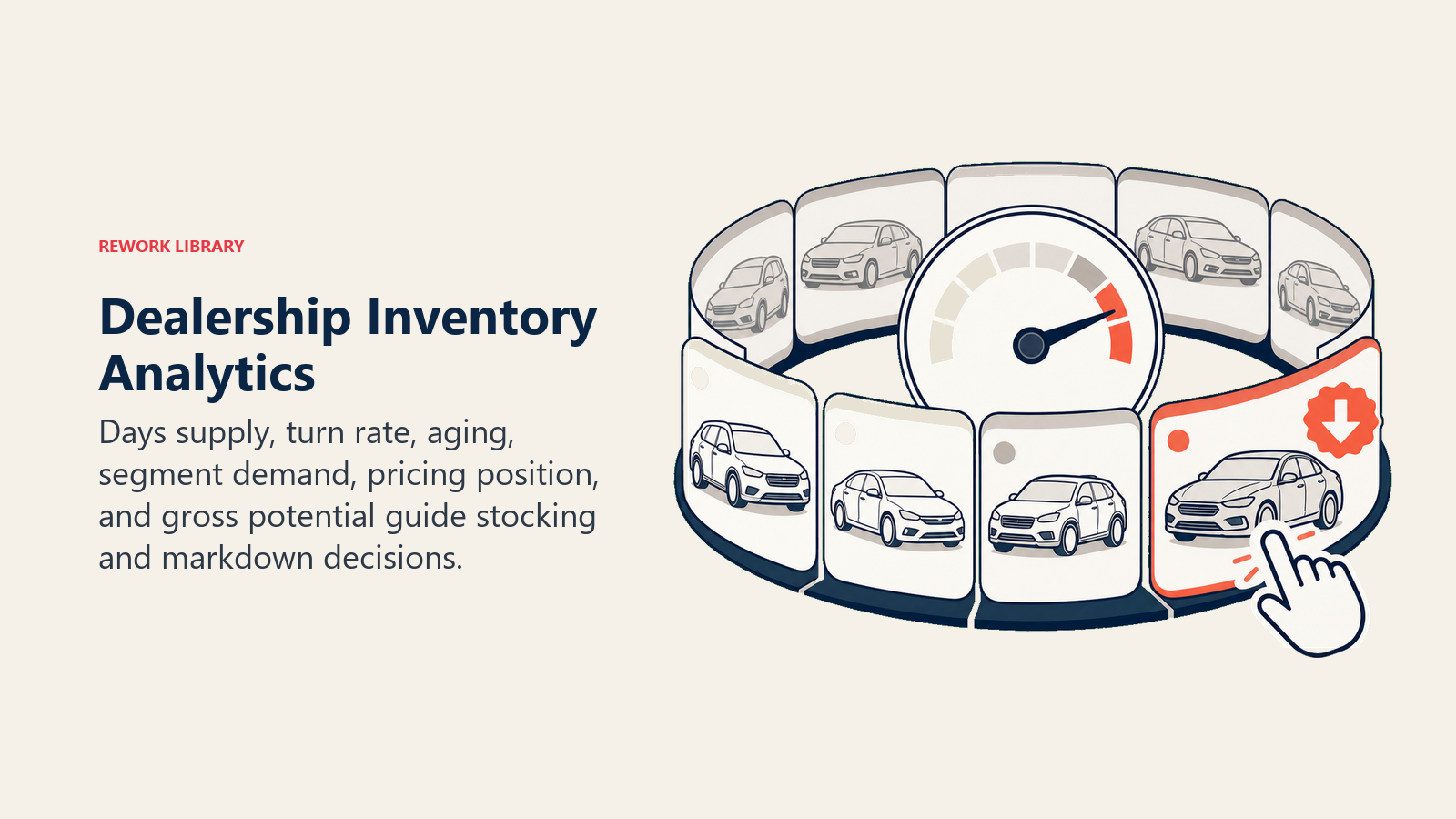
Days supply and turn rate by category prevent overstocking and understocking. The market might want 45 days of midsize SUVs but only 30 days of sedans. Track days supply by segment, by price range, and by new versus used. Compare your inventory mix to local market demand, not national averages.
Aging analysis and stocking alerts prevent costly mistakes. Every day a vehicle sits costs money: floor plan interest, opportunity cost, and depreciation. Set alerts for vehicles reaching 30, 60, and 90 days in stock. When alerts trigger, take action: reprice, move to the front line, or wholesale.
Market days supply and pricing pressure from competitors affect your pricing power. Tools like vAuto show you real-time market conditions: if you're the only dealer with a specific trim in 100 miles, you can price aggressively. If 12 similar units exist within 30 miles, you need competitive pricing.
Gross profit by age of vehicle creates urgency without panic. Front-line inventory (0-30 days) should deliver maximum gross. Units at 31-60 days take moderate gross. Anything past 60 days should move at wholesale or slight retail loss. Track this religiously and resist the temptation to hold overaged inventory hoping for a miracle buyer.
Trade-in acquisition and appraisal accuracy determine used vehicle profitability at purchase, not sale. Track actual reconditioning costs against estimates, actual sale prices against appraisal projections, and wholesale outcomes against ACV calculations. If appraisers consistently overestimate values, you're buying yourself into losses.
Recon cycle time and holding costs are hidden profit killers. A vehicle that sits in recon for 14 days before hitting the lot already has $200+ in unnecessary costs before the first customer sees it. Track time from acquisition to frontline ready. Leading dealers average under 5 days. Most struggle to break 10.
Predictive Analytics
Historical reporting tells you what happened. Predictive analytics tells you what's coming and what to do about it.
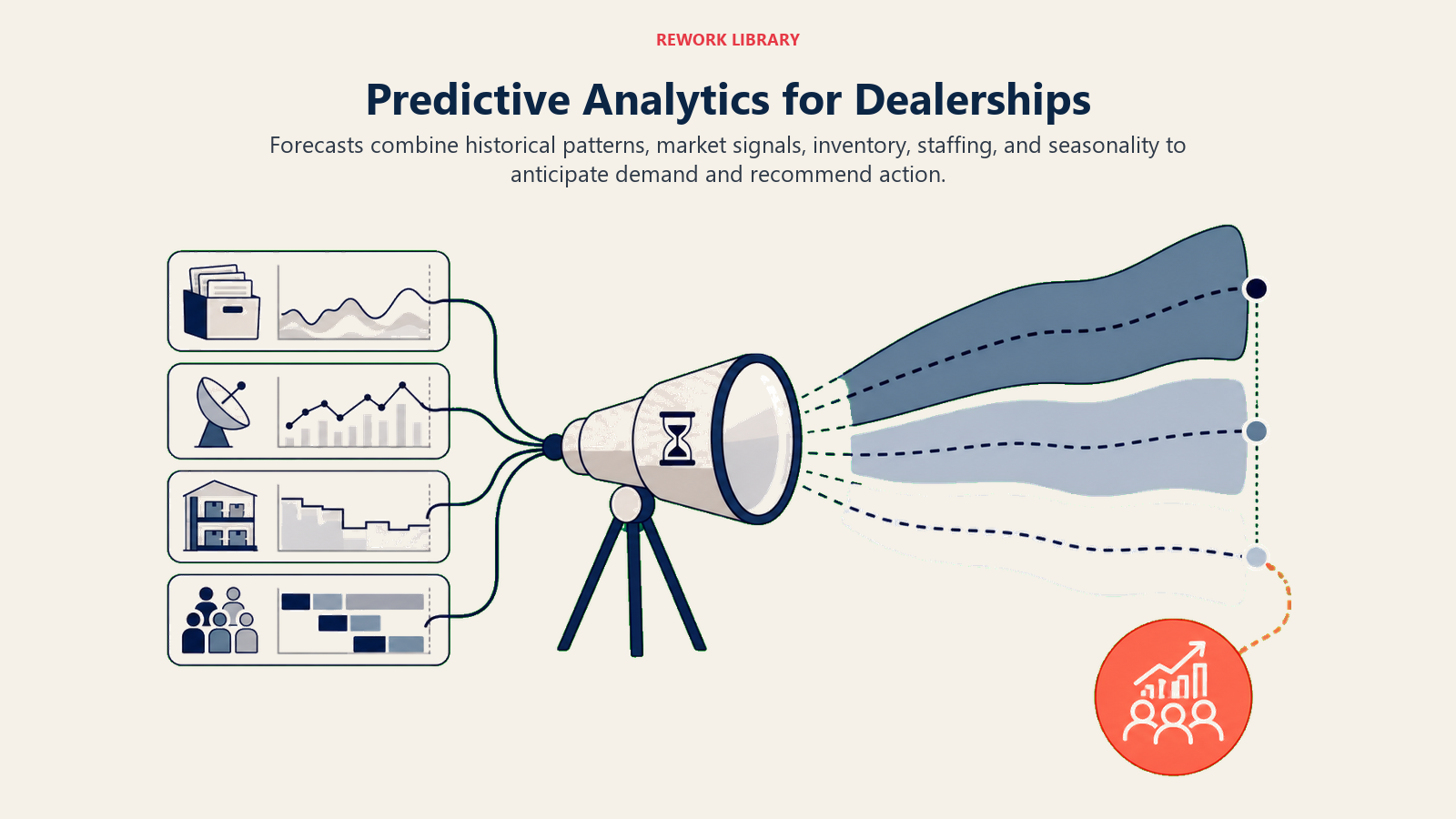
Sales forecasting and goal setting become data-driven instead of aspirational. Historical sales patterns by month, day of week, and seasonal factors create baseline forecasts. Layer in market trends, inventory availability, and staffing levels to project realistic targets. Then track daily performance against those projections and adjust tactics in real-time.
Customer defection prediction models identify at-risk customers before they're gone. Machine learning algorithms spot patterns: decreased service frequency, ignored marketing emails, social media sentiment changes, or competitive vehicle research. Flag these customers for targeted retention outreach.
Service-to-sales opportunity scoring ranks customers by purchase likelihood. Someone with a 6-year-old vehicle, positive equity, and regular service visits scores higher than someone with negative equity and spotty service. Focus sales outreach on high-score opportunities instead of spraying messaging everywhere.
Equity mining prioritization turns your customer database into a lead source. Not all equity customers are equal. Someone with $8,000 in equity who last purchased 36 months ago and has excellent credit scores higher than someone with $3,000 equity, 72 months since purchase, and credit challenges. Rank them and work the list systematically.
Lease maturity pipeline management prevents lost customers. You know exactly when every lease matures. Build campaigns that start 6 months before maturity, track engagement, and escalate outreach as the date approaches. Dealers who manage this proactively retain 60%+ of lease customers. Those who don't retain under 30%.
Seasonal trends and market shifts inform inventory and staffing decisions. If tax refund season drives a 40% sales spike in February-April, stock up on inventory in January and hire temporary salespeople in advance. If September is slow every year, reduce inventory and avoid heavy marketing spend.
Building Effective Dashboards
Raw data is useless. Dashboards turn data into decisions, but only if designed correctly.
Executive dashboards for daily decision-making should fit on one screen and update in real-time. The GM should see: yesterday's units sold by new/used, gross profit by department, service RO count, CSI scores, cash position, and progress toward monthly goals. That's it. Anything more creates overwhelm.
Department-specific views give managers the data they need without the clutter they don't. Sales managers need sales funnel metrics, consultant performance, and inventory aging. Service managers need RO count, labor utilization, technician productivity, and customer retention. F&I managers need penetration rates by product, reserve income, and individual manager performance.
Individual performance scorecards create accountability. Every sales consultant should see their stats: units sold, gross delivered, conversion rates, CSI scores, and ranking versus teammates. Make it visible daily. Service advisors need similar scorecards: ROs written, average ticket, labor sales, customer retention, and CSI.
Real-time versus historical reporting serves different purposes. Real-time dashboards drive daily activity and quick adjustments. Historical trend analysis identifies patterns, seasonal impacts, and long-term performance trajectories. You need both, but don't mix them on the same dashboard.
Mobile access and alerts enable management anywhere. Your GM shouldn't need to be at a desk to know how the day is going. Mobile dashboards and automated alerts (text or email) when metrics hit thresholds keep leadership informed and responsive.
Data Integration and Platforms
Dashboards require data from multiple systems. Integration determines whether your analytics actually work.
Business intelligence platforms like Tableau, Power BI, and Looker are powerful but require technical expertise. They can connect to virtually any data source, create sophisticated visualizations, and scale across large organizations. The downside: they're expensive and complex to implement. You'll need dedicated resources or external consultants.
Dealer-specific analytics tools like AutoAlert, DealerSocket Analytics, and VinSolutions Conquest offer pre-built integrations with common DMS and CRM platforms. They understand dealership KPIs and deliver value faster than generic BI tools. According to NADA Data, the nation's franchised dealerships generated more than $645 billion in total sales with service and parts exceeding $81 billion, emphasizing how critical accurate analytics are for managing these massive revenue streams. But they're less flexible for custom analysis and may not integrate with niche systems you use.
Data warehouse and ETL (extract, transform, load) processes create a single source of truth. Instead of pulling reports from six systems separately, you extract data nightly, transform it into consistent formats, and load it into a warehouse. Then your BI tool or analytics platform queries the warehouse. This approach delivers the best long-term results but requires the most upfront investment.
API integrations and data feeds enable real-time connectivity. Modern cloud-based platforms offer APIs that let systems talk to each other automatically. Your CRM can pull inventory data from your DMS, your website can update pricing from your inventory management system, and your marketing platform can sync customer data from your CRM, all without manual file exports.
Cost versus capability trade-offs determine the right approach. A single-point dealer might succeed with dashboard features built into their DMS and CRM. A 10-store dealer group needs enterprise-grade BI infrastructure. Don't overbuild too early, but don't wait so long that your competitors lap you with better data capabilities.
From Insight to Action
The most sophisticated analytics in the world mean nothing without processes that turn insights into actions.
Regular review cadences create rhythm and accountability. Leading dealers run 5-minute morning huddles reviewing yesterday's performance and today's goals. Weekly sales meetings dive into trends, problem areas, and upcoming opportunities. Monthly business reviews compare performance to budget, analyze variance, and adjust strategy.
Accountability systems and goal tracking connect data to consequences. When the dashboard shows a sales consultant converting shows at 18% while the team average is 25%, that triggers a coaching session. When service retention drops from 42% to 36%, that triggers a retention campaign. Data without accountability is just interesting trivia.
Experimentation and A/B testing culture separates leaders from followers. Instead of arguing about whether a new F&I menu approach will work, test it with half your team for 30 days and measure results. Instead of guessing which email subject lines drive opens, split test them. Let data settle debates.
Training teams to interpret and use data prevents misuse. Not everyone needs to build dashboards, but everyone should understand what metrics mean and how they're calculated. A sales consultant who understands that their closing rate is calculated as deliveries divided by shows can connect their daily activity to dashboard numbers. Without that understanding, the dashboard is just noise.
Common pitfalls sink many analytics initiatives. Analysis paralysis keeps teams studying data instead of acting on it. Poor data quality undermines trust, if your CRM has duplicate records and missing information, nobody will believe reports based on it. And lack of follow-through wastes everyone's time: don't build dashboards and metrics that nobody will review and act on.
Making Data Work for Your Dealership
The dealerships winning in 2026 aren't necessarily the biggest or the ones with the best locations. They're the ones that know their numbers, trust their data, and act on insights faster than competitors.
Start small if you're just beginning this journey. Pick one dashboard, maybe an executive daily snapshot or a sales consultant scorecard. Get that working reliably with good data. Build trust. Then expand to other areas.
Don't wait for perfect data before acting. You'll never have perfect data. Get what you can, validate it, understand its limitations, and use it to make better decisions than gut feel alone would provide.
And remember: data analytics isn't about generating more reports. It's about running a smarter, more profitable dealership where everyone knows what's working, what isn't, and what to do about it.

Senior Implementation Consultant