Service Customer Retention Strategy - Build a Loyal Service Customer Base - 2026 Guide
Turn this article into takeaways for your work.


Each assistant summarizes the article only for you and suggests best practices for your work.
Acquiring a new service customer costs 5-7x more than retaining an existing one, dealers with 65%+ service retention rates generate predictable fixed ops revenue and create a built-in sales pipeline when customers enter replacement cycle.
Here's a scenario that plays out at dealerships every single day. A customer buys a new vehicle from you, comes in for their first free oil change at 5,000 miles, returns for the second service at 10,000 miles, then disappears. Three years later, they're in the market for a new vehicle and they buy from a competitor because they've been servicing there for the past 30 months.
You lost a service customer, which cost you $2,500-$4,000 in lifetime service revenue. Then you lost a sales customer, which cost you another $3,000-$5,000 in front and back-end gross profit. Understanding the automotive customer journey is critical to preventing this loss.
That single lost customer just cost your dealership $5,500-$9,000. Multiply that by 100-200 customers per year and you're looking at $550,000 to $1.8 million in lost revenue that walked out the door because you didn't have a systematic retention strategy.
Let's fix that.
The Service Retention Metrics That Actually Matter
Most dealers track overall service revenue and call it a day. They're missing the metrics that predict future performance and identify problems before they become disasters.
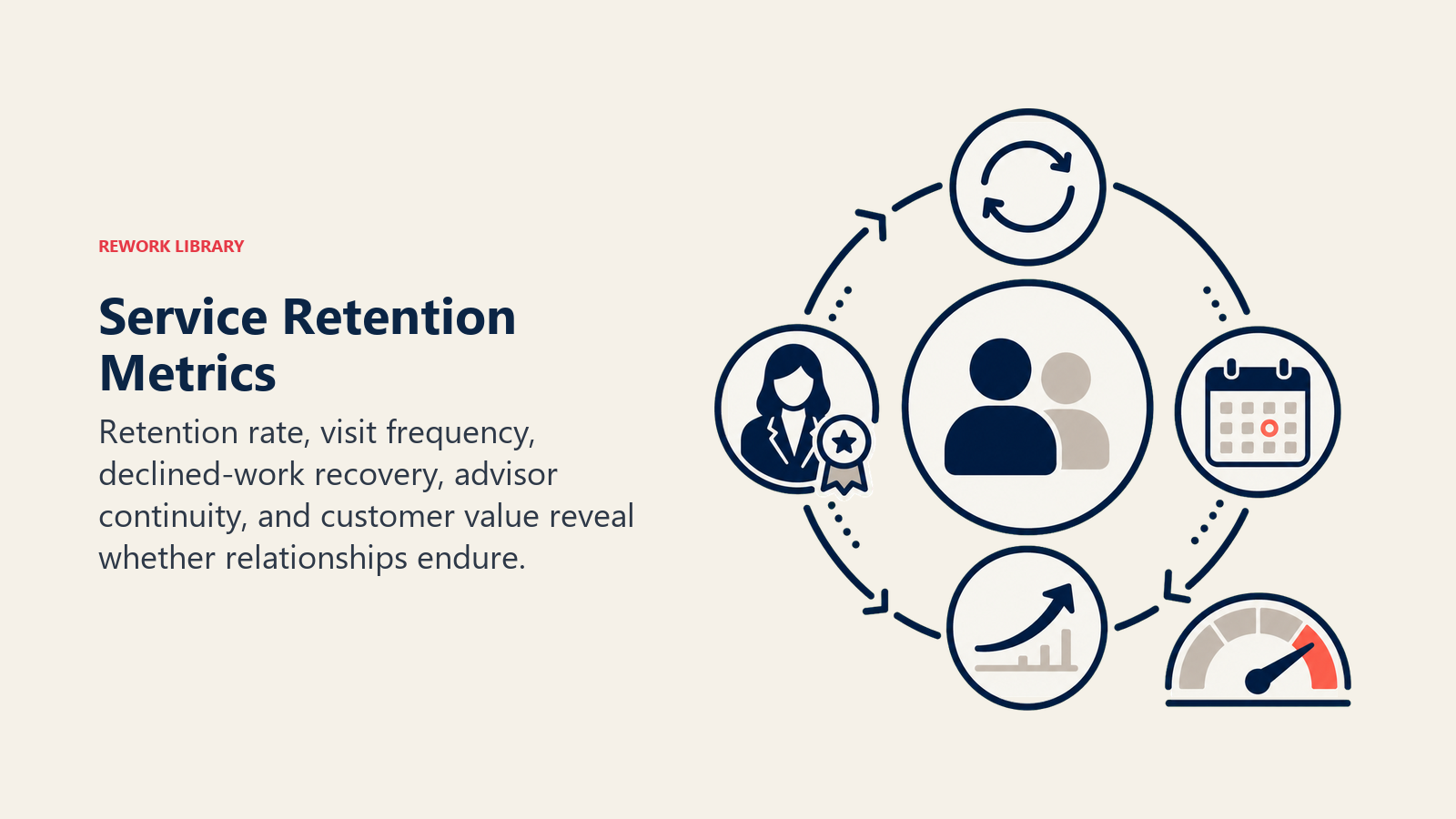
First-to-second visit conversion rate is your canary in the coal mine. When a customer completes their first service with you, what percentage returns for a second visit within the next 12 months?
Industry average hovers around 55-60%. Top-performing dealerships hit 75-80%. According to Statista research reported across industry sources, the automotive, transportation, and insurance industries maintain an impressive 83% customer retention rate, making them among the top-performing sectors. If you're below 50%, you have serious problems in the first-visit experience, price concerns, poor communication, inconvenient process, or lack of follow-up.
Calculate this metric monthly by tracking new service customers and monitoring whether they return within one year. Your DMS can generate this report if configured properly.
Active customer retention rate measures how many customers from 12 months ago are still actively servicing with you today. This is your core retention metric.
The calculation: (Number of customers who serviced in the past 12 months AND in the prior 12 months) ÷ (Total customers who serviced in the prior 12 months) × 100
If you serviced 5,000 unique customers from January-December 2025, and 3,250 of those customers also serviced with you in the 12 months prior (2024), your retention rate is 65%.
Benchmark: 50-60% is average. 65-70% is good. 75%+ is exceptional.
Service frequency by customer segment reveals who's loyal and who's at risk. Segment your customer base into:
- Very Active: 4+ visits per year
- Active: 2-3 visits per year
- At Risk: 1 visit per year
- Lost: No visits in 12+ months
Your Very Active customers are gold, they're trusting you with all their service needs. Active customers are solid but might be splitting service between you and independent shops. At Risk customers are one bad experience away from never returning. Lost customers need win-back campaigns.
Track the size of each segment and the direction customers are moving. Are more customers moving from Active to Very Active (good) or from Active to At Risk (bad)?
Lost customer identification and recovery starts with defining "lost." A customer who hasn't visited in 12-15 months isn't lost, they might own a low-mileage vehicle or had a slow driving year. But a customer who hasn't visited in 18-24 months is almost certainly servicing elsewhere.
Pull a monthly report of customers who haven't visited in 15+ months but previously were regular service customers. These are your win-back targets.
Creating an Exceptional First Service Visit Experience
You get one chance to make a first impression. When someone services with you for the first time, whether they just bought from you or they're a conquest customer from a competitor, everything about that experience determines whether they become a loyal customer or disappear.
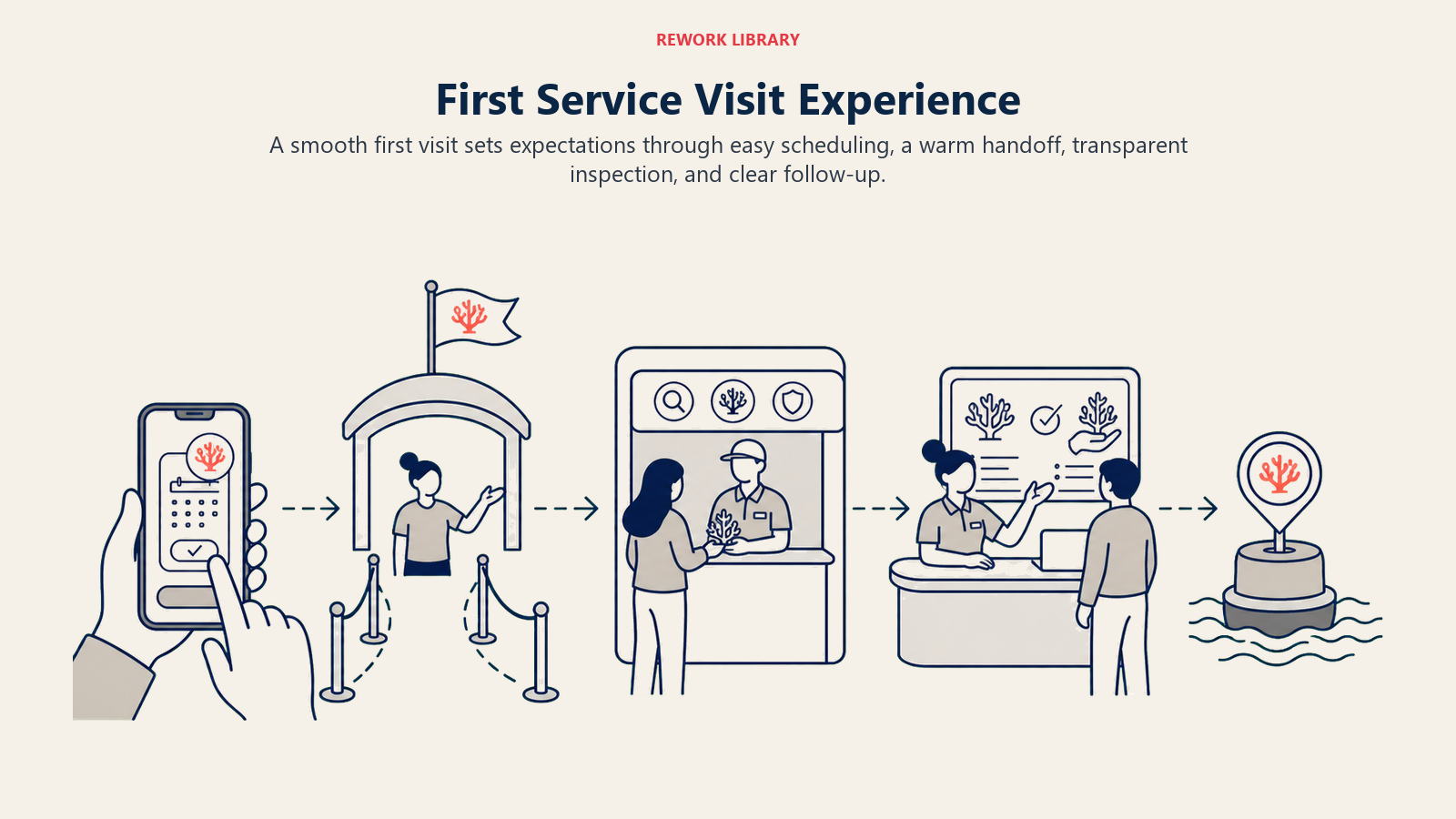
New customer welcome process should feel different from your standard service experience. Train service advisors to identify first-time customers (your DMS should flag them) and treat them accordingly.
"Welcome to ABC Motors! I see this is your first time servicing with us. I'm Mike, and I'll be your service advisor today. I want to make sure this experience exceeds your expectations, so please let me know if you have any questions or concerns."
That 15-second introduction signals you care about their experience, you're paying attention, and you're accountable to them personally.
Give them a brief tour if they've never been in your facility. Show them the waiting area, the vending machines, the Wi-Fi information, the complimentary coffee. Point out where the restrooms are located. Introduce them to another staff member.
This isn't necessary for repeat customers who know your facility, but first-timers appreciate the orientation.
Set service expectations and communication preferences upfront. "We should have your vehicle done by 2 PM as discussed. I'll call you if we find anything during our multi-point inspection that needs attention. Do you prefer I call your cell or send a text?"
Most customers prefer texts. Note that preference in your DMS so future service advisors know how to communicate with them.
Capturing complete customer data is essential for retention. You need accurate email addresses, mobile phone numbers, vehicle VIN, current mileage, and service history if they serviced elsewhere previously.
Many dealerships have outdated or incomplete contact information in their DMS because nobody asks customers to verify it. Make this part of your write-up process.
"Can you verify your email address for me? We'll send you service updates and your final invoice there." And "What's the best mobile number to reach you on? We'll text you when your vehicle is ready."
Without accurate contact data, your retention programs fail before they start.
Schedule the next appointment before they leave is the single most powerful retention tactic available. Before the customer walks out the door, book their next service appointment based on manufacturer recommendations.
"Based on your current mileage, your next service will be around 38,000 miles, which should be in about 4-5 months. Let's get that on your calendar now, how does a Thursday morning at 8 AM work for you in late June?"
Most customers will agree to schedule. You're making their life easier by planning ahead, and you've just increased the likelihood they return by 40-50% compared to customers who leave without a future appointment.
If they can't commit to a specific date four months out, book a tentative appointment and confirm you'll send a reminder a few weeks beforehand. Getting something on the calendar is better than hoping they remember to call.
Automated Service Reminder Programs That Drive Returns
Even with the best intentions, customers forget when service is due. Life gets busy. Your reminder program is the difference between a customer who returns on schedule and one who goes 18 months between services and ends up at an independent shop.
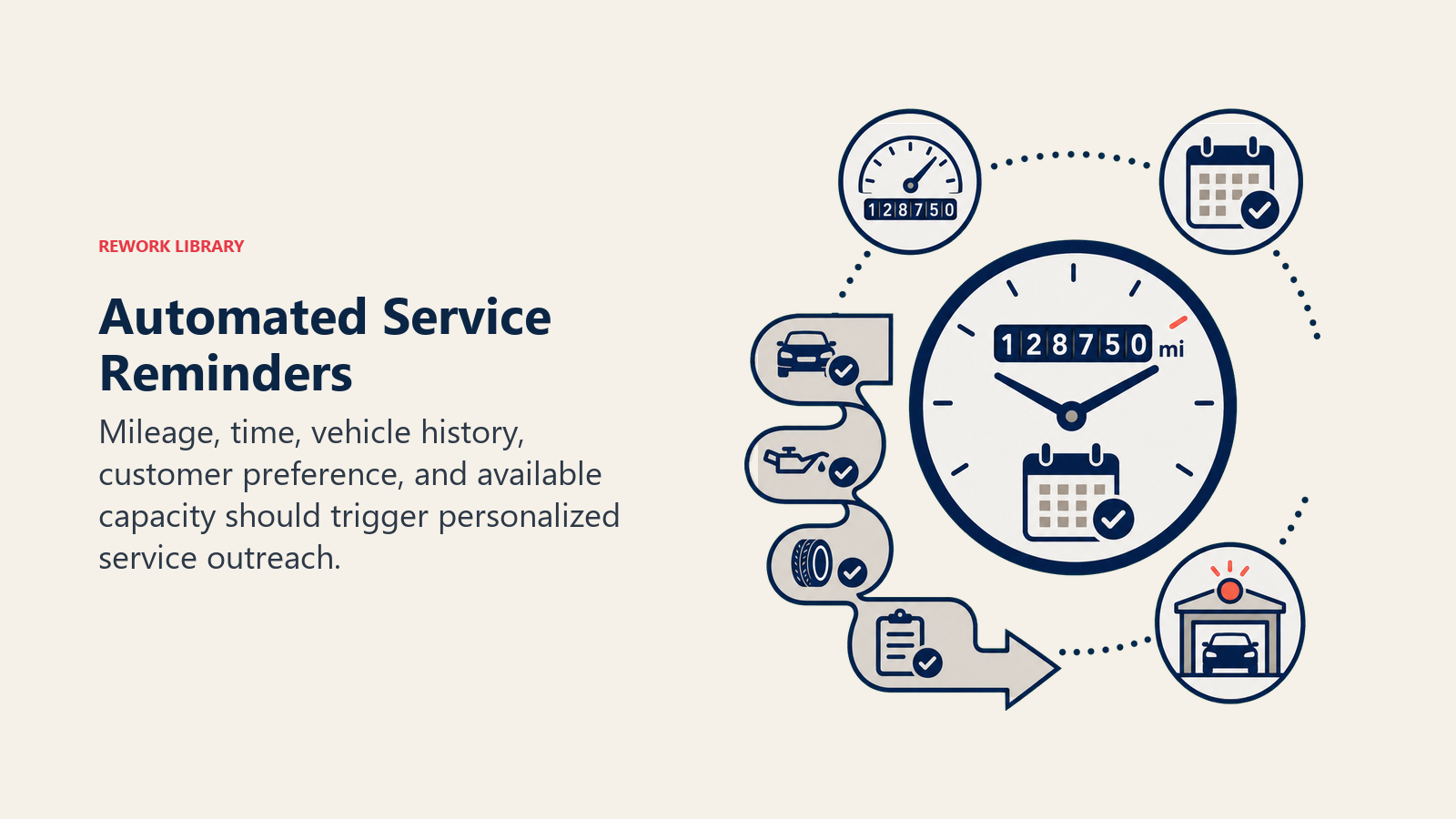
Mileage-based maintenance reminders use the odometer reading from their last service to estimate when they'll be due next. If they serviced at 25,000 miles and the next service is recommended at 30,000 miles, and they drive an average of 12,000 miles per year, you know they'll hit 30K in roughly 5 months.
Set your DMS to send a reminder at month 4: "Your vehicle is approaching the 30,000-mile service interval. Schedule your appointment now to keep your vehicle in optimal condition."
The timing matters. Too early and customers ignore it because they're not ready yet. Too late and they've already gone elsewhere.
Time-based service intervals work for customers who drive minimal miles. Even if someone only drives 6,000 miles per year, they still need annual service for fluid changes, inspections, and maintenance that degrades with time rather than mileage.
Set annual reminders for low-mileage customers: "It's been 12 months since your last service. Even if you haven't driven much, certain fluids and components degrade over time. Schedule your annual maintenance to keep your vehicle protected."
Recall and campaign notifications create touchpoints that bring customers back. When a manufacturer issues a recall or service campaign, you have a perfect excuse to reach out.
"We've been notified that your vehicle is affected by a safety recall for the fuel pump. We have parts in stock and can take care of this at no charge. Schedule your appointment now, this typically takes 1-2 hours."
The recall is free, but while the customer is there, you perform a multi-point inspection and identify customer pay work. You've brought them back into your service drive with a legitimate reason, and now you have the opportunity to keep them as an active customer.
Multi-channel reminder strategy recognizes that different customers prefer different communication methods. Your CRM-automated reminder program should include:
- Email reminders (lowest cost, good for customers who monitor email regularly)
- Text messages (highest response rate, preferred by most customers under 50)
- Phone calls (highest cost, but effective for high-value customers or those who don't respond to digital)
- Direct mail (still effective for older demographics and high-value service campaigns)
Use a waterfall approach. Send an email first. If they don't respond within 5 days, send a text. If they still don't respond within another 5 days, make a phone call.
Monitor response rates by channel so you optimize your approach over time.
Building Personal Relationships Through Consistent Service Advisors
The dealerships with the highest service retention rates aren't necessarily the cheapest. They're the ones where customers feel a personal connection to their service advisor.
When a customer knows their advisor by name, trusts their recommendations, and feels confident they're being treated fairly, price becomes less important. They're buying the relationship as much as the service.
Consistency in advisor assignment is critical. Your DMS should track which advisor serviced each customer previously and route them to the same advisor when possible.
If Mike serviced Sarah's vehicle the last three times, she should see Mike again on her fourth visit unless Mike is off that day. Consistency builds trust and familiarity.
Some dealerships assign customers to specific advisors permanently, Team A customers always see Mike, Team B customers always see Jennifer, Team C customers always see Carlos. This works well if your advisors have balanced workloads and similar skill levels.
Building personal relationships happens through small interactions that show you care. Use the customer's name throughout the conversation. Remember details from previous visits. Ask about things they mentioned last time.
"Hi Sarah, good to see you again! How did that road trip to Colorado go? You mentioned you were planning that when you were here last month."
J.D. Power's Customer Service Index research confirms that service advisors who completely focus on customer needs and immediately meet customers upon arrival drive significantly higher satisfaction scores. These personal touches take 10 seconds but create loyalty that lasts years.
Follow-up calls after major repairs demonstrate accountability and care. When a customer spends $800-$1,200 on a significant repair, call them 2-3 days later to verify everything is working properly.
"Hi Sarah, this is Mike from ABC Motors. I wanted to follow up on the brake service we completed on Thursday. Is everything working well? No concerns or issues?"
Most customers are surprised and delighted that you called to check on them. It's a small gesture that dramatically increases satisfaction and retention.
Service history review at each visit shows customers you're paying attention to their vehicle's long-term health, not just today's transaction.
"Looking at your service history, you're at 47,000 miles now and you last had your transmission fluid serviced at 35,000 miles during your purchase. Manufacturer recommends service at 50,000, so let's plan for that on your next visit in a few months."
This positions you as a proactive consultant managing their vehicle health over time rather than a transactional service provider.
Price vs. Value in Retention Strategy
Price sensitivity is real, but it's not the primary driver of customer attrition. Customers leave because they don't perceive value, not because you charge $15 more for an oil change than the shop down the street.
When price-matching hurts long-term retention: Some service managers panic when customers mention competitor pricing and immediately discount to match. This trains customers to always shop price and erodes profitability.
The better approach is to explain value through effective menu pricing: "I understand that shop charges $129 for brake service. Our brake service includes OEM pads, lifetime warranty on parts and labor, brake fluid flush, and a test drive to verify performance. Their service includes aftermarket pads with a 1-year warranty and no fluid service. You're comparing two different levels of service."
Customers who understand value don't fixate on price. Customers who only care about price aren't profitable long-term anyway.
Building value beyond price focuses on differentiators that independent shops can't match:
- Factory-trained technicians with brand-specific expertise
- OEM parts backed by manufacturer warranty
- Access to technical service bulletins and updated repair procedures
- Loaner vehicles or shuttle service for customer convenience
- Clean, comfortable waiting areas with amenities
- Direct relationship with sales department for trade-in opportunities
These matter more than $20 price differences to most customers, if you communicate them effectively.
Loyalty pricing strategies and VIP programs reward repeat customers without discounting to everyone. Create a loyalty program that offers benefits after X number of services:
- 10% off service after 5 paid visits
- Free tire rotation with every oil change for customers with 3+ annual visits
- Priority scheduling for VIP customers
- Exclusive service specials available only to loyalty program members
This creates incentive to return while maintaining full pricing for price shoppers who won't be loyal anyway.
Transparent pricing builds trust more than low pricing builds loyalty. Publish your service pricing on your website. Show customers itemized estimates with parts cost, labor cost, and shop supplies clearly broken out. Explain what's included and what's not.
When customers feel they understand exactly what they're paying for and why, objections decrease and satisfaction increases.
Conquest Service Strategies and Win-Back Campaigns
Even with perfect retention strategies, you'll lose some customers. Market dynamics change, people move, life circumstances shift. Your job is to proactively win them back and conquest new customers from competitors.
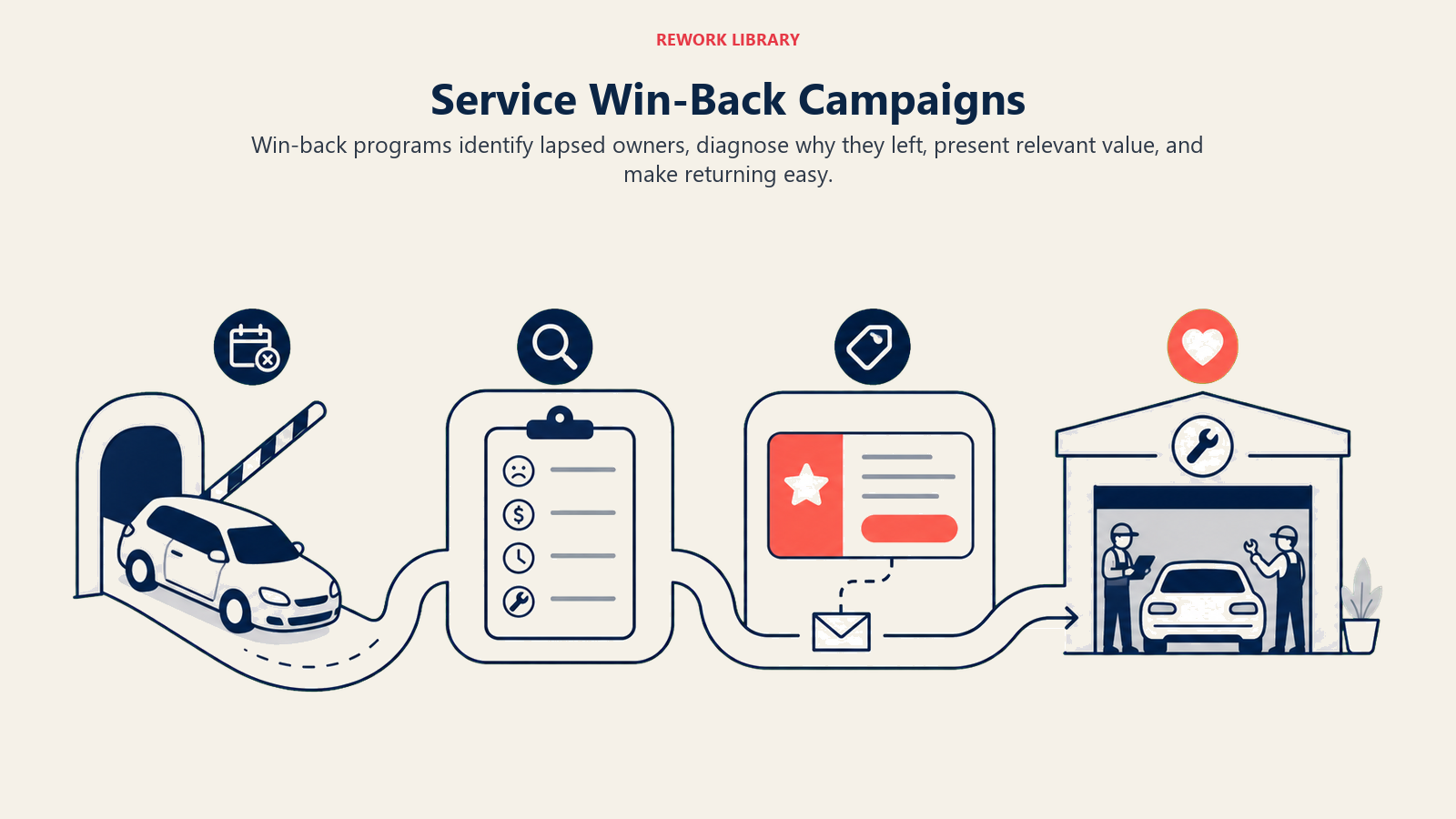
Target lapsed customers with win-back offers at the right time. A customer who hasn't visited in 15 months gets a personalized outreach:
"Hi Sarah, we noticed it's been a while since you serviced with us. We'd love to earn your business again. Bring your vehicle in this month and receive 20% off your service. Give us a chance to remind you why you chose us in the first place."
The discount is temporary and specific to win-back situations. You're investing in reactivating a relationship that has lifetime value.
Conquest campaigns for competitive brand owners tap into a huge market. In your trade area, there are thousands of Toyota owners, Honda owners, Ford owners who didn't buy from you but could service with you.
Direct mail campaigns targeting these owners with compelling introductory offers work: "Even though you didn't purchase from us, we'd love to be your service provider. First-time customers receive a complimentary multi-point inspection and 15% off service."
Digital advertising with geo-targeting reaches people searching for service near your location. When someone searches "Toyota service near me" and your dealership appears with a strong offer, you capture conquest customers actively looking for service.
Service-to-sales pipeline development turns service customers into sales customers. Every service customer is a potential future buyer, either they're approaching trade-in cycle or they know someone who is. This is a critical component of your service-to-sales pipeline.
Train service advisors to identify equity opportunities. When someone brings in a 6-7 year old vehicle with 80K+ miles for a $700 repair, that's a signal they might be ready to trade.
"I can definitely get this repair done for you. I'm also curious, have you thought about what this vehicle is worth in trade? Our used car manager can give you a quick appraisal while you're here. No pressure, just good information to have."
If they're interested, introduce them to a sales consultant. If they trade in, you've created incremental sales profit from a service opportunity.
Equity mining integration systematically identifies service customers with positive equity who might be ready to upgrade. Your DMS should flag customers whose vehicle value exceeds their loan payoff by $3,000-$5,000+. NADA's vehicle valuation services provide the trusted trade-in, loan, and retail values that support the entire appraisal-to-sale pipeline. This strategy is detailed in equity mining best practices.
These customers get targeted outreach: "Based on current market conditions, your vehicle has approximately $5,500 in positive equity. With manufacturer incentives available right now, you could upgrade to a newer model with similar or lower payments. Would you like to explore options?"
The service department becomes a lead generation machine for sales when you implement systematic equity mining.
Measuring and Improving Retention Performance
Retention isn't a project you complete, it's an ongoing operational focus that requires consistent measurement and optimization.
Set retention targets by segment: 80% first-to-second visit conversion, 70% active customer retention, 25% recovery rate on lost customers. Track monthly performance against targets through your dealership KPI dashboard.
Conduct lost customer surveys to understand why customers left. Don't guess, ask them. "We noticed you haven't serviced with us in over a year. Would you be willing to share what prompted you to service elsewhere?"
The answers are painful but invaluable. Price concerns? Convenience issues? Poor communication? Quality problems? You can't fix what you don't know is broken.
Benchmark your retention rates against 20-group peers or manufacturer standards. Where do you rank? What are top performers doing differently?
Review retention performance in monthly fixed ops meetings. What's the trend? Which advisors have the highest retention? What can others learn from them?
Celebrate retention wins with your team. When you improve retention by 5 percentage points, that's worth significant financial rewards. Share the success and the compensation that comes with it.
The Compounding Value of Retention
A 5% improvement in service retention doesn't sound dramatic. But let's do the math.
If you currently service 3,000 active customers per year with 60% retention, you're losing 1,200 customers annually who you have to replace through conquest efforts. Deloitte's automotive consumer research shows that as the automotive sector emphasizes longer-term ownership experiences, deeper collaboration between OEMs and dealers around servicing becomes critical to strengthening loyalty. At 5-7x acquisition cost, you're spending $50,000-$100,000+ per year on marketing to replace lost customers.
Improve retention to 65% and you lose 1,050 customers instead of 1,200. That's 150 fewer customers you need to replace, saving $6,250-$10,500 in acquisition costs.
But it compounds. Those 150 retained customers generate $375-$600 per year in service revenue. That's $56,250-$90,000 in incremental annual revenue. Over a 3-year average customer lifespan, that's $168,750-$270,000 in additional lifetime value.
From a 5% retention improvement.
Now imagine improving retention by 10-15% through systematic implementation of every strategy in this guide. You're talking about hundreds of thousands of dollars in incremental annual profit, more predictable revenue, and a service department that achieves 100%+ absorption regardless of sales performance.
That's the power of retention. Build the systems, train your team, measure obsessively through data analytics, and watch your service department transform from a cost center covering overhead to a profit machine driving dealership value.
Your customers want to be loyal. They want a service provider they trust, a facility that's convenient, and advisors who care about their vehicle and their experience. Give them that, and retention takes care of itself.

Senior Implementation Consultant
On this page
- The Service Retention Metrics That Actually Matter
- Creating an Exceptional First Service Visit Experience
- Automated Service Reminder Programs That Drive Returns
- Building Personal Relationships Through Consistent Service Advisors
- Price vs. Value in Retention Strategy
- Conquest Service Strategies and Win-Back Campaigns
- Measuring and Improving Retention Performance
- The Compounding Value of Retention