Cost Per Sale Analysis: How to Calculate It by Source
Turn this article into takeaways for your work.


Each assistant summarizes the article only for you and suggests best practices for your work.
Cost per sale analysis is the process of dividing marketing spend by the sales it produced, broken down by source, so you can see which channels actually drive revenue. The formula is total marketing cost divided by attributed sales. Done by source, it tells you where to scale spend, where to cut, and where you are guessing.
Most dealers know their total marketing spend, say $50,000 per month, and their total sales, maybe 100 units. But ask which $10,000 drove 30 sales and which $10,000 drove three, and you'll get silence. Cost per sale analysis fixes this blind spot.
Without source-level attribution, you're guessing about what works. You might be doubling down on underperforming channels while starving the ones delivering real ROI. That's not marketing strategy. That's hoping for the best.
The dealers winning today know their cost per sale by source down to the dollar. They shift budgets monthly based on performance. They kill what doesn't work and scale what does. And they do it with data, not gut feel.
Understanding Cost Per Sale
The basic formula couldn't be simpler: total marketing cost divided by attributed sales. If you spent $5,000 on Google Ads and sold 10 vehicles from those leads, your cost per sale is $500.
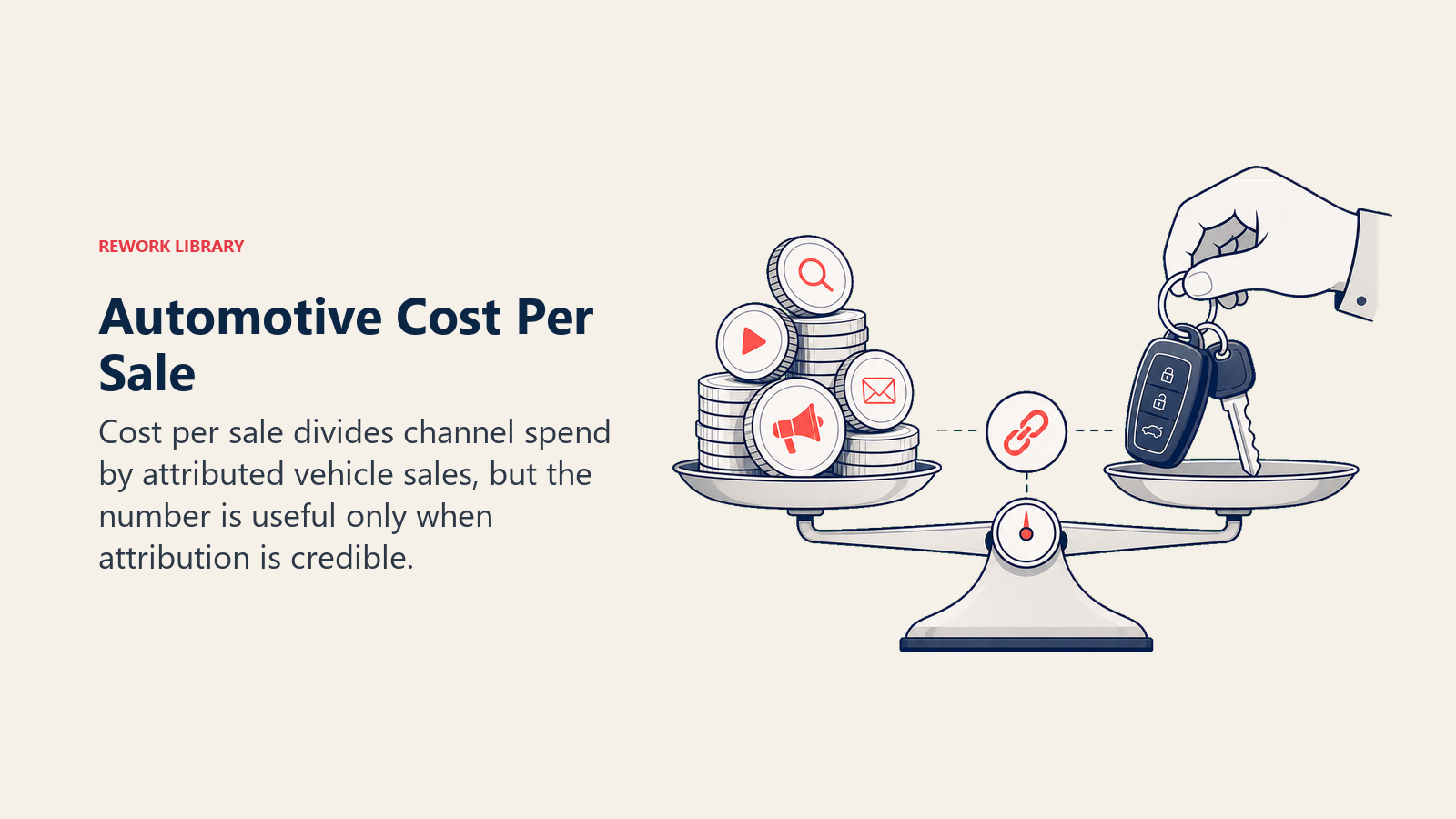
But simple in theory gets complicated in practice. Attribution challenges make this harder than it looks.
Direct attribution works when the customer journey is straightforward. Customer clicks your Facebook ad, submits a lead form, comes in, buys. That sale gets attributed to Facebook. Easy.
Indirect attribution accounts for influence without direct conversion. Someone sees your TV commercial, searches your dealership name on Google, clicks a paid search ad, then converts. Which source gets credit? The TV spot that created awareness? The Google ad that captured the search? Both played a role.
First-touch attribution gives credit to the initial source that brought the customer into your funnel. Last-touch attribution credits the final touchpoint before purchase. Multi-touch attribution tries to distribute credit across all touchpoints in the journey.
Cost per sale differs from cost per lead in a critical way. A source delivering leads at $50 each might close at 5%, giving you a $1,000 cost per sale. Another delivers leads at $100 each but closes at 20%, producing a $500 cost per sale. Cheaper leads don't always mean cheaper sales.
And volume isn't everything. A channel delivering 20 sales at $800 cost per sale with $2,500 average gross profit produces better results than one delivering 30 sales at $600 cost per sale with $1,200 gross. Profitability matters more than volume.
Marketing Cost Categories
To calculate accurate cost per sale, you need to know what costs to include. Most dealers undercount, skewing their analysis.
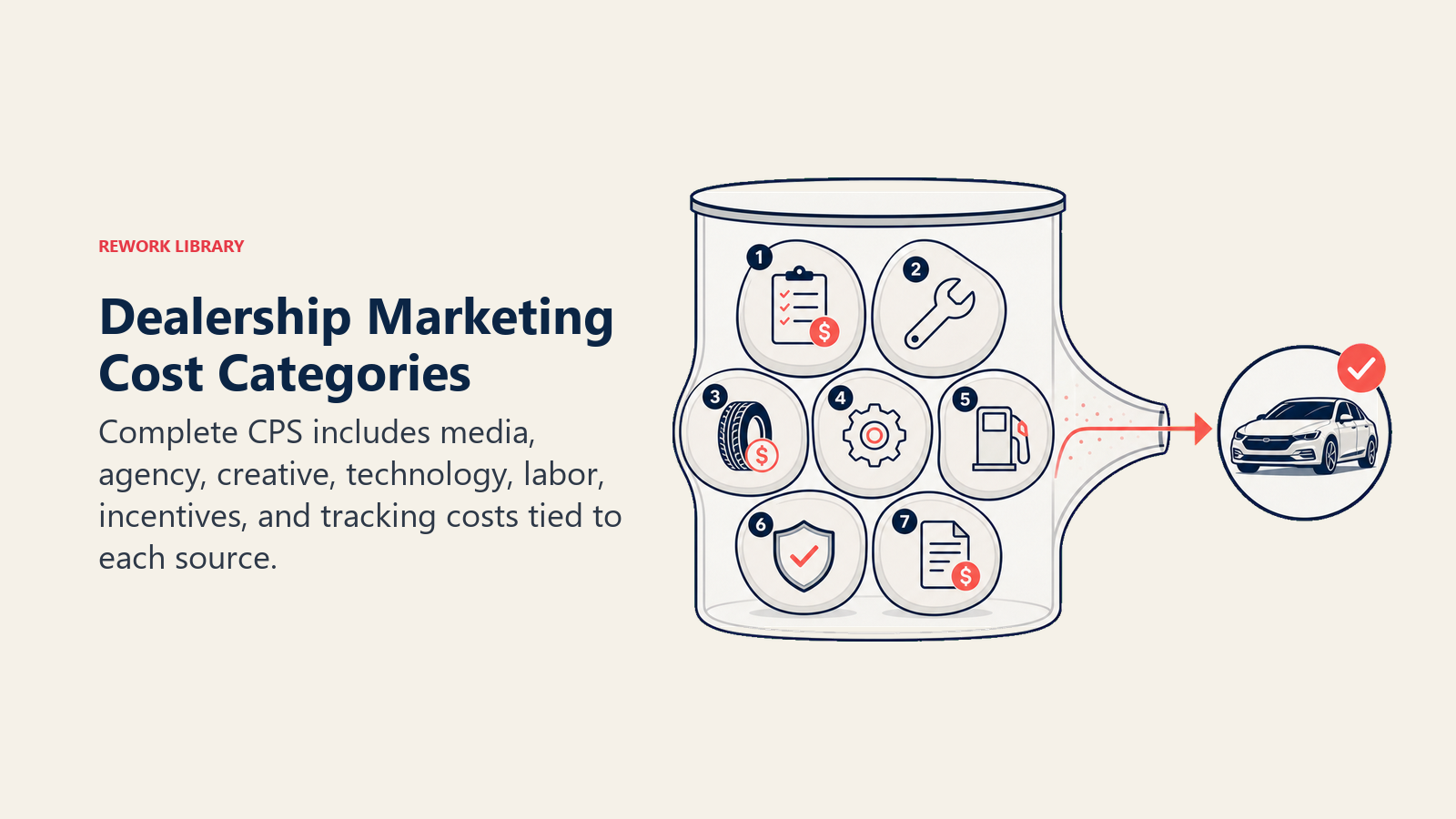
Digital advertising includes SEM and PPC campaigns (Google Ads, Bing Ads), display advertising, social media ads (Facebook, Instagram, TikTok), YouTube video ads, and programmatic display. These costs are easy to track because they're line items on invoices.
Third-party lead providers like Autotrader, Cars.com, CarGurus, and TrueCar send monthly bills that clearly show spend. Straightforward to include. Learn more about managing third-party lead relationships.
Website hosting and tools add up: hosting fees, domain registration, website platform fees, chat software, lead form tools, and analytics platforms. Often overlooked but legitimate marketing costs.
CRM and marketing automation platforms enable your marketing but aren't always counted. Your CRM subscription, email marketing platform, text messaging service, and marketing automation tools support revenue generation.
Traditional media still matters for many dealers: TV, radio, direct mail, print advertising, billboards, and sponsorships. These costs are clear but attribution is harder.
Personnel costs often get ignored in cost per sale calculations. Your BDC salaries, marketing director salary, digital marketing specialist, and anyone primarily focused on lead generation and conversion should be included for a true cost per sale.
Don't count variable sales costs like commissions or F&I. Those scale with sales volume. Focus on marketing costs that happen whether you sell 50 units or 150.
Attribution and Tracking
Great cost per sale analysis requires great tracking. Garbage in, garbage out.
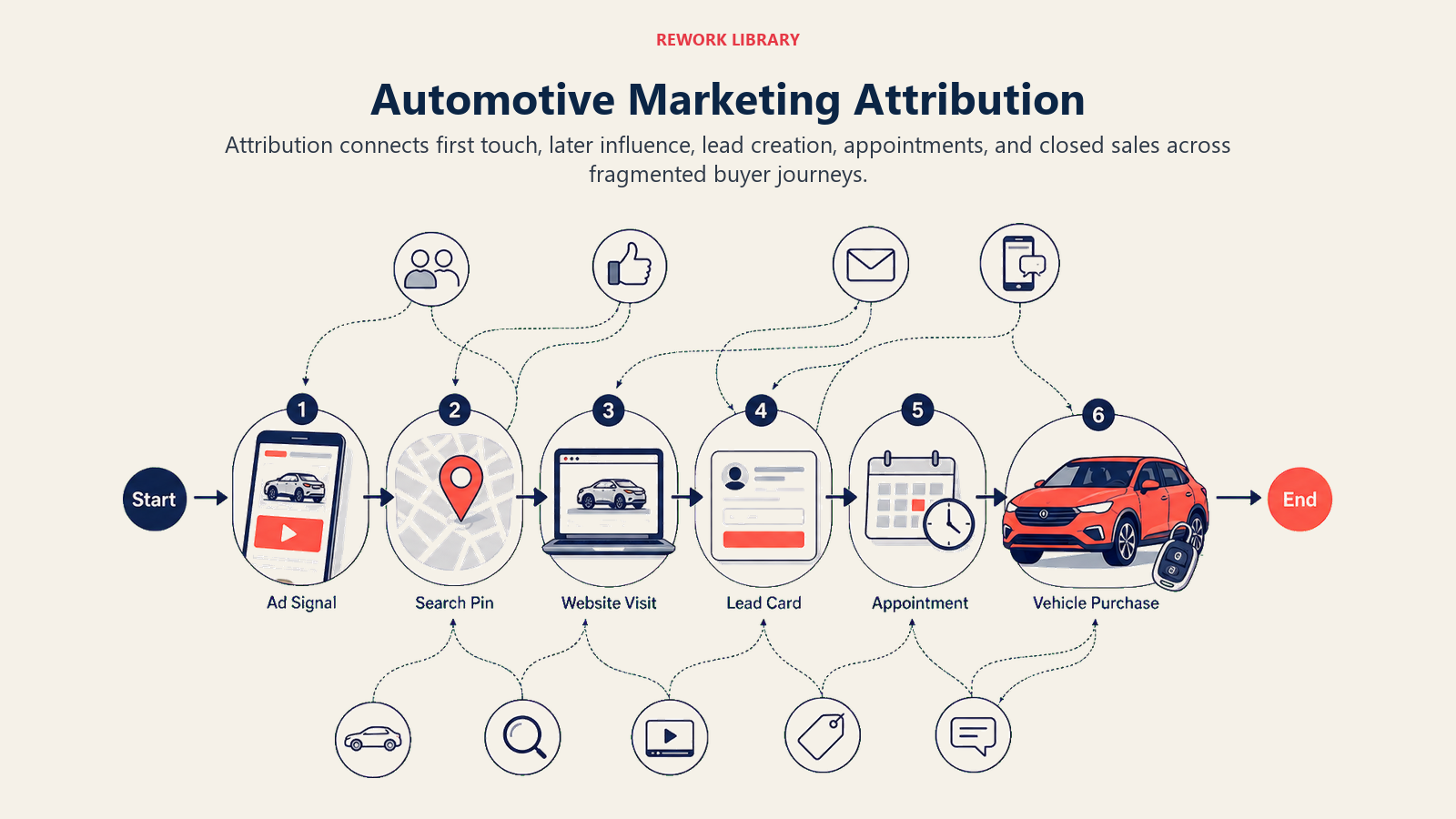
CRM source tracking starts with data integrity. Every lead must have a source. Every sold customer must trace back to their original lead source. No "unknown source" sales allowed.
Use UTM parameters on all digital advertising. These tiny bits of code in your URLs tell your analytics exactly which campaign, ad, and keyword drove each visitor. Format: yoursite.com?utm_source=facebook&utm_medium=paid&utm_campaign=spring-sale
Phone tracking numbers by source make offline conversion trackable. Use different phone numbers for TV, radio, billboards, and different digital campaigns. When someone calls, you know which ad prompted it.
Track form submissions and conversions with goal tracking in Google Analytics and your CRM. When someone submits a lead form, that event should fire in multiple systems with full source attribution.
Multi-touch customer journeys complicate everything. A customer might see your billboard, visit your website from a Google search, submit a form through Facebook, call from an Autotrader listing, then buy. Which source deserves credit?
Most dealers use last-touch attribution because it's simpler and your CRM probably records it automatically. But recognize its limitations. The customer's entire journey mattered, not just the final step.
DMS integration for sold unit attribution closes the loop. Your CRM tracks the lead source, but your DMS records the actual sale. These systems must talk to each other or you'll never know which sources convert.
Calculating Cost Per Sale by Source
Here's the step-by-step methodology that works.
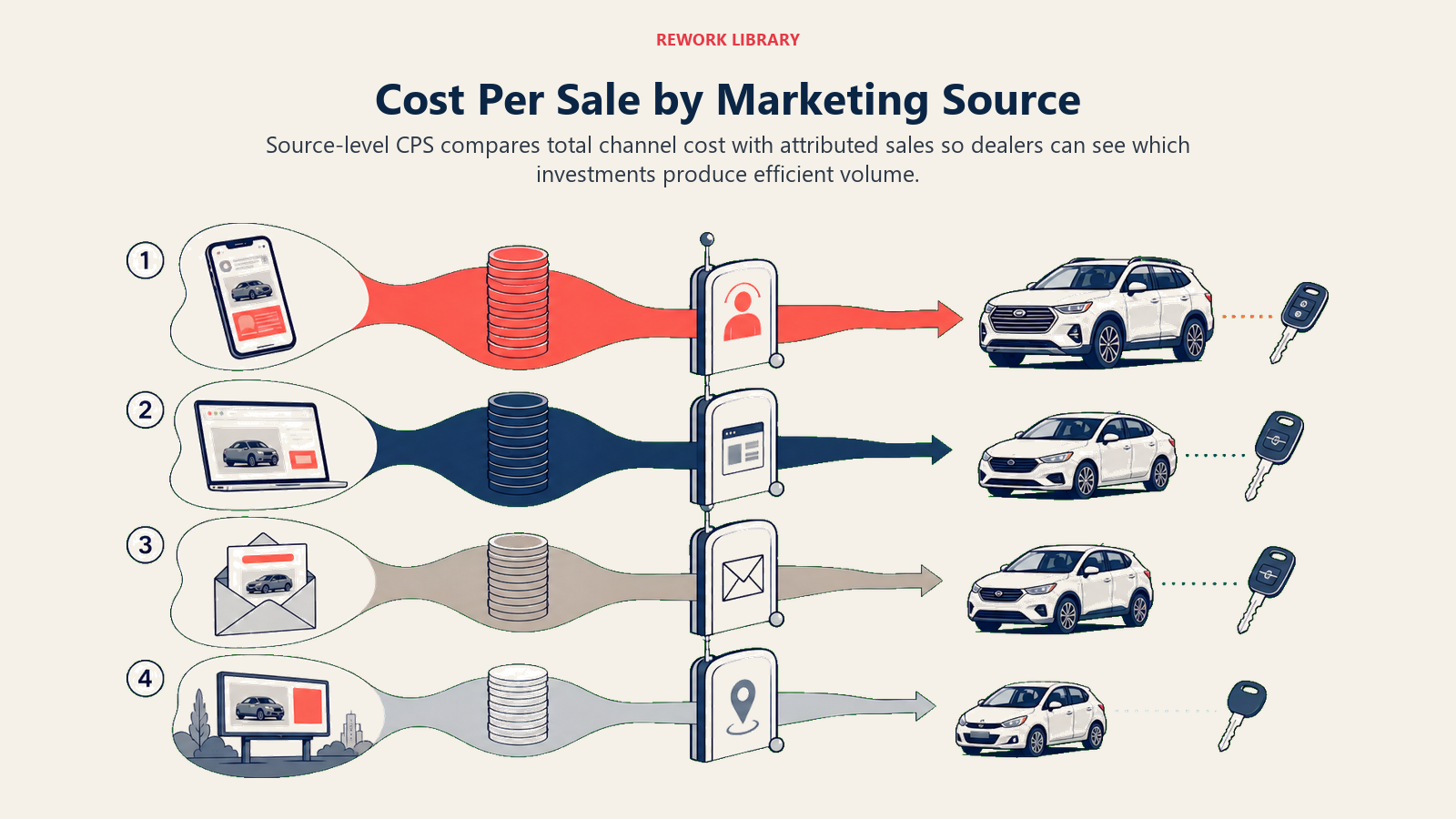
Define your measurement period. Monthly is standard because it matches how you receive marketing bills and review performance. Quarterly smooths out volatility. Weekly is too noisy for most dealers.
Collect total cost by source for that period. Add up all spend on Google Ads for the month. Include third-party lead costs from Cars.com. Don't forget your website platform fee and CRM subscription allocated by source if possible.
Attribute sold units to sources using your CRM and DMS data. Export a report of all sales from the period showing original lead source. Count them by source.
Handle multi-touch attribution by choosing a model (usually last-touch for simplicity) and applying it consistently. Don't change your attribution model month-to-month or you can't compare trends.
Calculate direct cost per sale by dividing source cost by attributed sales. $8,000 spent on Google Ads, 12 sales attributed: $667 cost per sale. Simple math, but powerful insight.
Calculate blended cost per sale by dividing total marketing spend by total sales. This gives you an overall benchmark. Individual sources should beat the blended average or you should question their value.
Create standardized reporting templates so you produce the same analysis monthly. Consistency lets you spot trends and compare performance over time.
Benchmarking Cost Per Sale
Context matters. Is $500 cost per sale good or bad? Depends on your market, mix, and margins.
Industry averages by channel typically fall in the $400-$800 range for dealers managing their marketing well. According to NADA industry research, the average dealership spends approximately $708 per new vehicle sold. Organic traffic often delivers $200-$400 cost per sale. Paid search might run $500-$700. Third-party leads can hit $800-$1,200.
But these are rough guidelines. Your mileage will vary based on competition, geography, and vehicle mix.
Organic versus paid channels show dramatic differences. Organic website traffic, SEO, and returning customers deliver the lowest cost per sale because you're not paying for each click or lead. Protect and grow these sources first.
New vehicle versus used vehicle cost per sale differs because margin structures differ. New cars often have lower gross profit, so a $600 cost per sale might consume 20% of your gross. Used cars with $3,000 gross can absorb a $900 cost per sale easily.
Lead source quality impacts acceptable cost per sale. A source closing at 8% needs to be cheaper than one closing at 20% to deliver the same cost per sale. Understand your lead-to-sale conversion metrics by source.
Gross profit per sale qualifies whether a cost per sale is acceptable. Spending $800 to acquire a $2,500 gross profit sale is better than spending $400 to acquire a $700 gross profit sale.
Optimizing Marketing Budget
Data only helps if you act on it. Cost per sale analysis guides budget decisions.
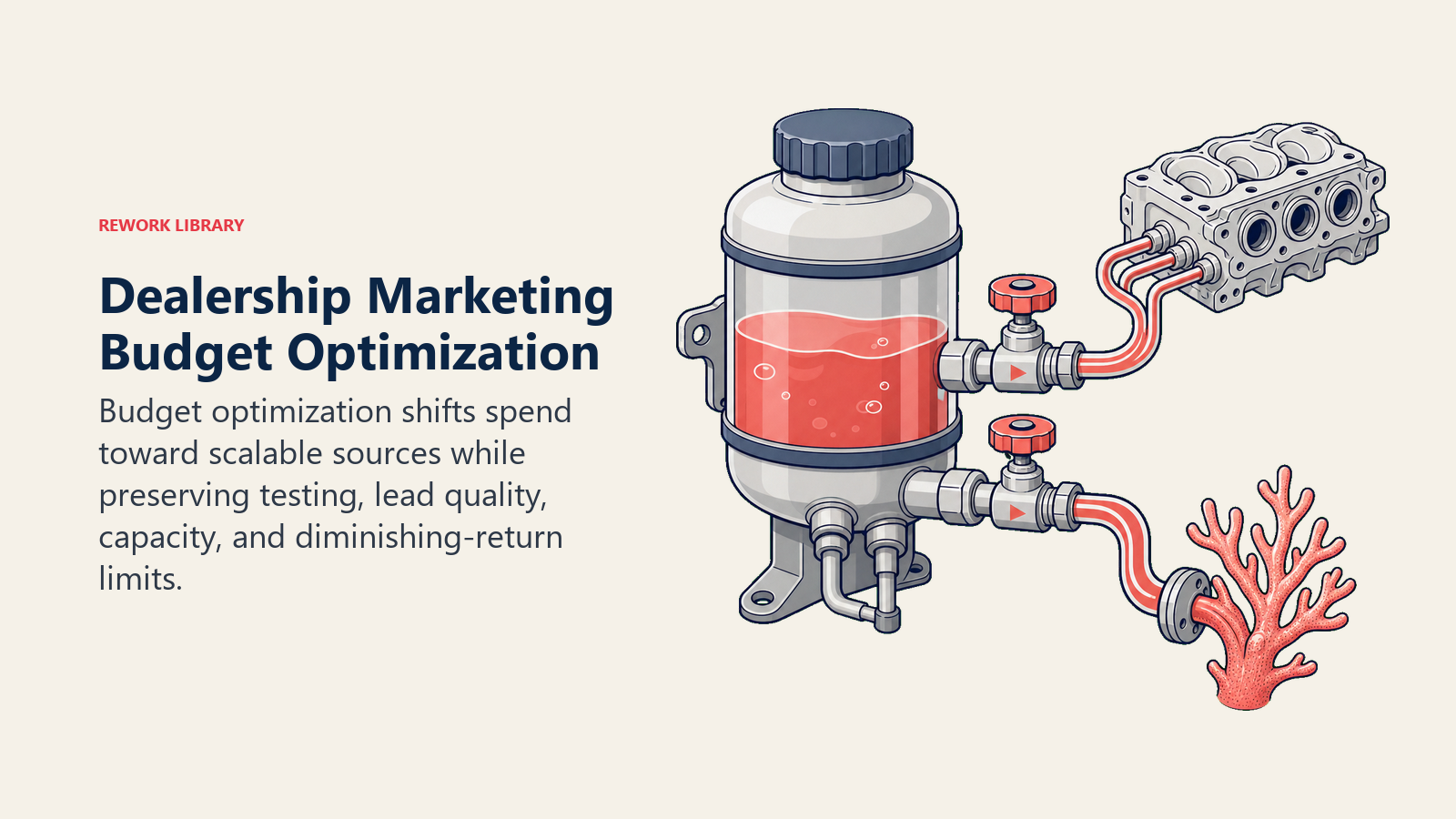
Identify high-ROI and low-ROI sources by comparing cost per sale to gross profit per sale by source. Calculate marketing ROI: (gross profit - cost per sale) ÷ cost per sale. Sources with 3x-5x ROI are winners. Sources under 1.5x need scrutiny.
Budget reallocation strategies start simple: take money from underperformers and give it to overperformers. If Google Ads delivers $450 cost per sale and Autotrader delivers $1,100, shift budget accordingly.
Scale what works carefully. Doubling your Google Ads budget won't always double your results. As you increase spend, you exhaust high-intent keywords and audiences, and performance degrades. Test incremental increases.
Cut what doesn't work, but give it a fair trial. One bad month doesn't kill a channel. Three months of consistent underperformance? Cut it.
Test new channels with controlled spend. Allocate 10-15% of your budget to experimentation. Try TikTok ads, streaming TV, or email marketing. Measure rigorously. Keep winners, kill losers.
Adjust for seasonal and market conditions. Incentive periods, model changeovers, and local events impact performance. A channel might underperform in summer but shine during year-end clearance.
Beyond Cost Per Sale
Cost per sale is critical, but it's not the only metric that matters.
Gross profit per marketing dollar spent is the ultimate ROI metric. Divide total gross profit by total marketing spend. A ratio above 5:1 is healthy. Above 8:1 is excellent. Below 3:1 needs improvement.
Customer lifetime value by acquisition source adds long-term perspective. A source delivering customers who return for service, buy again in three years, and refer friends is worth more than one-time buyers, even at higher cost per sale.
Time-to-sale by source measures velocity. Sources that convert faster tie up fewer resources and improve cash flow. A lead from your website that buys in 3 days beats a third-party lead that takes 45 days, even at similar cost per sale.
Customer quality and retention by source reveals whether you're attracting loyal customers or price shoppers. Track service retention and repurchase rates by original acquisition source.
Finance penetration and PVR by source shows backend profitability. Some sources deliver customers who finance at higher rates or buy more products. That additional profit offsets higher acquisition costs.
Common Pitfalls and Challenges
Even sophisticated dealers make these mistakes.
Poor data quality and attribution gaps undermine analysis. Cox Automotive analysis found only 8% of automotive sales are traceable in dealer CRM systems. If 30% of your sales show "unknown source" in your CRM, your cost per sale calculations are meaningless. Fix your data before analyzing it.
Ignoring multi-touch customer journeys oversimplifies reality. Crediting the last touchpoint ignores the awareness and consideration phases that made that final conversion possible.
Focusing only on last-touch attribution gives too much credit to bottom-of-funnel sources and none to top-of-funnel awareness building. Balance with first-touch or multi-touch models occasionally.
Not accounting for assisted conversions misses the full picture. Your billboard might not generate direct sales, but it makes your Google Ads more effective by building brand awareness.
Unrealistic expectations from brand advertising lead to wrong conclusions. TV and radio build awareness over months. As Cox Automotive research shows, the average car buyer spends 95 days in market, interacting with dozens of channels before purchase. Judging them by immediate cost per sale is like judging a foundation by whether it keeps you dry, it's necessary but not sufficient.
Short-term thinking versus long-term brand building creates blind spots. SEO delivers compounding returns over years. Paid search delivers immediate results but stops when you stop spending. Both matter.
Building a CPS Reporting System
Make cost per sale analysis routine, not a special project.
Create a monthly reporting template and dashboard showing cost per sale by source, units sold by source, total spend by source, gross profit by source, and ROI by source. One page, clear data.
Identify data sources and integration requirements. Pull spend from accounting. Pull sold units from DMS. Pull attribution from CRM. Ideally, automate as much as possible.
Assign responsibility and ownership. Someone, usually your marketing director or controller, owns creating this report monthly and presenting it to leadership.
Establish a review process and decision-making framework. Meet monthly to review cost per sale. Identify outliers. Make budget adjustment decisions. Document what you changed and why.
Build a culture of continuous improvement and testing. Celebrate wins when a channel improves. Analyze losses when performance drops. Always be testing new approaches. Use dealership benchmarking to contextualize your performance.
Cost per sale analysis isn't glamorous. But it's the difference between marketing by hope and marketing by data. And in a business where $50,000 monthly budgets are common, that difference matters enormously. Track these metrics alongside gross profit optimization and dealership data analytics for comprehensive performance insight.
Frequently Asked Questions about Cost Per Sale Analysis
How do you calculate cost per sale?
Divide total marketing cost by the number of sales attributed to that spend. If you spent $5,000 on Google Ads and closed 10 vehicles from those leads, your cost per sale is $500. For real insight, calculate it by source rather than as one blended number.
What is the difference between cost per sale and cost per lead?
Cost per lead measures what you pay to generate an inquiry. Cost per sale measures what you pay to generate an actual purchase. A channel with cheap leads can have an expensive cost per sale if those leads rarely close, so cost per sale is the more reliable budget signal.
What is a good cost per sale for a dealership?
Dealers managing marketing well typically land in the $400 to $800 range. Organic traffic often runs $200 to $400, paid search $500 to $700, and third-party leads $800 to $1,200. NADA data puts average spend near $708 per new vehicle sold, but acceptable cost depends on your gross profit per sale.
Why does attribution matter in cost per sale analysis?
Without source attribution, you cannot tell which spend produced which sales, so reallocation becomes guesswork. Tag every lead with a source, use UTM parameters and call tracking, and connect your CRM to your DMS so each sold unit traces back to the channel that earned it.

Senior Implementation Consultant