Online Review Management for Dealerships - Build Reputation and Drive Traffic - 2026 Guide
Turn this article into takeaways for your work.


Each assistant summarizes the article only for you and suggests best practices for your work.
Car buyers check a dealership's star rating long before they walk onto the lot. Yet most dealerships lack systematic review generation and response processes. They're leaving money on the table.
The bar is high. BrightLocal's 2024 consumer survey, as compiled by Demand Local, found that 86% of consumers won't consider a business rated below four stars. A dealership sitting at 3.8 gets filtered out by most shoppers before they read a single review.
Your online reputation isn't something that just happens. It's something you build, manage, and leverage as a strategic asset. Dealerships with strong review programs consistently outperform their competitors in both traffic and conversion. The correlation is clear and measurable. For more on converting this increased traffic, see Showroom Traffic Conversion. To understand how reviews fit into your overall digital presence, see Automotive SEO Strategy and Dealership Website Optimization.
But building a five-star reputation takes more than asking customers to leave reviews. It requires a systematic approach to generation, response, and continuous improvement. Let's break down exactly how to do it.
Key Review Platforms for Automotive
Not all review platforms matter equally in automotive. You need to focus your efforts where they'll have the most impact on customer decision-making and search visibility.
Google Business Profile is your highest-impact platform. Google reviews directly influence local search rankings, appear in Google Maps results, and show up prominently when customers search for your dealership. Google also displays star ratings in search results, which significantly affects click-through rates. A 4.8-star rating with 500+ reviews will dramatically outperform a 3.9-star rating with 50 reviews in both search visibility and customer perception.
Facebook reviews provide social proof and engagement opportunities. Facebook reviews appear on your dealership's Facebook page and can be shared, liked, and commented on. They're particularly important for building community engagement and reaching younger buyers who spend more time on social media than traditional search engines.
DealerRater and Cars.com are automotive-specific review platforms that serious car buyers check. These platforms allow detailed reviews covering sales, service, and specific employees. They also influence dealer awards and certifications that can be displayed on your website. Many third-party automotive sites pull ratings from these platforms, so they have extended reach beyond their own audiences.
Yelp relevance is market-dependent. In some cities (particularly on the West Coast), Yelp is the go-to review platform. In others, it barely matters. Check your analytics to see how much traffic comes from Yelp in your market. If it's significant, invest time in building your Yelp presence. If not, don't waste resources there.
OEM-specific review portals matter for manufacturer reputation scores and awards. Many brands have their own review systems that feed into dealer certification programs and customer satisfaction metrics. Make sure you're monitoring and responding to reviews on your manufacturer's platform, even if customer traffic from those sites is low.
The key is to prioritize based on impact. Most dealerships should focus 70% of effort on Google, 20% on Facebook and automotive-specific platforms, and 10% on everything else. Adjust based on your specific market dynamics.
Review Generation Strategy
Getting consistent positive reviews requires a systematic approach. You can't just hope customers will leave reviews on their own. You need to make it easy and timely.
Timing matters enormously. The optimal window for requesting reviews is 7-10 days post-delivery for sales and 2-5 days post-service for service department reviews. Too soon and the customer hasn't had enough time to fully experience your product or service. Too late and the memory has faded.
This timing captures customers when their excitement is still high but they've had enough time to appreciate the value you delivered. For sales, they've driven the car for a week and are still in the honeymoon phase. For service, the experience is fresh but they've confirmed their vehicle is working properly.
Multi-platform approach vs. single focus is a strategic decision. Some dealerships send customers directly to Google and focus all efforts there. Others use review distribution tools that let customers choose their preferred platform. There's no single right answer, but Google should be your priority because of its search impact.
The risk of spreading too thin is real. If you send customers to six different platforms, you dilute your reviews across all of them. 500 Google reviews with a 4.8 rating is more valuable than 100 reviews each across five platforms. Consider starting with Google exclusively until you have a strong base there, then expanding.
Make it effortless for customers to leave reviews. The biggest barrier to reviews isn't willingness, it's friction. Most customers who have positive experiences would happily leave a review if it was easy. Your job is to eliminate every possible obstacle.
Send direct review links via text and email that take customers straight to the review submission page with one click. No searching, no logging in, no extra steps. Just click and write. Most people read a text within minutes, while emails sit in crowded inboxes, so SMS should be your primary channel.
Staff training on when and how to ask for reviews is critical. Your sales consultants and service advisors need to feel comfortable requesting reviews as part of their natural conversation flow. The request shouldn't feel awkward or transactional. It should be a natural extension of ensuring customer satisfaction.
Train them to say something like: "I'm so glad you're happy with your new vehicle. Would you mind taking two minutes to share your experience on Google? It really helps other customers know what to expect when they work with us." Simple, direct, and tied to helping other customers, not boosting your ratings.
Incentive considerations and FTC compliance require careful attention. The FTC's review rule bars any incentive that expressly or implicitly requires a positive review. And on Google specifically, the contribution policy bars businesses from offering payment, discounts, or free goods or services in exchange for reviews at all, and incentivized reviews get removed from Maps. Drawings and thank-you gifts for reviews fall under that ban too.
The safest approach is to simply ask for honest reviews with no incentives attached. Customers who had genuinely great experiences will leave reviews if you make it easy enough. Focus on delivering excellent experiences first, and making the review process frictionless second.
Review Request Process
Building a consistent review stream requires integrating review requests into your existing customer touchpoints. This isn't a separate marketing initiative, it's part of your standard operating procedure.
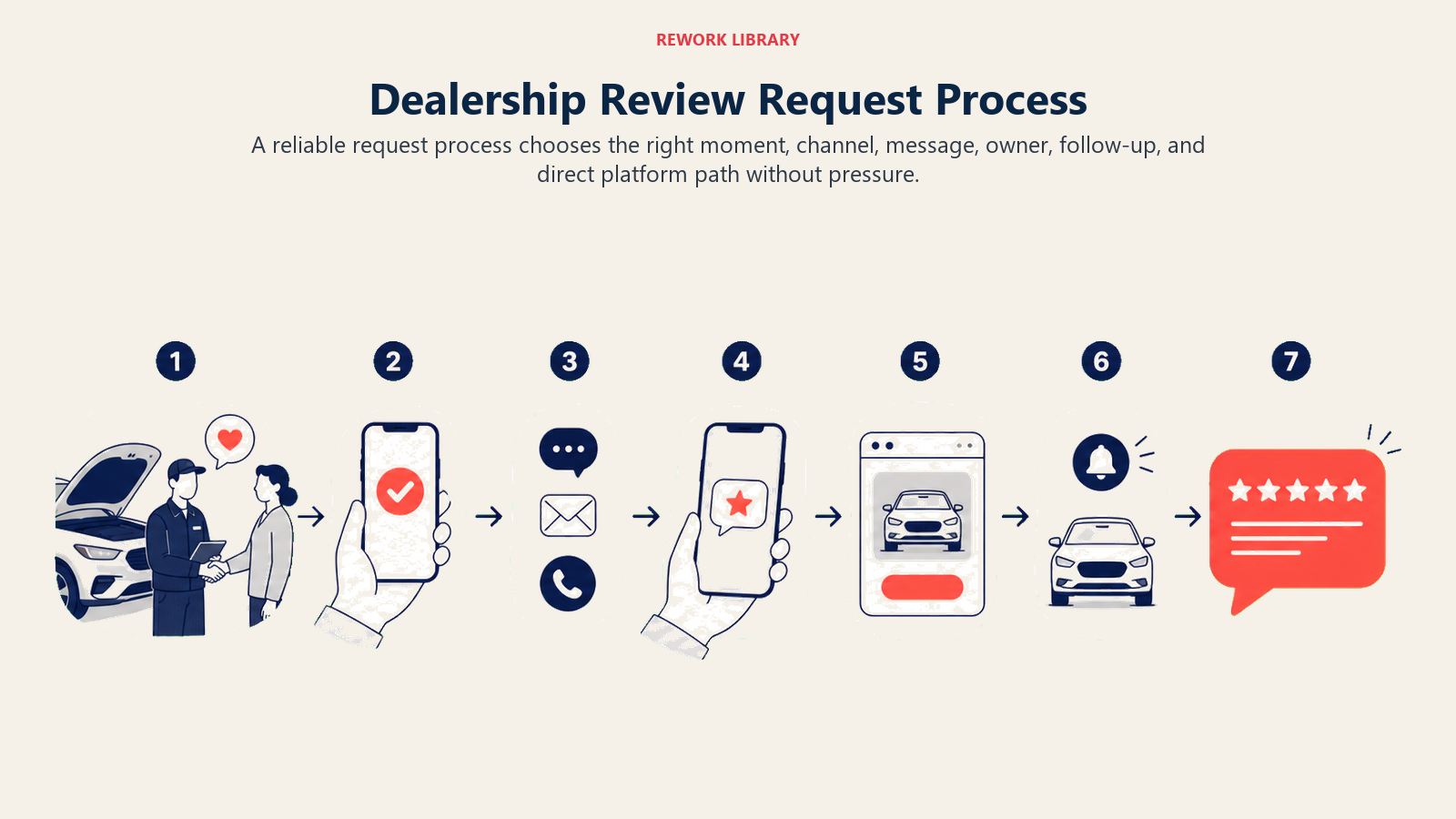
Post-delivery follow-up integration starts with your existing new customer outreach. You're already calling or emailing customers 7-10 days after delivery to ensure satisfaction. Add the review request to that same touchpoint. "I'm so glad you're loving the new Accord. Would you mind sharing your experience on Google?" Then send the direct review link immediately via text. For comprehensive post-sale follow-up strategies, see Post-Sale Follow-Up Process.
Post-service satisfaction checks work the same way. Service advisors should call customers 2-3 days after service to confirm the vehicle is running properly and the customer is satisfied. If everything is good, ask for a review. "That's great to hear. Would you mind taking a minute to tell other customers about your experience?" Then send the link.
Text message review requests have the highest conversion rates. A simple text saying "Hi [Name], this is [Your Name] from [Dealership]. Thanks again for your business. Would you mind leaving us a quick review? [Direct Link]" usually gets a noticeably better response than the same request by email. Track your own text and email response rates so you know which channel works for your customers.
Keep the message personal and brief. Use the customer's name. Reference something specific from their transaction if possible. Include only one call to action (the review link). No promotional content, no multiple asks, just the review request and link. Combine this approach with effective BDC operations setup for consistent execution.
Email review campaigns work as backup and for customers who don't respond to texts. Your email should be visually simple, personally written (not corporate-looking), and focused entirely on the review request. Include a clear button or link to the review page. Follow up once if they don't respond within 5 days, but don't nag.
In-person requests at delivery can be effective but require careful execution. You don't want to make the review request feel like a condition of completing the sale. The right time is at the very end of delivery, after all paperwork is signed and the customer has their keys. "We'd love to hear about your experience once you've had a chance to drive your new car for a week. I'll send you a link to make it easy." For structured delivery processes, see vehicle delivery experience.
Some dealerships have tablets in the delivery office and ask customers to leave reviews right there. This can work if the customer is truly delighted, but it risks rushed, generic reviews that don't provide much value. The better approach is to let them experience the vehicle or service for a few days first.
Responding to Reviews (Positive & Negative)
Review response is just as important as review generation. How you respond to reviews signals to potential customers how you treat people before and after the sale.
Response time targets should be 24-48 hours maximum for all reviews. Fast responses show you're paying attention and care about customer feedback. Delayed responses suggest indifference or poor customer service. Some dealerships aim for same-day responses to show exceptional attention.
Tone and messaging guidelines need to be established and followed consistently. Responses should be professional but warm, specific rather than generic, and signed by a real person (ideally the manager or employee mentioned in the review). Avoid corporate-speak and legal disclaimers that make responses feel impersonal.
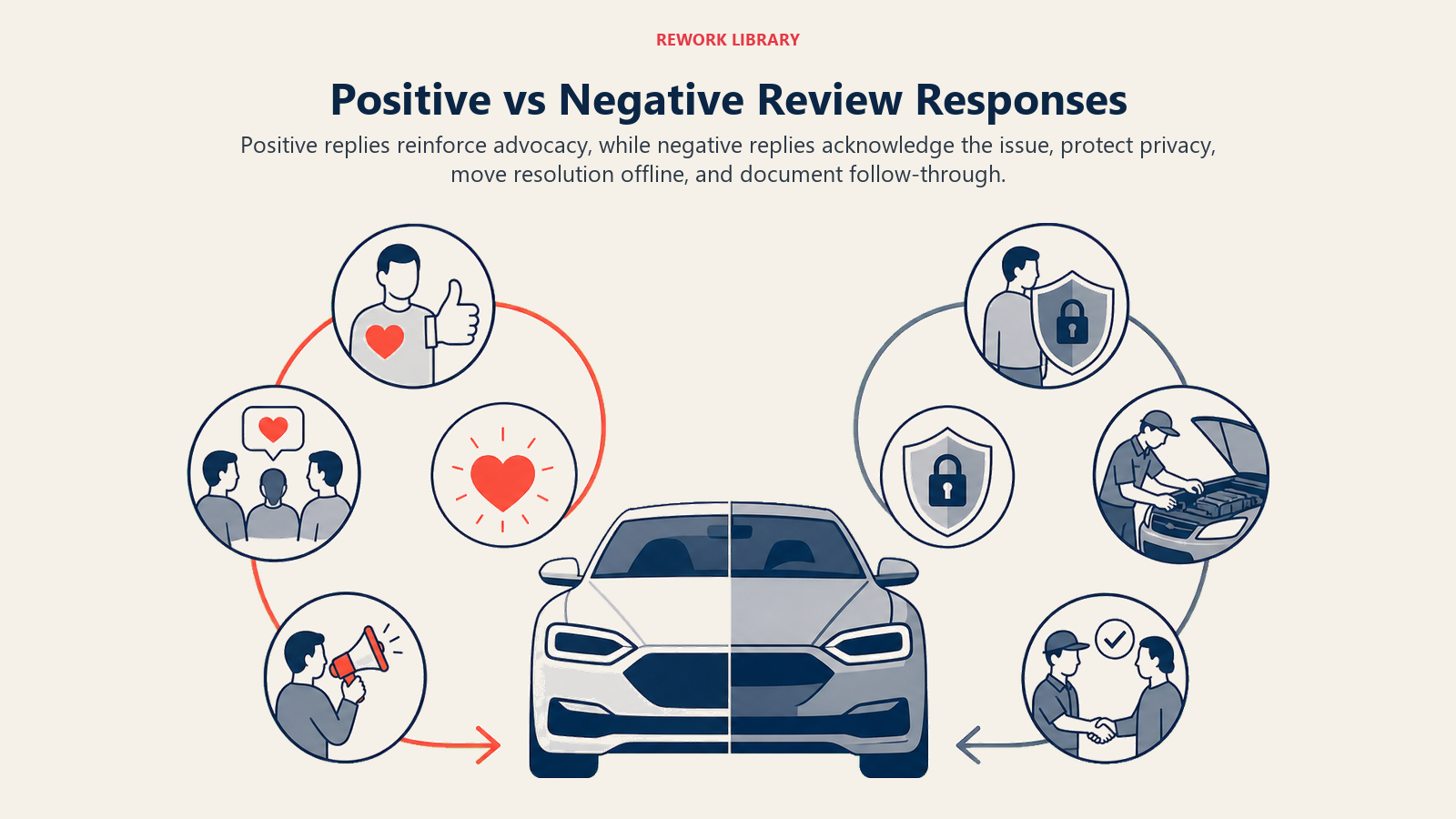
Thanking positive reviewers authentically means more than just saying "Thanks for the review." Reference specific details from their review. Acknowledge the employee they praised by name. Express genuine appreciation for their business. Make it clear a real human read their review and cares about their experience.
For example: "Thank you so much for the kind words about Michael's service. He takes great pride in making every customer feel taken care of, and I'll make sure he sees your comments. We're thrilled you're loving your new Explorer. Drive safe, and we'll see you for your first service!" That's personal, specific, and warm.
Addressing negative reviews professionally is where most dealerships struggle. The natural reaction is to get defensive or make excuses. Resist that urge. The review is already posted. Your response isn't for the upset customer, it's for the hundreds of future customers who will read it.
A good response to a negative review acknowledges the customer's experience, apologizes for falling short, and invites them to connect offline to make it right. "I'm sorry to hear about your experience in our service department. That's not the level of care we strive to provide. I'd like to learn more and see how we can make this right. Please contact me directly at [phone/email]."
Taking conversations offline when needed is critical. Don't try to resolve complex issues in public review responses. That just extends the argument where everyone can see it. Acknowledge the problem publicly, then move the resolution to a private channel. Once resolved, you can ask the customer if they'd consider updating their review to reflect the resolution.
Negative Review Management
Negative reviews will happen. Even the best dealerships occasionally have customers who feel they received poor service. How you handle those situations determines whether negative reviews hurt you or actually help build trust.
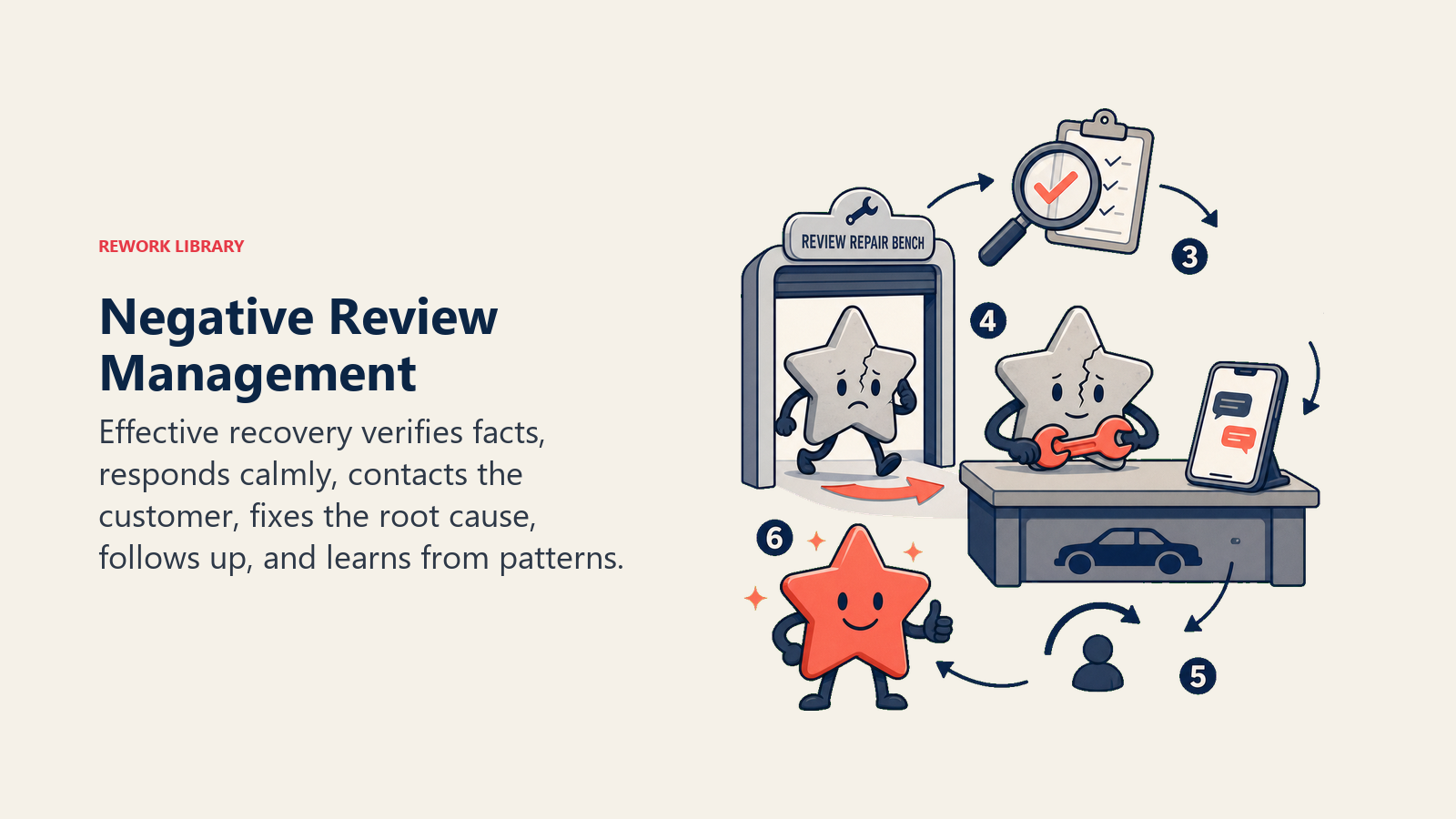
Internal escalation process for issues should be clear and fast. Every employee needs to know: when something goes wrong that might result in a negative review, who do they tell and how quickly? The faster you can intervene, the better your chances of preventing a bad review or mitigating its impact.
Create a simple escalation protocol: any customer interaction that ends with the customer frustrated or unsatisfied gets reported immediately to a manager. That manager contacts the customer within 24 hours to understand what went wrong and offer a resolution. This aligns with your CSI score improvement strategy.
Resolving customer concerns quickly often prevents bad reviews entirely. Many customers who have problems don't want to leave negative reviews, they want their problems solved. If you solve the problem before they're frustrated enough to vent online, you'll avoid the bad review altogether. Speed is everything.
When you do get a negative review, treat it as an opportunity to demonstrate your commitment to making things right. Respond publicly with empathy and a solution-oriented approach. Then contact the customer directly to resolve the issue. Go above and beyond if necessary. The cost of resolving one complaint is far less than the cost of a permanent bad review.
Requesting review updates after resolution is appropriate if you've genuinely made things right. After you've resolved the customer's issue and confirmed they're satisfied, you can say: "I'm so glad we could turn this around for you. Would you be willing to update your Google review to reflect how we handled this? I completely understand if you'd prefer not to, but I'd appreciate it if you felt comfortable doing so."
Most customers who were genuinely upset and then saw you work hard to make things right will update their reviews. The updated review becomes a positive signal, it shows you respond to problems and fix them. That builds more trust than a hundred generic five-star reviews.
OEM reputation management protocols may require specific response procedures for negative reviews. Some manufacturers have dedicated teams that monitor dealer reviews and require response templates or escalation processes. Make sure you understand your brand's requirements and comply with them.
Legal considerations around defamation and false reviews need attention but shouldn't be your first response. If a review contains factually false information that damages your reputation (not just negative opinion, but actual false claims), you can flag it with the platform for removal. You can also respond with a factual correction. But don't threaten legal action publicly, that always makes you look worse.
The vast majority of negative reviews aren't false, they're just negative. Your best response is to address the customer's concerns professionally and demonstrate your commitment to improvement. That's far more effective than trying to fight or remove every negative review.
Leveraging Reviews for Marketing
Reviews aren't just for reputation management. They're also powerful marketing assets that can drive traffic, improve conversion, and boost SEO.
Showcasing reviews on your website builds trust with visitors who haven't checked external review sites. Create a testimonial section on your homepage featuring recent five-star reviews. Include customer names and photos (with permission). Embed your Google review widget to show live reviews and star ratings. For broader website optimization strategies, see Dealership Website Optimization.
Place review highlights on key landing pages, inventory pages, service scheduling pages, and department pages. A five-star review from a happy service customer right above your "Schedule Service" button increases conversion rates by reinforcing trust at the moment of decision.
Social media review highlights turn positive reviews into engaging content. Screenshot great reviews and share them on Facebook and Instagram with commentary thanking the customer and the employee mentioned. This serves multiple purposes: it shows appreciation, provides social proof, and gives you authentic content that resonates better than promotional posts.
Create a regular cadence of review posts. Every week, share 2-3 outstanding reviews across your social channels. Tag employees who were mentioned by name. This builds employee morale and shows customers you value their feedback.
Review schema markup for SEO is a technical but important step. Implement structured data markup on your website that tells search engines about your reviews and star ratings. This can result in star ratings appearing in Google search results next to your dealership's listings, a visibility boost that can lift click-through rates.
Given that Google hosts roughly 73-78% of all online reviews, optimizing for Google's search results display is critical. Learn more about technical optimization in automotive SEO strategy.
If you're not technical, ask your website provider or SEO agency to implement review schema markup. It's a one-time setup that pays dividends for years.
Testimonial video creation from happy customers takes reviews to the next level. When you have a particularly enthusiastic customer who leaves a glowing review, reach out and ask if they'd be willing to record a short video testimonial. Most happy customers will say yes, especially if you make it easy (come to the dealership for a 5-minute recording).
Video testimonials are the most persuasive form of social proof because they feel authentic and human. Feature them prominently on your website, use them in paid advertising, and share them on social media. A single great video testimonial can influence hundreds or thousands of buying decisions. For video marketing strategies, see Automotive Video Marketing.
Your review program should be an integrated system: generate reviews systematically, respond to all reviews professionally, resolve problems quickly, and leverage positive reviews across all marketing channels. Done right, online reviews become one of your most powerful competitive advantages, and one that compounds over time as your review volume and rating continue to improve.
The dealerships winning at online reputation aren't doing anything magical. They're just being systematic about asking for reviews, responding to feedback, and fixing problems. Do that consistently for six months, and you'll see measurable improvements in both reputation and business results. For broader customer experience strategies that support review generation, see Automotive Customer Experience and Customer Loyalty Programs. To measure the impact on your overall performance, track results through your Dealership KPI Dashboard.