Automotive PPC Advertising: Maximizing ROI from Google Ads for Dealerships - 2026 Guide
Turn this article into takeaways for your work.


Each assistant summarizes the article only for you and suggests best practices for your work.
Two dealerships in the same market, same franchise, similar inventory. Both spend $8,000 monthly on Google Ads. One generates 10 sales. The other generates 35 sales. Same budget, 3.5x different results.
The difference isn't luck. It's strategy, campaign structure, keyword targeting, landing page optimization, and relentless testing. The dealers winning with PPC aren't spending more; they're spending smarter.
If you're treating Google Ads like a "set it and forget it" lead source, you're burning money. The platform requires active management, continuous optimization, and strategic thinking. But when done right, PPC delivers predictable, scalable lead volume at known costs.
The Automotive PPC Landscape
Google dominates paid search in automotive. 85% of dealership PPC budgets go to Google Ads. The remaining 15% splits across Bing (minimal but cheap), Facebook/Instagram (awareness), and YouTube (emerging).
The average cost per click (CPC) in automotive varies dramatically by keyword intent. Branded searches (your dealership name) cost $1-3 per click because competition is low. Competitor conquests (other dealer names) cost $3-6. Model-specific searches ("Honda CR-V for sale") cost $4-8. Generic searches ("SUVs for sale") cost $8-15. Location-based searches ("car dealerships near me") cost $10-20.
Lead quality follows intent. Someone searching your dealership name is ready to engage, conversion rate 35-50%. Someone searching a specific model is shopping around, conversion rate 20-30%. Someone searching "best SUVs" is researching, conversion rate 5-10%.
Cost per sale is the only metric that matters. A $3 branded click that converts at 40% costs $7.50 per lead and $60 per sale (at 12.5% close rate). A $12 generic click that converts at 8% costs $150 per lead and $1,200 per sale. Both are "leads," but the economics couldn't be more different.
The dealers who win understand this trade-off and build campaigns that maximize high-intent traffic while strategically testing lower-intent, higher-volume opportunities.
Campaign Structure Best Practices
Campaign organization determines how effectively you can manage and optimize. Most dealers run one or two campaigns. Top performers run 10-15 campaigns, each with specific goals and targeting.
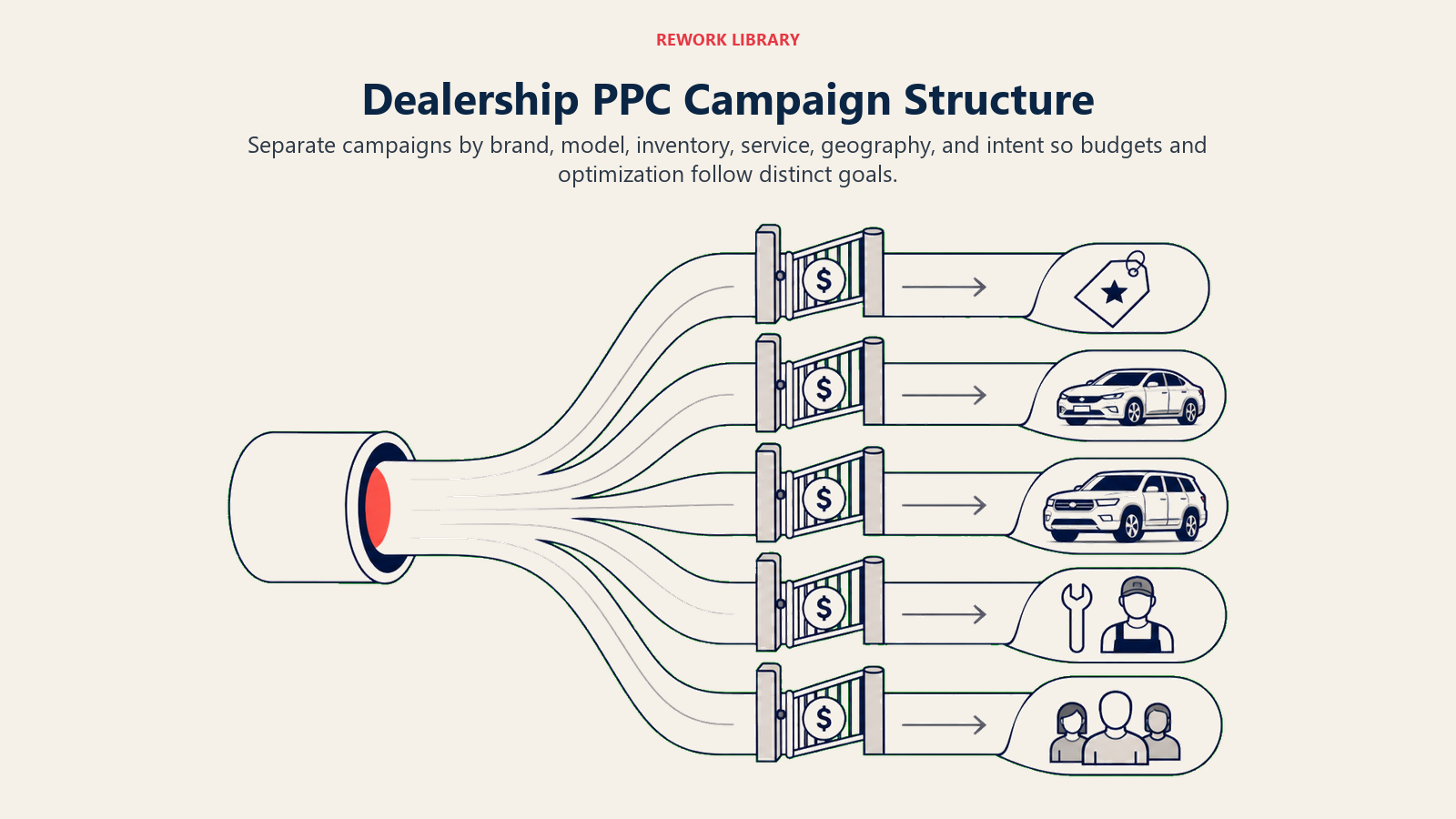
Start with branded campaigns that capture searches for your dealership name, variations, and misspellings. "Springfield Honda," "Honda Springfield," "Springfield Honda dealer", you should own 100% impression share on these terms at low cost. Someone searching your name knows who you are. Don't lose them to competitors bidding on your brand.
Competitor conquest campaigns target other dealer names. Bidding on "Toyota of Springfield" when you're a Honda dealer can work if you're aggressive with response and have competitive offers. But expect lower conversion rates (10-15%) because you're fighting brand loyalty. Budget 10-15% of total PPC spend here for testing.
Model-specific campaigns target year/make/model combinations through automotive customer journey tracking: "2026 Honda CR-V," "Honda Pilot for sale," "Accord lease deals." These capture mid-funnel shoppers who know what they want but haven't chosen a dealer. Conversion rates run 20-30%. Allocate 30-40% of budget here.
Generic/category campaigns go after broader terms: "midsize SUVs," "family sedans," "fuel efficient cars." These attract top-funnel researchers who might not know your brand. Lower conversion rates (8-15%) but higher volume. Test with 10-15% of budget, scale if economics work through automotive lead generation.
Shopping campaigns display your actual inventory in search results with photos, pricing, and specs through vehicle merchandising. These are vehicle ads that appear at the top of Google search and in the Shopping tab. Conversion rates match or exceed search campaigns (20-35%) at similar or lower cost per click. Allocate 25-30% of budget here.
Display campaigns show banner ads across millions of websites through dealership email marketing integration. These work for awareness, not direct response. Most dealers should minimize display spending (5-10% of budget) except for remarketing.
Retargeting/remarketing campaigns follow website visitors across the web after they leave your site through automotive marketing automation. Someone viewed a specific VDP but didn't submit a lead? Show them ads for that exact vehicle for the next 30 days. Conversion rates on retargeting run 3-5x higher than cold traffic. Budget 15-20% of spend here.
YouTube campaigns place video ads before automotive content through automotive video marketing. Pre-roll ads, in-stream ads, and discovery ads can generate leads at $40-80 each. Test with 5-10% of budget if you have video content ready.
Organize by franchise if you're a multi-brand group. Separate campaigns for Honda, Toyota, and Nissan allow brand-specific budgets, messaging, and landing pages. Organize by department for larger dealers, separate campaigns for new, used, service, and parts.
Keyword Strategy
Keyword selection determines who sees your ads. Get this wrong and you'll burn through budget with zero results.
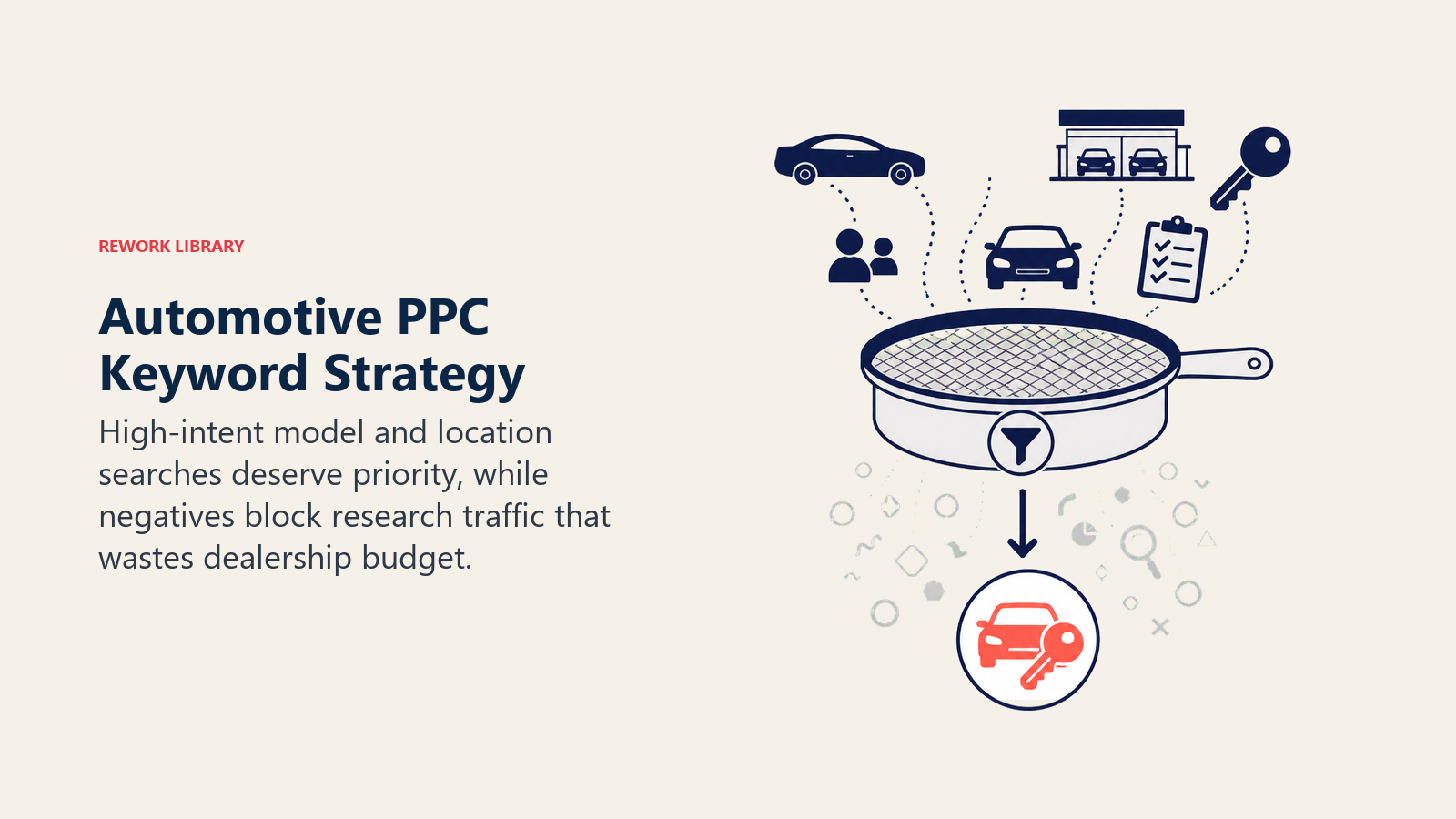
High-intent keywords are your bread and butter. These indicate immediate purchase consideration: your dealer name, competitor names, specific models with location modifiers ("Honda CR-V Springfield"), "in stock" terms, "for sale near me" terms. Bid aggressively on these. If a click costs $15 but converts at 30%, that's $50 per lead, cheaper than most third-party sources.
Mid-funnel keywords indicate active shopping: model comparisons ("CR-V vs RAV4"), reviews, trim level searches ("Honda Pilot EX-L"), lease vs buy queries. These convert at moderate rates (15-25%). Test systematically and scale winners.
Top-funnel keywords capture early research: vehicle type searches ("best midsize SUV"), feature searches ("cars with third row"), general category terms ("family vehicles"). Conversion rates are low (5-12%) but volume is high. Test small, scale cautiously.
Negative keywords are as important as target keywords. These prevent your ads from showing on irrelevant searches. Add negatives for: "jobs" (car sales jobs), "rental" (car rentals), "parts" (if you're targeting vehicle sales, not parts), "cheap" (if you don't want budget shoppers), competitor brands you don't carry, cities outside your market area.
Build a negative keyword list of 200-500 terms and apply it campaign-wide. Review search term reports weekly and add new negatives constantly. This prevents wasted spend on non-buyer traffic.
Match types control how closely searches must match your keywords:
- Exact match [honda CR-V] only triggers for that exact phrase or close variations. Lowest volume, highest relevance.
- Phrase match "honda CR-V" triggers for searches containing that phrase in order. Medium volume and relevance.
- Broad match honda CR-V triggers for related searches Google determines relevant. Highest volume, lowest relevance.
Start with exact and phrase match for control. Test broad match carefully with small budgets, Google's algorithm has improved but can still waste spend on irrelevant traffic.
Long-tail keywords ("certified pre-owned Honda CR-V under 30k miles Springfield") have lower search volume but higher intent and lower competition. Build dozens of these targeting specific inventory, offers, and local modifiers.
Google Shopping for Vehicles
Vehicle Ads (Google's automotive Shopping campaigns) changed the game for inventory advertising. Your vehicles appear directly in search results with photos, pricing, and details, no ad copy needed.
The foundation is your inventory feed, a data file containing every vehicle in stock with make, model, year, VIN, price, mileage, photos, and more through DMS integration best practices. This feeds from your DMS or website provider automatically. Quality matters enormously here.
Image quality directly impacts click-through rate through vehicle merchandising. Use professional photos with good lighting, clean backgrounds, multiple angles. Vehicles with 20+ photos get 40% more clicks than those with 5-8 photos. Vehicles with video get 60% more engagement.
Pricing strategy affects visibility through inventory pricing and aging. Google Shopping rewards competitive pricing with better placement. If your 2025 Honda Accord is priced $2,000 above market, it won't show prominently. Use tools like vAuto or ProfitTime to price competitively for the market.
Bidding strategies for Shopping campaigns differ from search campaigns through automotive inventory strategy. Start with manual CPC to understand performance, then test smart bidding (target ROAS or target CPA) once you have conversion data. Bid higher on high-margin vehicles, lower on aged inventory you need to move quickly.
Campaign structure for Shopping campaigns typically separates new and used inventory, then further segments by make/model or price range. This allows granular budget control, you might bid $3 per click on new vehicles but $1.50 on used vehicles.
Feed optimization is ongoing maintenance. Remove sold vehicles immediately (stale inventory hurts rankings and wastes budget). Update prices daily. Improve photo quality regularly. Add detailed descriptions. The better your feed quality, the better your performance.
Vehicle Ads should represent 25-30% of your total PPC budget because they work. Conversion rates match or exceed search campaigns, and customers appreciate seeing actual inventory with pricing upfront.
Ad Copy and Extensions
Your ad copy is your pitch in 90 characters. Make it count.
Headlines (max 3, 30 characters each) should include:
- Model name and year
- Location
- Key selling point
Examples:
- "2026 Honda CR-V | Springfield | 3.9% APR"
- "New & Used Honda | 500+ In Stock | Same-Day Financing"
- "Springfield Honda | Certified Pre-Owned | Lifetime Warranty"
Descriptions (max 2, 90 characters each) expand the value proposition:
- "Shop 500+ new and used vehicles. Same-day financing approval, all credit types welcome. Family-owned since 1987."
- "New 2026 Honda lineup in stock. Trade-ins welcomed. 0% APR financing available. Test drive today."
Call-to-action language should be specific: "Shop Inventory," "Get Pre-Approved," "Schedule Test Drive," "View Pricing," not generic "Learn More."
Ad extensions add additional information and take up more screen space (higher click-through rates):
- Sitelink extensions link to specific pages: New Inventory, Used Inventory, Finance Application, Schedule Service. Add 4-6 sitelinks per campaign.
- Callout extensions highlight key benefits: "Same-Day Approval," "500+ Vehicles," "Lifetime Warranty," "Loaner Vehicles Available." Add 8-10 callouts.
- Structured snippets list categories: Brands (Honda, Acura), Models (CR-V, Accord, Pilot), Services (Sales, Service, Parts).
- Location extensions show your address and distance from the searcher. Essential for local dealers.
- Call extensions display your phone number with click-to-call functionality. 40% of mobile searches convert via phone call.
- Price extensions show vehicle pricing ranges: "New CR-V from $32,500," "Used Accord from $18,900."
Test multiple ad variations per ad group. Google automatically shows better-performing ads more frequently. Test different headlines, offers, and calls-to-action. Expect 10-20% variation in click-through rates between ad variations.
Landing Page Strategy
Your ad gets the click. Your landing page gets the conversion. A great ad with a terrible landing page is wasted money.
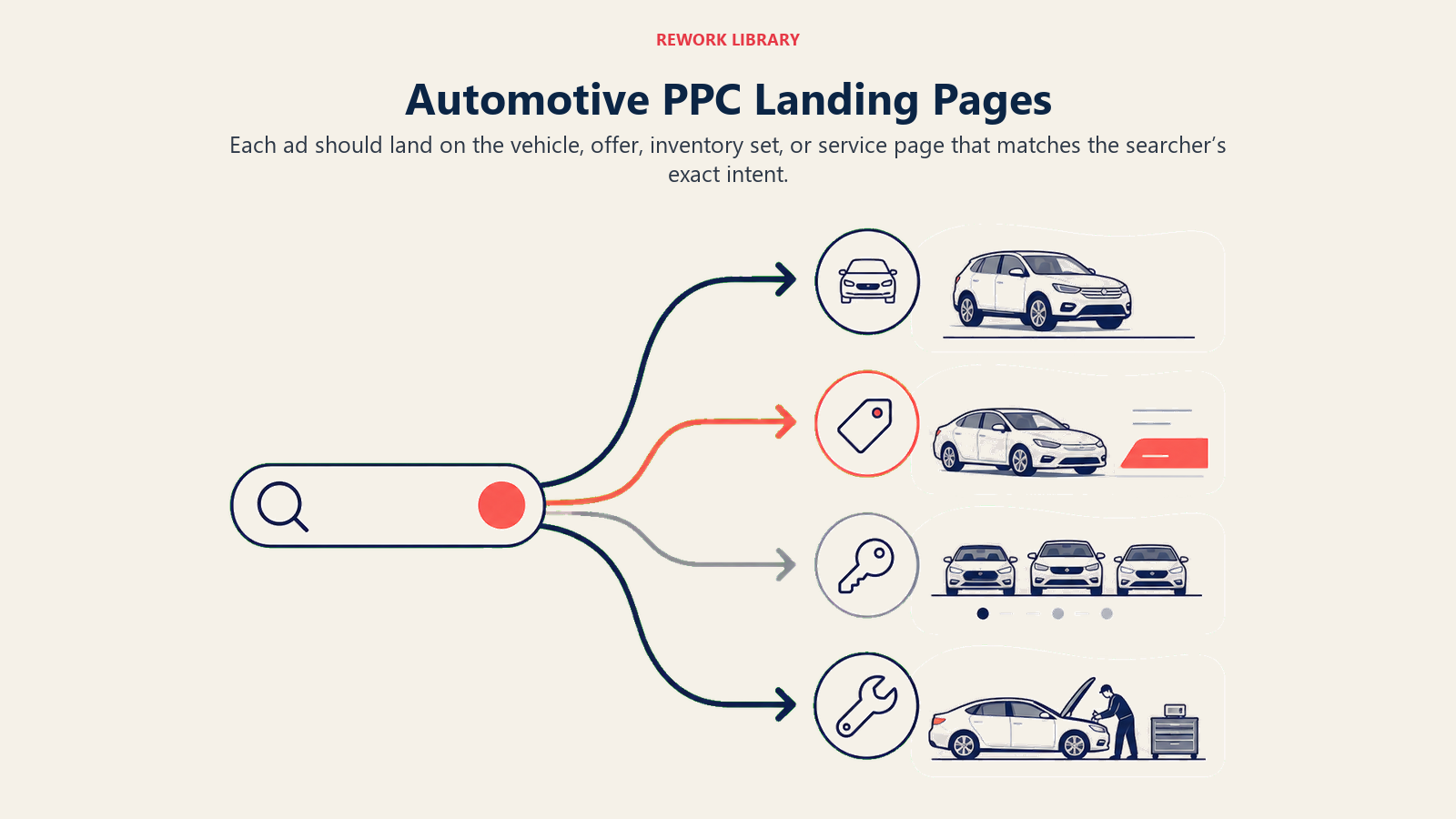
Most dealers send all PPC traffic to the homepage. This is a mistake. Send traffic to pages matching search intent.
VDP landing pages work for model-specific searches. Someone searching "2026 Honda CR-V Springfield" should land on a CR-V VDP or CR-V inventory page, not the homepage. Immediate relevance increases conversion rates 30-50%.
Dedicated landing pages work for offer-based campaigns. "0% APR financing" ad should land on a financing offer page, not a generic inventory page. These pages focus on one conversion goal with minimal distraction.
Form optimization dramatically impacts conversion rates. Multi-field forms (name, email, phone, address, credit score, trade-in info) convert at 2-3%. Simple forms (name, phone, email) convert at 8-12%. Test aggressively. For top-funnel traffic, use shorter forms. For high-intent traffic, longer forms might qualify leads better.
Speed optimization is critical. Landing pages that load in under 2 seconds convert 3x better than pages loading in 6+ seconds. Compress images, minimize JavaScript, eliminate unnecessary elements. Every second of load time costs conversions.
Mobile optimization matters because 65-70% of PPC traffic comes from mobile devices. Test your landing pages on actual phones. Are buttons big enough? Do forms work smoothly? Can users see vehicle photos clearly? Is the phone number click-to-call?
A/B testing identifies winners. Test one element at a time: headline, hero image, form length, button color, call-to-action text. Run tests for 1,000+ visitors or 30+ days before declaring winners. Small sample sizes produce misleading results.
Your vehicle detail page optimization work applies directly to PPC landing pages. Better VDPs = higher conversion rates = lower cost per lead = better ROI.
Bid Management and Budget Allocation
Bidding strategy determines whether you're overpaying for clicks or missing opportunities.
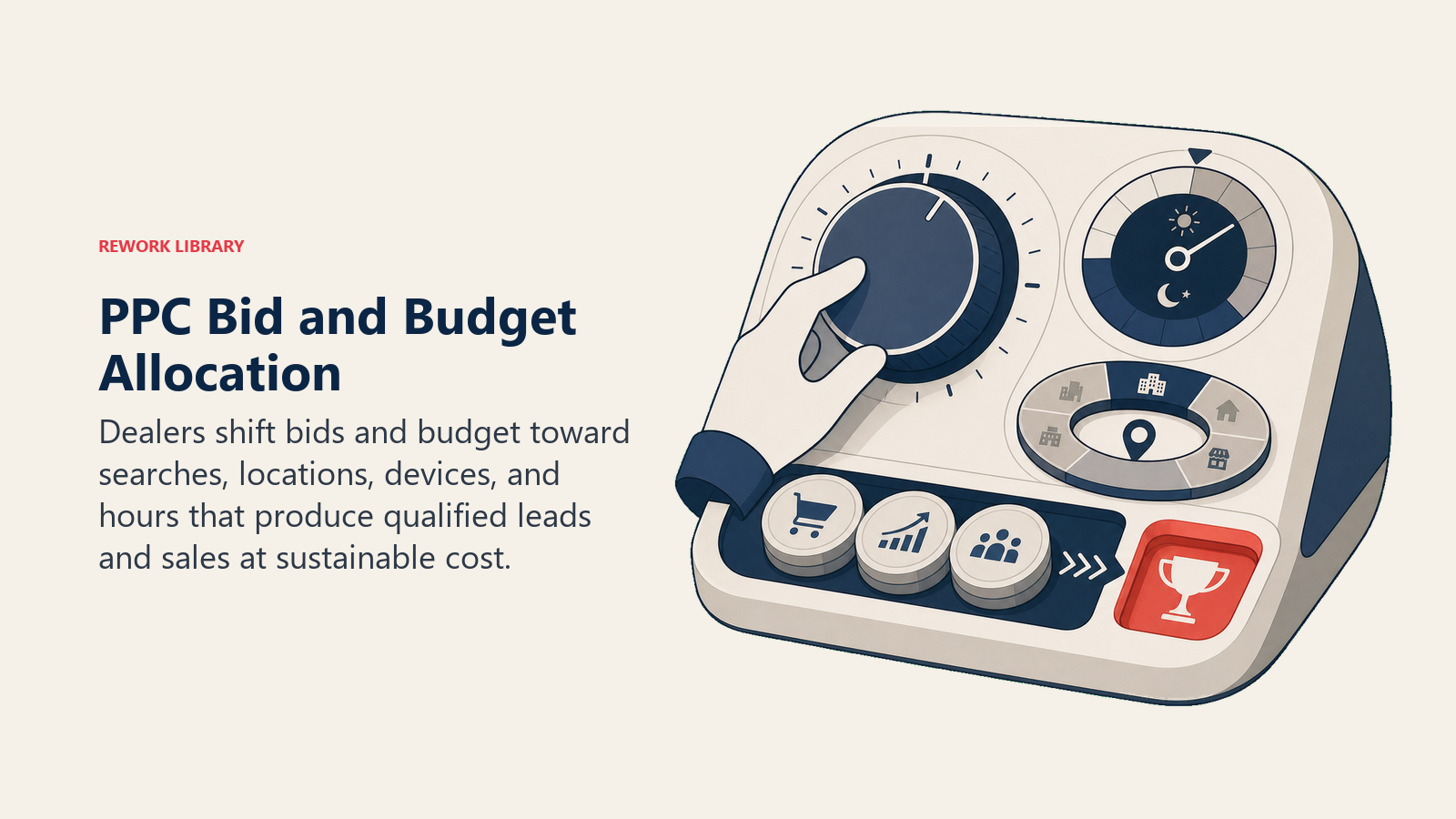
Manual CPC bidding gives you complete control. You set maximum bids for each keyword. This works well when starting because you learn what different keywords cost and convert at. It requires weekly optimization but provides maximum control.
Smart bidding strategies use Google's AI to optimize bids automatically:
- Target CPA (cost per acquisition) bids to hit a specific lead cost. You tell Google "get me leads at $50 each" and the algorithm adjusts bids accordingly. Requires 30+ conversions monthly to work effectively.
- Target ROAS (return on ad spend) optimizes for revenue, not just leads. Better for dealers tracking closed sales, not just leads.
- Maximize conversions gets the most conversions within your budget. Good for high-budget campaigns where volume matters more than efficiency.
- Maximize conversion value optimizes for high-value conversions. Useful if you're tracking vehicle profit margins.
Start with manual bidding for the first 60-90 days. Once you have conversion data, test smart bidding on one campaign. Compare performance for 30 days before rolling out wider.
Budget allocation should follow performance, not equal distribution. If branded campaigns cost $500 monthly and generate 30 sales while generic campaigns cost $2,000 and generate 12 sales, shift budget to branded. Obvious in hindsight, but many dealers allocate equally across campaigns.
Review budget pacing weekly. Campaigns that run out of budget by mid-month are missing opportunities. Campaigns with 40% budget remaining at month-end are underspending. Adjust daily budgets based on conversion performance.
Dayparting (scheduling ads by day/hour) can improve efficiency. If you get 60% of leads Monday-Friday 9am-6pm but run ads 24/7, you're wasting budget overnight. That said, many car shoppers research after hours, so don't be too aggressive with scheduling unless data clearly supports it.
Geographic bid adjustments allow different bids by location. If customers within 10 miles convert at 25% but customers 30+ miles away convert at 12%, increase bids for closer traffic and decrease for distant traffic. Or exclude distant locations entirely.
Competitor Conquest Campaigns
Bidding on competitor dealership names is aggressive but effective when done right.
The strategy: when someone searches "Toyota of Springfield," your Honda dealership ad appears offering to beat their deal, incentivize switching, or highlight your advantages. You're intercepting traffic intended for competitors.
Bid strategy for conquest requires careful math. These clicks cost more ($4-7) because you're competing with the branded advertiser. Conversion rates are lower (10-15%) because you're fighting brand loyalty. But the volume can be significant if competitors don't protect their brands.
Ad messaging for conquest campaigns must be aggressive. Don't be subtle, make the pitch clear: "Considering Toyota? Compare Honda pricing first, we'll beat their offer," or "Shop Springfield Honda before buying, $500 more for your trade-in."
Landing pages for conquest should directly address the comparison through automotive content marketing. A conquest campaign targeting Toyota shouldn't land on a generic Honda page, create a Toyota-vs-Honda comparison page highlighting your advantages (better warranty, lower pricing, customer service).
Ethical and legal boundaries exist through conquest marketing strategy. You can bid on competitor names. You cannot use their trademarked names in your ad copy without permission. Google prohibits this and will disapprove ads. You also can't make false claims about competitors ("Toyota engines fail after 100k miles"). Stick to factual comparisons and focus on your strengths.
Budget 10-15% of total PPC spend on conquest. Test one competitor at a time. Measure not just lead volume but close rates, conquest leads often require stronger sales processes to overcome brand preference.
Some dealers avoid conquest entirely, viewing it as antagonistic. Others run aggressive campaigns against every competitor. The right answer depends on your market, competitive positioning, and whether competitors are conquesting you (check by searching your own dealership name and seeing who else appears).
Measurement and Optimization
PPC without measurement is gambling. You need to track, analyze, and optimize continuously.
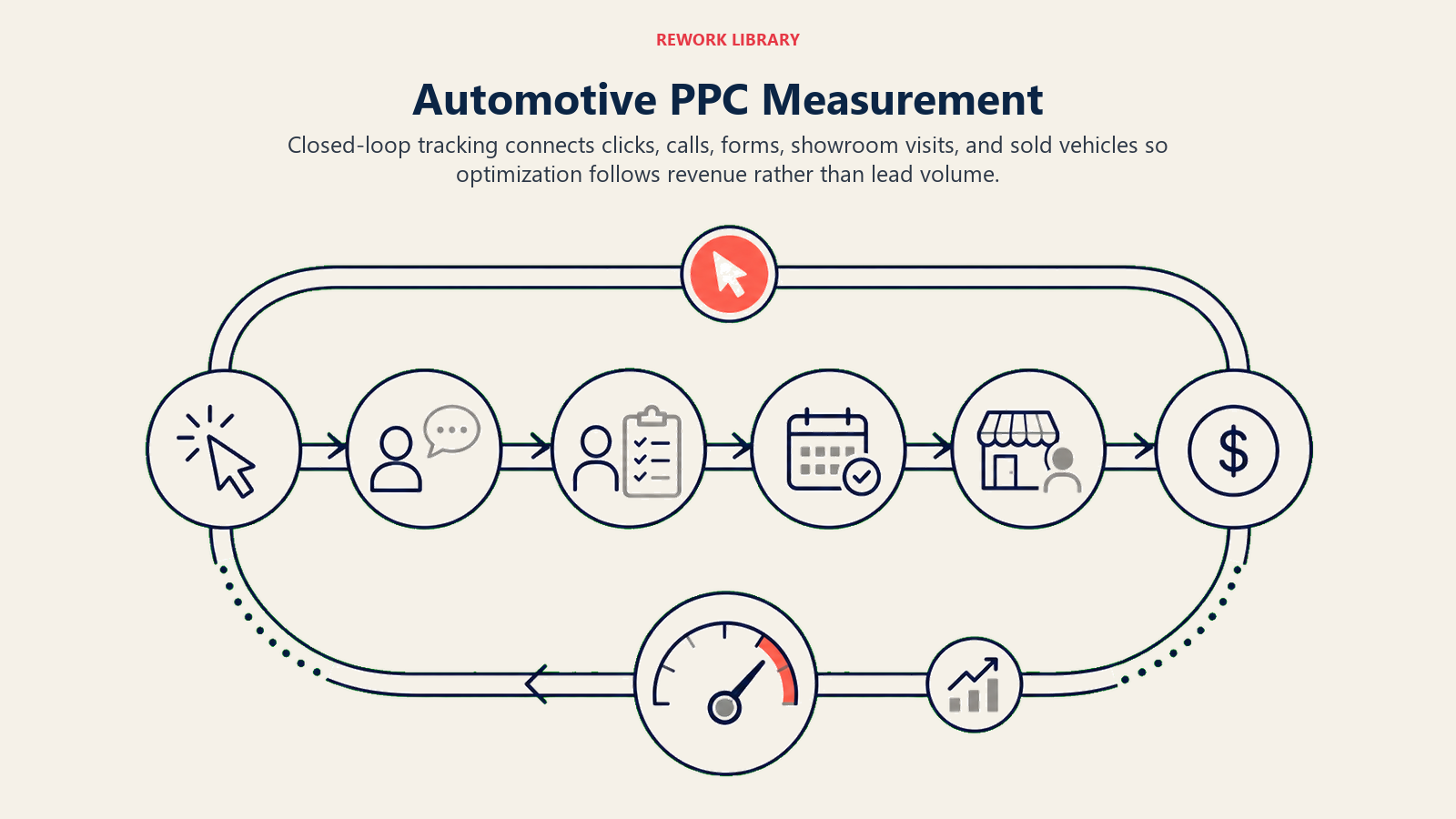
Conversion tracking setup is foundational. Install Google Ads conversion tracking on every lead form, phone call, and chat interaction. Without accurate tracking, you can't optimize. Test your tracking monthly, submit a test lead and verify it appears in Google Ads.
Lead quality scoring separates good leads from junk through automotive lead scoring. Not all form submissions are equal. Someone requesting pricing on a specific vehicle is a better lead than someone asking about "any SUV under $300/month." Build a lead scoring system (A/B/C leads) and track conversion rates by quality grade.
Cost per lead vs cost per sale tells the real story through cost per sale analysis. A campaign with $40 CPL that closes at 25% has $160 cost per sale. A campaign with $25 CPL that closes at 8% has $312 cost per sale. Track both metrics and optimize for cost per sale, not just CPL.
ROAS (Return on Ad Spend) calculates revenue per dollar spent through dealership KPI dashboard tracking. If you spend $5,000 on PPC and generate 25 sales averaging $2,500 gross profit, your return is 12.5x. But you need to track closed deals back to lead source to calculate this through automotive CRM implementation. Most dealers track leads but not closed sales by source, huge missed opportunity.
Weekly optimization routine keeps campaigns performing:
- Review search terms report, add negative keywords (15 min)
- Check campaign pacing, adjust budgets if needed (10 min)
- Review conversion rates by campaign, shift budget to winners (15 min)
- Test new ad copy variations (20 min)
- Review landing page conversion rates, identify issues (15 min)
This 75-minute weekly routine separates dealers generating 10 sales from those generating 35 sales on the same budget.
Monthly deep dives look at bigger trends:
- Which keywords drove the most sales? Increase bids.
- Which campaigns have declining performance? Diagnose why.
- Which ad copy variations performed best? Scale them.
- Which landing pages converted highest? Apply learnings elsewhere.
- Are there seasonal trends? Prepare for next month.
The dealers dominating PPC aren't smarter, they're more disciplined about optimization. They don't "set and forget." They actively manage campaigns like a portfolio investment.
Your automotive lead generation overview strategy needs PPC as a core component. While owned channels (SEO, website, email) deliver the lowest cost per sale long-term, PPC provides immediate, scalable volume. You can't rank organically next week, but you can launch PPC campaigns next week.
The key is treating PPC strategically, not tactically. Don't just "turn on Google Ads and see what happens." Build structured campaigns, target high-intent keywords, optimize landing pages, measure relentlessly, and adjust based on data.
The $8,000 monthly PPC budget should be driving 25-40 monthly sales depending on your market and average selling price. If you're getting 10 sales, you don't have a budget problem, you have a strategy problem. Fix the strategy, and the ROI follows.
Start with campaign structure. Build separate campaigns for branded, conquest, model-specific, and shopping. Allocate budget based on performance. Optimize weekly. Test aggressively. The results will follow.
PPC isn't magic. It's math, testing, and continuous improvement. The dealers who win understand this and treat it accordingly.